
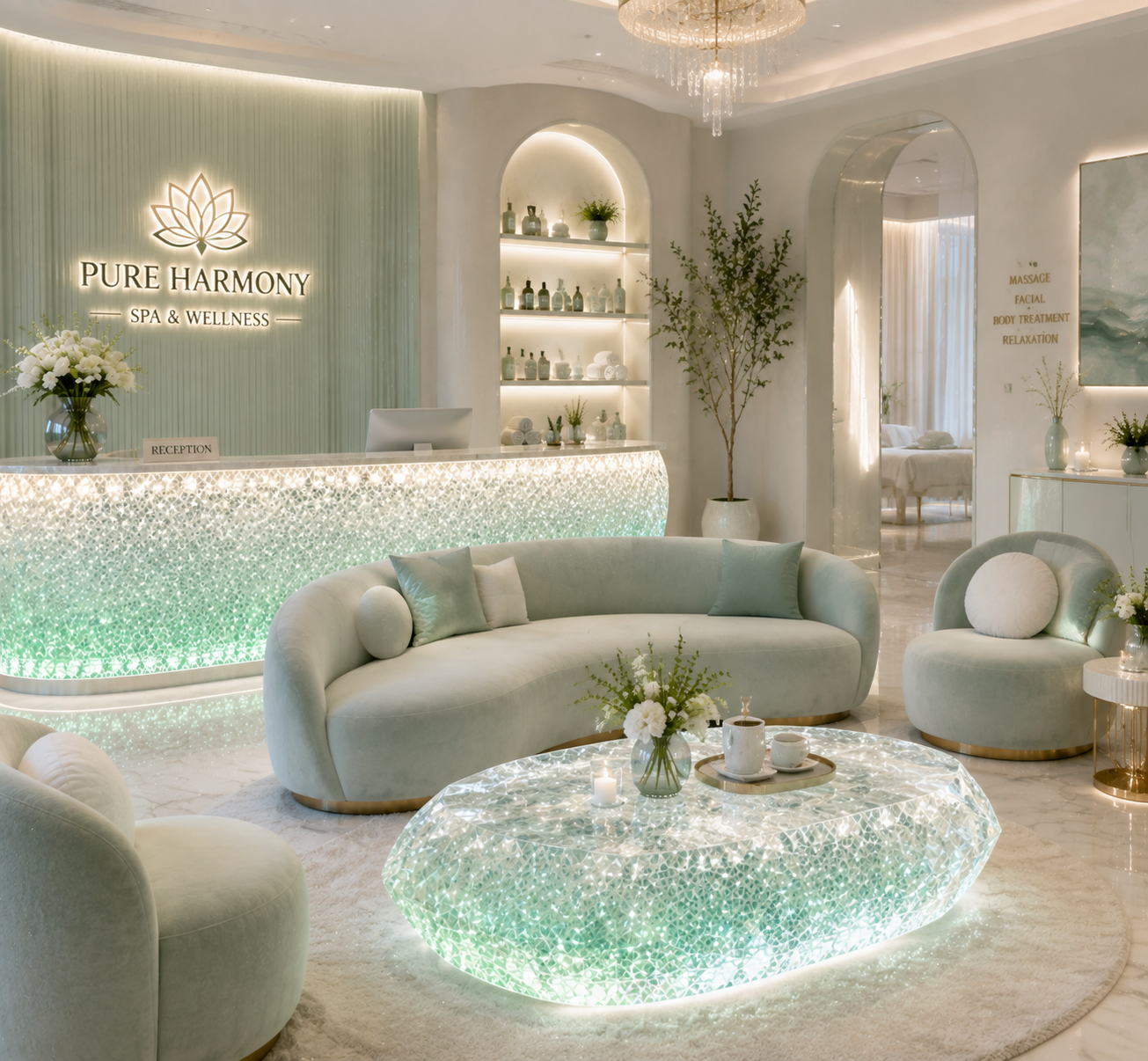
For years, transparent furniture in commercial interiors was often treated as a visual trick: use a clear table, make the space feel lighter, and avoid blocking sightlines. But in luxury retail, hospitality, premium showrooms, private clubs and high-end reception spaces, that way of thinking is becoming outdated.
Designers are no longer asking only, “Is it transparent?” They are asking what the material does with light, how deep the color appears at different thicknesses, whether the edges can achieve a jewel-like finish, how the surface behaves after repeated cleaning, and whether a custom piece can still look premium after years of commercial use.
This shift reflects a broader change in commercial design. Gensler’s 2026 Design Forecast identifies experience as an increasingly important measure of real-estate value, arguing that successful environments need to create emotional and narrative connections rather than function only as physical containers. JLL’s 2026 design research similarly reports that 65% of people globally seek unique and distinctive experiences.
That context helps explain why materials with a strong visual identity—including synthetic crystal, premium cast resin and high-clarity acrylic often described in the market as platinum acrylic—are receiving more attention.
The reason is not simply that they look luxurious. It is that their material performance can become part of the commercial experience itself.
1. Commercial spaces are becoming brand experiences, so materials can no longer be visually anonymous
A luxury flagship store is no longer simply a place where products are displayed. A hotel lobby is no longer just a circulation zone. A premium beauty showroom, jewelry boutique or members’ club increasingly functions as a physical expression of a brand.
JLL’s 2026 Prime Urban Retail research describes the shift in leading retail markets as increasingly experiential rather than purely transactional. It notes that prime retail corridors are highly competitive and that stores are increasingly being used to create immersive experiences and communicate brand identity. CBRE’s 2026 European retail outlook reaches a similar conclusion, observing that flagship stores increasingly serve as a strategic expression of brand identity and experience.
This changes how furniture should be specified.
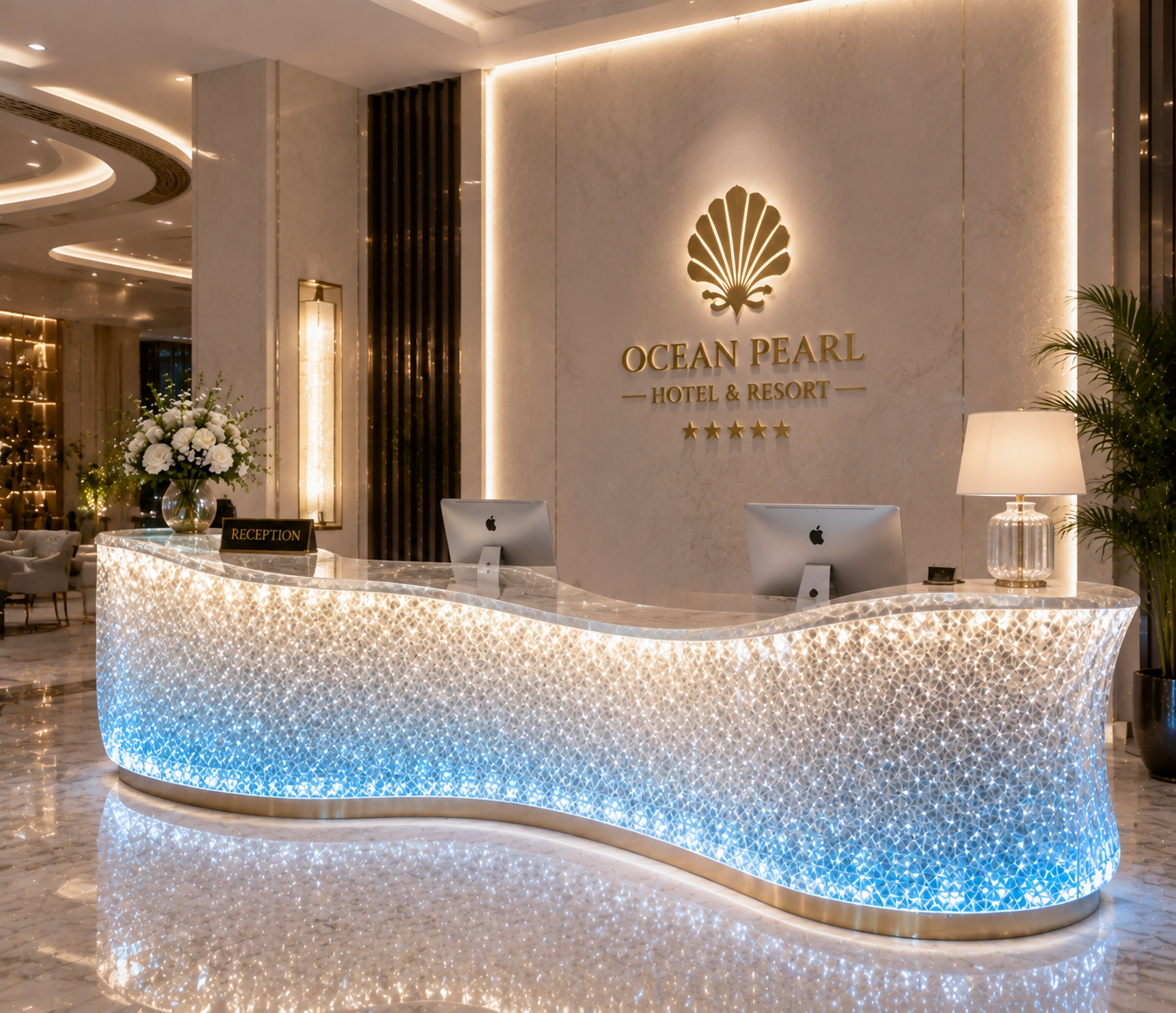
Consider a conventional stone reception table. It can communicate permanence and luxury, but it also has a strong visual weight. Replace part of that volume with a large synthetic-crystal reception desk incorporating transparent and champagne-toned sections, and the furniture can still feel substantial while allowing light and background materials to remain visible.
The result is not simply “a transparent desk.” It creates a different spatial experience.
The same principle works in luxury retail. A platinum-acrylic display table can allow a handbag, watch or piece of jewelry to remain visually dominant because the support structure does not compete with the merchandise. In a hotel lounge, a smoked-resin coffee table can provide a strong sculptural form without introducing another completely opaque block into an already layered interior.
This is particularly relevant because customers increasingly respond to the environment as part of the destination itself. CBRE’s July 2026 research into London retail destinations reports that more than one-third of London consumers identify the overall environment as an important factor influencing how long they stay in a destination.
For commercial designers, furniture material therefore becomes part of brand strategy. Transparency, color depth, reflection and mass are no longer decorative details; they help determine how the customer experiences the space.
2. “Clear” is no longer a sufficient specification: optical performance is becoming part of quality
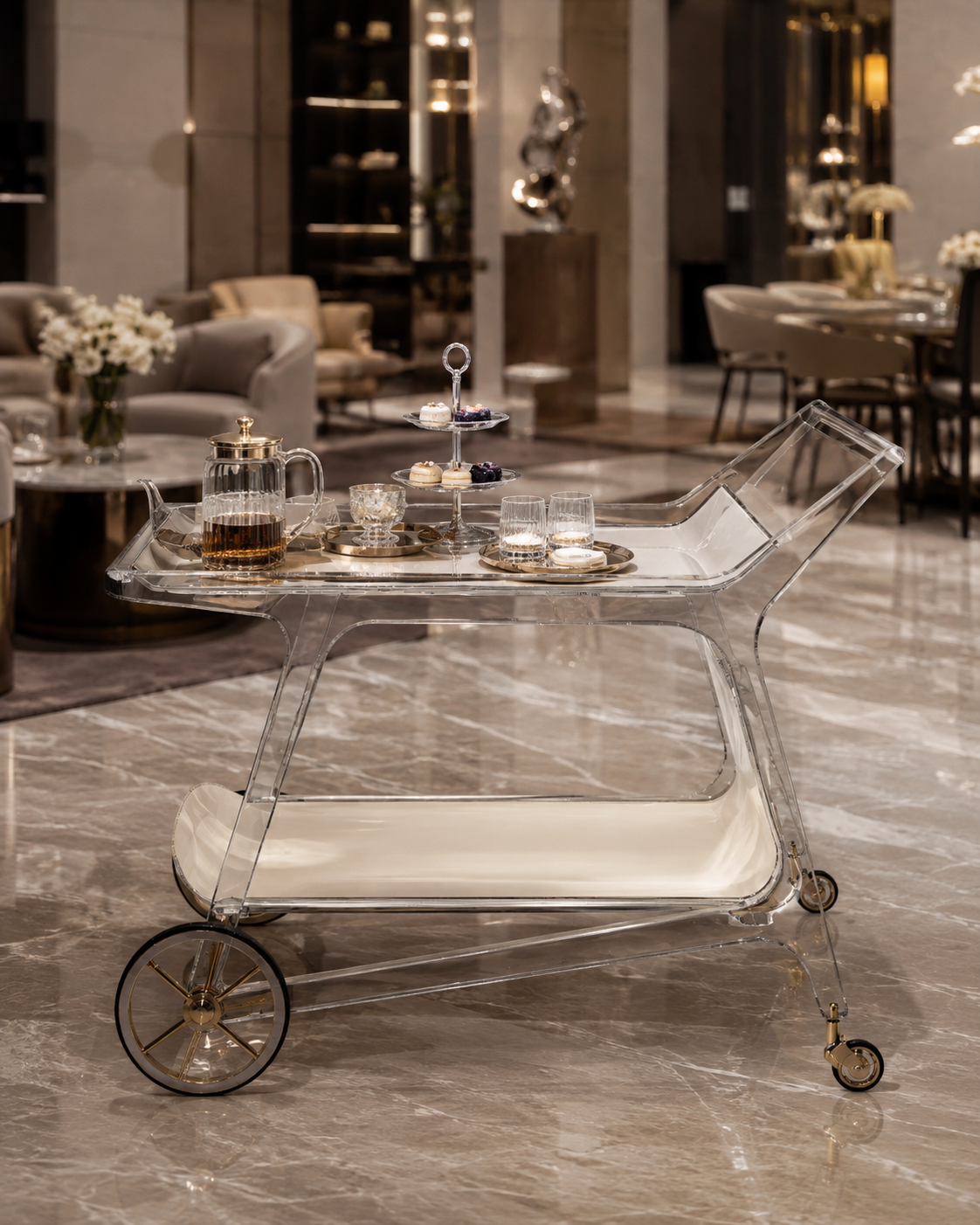
When synthetic crystal or acrylic furniture is used in a premium commercial environment, transparency itself becomes surprisingly complex.
Two materials may both look “clear” when shown as small samples, yet produce very different effects when fabricated into a 2.5-meter table or an 80-millimeter-thick sculptural base.
ASTM International’s ASTM D1003 standard distinguishes between luminous transmittance and haze when evaluating transparent plastics. ASTM explains that scattered light can create a hazy or smoky appearance and specifically notes that haze and luminous-transmittance measurements are useful for quality-control and specification purposes.
This is why an experienced designer should not evaluate a transparent furniture material only by holding a small sample up to a window.
In a luxury jewelry showroom, for example, a premium clear acrylic pedestal needs more than basic transparency. If the material contains visible haze, inconsistent clarity or poor edge finishing, lighting designed to make jewelry sparkle may make those imperfections even easier to see.
A synthetic-crystal dining or meeting table creates another challenge. Greater material thickness can produce stronger visual depth, and tinted materials such as smoke grey, champagne, amber or cognac may appear much more saturated in a thick leg than in a thin color sample.
NIST, the U.S. National Institute of Standards and Technology, notes that human vision is highly sensitive to differences in color and appearance and that many modern materials can change their appearance depending on illumination and viewing conditions. NIST also identifies attributes such as gloss and haze as important elements in appearance measurement.
For high-end commercial projects, this means material quality increasingly needs to be discussed in measurable and reproducible terms.
Instead of simply approving “clear resin,” the project team may need to consider clarity, haze, color consistency, thickness, edge treatment, polishing quality and the acceptable level of bubbles or inclusions.
That is a much more sophisticated conversation—and it is one reason material performance is receiving greater attention.
3. Synthetic crystal furniture can manipulate light, which makes it part of the lighting design
One of the greatest differences between conventional opaque furniture and crystal-like furniture is the way light interacts with the object.
Wood primarily reflects light from its surface. Marble reflects and, depending on the stone, may transmit a limited amount of light. Highly transparent synthetic crystal, resin and acrylic can allow light to enter the material, travel through its volume, reflect internally and become concentrated around edges.
As a result, the furniture can change dramatically between daytime and nighttime.
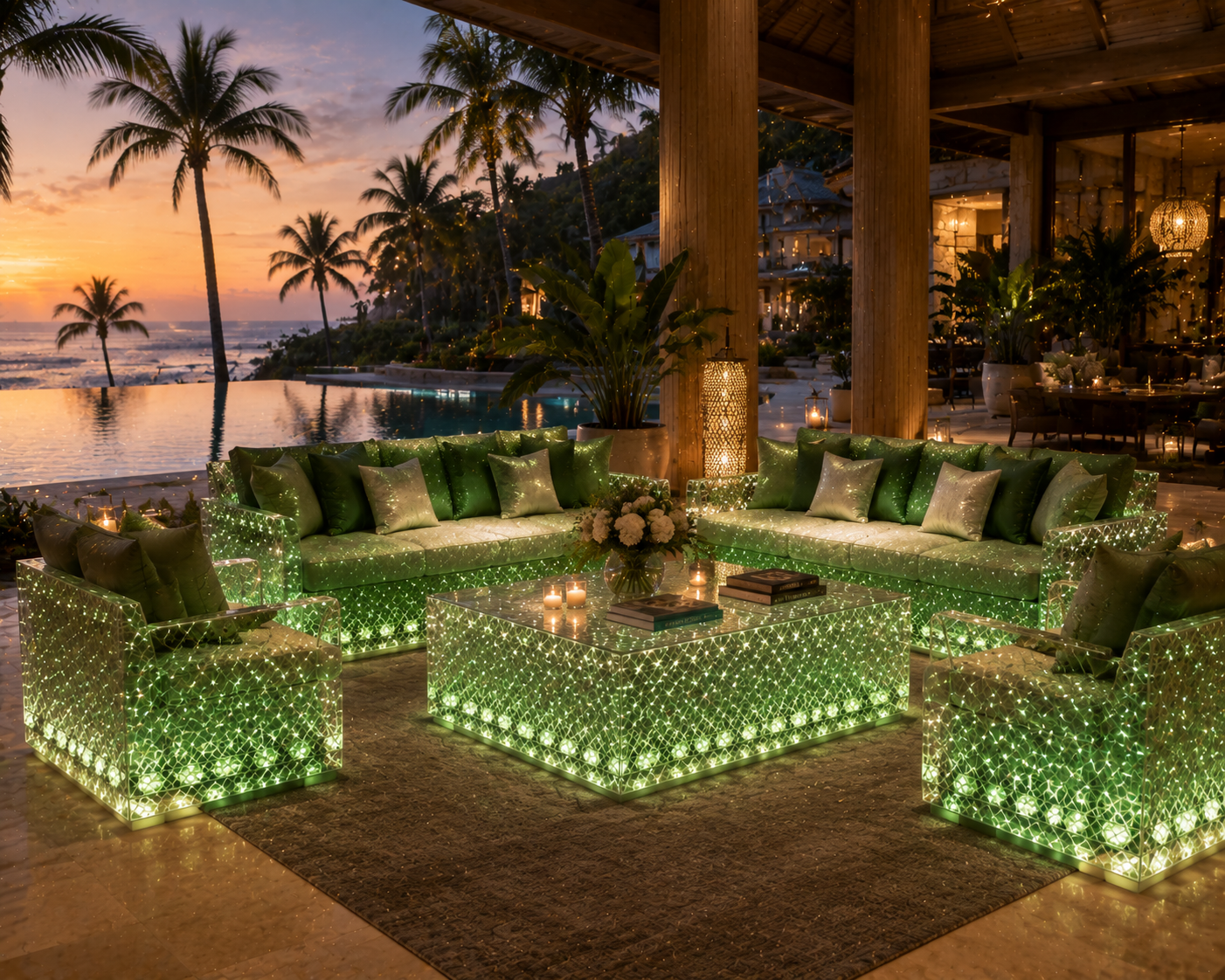
Imagine a luxury hotel lobby with a champagne-colored synthetic-crystal console positioned close to a softly illuminated stone wall. During the day, it may appear quiet and almost neutral. At night, warm architectural lighting can activate the thickness of the material, making the edges and internal color appear richer.
A smoked-resin side table can behave differently again. Under soft ambient light it may look almost charcoal; under directional lighting, transparent areas become visible and the piece gains depth.
This matters because the visual appearance of a material cannot be separated from its lighting conditions. NIST specifically highlights illumination and viewing geometry as important variables when assessing appearance.
For a designer, the opportunity is significant.
A sculptural high-end resin reception table can act as an intermediary between furniture and lighting without becoming an actual illuminated fixture. A transparent acrylic display unit can pick up reflections from the ceiling and merchandise lighting. A thick synthetic-crystal table leg can produce brighter edge effects than its central volume.
But the same characteristic also exposes poor decisions.
Too many direct spotlights may create distracting glare. Low-quality polishing may become obvious when edge lighting hits the material. A strongly colored surrounding wall can visually tint an otherwise clear acrylic table.
This is why premium transparent furniture should ideally be reviewed alongside the lighting concept, surrounding finishes and final installation environment.
The furniture is not merely placed under the light.
The material itself participates in the light.
4. Custom material effects give designers another way to create spaces that are difficult to copy
High-end commercial interiors increasingly compete on memorability.
Gensler’s 2026 forecast argues that successful spaces increasingly create value through narrative, emotional engagement and distinctive experiences. In hospitality, Gensler has also highlighted the growing importance of storytelling, craftsmanship and furniture as elements through which hotels establish a stronger sense of identity.
This is where premium resin and synthetic crystal offer something different from many standardized surface materials.
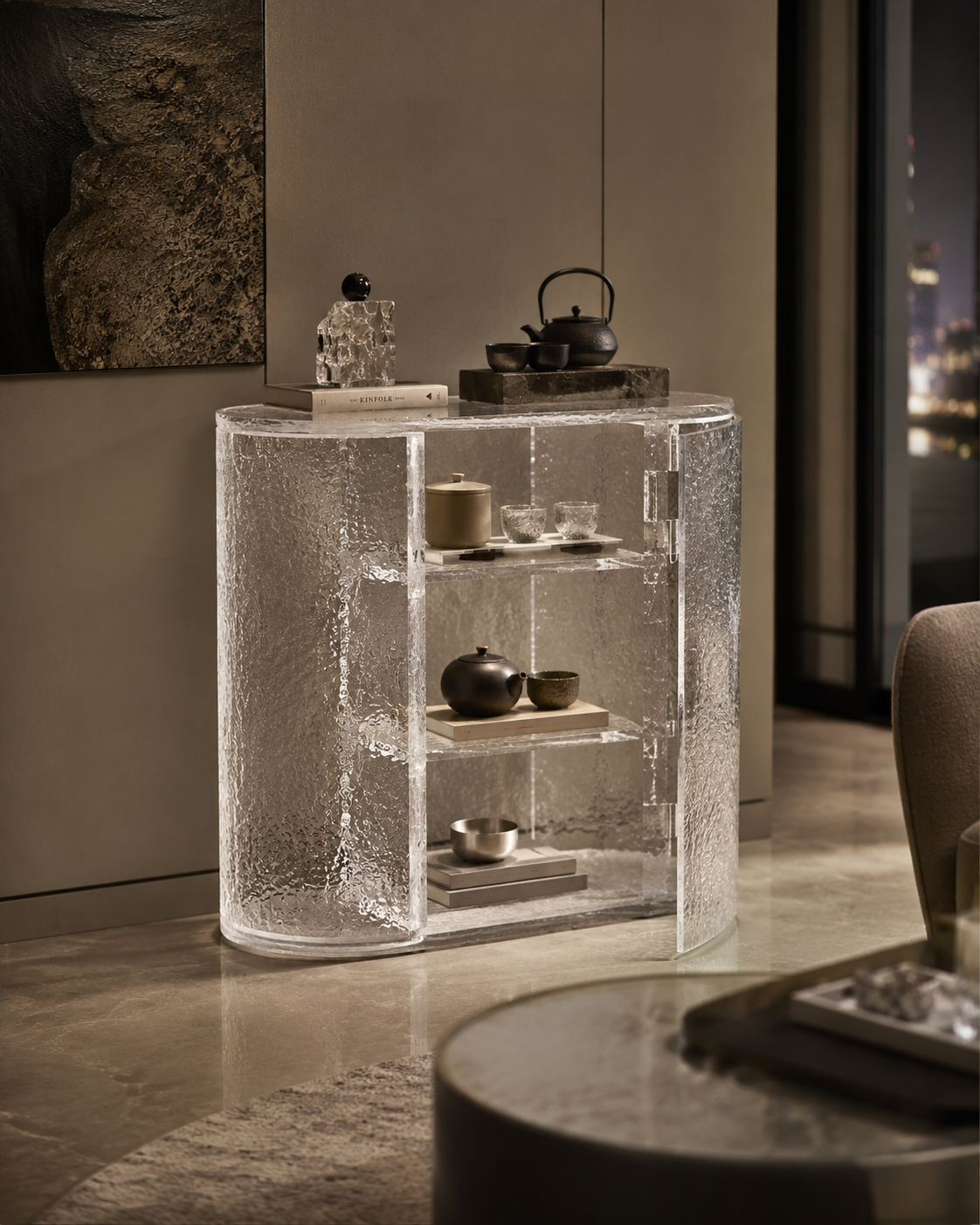
The material can potentially be developed in clear, smoke, champagne, amber, cognac or custom-tinted effects, and decorative inclusions, gradients, translucent zones or embedded elements can be incorporated depending on the manufacturing system.
That makes furniture itself a potential piece of brand language.
A luxury fragrance boutique, for example, might use an amber-gradient resin display table that relates visually to perfume bottles. A jewelry flagship may prefer an almost water-clear platinum-acrylic console with polished edges to avoid competing with the products. A premium restaurant could use smoked synthetic-crystal table bases with brushed stainless steel to create a darker, more architectural atmosphere.
The important point is not that resin should look unusual for the sake of being unusual.
The strongest projects use material customization with restraint.
If a lobby already contains dramatically veined marble, decorative metal ceilings and sculptural lighting, an intensely colored crystal table may make the environment feel overloaded. A nearly clear material with subtle champagne undertones could be much more effective.
Conversely, in a minimalist boutique built primarily with beige stone and neutral plaster, one large custom resin table may become the memorable visual anchor.
Unlike a logo printed on a wall, such an element can communicate identity through color, depth, reflection and craftsmanship.
That is why sophisticated clients increasingly care not only about what a furniture piece looks like in a rendering, but also about how specifically the material can be controlled and reproduced.
Exclusivity has little value if the production result cannot match the approved design.
5. In commercial interiors, long-term appearance matters as much as first-day appearance
A beautifully photographed sample is not the same thing as a commercially successful material.
A hotel coffee table may be cleaned several times every day. A luxury retail display table can be touched constantly by staff and customers. A restaurant console may encounter liquids, cleaning products and repeated contact. A reception counter can remain under artificial lighting for long operating hours and may also receive direct sunlight.
This is why the conversation is shifting from visual impact to long-term material performance.
ASTM D1044 provides a method for evaluating the resistance of transparent plastics to surface abrasion and specifically notes the importance of maintaining optical quality after wiping and abrasion. The standard quantifies abrasive damage through changes in haze.
The furniture industry is addressing similar concerns. ISO 4211-6:2025 establishes a method for assessing the scratch resistance of furniture surface finishes.
Light exposure is another issue. ISO 4892-1:2024 provides general guidance and requirements for exposing plastics to laboratory light sources when evaluating the effects of light exposure.
These standards do not mean that every synthetic-crystal table must be tested to every possible method. They do show, however, that terms such as “scratch resistant,” “UV resistant” or “commercial grade” should not be treated as purely marketing language.
The actual application matters.
A decorative resin console behind a hotel reception area has a very different risk profile from a clear acrylic table in a busy restaurant.
For designers and purchasing teams, the better questions are therefore practical: How will the surface respond to routine cleaning? Can fine scratches be polished? What cleaning agents are appropriate? How stable is the selected color under the expected lighting conditions? Can damaged components be repaired or replaced?
In premium commercial projects, luxury is not simply how a piece looks on opening day.
It is how convincingly that appearance can be maintained.
6. The real reason material performance matters is that luxury projects need predictable results
Perhaps the biggest change in professional specification is not an obsession with materials themselves. It is an increasing demand for control.
Commercial projects involve designers, developers, contractors, purchasing companies, manufacturers and operators. The beautiful sample approved by the design studio ultimately needs to become a full-size table, survive transportation, fit the site conditions and perform safely once installed.
For that reason, a premium furniture supplier cannot rely only on craftsmanship or attractive photography.
Consider a three-meter conference table with a thick synthetic-crystal base and a stone top. The project must address visual proportions, but also weight distribution, connections, tolerances and stability.
ISO 19682:2023 specifies test methods for determining the stability, strength and durability of tables and desks regardless of material, design or manufacturing process.
That principle is important: a luxury material does not automatically create a professional piece of furniture.
The final product is a system.
For custom synthetic-crystal furniture, this means a serious approval process may involve a reference sample, agreed color, real production thickness, finish standard, edge-polishing requirement, tolerance for bubbles or inclusions, hardware specification and, for important projects, a pre-production prototype or full-scale mock-up.
The same thinking applies to premium high-clarity or platinum acrylic furniture. The grade of acrylic, sheet thickness, joint design, polishing method and interaction with metal or stone components all affect the final result.
This is becoming especially relevant as commercial property owners place more emphasis on distinctive experiences and long-term asset performance. JLL’s 2026 Design Perspectives describes design as a strategic driver of long-term property value rather than simply an aesthetic layer.
That helps explain why high-end commercial spaces are paying greater attention to the material performance of synthetic crystal furniture.
It is not because transparency has suddenly become fashionable.
It is because designers and brands increasingly need furniture to perform several roles at once: create visual lightness, interact with lighting, express a distinctive identity, support customization, withstand real commercial use and remain controllable from sample approval to final installation.
A synthetic-crystal reception desk, premium-resin statement table or platinum-acrylic display console therefore should not be evaluated as just another piece of transparent furniture.
At its best, it becomes part of the architecture, part of the lighting strategy and part of the brand experience.
And in a market where premium commercial spaces increasingly compete on how people feel, remember and talk about them, that material performance can be far more valuable than transparency alone.
READ MORE:
- Why Custom Transparent Furniture Is Becoming a Choice for Designers Creating Unique Interiors
- The Buyer' s Guide to Choosing High-End Acrylic Furniture That Lasts for Years
- How Luxury Retail Spaces Use Crystal-Like Furniture to Create Stronger Brand Experiences
- What Makes Transparent Furniture Feel Expensive? The Design Details Customers Actually Notice
- Why Premium Acrylic Furniture Is Being Redefined as a Modern Luxury Material
- Perché chi sceglie mobili in cristallo sintetico non guarda soltanto all'estetica?
- Quando un designer sceglie mobili in cristallo sintetico, cosa dovrebbe valutare oltre alla "trasparenza"?
- Come abbinare colori e illuminazione ai mobili in cristallo sintetico per creare un hotel dal lusso contemporaneo?
- Perché i mobili in cristallo sintetico sono bellissimi nel campione, ma una volta realizzati l'effetto è diverso?


