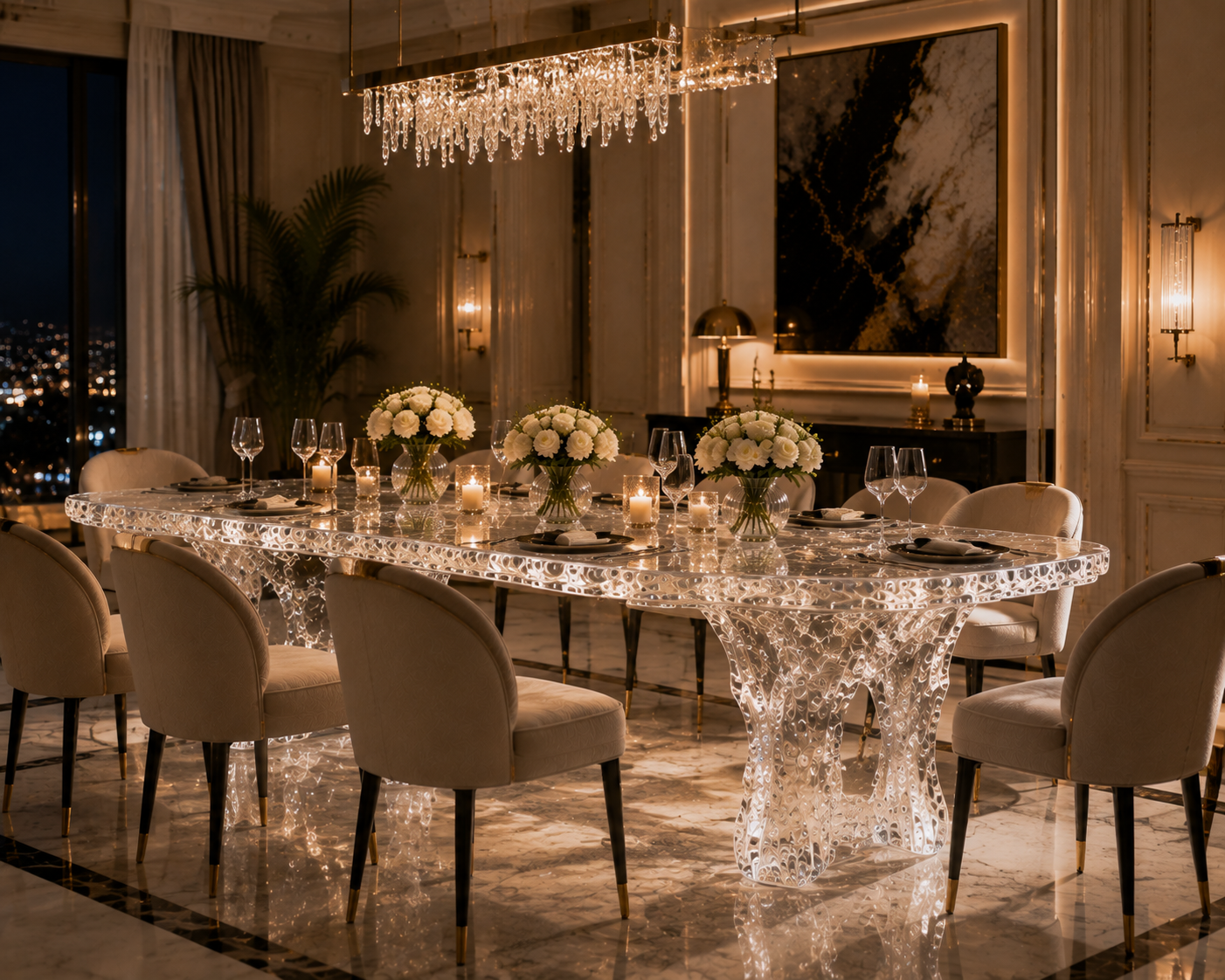
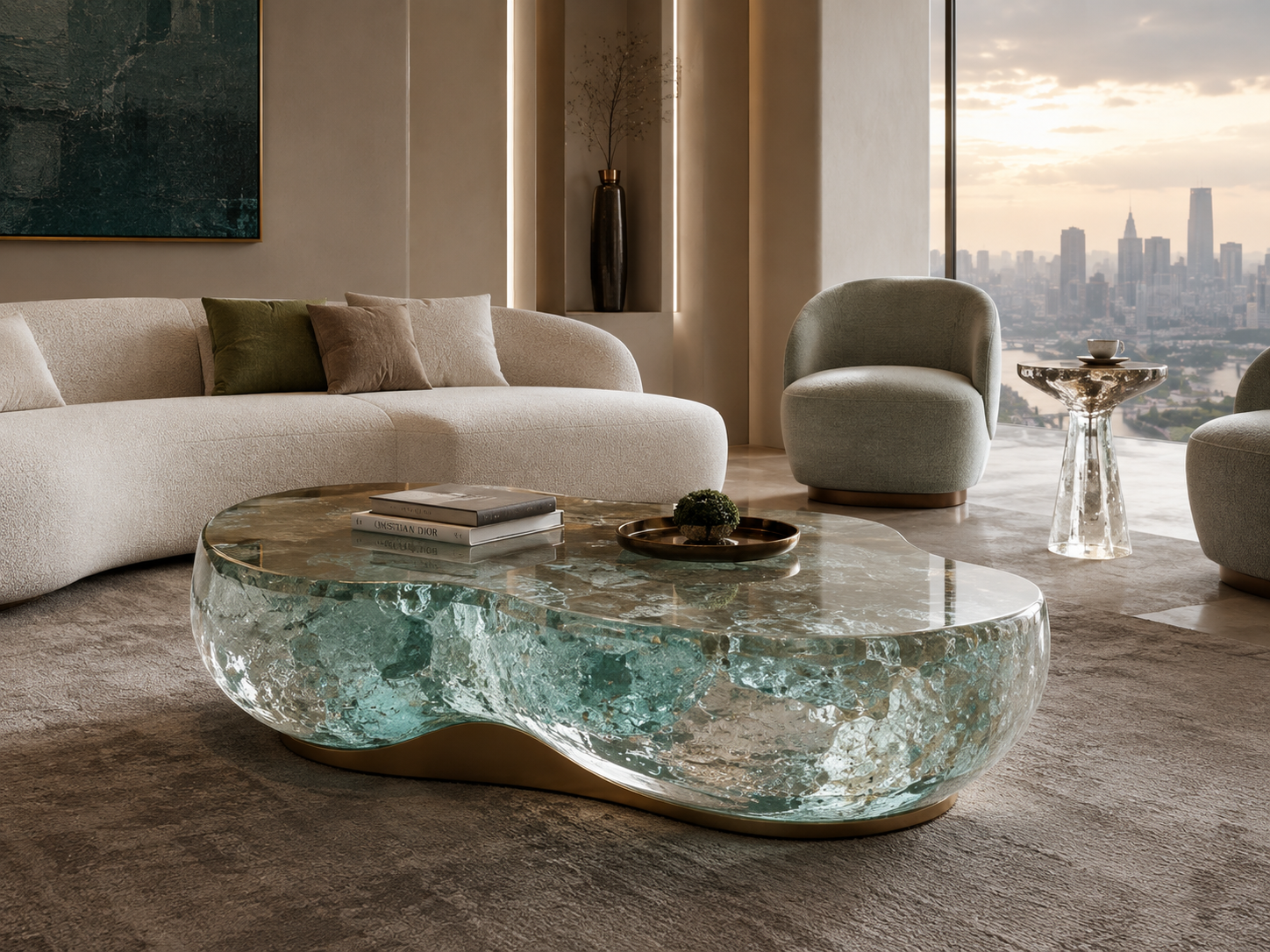
Walk into a memorable boutique, hotel lobby, restaurant, jewelry store, or luxury showroom and you may not remember every chair or wall finish. What usually remains is a visual moment: a glowing reception desk, a translucent table that seems to change as you move around it, or a display pedestal whose edges suddenly light up against a darker background.
That is why the value of synthetic crystal furniture, premium resin furniture, and high-clarity platinum acrylic furniture goes beyond transparency. These materials can interact with light. They can receive it, guide it, reflect it, diffuse it, or trap it visually inside a thick transparent volume. In the right commercial interior, furniture no longer acts only as something people sit at, place products on, or walk around. It becomes part of the lighting composition itself.
This idea is especially relevant as physical commercial spaces are being asked to deliver more than functionality. Bain & Company and Altagamma reported in their 2026 luxury-market update that global luxury spending reached approximately €1.443 trillion in 2025, while luxury experiences continued to outperform tangible goods. Bain describes an ongoing shift toward experiences and stronger emotional meaning rather than ownership alone. For premium retail and hospitality, that makes the physical environment an increasingly important part of the product.
So how can furniture that “catches the light” help make a space easier to remember?
1. Memorable commercial spaces need a visual anchor, not simply more decoration
One of the most common mistakes in commercial interiors is assuming that memorability comes from adding more elements: another feature wall, more decorative lighting, more textures, more metallic finishes, more display props.
The result can easily become visually expensive but emotionally forgettable.
A stronger approach is to create one or two elements that customers can immediately associate with the place. A large synthetic crystal table in the center of a hotel lobby, a translucent resin reception counter, or a row of clear platinum acrylic display plinths can perform this role because these objects do not have a fixed appearance. They change according to light, viewing angle, background, and movement.
This matters increasingly in premium commercial environments. Bain's latest luxury research argues that consumers continue to prioritize experience and meaning, and that brands need to strengthen emotional relevance rather than relying only on traditional product prestige.
Furniture can contribute directly to that experience.
Imagine a luxury fashion boutique finished in limestone, brushed stainless steel, and dark timber. Adding another marble table may be elegant, but the table will remain visually solid and predictable. Replace it with a thick clear synthetic crystal table with optically polished edges, and the relationship changes. The stone floor becomes visible through the table. Reflections of ceiling lights appear inside the legs. People and merchandise become partially layered behind its transparent mass. When a narrow beam reaches the edge, the object suddenly becomes brighter without the entire space needing more light.
In a hotel lobby, the same principle could be applied to a sculptural resin console in a champagne or smoky tint. During daylight hours it may appear subtle and almost architectural. At night, carefully positioned light can make the color appear deeper and the edges more luminous.
The objective is not to make every piece of furniture dramatic.
It is to give the customer one image worth remembering.
2. “Catching the light” is a material property that should be designed, not treated as a visual slogan
Transparent furniture looks simple, but optically it can be much more complex than opaque furniture.
The Illuminating Engineering Society's recommended practice for retail spaces specifically includes reflection, refraction, transmission, absorption, glare, and veiling reflections among the characteristics that lighting designers need to consider. It also discusses light distribution, ambient lighting, perimeter lighting and feature lighting rather than treating illuminance as the only measure of a successful retail environment.
This is particularly relevant to synthetic crystal and acrylic furniture.
With wood or stone, most of the visual effect occurs where light meets the surface. With a transparent or translucent material, light can enter the object, travel through part of its volume and return to the viewer from another surface or edge.
For comparison, Röhm reports light transmission of up to approximately 92% for some crystal-clear PLEXIGLAS® PMMA molding compounds and highlights their light-guiding properties. The material is optically capable enough to be used in lenses for Zumtobel's TECTON II professional lighting system.
That figure should not be applied automatically to every synthetic crystal, resin or acrylic furniture product; optical performance depends on formulation, thickness, pigmentation and finishing. But it demonstrates why high-quality acrylic materials can interact so strongly with lighting.
In furniture design, thickness is especially important. A thin transparent panel may visually disappear. A thick leg, solid base or large cast volume can reveal far more internal depth. Polished edges can become bright lines, while frosted surfaces diffuse light more softly. Curved resin forms create gradients, whereas sharp-cut geometry produces more defined reflections.
This means a platinum acrylic console, premium resin coffee table, synthetic crystal dining table or clear display pedestal should not be designed only in terms of shape and dimensions. The designer should ask where light will enter, which edges should remain visible, which surfaces should disappear, and what the object will look like from the customer's primary viewing angle.
That is when material specification becomes part of lighting design.
3. Use directional light to turn transparent furniture into a visual “light catcher”
If the goal is to show the optical quality of transparent furniture, flooding the whole room with uniform light is often the least effective approach.
Directional light usually produces more depth.
Consider a thick synthetic crystal console positioned against a relatively dark textured wall. If it is illuminated evenly from the front, the object may simply look transparent. Move the source toward one side or slightly behind the furniture, and something different happens: polished edges become brighter, the thickness becomes more legible and individual surfaces begin to reflect the surrounding architecture.
This technique is particularly powerful for synthetic crystal dining tables, side tables, console tables, benches and large sculptural furniture.
The contrast is essential. Light is easier to notice when darkness exists beside it.
That does not mean commercial interiors should be unnecessarily dark. It means lighting needs hierarchy. The IES retail-lighting guidance distinguishes between ambient and feature lighting and emphasizes direction and distribution as part of successful merchandise environments.
A practical example would be a premium restaurant with warm ambient lighting. Instead of placing strong downlights directly over every transparent table, the designer might allow a lower general illumination level and introduce controlled side or grazing light near selected resin or acrylic pieces. A smoky resin table may then pick up warm highlights along its curves without becoming visually aggressive.
The same idea can be seen in recent retail projects. ArchDaily's coverage of the 2025 PLEATSMAMA Store in Seoul describes transparent acrylic drawers that reinforce the brand's pleated language through light and reflection, while gradients of lighting help organize the experience of the store.
For brands, this creates an important advantage: the furniture itself can help communicate identity.
Instead of putting a logo on every surface, a store can develop a recognizable language using a specific transparent color, repeated acrylic geometry, thick resin volumes and a consistent lighting angle. Customers may not consciously analyze these elements, but they can remember the overall image.
That is a more sophisticated form of branding.

4. Combine transparent materials with darker or matte surfaces to make the light effect stronger
Too much transparency can weaken transparency.
If transparent furniture is placed in a space filled with glass, polished stainless steel, mirrors and bright white lighting, everything competes for reflection. The eye has difficulty understanding what is important.
Synthetic crystal and platinum acrylic often become more impressive when combined with materials that behave in the opposite way.
A clear acrylic table against travertine. A champagne resin console against dark timber. A translucent amber reception desk on a charcoal stone floor. Clear display plinths surrounded by matte plaster. The contrast between light-absorbing and light-transmitting materials allows the transparent object to become visually legible.
Recent commercial projects demonstrate this principle. In the LMOOD Flagship Store in Seoul, published by ArchDaily in 2025, the spatial composition combines a major acrylic wall with a dark architectural mass, concrete surfaces and a carefully sequenced lighting strategy. The lighting changes as visitors move deeper into the store, progressing from openness toward greater warmth and intimacy.
The lesson for furniture is straightforward: a transparent piece needs a background.
For a jewelry boutique, a platinum acrylic pedestal can almost disappear against a controlled dark backdrop, allowing a watch or jewelry piece to appear suspended. A narrow spotlight can illuminate the merchandise while catching only the edges of the acrylic.
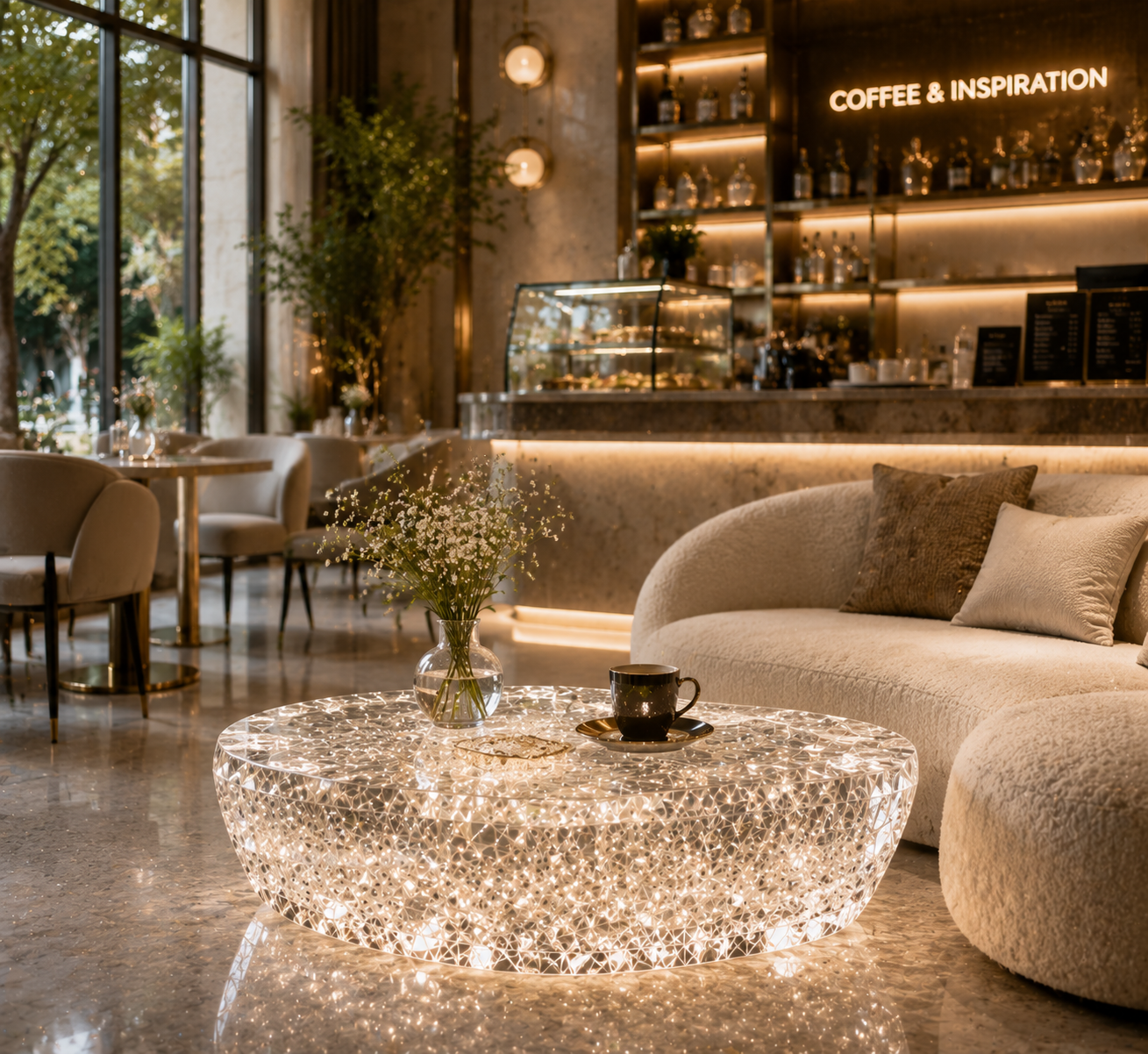
For a luxury hotel, a pale amber premium-resin table can sit against textured stone so the stone is visible through the material during the day. At night, warmer lighting can increase the apparent saturation of the resin and create a completely different visual character.
For a beauty or fragrance store, transparent acrylic shelves can reduce the visual weight of the fixture so packaging appears to occupy more of the customer's attention.
This is why designers should not ask only, “What color should the resin be?”
They should ask, “What will be behind it, underneath it, and reflected inside it?”
Transparent furniture incorporates the surrounding interior into its own appearance. Its context becomes part of the furniture.
5. Translucent premium resin can do something clear acrylic cannot: make the furniture itself appear to glow
“Catching light” does not always mean maximum transparency.
Sometimes the most memorable commercial effect comes from allowing the furniture to diffuse light instead of showing everything behind it.
This is where premium translucent resin becomes particularly valuable.
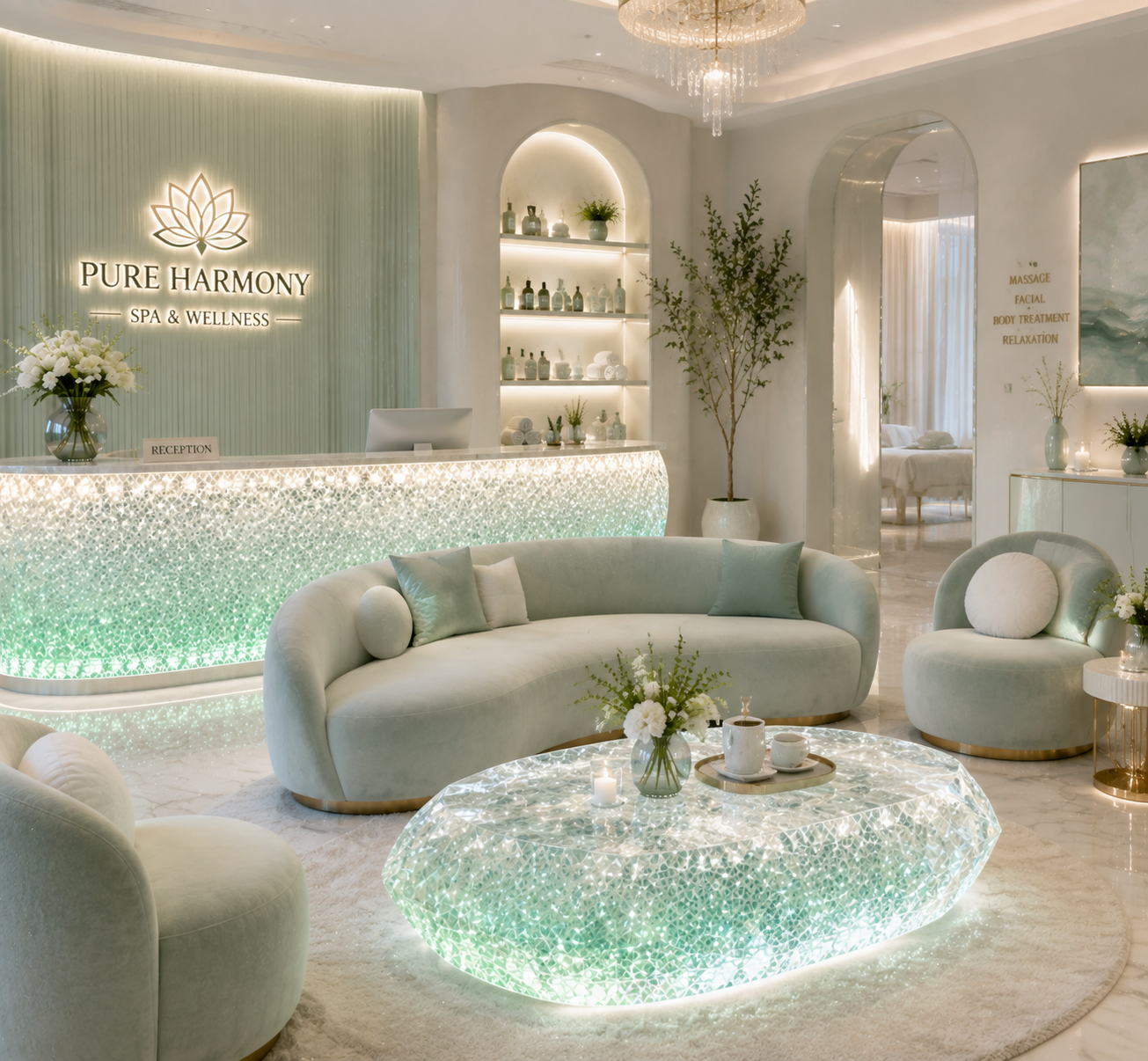
A reception counter produced in milky, amber, smoky or colored translucent resin can hide a controlled lighting system while allowing the material itself to become visually luminous. Instead of seeing individual LED points, the customer should ideally perceive a continuous glowing volume.
A useful architectural reference is the Blue Bottle Samseong Café in Seoul. ArchDaily reports that the project uses transparent and frosted panels to enhance depth and includes a blue-gradient acrylic wall at the bar as a strong focal point connecting brand identity with the surrounding urban setting.
The principle translates naturally into furniture.
A translucent premium-resin bar counter can create an evening identity for a restaurant. A sculptural reception desk can become the visual beacon of a hotel lobby. A resin base underneath a transparent synthetic crystal tabletop can produce the impression that light is rising through the furniture. Colored resin display blocks can give each product zone its own atmosphere without adding more architectural partitions.
But this effect must be carefully controlled.
If LEDs are too close to the surface, individual points or stripes can become visible. If the resin is too transparent, internal hardware and wiring may become distracting. If it is too opaque, the lighting effect disappears. Surface finish, thickness, diffusion distance, pigment concentration and access for maintenance therefore need to be resolved together.
Glare must also be considered. The CIE's 2024 position statement on integrative lighting emphasizes that good lighting quality should balance human well-being and functioning with architectural, environmental and energy considerations, and it specifically highlights the need for careful design to prevent glare.
The goal is not to produce the brightest piece of furniture in the room.
The goal is to make customers wonder, for a moment, where the light is coming from.
That moment of discovery creates memory.

6. The most successful projects design the furniture, lighting and customer journey as one system
A memorable transparent furniture piece cannot be specified from a catalog image alone.
Its real appearance depends on conditions that photographs rarely show: viewing distance, eye level, surrounding reflections, daylight, artificial lighting angle, neighboring materials, fingerprints, joint details, cable routes and the difference between daytime and nighttime operation.
For this reason, projects using large synthetic crystal, premium resin or platinum acrylic furniture benefit greatly from physical mock-ups.
Before producing a full reception desk, for example, a sample of the actual resin should be viewed under front, side, grazing and backlighting. A colored resin sample should be tested at a thickness close to the final piece because color depth can change substantially as the optical path through the material increases. Polished and satin finishes should be compared under the actual lighting direction. Clear acrylic edges should be tested against both dark and light backgrounds.
The purpose is not simply quality control. It is creative development.
A designer may discover that a transparent leg looks ordinary under a ceiling downlight but extraordinary when light enters from the side. A champagne resin initially selected for its color may become much more interesting when softly backlit. A perfectly clear acrylic shelf may need a subtly frosted edge to produce the desired visual definition.
The customer's movement should also be considered.
When someone approaches a synthetic crystal table from ten meters away, the furniture may first appear as a reflection. At five meters, the thickness becomes visible. At two meters, the customer begins to see objects through it. Walking past it changes the relationship between reflections, background and edges.
That changing image is precisely what makes the material suitable for commercial spaces that need to be photographed, shared and remembered.
It also aligns with the broader direction of premium retail. Bain's 2025–2026 research describes consumers placing greater value on immersive and emotionally meaningful experiences, while its 2025 report argued for physical luxury retail to move toward fewer but more impactful environments capable of creating emotion, immersion and personalized connection.
Furniture can be one of the most efficient ways to create that impact because it occupies both functional and visual territory.
A synthetic crystal table can still be a table while becoming a light sculpture at night. A premium-resin reception desk can manage guest arrival while acting as the visual signature of a lobby. A platinum acrylic display pedestal can support merchandise while almost disappearing beneath it. A translucent resin bar can provide service while becoming the lighting feature that customers photograph.
This is ultimately the strongest reason to use furniture that “catches the light.”
It does not require a commercial interior to become louder.
It allows the space to become more memorable with fewer, better-controlled elements.
In premium commercial design, that distinction matters. The most impressive space is rarely the one where every surface demands attention. It is the one where customers instinctively know where to look—and where one carefully designed piece of furniture catches the light at exactly the right moment.
READ MORE:
- How Boutique Hotels and Luxury Spaces Use Crystal-Like Furniture to Create Memorable Experiences
- The Hidden Factors That Make Transparent Furniture Look Expensive or Cheap
- Why Luxury Buyers Choose Statement Furniture Instead of Ordinary Interior Pieces
- How Designers Are Redefining Acrylic as a Premium Material for Modern Commercial Spaces
- Why High-End Acrylic Furniture Is Becoming a New Choice for Luxury Interior Projects
- Il mobile non deve essere soltanto un mobile: creare un punto focale negli spazi commerciali con il cristallo sintetico
- Far risplendere lo spazio più di notte che di giorno: 3 strategie di illuminazione per gli arredi in cristallo sintetico
- Quando si accende la luce, il mobile cambia: come gli arredi in cristallo sintetico diventano installazioni di luce e ombra?
- Come creare un senso di lusso stratificato negli spazi commerciali con luce, ombra e arredi in cristallo sintetico


