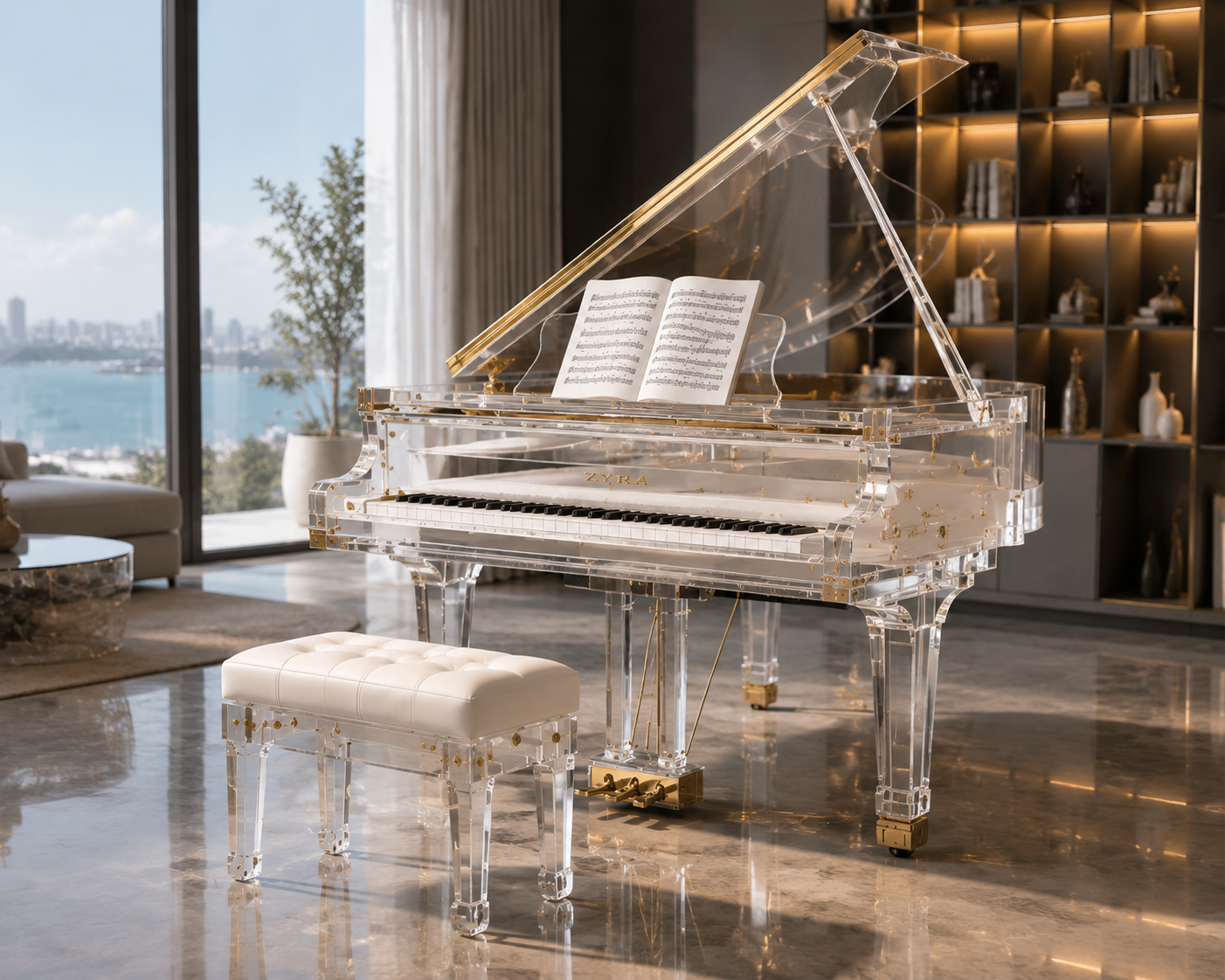
Luxury interior design is changing.
For many years, the idea of luxury was closely connected with visual weight. Heavy marble, dark timber, ornate metalwork, thick upholstery, carved decoration, and complex detailing were often used to communicate status and value.
These materials remain important, but modern luxury is developing a different language.
Today's high-end interiors increasingly emphasize openness, light, proportion, craftsmanship, material contrast, and carefully controlled simplicity.
Instead of filling a room with decorative elements, designers often try to create fewer but more distinctive pieces.
Instead of making every object visually dominant, they consider how furniture interacts with architecture, lighting, artwork, natural views, flooring, and circulation.
This shift has created new opportunities for materials that feel refined, contemporary, and technologically advanced.
Synthetic crystal acrylic is one of them.
High-quality acrylic, also known as PMMA, can achieve outstanding transparency, smooth surfaces, polished edges, substantial thickness, and a crystal-like appearance.
Unlike ordinary transparent plastic, premium acrylic can be carefully engineered and processed into sophisticated furniture components.
It can be cut, machined, bonded, polished, bent, engraved, colored, and combined with metal, marble, stone, wood, leather, glass, and lighting.
The result is a material that can look light but feel substantial.
It can almost disappear within a room while still creating a memorable visual effect.
It can support heavy marble while appearing nearly invisible.
It can reflect light without the visual heaviness of solid furniture.
It can create a futuristic atmosphere without making an interior feel cold or artificial.
For this reason, synthetic crystal acrylic furniture is increasingly relevant to modern luxury spaces.
It offers designers a way to balance technology and elegance, transparency and structure, minimalism and visual impact.
The following six areas explain why.
1. Why Futuristic Materials Are Redefining Modern Luxury
Modern luxury is no longer defined only by expensive materials.
It is increasingly defined by how materials are used.
A room may contain marble, brass, walnut, leather, and designer lighting, but if every element is visually heavy, the space can quickly feel crowded.
Contemporary designers often look for balance.
They may use one dramatic stone wall and then select visually lighter furniture.
They may introduce warm natural wood but contrast it with transparent or reflective surfaces.
They may use strong architectural geometry but soften the composition with curved or translucent furniture.
This creates a more sophisticated relationship between objects.
Synthetic crystal acrylic fits naturally into this approach because it does not behave like traditional opaque materials.
A wooden chair creates a strong silhouette.
A marble table base visually anchors the room.
A black metal structure defines clear lines.
A transparent acrylic component, however, can provide physical structure while reducing visual obstruction.
This creates a futuristic quality.
The furniture appears present and absent at the same time.
For modern luxury interiors, this is valuable because space itself becomes part of the design.
The room feels more open.
Natural light can continue through the furniture.
Decorative flooring remains visible.
Artwork is not unnecessarily blocked.
Architectural details maintain their presence.
The furniture supports the composition instead of competing with it.
This is particularly important in high-end residential and commercial projects where many expensive materials already need to coexist.
Acrylic can act as a visual bridge.
It allows the designer to introduce another functional object without adding another heavy material surface.
At the same time, futuristic does not have to mean cold.
Acrylic can be combined with warm materials to create balance.
Transparent acrylic legs beneath a walnut top can make wood feel lighter.
Acrylic supporting marble can make stone appear to float.
Clear acrylic next to velvet upholstery can emphasize the softness of the textile.
Tinted acrylic combined with bronze or brass can create a warmer, more glamorous interpretation of modern luxury.
This flexibility allows the material to work across several interior styles.
It can be minimal.
It can be glamorous.
It can be architectural.
It can be artistic.
It can be futuristic.
That adaptability is one reason acrylic is becoming increasingly important in premium furniture design.
2. Crystal-Like Transparency Creates a New Spatial Language
Transparency is the most recognizable characteristic of acrylic furniture, but its design value goes much further than simply being clear.
Transparency changes how furniture occupies space.
Consider a traditional coffee table.
A solid base creates a strong object in the center of the room.
Even if the table is not physically large, its visual mass can make the seating area feel smaller.
A clear acrylic coffee table behaves differently.
The user still receives the full function of the table, but the floor and carpet beneath remain visible.
The result is a lighter visual composition.
This effect becomes especially useful in smaller luxury spaces.
Urban penthouses, hotel suites, boutique apartments, dressing rooms, lounges, and private offices may have limited floor area.
Using too many visually heavy pieces can make these spaces feel crowded.
Transparent furniture allows designers to introduce necessary functions without closing the room visually.
Acrylic can also preserve important sightlines.
In a residence with floor-to-ceiling windows, clear furniture allows exterior views to remain dominant.
In a hotel lobby, transparent side tables can support lounge seating without interrupting the overall spatial flow.
In a luxury boutique, clear displays allow customers to see products and architectural features across the store.
In a showroom, acrylic furniture can support presentation while keeping the environment clean and open.
The crystal-like quality of thick acrylic adds another layer.
When acrylic is manufactured in substantial thicknesses and professionally polished, light can travel through its edges and create reflective highlights.
This gives the material depth.
A thin sheet may simply appear transparent.
A thick block can appear sculptural.
The edge can become a design feature.
Bevels, facets, rounded profiles, and polished transitions can produce visual effects that resemble glass or crystal.
This creates an interesting contrast between visual lightness and material substance.
A thick acrylic table leg may be physically significant, but because it is transparent, it does not look heavy.
This allows designers to create bold structural elements without making the interior feel dense.
It can also support the illusion of floating furniture.
A marble tabletop on clear acrylic supports may appear suspended.
A transparent bench base may seem to disappear beneath the cushion.
A console supported by thick acrylic slabs may allow the wall behind it to remain fully visible.
These effects are difficult to achieve with most conventional materials.
This is why transparency is not merely a decorative feature.
It is a spatial tool.
.png)
3. Advanced Fabrication Turns Acrylic into a High-End Design Material
Acrylic furniture is sometimes misunderstood because inexpensive transparent products are widely available.
However, premium custom acrylic furniture belongs to a different category.
Its quality depends on material selection, thickness, machining, polishing, bonding, engineering, and finishing.
High-quality PMMA can be produced in different thicknesses for different applications.
Thin sheets may be suitable for decorative panels.
Thicker acrylic can be used for table legs, structural bases, shelving, benches, display furniture, and sculptural components.
Very thick sections can create strong crystal-like depth.
The manufacturing process is critical.
Precision Cutting
Accurate cutting is necessary because transparent materials reveal construction errors clearly.
Uneven edges or poorly aligned components are more visible than they would be in opaque furniture.
CNC Machining
CNC technology allows acrylic to be shaped with high precision.
Designers can introduce grooves, holes, channels, facets, recesses, curves, and customized profiles.
This expands the material far beyond simple rectangular panels.
A table base can become sculptural.
A furniture leg can include precise transitions.
A retail display can be engineered around the dimensions of a particular product.
Acrylic can also be prepared for integration with metal hardware, lighting, or decorative inserts.
Polishing
Polishing is one of the most important processes in high-end acrylic furniture.
Poorly finished edges may look rough or cloudy.
Professionally polished edges can become clear and reflective.
On thick acrylic, this creates a jewel-like visual effect.
The quality of polishing can significantly influence whether the finished product feels ordinary or luxurious.
Bonding
Transparent furniture often requires precise bonding.
The goal is to create joints that are structurally reliable but visually clean.
Visible bubbles, adhesive marks, misalignment, or cloudy joints can reduce perceived quality.
High-end fabrication therefore requires both technical skill and aesthetic control.
Bending and Thermoforming
Acrylic can also be shaped into curves.
This gives designers alternatives to straight architectural geometry.
Curved furniture can feel softer and more fluid.
It may be used in chairs, side tables, screens, pedestals, shelves, benches, and decorative furniture.
Engraving and Surface Effects
Logos, patterns, textures, or graphic elements can be engraved or applied to acrylic.
This creates possibilities for branded environments, luxury retail, hotels, and custom furniture collections.
Color and Tinting
Clear acrylic is only one option.
Smoke gray, bronze, amber, blue, green, red, and custom colors can create different moods.
Tinted acrylic allows designers to preserve translucency while introducing a stronger visual identity.
These fabrication possibilities demonstrate why acrylic should not be treated as a basic substitute for glass.
It is a flexible design material capable of supporting highly customized furniture concepts.
4. Light, Reflection, and Mixed Materials Create a Richer Luxury Experience
One of the strongest reasons acrylic works so well in modern interiors is its relationship with light.
Opaque furniture primarily reflects light from its surface.
Transparent acrylic interacts with light in more complex ways.
Light may pass through the material.
It may reflect along polished edges.
It may create highlights inside thick sections.
It may change according to viewing angle.
This makes acrylic especially effective in carefully lit luxury spaces.
During the day, natural light can make the material appear almost invisible.
At night, focused lighting can create more dramatic reflections.
A spotlight directed toward a polished edge can emphasize transparency and thickness.
Integrated LEDs can create illuminated effects.
Colored lighting can interact with tinted acrylic.
This allows the same furniture piece to produce different impressions throughout the day.
Lighting is only one part of the experience.
Acrylic becomes even more interesting when combined with other luxury materials.
Acrylic and Marble
This is one of the most visually powerful combinations.
Marble communicates permanence, weight, and natural variation.
Acrylic provides transparency and lightness.
When a heavy stone top is supported by clear acrylic, the contrast creates tension.
The stone appears to float.
The support becomes visually subtle.
The marble remains the dominant decorative surface.
This combination works particularly well for dining tables, consoles, coffee tables, and statement furniture.
Acrylic and Metal
Metal introduces precision and architectural detail.
Brushed brass, bronze, stainless steel, chrome, black metal, or aluminum can be used as connectors, trim, frames, feet, handles, or decorative accents.
The metal gives the transparent material a clear point of contrast.
This can create a contemporary, glamorous, or technical aesthetic.
Acrylic and Wood
Wood provides warmth.
Acrylic provides visual lightness.
Together, they can create modern furniture that feels refined but not cold.
Walnut, oak, ash, or other veneers may be used for tops, drawers, shelves, or decorative panels.
The combination works particularly well in high-end residential interiors.
Acrylic and Leather
Leather introduces softness and tactile luxury.
Clear acrylic arms, frames, or bases combined with leather seating can create an elegant contrast between transparency and comfort.
This combination is suitable for benches, chairs, stools, and occasional furniture.
Acrylic and Glass
Glass and acrylic can work together when a designer wants multiple layers of transparency.
Their reflective qualities differ, which can create subtle visual variation.
Acrylic and Lighting
Integrated lighting transforms acrylic from a passive surface into an active visual feature.
This is especially useful in retail, hospitality, exhibitions, bars, clubs, and branded environments.
These mixed-material possibilities give designers a broad creative vocabulary.
Luxury is created not by one material alone, but by the relationship between materials.
5. Custom Acrylic Furniture Fits the Needs of High-End Residential and Commercial Projects
The strongest market for premium acrylic furniture is often project-based customization.
High-end interiors rarely depend entirely on standard dimensions.
Architectural conditions vary.
Design concepts vary.
Material palettes vary.
Brand requirements vary.
Acrylic is well suited to this environment because it can be adapted to specific project needs.
Luxury Villas and Penthouses
Private residences often use acrylic furniture to maintain openness.
A transparent coffee table can preserve the visibility of a valuable carpet.
Acrylic dining chairs can make a dining zone feel less crowded.
Clear console tables can complement marble flooring and decorative walls.
Customized pieces can be produced according to the exact dimensions of the interior.
Hotels and Resorts
Hospitality design depends strongly on atmosphere.
Guests experience furniture in lobbies, lounges, guestrooms, restaurants, bars, suites, and VIP spaces.
Acrylic furniture can contribute a contemporary and exclusive character.
It can also be combined with materials already used throughout the hotel, such as stone, metal, wood, and upholstery.
Luxury Retail
Acrylic is particularly useful in retail because it does not visually compete with the merchandise.
Jewelry, watches, cosmetics, handbags, fashion accessories, shoes, and collectibles can be displayed on transparent furniture while remaining the main focus.
Custom dimensions can be designed around specific products.
Brand colors or logos can also be integrated.
Boutiques and Showrooms
Clear furniture helps maintain long sightlines.
This is valuable in fashion boutiques, furniture showrooms, automotive spaces, property sales centers, material libraries, and premium exhibition environments.
Restaurants and Private Clubs
Modern restaurants and private clubs increasingly use design as part of the customer experience.
Acrylic furniture can contribute a glamorous, futuristic, or contemporary atmosphere.
It works particularly well when combined with lighting, velvet, stone, or metallic finishes.
Executive Offices
High-end offices often seek furniture that communicates innovation and refinement.
Acrylic desks, meeting tables, consoles, shelving, or decorative furniture can help create a distinctive executive environment.
Events and Brand Activations
Temporary luxury environments often require furniture that photographs well and creates immediate visual impact.
Acrylic works effectively in fashion events, exhibitions, product launches, luxury pop-ups, and branded installations.
This range of applications makes acrylic commercially attractive.
Manufacturers and brands can use the same core material knowledge across multiple project types while adapting the design language to each customer.
.png)
6. From Futuristic Appearance to Long-Term Brand and Project Value
The visual impact of acrylic can attract attention, but its larger value lies in differentiation.
Modern furniture markets are highly competitive.
Many suppliers can produce tables, chairs, cabinets, consoles, and shelving.
The challenge is to create something that is recognizable.
Acrylic can help designers and brands establish a more distinctive identity.
A furniture brand may develop a collection based on thick transparent structural elements.
Another may combine colored acrylic with polished metal.
Another may specialize in acrylic and stone furniture.
Another may use acrylic as a signature detail across multiple product categories.
Over time, these choices can become part of the brand's visual language.
The same applies to hotels and retailers.
A hotel can use related acrylic details across guestroom furniture, lounge tables, reception furniture, and suites.
A luxury retail brand can develop a repeatable transparent display system for multiple stores.
A property developer can create a distinctive furniture language for show apartments.
An interior design studio can use acrylic strategically across different projects to create signature visual effects.
Customization also supports premium pricing.
Standard furniture is easy to compare.
A custom acrylic product with specific dimensions, material thickness, metal details, specialized polishing, custom color, and project-specific engineering is much more difficult to compare directly.
The product becomes a solution rather than a commodity.
This is important for manufacturers.
Competing only on price can reduce acrylic furniture to a simple transparent product category.
Competing on design capability, engineering, finishing, material integration, and project service creates a stronger premium position.
High-end clients often value reliability as much as appearance.
They need accurate drawings.
They need samples.
They need consistent finishing.
They need strong packaging.
They need communication.
They need the product to arrive in the correct dimensions and condition.
These services contribute to the final value.
In premium furniture, the customer is not only buying material.
They are buying confidence.
Why Acrylic Represents the Future-Facing Side of Luxury
The concept of futuristic luxury is often misunderstood.
It does not necessarily require unusual shapes, dramatic technology, or extreme visual effects.
Sometimes the future appears through restraint.
A table that seems to float.
A transparent structure that almost disappears.
A polished material that interacts with light.
A furniture piece that feels technically advanced but visually simple.
Acrylic supports this kind of design particularly well.
It reflects several broader trends in modern interiors: greater visual openness; more personalized furniture; stronger material contrast; increased use of lighting; more attention to architectural integration; stronger demand for photogenic spaces; greater interest in branded environments; growing emphasis on custom manufacturing.
These trends suggest that transparent and semi-transparent materials will continue to play an important role in contemporary luxury design.
What Should Designers Consider When Specifying Acrylic Furniture?
The success of an acrylic furniture project depends on several decisions.
First, material quality should match the visual requirements.
Second, thickness should be selected according to both structure and appearance.
Third, edge treatment should be carefully considered.
Fourth, joints should be designed for both strength and visual cleanliness.
Fifth, hardware needs to be integrated carefully.
Sixth, mixed materials must be engineered to account for differences in weight and construction.
Seventh, lighting conditions should be considered because transparency changes dramatically under different environments.
Eighth, surface protection and packaging should be planned from the beginning.
Ninth, prototypes or samples may be useful for complex projects.
Tenth, communication between designer and manufacturer should remain clear throughout development.
Acrylic furniture may appear minimal, but achieving true simplicity often requires very precise manufacturing.
The fewer visual distractions a product has, the more visible every detail becomes.
This is why craftsmanship is especially important.
How Synthetic Crystal Acrylic Can Create a Stronger Luxury Experience
Acrylic creates luxury when it is used intentionally.
Transparency can make a room feel larger.
Thickness can create visual depth.
Polishing can make edges appear jewel-like.
Lighting can make the material glow.
Marble can provide contrast.
Metal can introduce precision.
Wood can add warmth.
Leather can introduce softness.
Color can create identity.
Custom shapes can create exclusivity.
When these elements are balanced carefully, acrylic furniture becomes much more than a transparent object.
It becomes part of the atmosphere.
The best designs do not use acrylic simply because it looks modern.
They use it because its material characteristics solve a design problem.
Perhaps the designer wants to preserve a panoramic view.
Perhaps a marble tabletop needs visually lighter support.
Perhaps a boutique wants display furniture that does not distract from products.
Perhaps a hotel needs a distinctive material language.
Perhaps a luxury residence needs furniture that feels elegant without becoming heavy.
In each case, the value comes from matching material characteristics with design purpose.
Conclusion
Synthetic crystal acrylic furniture is becoming an important material direction for modern luxury spaces because it combines futuristic visual language with strong customization potential.
Its transparency allows furniture to occupy space without creating excessive visual weight.
Its polished thickness can produce crystal-like depth.
Its compatibility with advanced machining allows designers to create precise, sculptural, and customized forms.
Its interaction with light makes it especially suitable for contemporary interiors.
Its ability to combine with marble, metal, wood, leather, glass, stone, and lighting creates a wide range of luxury material contrasts.
Most importantly, acrylic supports the way modern luxury is evolving.
Luxury today is increasingly about balance rather than excess.
It is about craftsmanship rather than decoration alone.
It is about creating distinctive experiences rather than simply displaying expensive materials.
It is about integrating furniture with architecture, lighting, branding, and space.
Synthetic crystal acrylic fits naturally into this new direction.
It can make heavy materials appear lighter.
It can make compact rooms feel more open.
It can create dramatic reflections without dominating the environment.
It can become almost invisible when other design elements should take priority.
And when designers want it to become a focal point, thick polished acrylic, color, curves, lighting, and sculptural forms can create a powerful statement.
For furniture designers, architects, developers, hotels, retailers, and premium brands, this creates an important opportunity.
Acrylic can help move furniture beyond conventional material language.
It can support custom solutions that are difficult to reproduce with standard furniture.
It can create signature products.
It can strengthen brand identity.
It can make spaces more memorable.
As contemporary interiors continue to prioritize openness, customization, material innovation, and visual experience, synthetic crystal acrylic furniture is likely to become an increasingly important tool for creating modern luxury.
The future of luxury furniture may not always look heavier, richer, or more decorative.
In many cases, it may look clearer, lighter, more precise, and more intelligently integrated with the space around it.
Synthetic crystal acrylic is one of the materials capable of delivering exactly that experience.
READ MORE:
- Why Is High-End Furniture Paying More Attention to the Dual Experience of Touch and Vision?
- Synthetic Crystal Acrylic Furniture: Helping Designers and Brands Find New Breakthrough Directions
- From Material Differences to Product Premium: An Analysis of the Competitive Advantages of Synthetic Crystal Acrylic Furniture
- Synthetic Crystal Acrylic Furniture: Why Is It Becoming a New Favorite in High-End Custom Projects?
- Why Luxury Buyers Are Looking Beyond Traditional Furniture Materials
- Un processo di progetto più efficiente: prima si definisce il cristallo sintetico, poi si sviluppano dimensioni e struttura del mobile
- Dal campione approvato alla messa in produzione: come ridurre il tempo perso in continue revisioni nei progetti di mobili in cristallo sintetico?
- Colore, dimensioni, spessore e struttura: quali dettagli confermare prima di ordinare mobili in cristallo sintetico?
- Hotel, ville e spazi commerciali: come pianificare in anticipo materiali e tempi di consegna dei mobili in cristallo sintetico?


