For a long time, stone was almost a symbol of status in high-end European villa design. Large marble floors, natural stone feature walls, stone kitchen islands, stone bathrooms, and stone fireplaces were often regarded as standard elements of luxury residences. For many homeowners, stone represented stability, expense, classic taste, and an irreplaceable sense of quality.
However, in recent years, the material language of high-end European residences has been changing noticeably. More and more villa projects are no longer relying on large areas of stone to express luxury. Instead, they are moving toward a more transparent, lightweight, restrained, and personalized spatial expression. Glass, acrylic, transparent resin, laminated transparent materials, and other clear materials are increasingly appearing in high-end villa design through furniture, partitions, staircases, display systems, art installations, and partial architectural structures.
This does not mean that stone is being completely eliminated. On the contrary, stone remains one of the most valuable materials in high-end residential spaces. What has truly changed is that stone is no longer the only protagonist, nor is it suitable to be used simply, repeatedly, and extensively. High-end European villas are shifting from “material-stacked luxury” to “experience-driven luxury,” and transparent materials fit perfectly into this transformation.
1. European Villa Aesthetics Are Moving from “Heavy Luxury” to “Light Sophistication”
Traditional luxury residences often created visual impact through heavy materials. The texture of natural marble, the hardness of granite, and the surface character of travertine could immediately communicate expense and stability. Therefore, in past villa interiors, large stone floors, full-height stone walls, and stone staircases were very common.
However, for today’s high-end European residential clients, the definition of luxury is no longer simply about how expensive the material is. They care more about whether the space feels natural, comfortable, quiet, and suitable for long-term living, rather than whether it creates visual shock during a short visit. Excessive use of stone can certainly create a strong decorative effect, but it can also make a space feel cold, heavy, and lacking in warmth.
This is especially true in high-end villas, where the scale of space is usually generous. If every major area relies on stone to emphasize its presence, the interior may become overly hard and rigid. When the living room, dining room, staircase, bathroom, and corridor all use similar stone language, the sense of spatial layering is weakened, and residents may experience visual fatigue.
Transparent materials offer another way to express high-end design. They do not rely on weight to create luxury. Instead, they use light, reflection, transparency, and a floating visual effect to shape a sophisticated atmosphere. For example, transparent acrylic side tables, glass stair railings, clear display cabinets, and transparent art plinths can keep the space open while adding modernity and refinement.
This design logic of “light sophistication” is more aligned with the current aesthetic direction of high-end European residences. True luxury no longer comes from the dominant presence of expensive materials. It comes from the balance of spatial proportions, the flow of light, the relationship between materials, and the precision of details.
2. “Standard Stone” Is Losing Differentiation, While High-End Clients Need Unique Design Memories
Stone became popular because it naturally carries rarity and decorative value. Every piece of natural stone has its own unique veining, which seems to provide an unrepeatable effect. But as global supply chains and stone-processing technologies have become more mature, many stone applications that once belonged only to high-end projects have gradually turned into repeatable design templates.
When a large number of villas, hotels, clubs, and showrooms all begin using similar gray marble, white marble, or black stone feature walls, the premium impression of stone itself becomes weakened. For truly high-end clients, they do not want their homes to look like another “standard luxury showroom.” They want their spaces to have personal character, collectible value, and a clear sense of memorability.
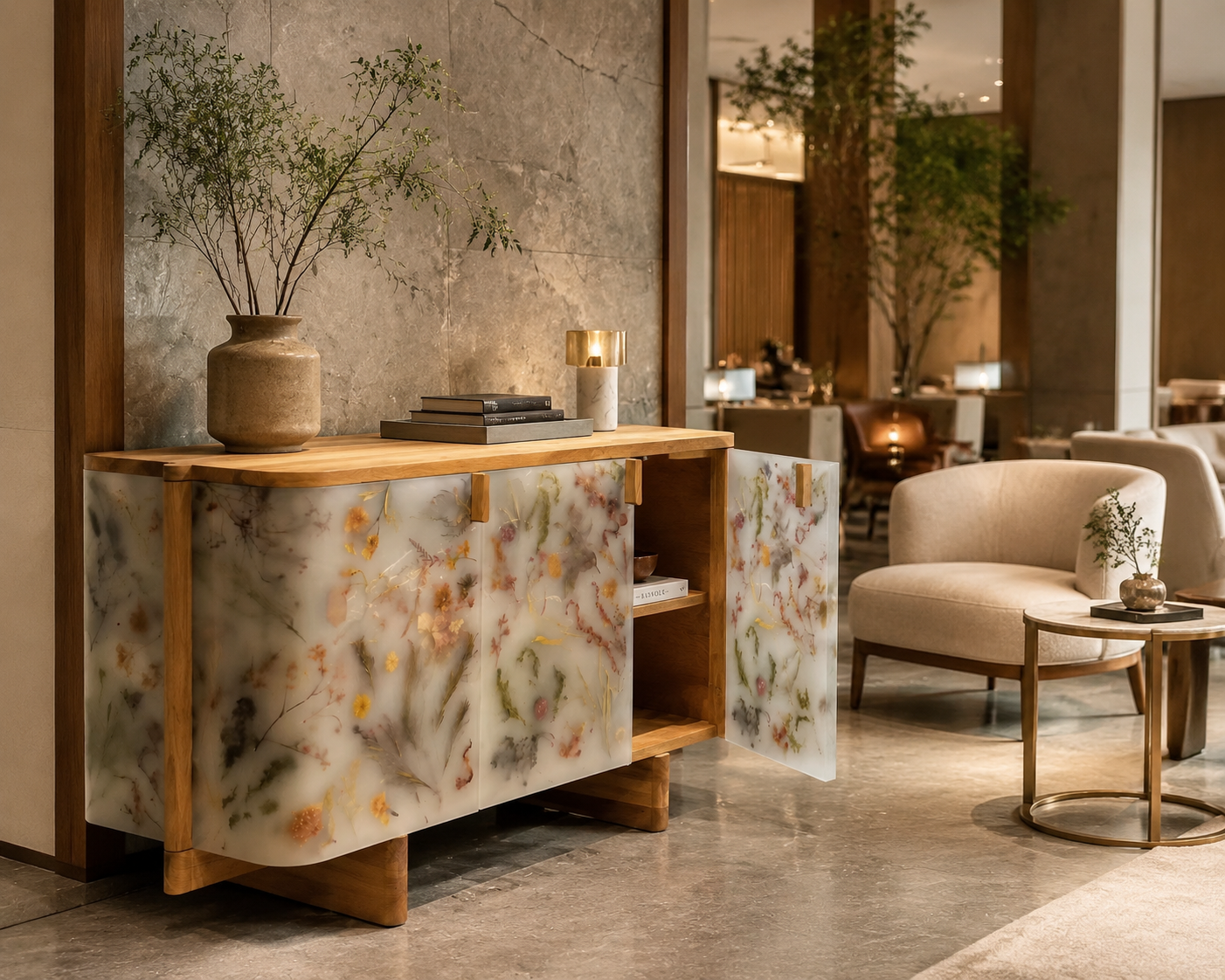
Transparent materials have a strong advantage in this regard. They can either disappear visually or become a focal point. They can reduce the visual volume of furniture while creating unique effects through shape, thickness, edge finishing, and lighting. For example, a thick acrylic coffee table can keep the living room clean and open; a set of transparent display shelves can highlight art, books, or collectibles; a furniture piece combining transparent resin and wood can create a strong sense of customization.
For high-end European villas, design is shifting from “using expensive materials” to “creating exclusive experiences.” A rare stone slab can certainly reflect value, but if it is only used as a conventional feature wall, it may not create a strong design memory. By contrast, when transparent materials are combined with stone, wood, metal, leather, fabric, and other materials, they often create richer spatial layers.
A high-end space does not require every material to speak loudly. The value of transparent materials lies in their ability to leave visual breathing room, allowing the architecture, natural scenery, art pieces, and living scenes to become the true protagonists.
.png)
3. Natural Light, Views, and Spatial Scale Are Becoming Core Values in Villa Design
High-end European villas are usually more than just interior spaces. They are complete combinations of architecture, gardens, nature, and lifestyle. Whether it is a manor in southern France, a mountain villa in Switzerland, a sea-view residence in Spain, or a lakefront villa in Italy, views, light, and spatial flow are core values.
In such residences, material selection must serve the architecture itself. If too many heavy stone surfaces and solid partitions are used indoors, sightlines can be interrupted, and the connection between interior and exterior can be weakened. Especially in villas with large floor-to-ceiling windows, terraces, pools, gardens, or courtyards, the most valuable part of the space is often not a single wall, but the view extending from indoors to outdoors.
Transparent materials play an important role here. Glass railings can make staircases and mezzanines feel lighter. Transparent acrylic furniture can reduce obstruction to the floor and background. Glass partitions can separate functional areas while maintaining light penetration. Clear display cabinets can provide both storage and display functions without making the space feel crowded.
For large homes, transparency does not mean emptiness. Good use of transparent materials means maintaining spatial continuity while establishing refined details. For example, transparent side tables in a living room can create a more natural relationship between the carpet, sofa, and artwork. Transparent display structures in a walk-in closet can create a boutique-like presentation. Glass systems in a wine cellar or collection room can turn a functional area into a visual highlight.
Transparent materials can also enhance the layering of light. When natural light enters an interior, it creates subtle reflections on glass, acrylic, and metal surfaces, making the space feel more breathable. This is an effect that heavy stone materials find difficult to provide. Stone emphasizes stability and depth, while transparent materials emphasize flow and extension. The two are not opposites; they represent different spatial moods.
4. Sustainability and Lightweight Design Are Driving Material Changes
High-end residential design is not only about aesthetics. It increasingly focuses on sustainability, construction efficiency, maintenance costs, and long-term performance. The European market is paying growing attention to environmental responsibility, low-carbon design, and material life cycles, and this is influencing material choices in villa projects.
Natural stone has many advantages, including durability, stability, and a premium texture. However, it also comes with practical challenges. Large-format stone requires high costs from quarrying and transportation to processing and installation. Some imported stones travel long distances, affecting both project budgets and carbon footprints. Large-scale stone installation also increases structural load and places higher demands on construction accuracy, base preparation, and future maintenance.
In high-end villas, heavier does not necessarily mean better, and more materials do not necessarily mean more luxury. Controlling material weight and reducing unnecessary decorative stacking have become important principles in modern design. The introduction of transparent materials can maintain a premium visual effect while reducing spatial pressure and material consumption.
For example, in some non-load-bearing areas, transparent acrylic furniture can replace certain heavy stone furniture pieces. In spatial division, glass partitions can replace solid walls. For display functions, transparent cabinets can reduce the bulkiness of traditional millwork or stone structures. This type of design is more flexible and more suitable for modern lifestyles.
Of course, transparent materials also need to be selected rationally. High-end projects cannot pursue “transparency” alone. They must also consider material quality, durability, anti-yellowing performance, surface treatment, maintenance methods, and processing precision. Transparent materials suitable for villa projects must offer stability and long-term beauty, rather than merely creating a short-term visual effect.
5. Transparent Materials Are Not a “Cheap Substitute” but a New Language of Luxury Design
When many people hear about transparent materials, they first think of ordinary plastic or simple glass products. As a result, they may assume that transparent materials are not high-end enough. In reality, in the field of premium design, the luxury of transparent materials often depends on craftsmanship rather than the material name itself.
Take acrylic as an example. Ordinary thin acrylic sheets and high-quality thick acrylic panels are completely different in terms of visual effect, light transmission, edge quality, durability, and processing difficulty. High-end acrylic furniture usually requires precision cutting, polishing, heat bending, bonding, and surface finishing to achieve a crystal-clear, substantial, and seamless appearance. Premium acrylic is not a low-cost substitute. It is a modern material capable of creating a sense of suspension and crystal-like elegance.
The same applies to glass. Ordinary glass partitions and high-end laminated glass, low-iron glass, curved glass, and artistic glass create very different spatial effects. In villa projects, glass can be used for staircases, skylights, wine cellars, bathrooms, landscape windows, interior doors, and art installations. Its value is not only transparency, but also its ability to connect light and space.
Transparent resin offers even more artistic possibilities. It can encapsulate wood, metal, fabric, botanical textures, or sculptural elements, forming one-of-a-kind custom furniture and decorative pieces. For high-end clients who pursue personalization, such materials are closer to art pieces than conventional interior materials.
Therefore, the popularity of transparent materials is not because they are cheaper than stone. It is because they represent a new design language: light, restrained, modern, flexible, and customizable. They allow villa spaces to shift from “displaying material value” to “displaying spatial relationships.” This transformation is an important sign of the aesthetic upgrade in contemporary high-end residential design.
6. Future Trend: Stone Will Not Disappear, but It Will Shift from Protagonist to Refined Accent
Discussing the rise of transparent materials does not mean denying the value of stone. Stone remains an extremely important material in high-end villas, especially for fireplaces, bathrooms, kitchen islands, partial feature walls, key flooring areas, and sculptural furniture. Its natural veining, tactile quality, and sense of history cannot be fully replaced by many modern materials.
However, the future trend is that stone will be used more precisely. The previous approach of covering entire homes with stone, applying stone to full walls, and relying on stone in every key area to express luxury will gradually decrease. High-end designers will pay more attention to the proportional relationship between materials: where the stability of stone is needed, where the warmth of wood is needed, where the refinement of metal is needed, and where the lightness of transparent materials is needed.
In a mature high-end European villa interior, stone may only appear in the most important positions, but every appearance will carry enough visual power. Transparent materials, meanwhile, will take on the role of connecting spaces, optimizing natural light, reducing visual volume, and enhancing modernity. When the two are combined properly, the space can become even more sophisticated.
For example, a living room can retain a natural stone fireplace as the visual core, while using a transparent coffee table and glass display system to reduce heaviness. A dining room can use a stone sideboard together with transparent acrylic dining chairs or artistic lighting, creating a space that feels both stable and light. A bathroom can use stone walls in selected areas while improving transparency through glass partitions and clear details.
A truly high-end villa is not defined by a single material. It allows different materials to perform their own roles. Stone provides a sense of time, wood brings warmth, metal adds precision, fabric offers comfort, and transparent materials contribute light, flow, and a sense of the future.
Therefore, the fact that high-end European villas are using less “standard stone” is not simply a change in material preference. It reflects a shift in the values of luxury residential design. Homeowners are no longer satisfied with repeatable luxury templates. They are pursuing living environments that are more natural, more personal, more sustainable, and more focused on spatial experience.
Transparent materials are becoming a new trend precisely because they respond to this demand. They are not loud, yet they can change the atmosphere of a space. They are not heavy, yet they can elevate the design level. They do not replace stone, but they make the use of stone more restrained and more valuable. In the future, high-end villa design will no longer measure luxury by “how much stone is used.” Instead, true sophistication will be judged by whether the space is transparent, whether the materials are balanced, whether the details are precise, and whether the living experience can stand the test of time.
Contact
LinkedIn: https://www.linkedin.com/in/adtender-zyra/?locale=zh_CN
Facebook: https://www.facebook.com/profile.php?id=61586259131631
Instagram: https://www.instagram.com/zzzzyyrraa4/
YouTube: https://www.youtube.com/@ZZZZyra-k7w
Office: (904) 258-3290
WhatsApp/Wechat: +86 18923188839


