In high-end villa projects, what truly makes a space memorable is often not a single luxury configuration or the advantage of a large floor area, but the carefully considered material details throughout the space. An entrance feature wall, a background wall, a staircase handrail, a cabinet edge detail, or even a piece of transparent acrylic furniture can become the visual highlight of the entire project.
For villa design, a “premium feel” is not simply created by using expensive materials. It comes from the relationship between materials, proportions, textures, lighting, shadow, and craftsmanship, allowing the space to develop a unique character. As clients become increasingly sophisticated in their aesthetic preferences, whether a project has memorable design features directly affects its recognition, communication value, and overall perceived worth.
Below, we analyze how villa projects can create a more distinctive spatial experience through five types of premium material details.
1. Why Do Villa Projects Need a “Memorable Feature”?
A villa is different from an ordinary residence. It carries not only living functions, but also the owner’s aesthetic taste, lifestyle, and personal identity. Therefore, a mature villa project should not remain at the level of simply being “beautiful” or “luxurious”; it should create a clear and lasting spatial impression.
A memorable feature can come from the visual impact of a material or from the refined experience brought by a specific detail. For example, a full-height natural stone feature wall in the entrance hall, a set of transparent acrylic furniture in the living room, a delicate metal staircase handrail, or the warm texture created by wood veneer and lighting in a walk-in closet.
The value of these details lies in their ability to help a space stand out from standardized interior decoration and form a unique identity. After entering the space, clients may not remember every configuration, but they often remember the scene with the strongest sense of quality and design.
Truly premium villa material design should meet three conditions: first, it should match the overall style of the space; second, it should have a refined level of craftsmanship; third, it should connect with the user’s lifestyle. Only in this way can materials become part of the spatial character rather than simple decoration.
2. Natural Stone: Creating Spatial Presence Through Texture, Pattern, and Scale
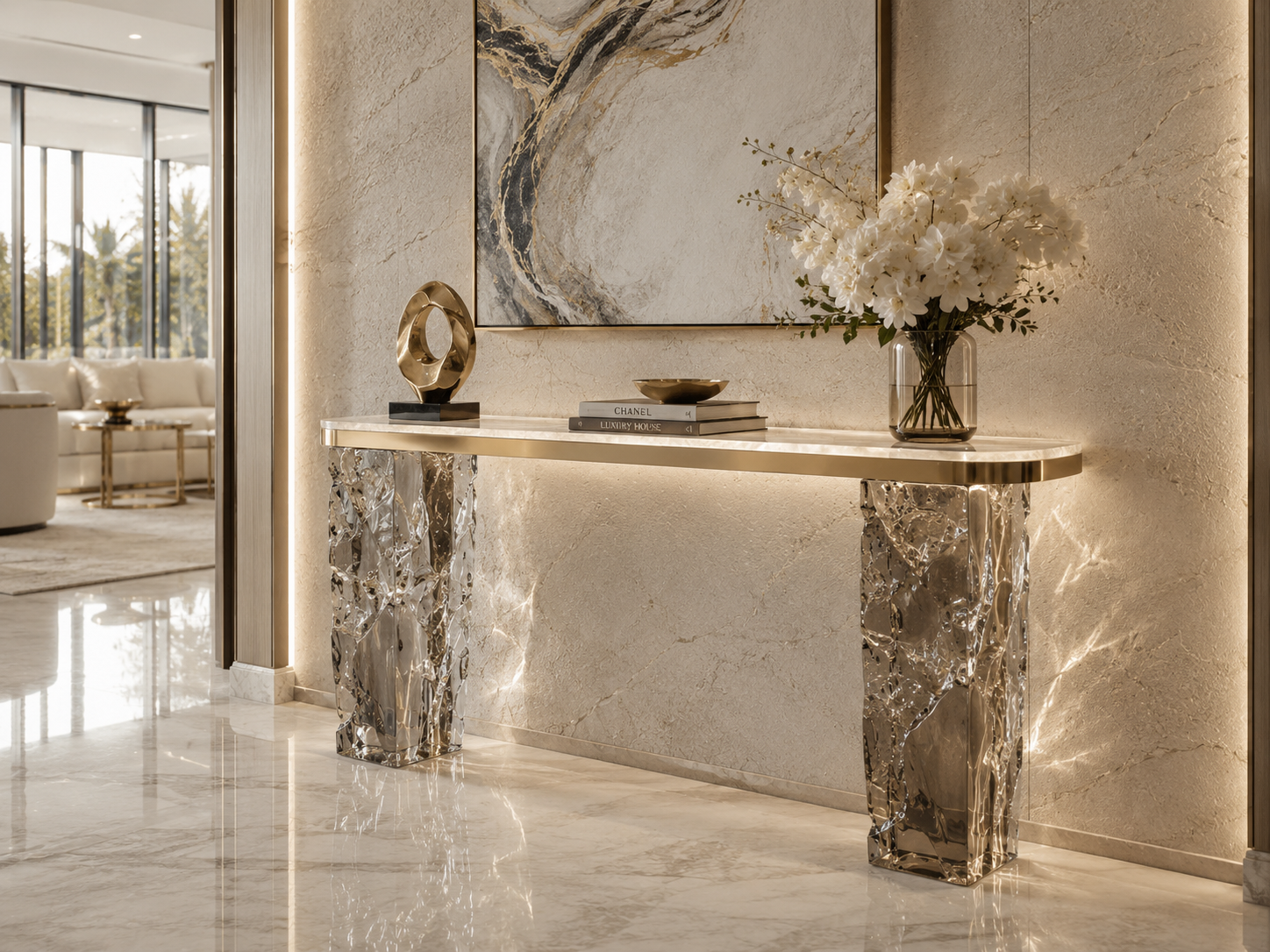
Natural stone is one of the most common premium materials in villa projects and one of the easiest ways to create a visual memory point. Marble, travertine, luxury stone, limestone, and other materials are often used in key areas such as living room feature walls, entrance focal points, staircase steps, island countertops, and bathroom spaces because their natural textures are unique and impossible to replicate.
In villa spaces, the greatest advantage of stone is its ability to quickly establish spatial presence. Especially when used on a large scale, natural veining creates strong visual tension, making the space appear more open, stable, and refined.
However, stone does not become more luxurious simply because it is used in larger quantities. Many projects look overly extravagant because highly contrasting stone textures are overused, resulting in excessive visual information. A more professional approach is to control where stone appears according to the hierarchy of the space. For example, the entrance feature wall can use stone with stronger veining as the first visual focal point, while the living room background wall can use stone with softer patterns and more stable colors to avoid creating a sense of pressure.
The premium quality of stone is also reflected in detail processing. Book-matching, pattern alignment, continuous corner treatment, edge finishing, and chamfering all affect the final result. For example, if the veining of a background wall flows naturally and continuously, the visual effect will be more complete. If the corner treatment is rough, even expensive material will lose its sense of quality.
Surface treatment is equally important. Polished stone can create a more luxurious feeling, but it can also appear too showy. Matte, terrazzo-like, grooved, bush-hammered, and other surface treatments are better suited to the restrained, natural, and premium expression of modern villas. When stone is combined with wood veneer, metal lines, and lighting systems, it creates even richer layers.
3. Wood Veneer and Millwork Systems: Bringing Warmth and Order to Villa Spaces
If stone is responsible for establishing spatial presence, wood veneer is responsible for creating warmth and order. A high-end villa space should not only have a cold visual impact; it should also offer a comfortable, stable, and timeless living atmosphere. Wood is one of the best materials for achieving this purpose.
Walnut, oak, teak, smoked veneer, and other wood materials vary greatly in tone, grain, and character. Dark walnut is more suitable for calm and elegant spaces. Light oak is ideal for natural and minimalist modern residences. Smoked veneer can bring a stronger sense of design and artistic quality.
In villa projects, wood veneer should not be understood merely as wall decoration. It should be considered as a complete system. Walls, invisible doors, cabinets, ceilings, staircases, and wall panels can all be connected through a unified millwork language, making the space more complete and more customized.
Millwork design places high demands on proportion and detail. The direction of wood grain, panel divisions, door gaps, cabinet edging, and skirting details all influence the final sense of refinement. For example, if the panel divisions on a wood veneer wall are too dense, the space may appear fragmented. If the proportions are too large, the design may lack delicacy. A professional approach is to design based on ceiling height, wall scale, and furniture proportions.
Wood veneer can also create strong memorable features when combined with other materials. Wood paired with stone can balance warm and cool tones. Wood paired with metal can enhance refinement. Wood combined with acrylic or glass can add a sense of lightness to a warm space.
4. Metal Details: Enhancing Refinement Through Lines and Sheen
Metal is usually not the main material in villa interiors, but it often determines whether a space feels refined. Many premium projects look clean, sharp, and high-quality because of carefully controlled metal lines, metal trims, and hardware details.
Common metal materials include stainless steel, brass, antique bronze, titanium gold, and black titanium. Different metals create different atmospheres. Brass feels warm and is suitable for light luxury and vintage-style spaces. Black titanium is more modern and restrained, making it suitable for minimalist or contemporary interiors. Antique bronze has a stronger sense of history and is appropriate for spaces that emphasize artistic character.
Metal can be used in wall inlays, door frames, cabinet handles, staircase handrails, skirting boards, screens, and lighting frames. Its role is not to dominate the visual center, but to create delicate linear relationships within the space and add depth to material transitions.
It is important to avoid overusing metal details. If every wall, cabinet, and joint is decorated with metal lines, the space may appear cheap and overly complicated. In high-end villas, metal design emphasizes restraint: it should appear precisely where needed and remain absent where cleanliness is more important.
In terms of surface effect, matte metal is usually more suitable for high-end residences than highly polished metal. Highly reflective metal can look commercial, while matte metal has a softer sheen, is more timeless, and integrates more easily with stone, wood, leather, and other materials.
5. Glass and Acrylic Materials: Creating Lightness, Transparency, and Modernity
In villa projects, glass and acrylic are often used to create transparency, lightness, and a modern atmosphere. Compared with the heaviness of stone and wood, transparent materials can soften spatial boundaries, open up the visual field, and give local design details a more artistic quality.
Glass is widely used in villa interiors, including ultra-clear glass, fluted glass, wired glass, and artistic glass. Ultra-clear glass is suitable for display cabinets, wine cellars, walk-in closets, and other spaces that require clear presentation. Fluted glass has a soft, blurred effect and is suitable for partitions, door panels, and bathroom areas. Artistic glass can be used as a feature element or background to enhance decoration.
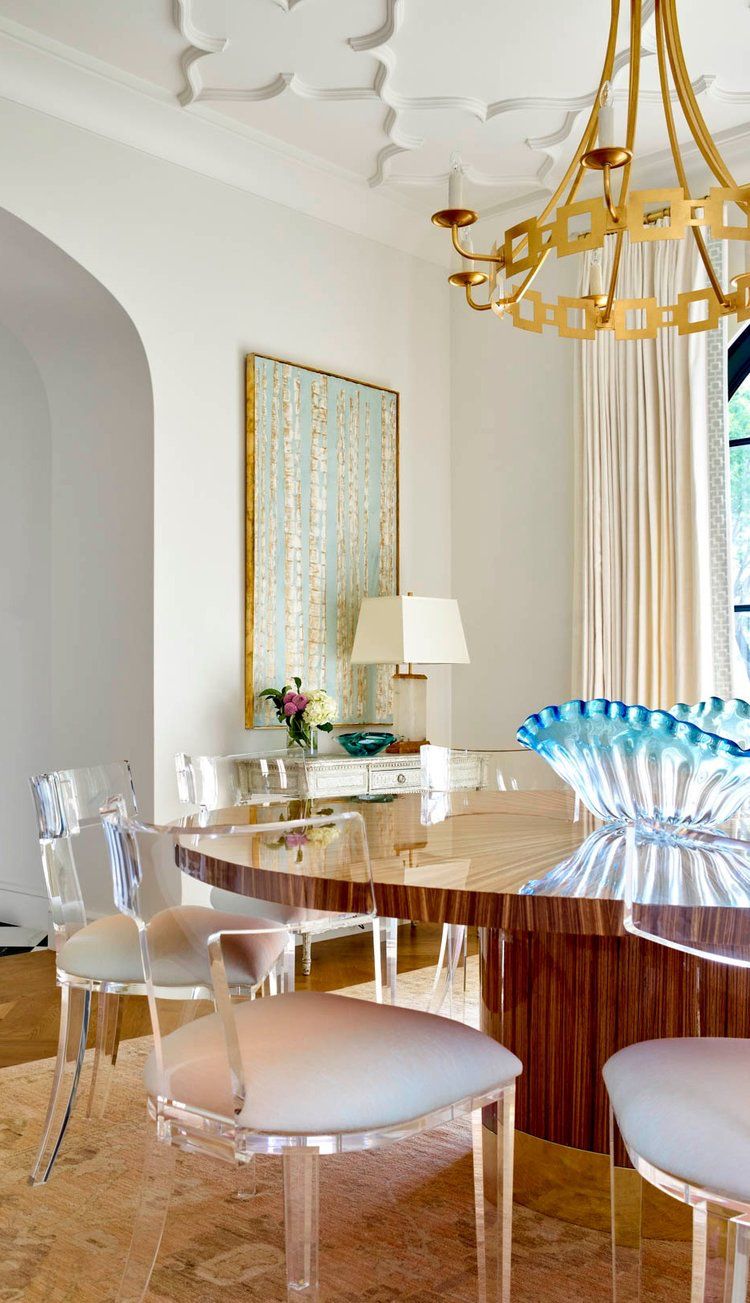
Acrylic is also becoming increasingly common in modern villa projects. High-quality acrylic offers excellent transparency, flexibility, and visual lightness. It can be used to make acrylic furniture, acrylic display stands, acrylic staircase handrails, acrylic decorative pieces, and more. It can blend into modern spaces while also serving as a local highlight, adding fashion and recognition to the interior.
For example, in a villa living room, a transparent acrylic coffee table can reduce visual weight and make the space feel more open. In an art display area, an acrylic display stand can highlight the collection itself without overwhelming it. In a walk-in closet or wine cellar, acrylic combined with lighting can create a highly refined display effect.
Glass and acrylic are especially suitable for use with lighting. Linear lights, backlighting, shelf lights, and spotlights can emphasize the edge definition and three-dimensional quality of transparent materials, allowing them to present different effects at different times of day. These details are highly suitable as memorable features in villa projects.
6. Leather, Fabrics, and Upholstery: Enhancing the Tactile Layers of Villa Spaces
A premium villa space should not only focus on visual appeal; it should also consider touch and comfort. The value of leather, fabrics, and upholstered materials lies in their ability to make a space more comfortable, quieter, and more private.
Soft materials are especially important in bedrooms, studies, home theaters, and walk-in closets. Genuine leather, synthetic leather, suede, wool, linen, and high-end fabrics can be used for headboard backgrounds, upholstered wall panels, cabinet door finishes, sofas, lounge chairs, curtains, and cushions.
Leather brings a mature and stable texture. When used on headboard backgrounds or cabinet doors, it can make the space feel more customized. Fabric materials are softer and more suitable for creating a relaxed and comfortable living atmosphere. Suede and velvet-like materials have a delicate touch and are suitable for partial use to enrich spatial layers.
Color selection is also crucial for upholstered materials. In high-end villas, large areas of overly bright colors are not recommended, as such colors can easily become outdated and may disrupt the stability of the space. Low-saturation tones such as beige, gray, coffee brown, smoky pink, olive green, and deep blue are more timeless and easier to combine with stone, wood veneer, and metal.
In terms of material combinations, leather paired with wood veneer can increase warmth. Leather paired with metal lines can enhance refinement. Fabrics paired with stone can balance hardness and softness, making the space more suitable for long-term living.
7. Practical Suggestions for Villa Material Implementation: Premium Quality Comes From Systematic Coordination, Not Material Stacking
To create truly memorable features in a villa project, one should not rely solely on a single expensive material. Instead, it is necessary to build a complete material system. The relationship between materials is more important than the materials themselves.
First, the main material direction should be determined according to the overall villa style. A modern style can combine stone, wood veneer, metal, acrylic, and glass. A French or vintage style can use more natural stone, brass, woodwork, and fabrics. A minimalist style places greater emphasis on material proportion, texture, and the precision of details.
Second, the number of main materials should be controlled. If too many materials appear in one space, the visual effect will become chaotic. It is generally recommended to define one or two main materials and use supporting materials to create additional layers. For example, a living room can use stone and wood veneer as the main materials, metal as a finishing detail, and acrylic furniture as a light visual accent.
Third, craftsmanship at the joints should be taken seriously. Much of the premium feeling comes from finishing details rather than material prices. How the wall meets the floor, how cabinets transition into walls, how stone corners are handled, whether metal lines are straight, and whether lighting is naturally concealed all directly affect the quality of the space.
Fourth, each core space should have one visual focal point. The entrance can feature a stone wall, the living room can feature acrylic furniture or an artistic background, the dining room can highlight a stone island, the staircase area can emphasize metal handrails and lighting, and the master bedroom can use a leather upholstered background. A space does not need too many focal points, but the focal point must be clear.
Finally, memorable material details must serve the lifestyle of the residents. A villa is not a showroom; it is a space for long-term living. Material selection should not only be beautiful, but also consider durability, cleaning, maintenance, safety, and comfort. Only when visual beauty, craftsmanship, and practical experience are unified can the space truly achieve premium value.
Conclusion
The memorable features of a villa project are not created by stacking expensive materials. They are formed through the spatial presence of natural stone, the warmth of wood veneer, the refinement of metal details, the transparency of glass and acrylic, and the tactile comfort of leather and fabrics.
Professional material design means finding balance within the overall spatial logic: creating visual focus while maintaining living comfort; using premium materials while respecting craftsmanship; satisfying aesthetic expression while standing the test of long-term use.
For owners, designers, and custom brands who want to create high-end villa projects, materials should not be treated as the final decorative step. They are an essential part of spatial value. Only by integrating materials, proportion, light, shadow, craftsmanship, and lifestyle can a villa space develop truly distinctive and memorable features.
Contact
LinkedIn: https://www.linkedin.com/in/adtender-zyra/?locale=zh_CN
Facebook: https://www.facebook.com/profile.php?id=61586259131631
Instagram: https://www.instagram.com/zzzzyyrraa4/
YouTube: https://www.youtube.com/@ZZZZyra-k7w
Office: (904) 258-3290
WhatsApp/Wechat: +86 18923188839


