Introduction: The New Luxury Is Controlled Simplicity
In modern high-end interior design, a clear shift is taking place. Luxury is no longer defined by how much a space contains, but by how intelligently it is composed.
The most successful interiors today are not the most decorated ones. They are the most restrained. Spaces that feel intentional, calm, and visually “uncluttered” tend to create a stronger emotional impression than those filled with multiple competing design elements.
In this context, synthetic crystal furniture has become a powerful design tool. Not because it fills space, but because it defines it. Its transparency, light interaction, and visual lightness allow it to act as a focal anchor without creating visual noise.
The real challenge is no longer how to decorate a space, but how to create a single strong visual moment without overcrowding everything around it.
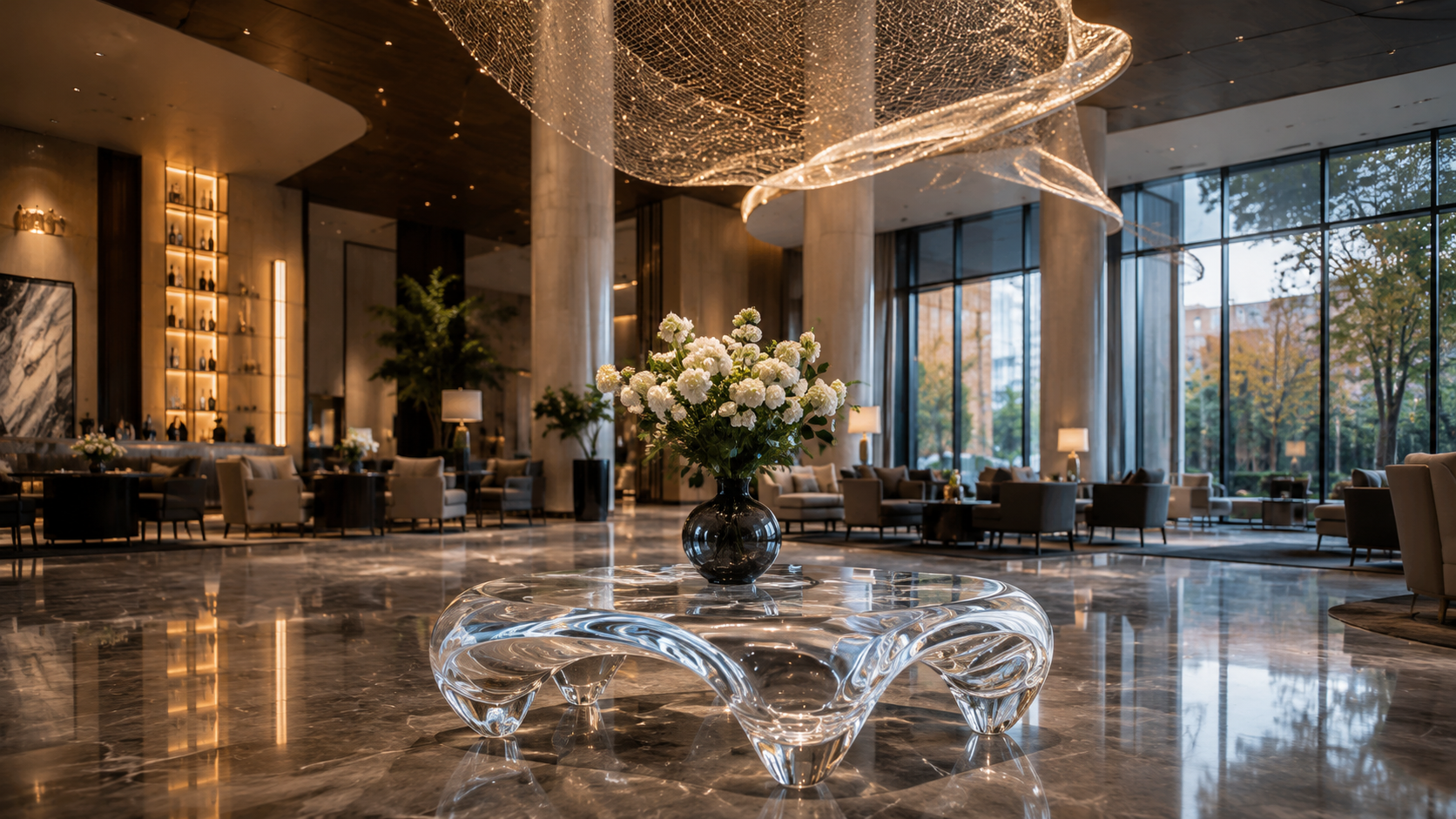
1. Industry Insight: Why Focal Point Design Is Becoming the Core of Luxury Interiors
Across luxury hotels, private villas, high-end retail environments, and premium office spaces, a clear design philosophy has emerged: every space needs a focal point, but only one.
This shift is driven by a growing appreciation for “controlled visual hierarchy.” Instead of distributing attention across multiple decorative elements, designers are now intentionally guiding the eye toward a single dominant object or zone.
Synthetic crystal pieces fit naturally into this approach because they behave differently from traditional materials. They do not block visual flow or occupy heavy physical presence. Instead, they interact with light, reflection, and transparency, allowing them to stand out without visually compressing the space.
A crystal console table, sculpture, or centerpiece can become the entire emotional anchor of a room—while everything else remains quiet and supportive.
This is why focal point design is no longer about adding more elements. It is about selecting one that carries the entire visual responsibility.
2. Five Key Trends Driving Minimalist Focal Point Design
The rise of single-focus spatial design is not accidental. It is supported by several global shifts in luxury aesthetics and user behavior.
1. Single-Focal Design Is Becoming the Standard
Instead of multiple decorative highlights, designers now concentrate visual attention into one controlled point.
2. The Value of Negative Space Is Increasing
Empty space is no longer seen as unfinished. It is now understood as part of the composition.
3. Transparent Materials Are Enhancing Layered Perception
Synthetic crystal allows objects to exist visually without blocking background depth.
4. Light and Shadow Have Become Design Language
Lighting is no longer functional only—it is part of the composition strategy that defines focus.
5. “Less Is More” Has Become a Structural Design Principle
Minimalism is no longer aesthetic preference. It is a functional approach to controlling visual clarity.
These trends collectively support a design environment where one well-placed crystal piece can define an entire space.
3. Changing Client Expectations: Memory Without Complexity
High-end clients today—whether hotel developers, villa owners, or commercial space operators—are becoming more refined in what they expect from interior environments.
They no longer want spaces that feel visually overwhelming or overly decorative. Instead, they are looking for environments that are:
Immediately recognizable
Visually calm and controlled
Easy to remember without being complex
Photogenic without being crowded
Emotionally impactful without excessive detail
This is where synthetic crystal furniture plays a unique role.
Because of its transparency and light interaction, it creates a “visual anchor” that does not compete with the space—it organizes it.
A single crystal installation can become the defining memory point of an entire environment, even when everything else remains minimal.
4. Ten Key Design Challenges When Creating a Strong Focal Point
Creating a focal point with synthetic crystal is not simply about placing an object in a room. It requires careful control over multiple design variables:
1. Visual Center Control
Ensuring the eye naturally lands on the intended object without distraction.
2. Spatial Proportion Balance
The focal piece must be strong enough to dominate without overwhelming the room.
3. Lighting Distribution Strategy
Light must enhance the object without creating glare or overexposure.
4. Transparency vs. Solid Contrast
Balancing invisible structure with visible impact.
5. Furniture Scale Calibration
Oversized pieces destroy elegance; undersized pieces lose authority.
6. Background Visual Noise Control
Walls, flooring, and surrounding elements must remain visually quiet.
7. Circulation Flow Alignment
The focal point must align with how people move through the space.
8. Photography and Visual Capture Quality
Modern luxury spaces must perform well in visual media, not just in person.
9. Brand Expression Consistency
In commercial spaces, focal design must reflect brand identity without clutter.
10. Long-Term Visual Stability
The focal point must remain strong even as lighting and usage conditions change over time.
Each of these challenges determines whether a focal point feels intentional or accidental.
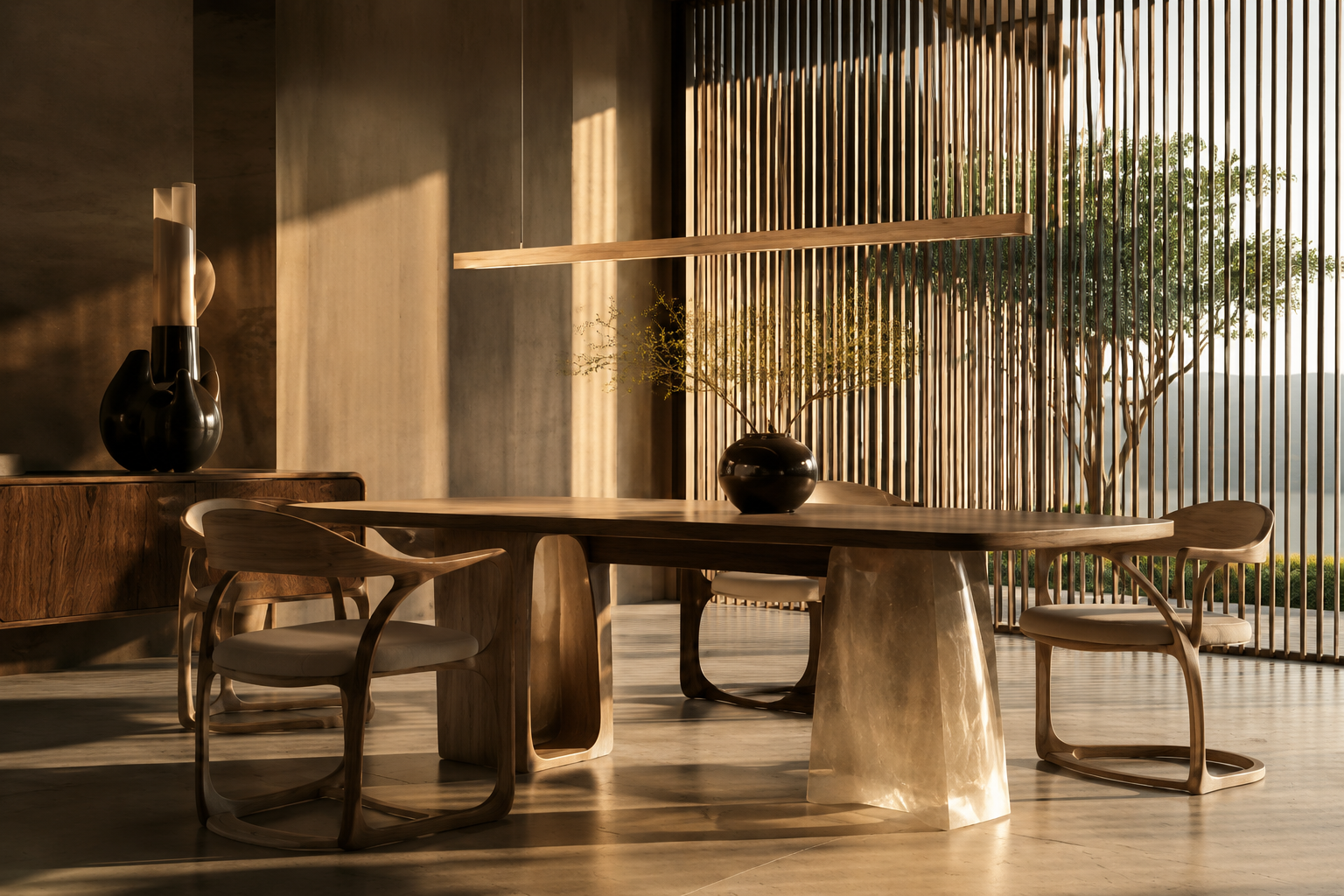
5. Material Evolution: From Decorative Object to Spatial Anchor
Traditionally, decorative furniture was used to “fill” space. Its purpose was additive—more objects meant more richness.
Synthetic crystal changes this logic completely.
Instead of filling space, it defines spatial hierarchy.
Because of its optical properties, it does not behave like traditional materials such as wood or stone. It does not block vision or dominate physically. Instead, it allows light and background elements to remain visible while still asserting presence.
This makes it ideal for focal point design, where the goal is not to occupy space, but to organize it visually.
In modern high-end interiors, synthetic crystal is increasingly treated as a “visual anchor material” rather than a decorative surface.
It holds attention without creating density.
6. How to Design a Strong Focal Point Without Visual Overcrowding
Creating a successful focal point using synthetic crystal requires a disciplined approach to spatial composition.
The first principle is singularity. Only one focal point should exist in a controlled visual field. Multiple competing highlights weaken the overall impact and create visual confusion.
The second principle is contrast through restraint. The surrounding environment must remain visually quiet. Neutral tones, simple geometry, and minimal decorative interference allow the crystal piece to stand out naturally.
The third principle is lighting precision. Light should be used to reveal the material’s transparency and depth, not to overpower it. Over-lighting destroys subtlety, while under-lighting reduces presence.
The fourth principle is spatial breathing room. The focal object must have enough negative space around it to establish visual authority. Crowding eliminates hierarchy.
The fifth principle is directional positioning. Placement matters more than size. A well-positioned crystal piece at an entry axis or central sightline will always outperform a larger object placed without spatial intention.
7. Strategic Placement: Where Synthetic Crystal Works Best
In practical applications, synthetic crystal focal pieces perform best in specific spatial zones:
In entrance areas, a single crystal console or sculptural piece can define the first impression of the entire space. It sets the tone immediately without requiring additional decoration.
In living room centers, a crystal coffee table or art piece can act as a silent visual anchor, organizing seating and circulation around it.
In display or gallery zones, a single illuminated crystal installation can guide attention more effectively than multiple competing objects.
At the end of visual corridors or architectural sightlines, crystal pieces function as destination markers, naturally pulling the eye forward and completing spatial composition.
In all cases, the principle remains the same: one strong element, carefully supported by visual silence around it.
Conclusion: True Luxury Spaces Are Not Filled, They Are Focused
The most successful modern interiors are not defined by complexity, but by clarity of intention. When a space is overcrowded, no single element has the power to define it. But when everything is reduced to support a single focal point, that one element gains emotional and visual strength far beyond its physical size.
Synthetic crystal furniture fits perfectly into this design philosophy because it does not demand attention through mass or volume. Instead, it earns attention through light, transparency, and spatial intelligence.
And as more designers move toward controlled minimalism, the ability to create one perfect focal point will become more valuable than ever—but the real challenge begins when you realize that the most powerful focal point is often the one that quietly changes the entire perception of the space without revealing everything it is capable of doing just yet…


