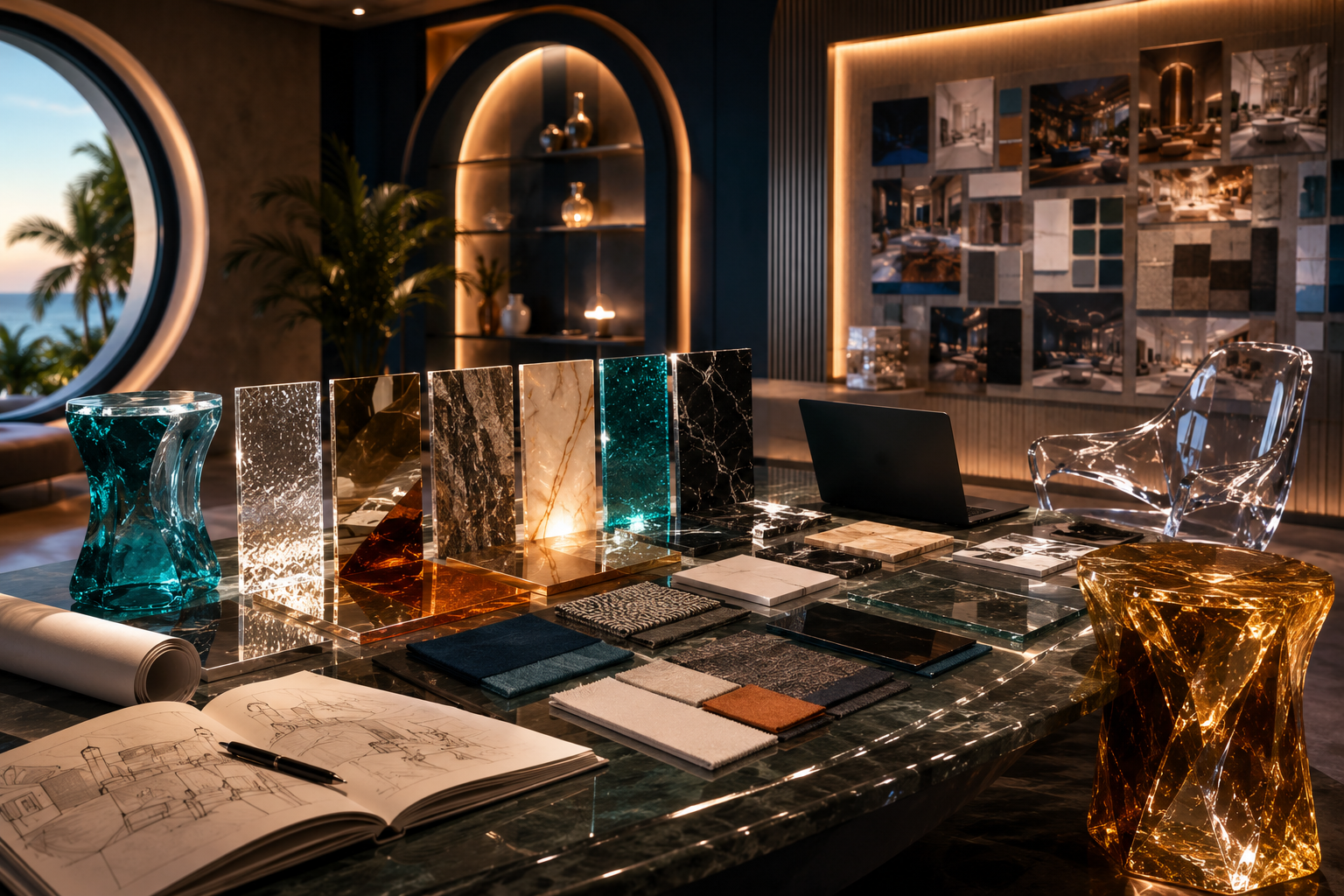
Luxury resort design is no longer defined only by expensive finishes, decorative complexity, or the number of premium materials used in a space.
Across international hospitality projects, the focus is shifting from luxury decoration to immersive destination experience. Guests expect a resort to offer more than a beautiful room. They want to feel removed from daily life, emotionally connected to the surrounding environment, and immersed in a place that could not be easily reproduced elsewhere.
This change has made material selection far more strategic.
Materials influence how guests perceive light, temperature, openness, privacy, comfort, and connection with nature. They affect whether a lobby feels calm or theatrical, whether a restaurant feels intimate or generic, and whether a villa feels genuinely connected to its location.
For resort developers, hotel design companies, and international architectural firms, the question is no longer simply whether a material looks luxurious.
The more important questions are practical and experiential:
Can the material help define the destination?
Will it perform under the project’s lighting and environmental conditions?
Can it be customized without creating unnecessary engineering risk?
Can it be packed, shipped, installed, maintained, and replaced efficiently?
Will guests remember it after they leave?
Transparent, translucent, light responsive, and naturally textured materials are becoming increasingly relevant because they can create strong visual identity without making a space feel heavy.
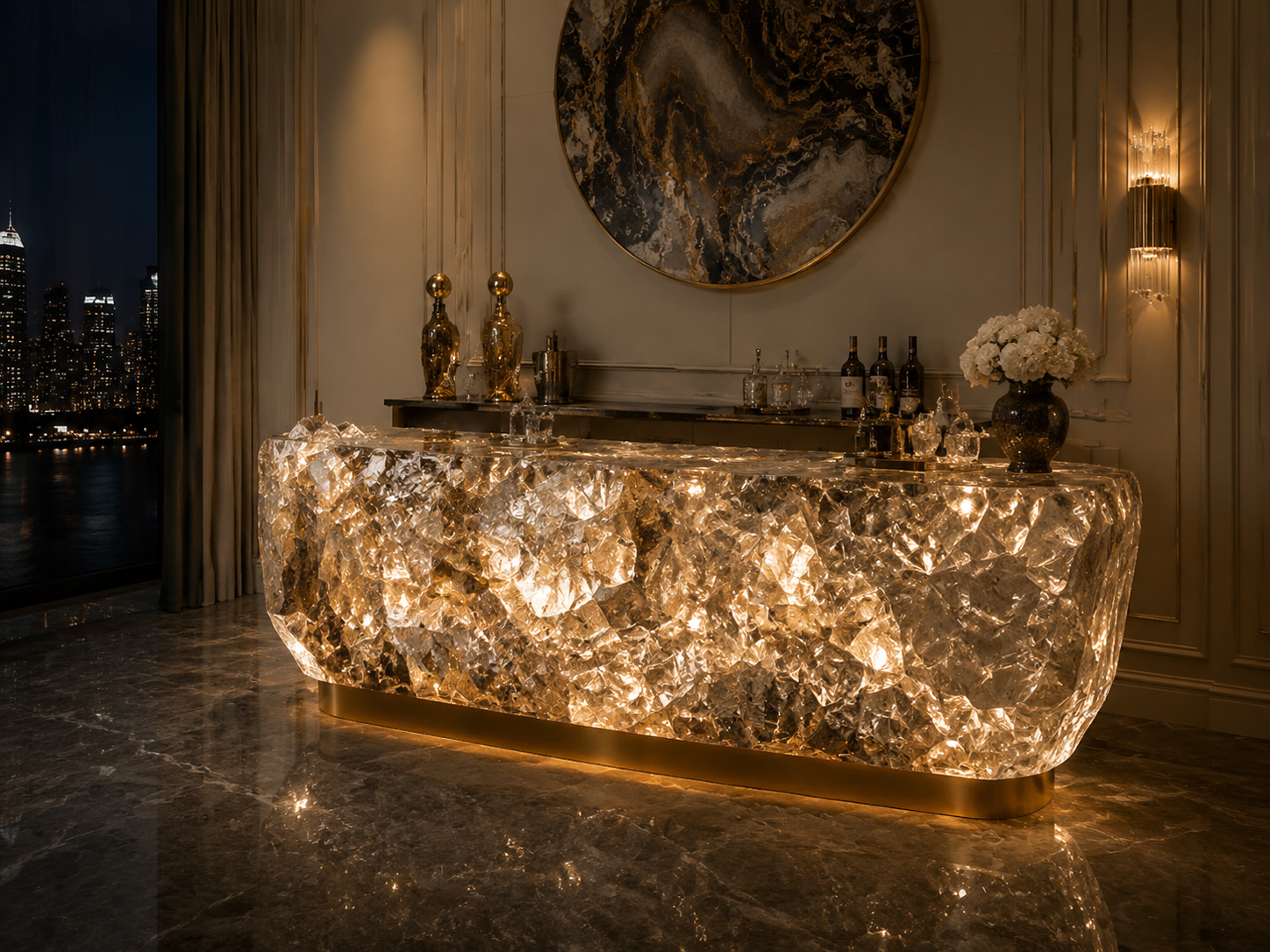
Among these materials, high end synthetic crystal offers an unusual combination of visual clarity, sculptural freedom, color customization, and integration potential. It can be developed into reception counters, feature tables, bar fronts, consoles, side tables, benches, decorative panels, lighting elements, and large art installations.
However, successful application depends on more than selecting an attractive sample.
Synthetic crystal furniture must be evaluated as part of a complete project system involving architecture, lighting, structural support, transportation, installation, daily maintenance, and long term hotel operations.
Resort Design Is Moving from Appearance to Experience
Traditional luxury interiors often communicated value through visible material cost. Imported marble, rare timber, polished brass, oversized lighting fixtures, and highly decorative furniture were used to create an immediate impression of prestige.
These elements still have a place in hospitality design, but international travelers have become more sensitive to authenticity and atmosphere.
A resort may contain expensive materials and still feel interchangeable with properties in other countries. By contrast, a carefully designed resort using a more controlled material palette can feel highly distinctive when the architecture, furniture, lighting, and landscape support one clear destination story.
A coastal resort, for example, may use translucent furniture to reflect the changing tones of the sea. A tropical retreat may combine synthetic crystal with natural timber, woven surfaces, and planting. A desert resort may use warm amber or smoke colored crystal pieces to respond to sunlight and mineral tones. A mountain property may pair transparent furniture with stone and textured wood to balance visual lightness with warmth.
The objective is not to create a literal imitation of nature.
The objective is to translate the atmosphere of the destination into material, color, form, and light.
This is where synthetic crystal can offer value. Unlike conventional opaque furniture, it can preserve sightlines, capture daylight, reflect surrounding colors, and change in appearance from morning to evening.
A piece may look almost weightless during the day, become warmer at sunset, and transform into a luminous visual feature under carefully planned evening lighting.
That changeability allows one piece of furniture to contribute to several moments within the guest journey.
Five Changes Influencing Material Selection in Overseas Resort Projects
1. Experiential Design Is Replacing Decorative Luxury
Modern resort guests do not remember every finish specification. They remember moments.
They remember the first view from the arrival lobby, the table beside the infinity pool, the atmosphere of the bar after sunset, the privacy of the spa, and the unexpected object that made the resort feel different from anywhere else.
Materials must therefore support a sequence of experiences rather than simply decorate individual rooms.
In a lobby, a custom synthetic crystal reception desk may establish the first visual identity of the property. In a restaurant, translucent tables may preserve the ocean view while creating a more distinctive dining environment. In a spa, softly frosted surfaces may introduce visual calm. In a villa, a sculptural side table may provide individuality without overwhelming the interior.
The value lies in how the material performs within each specific experience.
Project Insight
A transparent material should not automatically be specified at its highest level of clarity. In highly exposed arrival areas, completely clear surfaces may create excessive reflection, reveal fingerprints more easily, or compete with the view behind them.
A lightly tinted or softly frosted finish can often provide a stronger balance between transparency, visual comfort, and daily maintenance.
The best option is usually determined through mock-up review rather than from a small sample alone.
2. Nature and Luxury Are Becoming More Closely Connected
Resort guests increasingly expect luxury to feel natural, calm, and appropriate to the environment.
This has encouraged designers to combine refined contemporary materials with stone, timber, plants, water, woven textures, handmade surfaces, and local craft references.
Synthetic crystal can be effective in this context because it creates contrast without necessarily creating conflict.
When placed beside natural stone, its clarity highlights the stone’s weight and texture. When combined with timber, it can make the timber feel warmer. Near water, it can reflect movement and light. With brushed metal, it can create a more architectural and precise expression.
The material should not be treated as a replacement for natural finishes. Its strongest role is often to create a controlled contrast between transparency and solidity, contemporary form and natural texture, visual lightness and physical presence.
Engineering Note
When synthetic crystal is combined with stone, metal, or timber, the connection detail should be reviewed early.
Different materials behave differently during production, transport, installation, and temperature changes. Hidden fixing systems, support frames, expansion allowances, adhesive selection, and weight distribution should be coordinated before the final form is approved.
A visually simple table may require a carefully engineered internal structure to remain stable and serviceable.
3. Transparent Materials Are Being Used More Strategically
Transparency has become an important design language in hospitality because it allows furniture and installations to occupy space without completely blocking it.
This is especially valuable in resorts where the landscape is a primary asset.
Oceanfront restaurants, cliffside lounges, forest retreats, and mountain properties depend on uninterrupted views. Large opaque furniture can reduce that connection and make public areas feel heavier than intended.
Synthetic crystal tables, counters, consoles, benches, and partitions can preserve visual continuity while still providing a clear functional presence.
However, transparency must be controlled carefully.
A completely clear piece placed against a visually complex background may lose definition. A slightly tinted piece may be more visible and photograph better. A frosted finish may feel softer and reduce the visibility of fingerprints. A thicker section may create stronger optical depth, while thinner elements may appear more minimal.
Client Question
“Can the final color be approved from a small sample?”
A small sample is useful for early comparison, but it may not accurately represent a large finished piece. Color often appears stronger when material thickness increases, and the surrounding floor, wall, lighting temperature, and daylight exposure can change the final perception.
For important resort furniture, larger samples or a partial full-size mock-up provide more reliable approval.
4. Artistic Furniture Is Becoming Part of Resort Branding
Furniture in luxury hospitality is increasingly expected to perform more than one function.
A successful feature piece may act as furniture, sculpture, wayfinding element, social media landmark, and brand identifier at the same time.
This is especially relevant in lobbies, signature restaurants, pool lounges, private villas, and destination bars.
Synthetic crystal can be shaped into forms inspired by waves, coral, minerals, ice, clouds, tropical plants, or local architectural geometry. It can also be combined with lighting, metal, stone, or timber to create a more project-specific result.
The objective should not be to make every piece dramatic.
If too many objects compete for attention, the resort loses visual hierarchy. A more effective strategy is to identify a limited number of high-value locations where custom synthetic crystal furniture can create a memorable focal point.
These may include the main reception desk, a central lobby table, a private dining table, an illuminated pool bar, or a sculptural installation at the transition between indoor and outdoor spaces.
Project Insight
One common design mistake is selecting a statement material before deciding where the guest’s attention should be directed.
A feature table may look impressive in isolation but become visually ineffective if placed beneath an oversized chandelier, in front of a highly patterned wall, and beside several other sculptural objects.
The material performs best when the surrounding space allows it to become the intended focus.
5. Shareable Spaces Are Now Part of Commercial Strategy
Hospitality interiors are increasingly designed with photography and digital visibility in mind.
Guests naturally share spaces that feel unusual, emotionally engaging, or visually distinctive. A reception counter, sunset lounge, translucent dining table, illuminated bar, or sculptural bench can become part of the property’s organic marketing.
This does not mean every area should be designed as a social media backdrop.
Highly theatrical spaces may attract attention initially but can quickly feel outdated. The strongest shareable environments are usually those where architecture, material, light, and landscape already work together naturally.
Synthetic crystal can contribute because it changes according to viewing angle, light direction, time of day, and surrounding color.
A piece may appear clear in the morning, reflect blue tones at midday, capture warm sunset light in the evening, and become internally luminous at night.
That visual variation gives guests more than one reason to notice and photograph the same location.
.png)
What Resort Developers and Design Firms Actually Need to Know
Resort developers, hospitality designers, and architectural firms are becoming more cautious about specifying unfamiliar or highly customized materials.
A striking rendering is not enough.
During design development and procurement, practical questions usually become more important than broad claims about beauty or luxury.
Clients want to know:
Can the product be manufactured at the required scale?
Can several pieces maintain acceptable color consistency?
How will the structure be supported?
Will joints remain visible?
Can lighting be integrated without creating hot spots?
Can the piece fit through doors, elevators, or site access routes?
How will it be packed for international shipment?
Can damaged sections be repaired or replaced later?
What cleaning methods should hotel staff use?
These questions often determine whether a material remains in the final specification.
Synthetic crystal should therefore be presented not only as an artistic material but as a complete project solution.
From Concept to Installation: A Practical Development Process
Custom resort furniture usually requires several stages of verification.
The exact sequence depends on the scale and complexity of the piece, but a structured process may include:
Concept review
Material and color selection
Small sample approval
Scaled prototype
Structural and lighting coordination
Partial or full-size mock-up
Factory inspection
Packing simulation
International shipment planning
Site installation
Maintenance guidance
Each stage solves a different type of risk.
A color sample helps evaluate tone and transparency. A scaled prototype helps verify proportion and form. A full-size mock-up helps identify issues involving ergonomics, thickness, joints, lighting, and visual weight. Packing simulation helps determine whether the product can be protected and loaded safely. Installation planning helps avoid problems when the product reaches site.
Skipping these stages may reduce initial development time, but it can increase the risk of expensive modifications later.
Sample Review
The first sample stage should compare more than color.
Design teams should review transparency, internal texture, surface gloss, edge finish, thickness, background interaction, and lighting response.
Whenever possible, samples should be evaluated against the actual or proposed surrounding materials.
A pale blue sample may appear elegant against warm stone but overly cold against gray flooring. A clear sample may look refined under soft interior lighting but produce unwanted glare beside a west-facing façade.
Scaled Prototype
A scaled prototype is useful for complex or sculptural pieces.
It allows the design team to evaluate proportion, geometry, balance, and relationship with other furniture before committing to full-size production.
However, a small model cannot fully predict optical depth or final color intensity. It should be used for form evaluation rather than as the only basis for material approval.
Full-Size Mock-Up
For important reception desks, large tables, bar counters, or sculptural installations, a full-size mock-up provides the most reliable review.
The mock-up can reveal whether the height is comfortable, whether the internal structure is visible, whether lighting appears even, whether joints are positioned correctly, and whether the piece feels too light or too dominant within the space.
It also gives the hotel operator an opportunity to review practical issues such as cleaning access, cable management, storage, and guest circulation.
Engineering Note
Lighting should be tested using the project’s intended color temperature whenever possible.
A synthetic crystal finish can look significantly different under 2700K, 3000K, and 4000K lighting. The distance between the light source and material, diffusion method, internal structure, and surrounding finishes will also affect the result.
Lighting approval should not rely only on digital renderings.
Lessons That Improve Synthetic Crystal Furniture Applications
Higher Transparency Is Not Always Better
Completely transparent surfaces can appear elegant in controlled conditions, but they may reveal fingerprints, dust, internal fixings, cables, and background clutter more easily.
In restaurants, bars, and reception areas, a lightly frosted or tinted finish may be more practical.
The correct transparency level depends on use, lighting, cleaning frequency, and the visual character of the space.
Large Pieces Should Be Designed Around Transportation Limits
Oversized reception counters and feature tables are rarely shipped internationally as one complete unit.
Even when one-piece production is technically possible, site access, container dimensions, weight restrictions, elevators, doorways, and installation routes may make modular construction necessary.
The most effective approach is to determine module divisions during the design stage.
Joints can often be positioned beneath lighting grooves, within shadow gaps, behind structural features, or at natural changes in geometry.
When modularization is considered early, the final piece can still preserve a monolithic appearance.
Structure Should Be Coordinated Before Form Is Finalized
A visually light piece may still require substantial support.
Long spans, cantilevered sections, heavy tops, integrated lighting, and guest interaction all influence structural requirements.
If engineering is introduced too late, the final product may require visible supports that were not included in the original design.
Early coordination between the designer, manufacturer, structural consultant, and installer reduces this risk.
Maintenance Must Be Considered During Specification
Hotel furniture is cleaned frequently and used by many guests.
The specification should consider how easily a surface shows fingerprints, dust, scratches, water marks, food residue, sunscreen, and cleaning products.
Hotel staff should receive clear instructions regarding approved cleaning methods, suitable cloths, prohibited chemicals, and procedures for minor surface care.
A material is not truly suitable for hospitality simply because it looks good at installation.
It must remain practical during daily operation.
Replacement Planning Creates Long-Term Value
For customized resort furniture, long-term maintenance should include documentation.
Color references, production drawings, module sizes, connection details, surface finish specifications, and installation photographs can all help if a component needs to be repaired or reproduced later.
This is particularly important for phased resort developments or properties that may renovate individual areas over time.
Ten Design Questions to Resolve Before Specification
1. How Will Natural Light Affect the Material?
Review the piece during morning, midday, and evening conditions whenever possible.
Pay particular attention to direct sunlight, reflected water light, glazing, and west-facing façades.
2. Is the Product Intended for Indoor, Semi-Outdoor, or Outdoor Use?
Environmental exposure should be clearly defined.
Humidity, salt air, ultraviolet exposure, rain, heat, and temperature variation may affect material selection, structure, finishes, and maintenance requirements.
Performance claims should be based on verified product information and the actual installation condition.
3. What Atmosphere Should the Space Create?
Clear finishes may feel open and precise. Frosted finishes may feel softer. Amber tones can create warmth. Blue and green tones may connect with water or vegetation. Smoke tones can add depth and sophistication.
The choice should support the emotional purpose of the area.
4. Where Is the Main Visual Focus?
Synthetic crystal should be placed where it contributes to the hierarchy of the space.
It may define the reception point, frame a view, mark a transition, or create a memorable social area.
5. How Will Color Interact with Surrounding Materials?
Color should be reviewed beside flooring, walls, stone, timber, textiles, and metal finishes.
A finish that appears balanced in isolation may look very different in the completed interior.
6. What Material Contrast Is Needed?
Synthetic crystal often works best when paired with materials that offer a different visual and tactile quality.
Stone adds weight. Timber adds warmth. Metal adds precision. Textiles add softness.
7. How Will Guests Use the Piece?
Consider touching, leaning, placing luggage, serving food, moving chairs, and cleaning.
Furniture should be designed around actual behavior rather than appearance alone.
8. How Will the Product Reach the Installation Area?
Review container dimensions, crate sizes, site access, loading restrictions, elevators, doorways, corridors, and lifting requirements before production.
9. Can the Product Be Maintained and Repaired?
The project team should understand cleaning requirements, surface care, repair possibilities, and replacement procedures.
10. What Long-Term Value Will the Piece Create?
A custom feature should contribute to more than immediate visual impact.
It may strengthen brand identity, support photography, define a premium area, improve guest memory, or remain relevant through future interior updates.
Applying Synthetic Crystal in Key Resort Areas
Hotel Lobby
The lobby is often the strongest location for a signature piece because it shapes the guest’s first impression.
Possible applications include reception counters, central tables, consoles, benches, decorative screens, and sculptural installations.
A large counter should be coordinated with lighting, cable management, staff storage, accessibility, guest circulation, and modular installation.
A central table should be reviewed in relation to ceiling features, flooring patterns, seating groups, and major sightlines.
CTA
Planning a resort arrival space? Share your lobby drawings, mood boards, preferred dimensions, and lighting concept for preliminary material and feasibility feedback before specification.
Pool Bar
Pool bars benefit from materials that respond to water, sunlight, and evening lighting.
Synthetic crystal can be used in bar fronts, cocktail tables, side tables, decorative panels, and illuminated features.
For semi-outdoor applications, environmental exposure, drainage, cleaning, structural support, and surface temperature should be reviewed carefully.
A visually attractive concept should not be approved until the intended installation conditions are clearly understood.
Ocean View Restaurant
Furniture in an ocean view restaurant should preserve the landscape rather than compete with it.
Transparent or translucent tables can reduce visual weight, while controlled color can reflect the sea or sunset.
Dining furniture must also meet practical requirements related to stability, chair clearance, service circulation, cleaning, and surface use.
In some restaurant applications, a lightly frosted finish may be more practical than completely clear material because it reduces the visibility of fingerprints and minor surface marks.
Spa and Wellness Area
Spa environments require a quieter material language.
Softly frosted synthetic crystal, smoke tones, warm amber, pale green, or subtle blue can be combined with timber, stone, linen, and indirect lighting.
Potential applications include reception counters, display units, side tables, decorative panels, and lighting features.
The material should support calmness rather than become visually overstimulating.
Private Villas and Suites
In villas, synthetic crystal furniture should feel residential, functional, and carefully proportioned.
Coffee tables, bedside tables, consoles, minibars, dining tables, and decorative objects can introduce individuality without making the room feel overly formal.
Customized pieces can also help distinguish premium villa categories and branded residences.
Transitional and Landscape Spaces
Covered walkways, corridors, garden lounges, and transition areas can provide opportunities for smaller moments of discovery.
A sculptural bench, illuminated marker, or transparent art object can support wayfinding and strengthen the guest journey between major spaces.
These applications should be selected carefully so that the resort remains visually coherent.
Frequently Asked Questions
Can Synthetic Crystal Be Used in Coastal Resort Projects?
It may be suitable for certain coastal applications, but the exact installation environment must be evaluated.
Indoor, covered semi-outdoor, and fully exposed outdoor conditions require different considerations. Humidity, salt air, direct sunlight, temperature, structural materials, and cleaning methods should all be reviewed before specification.
Will Synthetic Crystal Turn Yellow?
Color stability depends on the exact material formulation, production quality, exposure conditions, and verified technical performance.
Absolute claims such as “never yellows” should be avoided unless supported by appropriate testing and product documentation.
For projects with strong sunlight exposure, request relevant technical information and approve the finish based on the intended application.
Are Scratches Visible?
Visibility depends on color, gloss level, transparency, lighting, and use.
Highly polished clear surfaces may show marks more easily than frosted or lightly tinted finishes. Hospitality applications should be selected according to expected guest contact and cleaning frequency.
Can Minor Scratches Be Repaired?
Some surface marks may be reduced through professional refinishing, depending on depth, location, finish, and material construction.
Repair methods should be confirmed with the manufacturer rather than handled using unapproved chemicals or abrasive tools.
How Large Can One Seamless Piece Be?
The answer depends on design, thickness, weight, production capability, transport restrictions, and site access.
The largest manufacturable size is not always the most practical shipping or installation size.
For oversized furniture, modular construction may provide a safer and more efficient solution.
How Is Color Consistency Controlled?
Color consistency should be managed through approved samples, production references, batch planning, and quality inspection.
For projects requiring multiple matching pieces, production should be coordinated carefully, especially when pieces will be installed beside one another.
Can Lighting Be Integrated?
Yes, lighting can be integrated into many synthetic crystal applications, but the system must be coordinated with structure, heat management, cable access, diffusion, maintenance, and replacement.
Factory lighting tests are recommended for important feature pieces.
How Is the Furniture Packed for International Shipping?
Packing design should reflect the product’s weight, shape, surface sensitivity, lifting points, container loading method, and final installation sequence.
Customized crates, protective layers, reinforced supports, moisture protection, and clear handling instructions may be required.
Packing should be treated as part of engineering rather than as the final step after production.
Can Large Pieces Be Installed Without Visible Joints?
Joints can often be minimized or positioned discreetly, but the result depends on design geometry, module planning, lighting, surface treatment, and installation quality.
The most effective joint locations are usually determined during design development.
What Information Is Needed for an Initial Project Review?
Useful information includes concept drawings, renderings, mood boards, preferred dimensions, quantity, installation location, surrounding materials, lighting concept, expected environmental exposure, site access limitations, and target schedule.
This information allows the manufacturer to provide more meaningful feedback on material selection, structure, sampling, production, packing, and installation.
Building a More Reliable Inquiry and Specification Process
For designers and developers, the first step does not need to be a final quotation.
A more effective process begins with early feasibility review.
The project team can share concept drawings, mood boards, intended dimensions, application area, lighting references, and installation conditions. Based on this information, suitable synthetic crystal finishes, sample options, structural considerations, and potential risks can be discussed before the material enters the final specification.
The next step may be a physical sample or color board.
For more complex projects, a scaled prototype or partial mock-up may follow. Once the visual and technical direction is approved, production drawings, module divisions, packing strategy, and installation requirements can be coordinated.
This process helps reduce uncertainty for architects, interior designers, procurement teams, contractors, and hotel operators.
It also allows custom synthetic crystal furniture to be developed as part of the architecture rather than added as a decorative product at the end.
Creating a Distinctive Sense of Escape
The most memorable resorts are not always those that use the greatest number of premium materials.
They are the properties where every important material supports a clear emotional purpose.
Guests feel the destination through the way light enters the lobby, the way furniture frames the landscape, the way surfaces change at sunset, and the way one carefully designed object becomes connected to a particular memory.
Synthetic crystal can support this experience through transparency, color, optical depth, sculptural form, and interaction with light.
Its strongest value does not come from being unusual on its own.
Its value comes from being developed correctly for the specific space, climate, lighting concept, guest journey, operational requirement, and brand identity of the resort.
For overseas hospitality projects, this requires collaboration between the design team, manufacturer, engineers, logistics partners, installers, and hotel operators from the early stages of development.
When those decisions are coordinated carefully, a reception counter becomes more than a counter, a table becomes more than furniture, and a transparent material becomes part of the destination itself.
Send us your concept drawings, mood boards, intended dimensions, and installation conditions to begin a material and feasibility discussion, because the signature feature your guests remember most may still be waiting inside the first synthetic crystal sample.
READ MORE:
- Future Luxury Home Trends: How Synthetic Crystal Acrylic Is Redefining Furniture Aesthetics
- Synthetic Crystal Acrylic Furniture: Creating Irreplaceable Spatial Experiences Through Transparent Aesthetics
- Why Are High-End Customers Increasingly Focused on the “Material Expression” of Furniture?
- From “Furniture” to “Art Installation”: How Synthetic Crystal Acrylic Enhances Spatial Value
- Synthetic Crystal Acrylic Furniture: Why Is It Becoming the Visual Focus of High-End Spaces?
- Custom Furniture Without Project Delays: What Designers Should Confirm Before Production
- How Lighting Changes the Appearance of Transparent and Reflective Furniture
- Where Statement Furniture Creates the Most Value in a Luxury Hotel
- How to Compare Decorative Materials Faster: A Practical Framework for Hospitality Projects


