

In a luxury hotel, high-end residence, flagship retail store, or premium commercial project, approving a beautiful furniture sample is only the beginning. The real test comes later: Can the manufacturer reproduce that approved appearance across 20, 100, or several hundred pieces? Will the dimensions remain consistent? Will the transparent surfaces arrive without avoidable damage? If a second phase begins six months later, can the same material effect be recreated?
These questions are becoming more important as hospitality development expands globally. Lodging Econometrics reported in February 2026 that the worldwide hotel construction pipeline had reached an all-time high of 15,922 projects and 2,437,354 rooms at the end of 2025. The luxury segment alone reached a record 1,328 projects and 252,544 rooms. Large pipelines create a simple operational reality: designers and procurement teams need suppliers that can translate an approved concept into repeatable production, not merely produce an impressive prototype.
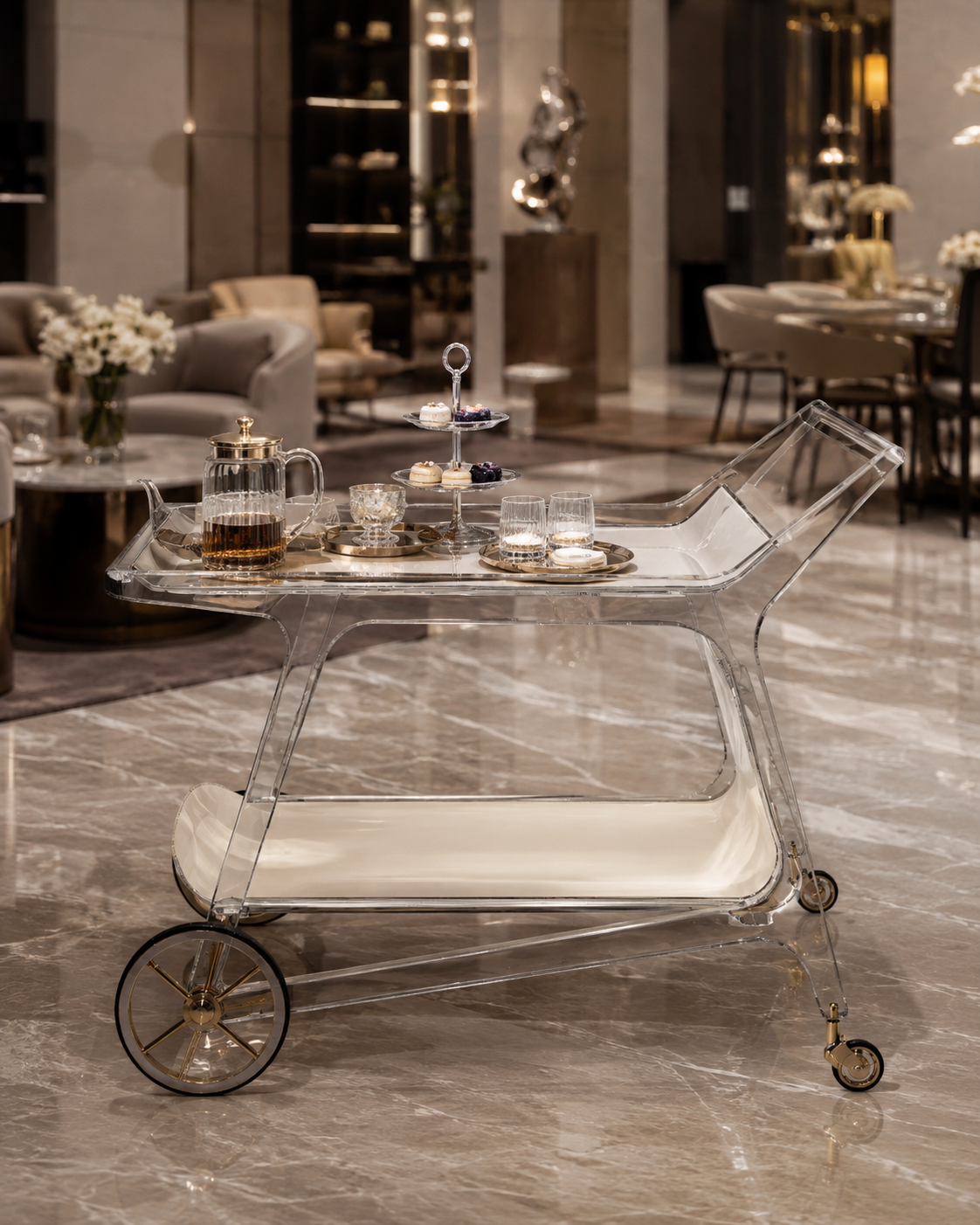
This is particularly relevant to transparent and translucent furniture. Synthetic crystal, high-end resin, and premium PMMA-based materials such as Platinum Acrylic can create highly distinctive dining tables, coffee tables, consoles, side tables, benches, pedestals, and retail displays. But their visual qualities also make manufacturing discipline more important. Color depth, clarity, internal effects, polishing, edges, joints, and surface condition can all influence whether the production furniture actually looks like the piece the designer approved.
For project delivery, therefore, the central question is not simply whether a supplier can make the sample. It is whether the sample can become a controlled production standard.
1. Treat the Approved Sample as a Production Standard, Not Just a Visual Reference
One of the most common mistakes in custom furniture projects is treating sample approval as a subjective event: the designer looks at a piece, says the color is correct, and production begins.
That is rarely sufficient for sophisticated transparent furniture.
Consider a champagne-colored synthetic crystal coffee table. The designer may approve its overall appearance, but what exactly has been approved? The color? The level of transparency? The distribution of internal visual effects? The gloss level? The edge treatment? The relationship between a thick leg and a thinner tabletop?
If those details remain undefined, different people can interpret the same approval differently.
The approved sample should therefore become a physical master standard supported by documented information. Its material code, color formulation or approved color range, dimensions, finish, transparency, edge profile, construction details, hardware interfaces, and acceptable visual variation should all be recorded before mass production begins.
This principle reflects broader quality-management practice. ISO explains that ISO 9001 quality-management systems are designed to help organizations achieve more consistent products and services through process control, documented information, monitoring, measurement, defined responsibilities, and control of variation and errors.
A furniture manufacturer does not need to turn a luxury table into a bureaucratic exercise, but the underlying idea is extremely relevant: what is not clearly defined is difficult to reproduce consistently.
For synthetic crystal and cast high-end resin furniture, this is particularly important because handcrafted or casting-related visual variation may be part of the character of the product. The goal should not always be absolute visual uniformity. Instead, the manufacturer and designer should agree on the acceptable range of variation.
A well-controlled sample approval answers a much stronger question than “Do you like this piece?”
It answers: “Is this the reference against which production will be judged?”
Once the answer is yes, the transition from design development to manufacturing becomes considerably smoother.

2. Freeze the Technical Specification Before the Factory Scales Up
Many delivery problems that appear to be production problems are actually late design decisions.
A sample is approved, but the tabletop thickness changes. The designer later asks for a warmer tint. The metal connector is revised after the acrylic components have already been machined. The hotel operator requests a different cleaning requirement after production has started. A side table originally intended for guestrooms is suddenly proposed for a higher-traffic lobby.
Every individual change may sound small. Collectively, they can disrupt material ordering, tooling, fabrication, polishing, assembly, quality inspection, packaging, and delivery schedules.
The solution is a clearly defined specification-freeze point between sample approval and mass production.
This matters because construction and interiors involve many stakeholders and large quantities of information. An Autodesk and FMI study of more than 3,900 construction professionals estimated that inaccurate, incomplete, inaccessible, inconsistent, or untimely project data may have cost the global construction industry $1.85 trillion in 2020. The study estimated that decisions based on bad data accounted for 14% of construction rework. It also found that respondents using more intentional data strategies reported benefits such as less rework, fewer change orders, and fewer project delays. These figures cover the wider construction industry rather than furniture manufacturing specifically, but the lesson for FF&E procurement is clear: uncontrolled information creates expensive downstream consequences.
Before batch production, a synthetic crystal dining table should therefore have approved dimensions, material appearance, construction, edge treatment, interface details, and packaging assumptions. A high-end resin console should have its approved visual standard and acceptable variation documented. A Platinum Acrylic pedestal should identify the acrylic specification, thickness, tint, fabrication method, polished-edge requirements, and assembly details.
Changes can still happen after this point, but they should become controlled changes rather than informal requests.
The difference is important. A controlled change identifies what is changing, why it is changing, which products are affected, and whether the change alters cost or schedule.
This protects both the project team and the manufacturer from a common source of conflict: producing correctly according to yesterday's approval while somebody else is already working from today's revision.
3. Convert “Looks Like the Sample” into Measurable Production Criteria
Transparent furniture is unusually sensitive to visual quality. A small difference in haze, tint, polishing, or internal appearance may be far more visible in a clear table than it would be in an opaque cabinet.
That makes measurable criteria valuable.
For PMMA-based Platinum Acrylic furniture, ASTM D4802 provides a useful technical reference. The current specification covers monolithic PMMA acrylic sheet and identifies testable characteristics including luminous transmittance, haze, water absorption, tensile properties, impact strength, abrasion resistance, coating adhesion, and chemical resistance. ASTM also notes that acrylic sheet is frequently used in applications where extreme clarity, low optical distortion, and absence of foreign particulate matter are important.
This does not mean every acrylic table needs every ASTM test, nor does it mean a product automatically complies merely because it is made from PMMA. The project should select criteria appropriate to the actual application.
The same principle applies to synthetic crystal and high-end resin.
Because formulations differ between manufacturers, terms such as “crystal clear,” “non-yellowing,” “high hardness,” or “scratch resistant” should not be used as substitutes for actual product-specific information. When a particular performance characteristic matters to a project, the manufacturer should define it and, where necessary, support it with an appropriate test method.
Visual criteria matter just as much.
A production standard might define acceptable color variation against the master sample, clarity, inclusions, bubble characteristics where relevant, gloss, polished-edge quality, visible joining, dimensional tolerances, and acceptable surface defects at an agreed viewing distance.
For example, the controlled variation expected in a sculptural cast-resin coffee table may be very different from the expectation for a geometrically precise clear Platinum Acrylic display pedestal.
The important point is that these differences should be intentional.
Once the project translates “luxury quality” into observable and measurable criteria, production inspection becomes less subjective. Designers, procurement companies, third-party inspectors, and manufacturers are then evaluating the same requirements rather than arguing about whether an individual piece simply “looks good enough.”

4. Control Batch Quality During Production Instead of Waiting for the Final Inspection
A strong sample does not guarantee a strong production batch.
If 120 resin side tables are manufactured for a hotel, discovering a recurring color problem after all 120 pieces are finished creates a much larger problem than identifying it during the first production units.
Quality control should therefore happen throughout production.
An effective process can compare first-off production pieces with the approved master sample, verify dimensions during fabrication, monitor color and transparency across batches, inspect polished edges and joints, and identify recurring defects before the entire order reaches final inspection.
Modern quality practice also provides structured ways to inspect production lots. ISO 2859-1:2026, published in January 2026, establishes acceptance-sampling procedures indexed by Acceptance Quality Limit, or AQL, for lot-by-lot inspection. ISO explains that the approach allows organizations to assess product or process quality through statistically based sample inspection rather than necessarily inspecting every item, while providing mechanisms to tighten inspection if quality deteriorates.
The appropriate inspection system still depends on the furniture and project requirements. A unique sculptural reception table might justify 100% inspection, while a larger batch of repeating side tables could use agreed sampling procedures alongside process inspections.
For transparent furniture, it is also useful to separate different types of defects instead of creating one vague category called “quality.”
A critical structural or safety-related issue should obviously be treated differently from a minor cosmetic characteristic. Likewise, a visible scratch on the center of a transparent tabletop may have a different significance from a small imperfection in a concealed location.
This is particularly important for synthetic crystal and resin furniture because some internal variation may be inherent to the visual design rather than a defect.
Defining those boundaries before shipment protects everyone.
The manufacturer can produce against a realistic acceptance standard. Inspectors have clear criteria. Procurement teams receive evidence of quality control. Designers have greater confidence that mass production has not gradually drifted away from the original sample.
The best final inspection is therefore one that confirms quality—not one that discovers the production process was uncontrolled.
5. Design the Packaging and Logistics at the Same Time as the Furniture
For high-end transparent furniture, production is not finished when the table leaves the polishing department.
It is finished when the table reaches the project site in the expected condition.
This distinction matters because synthetic crystal, high-end resin, and polished acrylic furniture often include large glossy surfaces, visually sensitive edges, heavy components, or complex sculptural forms. A flawless product can be damaged by vibration, impact, abrasion, improper restraint, forklift handling, or unsuitable packaging.
Packaging therefore needs to be engineered around the actual furniture rather than added as an afterthought.
The International Safe Transit Association maintains dedicated test procedures for packaged products. Its Procedure 2C specifically addresses furniture packages, while ISTA's 3-Series procedures are designed to simulate damage-producing motions, forces, conditions, and transport sequences such as vibration and handling shocks. ISTA describes these simulation tests as tools for understanding the risk of transport damage.
Not every hotel table needs formal ISTA certification, but the engineering principle is valuable.
A large synthetic crystal dining-table base may require different internal restraints from a lightweight acrylic side table. Highly polished Platinum Acrylic surfaces may need protective films and non-abrasive contact materials. Separate components may need controlled spacing so they cannot collide during transport. Heavy resin consoles may require crates designed around lifting points and the way the product will actually be handled at the destination.
Installation conditions should also influence packaging.
If furniture is going to the 30th floor of a hotel through a service elevator, component size and assembly sequence may matter as much as container efficiency. If a large sculptural piece must pass through finished corridors, the project team should confirm access dimensions before production, not when the truck reaches the site.
For international projects, good packaging also supports smoother customs inspection, warehouse handling, phased deliveries, and site distribution.
A premium piece of furniture that arrives damaged is not a premium project outcome.
For that reason, packaging should be considered part of product engineering—and part of the approved delivery standard.
6. Build Traceability So the First Order Is Not the Last Time the Project Can Reproduce the Furniture
Project delivery becomes truly smooth when the manufacturer can do more than complete one shipment.
Hotels, branded residences, luxury retail groups, and commercial developers frequently need replacement pieces, later phases, additional locations, or refurbishment orders. Lodging Econometrics reported that renovation and conversion activity also reached record levels at the end of 2025, with 3,777 renovation and conversion projects totaling 540,459 rooms in the global pipeline.
That makes long-term reproducibility increasingly valuable.
Imagine that a hotel installs 80 custom synthetic crystal bedside tables. Three years later, six rooms are renovated after damage, and replacement tables are required. If the original production information has disappeared, the project may need to restart from photographs and approximate color samples.
If the manufacturer retained the approved master sample, formulation or material reference, drawings, dimensions, edge profiles, hardware information, inspection criteria, and production records, replacement becomes far easier.
The same principle applies to branded commercial rollouts. A retailer might approve one Platinum Acrylic display family for Shanghai, then request related furniture for Singapore, Dubai, or Los Angeles. A hospitality designer might want the same translucent resin language used in a flagship hotel to appear in a second property with different furniture forms.
This is where systematic manufacturing becomes a genuine design advantage.
ISO's guidance on ISO 9001 emphasizes documented information, process control, monitoring, measurement, and the control of variation as foundations for consistent delivery. Meanwhile, BIFMA's current e3-2024 Furniture Sustainability Standard reflects the wider furniture industry's movement toward more structured evaluation of products, manufacturing, materials, and supply-chain practices. BIFMA states that the standard is now in its sixth edition and aligns with major frameworks including LEED and WELL.
For synthetic crystal, high-end resin, and Platinum Acrylic furniture suppliers, this creates an opportunity to compete on something more valuable than appearance alone.
A beautiful sample attracts a designer's attention. A reliable system earns the project's trust.
The strongest manufacturer can take an approved synthetic crystal coffee table, resin console, transparent dining table, acrylic bench, or retail pedestal and preserve the design intent through technical documentation, controlled production, inspection, packaging, shipment, installation, and future replacement.
That is ultimately what smoother project delivery means.
The goal is not merely to move furniture from the factory to the site. It is to ensure that the piece installed in the project is the piece the designer believed they approved months earlier—and that the same quality can be reproduced when the project needs it again.
For high-end projects, this is where synthetic crystal furniture can become more than a striking material choice. When supported by disciplined sampling, specification control, batch-quality management, and traceability, it becomes a repeatable project solution: visually distinctive enough for luxury interiors, yet structured enough for professional procurement and large-scale delivery.

READ MORE:
- How Can a Design Rendering Become Reality? The Critical Role of Synthetic Crystal Furniture in Connecting Design and Construction
- The Material Selection Challenge in High-End Interior Design: Why Transparent Crystal Furniture Is Becoming a New Choice for Designers
- How to Avoid Repeated Material Revisions in Hotel and Commercial Space Projects
- Why More High-End Projects Are Building Unified Material Selection Standards: A New Solution with Synthetic Crystal Furniture
- Synthetic Crystal Acrylic Furniture: A New Breakthrough for High-End Brand Differentiation
- Why Are More Designers Seeing Synthetic Crystal Acrylic as a Material of the Future?
- Synthetic Crystal Acrylic Furniture: How Can Products Gain Stronger Visual Competitiveness?
- From Furniture Manufacturing to Spatial Art: New Possibilities Created by Synthetic Crystal Acrylic
- Synthetic Crystal Acrylic Furniture: Why Do High-End Spaces Increasingly Need a Sense of “Light Luxury Transparency”?


