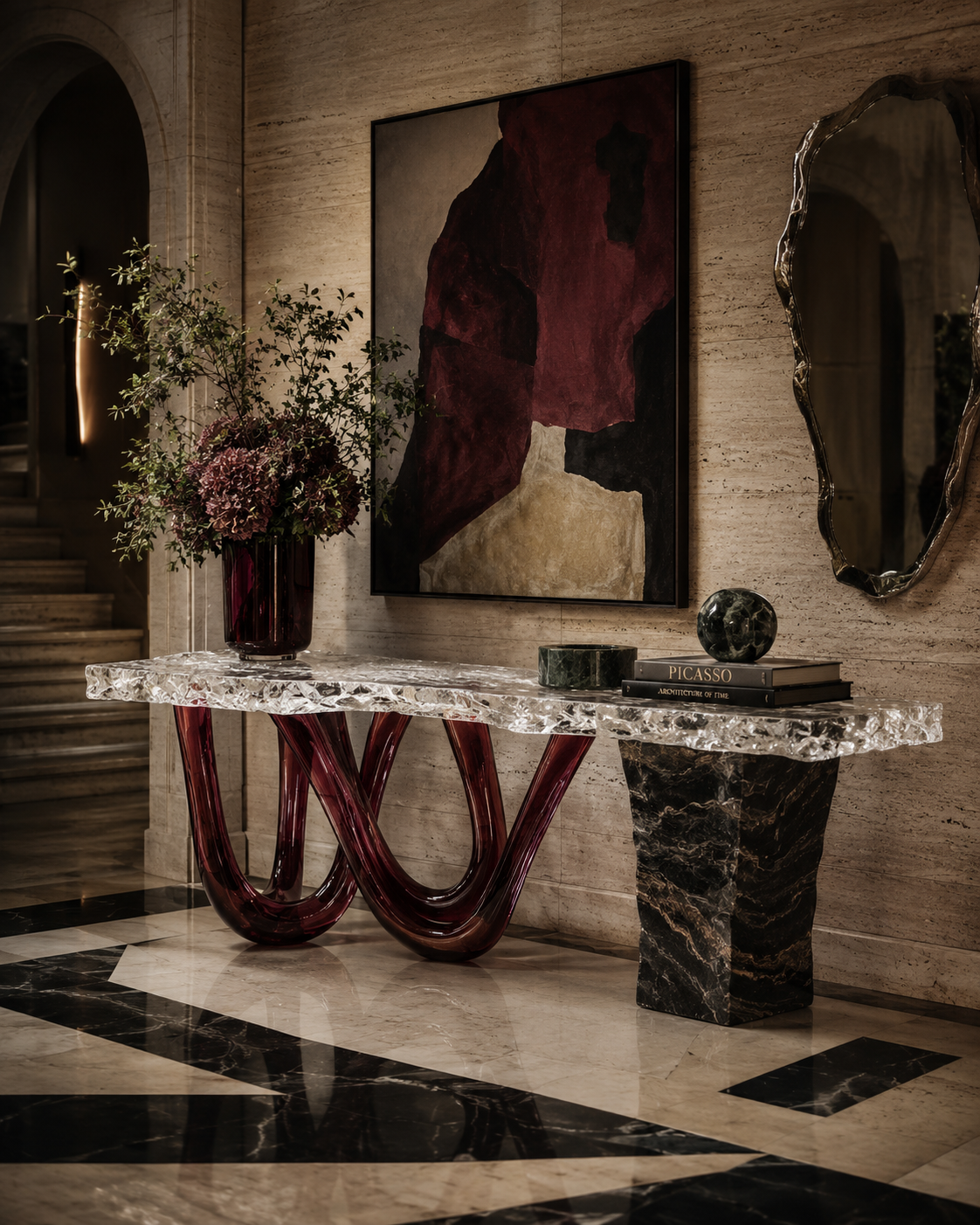
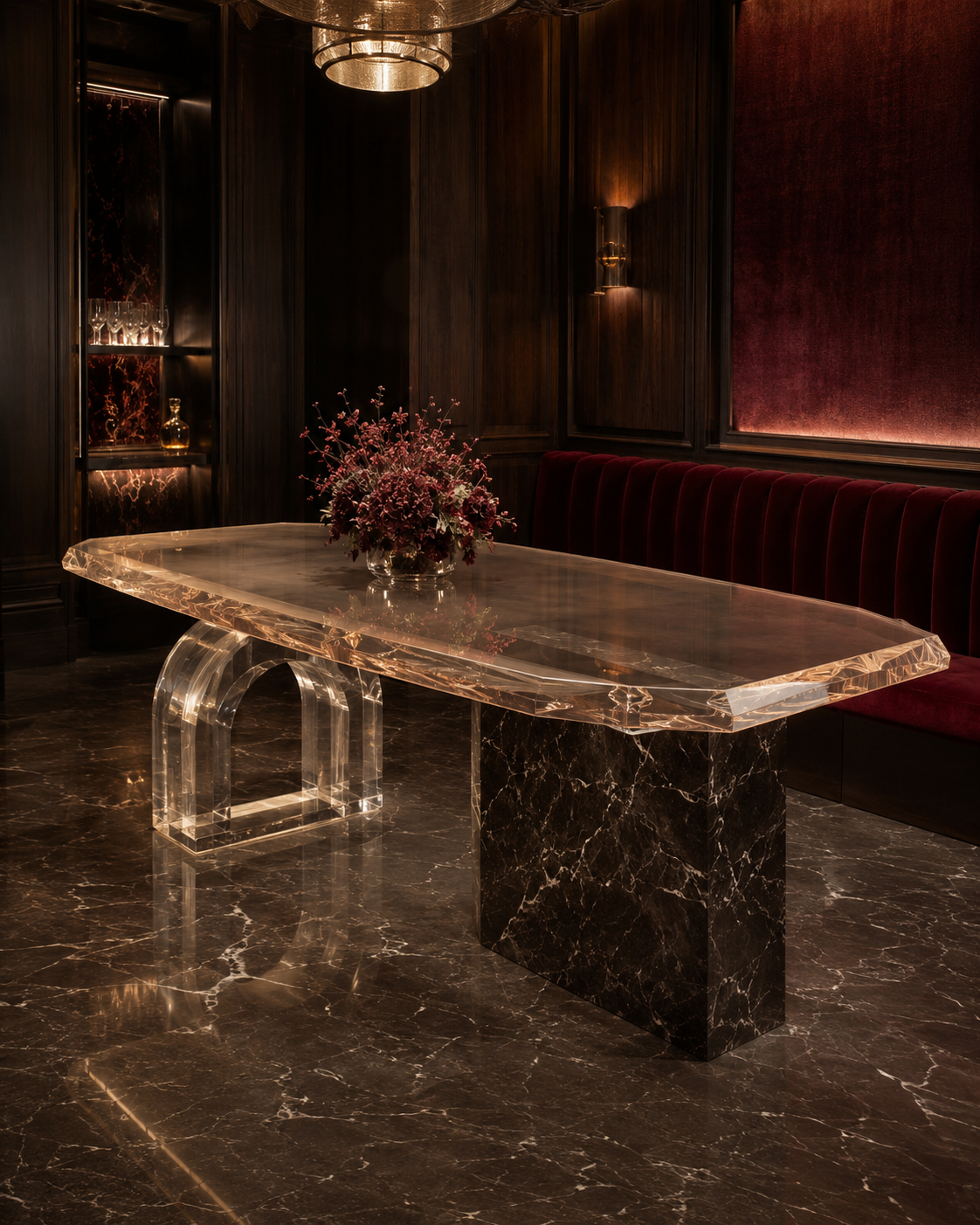
Synthetic crystal furniture has become increasingly relevant to luxury interiors because it offers something conventional furniture materials often cannot: the visual depth of crystal, the freedom of casting, large transparent forms, custom colors, embedded artistic effects, and the ability to create sculptural furniture with a strong architectural presence.
For international projects, however, a beautiful sample is only the beginning of material selection.
A synthetic crystal coffee table installed in an air-conditioned London residence, a transparent resin console in a Singapore hotel, and a crystal-style dining table in a Dubai villa can have almost identical designs while facing completely different environmental stresses. Temperature, humidity, sunlight, installation position, cleaning frequency, and surrounding materials all influence how transparent polymers age.
This is why professional specification should distinguish between synthetic crystal, high-end resin, and premium cast PMMA, sometimes commercially described as platinum acrylic in the luxury furniture market. These materials can all create premium transparent furniture, but their formulations, processing methods, optical characteristics, and appropriate applications are not identical.
BIFMA's 2025 Outdoor Furniture Whitepaper highlights direct UV exposure, high heat and cold, and moisture as major environmental challenges for furniture. It also notes that a single material-independent accelerated-weathering method cannot reliably predict every furniture system. That is an important starting point: project suitability must be evaluated according to the actual environment, not simply according to a label such as “outdoor grade.”
1. Luxury Hotels and Resorts Are Strong Applications—But Location Within the Project Matters
Hotels and resorts are among the most natural applications for synthetic crystal furniture because these projects often need statement pieces rather than ordinary functional furniture.
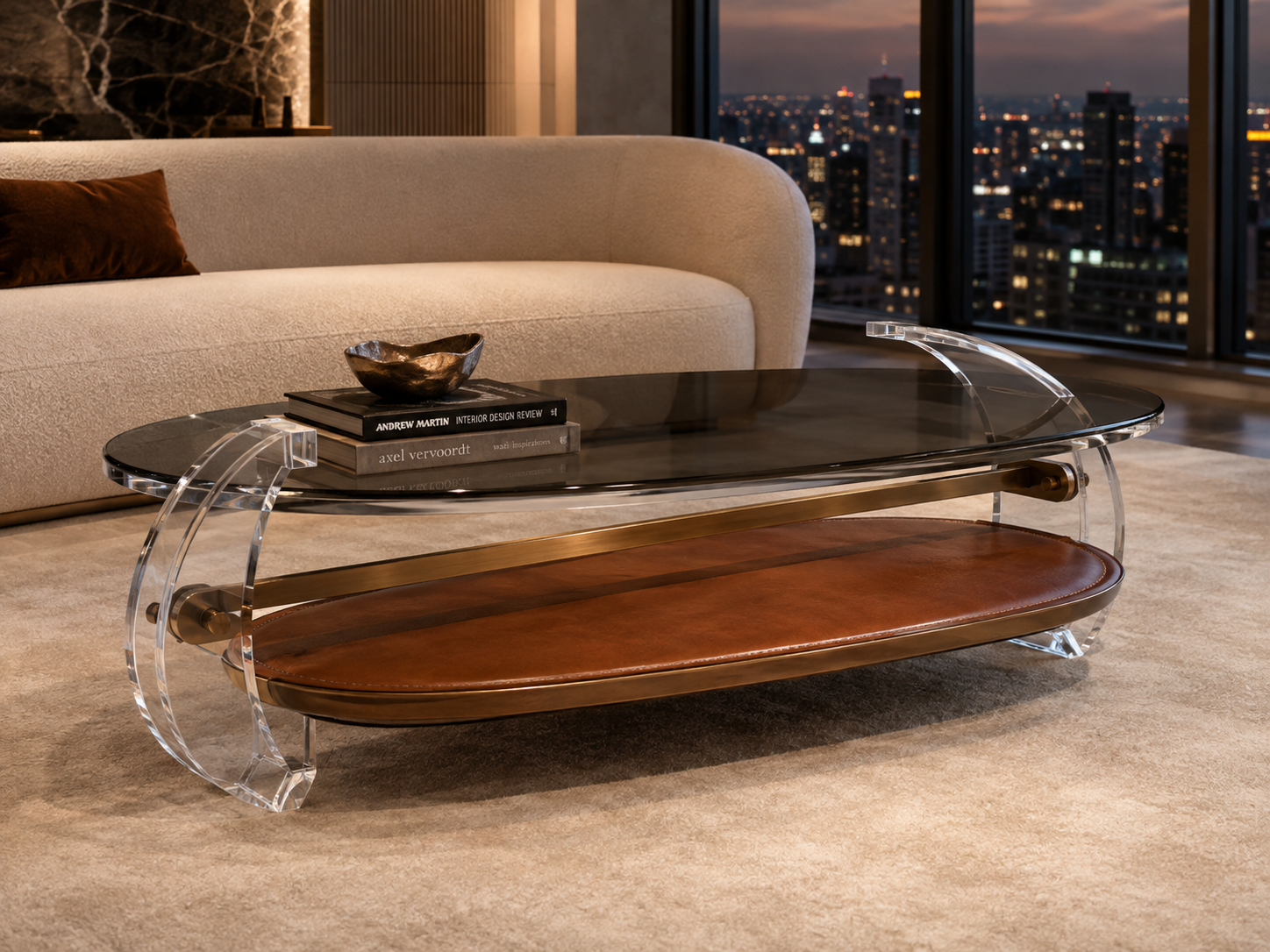
A large transparent coffee table in a lobby, a colored resin console behind a reception area, a sculptural synthetic crystal pedestal in a VIP lounge, or a platinum acrylic side table in a suite can create visual impact without making the space feel physically heavy. Designers can use transparency to preserve sightlines while introducing substantial furniture volumes.
Yet “hotel furniture” is not one environmental category.
A synthetic crystal table in an air-conditioned guest suite may experience relatively stable temperature and humidity. The same table in an open-air resort lobby may experience daylight, warm humid air, condensation, rain carried by wind, and frequent cleaning. A poolside lounge installation introduces another level of moisture and chemical exposure.
Singapore illustrates how demanding a tropical hospitality environment can be. Meteorological Service Singapore states that the country has high and relatively uniform temperatures and high humidity throughout the year. Its 1991–2020 data shows average annual rainfall of 2,113.3 mm, around 171 rain days per year, and mean annual relative humidity of approximately 82%. Humidity can exceed 90% before sunrise and frequently reach 100% during prolonged rain.
For a tropical hotel, therefore, the correct synthetic crystal solution should emphasize controlled resin chemistry, complete curing, moisture-resistant interfaces, suitable adhesives, stable pigments, careful polishing, and hardware selected for the environment.
ASTM D4329-26 reinforces this combined approach because it evaluates deterioration of plastics associated with UV radiation, moisture, and heat rather than treating these stresses as unrelated.
For highly exposed transparent components where exceptionally stable optical performance is the priority, premium PMMA or platinum acrylic may also be incorporated into the furniture. In many hospitality projects, the strongest solution is not one material everywhere but a deliberate combination of synthetic crystal, high-end resin, acrylic, and appropriate metal structures.

2. High-End Residential Projects Are Ideal When Transparency and Customization Are the Priority
Luxury residences are another strong market for synthetic crystal furniture because residential clients often value individuality more than standardization.
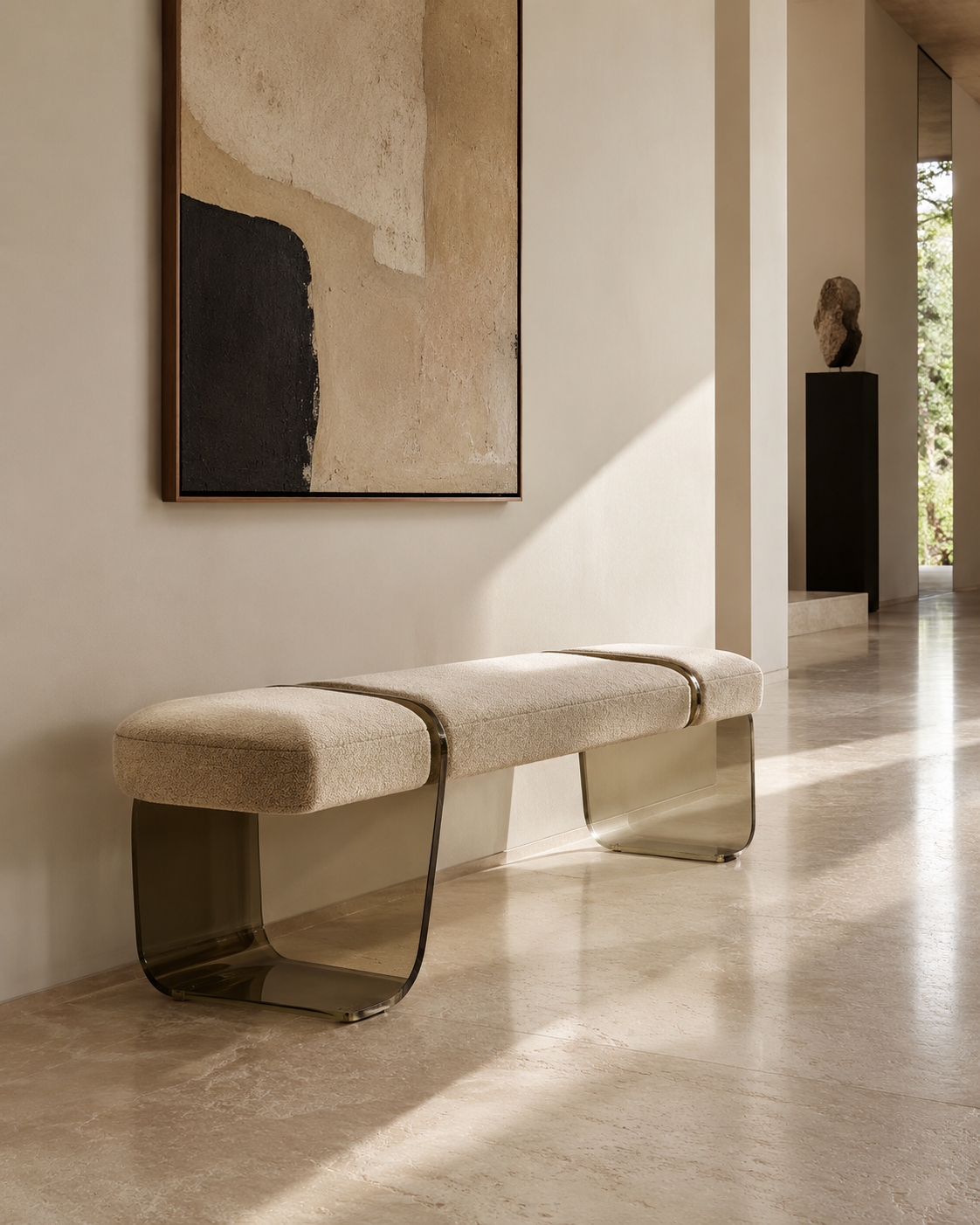
A custom synthetic crystal dining table base can become the visual centerpiece of a dining room. A high-end resin console can incorporate a specific amber, smoky, blue, or champagne tone selected by the interior designer. A thick transparent coffee table can create the appearance of carved crystal without relying on conventional glass construction. Platinum acrylic can be used for precise geometric legs, shelves, benches, or side tables where crisp edges and high transparency are required.
Temperature and light should still influence specification.
A table positioned in the center of a climate-controlled room experiences a different environment from one placed directly in front of floor-to-ceiling glazing. ISO 4892-3:2024 specifically recognizes both global solar radiation and solar radiation filtered through window glass when describing laboratory exposure methods for plastics. The standard uses fluorescent UV radiation together with heat and water to reproduce important aspects of weathering.
This is highly relevant to modern luxury homes, where large windows are common.
A customer may describe a table as “indoor furniture,” but if that table receives several hours of intense daylight every day, optical stability becomes an important specification requirement. For a perfectly clear synthetic crystal or high-end resin piece, gradual yellowing that might be insignificant on an opaque product can become immediately visible.
The World Health Organization also notes that solar UV intensity changes with sun elevation, latitude, altitude, cloud cover, ozone, and reflection from surfaces such as water and sand. This means two luxury residences with similar interior designs can expose furniture to very different solar conditions.
For international residential projects, manufacturers should therefore ask where the furniture will actually be positioned. “Indoor” is useful information, but distance from glazing, direct sun exposure, local climate, and expected temperature variation provide a much better material brief.
3. Luxury Retail, Showrooms, and Brand Flagships Favor Materials With High Optical Consistency
Luxury retail environments are particularly suitable for transparent furniture because furniture in these spaces often functions as part of the brand presentation.
A platinum acrylic display table can visually disappear beneath jewelry, watches, handbags, cosmetics, or decorative objects. A synthetic crystal pedestal can create the appearance of a solid block of light or color. A high-end resin display console can incorporate customized pigments that correspond with a brand's visual identity.
In these projects, optical quality is often more important than extreme outdoor durability.
Clear furniture is unforgiving because scratches, haze, edge imperfections, yellowing, adhesive lines, and polishing defects are easy to see under strong retail lighting. For that reason, quality should not be judged only by whether a material remains structurally intact.
ASTM D1003 provides a recognized method for measuring haze and luminous transmittance in transparent plastics. These measurements are useful precisely because a transparent polymer can still allow substantial light transmission while increased scattering makes it look cloudy or less premium.
This makes premium material selection valuable for high-end retail.
Specific PMMA systems demonstrate the optical durability achievable with carefully engineered acrylic. Röhm, for example, states that its PLEXIGLAS® Soundstop product has a 30-year guarantee against yellowing and is designed to retain transparency and light transmission. That guarantee applies to the specified Röhm product rather than to every acrylic material, but it illustrates why the exact grade and documented performance matter more than simply requesting “acrylic.”
For furniture manufacturers, the same logic should apply to synthetic crystal and high-end resin. A premium transparent display table should be manufactured from a defined resin system with controlled casting, curing, polishing, and quality inspection rather than from a generic clear resin selected on price alone.
Luxury retail projects are therefore especially appropriate for synthetic crystal and platinum acrylic furniture when the manufacturer can provide repeatable optical appearance and tight fabrication control.
4. Hot and High-Light Projects Can Use Synthetic Crystal Furniture, but Material Formulation Must Be Upgraded
Projects in the Middle East, sunny Mediterranean locations, tropical destinations, and other high-solar-exposure markets can also use synthetic crystal furniture successfully, but they require more deliberate engineering.
The biggest misunderstanding is assuming that heat resistance only matters when a plastic approaches its melting or softening limit.
Furniture can experience problems much earlier.
Temperature changes create dimensional movement, particularly in large transparent components. When acrylic, resin, stainless steel, brass, or aluminum are combined in one table, each material responds differently to temperature. A rigid joint that performs well in a stable air-conditioned room may concentrate stress when installed near a hot façade or on a covered terrace.
Strong light also increases concern about long-term color stability.
WHO explains that UV radiation is influenced by latitude, sun position, altitude, cloud conditions, and surface reflection. Water and sand can increase exposure through reflection—an especially relevant consideration for resort, poolside, and desert environments.
ISO 4892-3 and ASTM D4329 are useful references when evaluating transparent polymers for such projects because both address accelerated exposure involving UV radiation, heat, and moisture. ASTM also warns that operating conditions must be reported because different test conditions do not necessarily produce equivalent results.
This means a statement such as “1,000 hours UV tested” should not automatically be interpreted as a guaranteed number of years of real-world service.
For a Dubai hotel lobby or a luxury villa with large south- or west-facing glazing, a manufacturer may select a more UV-stabilized synthetic crystal formulation, modify pigment chemistry, use platinum acrylic for particularly exposed clear elements, or redesign connections to accommodate greater thermal movement.
The finished furniture can still look identical to the standard version.
The difference is that the material system has been engineered for the project rather than copied from a catalog.
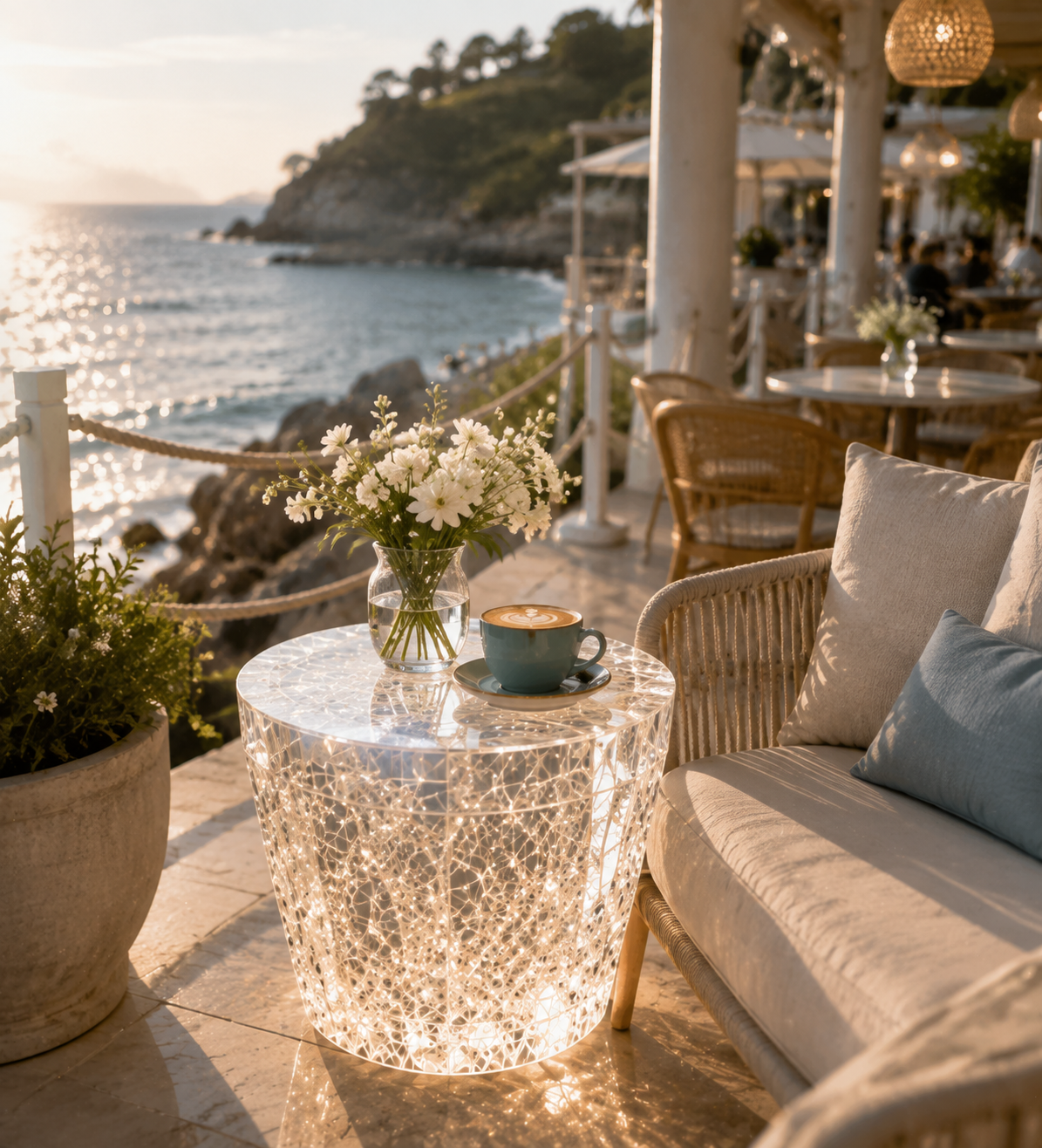
5. Coastal, Poolside, and Semi-Outdoor Projects Are Possible Only When the Complete Assembly Is Evaluated
Coastal projects reveal one of the most important principles in transparent furniture manufacturing: the clear material is not always the weakest part of the product.
A synthetic crystal table can have excellent optical stability while a hidden metal insert begins to corrode. A platinum acrylic tabletop can remain clear while an unsuitable fastener creates staining or stress. A high-end resin pedestal can perform well while its adhesive or decorative metal trim deteriorates.
ISO 9223 identifies the temperature-humidity complex, sulfur dioxide pollution, and airborne salinity as key factors in atmospheric corrosion of metals and alloys. Airborne salinity makes this standard particularly relevant to furniture installed near the sea.
This matters aesthetically as well as structurally.
Because synthetic crystal and acrylic are transparent, corrosion around a hidden insert may become visible through the furniture. What would remain concealed inside an opaque wooden or metal table can become an obvious defect inside a crystal-clear product.
ASTM D4329 also explicitly states that its UV, heat, and moisture exposure procedure is not intended to reproduce localized environmental effects such as saltwater exposure. In practical terms, a good UV-weathering report does not automatically prove that a furniture assembly is ready for a beachfront resort.
Poolside projects present similar questions. The manufacturer needs to consider not only sunlight and water but also cleaning agents, wet-dry cycling, hardware, adhesives, and how water can collect around joints.
This does not mean synthetic crystal furniture should be excluded from coastal or semi-outdoor projects. It means these are engineering applications rather than standard-product applications.
A statement synthetic crystal table under a covered resort terrace, for example, may be entirely viable when the resin formulation, UV exposure, metal components, joints, drainage, and maintenance requirements are addressed in advance.
6. The Best Overseas Projects Are Those Where the Material Is Selected From the Environment Backward
Synthetic crystal furniture is particularly well suited to projects that value visual impact: five-star hotels, luxury resorts, high-end villas and apartments, flagship stores, showrooms, restaurants, private clubs, executive spaces, galleries, branded hospitality environments, and custom architectural interiors.
But the most successful projects share something more important than project type.
They define environmental conditions before finalizing the material.
BIFMA's outdoor furniture work is useful here because the association spent more than three years consulting manufacturers, weathering specialists, and other stakeholders and concluded that no single material-agnostic weathering approach could adequately bridge accelerated aging and furniture performance. Different materials and furniture systems need different evaluation strategies.
That is exactly how synthetic crystal furniture should be specified internationally.
If the furniture will remain in a stable, climate-controlled interior, design freedom can take priority and synthetic crystal or high-end decorative resin may offer the greatest creative value.
If humidity is consistently high, the resin system, adhesives, embedded elements, and joints deserve greater attention.
If intense sunlight is the dominant concern, UV stabilization and measurable optical stability should move higher in the specification.
If maximum clarity and established outdoor optical durability are required, premium PMMA or platinum acrylic may become the preferred material for some elements. Röhm's documented use of specialized PMMA in demanding exterior applications—including a product for which it provides a 30-year guarantee against yellowing—illustrates the performance level that well-defined acrylic grades can achieve.
If the project is coastal, metal corrosion and the complete furniture assembly have to enter the discussion.
And if a project combines several risks, the best solution may combine materials: synthetic crystal for thick sculptural volumes, high-end resin for artistic colors or casting effects, platinum acrylic for precision transparent elements, and carefully selected metal hardware for structural support.
The most important question for an overseas buyer is therefore not:
“Is synthetic crystal furniture suitable for my country?”
A better question is:
“What temperature, humidity, sunlight, moisture, and installation conditions will this furniture actually experience, and which material configuration will preserve the intended appearance under those conditions?”
When that question is answered before production, synthetic crystal furniture can move beyond being a decorative novelty and become a serious specification option for international luxury projects.
The objective is not merely to deliver a clear table, resin console, or acrylic installation that looks impressive when it leaves the factory.
The objective is to deliver furniture whose clarity, depth, color, surface quality, and architectural presence remain consistent with the original design after it reaches the real project environment.
That is the difference between simply manufacturing transparent furniture and engineering it for the global luxury market.
READ MORE:
- Perché alcuni mobili trasparenti diventano il punto focale della stanza anche senza colore, decorazioni o forme eccessive
- Dal piedistallo alla consolle: quali mobili in cristallo sintetico valorizzano meglio opere d’arte, prodotti e oggetti da collezione
- Un tavolo quasi invisibile può cambiare una stanza: come il volume visivo dei mobili influenza la percezione dello spazio
- Perché hotel, boutique e showroom scelgono mobili trasparenti quando vogliono mostrare di più senza riempire di più
- Quando un mobile trasparente funziona davvero: come usare il cristallo sintetico senza rendere lo spazio freddo o impersonale
- Why Does the Same Crystal Furniture Need Different Material Specifications in Different Countries?
- How Should Furniture Materials Be Selected for High-Temperature, High-Humidity, and High-Light Environments?
- How Does Furniture Material Selection Change Across Different Climate Regions?
- Why Weather Resistance Can Make or Break a Furniture Project: 3 Critical Material-Selection Factors for Synthetic Crystal Furniture


