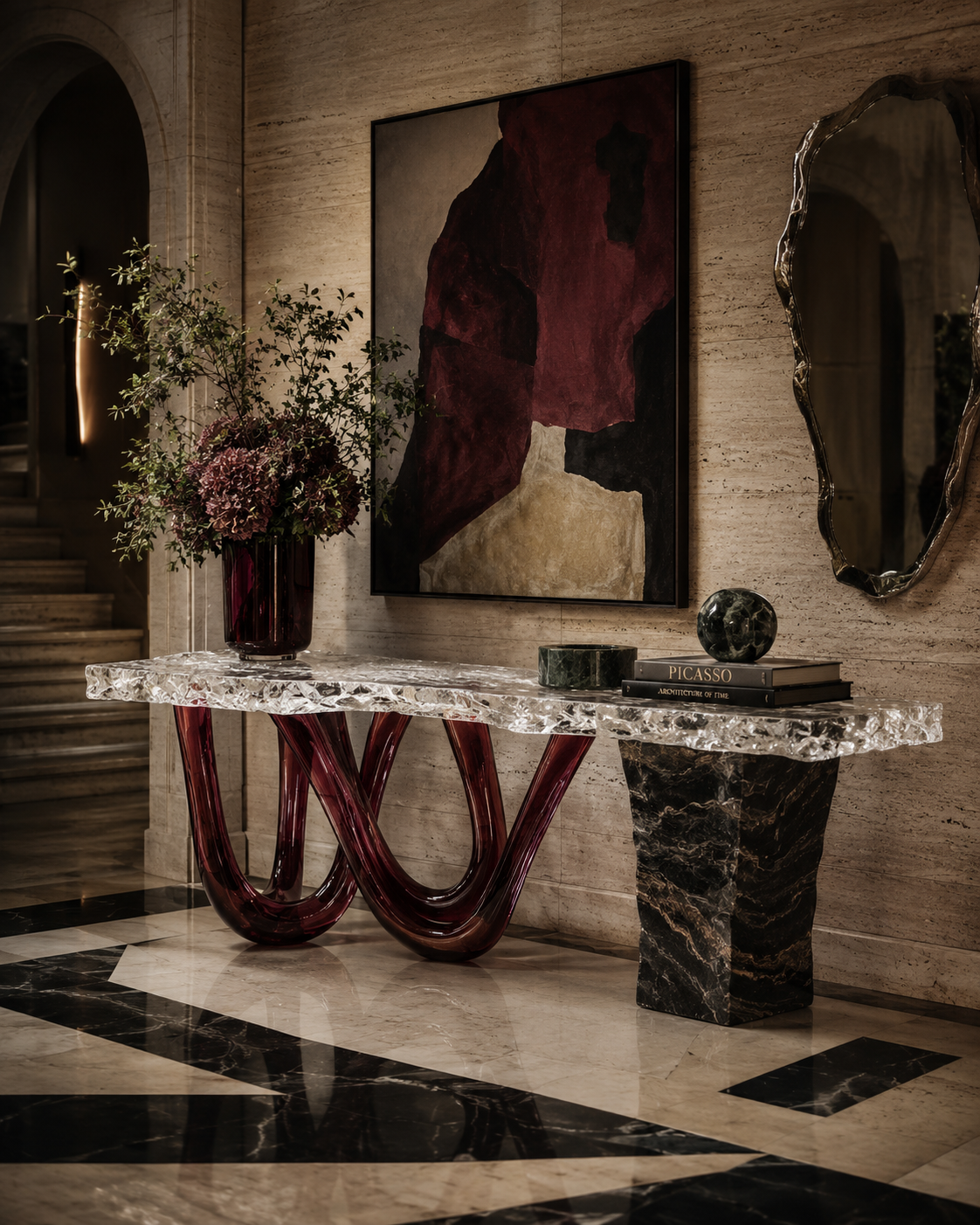
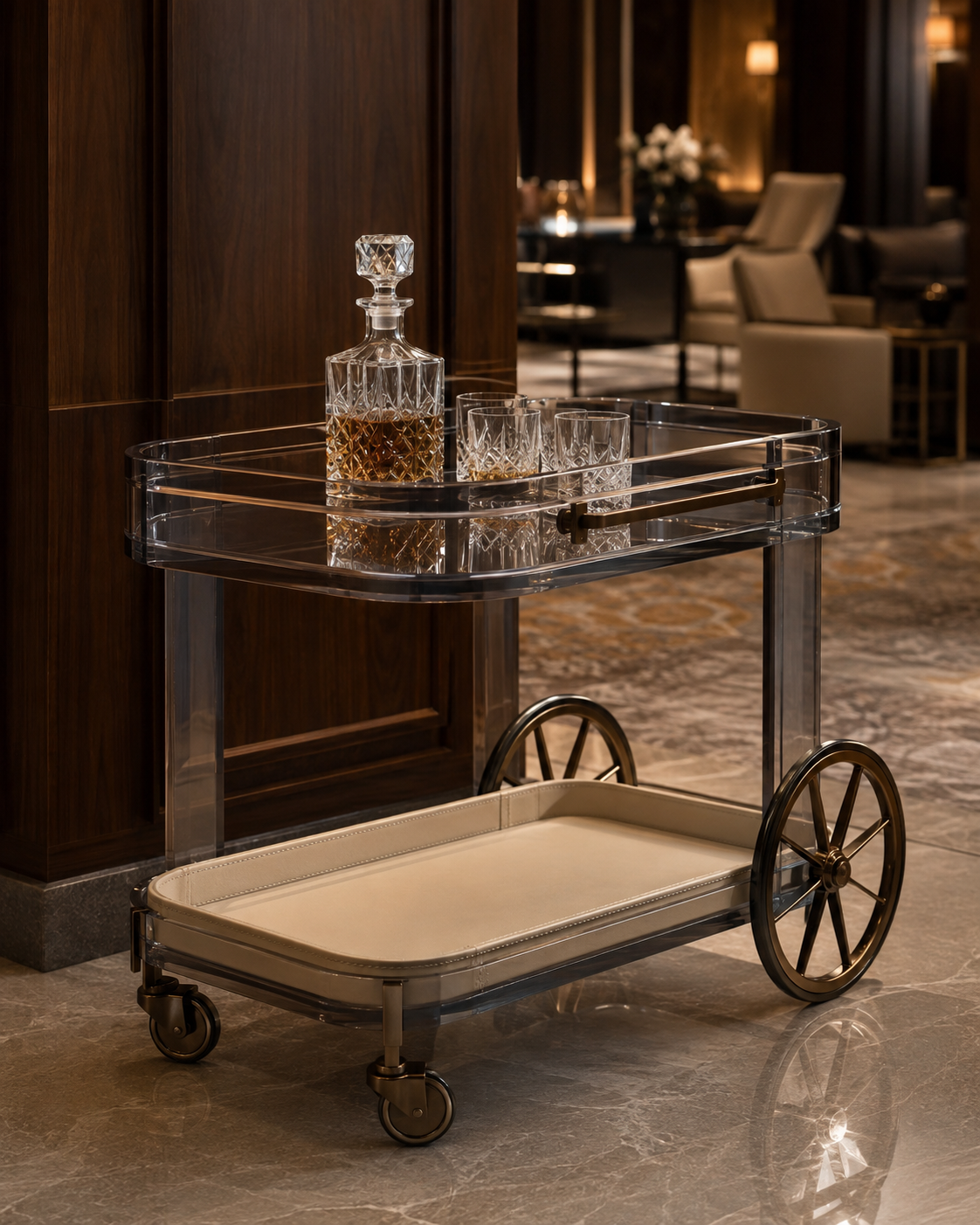
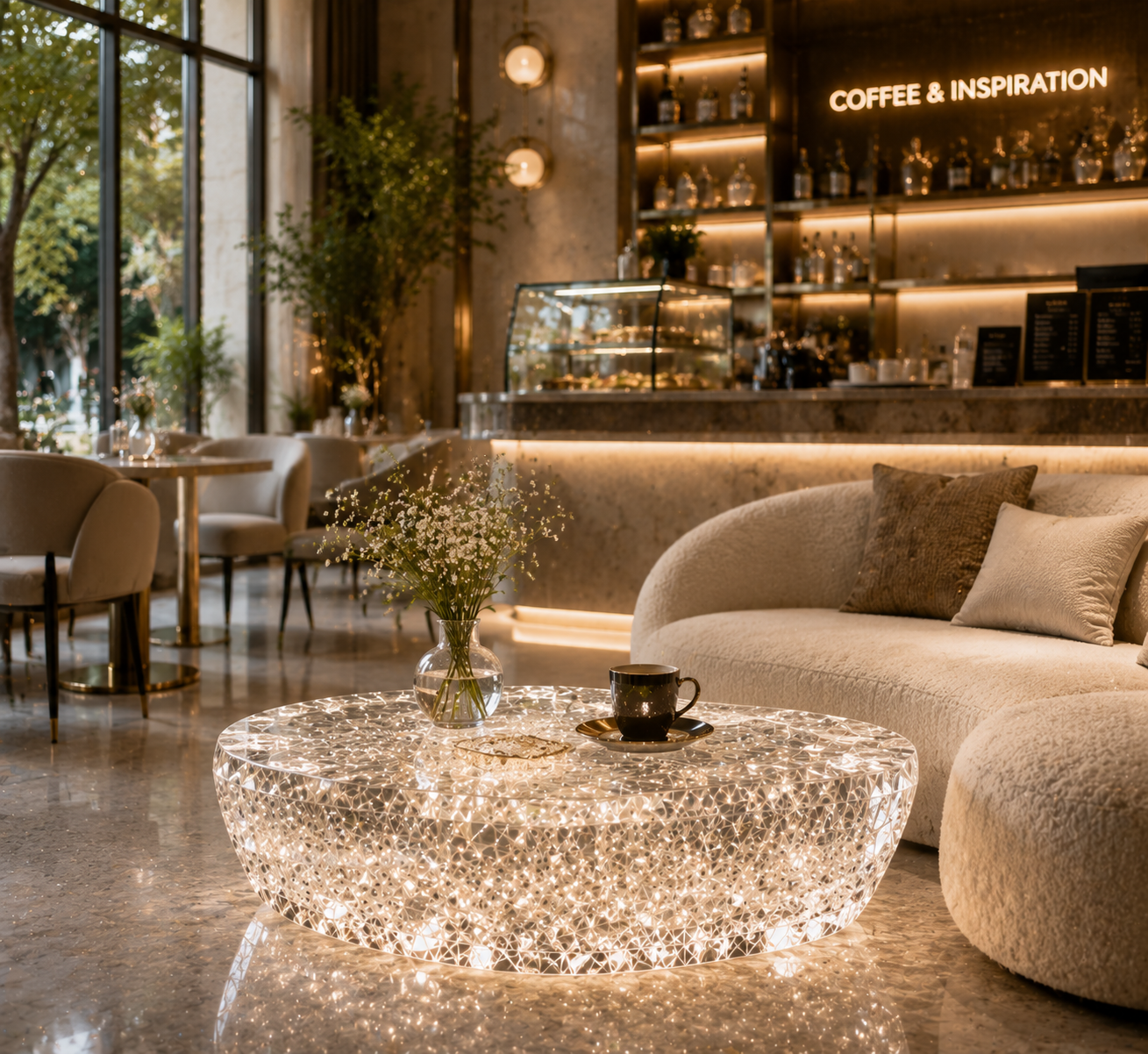
A crystal-clear coffee table can have exactly the same dimensions, shape, color, and visual appearance in Singapore, Dubai, Miami, Toronto, or London. From a design perspective, it is the same product. From a materials-engineering perspective, however, it may need to be five different products.
This is one of the most important distinctions in international luxury furniture manufacturing.
For furniture made from synthetic crystal, high-end resin, and premium cast PMMA—sometimes marketed in the luxury furniture industry as platinum acrylic—appearance is only the starting point. The material must continue to maintain its transparency, color, surface quality, dimensional stability, connections, and structural performance after it reaches the destination country.
BIFMA's 2025 Outdoor Furniture Whitepaper identifies direct UV exposure, high heat and humidity, cold, and moisture among the harsh environmental conditions that furniture manufacturers need to consider. More significantly, BIFMA concluded after consultation with manufacturers and accelerated-weathering specialists that a single material-independent method could not reliably connect accelerated weathering to the performance of every furniture construction.
That explains why a professional manufacturer should not simply reproduce the same material specification for every export market.
The design can remain the same. The engineering behind it may need to change.
1. The Same Furniture Can Face Completely Different Aging Mechanisms
International buyers often think of a furniture model as a fixed specification. Once a synthetic crystal coffee table has been successfully produced for one project, it may seem logical to use exactly the same resin, acrylic, adhesive, hardware, and construction for the next country.
Climate makes that approach risky.
ISO 4892-3:2024 evaluates plastic weathering by exposing specimens to fluorescent UV radiation, heat, and water. The standard is specifically intended to reproduce important effects associated with real end-use environments, including exposure to global solar radiation and sunlight filtered through window glass. ASTM D4329-26 similarly addresses the deterioration of plastics caused by combinations of ultraviolet radiation, moisture, and heat.
The key word is combination.
A synthetic crystal console installed in a climate-controlled London apartment might mainly need resistance to interior daylight, routine cleaning, and normal room-temperature cycling. The same console placed in an open hotel lobby in Southeast Asia may encounter high humidity, strong sunlight, condensation, and frequent wet cleaning. On a beachfront property, salt-containing air introduces another risk. At a mountain resort, low temperatures and intense reflected sunlight can become more important.
These conditions do not necessarily require changing the outward appearance of the furniture. Instead, the manufacturer may change the underlying formulation, UV-stabilization package, acrylic grade, casting method, adhesive, hardware material, tolerances, or joint geometry.
That is particularly important with transparent furniture because degradation is unusually visible. A conventional opaque table might tolerate a small internal color change without the customer noticing. A water-clear synthetic crystal dining-table base cannot. Yellowing, haze, bubbles, stress marks, adhesive discoloration, or corrosion around an internal metal insert may immediately lower the perceived value of the entire piece.
For international projects, therefore, a furniture model should have a design specification and an environmental material specification. The first controls what the customer sees. The second controls whether the customer will continue to see the same thing years later.
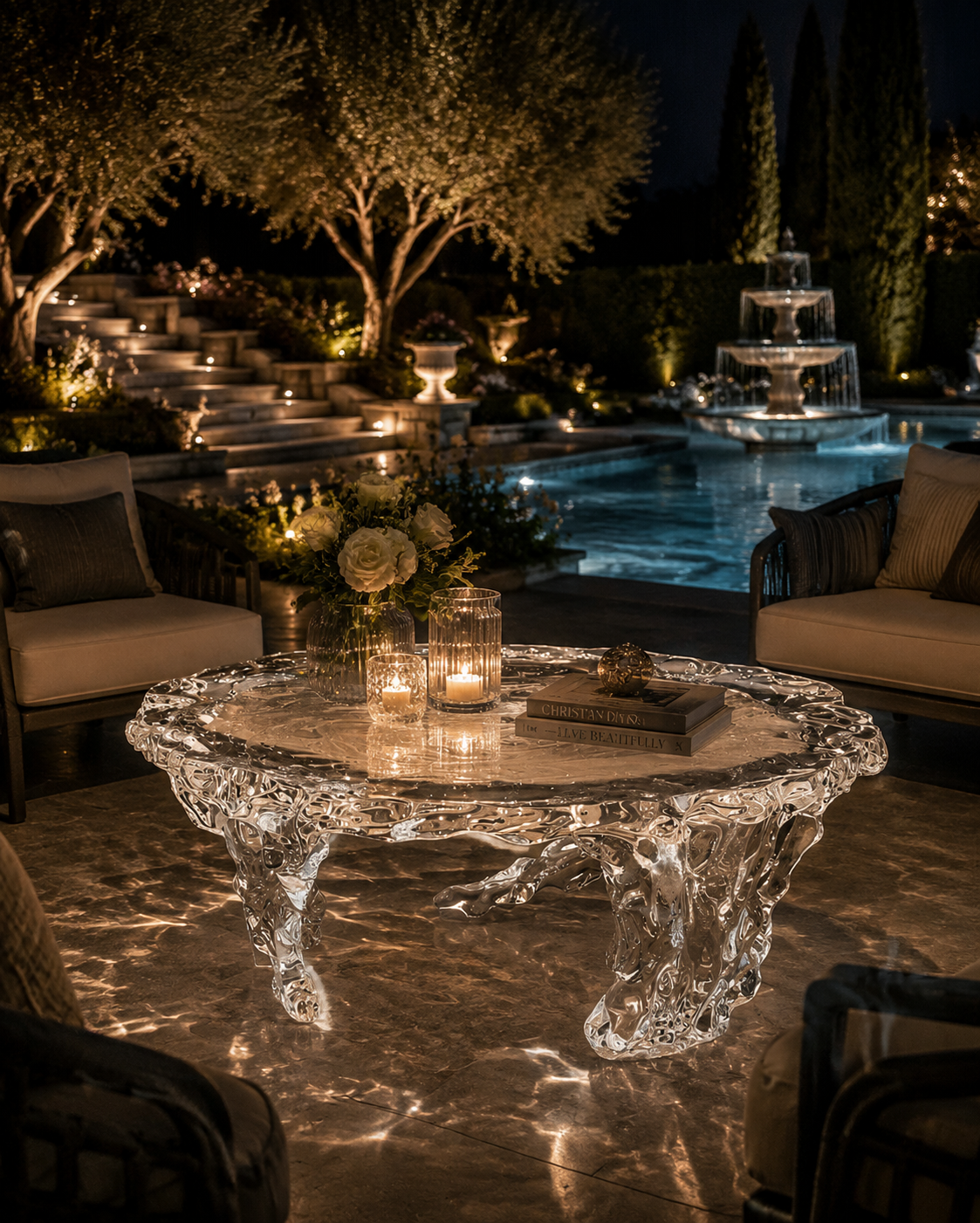
2. A Singapore Specification Should Prioritize Humidity and Moisture Differently from a Dry-Climate Specification
Consider exporting the same transparent synthetic crystal side table to Singapore and to a dry inland market.
Singapore's Meteorological Service describes the country's climate as having high and relatively uniform temperatures and high humidity throughout the year. Its 1991–2020 climate data gives long-term mean annual rainfall of approximately 2,113.3 mm, while mean annual relative humidity is about 82%. Relative humidity commonly exceeds 90% before sunrise and can reach 100% during prolonged rain.
Those numbers change the material-selection conversation.
ASTM D570 explains that the moisture content of plastics can be closely related to characteristics including mechanical strength, appearance, and dimensions. It also notes that water absorption depends on the nature of the material, exposure conditions, component geometry, and even whether moisture enters through cut edges or molded surfaces.
For a high-end resin or synthetic crystal table destined for a tropical hotel, the manufacturer should therefore examine more than whether the resin is technically “waterproof.” The complete system matters: resin chemistry, curing quality, casting thickness, polished edges, adhesive joints, embedded decorative components, metal inserts, and surface finishing.
Published research on epoxy resin systems illustrates why formulation matters. Experimental work on thermal, UV, and natural aging found that yellowing can develop through oxidation reactions that create light-absorbing chemical structures. Separate research into hygrothermal aging has also documented yellowing mechanisms under combinations of heat and moisture. These findings should not be generalized to every proprietary furniture resin, but they demonstrate that two products both called “clear resin” can age very differently.
For a tropical project, a manufacturer may therefore select a higher-performance synthetic crystal formulation, modify the curing process, change the bonding system, or use premium PMMA for components where maximum optical stability is required.
The customer still receives the same table.
What changes is the unseen engineering required to make that table suitable for Singapore rather than simply suitable for the showroom.
3. Middle Eastern Markets Make Heat, UV Stability, and Thermal Expansion More Important
Now place the same furniture in the Middle East.
In this environment, high solar exposure and high temperatures can shift the critical failure mechanisms. A transparent table beside large glazing or in a semi-outdoor hospitality space may experience much higher surface temperatures than its appearance suggests.
This matters especially when premium acrylic is combined with metal.
Technical documentation for specified PLEXIGLAS® PMMA products gives a coefficient of linear thermal expansion of approximately 0.07 mm per meter per °C over the stated temperature range. The figure is product-specific, but it demonstrates an important engineering principle: large acrylic components move as temperature changes.
Imagine a two-meter platinum acrylic dining table top attached to a stainless-steel base. If the designer concentrates only on transparency and ignores thermal movement, a rigid connection can transfer stress toward holes, bolts, adhesive areas, or sharp internal corners. The furniture does not need to approach the polymer's melting temperature for this to become a problem.
The connection design may therefore need more tolerance in a hot-country specification than in a stable indoor environment.
Strong sunlight adds another variable. The World Health Organization notes that solar UV levels depend on sun elevation, latitude, altitude, cloud cover, ozone, and reflection from surfaces such as water and sand. This means “sunny country” is not itself a complete UV specification; actual exposure conditions matter.
For synthetic crystal or high-end resin furniture, an export specification for a strongly sun-exposed market may therefore require a different UV-stabilized resin system from an indoor European specification. Where exceptional long-term transparency is the priority, premium cast PMMA may be selected for certain components instead.
Manufacturers should also be careful with claims such as “UV resistant.” ASTM D4329-26 states that test conditions need to be documented because different accelerated-weathering conditions do not necessarily produce identical results. The standard recommends comparison with a control material of known performance and recommends multiple specimens where statistical evaluation is required.
For a Middle Eastern luxury project, therefore, the question should never be only, “Can we make this table clear?”
It should be, “Can we keep this table clear while allowing the material to behave correctly under the actual thermal and solar environment?”
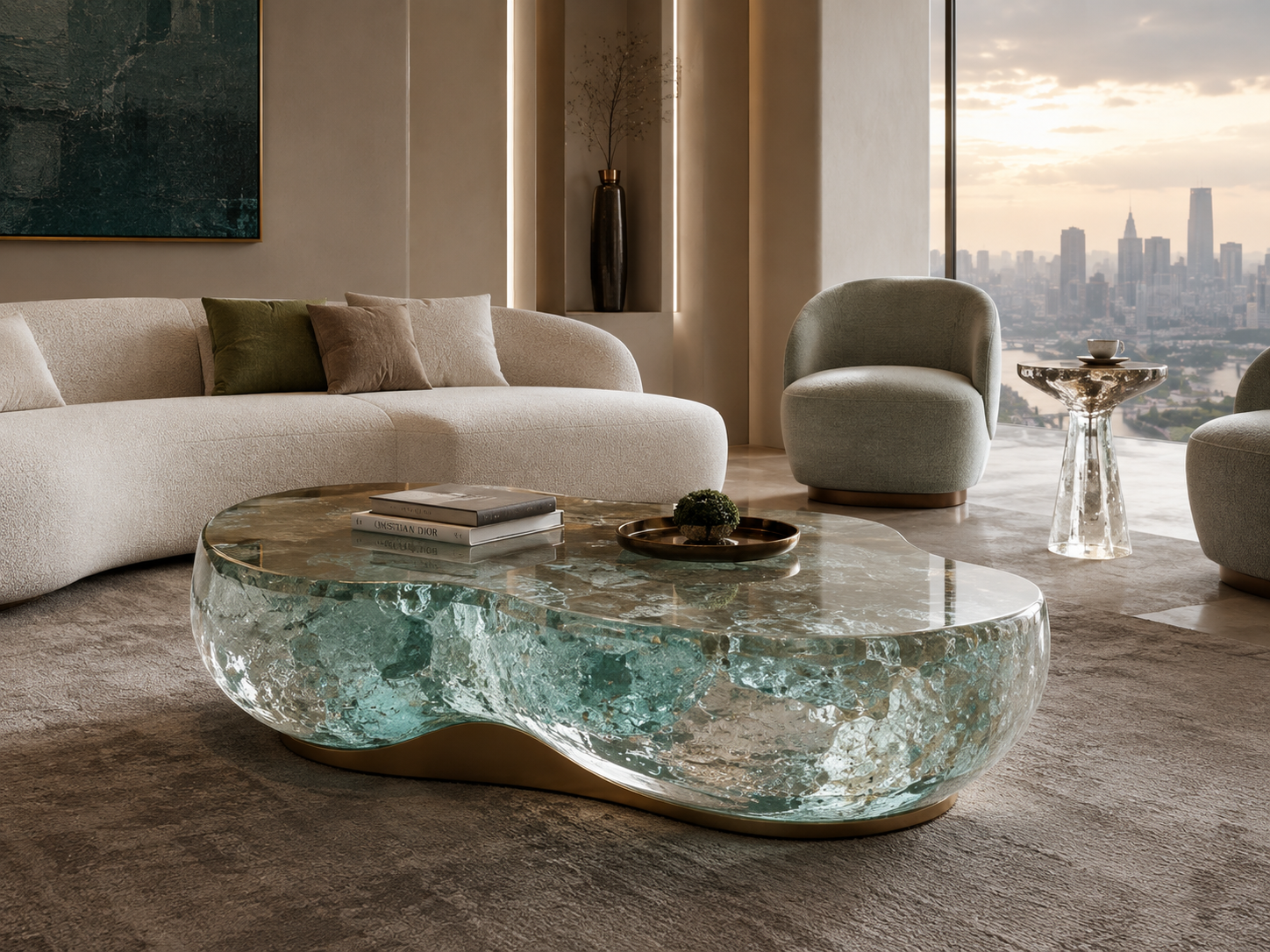
4. Coastal Countries Can Require Changes to Hardware Even When the Crystal Material Does Not Change
Another important example is coastal furniture.
Suppose a luxury resort in Florida and an inland residential project order exactly the same synthetic crystal console. The transparent body might not need to change significantly, but the hardware specification might.
Salt-containing atmospheric environments create additional corrosion risks for metals. ISO 9223 provides an internationally recognized system for classifying atmospheric corrosivity and includes environmental parameters relevant to metal corrosion, including airborne salinity. The standard remains current following ISO review.
This is particularly important for transparent furniture because hardware problems may become visible through the furniture itself.
A synthetic crystal table may contain threaded inserts, internal steel reinforcement, decorative metal plates, screws, or brackets. A platinum acrylic bench may connect to a stainless-steel frame. A high-end resin console may combine cast transparent components with brass or coated-steel detailing.
If a hidden metal part begins to corrode, discoloration can become visible through the clear body before the furniture experiences serious structural damage.
That means the coastal version of the same design may require a different stainless-steel grade, coating system, fastener specification, isolation detail, or drainage strategy.
ASTM D4329 itself reinforces why separate testing is necessary: accelerated UV exposure designed for plastics is not intended to reproduce every localized environmental phenomenon. Earlier and current guidance explicitly warns against assuming that a UV-and-moisture weathering procedure represents environments such as saltwater exposure.
In other words, receiving an impressive UV test report for a resin does not prove that the complete table is ready for a beachfront resort.
This is one reason experienced project furniture manufacturers evaluate the entire assembly rather than focusing exclusively on the hero material.
For coastal applications, the best synthetic crystal in the world can still be compromised by the wrong ten-cent fastener.
5. Cold and High-Altitude Countries Change the Requirements Again
Cold countries introduce almost the opposite problem.
A manufacturer may need to think about contraction, temperature cycling, impact behavior, differential movement between materials, and joint performance at lower temperatures. Yet UV should not be ignored simply because the climate is cold.
WHO specifically notes that UV levels increase with altitude because the atmosphere becomes thinner, while reflective surfaces such as fresh snow can increase UV exposure.
This has practical consequences for a crystal-like side table installed in a mountain chalet or a transparent acrylic bench used in a ski resort.
The furniture may spend long periods in a heated interior and then be moved onto a cold terrace. A semi-outdoor installation may experience repeated seasonal and daily temperature cycles. Acrylic, metal, resin, and adhesive systems do not necessarily change dimensions at identical rates.
The material scheme may therefore need to prioritize impact-modified grades, appropriate adhesives, more forgiving connection geometry, and sufficient movement allowance.
For platinum acrylic furniture, this is precisely why “PMMA” should not be treated as one single material specification. Manufacturers formulate and sell different PMMA grades for different priorities. Technical documentation for specialist PMMA products, for example, includes variations designed to improve impact performance while maintaining transparency and weathering characteristics.
Similarly, the synthetic crystal formulation used for a thick pedestal should be assessed under the intended temperature range rather than selected purely from a room-temperature showroom sample.
This demonstrates a broader purchasing principle: material family is not enough.
“Resin,” “acrylic,” and “synthetic crystal” describe categories. Professional furniture manufacturing requires decisions at the level of grade, formulation, thickness, processing method, and complete assembly.
The colder the environment—or the wider its seasonal temperature range—the more important those distinctions become.
6. Global Furniture Manufacturing Should Standardize the Design but Localize the Material Solution
For an international furniture brand, architect, distributor, hotel group, or procurement company, adapting materials by country does not mean abandoning standardization.
It means standardizing the right things.
The visible dimensions, geometry, color concept, transparency, proportions, and design language of a synthetic crystal coffee table can remain identical worldwide. Behind that visual consistency, the technical specification can be localized according to environmental risk.
A tropical version may prioritize moisture-resistant resin chemistry and stable bonding systems. A high-UV version may use a more highly stabilized synthetic crystal formulation or premium acrylic for critical clear components. A hot-climate platinum acrylic table may require greater allowance for thermal movement. A coastal version may use upgraded metal hardware and corrosion-resistant interfaces. A cold-climate version may prioritize thermal cycling and impact behavior.
Premium acrylic provides a useful example of why grade-level specification matters. Röhm states that certain specialized PLEXIGLAS® products used in demanding exterior infrastructure applications carry a 30-year guarantee against yellowing and retention of transparency and light transmission. This guarantee applies to those specific products and applications—not to every sheet of acrylic—but that distinction is exactly the point: credible durability comes from a defined material system with documented performance, not from a generic material name.
The same principle should apply to high-end furniture.
When an overseas customer asks whether a synthetic crystal table is “weather resistant,” a professional manufacturer should ask where the project is located, whether the furniture will be indoors, outdoors, or semi-outdoors, how much direct sunlight it receives, whether it is near the sea or a swimming pool, the expected temperature and humidity range, and how the product will be cleaned.
Those answers determine whether the project is best served by synthetic crystal, a specially formulated high-end resin, platinum acrylic, or a combination of several materials.
The result may look exactly the same in every country.
That is actually the objective.
A guest entering a luxury hotel in Singapore should see the same crystal-clear visual quality as a customer entering a residence in Dubai, a coastal resort in the United States, or a mountain hotel in Europe. Achieving that consistency does not come from forcing one material specification into every climate.
It comes from changing the invisible material engineering so that the visible design does not have to change.
That is why the same crystal furniture may need different material solutions in different countries—and why climate-specific engineering should be considered a mark of professional furniture manufacturing rather than unnecessary customization.

READ MORE:
- Perché alcuni mobili trasparenti diventano il punto focale della stanza anche senza colore, decorazioni o forme eccessive
- Dal piedistallo alla consolle: quali mobili in cristallo sintetico valorizzano meglio opere d’arte, prodotti e oggetti da collezione
- Un tavolo quasi invisibile può cambiare una stanza: come il volume visivo dei mobili influenza la percezione dello spazio
- Perché hotel, boutique e showroom scelgono mobili trasparenti quando vogliono mostrare di più senza riempire di più
- Quando un mobile trasparente funziona davvero: come usare il cristallo sintetico senza rendere lo spazio freddo o impersonale
- Which Overseas Projects Are Suitable for Synthetic Crystal Furniture? A Material Guide Based on Temperature, Humidity, and Light Exposure
- How Should Furniture Materials Be Selected for High-Temperature, High-Humidity, and High-Light Environments?
- How Does Furniture Material Selection Change Across Different Climate Regions?
- Why Weather Resistance Can Make or Break a Furniture Project: 3 Critical Material-Selection Factors for Synthetic Crystal Furniture


