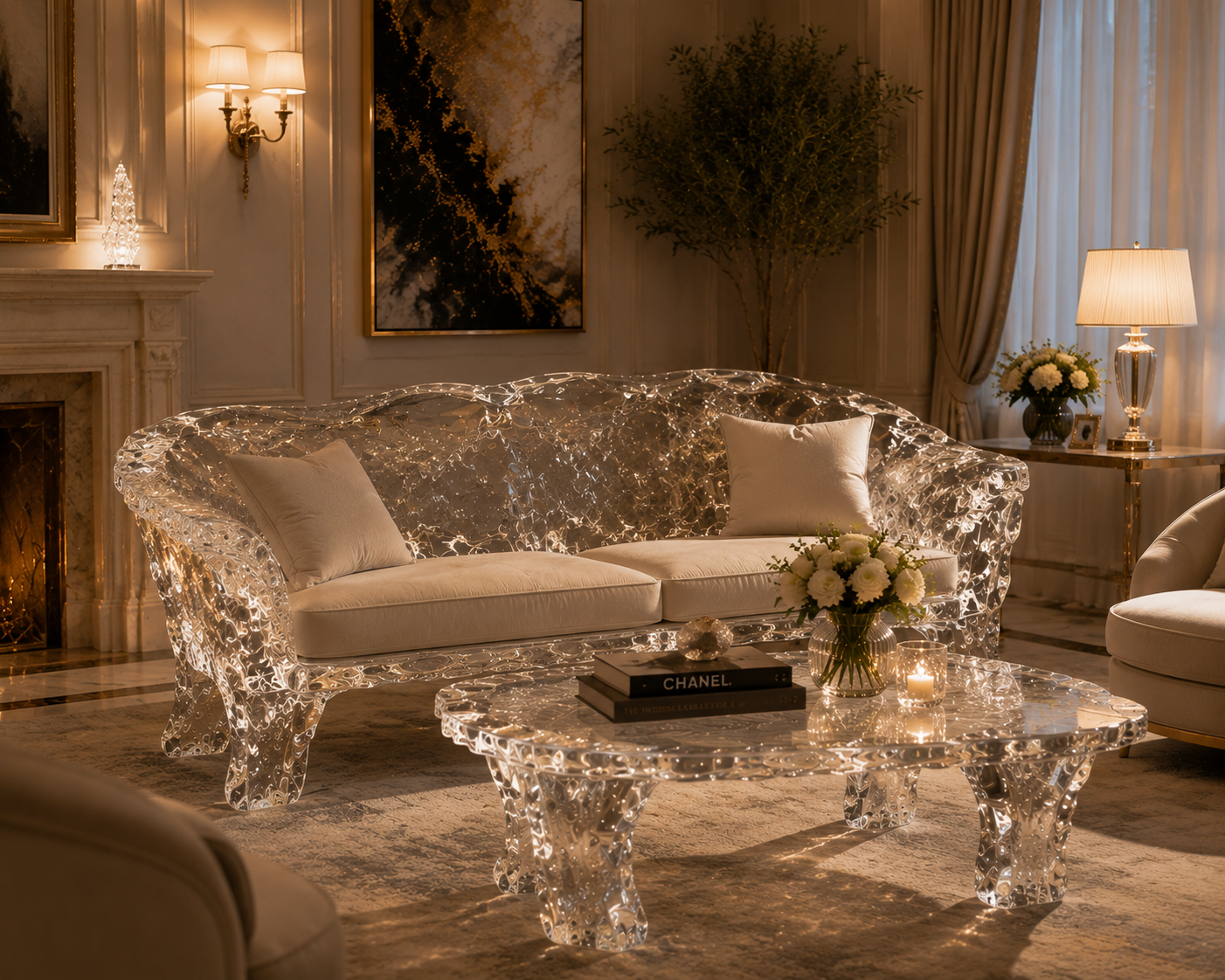

A transparent table installed in Singapore, a resin console specified for Dubai, and an acrylic bench used at a mountain resort may look similar in a furniture catalog, but they should not necessarily be built to the same material specification.
Climate changes the way furniture ages. Heat affects dimensional stability and accelerates some degradation processes. Humidity introduces moisture into materials and joints. Ultraviolet radiation can change color and optical properties. Salt-laden coastal air creates another challenge for metal connectors and mixed-material assemblies. Cold climates introduce contraction, impact concerns, and repeated temperature cycling.
This matters especially for luxury transparent furniture made from synthetic crystal, high-end resin, and premium or “platinum” acrylic. These materials are often chosen for clarity, depth, polished surfaces, sculptural forms, and visual impact. Consequently, appearance is part of their functional performance. A table that remains structurally intact but turns yellow, develops haze, shows stress around fasteners, or loses its crystal-clear appearance has still failed the design brief.
So the right question is not simply, “Which furniture material is the most durable?” It is: Which material system is best suited to the climate in which the furniture will actually be used?
1. Climate Should Be Treated as a Design Load, Not a Location on a Shipping Label
Furniture specifications often identify dimensions, color, surface finish, load requirements, and packaging before anyone seriously discusses climate. For international projects, that sequence should be reversed.
BIFMA, the Business and Institutional Furniture Manufacturers Association, addressed this issue in its 2025 Outdoor Furniture Whitepaper. The organization identified direct UV exposure, high heat, cold, and moisture as major environmental stresses for exterior furniture. After working with manufacturers and weathering specialists, BIFMA also concluded that it was not practical to create one material-independent accelerated-weathering method that could reliably connect environmental aging with the performance of every type of furniture.
That conclusion is important because “outdoor grade,” “weather resistant,” and “UV resistant” are often used as if they describe one universal performance level. They do not.
ISO 4892-3:2024, for example, evaluates plastics using fluorescent UV radiation together with heat and water to simulate important aspects of real environmental weathering. ASTM D4329-26 similarly addresses deterioration associated with light, heat, and water. Both approaches reinforce the same principle: real aging is produced by combinations of environmental factors rather than by a single variable.
For furniture buyers, architects, and hospitality procurement teams, climate should therefore become part of the initial product brief.
A synthetic crystal coffee table for an air-conditioned apartment in London requires a different risk assessment from the same design installed in an open-air villa in Southeast Asia. A platinum acrylic console inside a luxury retail store in Paris has different exposure from one positioned directly beside glazing in the Middle East. A high-end resin table used on a Mediterranean beachfront terrace has to deal with factors that an identical piece inside a New York residence may never encounter.
Material selection begins with exposure, not geography alone.
2. Hot and Humid Tropical Climates Require Control of Moisture, Heat, and Optical Aging
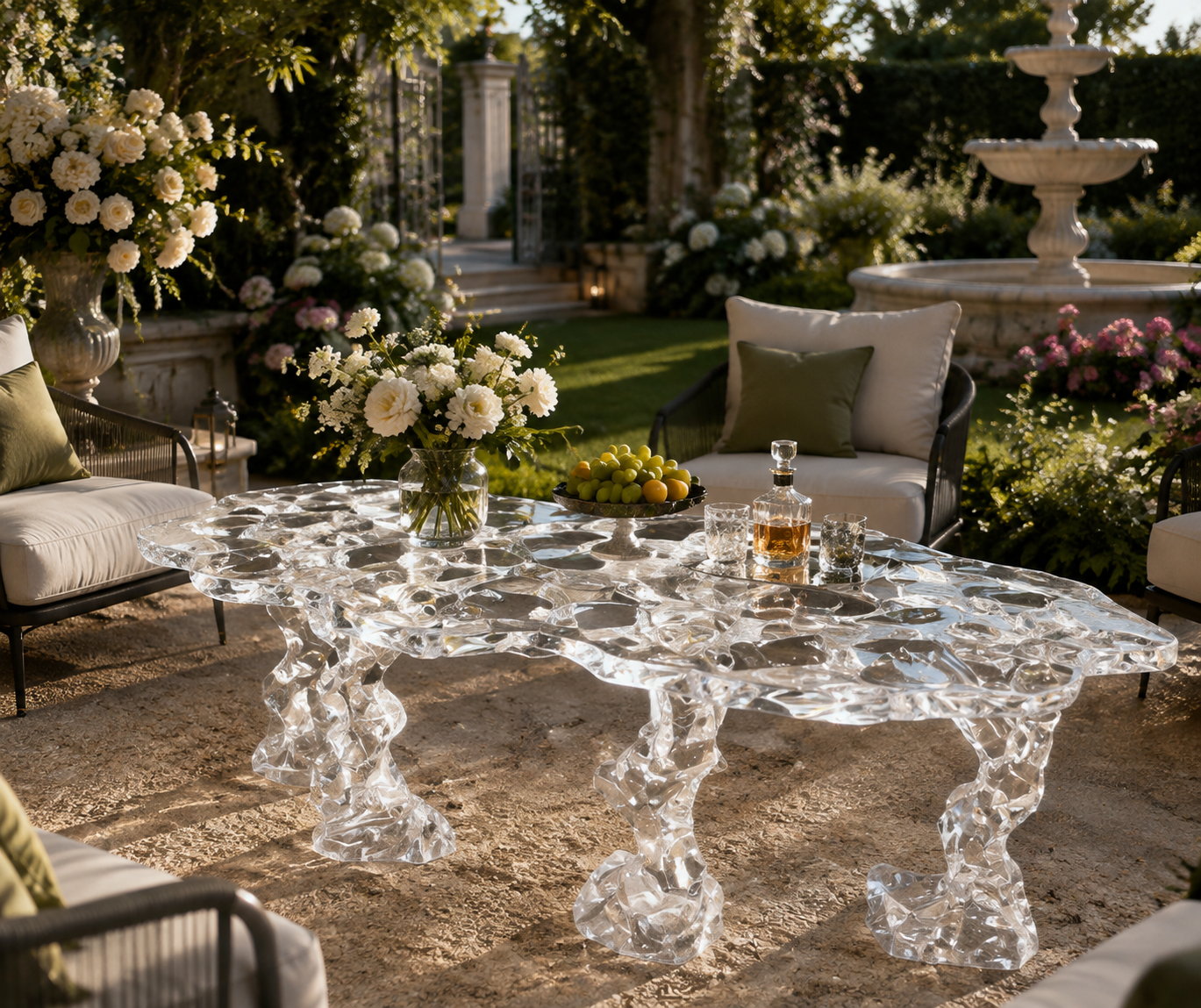
In tropical and subtropical locations, furniture often faces a difficult combination: sustained warmth, high humidity, strong solar exposure, heavy rainfall, condensation, and frequent cleaning.
For transparent furniture, moisture is not simply a question of whether water leaves stains on the surface. ASTM D570, which covers water absorption of plastics, explains that moisture content can be closely related to properties including mechanical strength, dimensions, and appearance. ASTM also notes that water absorption depends on exposure conditions, specimen geometry, and the characteristics of the material itself.
This has direct consequences for furniture design.
Consider a thick synthetic crystal pedestal table installed in a resort lobby in Thailand. The lobby may be covered, yet outside air continuously enters the space. The table can experience high humidity throughout the year, strong daylight from open façades, temperature fluctuations, wet cleaning, and occasional contact with drinks or water.
A general-purpose casting resin selected mainly because it produces an attractive transparent sample may not be the best choice. The resin formulation, curing process, casting thickness, pigment system, UV stabilization, polishing method, and bonding materials all need to be evaluated for the actual environment.
High-end resin remains highly valuable in tropical projects because it allows thick castings, complex curves, embedded decorative elements, translucent colors, gradients, and sculptural furniture forms that are difficult to achieve with conventional sheet materials. The selection logic, however, should prioritize formulations with documented environmental performance rather than simply maximum initial clarity.
Premium PMMA, including high-clarity acrylic products sometimes marketed in the luxury furniture industry as platinum acrylic, can be attractive when long-term transparency is the primary visual requirement. Technical data for specified PLEXIGLAS® PMMA products, for example, reports visible-light transmission around 91–92% and describes strong weathering performance. These values belong to the specified grades and should not be assumed for every acrylic product, but they demonstrate why material grade is more important than the generic word “acrylic.”
In tropical climates, therefore, the best material is usually the one whose optical stability, moisture behavior, joints, and surface finish have all been considered together.
3. Hot, Dry, and Desert Climates Shift the Priority Toward UV Exposure and Thermal Movement
Dry heat creates a different engineering problem.
Furniture specified for regions such as the Gulf, inland Australia, parts of the southwestern United States, or other hot and sunny locations may experience low rainfall yet extremely strong sunlight and major surface-temperature changes between day and night.
Humidity may be less important than in a tropical resort, but this does not make material selection easier.
The World Health Organization notes that solar UV levels are affected by latitude, sun elevation, cloud cover, altitude, ozone, and reflection from surrounding surfaces. This means that two locations with similar air temperatures may not expose a transparent furniture material to the same radiation environment.
For synthetic crystal and high-end resin furniture, UV stability therefore becomes a major purchasing criterion. Buyers should request evidence based on relevant accelerated-weathering methods rather than accepting a simple “anti-yellowing” claim. ISO 4892-3:2024 specifically exposes plastics to UV radiation, heat, and water to investigate weathering behavior associated with actual end-use environments.
Thermal movement also becomes particularly important with large furniture dimensions.
Technical information for specific PLEXIGLAS® cast and extruded PMMA grades gives a coefficient of linear thermal expansion of approximately 0.07 mm per meter per degree Celsius. That figure is grade-specific rather than a universal value for every acrylic, but it illustrates an important design issue. A two-meter transparent tabletop can undergo meaningful dimensional movement as its temperature changes.
If an acrylic tabletop is rigidly attached to a stainless-steel or brass base without enough allowance for movement, stress can become concentrated around fasteners, drilled holes, or bonded interfaces.
That is why a platinum acrylic dining table designed for a hot climate requires more than premium raw material. Hole dimensions, connector geometry, expansion allowance, adhesive selection, edge finishing, and installation method all influence durability.
In desert environments, UV resistance and thermal design often matter more than moisture resistance alone.
4. Coastal and Marine Climates Make the Weakest Material in the Assembly More Important
Coastal furniture specifications require a wider view because salt changes the risk profile.
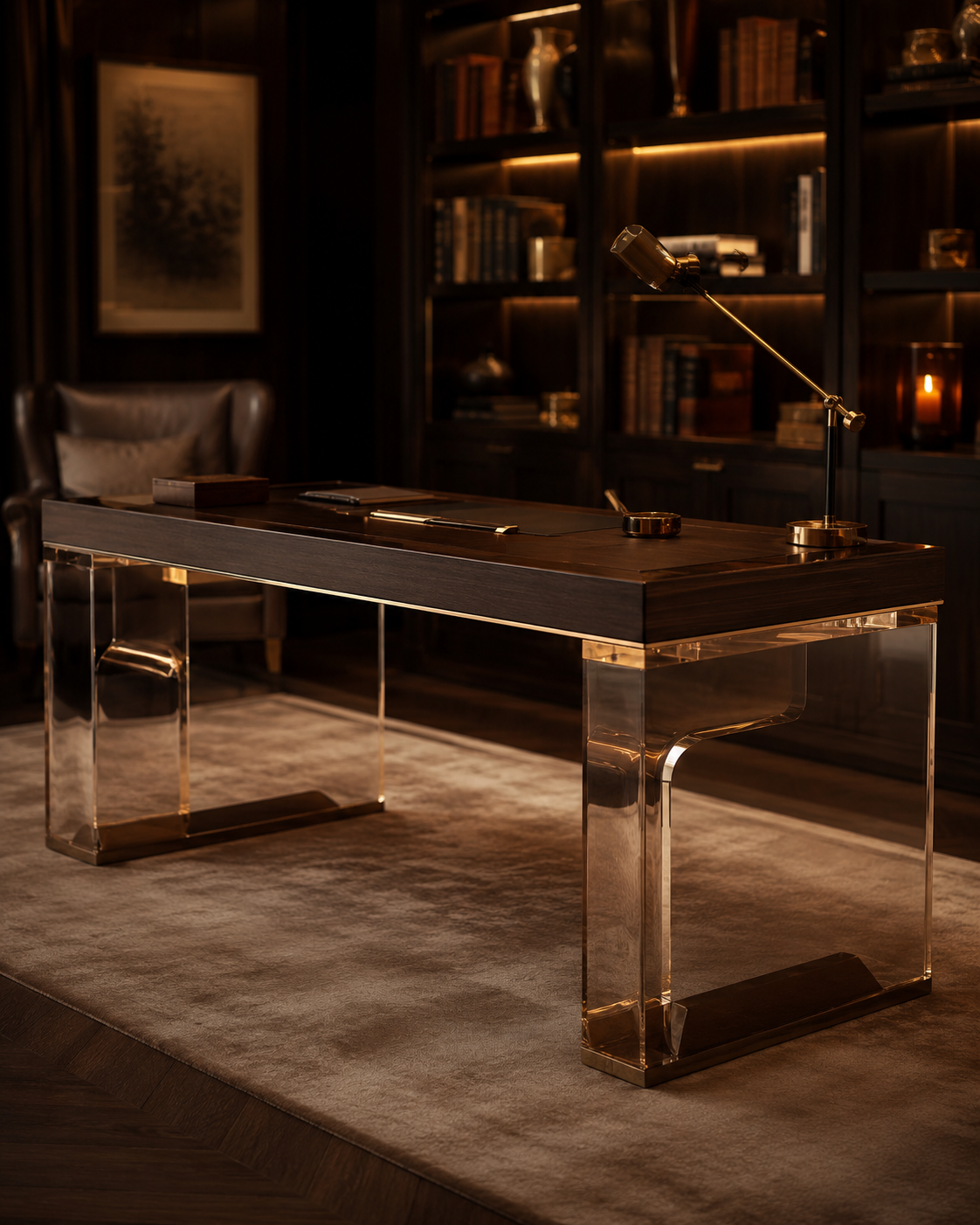
A transparent acrylic or synthetic crystal component may itself perform well, while metal bolts, hidden inserts, brackets, screws, decorative trims, or bonding interfaces become the point of failure.
ISO 9223 addresses atmospheric corrosion of metals and alloys and identifies environmental factors used to evaluate atmospheric corrosivity. Airborne salinity is especially relevant when products are installed near the coast. ISO 9224 complements this framework by providing guidance for corrosion attack over longer outdoor exposure periods.
For furniture, that means specifying the transparent body without reviewing the hardware is not enough.
Imagine a synthetic crystal side table produced for a beachfront resort. The cast body may retain excellent clarity, but if embedded metal components corrode, staining may become visible through the transparent material. If corrosion develops around a fastener, the problem can become both structural and aesthetic.
ASTM B117-26 provides a controlled salt-spray environment that is widely used to obtain comparative corrosion-resistance information for metals and coated metals. It should not be treated as a perfect prediction of years of real coastal service, but it can provide useful comparative evidence when metal hardware or coatings are being evaluated.
This changes the material-selection logic for luxury furniture.
For a coastal project, high-quality PMMA may be chosen for transparent surfaces because of its optical and weathering characteristics. Synthetic crystal or high-end resin may still be the better solution for thick sculptural bases and artistic components. But the specification must extend to stainless-steel grade, metal finishing, adhesive compatibility, drainage details, trapped moisture, and maintenance.
Even premium transparent materials cannot compensate for poorly chosen hardware.
In marine environments, the correct unit of evaluation is therefore the complete furniture assembly, not the decorative material in isolation.
5. Cold, Continental, and High-Altitude Climates Require Attention to Cycling, Impact, and UV
Cold climates create a very different misconception: because the weather is not hot, sunlight is sometimes considered less important.
That assumption can be dangerous.
WHO states that UV radiation increases with altitude because the atmosphere becomes thinner, and it also identifies fresh snow as a reflective surface capable of increasing UV exposure. Consequently, a transparent furniture installation at a high-altitude ski resort can experience significant light exposure even though ambient temperatures are low.
Temperature cycling is equally important.
Furniture in a continental climate can experience warm summers, freezing winters, heated indoor conditions, and repeated transitions between them. Large transparent components expand and contract, while adhesives, metals, and polymers may respond differently to the same temperature change.
For premium acrylic furniture, grade selection becomes especially important when impact is a concern. Technical information for PLEXIGLAS® Resist, for example, describes an impact-modified PMMA product with greater break resistance than standard acrylic while retaining high transparency and weather resistance. Again, this does not mean that every impact-modified acrylic has identical properties; it shows that PMMA can be engineered into different grades for different performance priorities.
For synthetic crystal furniture, designers should examine whether the resin system remains dimensionally and visually stable under the expected temperature range. Thick cast pieces, embedded metal structures, and bonding interfaces deserve particular attention because different components may contract at different rates.
Cold-climate furniture should therefore not be selected merely by choosing the material with the highest nominal strength at room temperature.
A better specification considers low-temperature behavior, thermal cycling, impact risk, joint design, sunlight, and the possibility of reflected UV from snow.
For mountain hotels, ski resorts, high-altitude residences, and cold-climate commercial projects, low temperature does not eliminate weathering—it changes the form weathering takes.
6. The Best Global Material Strategy Is to Match the Material to the Failure Risk
The biggest mistake in international furniture procurement is trying to establish one material hierarchy for every market.
Synthetic crystal is not automatically better than high-end resin. High-end resin is not automatically better than acrylic. Platinum acrylic is not automatically the correct solution for every transparent furniture application.
Their strengths are different.
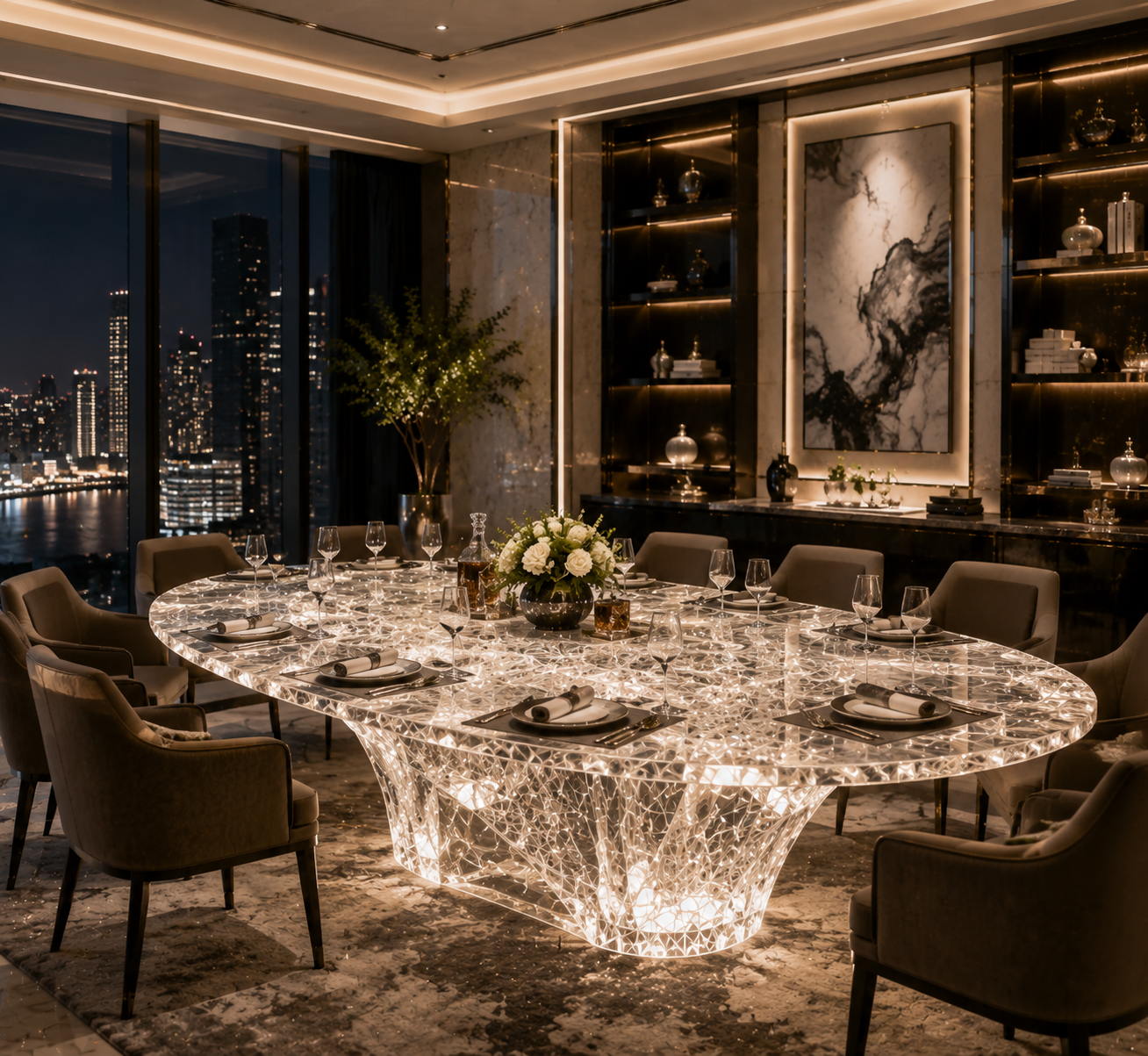
Synthetic crystal is particularly effective when a project requires thick monolithic forms, deep optical effects, embedded objects, artistic colors, or sculptural furniture such as statement coffee tables, dining-table bases, consoles, stools, and decorative pedestals.
High-end resin provides exceptional creative flexibility for gradients, inclusions, textures, irregular geometries, and custom cast pieces. Where these products will experience high UV, heat, or humidity, however, the specific resin formulation and documented weathering behavior become critical.
Premium cast PMMA or platinum acrylic is often attractive where very high transparency, polished edges, geometric precision, and long-term optical appearance are key priorities. Röhm, for example, provides a 30-year guarantee against yellowing for certain specified PLEXIGLAS® products intended for demanding exterior applications. That guarantee applies to those particular product systems, not to acrylic generically, but it illustrates the level of material-specific documentation that professional buyers should look for.
Optical performance can also be measured rather than judged only by eye. ASTM D1003 provides standardized methods for evaluating haze and luminous transmittance in transparent plastics and identifies these measurements as useful for specification and quality-control purposes. For luxury transparent furniture, this matters because a material can remain physically intact while an increase in haze makes it appear cloudy or inexpensive.
The practical selection logic is therefore climate-specific.
Hot and humid markets place greater emphasis on moisture, heat, optical stability, and complete resin systems. Hot and dry regions increase the importance of UV resistance and thermal movement. Coastal locations require corrosion-resistant hardware and careful mixed-material design. Cold and high-altitude environments bring temperature cycling, impact, and reflected or intensified UV into the calculation. Temperate climates may appear less demanding, but their wide seasonal variation can expose furniture to several of these mechanisms over the course of one year.
The best furniture manufacturer does not simply tell an international client, “This material is weather resistant.”
It asks where the furniture will be used, whether it is indoors, outdoors, or semi-outdoors, how much direct sunlight it receives, whether the environment is coastal, how the space is cleaned, what temperature range is expected, and which visual characteristics must remain unchanged.
That information determines whether the most appropriate solution is synthetic crystal, high-end resin, platinum acrylic, or a carefully engineered combination of several materials.
For architects, interior designers, luxury furniture brands, hospitality developers, and distributors working across different regions, climate-specific material selection is ultimately a form of risk management. It reduces premature yellowing, haze, dimensional problems, corrosion, joint failures, replacement costs, and disputes about product quality.
More importantly, it protects what luxury transparent furniture was designed to deliver in the first place: clarity, visual depth, precision, and lasting architectural impact.
READ MORE:
- Perché alcuni mobili trasparenti diventano il punto focale della stanza anche senza colore, decorazioni o forme eccessive
- Dal piedistallo alla consolle: quali mobili in cristallo sintetico valorizzano meglio opere d’arte, prodotti e oggetti da collezione
- Un tavolo quasi invisibile può cambiare una stanza: come il volume visivo dei mobili influenza la percezione dello spazio
- Perché hotel, boutique e showroom scelgono mobili trasparenti quando vogliono mostrare di più senza riempire di più
- Quando un mobile trasparente funziona davvero: come usare il cristallo sintetico senza rendere lo spazio freddo o impersonale
- Which Overseas Projects Are Suitable for Synthetic Crystal Furniture? A Material Guide Based on Temperature, Humidity, and Light Exposure
- Why Does the Same Crystal Furniture Need Different Material Specifications in Different Countries?
- How Should Furniture Materials Be Selected for High-Temperature, High-Humidity, and High-Light Environments?
- Why Weather Resistance Can Make or Break a Furniture Project: 3 Critical Material-Selection Factors for Synthetic Crystal Furniture


