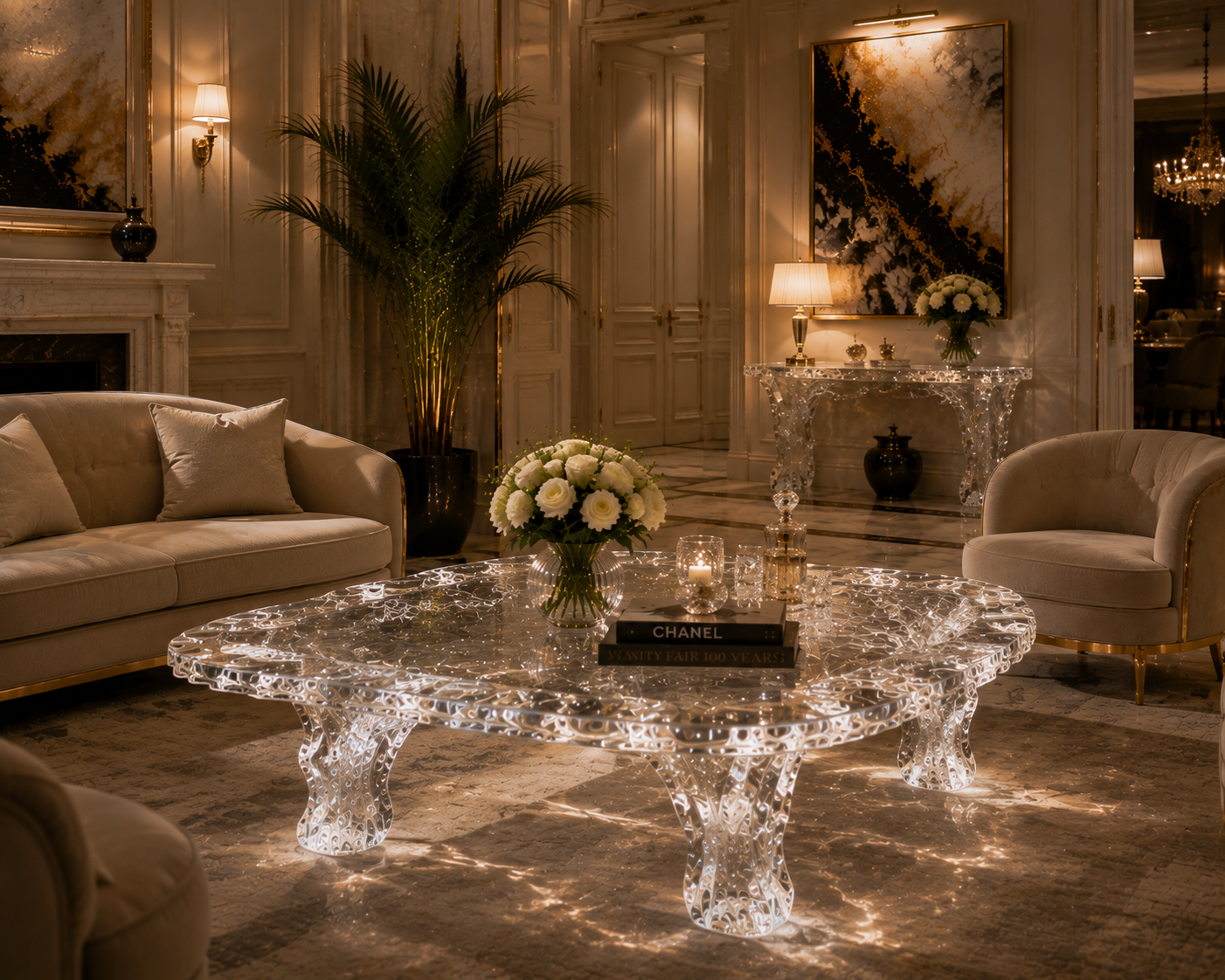
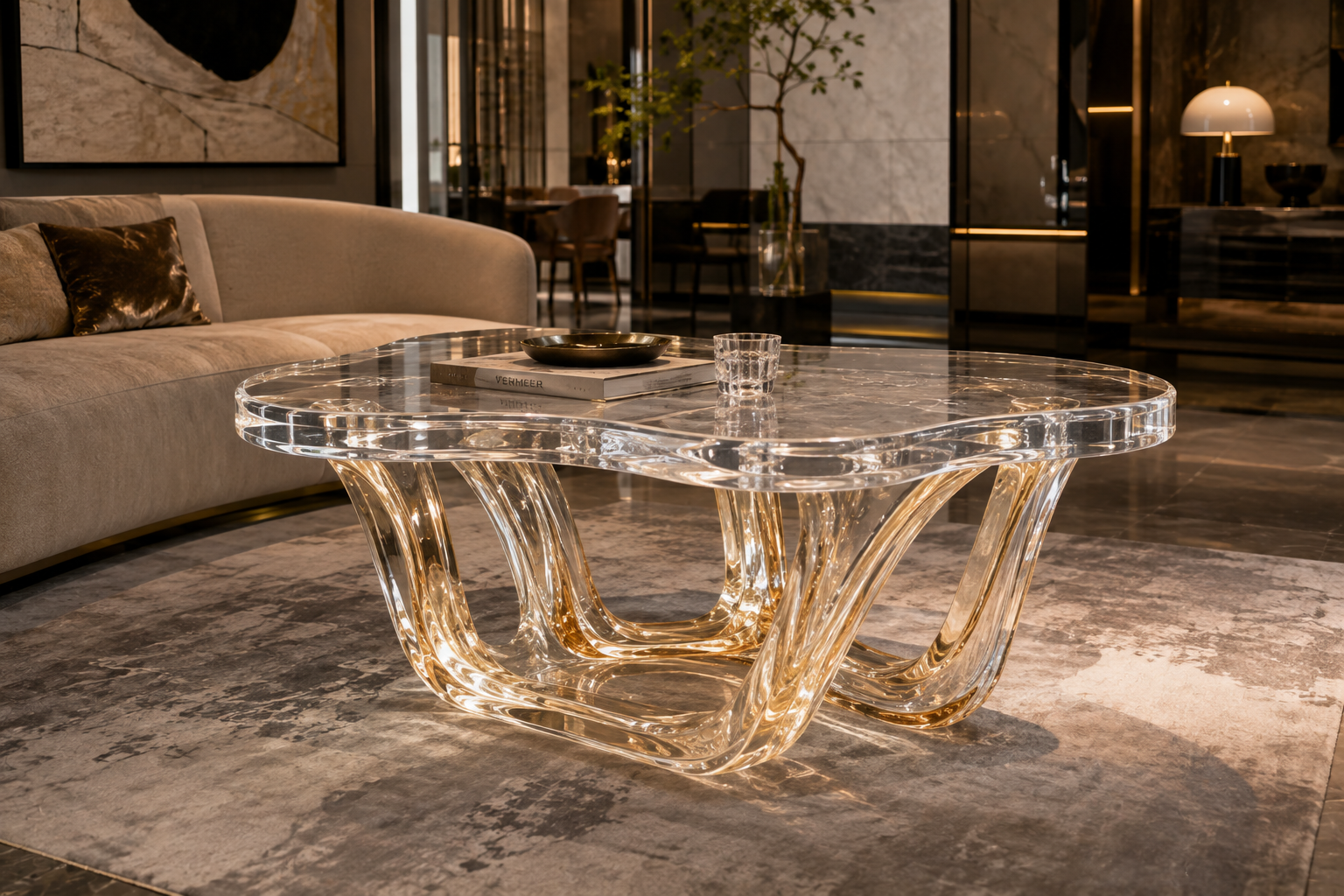
A furniture material that performs perfectly in an air-conditioned showroom may behave very differently when it is installed beside a floor-to-ceiling window, on a hotel terrace, in a tropical resort, or near a swimming pool. High temperature, high humidity, and intense light do not simply affect comfort; together, they can accelerate discoloration, dimensional movement, surface deterioration, loss of transparency, joint failure, and other forms of material aging.
This is especially important for transparent and translucent luxury furniture. Synthetic crystal coffee tables, high-end resin consoles, crystal-like dining table bases, transparent benches, sculptural resin furniture, and premium acrylic pieces are often selected precisely because of their clarity and visual depth. Their appearance is part of their function. If a transparent table remains structurally usable but becomes yellow, cloudy, distorted, or visibly stressed around its joints, the client will still regard the product as having failed.
BIFMA, the Business and Institutional Furniture Manufacturers Association, identified direct UV exposure, high heat, cold, and moisture as major environmental challenges for exterior furniture in its 2025 Outdoor Furniture Whitepaper. More importantly, BIFMA concluded that it is difficult to create one material-independent accelerated-weathering rule that can predict the performance of every furniture construction. In practical terms, there is no meaningful universal label called simply “weatherproof furniture.” The material, construction method, environment, and performance requirement have to be considered together.
So how should designers, furniture brands, hospitality buyers, and project contractors choose materials when heat, humidity, and strong light are all present?
1. Treat Heat, Humidity, and Light as One Combined Aging Environment
The first mistake in material selection is evaluating temperature, humidity, and sunlight separately.
In an actual project, furniture rarely experiences only one environmental stress. Imagine a transparent synthetic crystal side table on the terrace of a beachfront hotel. Strong sunlight heats the surface during the afternoon. High relative humidity surrounds the material for much of the day. Rain, condensation, or poolside water may repeatedly wet the furniture. At night, the temperature falls, and the material cools again. The same cycle repeats hundreds of times.
That combination matters because polymer degradation is driven by interacting mechanisms. The current ASTM D4329-26 standard for fluorescent-UV exposure of plastics specifically describes resistance to deterioration associated with light, heat, and water as significant to material performance. The standard is designed to induce changes associated with UV solar irradiance, moisture, and heat rather than treating UV exposure as an isolated phenomenon.
ISO takes a similar approach. ISO 4892-3:2024 describes laboratory exposure of plastics to fluorescent UV radiation, heat, and water to simulate important weathering effects associated with actual solar exposure, including solar radiation filtered through window glass. This last point is particularly relevant for furniture used indoors near large architectural windows: “indoor” does not automatically mean “protected from light aging.”
For a luxury furniture project, therefore, material selection should begin with an exposure profile rather than a catalog.
A synthetic crystal console in a climate-controlled private residence has a very different requirement from a similar-looking console installed in an open-air hotel lobby. A resin dining table beneath a skylight receives different exposure from one in a windowless restaurant. A platinum acrylic bench installed near a swimming pool must deal not only with light and heat but also with moisture, cleaning chemicals, and potentially chlorinated water.
The first question should not be, “Which material looks best?”
It should be, “What will this furniture actually experience every day?”
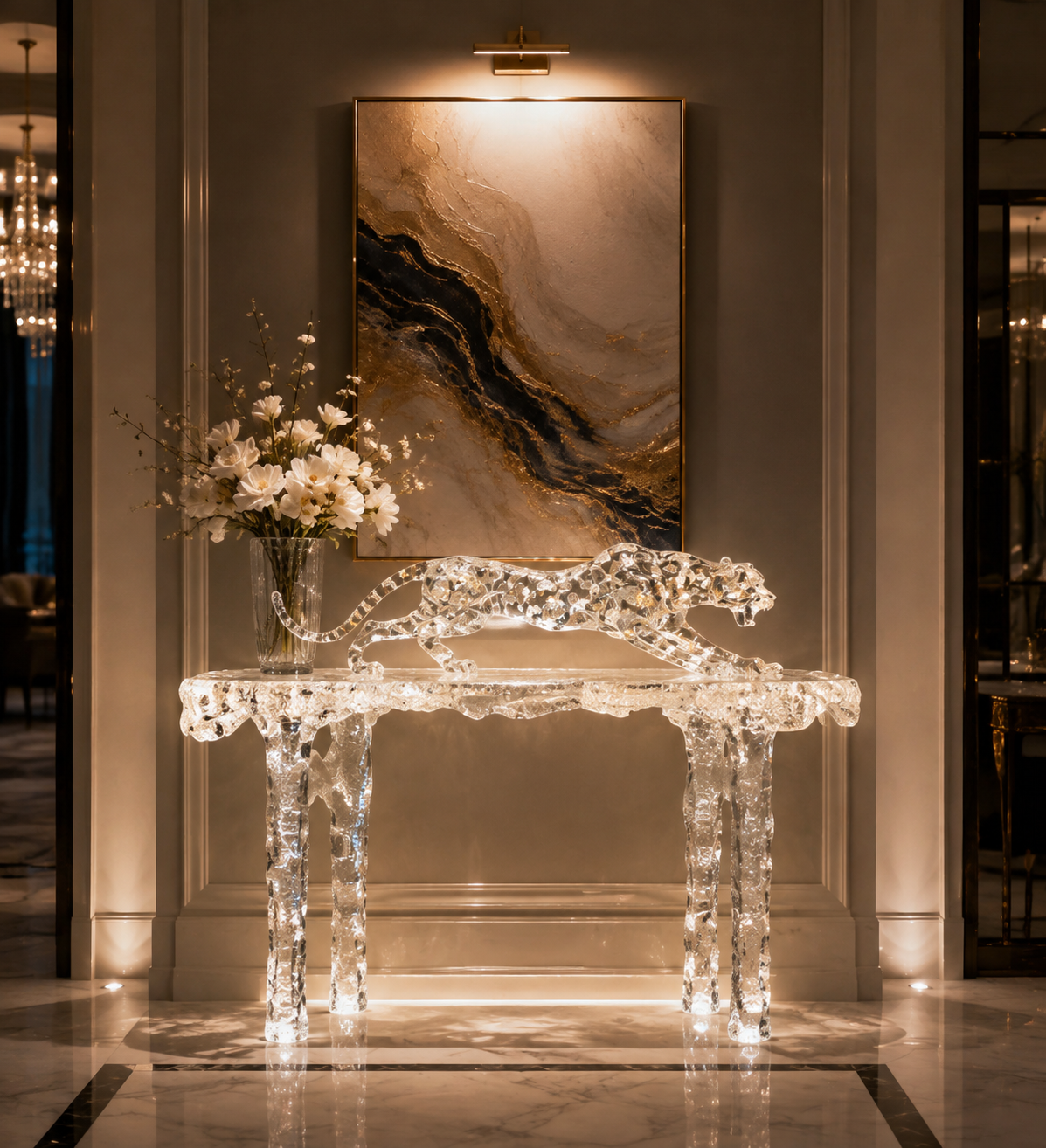
2. In High Temperatures, Look Beyond Whether the Material Simply “Melts”
When discussing heat resistance, buyers often ask for a maximum temperature. That number can be useful, but it does not tell the entire story.
Furniture does not need to melt to suffer heat-related problems. A transparent tabletop can expand enough to stress a rigid connector. A long acrylic component can move relative to a metal frame. An inadequately formulated resin can gradually discolor under repeated thermal exposure. A bonded joint can experience internal stress because two materials expand at different rates.
This is particularly important when transparent polymers are combined with stainless steel, brass, aluminum, stone, or glass—a common construction method in high-end furniture.
Technical information for PLEXIGLAS® PMMA, for example, lists a coefficient of linear thermal expansion of approximately 0.07 mm per meter per °C for standard cast and extruded grades over the stated temperature range. Its technical documentation also gives approximate maximum continuous service temperatures of around 80°C for specified cast grades and around 70°C for specified extruded grades. These numbers are product-specific rather than universal values for every acrylic, but they demonstrate why thermal movement must be designed into large transparent components.
Consider a large platinum acrylic dining table or console measuring two meters in length. Even when the operating temperature is far below the material's heat limit, meaningful dimensional movement can occur as temperatures change. If metal brackets, drilled holes, or adhesive connections do not accommodate that movement, stress can accumulate at exactly the places where a designer does not want to see it.
Heat can also affect resin aesthetically before obvious mechanical failure occurs. Research into the thermal aging of epoxy systems has documented changes from transparent toward yellow and eventually brown coloration as thermal exposure increases, with oxidation playing an important role in the process.
For synthetic crystal and high-end resin furniture, this makes formulation particularly important. A resin developed for decorative indoor casting should not automatically be assumed suitable for a sun-exposed hotel installation. UV stabilizers, resin chemistry, curing conditions, pigmentation, casting thickness, and post-curing procedures can all influence long-term results.
When specifying furniture for a hot environment, the correct requirement is therefore not simply “heat resistant.” The design must consider long-term optical stability, thermal expansion, connection design, material thickness, and the highest realistic surface temperatures the furniture may experience.
3. In High Humidity, Evaluate Moisture Effects on the Entire Furniture Assembly
Humidity is frequently underestimated because the furniture may never be completely submerged in water.
However, polymers interact with moisture even when there is no visible standing water. Long periods of high relative humidity, condensation, repeated cleaning, rain exposure, or wet-dry cycling may alter the behavior of the material and its interfaces.
ASTM D570, the standard test method for water absorption of plastics, explains why moisture matters. ASTM states that moisture content can be closely related to mechanical strength, appearance, and dimensions, and that the effect depends on the type of exposure, part geometry, and inherent properties of the plastic. ASTM also notes that water absorption behavior can differ between exposed edges and molded surfaces.
This becomes very practical in furniture manufacturing.
A polished synthetic crystal block is not the same object as a thin resin sample used in a laboratory. A thick resin pedestal has a large cross-section. A machined acrylic tabletop may contain drilled holes and polished edges. A transparent furniture assembly may also include adhesives, metal inserts, threaded fasteners, decorative inclusions, coatings, or laminated sections.
Each interface creates another question about moisture resistance.
Scientific studies of epoxy materials also demonstrate that elevated temperature and humidity can work together rather than independently. Research on hygrothermal aging of a common amine-cured epoxy examined yellowing under heat-and-moisture conditions and linked the discoloration to chemical changes associated with aging. The researchers also observed that simply drying previously saturated samples did not necessarily reverse the discoloration.
For the furniture buyer, the lesson is straightforward: moisture-related appearance changes cannot always be treated as temporary.
Take a high-end resin coffee table used in a tropical villa. If the furniture is repeatedly exposed to humid air and sunlight, the supplier should understand not only whether the finished resin absorbs moisture, but also whether the complete casting system remains optically stable and whether bonded details maintain their appearance.
For poolside or coastal projects, the specification should go even further. ASTM D4329 explicitly warns that its UV-and-water exposure procedure is not intended to reproduce localized environmental effects such as saltwater exposure. Therefore, a supplier presenting a standard UV-weathering report has not automatically demonstrated that the furniture is suitable for a marine environment.
Real environmental conditions must always take priority over marketing terminology.
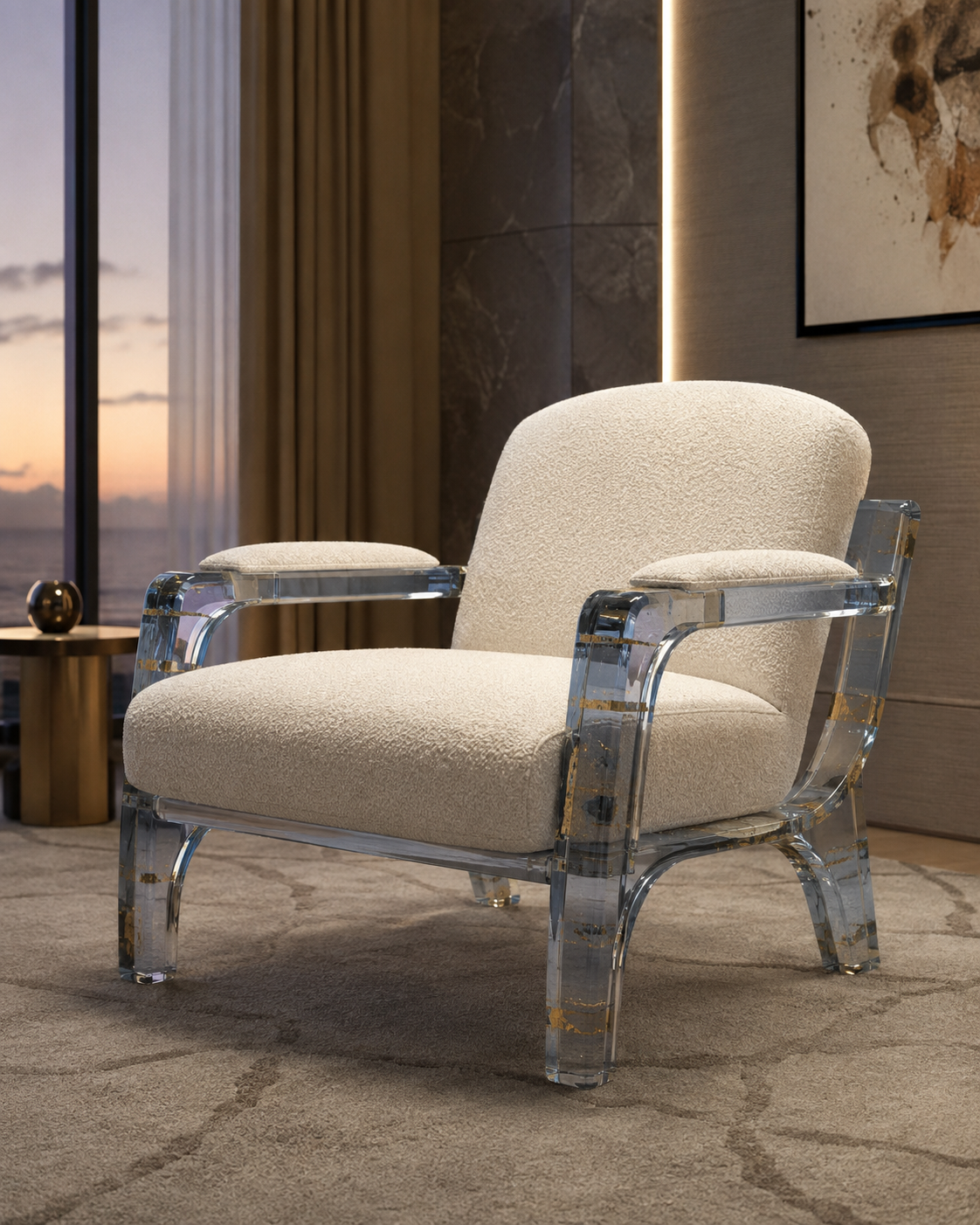
4. Under Strong Light, Optical Stability Matters as Much as Structural Strength
Strong light is particularly unforgiving to transparent furniture because aging is visible.
With an opaque furniture surface, a modest internal chemical change may go unnoticed. With a water-clear synthetic crystal table, platinum acrylic console, or transparent resin sculpture, small changes in color and haze can immediately affect perceived quality.
This is why “UV resistant” should never be the end of the discussion.
ISO 4892-3:2024 and ASTM D4329-26 provide established approaches for accelerated exposure of plastics to UV, heat, and moisture. But ASTM also warns that exposure conditions must be reported and that results can vary with testing conditions. It recommends comparison with a control material of known performance and recommends exposing at least three replicates when statistical evaluation is required.
After exposure, the change also has to be measured.
ASTM E313-20(2025) provides a method for calculating yellowness and whiteness indices for near-white or colorless materials, including plastics. For a premium transparent furniture project, this is far more meaningful than allowing someone to look at an aged sample and simply say, “It still seems clear.”
Transparency should also be assessed quantitatively. ASTM D1003 addresses haze and luminous transmittance in transparent plastics and specifically identifies these measurements as useful for quality control and specification. The standard explains that scattered light can create a hazy or smoky appearance even when light still passes through the material.
That distinction matters enormously in luxury furniture.
A synthetic crystal dining table base may still transmit light but lose the deep, water-like clarity that originally justified its price. A high-end resin console may remain structurally sound but develop a slight yellow cast. A platinum acrylic coffee table may retain excellent transparency in the material itself but look poor because its bonding lines, polished edges, or surface scratches have become more visible.
Premium PMMA demonstrates what is technically possible when optical performance and weatherability are designed together. Manufacturer data for specified PLEXIGLAS® grades reports visible-light transmittance around 92%, alongside UV-absorbing properties for designated grades. Those figures should not be generalized to every acrylic product, but they illustrate why the exact PMMA grade matters more than the generic word “acrylic.”
For transparent furniture, appearance is not merely decoration. Clarity is a performance requirement.
5. Choose Synthetic Crystal, High-End Resin, and Platinum Acrylic According to the Application
There is no single transparent material that is best for every hot, humid, high-light environment.
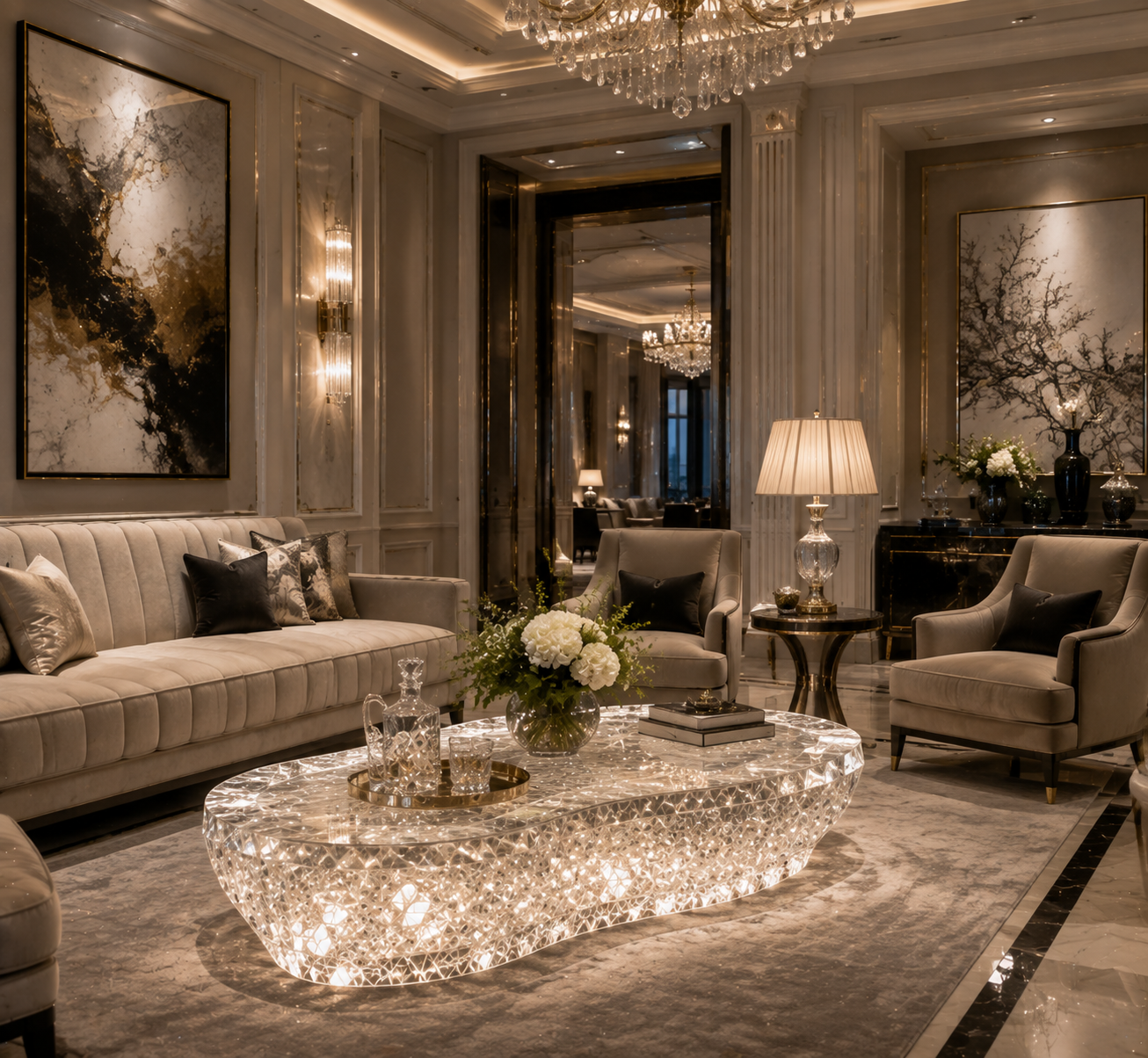
Synthetic crystal is particularly valuable when designers want thick, monolithic visual forms, crystal-like depth, artistic coloration, embedded objects, flowing geometries, or sculptural cast furniture. It can be used for coffee tables, side tables, dining table bases, consoles, stools, decorative pedestals, and statement pieces that would be difficult to manufacture using conventional sheet materials.
For these products, the resin system behind the “synthetic crystal” appearance becomes critical. When the furniture will receive substantial sunlight or heat, the manufacturer should select a formulation developed for optical stability under the intended conditions rather than using a general-purpose clear casting resin.
High-end resin offers even greater freedom in colors, gradients, textures, inclusions, and large sculptural forms. It can be an excellent material for custom furniture where artistic expression is more important than achieving the perfectly uniform appearance of a sheet product. However, scientific research shows that epoxy-type systems can undergo yellowing and other aging effects under thermal, UV, and hygrothermal exposure, so resin chemistry and stabilization cannot be ignored.
Premium acrylic, including the high-clarity PMMA products that may be commercially positioned as platinum acrylic in luxury furniture collections, has a different strength. It is particularly suitable for crisp transparent geometries, polished edges, precision-machined furniture components, clear table legs, consoles, shelves, benches, and architectural-style furniture where consistent optical clarity is central to the design.
High-quality PMMA products can provide excellent optical and weathering performance, but even here the furniture must be engineered correctly. The technical properties of specified PLEXIGLAS® grades show approximately 92% visible-light transmittance while also documenting thermal expansion and grade-dependent service-temperature limits. The same data sheet therefore illustrates two sides of material selection: excellent transparency does not eliminate the need to manage temperature and dimensional movement.
In many luxury projects, the best answer is actually a combination.
A custom furniture collection might use platinum acrylic where maximum optical precision is required, synthetic crystal for thick sculptural table bases, and high-end colored resin for artistic components. Stainless steel or brass may then provide structural reinforcement or decorative contrast.
The goal is not to prove that one material is universally superior. It is to put each material in the environment where its strengths create the greatest value.
6. Turn “Weather Resistant” Into a Measurable Procurement Specification
The most reliable furniture projects are those in which performance expectations are defined before production begins.
When a supplier says a material is “UV resistant,” “anti-yellowing,” “outdoor grade,” or “weather resistant,” professional buyers should ask what those terms actually mean for the finished furniture.
ASTM D4329-26 itself is a useful reminder that accelerated weathering is not a simple conversion machine. The standard states that its laboratory exposure is intended to induce changes associated with certain end-use conditions, but it does not reproduce every localized environmental factor. ASTM also requires operating conditions to be reported because differences in exposure conditions can affect results.
BIFMA reached a related conclusion when researching outdoor furniture: after years of work with furniture manufacturers and accelerated-weathering specialists, its committee concluded that developing one material-agnostic method linking accelerated weathering directly to furniture safety and performance was not presently practical.
That is why claims such as “1,000 hours of UV testing” should never be interpreted automatically as a specific number of years of real-world furniture life. Exposure geography, orientation, temperature, humidity, rain, pollution, chemicals, material formulation, color, thickness, and construction all affect actual aging.
For transparent luxury furniture, a stronger procurement specification should identify the real installation environment and then define measurable acceptance criteria. Weathering can be evaluated using relevant ISO or ASTM exposure procedures; changes in transparency can be checked using haze and transmittance measurements such as ASTM D1003; and yellowing of near-colorless materials can be tracked instrumentally using practices such as ASTM E313.
The project should also be evaluated at furniture level, not only material level. A sample of platinum acrylic may perform beautifully by itself while the finished table develops stress around poorly designed fasteners. A synthetic crystal resin may have good UV stability while an unsuitable adhesive yellows visibly behind it. A high-end resin panel may retain its color while an exposed metal-resin connection performs poorly under repeated thermal cycling.
For hotels, luxury residences, resorts, restaurants, retail environments, and custom commercial projects, this engineering approach protects much more than the furniture.
It protects the original design concept.
The real question in high-temperature, high-humidity, and high-light environments is therefore not simply, “Which material is the most durable?”
It is:
“Which material and construction system can preserve the appearance, dimensions, connections, and performance that this particular project requires under its actual conditions?”
When synthetic crystal, high-end resin, and platinum acrylic furniture are selected according to that standard, environmental resistance becomes more than a technical specification. It becomes one of the reasons a luxury furniture project still looks intentional, valuable, and beautiful years after installation.
READ MORE:
- Perché alcuni mobili trasparenti diventano il punto focale della stanza anche senza colore, decorazioni o forme eccessive
- Dal piedistallo alla consolle: quali mobili in cristallo sintetico valorizzano meglio opere d’arte, prodotti e oggetti da collezione
- Un tavolo quasi invisibile può cambiare una stanza: come il volume visivo dei mobili influenza la percezione dello spazio
- Perché hotel, boutique e showroom scelgono mobili trasparenti quando vogliono mostrare di più senza riempire di più
- Quando un mobile trasparente funziona davvero: come usare il cristallo sintetico senza rendere lo spazio freddo o impersonale
- Which Overseas Projects Are Suitable for Synthetic Crystal Furniture? A Material Guide Based on Temperature, Humidity, and Light Exposure
- Why Does the Same Crystal Furniture Need Different Material Specifications in Different Countries?
- How Does Furniture Material Selection Change Across Different Climate Regions?
- Why Weather Resistance Can Make or Break a Furniture Project: 3 Critical Material-Selection Factors for Synthetic Crystal Furniture


