In luxury interior design, differentiation has always been important. A five-star hotel, private villa, flagship store, premium club, luxury restaurant, or high-end commercial space is expected to offer something that ordinary environments cannot easily reproduce. In the past, this differentiation was often achieved through decorative style. Designers changed colors, patterns, furniture shapes, lighting arrangements, and artistic accessories to establish a distinctive atmosphere.
Today, however, high-end projects are moving one step further.
Increasingly, designers, developers, architects, and project owners are paying attention not only to what furniture looks like, but also to what the furniture is actually made from.
This is where material differentiation becomes important.
Among the materials attracting attention in contemporary luxury interiors, synthetic crystal acrylic has become particularly interesting. With its crystal-like transparency, substantial visual presence, customizable structure, and ability to interact dramatically with lighting, acrylic furniture offers a design language that is very different from traditional solid wood, metal, stone, or upholstered furniture.
The growing popularity of synthetic crystal acrylic furniture is therefore not simply the result of a trend toward transparent furniture. It reflects a broader change in the luxury project market: materials themselves are becoming part of a project's identity.
For high-end spaces, material selection is no longer a secondary technical decision. It has become a strategic design tool.
1. High-End Design Is Moving from Style Differentiation to Material Differentiation
The luxury interior market has become increasingly sophisticated.
Many design styles that were once considered distinctive are now widely available. Minimalist interiors, contemporary European spaces, modern Italian-inspired furniture, neutral luxury palettes, brushed metal details, marble surfaces, and sculptural lighting can now be found in projects across many markets.
This creates a new challenge for designers.
If different hotels, villas, offices, showrooms, and luxury residences use similar colors, similar furniture silhouettes, and similar decorative concepts, how can a project establish a truly recognizable identity?
One answer is material differentiation.
Two chairs may have almost the same shape, but their visual impact can be completely different if one is manufactured from conventional timber while the other is constructed from thick crystal-clear acrylic.
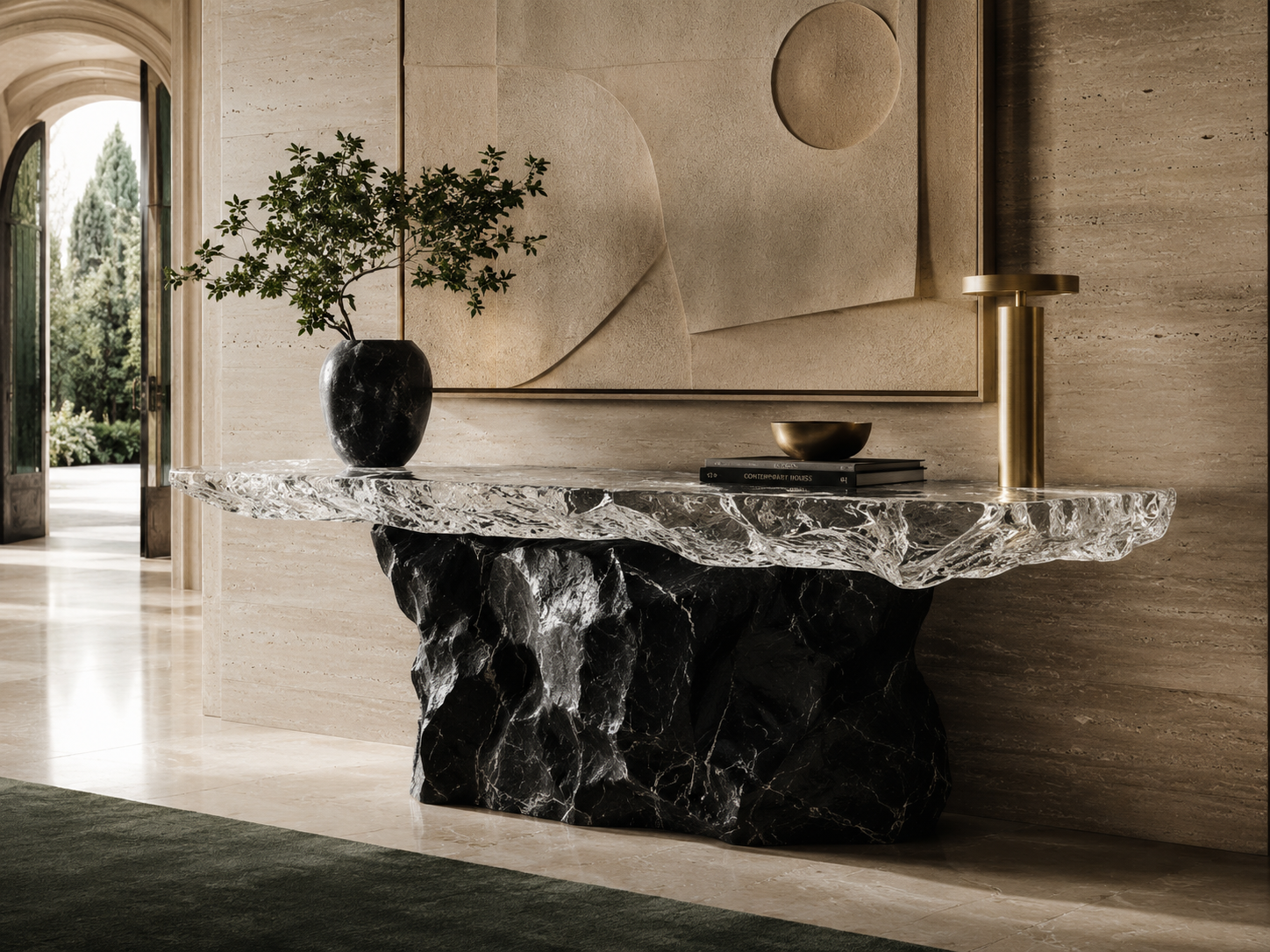
A console table may have a simple rectangular profile, yet when it is produced from highly transparent acrylic with polished edges and significant thickness, the object begins to feel less like conventional furniture and more like an architectural sculpture.
This difference is important.
Luxury design is increasingly about the quality of details that are not easily copied at first glance. The material itself becomes part of the experience.
Synthetic crystal acrylic furniture gives designers a way to create familiar functions through an unfamiliar visual language. Chairs, tables, stools, benches, consoles, cabinets, display stands, bar furniture, side tables, and decorative objects can all be reinterpreted through transparency and optical depth.
This is particularly valuable in projects where the designer wants to avoid standardized furniture.
A project may use a relatively restrained interior palette but still appear highly distinctive because of one or two carefully selected acrylic furniture pieces.
In this context, the furniture does not need excessive decoration.
The material becomes the decoration.
This is one of the reasons material differentiation is becoming increasingly important in premium projects. Instead of adding more ornamental elements, designers can generate visual interest through the intrinsic characteristics of the material.
For architects and interior designers, this creates a more refined form of differentiation.
2. Transparency, Light, and Sculptural Presence Create a Different Visual Experience
One of the strongest advantages of synthetic crystal acrylic furniture is its relationship with light.
Traditional furniture usually blocks light. A wooden table, upholstered chair, or stone pedestal occupies visual space through mass and opacity.
Transparent acrylic behaves differently.
Light can pass through the material, reflect along polished surfaces, and create highlights around edges and corners. Thick sections can produce a stronger sense of optical depth, while carefully finished surfaces can give the furniture a polished, crystal-like character.
This interaction changes the visual weight of furniture.
A large acrylic table can occupy considerable physical space while appearing visually lighter than a similarly sized wooden or stone table. This is especially useful in high-end interiors where designers want substantial furniture without making the room feel crowded.
Consider a luxury apartment with panoramic windows.
Placing a heavy opaque console near the glazing may interrupt the sense of openness. A crystal-clear acrylic console can provide the required function while preserving the visual connection between the interior and the view.
The same principle can be applied to boutique hotels, luxury retail spaces, reception areas, private clubs, and gallery-style residences.
Transparency also creates interesting opportunities for lighting design.
Under warm lighting, clear acrylic can take on a soft and elegant appearance. Under focused architectural lighting, polished edges can become more visually prominent. In spaces with decorative lighting or illuminated backgrounds, transparent furniture can interact with its surroundings instead of visually separating itself from them.
This means acrylic furniture often changes throughout the day.
Natural daylight, sunset lighting, ambient illumination, and nighttime architectural lighting can each create a slightly different appearance.
For luxury projects, this dynamic quality is valuable.
High-end interior design increasingly focuses on experience rather than static decoration. Designers want spaces that feel different from various angles and under different lighting conditions.
Synthetic crystal acrylic furniture supports this objective because its visual character depends partly on the surrounding environment.
Another important factor is thickness.
Thin transparent plastic and substantial crystal-like acrylic furniture create very different impressions. In high-end projects, designers often use thicker material sections to produce a stronger sense of substance, optical depth, and craftsmanship.
The result can resemble a functional sculpture.
Acrylic dining tables, coffee tables, benches, and consoles can therefore become focal points even when their geometry is relatively simple.
Instead of relying on elaborate carving or ornament, the furniture creates visual impact through transparency, proportion, polishing, and material mass.
That minimalist form of luxury is increasingly attractive to contemporary designers.
.png)
3. Customization Gives Designers More Freedom to Build Unique Spaces
Luxury projects rarely want to look completely standardized.
Even when designers select products from established furniture collections, they often require changes in dimensions, finishes, colors, configurations, or structural details.
For major hospitality and residential projects, customization is even more important.
Synthetic crystal acrylic furniture is particularly suitable for this environment because it can be developed in many different forms depending on manufacturing capabilities and project requirements.
Designers may specify different thicknesses, proportions, transparent or tinted appearances, edge profiles, surface treatments, combinations with other materials, and custom dimensions.
Acrylic can also be combined with stainless steel, brass finishes, glass, upholstery, wood, stone, lighting components, or decorative inserts.
This opens a wide range of design possibilities.
For example, a luxury hotel may require custom acrylic side tables that visually match the geometry of its guest rooms.
A flagship retail store may need transparent display furniture that does not compete visually with the products being presented.
A private villa may use an oversized acrylic dining table designed specifically for the dimensions of the dining room.
A high-end club may require illuminated acrylic elements integrated into bar furniture.
A designer may even use tinted or colored acrylic to create a signature visual identity across several pieces.
These possibilities are difficult to achieve with mass-market furniture.
Customization therefore becomes another level of material differentiation.
The value is not simply that the furniture is made from acrylic. The real value comes from the ability to use the material in a way that belongs specifically to the project.
This distinction is important for luxury buyers.
At the premium end of the market, customers often do not want to purchase exactly the same furniture they have seen in many other locations.
They want something recognizable but individualized.
Custom acrylic furniture allows designers to control dimensions and visual language while maintaining a contemporary aesthetic.
It can also support architectural continuity.
Acrylic furniture can echo the proportions of wall panels, doorways, ceiling structures, display fixtures, or lighting features. When furniture and architecture share similar design logic, the project feels more coherent.
This is why supplier capability matters.
Producing premium acrylic furniture requires more than simply cutting transparent material into basic shapes. High-end projects may require precise fabrication, controlled bonding, careful polishing, structural planning, consistent dimensions, prototype development, and quality inspection.
As project requirements become more complex, designers increasingly evaluate manufacturers not only by price but also by engineering capability and customization experience.
Material differentiation therefore depends heavily on manufacturing quality.
A creative design can only deliver a premium result when the production process supports the original concept.
4. Material Storytelling Strengthens the Perceived Value of Luxury Furniture
Luxury is not created only by appearance.
It is also created by perception.
When customers encounter premium furniture, they often want to understand why it is special.
What material is being used? How was it manufactured? Why does it look different? Was it made specifically for the project? Is the construction technically difficult? How does it interact with the architecture?
These questions contribute to what can be described as material storytelling.
In high-end projects, furniture increasingly needs a story that goes beyond function.
Synthetic crystal acrylic naturally supports this type of storytelling because the material immediately looks different from conventional furniture.
A thick transparent table can prompt curiosity.
A polished acrylic chair can appear almost invisible from one angle and highly reflective from another.
A transparent console combined with metal or stone can create an unusual contrast between visual lightness and physical substance.
These characteristics give designers something meaningful to communicate.
Instead of describing a furniture piece only as “modern” or “luxury,” the designer can explain the relationship between transparency, light, structure, and surrounding materials.
That creates a richer design narrative.
Material storytelling is especially important in hospitality and retail environments.
Hotels increasingly compete through memorable interior experiences. Luxury stores use architecture and furniture to reinforce brand identity. Restaurants and private clubs rely on atmosphere to differentiate themselves from competitors.
In these environments, unusual materials can become part of the brand experience.
Guests may not know the technical details of the furniture, but they can recognize that the environment feels distinctive.
That perception contributes to premium positioning.
The same principle applies to residential design.
High-net-worth homeowners often want interiors that feel personal rather than formulaic. A bespoke acrylic table, console, or bench can function as a statement piece that is closely connected to the architecture of the home.
Material differentiation also helps designers create contrast.
Acrylic does not need to dominate the entire space.
In many cases, its strongest effect comes from being placed next to contrasting materials.
Transparent acrylic beside natural stone creates a contrast between visual lightness and geological weight.
Acrylic beside dark timber creates a contrast between transparency and warmth.
Acrylic combined with brushed metal can produce a highly contemporary atmosphere.
Acrylic beside soft leather or fabric can balance hardness with comfort.
These combinations allow designers to build more sophisticated material palettes.
In other words, the value of acrylic furniture does not exist in isolation.
Its value often comes from the relationships it creates with surrounding materials.
That makes it particularly useful in luxury interior design, where material composition is carefully controlled.
5. Acrylic Furniture Integrates Well with Contemporary Luxury Architecture
Modern luxury spaces increasingly emphasize openness.
Large windows, high ceilings, architectural lighting, natural stone surfaces, metallic details, and clean geometric lines are common characteristics of premium interiors.
Furniture must work within this architecture rather than overpower it.
This is another reason synthetic crystal acrylic furniture has become attractive.
Because transparent furniture allows visual information to continue through the object, it can maintain a sense of openness.
Acrylic furniture can provide function without creating the same visual barrier as opaque furniture.
This quality is useful in many applications.
In a hotel lobby, acrylic side tables can support lounge seating while keeping the overall environment visually spacious.
In a luxury retail store, transparent display fixtures can highlight products rather than compete with them.
In a private residence, an acrylic coffee table can allow a valuable rug, stone floor, or custom flooring pattern to remain visible.
In a restaurant or club, acrylic furniture can interact with decorative lighting and reflective surfaces.
In a showroom, transparent furniture can support a minimalist presentation without making the space appear empty.
This flexibility explains why acrylic can fit multiple design languages.
It can appear glamorous in a highly decorative environment.
It can appear minimal in a restrained contemporary space.
It can look futuristic when combined with metal and lighting.
It can also soften the visual impact of heavy natural materials.
One important principle in luxury design is balance.
If every material is visually heavy, the room can become overwhelming.
Large quantities of marble, dark timber, metal, upholstery, and decorative panels may create richness, but they can also make the space feel dense.
Transparent acrylic can act as a visual counterbalance.
It introduces function without adding excessive visual weight.
This can be especially useful in smaller luxury spaces.
Not every premium residence or hotel room is extremely large. Designers may need to create an expensive, sophisticated atmosphere within limited dimensions.
Transparent furniture can help achieve that balance.
A substantial acrylic side table or console can still feel premium while allowing the room to appear more open.
For this reason, acrylic furniture is not simply a decorative choice.
It can become part of spatial planning.
The furniture contributes to how the eye moves through the room.
That architectural relationship is increasingly important as interior design becomes more integrated.
Designers are no longer treating furniture as an afterthought placed into a completed architectural shell.
Furniture, lighting, materials, artwork, and architecture are being developed as one visual system.
Synthetic crystal acrylic furniture works well within this approach because it can respond strongly to surrounding elements while remaining visually distinctive.
.png)
6. Material Differentiation Is Becoming a Commercial Advantage
The growing interest in material differentiation is not driven only by aesthetics.
There is also a commercial reason.
High-end projects compete for attention.
Hotels compete for guests. Luxury developers compete for buyers. Retail brands compete for customer engagement. Restaurants and clubs compete for memorable experiences. Design studios compete for clients.
In all these situations, visual differentiation has business value.
A distinctive interior is easier to photograph, easier to remember, and easier to associate with a particular brand or project.
Furniture plays an important role in this process.
A custom synthetic crystal acrylic table in a hotel lobby may become part of the project's visual identity.
A sculptural acrylic display unit in a luxury store may help create a recognizable retail environment.
A transparent dining table in a private residence may become one of the most memorable features of the interior.
These objects create differentiation at a level that conventional furniture may not achieve.
This also affects project procurement.
In premium projects, purchasing decisions are not always based on the lowest price.
Decision-makers may evaluate the total contribution of a product to the project.
Can the furniture be customized? Does the supplier understand architectural drawings? Can the manufacturer control dimensions and finishes? Is the polishing consistent? Are joints visually clean? Can prototypes be produced? Can the material appearance remain consistent across multiple pieces? Can packaging and transportation protect finished surfaces? Can the supplier support project-specific production?
These questions become critical when acrylic furniture moves from a decorative accessory to an important part of the interior concept.
Quality control is especially important because transparent materials reveal details very clearly.
Imperfections that may be less visible on opaque materials can become noticeable on crystal-clear surfaces.
Edge finishing, bonding quality, surface protection, polishing, dimensional accuracy, and handling therefore influence the final impression.
For this reason, high-end acrylic furniture is closely connected to manufacturing discipline.
The material may appear visually simple, but producing a refined finished product can require considerable attention to detail.
This creates another form of differentiation.
Projects that work with experienced manufacturers can achieve furniture that looks cleaner, more substantial, and more architectural.
Projects that focus only on superficial appearance may struggle to achieve the same result.
As luxury markets mature, clients increasingly understand this distinction.
They are not simply asking for “an acrylic table.”
They may ask about transparency, thickness, edge treatment, structural design, customization, production quality, and material combinations.
This change indicates that acrylic furniture is becoming a more sophisticated product category.
The market is moving from novelty toward specification.
That transition is important.
When designers begin specifying a material intentionally rather than using it only as decoration, the material becomes part of the architectural vocabulary of high-end projects.
Conclusion: In Luxury Projects, Material Is Becoming Part of the Brand
The increasing use of synthetic crystal acrylic furniture reflects a larger transformation in the luxury design market.
High-end projects are searching for forms of differentiation that go beyond decorative style.
Color schemes can be copied. Furniture silhouettes can be imitated. Popular design styles can spread quickly.
But carefully selected materials, custom proportions, sophisticated fabrication, and project-specific details are much more difficult to reproduce.
This is why material differentiation is becoming increasingly valuable.
Synthetic crystal acrylic offers several characteristics that support this strategy: transparency, optical depth, interaction with lighting, visual lightness, substantial physical presence, customization potential, and compatibility with a wide range of premium materials.
These qualities allow acrylic furniture to function at several levels simultaneously.
It can be practical furniture. It can be a sculptural object. It can reduce visual heaviness. It can create contrast. It can support architectural lighting. It can strengthen a project's material story. And, most importantly, it can help create an interior that customers remember.
For designers, developers, hospitality groups, luxury retailers, and private clients, this is increasingly important.
The question is no longer simply, “Which furniture style should we choose?”
The more strategic question is becoming:
“Which materials will make this project impossible to confuse with any other?”
That is the real value of material differentiation.
And it is one of the reasons synthetic crystal acrylic furniture is gaining a stronger position in contemporary high-end projects.
READ MORE:
- Lighting + Synthetic Crystal: How Light and Shadow Details Make Commercial Spaces More Attractive
- The Spatial Perception Value of Synthetic Crystal Furniture
- How Material Texture Shapes Brand Trust: Application Ideas for Synthetic Crystal Furniture in Commercial Spaces
- Make Your Store Unforgettable at First Sight: How Synthetic Crystal Furniture Becomes a Visual Focal Point
- Why Are Customers Drawn to Spatial Details? Understanding the Material and Light of Synthetic Crystal Furniture
- Synthetic Crystal Acrylic Furniture: How Innovative Materials Are Upgrading the Value of Furniture
- Why Transparent Furniture Is Moving from a Niche Design Choice to a High-End Trend
- Synthetic Crystal Acrylic Furniture: A New Design Language for Future High-End Spaces
- From Visual Appeal to Brand Value: The Long-Term Competitiveness of Synthetic Crystal Acrylic Furniture


