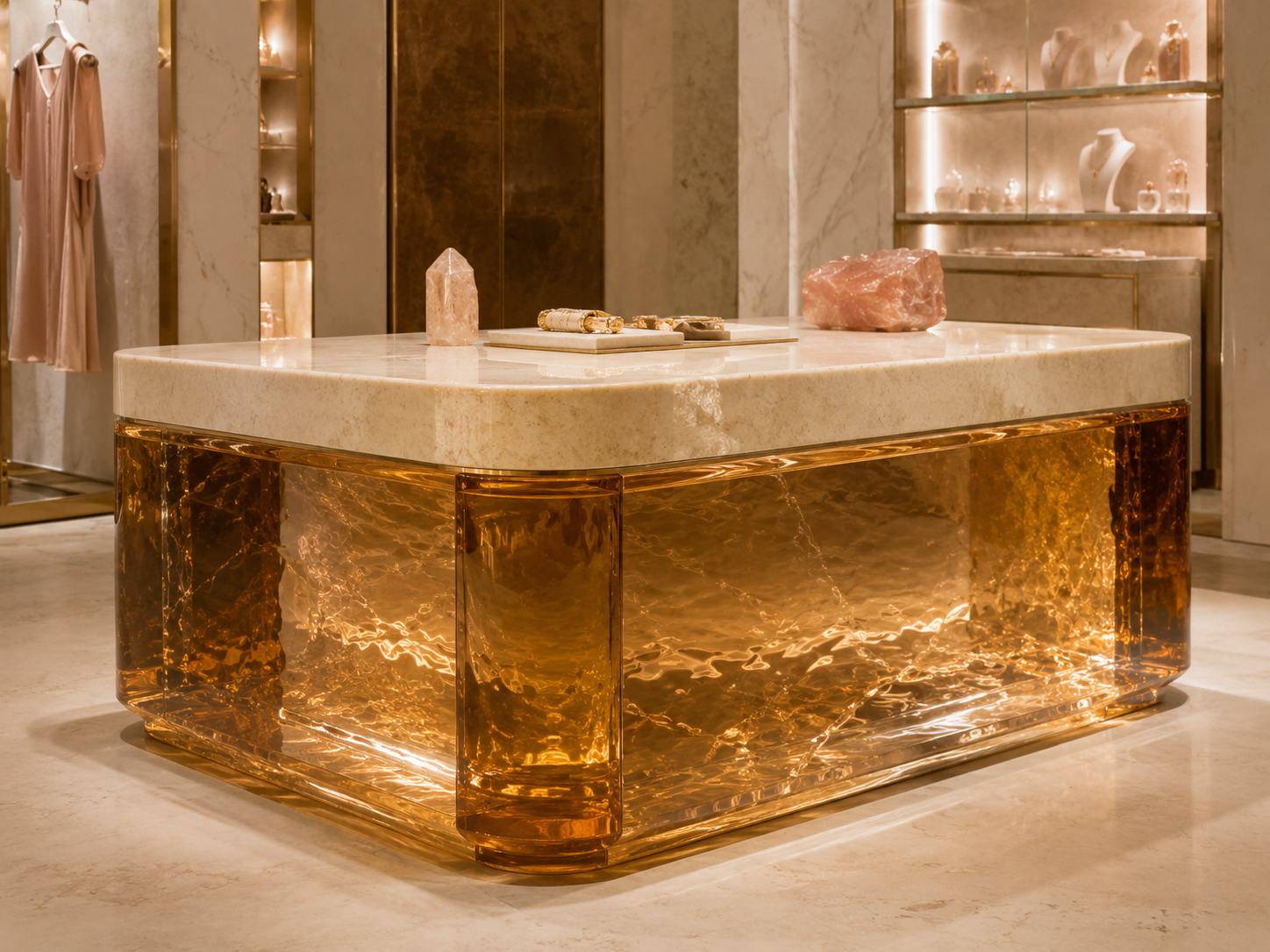
Synthetic crystal acrylic furniture often creates a strong first impression.
A crystal-clear acrylic dining table, console, chair, bench, coffee table, or display unit can immediately attract attention because it behaves differently from conventional furniture materials. Instead of visually blocking the space, it allows light, color, flooring, architecture, and surrounding objects to remain visible. Thick transparent sections create optical depth, while polished surfaces reflect light and produce a refined, almost sculptural appearance.
This visual impact explains why acrylic furniture has become increasingly popular in luxury hotels, private villas, high-end residences, flagship retail stores, restaurants, clubs, showrooms, and premium commercial spaces.
But visual attraction alone does not explain its long-term value.
In luxury projects, a material may become fashionable quickly, but it can also disappear quickly if it provides nothing beyond novelty. A product that attracts attention for one season is not necessarily a product with lasting competitiveness.
The more important question is therefore not whether synthetic crystal acrylic furniture looks impressive.
The real question is:
Can its visual difference be transformed into lasting design value, project value, and brand value?
The answer depends on how the material is designed, manufactured, customized, specified, and integrated into a larger interior concept.
When synthetic crystal acrylic furniture is treated simply as transparent furniture, its competitive advantage is limited. When it is treated as a material system capable of supporting architectural design, customization, brand identity, premium positioning, and project-specific manufacturing, its value becomes much stronger.
This distinction is becoming increasingly important as the luxury furniture market becomes more competitive.
1. Visual Appeal Is Only the Beginning
The first competitive advantage of synthetic crystal acrylic furniture is obvious: it looks different.
Most traditional furniture materials create visual mass.
Wood provides warmth and natural texture. Stone creates weight and permanence. Metal communicates precision and strength. Upholstery adds softness and comfort. Glass offers transparency, but it generally creates a different visual and structural impression from thick acrylic.
Synthetic crystal acrylic occupies a unique position.
It can appear transparent yet substantial.
It can create the impression of visual lightness while still having strong physical presence.
A thick acrylic table leg, for example, may be nearly invisible from one direction but create significant refraction and edge highlights from another.
This changing appearance gives the furniture a dynamic character.
Lighting has an especially important influence.
Natural daylight can make clear acrylic appear clean and almost invisible. Warm interior lighting can give the material a softer, more luxurious appearance. Focused lighting can emphasize polished edges and thickness. Colored architectural lighting can completely change the visual personality of transparent furniture.
For designers, this creates opportunities that conventional furniture cannot always provide.
Acrylic furniture can become part of the lighting environment rather than simply an object placed inside it.
This is one reason it performs particularly well in hotels, clubs, luxury retail spaces, restaurants, reception areas, showrooms, and contemporary residences.
However, visual attractiveness has a limitation.
Anything that is visually unusual can eventually become familiar.
If manufacturers compete only by producing transparent chairs or tables, the market can quickly become crowded with similar products.
At that point, transparency itself is no longer enough.
The long-term competitiveness of synthetic crystal acrylic furniture therefore depends on what happens after the first visual impression.
Is the proportion elegant? Is the thickness appropriate? Are the edges perfectly polished? Is the furniture structurally stable? Does the design fit the architecture? Can it be customized? Can the manufacturer reproduce the same quality across multiple pieces? Can the product survive transportation and installation? Can it become part of a broader brand identity?
These questions determine whether acrylic furniture remains a novelty or develops into a serious premium product category.
For high-end projects, the first impression opens the door.
Long-term value determines whether the product stays inside the project.
2. Material Differentiation Creates a Recognizable Design Identity
The second long-term advantage of synthetic crystal acrylic furniture is material differentiation.
Luxury interior projects increasingly face a problem of visual similarity.
Across different markets, many hotels, luxury residences, clubs, restaurants, and retail stores use similar design references. Marble, brushed metal, warm timber, neutral fabrics, oversized lighting fixtures, sculptural furniture, and minimalist architectural details have become common.
Individual projects may still be beautiful, but beauty alone does not guarantee recognition.
This is why material identity matters.
A project becomes more memorable when certain materials are used in a way that feels specific to that environment.
Synthetic crystal acrylic can play an important role in establishing this identity.
Consider two luxury hotel lobbies with similar beige stone floors, bronze-colored metal details, and neutral seating.
If one lobby uses conventional wooden side tables while the other uses custom thick acrylic tables with precisely polished edges, the second environment may create a much more distinctive visual impression.
The furniture becomes a recognizable part of the project.
This difference becomes even stronger when acrylic is customized specifically for the architecture.
A designer may repeat the geometry of the building in an acrylic console.
A hotel may use a particular tinted acrylic color across guest rooms, suites, lounges, and VIP areas.
A luxury retailer may develop transparent display furniture that allows merchandise to appear visually dominant.
A villa may use custom acrylic dining and occasional furniture to maintain panoramic views through large windows.
In each case, the material is doing more than providing function.
It is contributing to identity.
This is significant because high-end interior design is increasingly connected to photography, digital media, project portfolios, social platforms, and brand communication.
A distinctive material can make a project easier to recognize in photographs.
People may not know the technical name of the material, but they may remember the transparent sculptural table in the lobby, the crystal-like console in the entrance, or the thick acrylic display structure in a flagship store.
Recognition creates value.
For interior designers, it strengthens portfolio differentiation.
For hotel operators, it supports brand memory.
For retailers, it contributes to visual merchandising.
For developers, it can make a property feel less standardized.
Material differentiation therefore has a commercial dimension.
A material that helps a project become recognizable can contribute more than its physical function.
It becomes part of the project's visual signature.
.png)
3. Customization Turns Furniture into a Project-Specific Design Asset
Customization is where synthetic crystal acrylic furniture begins to develop deeper competitive value.
Mass-produced furniture solves common problems.
Custom furniture solves specific problems.
Luxury projects usually require the second.
A hotel may need side tables that fit precisely between custom seating modules.
A private villa may require a dining table that matches unusual architectural proportions.
A flagship store may need transparent display structures designed around specific products.
A reception area may require a large acrylic console that follows the geometry of a wall.
A club or restaurant may require colored acrylic furniture that responds to a particular lighting concept.
These requirements cannot always be satisfied through standard products.
Synthetic crystal acrylic offers designers considerable freedom.
Dimensions can be adjusted.
Material thickness can be selected according to scale and structural requirements.
Clear, translucent, tinted, colored, or combined appearances can be explored.
Edges may be polished to create different visual effects.
Acrylic can be paired with stainless steel, brass, glass, stone, wood, leather, upholstery, lighting components, or decorative inserts.
This flexibility allows designers to move beyond the category of “acrylic furniture.”
Instead, they can develop furniture specifically for a particular project.
That distinction creates long-term competitiveness.
When a manufacturer is capable only of producing standard acrylic tables, customers can easily compare suppliers based on price.
When a manufacturer can interpret drawings, develop prototypes, solve structural details, control thickness, coordinate materials, and support custom production, competition becomes more complex.
The value shifts from the product itself to the capability behind the product.
This creates stronger relationships between manufacturers, designers, architects, contractors, developers, and procurement teams.
Experienced project clients often prefer suppliers who understand the entire development process.
They may need technical discussions before production.
They may request samples.
They may adjust dimensions several times.
They may require prototypes.
They may need consistency across a large quantity.
They may have strict packaging, shipping, and installation requirements.
A supplier who can support these needs becomes more difficult to replace.
This is important for long-term business.
Product differentiation can be copied.
Service capability is harder to copy.
Manufacturing experience is even harder to copy.
When customization, engineering, communication, and quality control work together, synthetic crystal acrylic furniture becomes more than a visually attractive object.
It becomes a project-specific solution.
That is a much stronger competitive position.
4. Manufacturing Quality Determines Long-Term Product Value
Transparency is visually attractive, but it is also unforgiving.
This is one of the most important realities of high-end acrylic furniture.
Opaque materials can hide certain manufacturing details.
Transparent acrylic cannot.
If polishing is inconsistent, it can be visible.
If bonding is poorly controlled, the joint may become obvious.
If surfaces are scratched, the defect can immediately affect the premium appearance.
If dimensions are inaccurate, transparent furniture can make alignment problems easier to notice.
If thickness varies unexpectedly, the entire piece may feel less refined.
For this reason, long-term competitiveness depends heavily on manufacturing quality.
High-end clients often evaluate furniture through details that ordinary buyers may overlook.
Edge quality is one example.
A properly polished acrylic edge can create strong optical clarity and a crystal-like appearance. A poorly finished edge can immediately reduce the perceived value of the entire product.
Bonding is another critical issue.
Transparent furniture frequently requires joining components in ways that minimize visible connection marks. Controlling these joints requires experience, process discipline, and attention to appearance.
Structural design is equally important.
Acrylic furniture must not only look delicate and transparent. It must also perform reliably in real environments.
Dining tables, coffee tables, consoles, benches, display units, and other products may experience significant loads during daily use.
Designers and manufacturers therefore need to balance aesthetics with engineering.
Packaging and transportation also affect final quality.
A perfect acrylic surface leaving the factory can be damaged during handling if protection is inadequate.
Luxury projects may involve long-distance shipping, multiple transfers, warehouse storage, construction-site handling, and final installation.
The product must be protected through this entire process.
This highlights an important point:
The customer does not judge factory quality.
The customer judges the product they see after installation.
Every stage between production and installation therefore contributes to perceived value.
This is why premium acrylic furniture cannot be built around appearance alone.
Quality control must include raw-material inspection, dimension verification, surface examination, edge finishing, bonding quality, assembly accuracy, protective packaging, and shipment preparation.
For large projects, consistency becomes particularly important.
A client may approve one excellent prototype, but then order dozens or hundreds of products.
The manufacturer's challenge is to reproduce the approved quality repeatedly.
That capability creates trust.
And trust is one of the foundations of long-term competitiveness.
In premium markets, a supplier with stable quality can often build stronger relationships than a supplier offering the lowest quotation.
Luxury projects are expensive.
Delays, replacement, defects, and installation problems can cost far more than the original difference in furniture price.
As a result, reliable manufacturing becomes part of the product's brand value.
5. Acrylic Furniture Can Become Part of Brand Storytelling
The most valuable materials in luxury design often communicate something beyond their physical properties.
Natural stone may communicate permanence.
Leather may communicate craftsmanship and tradition.
Brushed metal can suggest technological precision.
Solid timber can suggest nature, warmth, and authenticity.
Synthetic crystal acrylic communicates a different set of ideas.
It can suggest modernity, lightness, innovation, precision, experimentation, and contemporary luxury.
For brands that want to express these qualities, acrylic furniture can become a storytelling tool.
This is particularly relevant for hospitality and retail projects.
A luxury hotel does not sell only accommodation.
It sells an experience.
A flagship store does not simply provide shelves for products.
It creates a physical representation of the brand.
A private club does not only provide seating.
It builds an atmosphere that communicates exclusivity.
Furniture contributes to each of these experiences.
When a distinctive material is used consistently and intelligently, it can become associated with the brand itself.
Imagine a luxury hotel group using custom crystal-clear acrylic consoles and side tables across selected signature properties.
Over time, those pieces may become part of the brand's visual language.
A luxury fashion store may use transparent acrylic display furniture so the products appear to float within the space.
A contemporary jewelry brand may use thick polished acrylic to reinforce themes of clarity, light, and precision.
A premium residential development may use custom acrylic furniture in show apartments to communicate modern exclusivity.
In these situations, the material is not chosen only because it looks attractive.
It supports a narrative.
This narrative also has marketing value.
Distinctive acrylic furniture photographs well when used correctly.
Transparency allows architecture, flooring, products, and surrounding materials to remain visible through the furniture.
This can produce visually layered images that perform effectively in project photography, social media, brochures, websites, design awards, and press coverage.
The more recognizable a project becomes, the greater the potential branding value.
This represents an important evolution.
Furniture was once viewed primarily as an interior product.
Today, in premium projects, furniture can also become media content.
It appears in photographs.
It appears in videos.
It appears in design publications.
It becomes part of the project portfolio.
It may be seen by customers who never physically visit the space.
A distinctive material therefore creates value both inside and outside the project.
This is one of the reasons long-term competitiveness should not be measured only by manufacturing cost.
The right furniture can contribute to perception, communication, marketing, and brand identity.
.png)
6. Long-Term Competitiveness Comes from an Integrated Capability
The strongest long-term competitive advantage in synthetic crystal acrylic furniture does not come from transparency alone.
It comes from integration.
Design capability must connect with engineering capability.
Engineering must connect with manufacturing.
Manufacturing must connect with quality control.
Quality control must connect with packaging.
Packaging must connect with logistics.
And all of these areas must connect with project communication and customer service.
This integrated capability is what separates a furniture manufacturer from a true project partner.
Luxury projects are rarely simple.
Design drawings may change.
Dimensions may be updated after site measurement.
Material combinations may need testing.
Samples may need approval.
Prototypes may reveal unexpected structural issues.
Shipping schedules may change.
Installation teams may require additional information.
A manufacturer that can respond to these situations creates long-term value.
This is particularly important in custom acrylic furniture because each project may involve different technical challenges.
A thick acrylic dining table has different requirements from a transparent display unit.
An acrylic chair has different structural considerations from a decorative console.
Furniture combined with stone requires different coordination from furniture combined with metal.
Lighting-integrated acrylic introduces additional technical considerations.
The more applications a manufacturer can successfully manage, the more valuable its accumulated experience becomes.
Experience creates another competitive barrier.
Machines can be purchased.
Raw materials can be sourced.
Basic product designs can be copied.
But the practical knowledge developed through many projects is more difficult to reproduce.
Manufacturers learn how different thicknesses behave.
They learn which structures are practical.
They understand how polishing affects appearance.
They become better at controlling bonding.
They improve protective packaging.
They understand designer expectations.
They learn how to communicate with international project teams.
All of this knowledge contributes to long-term competitiveness.
The market therefore gradually changes from asking:
“Who can make acrylic furniture?”
to asking:
“Who can reliably deliver high-end custom acrylic furniture for complex projects?”
That is a very different question.
The first question creates price competition.
The second creates capability competition.
For manufacturers seeking sustainable growth, capability competition is much more valuable.
It allows the business to move away from simple commodity comparisons.
It supports stronger customer relationships.
It creates opportunities to participate earlier in project development.
It makes repeat orders more likely.
It also allows manufacturers to contribute ideas rather than simply execute drawings.
At that stage, synthetic crystal acrylic furniture becomes part of a larger service system.
The product remains important, but the expertise behind the product becomes equally important.
Conclusion: The Real Competitive Advantage Is the Value Behind the Transparency
Synthetic crystal acrylic furniture naturally attracts attention.
Its transparency, optical depth, polished edges, substantial thickness, and interaction with light give it a visual language that is difficult to achieve with traditional furniture materials.
But visual attraction is only the first stage of its value.
The long-term competitiveness of this category comes from the ability to convert visual difference into something more meaningful.
Material differentiation creates project identity.
Customization creates exclusivity.
Manufacturing quality creates trust.
Project experience creates reliability.
Brand storytelling creates emotional and commercial value.
Integrated design and manufacturing capability creates a barrier that competitors cannot easily reproduce.
This transformation is particularly important in the high-end market.
Luxury customers are becoming more knowledgeable.
Designers are becoming more demanding.
Projects are becoming more customized.
Procurement teams are paying greater attention to supplier capability.
Brands are looking for spaces that are recognizable online as well as offline.
In this environment, synthetic crystal acrylic furniture has the opportunity to move beyond the category of decorative transparent furniture.
It can become a strategic material for premium interiors.
The companies most likely to succeed in this market will not be those that simply manufacture the most acrylic products.
They will be those that understand how to connect materials with architecture, furniture with branding, manufacturing with customization, and visual appeal with long-term project value.
Ultimately, the strongest competitive advantage of synthetic crystal acrylic furniture is not that people notice it when they first enter a space.
It is that, when designed and manufactured correctly, people remember the space because of it.
That is the point where visual attraction becomes brand value.
And that is where the long-term competitiveness of synthetic crystal acrylic furniture truly begins.
READ MORE:
- Lighting + Synthetic Crystal: How Light and Shadow Details Make Commercial Spaces More Attractive
- The Spatial Perception Value of Synthetic Crystal Furniture
- How Material Texture Shapes Brand Trust: Application Ideas for Synthetic Crystal Furniture in Commercial Spaces
- Make Your Store Unforgettable at First Sight: How Synthetic Crystal Furniture Becomes a Visual Focal Point
- Why Are Customers Drawn to Spatial Details? Understanding the Material and Light of Synthetic Crystal Furniture
- Synthetic Crystal Acrylic Furniture: How Innovative Materials Are Upgrading the Value of Furniture
- Why Transparent Furniture Is Moving from a Niche Design Choice to a High-End Trend
- Synthetic Crystal Acrylic Furniture: A New Design Language for Future High-End Spaces
- Synthetic Crystal Acrylic Furniture: Why High-End Projects Are Increasingly Focused on “Material Differentiation”


