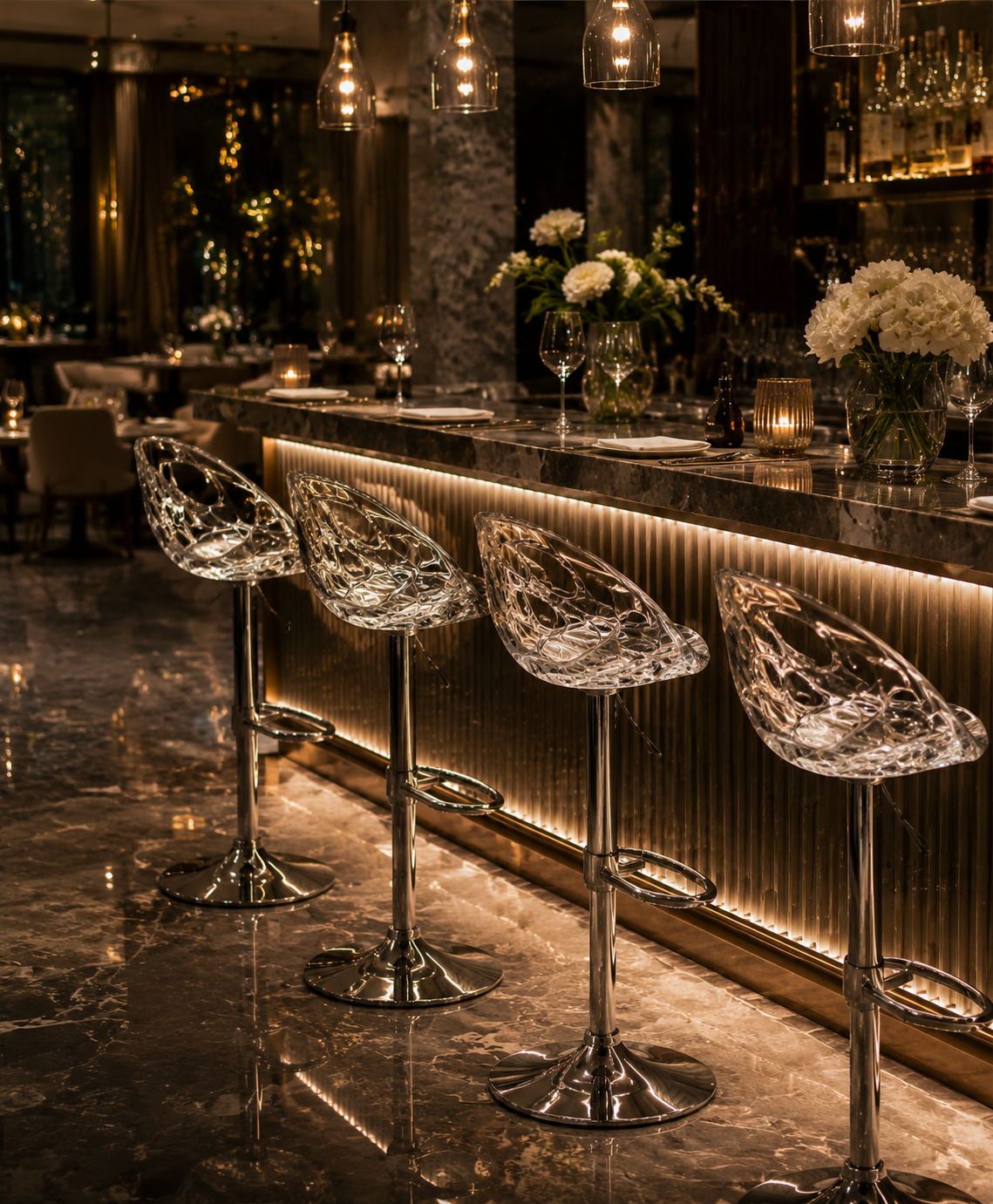
Luxury interior design is entering a new stage.
For many years, high-end spaces were defined by recognizable symbols of luxury: rare stone, natural timber, polished metal, leather, decorative lighting, handmade details, and large-scale furniture. These materials remain important, but contemporary designers are increasingly looking for a different way to express exclusivity.
Future luxury is becoming lighter, more architectural, more experimental, and more closely connected to technology.
Instead of asking only whether a space looks expensive, designers are asking whether it feels original.
They want materials that can create a distinctive atmosphere without relying on excessive decoration. They want furniture that can interact with light, architecture, artwork, and surrounding surfaces. They want objects that feel contemporary without becoming cold, and visually powerful without making the room feel heavy.
Synthetic crystal acrylic furniture fits naturally into this transformation.
Its transparency, optical depth, substantial thickness, sculptural quality, and customization potential allow it to operate differently from conventional furniture materials.
Acrylic furniture can disappear visually and attract attention at the same time.
It can occupy physical space while maintaining a feeling of openness.
It can reflect light without behaving exactly like metal or glass.
It can appear minimal in one environment and dramatic in another.
For this reason, synthetic crystal acrylic is gradually becoming more than a material for tables, chairs, consoles, and display furniture.
It is becoming part of a new design language for high-end interiors.
1. Transparency Becomes a New Form of Luxury
Traditional luxury interiors often communicated value through visual weight.
Heavy marble tables, dark timber cabinets, thick upholstered seating, decorative metal structures, and large architectural features were used to create a feeling of permanence and richness.
Contemporary luxury is becoming more diverse.
In many premium projects, designers now want to create spaciousness rather than heaviness.
Large windows, open layouts, continuous flooring, minimal partitions, indirect lighting, sculptural furniture, and carefully controlled material palettes are becoming more common.
Within this environment, transparency has a new value.
Transparent furniture allows designers to introduce function without creating excessive visual interruption.
A clear acrylic table can occupy a large physical area while still allowing the floor, carpet, lighting, and surrounding architecture to remain visible.
A transparent console can provide a strong furniture presence near a wall without making the composition feel dense.
Acrylic chairs or benches can add function to a room while maintaining visual continuity.
This creates an important design advantage.
Future high-end spaces increasingly depend on the relationship between emptiness and objects.
Not every area needs to be filled.
Not every piece of furniture needs to dominate.
Luxury can come from restraint.
Synthetic crystal acrylic works well within this philosophy because it allows furniture to exist without creating the same visual weight as opaque materials.
At the same time, acrylic does not need to look invisible.
Thick acrylic sections can create strong optical depth.
Polished edges can reflect and refract light.
Curved forms can distort the surrounding environment in subtle ways.
Under architectural lighting, the material can produce highlights that change depending on the viewer's position.
This means transparency itself becomes expressive.
It is no longer simply the absence of color.
It becomes a design characteristic.
In a luxury villa, a thick acrylic coffee table may preserve the visibility of a custom rug while creating an almost crystal-like object at the center of the seating area.
In a hotel lobby, transparent side tables may support large lounge furniture without adding visual congestion.
In a flagship retail store, acrylic display furniture may allow merchandise to remain the primary focus.
In each example, transparency supports the space rather than competing with it.
That is why it is becoming an increasingly important language of contemporary luxury.
2. Furniture Evolves from Object to Spatial Element
One of the most significant changes in high-end interior design is the growing integration between furniture and architecture.
Furniture was once treated as something added after the architectural environment was completed.
Today, designers often develop architecture, lighting, furniture, materials, artwork, and decorative elements as one coordinated system.
Synthetic crystal acrylic furniture works particularly well within this approach.
Because transparent furniture allows the surrounding environment to remain visible through the object, it naturally creates a stronger relationship with the architecture.
It does not simply sit in front of a wall.
It interacts with the wall.
It does not completely cover the floor.
It allows the flooring pattern to continue visually.
It does not block decorative lighting.
It can transmit, reflect, and reinterpret that lighting.
This transforms furniture from an independent object into a spatial element.
Imagine a transparent acrylic console positioned in front of a textured stone wall.
A conventional opaque console would visually separate the viewer from the stone.
The acrylic version allows the wall to remain visible, while polished edges and transparent thickness introduce another visual layer.
The result is not simply a piece of furniture in front of architecture.
The furniture and the wall become part of one composition.
The same principle can be applied to panoramic windows.
In a high-rise luxury residence, transparent furniture can preserve exterior views.
Instead of creating a barrier between the interior and the skyline, acrylic can help maintain a sense of visual continuity.
In a hotel, restaurant, or private club, transparent furniture can also interact strongly with dramatic lighting environments.
Light passing through acrylic may create subtle reflections or edge illumination.
This gives designers additional control over atmosphere.
Furniture can respond to daytime natural light and appear differently under nighttime illumination.
That dynamic behavior is particularly suitable for future-oriented interior design.
High-end spaces are increasingly expected to create different experiences throughout the day.
A lobby may appear calm in daylight and dramatic at night.
A restaurant may shift from a bright daytime environment to a more theatrical evening atmosphere.
Acrylic furniture can participate in these changes.
Its visual identity is not fixed.
It depends partly on light, surroundings, and viewing angle.
This gives designers a more responsive design tool.
Instead of treating furniture as static decoration, they can use it as part of the changing spatial experience.
That is a major reason synthetic crystal acrylic has the potential to become an important material in future luxury interiors.
.png)
3. Customization Creates a New Design Vocabulary
Future high-end spaces are moving away from standardization.
Luxury clients increasingly expect environments that feel personal, project-specific, and difficult to duplicate.
This creates greater demand for custom furniture.
Synthetic crystal acrylic offers significant opportunities in this area.
Depending on design requirements and manufacturing capability, acrylic furniture can be produced in different dimensions, thicknesses, shapes, colors, edge treatments, structural configurations, and material combinations.
This makes it highly adaptable.
A designer may specify a large transparent dining table for a private villa.
Another project may require smaller tinted acrylic side tables for hotel guest rooms.
A flagship retail store may need custom display furniture designed around the exact proportions of its products.
A luxury club may use thick acrylic tables combined with integrated lighting.
A showroom may require sculptural acrylic pedestals that visually disappear behind displayed products.
The material can therefore be used in very different ways.
Customization also allows designers to create repetition across a project.
A specific edge profile may appear in tables, benches, and consoles.
A particular acrylic tint may be repeated in several rooms.
A geometric language used in the architecture may be translated into furniture.
This creates stronger visual consistency.
The furniture no longer feels selected from a catalogue.
It feels developed specifically for the space.
That distinction is important in luxury design.
Mass-market products can create attractive interiors, but they are easy to reproduce.
Custom furniture creates stronger identity.
It also supports brand differentiation.
For hotel groups, custom acrylic furniture can become a recognizable feature.
For luxury residential developers, it can help show apartments feel more exclusive.
For fashion and jewelry retailers, customized transparent furniture can support a particular visual-merchandising concept.
For designers, bespoke furniture can become part of their signature style.
This means customization is not simply a production service.
It becomes part of the design language.
The more flexible the manufacturing process, the more creative freedom designers have.
However, this also increases the importance of communication between designers and manufacturers.
Complex custom projects may require technical drawings, samples, prototypes, structural discussions, material testing, and repeated adjustments.
A manufacturer that understands only standard furniture production may struggle with these requirements.
A manufacturer with strong custom development capability can become a valuable project partner.
This relationship will become increasingly important as future luxury spaces become more individualized.
The market will not simply demand more acrylic furniture.
It will demand more specific acrylic furniture.
That is where customization becomes a true competitive advantage.
4. Material Fusion Expands Creative Possibilities
Synthetic crystal acrylic becomes even more interesting when it is combined with other materials.
Luxury interiors are rarely built around one material.
Their richness comes from carefully controlled contrast.
Stone may provide weight.
Wood may provide warmth.
Metal may add precision.
Leather may add softness.
Glass may add reflection.
Acrylic can connect these materials in new ways.
Its transparency allows it to function as a visual bridge.
For example, a clear acrylic table with a stone top can combine the visual lightness of transparency with the physical weight of natural stone.
Acrylic paired with brushed brass can create a strong contrast between invisible mass and metallic detail.
Acrylic and wood can balance futuristic transparency with natural warmth.
Acrylic combined with leather can create furniture that feels both technical and comfortable.
Acrylic and lighting can create an even more dramatic effect.
These combinations are particularly relevant to contemporary luxury design because clients increasingly want interiors that feel layered.
A space that relies entirely on one material may appear simple.
A space that combines too many materials without control may feel chaotic.
The challenge is to create contrast while maintaining coherence.
Acrylic can help achieve this balance.
Because it is transparent, it does not always compete strongly with surrounding materials.
Instead, it can amplify them.
A stone surface may appear more visually important when supported by transparent acrylic.
A decorative metal component can seem to float when embedded within a clear structure.
Acrylic furniture can preserve views of custom flooring, rugs, or wall finishes.
This allows other premium materials to remain visible.
In this sense, acrylic does not always need to be the primary visual feature.
Sometimes its greatest value comes from making other materials more visible.
This is an important characteristic of future high-end design.
Luxury is becoming less about isolated expensive objects and more about relationships between materials.
Designers are creating material systems.
Acrylic can become one of the connectors within those systems.
Its ability to work with both traditional materials and more futuristic technologies gives it unusual flexibility.
It can sit beside marble in a classical luxury environment.
It can work with stainless steel in a modern interior.
It can integrate with lighting in a futuristic space.
It can combine with handcrafted materials in a more artistic project.
This adaptability gives synthetic crystal acrylic strong long-term potential.
Instead of belonging to one design style, it can participate in many.
That makes it useful for designers seeking a material that can evolve with future trends.
5. Technology and Manufacturing Quality Define Premium Value
The visual simplicity of acrylic furniture can hide considerable manufacturing complexity.
This is especially true in the premium market.
Transparent materials reveal details very clearly.
A small scratch can be noticeable.
An uneven edge can reduce perceived quality.
A poorly controlled joint can become visually distracting.
Inaccurate dimensions can affect the entire composition.
For this reason, the future success of synthetic crystal acrylic furniture depends heavily on manufacturing technology and process control.
Precision cutting is essential.
The dimensions of each component must match the design accurately.
Polishing must be carefully controlled to achieve the desired optical clarity.
Bonding requires technical experience because transparent joints can reveal imperfections.
Structural engineering is also important, especially for large tables, benches, consoles, and other load-bearing products.
Thickness must be selected according to design scale and performance requirements.
Packaging requires equal attention.
Acrylic surfaces can be vulnerable to scratches if they are not protected correctly during transportation and installation.
High-end projects may involve international shipping, warehouse storage, site handling, and complex installation schedules.
The product must remain protected throughout this process.
This demonstrates an important principle:
Luxury quality is not created only during manufacturing.
It must be preserved until final installation.
Future competition in acrylic furniture will therefore increasingly depend on integrated capability.
Manufacturers will need design support, engineering knowledge, skilled fabrication, quality-control systems, protective packaging, and project coordination.
This represents a shift in the industry.
The question is no longer simply whether a company can produce a transparent table.
The question is whether it can consistently produce high-end custom furniture that meets the expectations of architects, designers, developers, hotel groups, and luxury brands.
That requires much more than basic production.
It requires experience.
Manufacturers learn from each project.
They learn how different thicknesses behave.
They learn how complex forms affect polishing.
They learn how to minimize visible bonding.
They learn how to combine acrylic with metal or stone.
They learn how to protect surfaces during shipping.
They learn how to communicate with project teams.
Over time, this experience becomes a competitive advantage.
Machines can be purchased.
Raw materials can be sourced.
Designs can be copied.
Accumulated project knowledge is more difficult to reproduce.
That is why manufacturing expertise will be one of the most important foundations of the future acrylic furniture market.
The most successful suppliers will not simply sell material.
They will sell reliability, precision, customization, and technical confidence.
.png)
6. Acrylic Furniture Becomes Part of Future Brand Identity
The future of luxury design is closely connected to branding.
Hotels want recognizable environments.
Luxury retailers want distinctive physical stores.
Developers want memorable show apartments.
Restaurants and private clubs want spaces that customers remember and share.
Interior design has therefore become part of brand communication.
Furniture plays an important role in this process.
A distinctive acrylic table can become a visual signature in a hotel lobby.
A transparent display system can become part of a luxury retail concept.
A sculptural acrylic dining table can become the focal point of a private residence.
Acrylic furniture can also perform strongly in photography and video.
Because it is transparent, it allows surrounding architecture and materials to remain visible.
This creates layered images.
A photographer can capture furniture, flooring, lighting, wall finishes, and architectural depth in a single composition.
For projects that depend heavily on social media, digital marketing, design publications, and online portfolios, this is highly valuable.
Future luxury spaces will increasingly be experienced twice.
First, people experience them physically.
Second, they experience them through images and video.
A successful interior must therefore perform in both environments.
Synthetic crystal acrylic furniture has advantages in this context.
Its optical characteristics can create dramatic photographs.
It can reflect lighting.
It can appear almost invisible from certain angles.
It can create highlights through polished edges.
It can add depth without blocking the rest of the scene.
These characteristics make it highly suitable for contemporary brand communication.
Material identity can therefore become part of brand identity.
A hotel group may repeatedly use a particular acrylic furniture language.
A luxury fashion brand may use transparent fixtures to communicate modernity and product focus.
A jewelry brand may connect crystal-clear acrylic with ideas of clarity and precision.
A premium residential development may use acrylic furniture to communicate openness and contemporary exclusivity.
When material choices are repeated consistently, they become recognizable.
This is the point where furniture creates value beyond function.
It becomes part of a brand system.
For manufacturers, this creates new opportunities.
Instead of supplying one isolated product, they may participate in long-term brand programs.
They may develop custom furniture collections for hotel groups, retailers, developers, or design studios.
They may help brands standardize certain visual details across multiple projects.
This type of cooperation creates much stronger business value than one-time product sales.
It also demonstrates why future competitiveness will increasingly depend on design understanding.
Manufacturers who understand branding, architecture, and project identity will be better positioned to create meaningful furniture solutions.
Those who focus only on production may face stronger price competition.
Conclusion: A Material for the Next Generation of Luxury Interiors
Synthetic crystal acrylic furniture represents more than a transparent alternative to traditional furniture.
It represents a different way of thinking about space.
Transparency can replace visual heaviness.
Furniture can become part of architecture.
Customization can create project-specific identity.
Material fusion can expand creative possibilities.
Manufacturing technology can transform simple forms into premium products.
Brand storytelling can turn furniture into a recognizable design asset.
Together, these characteristics create a new design language.
This language is especially relevant to future high-end spaces because luxury itself is changing.
The next generation of luxury interiors will not necessarily depend on more decoration, more material, or more visual complexity.
In many cases, luxury will come from precision.
It will come from originality.
It will come from how carefully materials are selected and combined.
It will come from the ability to create memorable spaces with fewer but more meaningful elements.
Synthetic crystal acrylic fits naturally into this direction.
Its greatest strength is not simply transparency.
Its greatest strength is flexibility.
It can be visible or almost invisible.
It can appear minimal or sculptural.
It can work with natural materials or technological materials.
It can support architecture or become a focal point.
It can serve residential, hospitality, retail, commercial, and artistic environments.
It can be standardized, but its real value emerges through customization.
As designers continue exploring new ways to define contemporary luxury, synthetic crystal acrylic furniture has the potential to move from a niche material to a strategic design tool.
The future high-end interior will not be defined only by what objects it contains.
It will be defined by how materials interact, how light moves through the space, how furniture connects with architecture, and how the entire environment communicates identity.
Within that future, synthetic crystal acrylic furniture offers something particularly valuable:
the ability to make furniture feel less like an object placed inside a space and more like a part of the space itself.
That is why it is becoming a new design language for the future of luxury interiors.
READ MORE:
- Lighting + Synthetic Crystal: How Light and Shadow Details Make Commercial Spaces More Attractive
- The Spatial Perception Value of Synthetic Crystal Furniture
- How Material Texture Shapes Brand Trust: Application Ideas for Synthetic Crystal Furniture in Commercial Spaces
- Make Your Store Unforgettable at First Sight: How Synthetic Crystal Furniture Becomes a Visual Focal Point
- Why Are Customers Drawn to Spatial Details? Understanding the Material and Light of Synthetic Crystal Furniture
- Synthetic Crystal Acrylic Furniture: How Innovative Materials Are Upgrading the Value of Furniture
- Why Transparent Furniture Is Moving from a Niche Design Choice to a High-End Trend
- From Visual Appeal to Brand Value: The Long-Term Competitiveness of Synthetic Crystal Acrylic Furniture
- Synthetic Crystal Acrylic Furniture: Why High-End Projects Are Increasingly Focused on “Material Differentiation”


