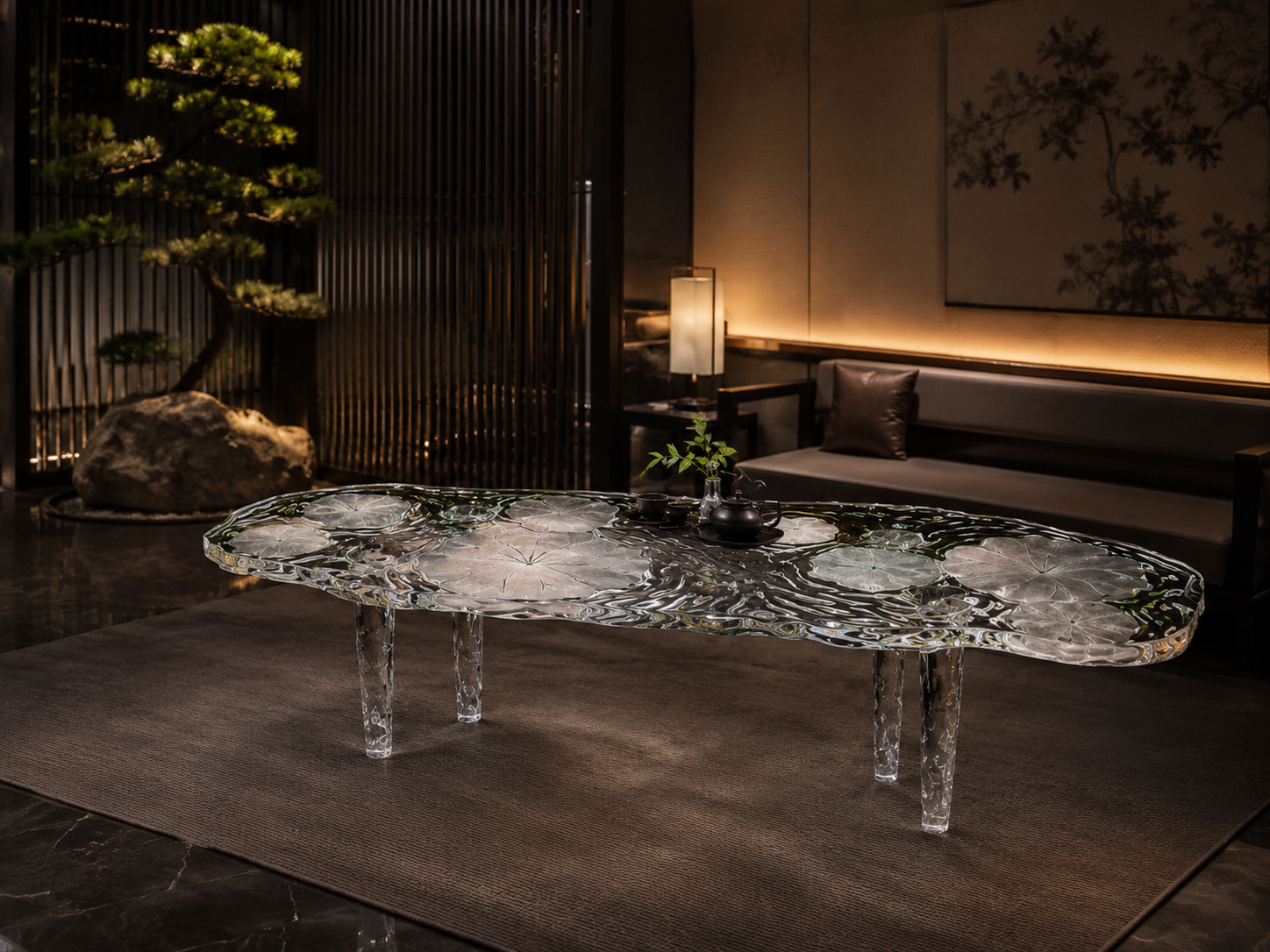
Transparent furniture was once viewed as a relatively experimental category.
For many years, clear chairs, acrylic tables, transparent consoles, and crystal-like furniture appeared mainly in fashion-forward interiors, art-oriented spaces, temporary displays, and highly contemporary residences. They attracted attention precisely because they looked unusual. Compared with traditional furniture made from wood, metal, stone, leather, or fabric, transparent furniture seemed more decorative, more conceptual, and in some cases less practical.
That perception is changing.
Today, transparent furniture is increasingly appearing in luxury hotels, private villas, premium residences, flagship retail stores, high-end clubs, restaurants, showrooms, offices, and commercial interiors.
The change is significant.
Transparent furniture is no longer being selected only because it looks different. It is increasingly being chosen because it solves several important design problems at the same time.
It can preserve visual openness.
It can interact with architectural lighting.
It can make premium flooring and wall finishes more visible.
It can reduce visual heaviness.
It can create a strong focal point without dominating the room.
It can be customized for specific projects.
And when produced with high-quality materials and precise manufacturing, it can communicate a distinctly contemporary form of luxury.
This evolution explains why transparent furniture is gradually moving from a niche design choice into a broader high-end trend.
The trend is not simply about transparency.
It reflects deeper changes in how designers, architects, developers, hospitality groups, luxury brands, and private clients define premium space.
1. Transparency Matches the New Definition of Luxury
Luxury design is changing.
In the past, premium interiors were often associated with visible abundance.
Heavy stone surfaces, large wooden furniture, decorative metalwork, thick upholstery, elaborate details, and richly layered materials were frequently used to communicate value.
These elements still have an important place in high-end design, but contemporary luxury is becoming more restrained.
Many of today's most sophisticated interiors focus on proportion, light, material quality, architectural clarity, and carefully controlled details.
Instead of filling a room with expensive objects, designers often create luxury through space.
Large windows, open circulation, continuous flooring, minimal partitions, indirect lighting, and sculptural furniture have become important features of premium interiors.
Transparent furniture fits naturally into this environment.
A clear acrylic coffee table, for example, performs the same practical function as a wooden table, but its visual effect is completely different.
The floor remains visible.
The rug remains visible.
Light continues through the object.
The furniture occupies physical space without creating the same visual barrier.
This makes the room feel more open.
The effect is particularly valuable in luxury apartments, hotel suites, boutique interiors, and smaller premium spaces where every piece of furniture must contribute to both function and atmosphere.
Transparency also supports architectural clarity.
When designers invest heavily in stone flooring, decorative carpets, wall panels, lighting, or panoramic views, they may not want furniture to hide those elements.
Transparent furniture allows the interior architecture to remain visible.
That changes the relationship between furniture and space.
Instead of competing with architecture, the furniture supports it.
This is one reason transparent furniture feels increasingly relevant to contemporary high-end interiors.
Luxury is becoming less about how much material is visible and more about how intelligently materials are used.
Transparency is therefore not simply a visual effect.
It has become part of a new luxury philosophy.
2. Transparent Furniture Creates Strong Visual Impact with Less Visual Weight
One of the most interesting characteristics of transparent furniture is its ability to be visually light and visually dramatic at the same time.
This may seem contradictory.
A transparent object should theoretically disappear.
But high-quality acrylic furniture, especially pieces made from thicker crystal-clear material, can create significant visual impact.
The reason is light.
Transparent furniture interacts with its surroundings in ways that opaque furniture cannot.
Light passes through it.
Edges reflect light.
Thick sections create optical depth.
Polished surfaces produce highlights.
Curved or angled forms can slightly distort the environment behind them.
As the viewer moves around the furniture, its appearance changes.
This dynamic quality makes transparent furniture particularly attractive in high-end spaces.
A thick acrylic console may appear almost invisible from one angle.
From another angle, its polished edges may become highly visible.
Under daylight, the object may feel quiet and minimal.
Under evening lighting, it may appear more sculptural.
This relationship with light gives transparent furniture an architectural quality.
It is not simply an object with a fixed color and surface.
Its appearance depends partly on the environment around it.
For designers, this creates creative freedom.
Acrylic furniture can be placed near windows to preserve exterior views.
It can be positioned beneath decorative lighting to create highlights.
It can be used in front of stone walls without blocking the material behind it.
It can work with reflective surfaces, metal details, and illuminated backgrounds.
This allows transparent furniture to become part of a larger visual composition.
The ability to create impact without visual heaviness is especially important in luxury interiors.
Large furniture can often make a room feel smaller.
Transparent furniture reduces this effect.
A substantial acrylic dining table can occupy significant floor area while still allowing the room to feel open.
A transparent console can provide storage or display function without creating the same density as a solid cabinet.
Acrylic side tables can support large lounge seating while keeping the composition balanced.
This combination of presence and lightness is difficult to achieve with conventional furniture.
It is one of the strongest reasons transparent furniture is becoming increasingly attractive to high-end designers.
.png)
3. High-End Projects Need More Material Differentiation
The luxury design market has become highly competitive.
Hotels compete with other hotels.
Residential developers compete for premium buyers.
Luxury retailers compete for customer attention.
Restaurants, clubs, and entertainment spaces compete for memorable experiences.
Interior designers compete to create recognizable projects.
In this environment, attractive design is no longer enough.
Projects need identity.
This is where material differentiation becomes important.
Many high-end interiors now use similar combinations of marble, wood, brushed metal, neutral upholstery, and decorative lighting.
These materials can create beautiful spaces, but they are widely used.
As a result, designers increasingly look for materials that can give a project a more distinctive character.
Transparent furniture provides one solution.
A crystal-clear acrylic table looks fundamentally different from a conventional wooden table.
A transparent display unit creates a different retail experience from a standard metal fixture.
A thick acrylic console introduces a different sense of depth from glass or stone.
This difference becomes even more valuable when the furniture is customized.
A hotel may use a specific acrylic thickness and geometric language across several spaces.
A luxury fashion store may create transparent display furniture designed around its products.
A private villa may use custom acrylic dining and occasional furniture to maintain views and emphasize architectural openness.
A club may combine acrylic furniture with colored lighting to create a recognizable nighttime atmosphere.
In each case, the material contributes to the identity of the project.
This is a major shift.
Furniture is no longer selected only for function or style.
It is increasingly selected for its ability to communicate something.
Transparent furniture can communicate modernity.
It can communicate precision.
It can communicate experimentation.
It can communicate visual lightness.
It can communicate contemporary luxury.
These associations are valuable to high-end projects.
Material choice is therefore becoming part of branding.
A distinctive piece of transparent furniture can become one of the most photographed elements in a hotel lobby or residence.
It may appear in project photography, social media, brochures, websites, design publications, and marketing videos.
That gives the furniture value beyond its physical function.
It becomes part of the project's image.
This branding effect is one of the reasons transparent furniture is moving into a more important position within high-end design.
4. Customization Is Expanding the Possibilities of Transparent Furniture
Another major factor behind the growth of transparent furniture is customization.
Standard transparent furniture has existed for many years.
The real change is the growing ability to produce bespoke transparent furniture for specific projects.
This expands the category significantly.
Designers can now work with different dimensions, thicknesses, shapes, colors, edge treatments, structural configurations, and material combinations.
Acrylic furniture does not need to be completely clear.
It can be tinted.
It can be colored.
It can include frosted areas.
It can combine transparent and opaque elements.
It can be paired with metal, wood, stone, leather, glass, lighting, or decorative inserts.
This makes the material much more flexible.
A designer may create a large crystal-clear dining table for a private residence.
A hotel may require dozens of customized acrylic side tables designed around guest-room dimensions.
A retail brand may need display units with precise product-specific proportions.
A luxury club may use tinted acrylic furniture to complement atmospheric lighting.
A jewelry showroom may use thick transparent platforms to create a floating display effect.
These applications demonstrate why customization is important.
The furniture is no longer being selected from a limited range of standard transparent products.
It is being designed as part of the project.
That changes its status.
It moves from accessory to architectural element.
Customization also creates stronger value for manufacturers.
A company that produces only standard acrylic tables can be easily compared with competitors.
Price becomes a major factor.
A manufacturer that can interpret architectural drawings, develop prototypes, solve structural details, manage custom dimensions, combine multiple materials, and maintain consistent quality provides a much more complex service.
This makes the supplier more valuable to designers and project teams.
Luxury projects often involve repeated adjustments.
Dimensions may change.
Site conditions may affect the design.
Samples may need approval.
Finishes may need testing.
Large furniture may require structural evaluation.
Packaging may need to be customized for international shipping.
The ability to support these requirements creates long-term competitive advantage.
This is another reason transparent furniture is becoming more accepted in high-end projects.
It is no longer limited by standard product design.
It can now respond to architecture, branding, customer requirements, and project-specific challenges.
5. Manufacturing Technology Is Improving Premium Quality
Transparent furniture has another important characteristic: it exposes manufacturing quality very clearly.
This can be both an advantage and a challenge.
With opaque materials, certain joints, internal structures, and surface imperfections may be relatively easy to hide.
With transparent furniture, details are more visible.
If polishing is poor, the edge may look cloudy.
If bonding is uncontrolled, the joint can become distracting.
If the surface is scratched, the defect can affect the entire appearance.
If dimensions are inaccurate, alignment problems may be obvious.
This is why high-end transparent furniture requires strong manufacturing capability.
Modern production technology has improved significantly.
Precision cutting allows more accurate dimensions.
Advanced polishing techniques can create clearer surfaces and edges.
Better bonding methods can improve visual cleanliness.
CNC machining allows more complex forms.
Improved structural engineering makes larger and more ambitious furniture possible.
Protective films and better packaging systems help preserve finished surfaces during transportation.
These improvements are important because they allow transparent furniture to move beyond decorative novelty.
It can now be specified for serious luxury projects.
Acrylic tables can be produced at architectural scale.
Display systems can be designed for premium retail environments.
Benches, consoles, stools, side tables, and other furniture can be customized for commercial use.
However, production quality remains critical.
High-end clients do not judge a product only from a distance.
They examine details.
They notice edge quality.
They notice surface clarity.
They notice joints.
They notice proportions.
They notice whether multiple pieces look consistent.
This makes quality control essential.
Raw materials must be inspected.
Dimensions must be verified.
Surfaces must remain protected.
Polishing must be consistent.
Assembly must be accurate.
Packaging must prevent scratching and impact.
For project furniture, consistency is especially important.
A perfect prototype is not enough.
If a hotel requires 100 pieces, all 100 pieces must meet an acceptable standard.
This ability to reproduce quality creates trust.
And trust is one of the reasons professional designers and procurement teams become willing to use transparent furniture in larger projects.
The category grows when clients believe the material can deliver not only appearance, but also reliability.
Manufacturing technology is therefore one of the hidden forces behind the transition from niche design to high-end trend.
.png)
6. Transparent Furniture Is Becoming a Long-Term High-End Category
Every design trend faces the same question:
Is it temporary, or will it remain relevant?
Transparent furniture has strong potential to become a long-term category because its value is not based on one visual style.
It solves several lasting design needs.
It supports open space.
It preserves architectural visibility.
It works with natural light.
It interacts with artificial lighting.
It reduces visual weight.
It creates material differentiation.
It can be customized.
It photographs well.
It can support brand identity.
These benefits are not tied to one short-term fashion.
They are connected to broader changes in architecture and interior design.
Contemporary interiors increasingly value flexibility.
They value openness.
They value multi-material composition.
They value customized experiences.
They value spaces that perform well both physically and digitally.
Transparent furniture fits all of these directions.
It also works across different design styles.
In a minimalist space, it can appear clean and restrained.
In a glamorous interior, it can feel crystal-like and luxurious.
In a futuristic environment, it can feel technological.
In a natural-material interior, it can create contrast with wood and stone.
In a retail space, it can disappear visually and emphasize products.
This versatility gives it long-term strength.
Transparent furniture does not belong to only one style.
It can evolve with changing design preferences.
This is important.
Many niche furniture trends disappear because they are too closely connected to one visual moment.
Transparent furniture has a broader foundation.
Its core benefit is spatial.
That gives it greater durability.
The future market is also likely to become more sophisticated.
Clients will increasingly distinguish between low-cost transparent furniture and premium synthetic crystal acrylic furniture.
They will ask more questions about material quality, thickness, optical clarity, edge finishing, customization, structural design, production consistency, and supplier capability.
This will divide the market.
Basic transparent furniture may remain a commodity.
High-end transparent furniture will become a specialized project category.
That specialization creates opportunity.
Manufacturers with strong design development, engineering, fabrication, quality control, and customization capabilities will be able to serve more demanding clients.
Designers will gain access to more sophisticated products.
Brands will use transparent furniture more strategically.
As this ecosystem develops, the category will become more mature.
That is how a niche design trend becomes a stable high-end market.
Conclusion: Transparent Furniture Is No Longer About Novelty
The rise of transparent furniture is not simply the result of people becoming more interested in clear tables and chairs.
It reflects a much broader transformation in luxury design.
High-end spaces are becoming lighter.
Architecture is becoming more open.
Furniture is becoming more integrated with the surrounding environment.
Materials are becoming part of brand identity.
Customization is becoming more important.
Manufacturing technology is making complex designs more reliable.
Photography, digital media, and visual storytelling are influencing how projects are designed and presented.
Transparent furniture sits at the intersection of all these changes.
Its transparency allows it to reduce visual weight.
Its optical depth creates sculptural interest.
Its relationship with light creates changing visual experiences.
Its customization potential allows it to become project-specific.
Its compatibility with metal, stone, wood, leather, glass, and lighting gives designers significant creative freedom.
Its distinctive appearance helps projects create stronger recognition.
This is why transparent furniture is moving beyond its original niche position.
The material is no longer valuable only because it looks unusual.
It is valuable because it performs strategically within contemporary high-end space.
The most important change is therefore not that more people are buying transparent furniture.
The real change is that designers are beginning to treat it seriously.
They are specifying it intentionally.
They are integrating it with architecture.
They are customizing it.
They are using it to create identity.
They are expecting better manufacturing quality.
They are asking suppliers to provide project-level solutions.
Once a material reaches this stage, it is no longer simply a trend.
It becomes part of the design vocabulary.
That is exactly what is happening with transparent furniture today.
What was once considered experimental is increasingly becoming premium.
What was once associated with novelty is increasingly associated with sophistication.
And what was once a small design category is now developing into a recognizable part of the future luxury interior market.
READ MORE:
- Lighting + Synthetic Crystal: How Light and Shadow Details Make Commercial Spaces More Attractive
- The Spatial Perception Value of Synthetic Crystal Furniture
- How Material Texture Shapes Brand Trust: Application Ideas for Synthetic Crystal Furniture in Commercial Spaces
- Make Your Store Unforgettable at First Sight: How Synthetic Crystal Furniture Becomes a Visual Focal Point
- Why Are Customers Drawn to Spatial Details? Understanding the Material and Light of Synthetic Crystal Furniture
- Synthetic Crystal Acrylic Furniture: How Innovative Materials Are Upgrading the Value of Furniture
- Synthetic Crystal Acrylic Furniture: A New Design Language for Future High-End Spaces
- From Visual Appeal to Brand Value: The Long-Term Competitiveness of Synthetic Crystal Acrylic Furniture
- Synthetic Crystal Acrylic Furniture: Why High-End Projects Are Increasingly Focused on “Material Differentiation”


