Furniture has always been closely connected to materials.
Wood communicates warmth and craftsmanship. Stone suggests permanence and weight. Metal expresses precision and strength. Leather creates comfort and refinement. Glass introduces transparency and reflection.
For a long time, the value of furniture was primarily judged by how these traditional materials were selected, processed, and assembled.
Today, however, the furniture industry is entering a different stage.
Designers, architects, developers, luxury brands, hospitality groups, and private clients are increasingly interested in materials that can create new experiences rather than simply repeat familiar ones.
This change is especially visible in the high-end market.
Premium furniture is no longer evaluated only by whether it is durable, beautiful, or expensive. It is also evaluated by whether it creates differentiation.
Does it make the space more memorable?
Does it support the architectural concept?
Does it create a unique visual identity?
Can it be customized?
Does it offer a material experience that standard furniture cannot provide?
These questions are changing the meaning of furniture value.
Synthetic crystal acrylic furniture is one of the clearest examples of this transformation.
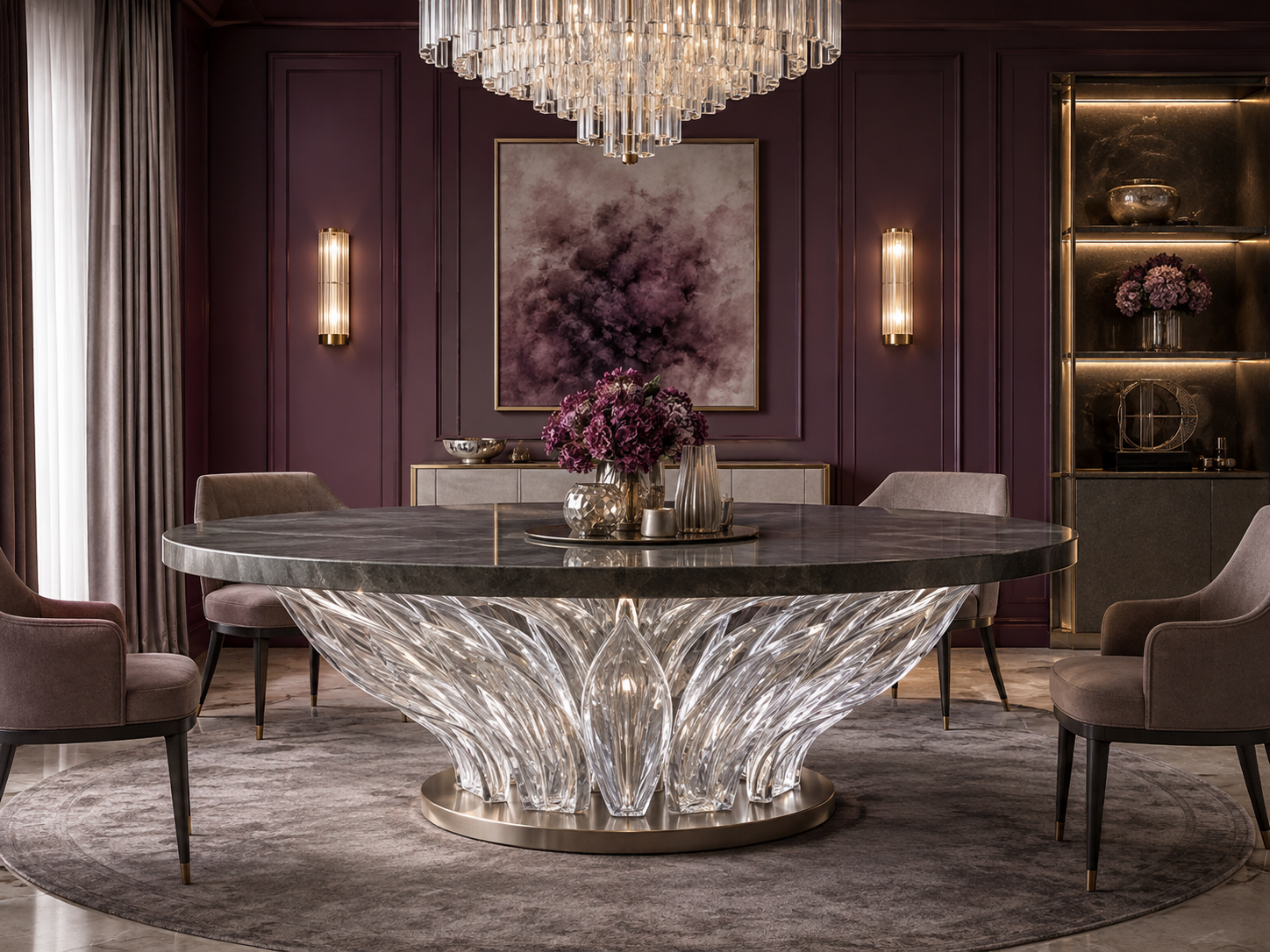
With its transparency, optical depth, sculptural presence, customization potential, and ability to interact with light and surrounding materials, acrylic furniture offers a different approach to premium furniture design.
It demonstrates how an innovative material can move furniture beyond basic function and toward higher levels of visual, project, and brand value.
1. Innovative Materials Are Redefining Furniture Value
Traditionally, furniture value was strongly connected to material cost, craftsmanship, durability, and complexity of construction.
These factors remain important.
However, in contemporary luxury markets, they are no longer enough.
Many furniture manufacturers can produce high-quality wooden tables, metal frames, marble surfaces, upholstered chairs, and decorative cabinets.
As production capabilities become more widely available, quality alone does not always create differentiation.
Innovation becomes increasingly important.
Material innovation offers one of the most effective ways to create new value.
A different material can completely change the meaning of a familiar furniture form.
Consider a console table.
If it is made from dark timber, it may communicate warmth and tradition.
If it is made from polished stainless steel, it may feel more technological.
If it is made from natural stone, it may appear architectural and permanent.
If the same basic form is created using thick synthetic crystal acrylic, it becomes visually lighter, more experimental, and more closely connected to light and transparency.
The function has not changed.
The emotional and visual value has.
This is the essence of material-driven value upgrading.
Synthetic crystal acrylic gives furniture a new visual identity.
It allows designers to create objects that are physically substantial but visually light.
It can produce dramatic polished edges.
It can reflect and refract light.
It can preserve views of flooring, rugs, wall finishes, and architectural elements.
These characteristics create a very different user experience.
This is particularly important in luxury hotels, villas, premium residences, flagship stores, clubs, restaurants, showrooms, and high-end commercial spaces.
These projects often need more than practical furniture.
They need furniture that contributes to atmosphere.
They need furniture that supports brand identity.
They need pieces that feel specific to the project rather than universally available.
Innovative materials can provide that difference.
This is why synthetic crystal acrylic should not be viewed simply as an alternative to wood or glass.
Its greater value lies in what it allows designers to do differently.
When materials create new possibilities, they also create new categories of furniture value.
2. Transparency and Optical Depth Create New Visual Value
One of the strongest features of synthetic crystal acrylic furniture is transparency.
At first glance, transparency may appear simple.
In reality, it creates a complex visual effect.
Transparent furniture does not interact with space in the same way as opaque furniture.
A traditional solid table creates a visual boundary.
A transparent table allows the eye to continue through the object.
The floor remains visible.
The architecture remains connected.
Surrounding colors influence the appearance of the furniture.
Lighting becomes part of the material experience.
This creates a powerful design advantage.
Furniture can occupy significant physical space without creating the same sense of visual congestion.
This is especially valuable in modern luxury interiors.
Many high-end projects now emphasize openness, natural light, panoramic views, continuous flooring, large windows, and carefully controlled circulation.
Heavy furniture can interrupt these qualities.
Transparent furniture can preserve them.
A large acrylic dining table may serve as the centerpiece of a room while allowing the entire flooring pattern to remain visible.
A thick acrylic console can sit in front of a decorative wall without hiding its surface.
A transparent coffee table can provide function without covering an expensive rug.
This relationship with the surrounding environment increases visual value.
Thickness also plays an important role.
Very thin transparent material may appear lightweight or temporary.
Thick crystal-like acrylic creates a different impression.
The material develops optical depth.
Edges become more noticeable.
Light travels through the thickness and creates changing highlights.
The furniture begins to feel more sculptural.
Polishing further increases this effect.
Highly refined surfaces and edges can create a clarity that gives the material a jewel-like or crystal-like character.
This is why manufacturing quality is so important.
The luxury perception of acrylic furniture is not created by transparency alone.
It comes from the combination of transparency, thickness, proportion, polishing, and lighting.
When these factors work together, the visual value of the furniture increases dramatically.
This makes synthetic crystal acrylic suitable for projects seeking a contemporary expression of luxury.
Instead of communicating luxury through heavy ornament, the material communicates luxury through precision and optical quality.
That is a major shift in furniture design.
.png)
3. Customization Transforms Furniture from Product to Design Solution
Another important way innovative materials increase furniture value is through customization.
Standard furniture is designed for a broad market.
Custom furniture is designed for a specific space.
This difference is especially important in high-end projects.
Luxury hotels, villas, flagship retail stores, clubs, restaurants, showrooms, and premium residences often have unique dimensions and design requirements.
Standard furniture may not fit the architecture perfectly.
Synthetic crystal acrylic can be highly suitable for customized production.
Designers can specify different lengths, widths, heights, thicknesses, colors, edge treatments, structural forms, and combinations with other materials.
This allows furniture to respond directly to the project.
A hotel may require side tables designed around the exact dimensions of custom sofas.
A villa may need a large dining table proportioned specifically for its dining room.
A luxury fashion store may require display furniture designed around product dimensions.
A jewelry showroom may need transparent platforms that create a floating effect.
A club may want tinted acrylic tables that interact with atmospheric lighting.
Each project creates a different requirement.
Customization turns the material into a design system.
This increases furniture value because the final product becomes more difficult to replace.
A standard table can be purchased from many suppliers.
A project-specific acrylic table may require technical drawings, structural discussion, prototyping, material selection, custom polishing, and precise manufacturing.
The value therefore shifts from the object itself to the complete development process.
This creates deeper cooperation between designers and manufacturers.
It also makes supplier capability more important.
A strong manufacturer must be able to understand design intent.
It must translate drawings into practical production details.
It must communicate about thickness, structure, load, bonding, and finish.
It may need to produce samples or prototypes.
It must control quality across multiple pieces.
This ability creates a significant competitive advantage.
In this context, customization is not simply an optional service.
It becomes a major source of furniture value.
The more accurately the furniture responds to the architecture and brand identity of a project, the greater its contribution to the total interior environment.
That is how acrylic furniture moves from being a decorative product to becoming a design solution.
4. Material Integration Expands Functional and Aesthetic Possibilities
Another reason synthetic crystal acrylic can create higher value is its ability to combine with other materials.
Luxury interior design is rarely based on one material.
The most sophisticated spaces rely on carefully controlled combinations.
Stone may provide weight.
Wood may provide warmth.
Metal may add precision.
Leather may provide softness.
Glass may add reflection.
Acrylic can connect these different material qualities.
For example, a transparent acrylic base can support a stone tabletop.
This creates a strong contrast.
The top feels heavy and permanent, while the base appears visually light.
Acrylic combined with brass or stainless steel can create a more technological and contemporary appearance.
Acrylic paired with wood can balance transparency with natural warmth.
Acrylic and leather can create furniture that feels both modern and comfortable.
Acrylic combined with lighting introduces even more possibilities.
Light can pass through transparent elements, highlight edges, and create changing effects.
This gives designers an additional tool for creating atmosphere.
The ability to combine materials increases both aesthetic and functional value.
It allows designers to create furniture that does not belong to one fixed style.
Acrylic can work in minimalist interiors.
It can also work in glamorous interiors.
It can appear futuristic.
It can create contrast in traditional spaces.
It can support luxury retail environments.
It can work in residential, hospitality, commercial, and artistic projects.
This versatility strengthens long-term market potential.
Material integration also helps designers avoid visual monotony.
A room filled entirely with acrylic furniture might become repetitive.
But carefully selected acrylic pieces can create contrast with opaque materials.
This contrast makes both materials stronger.
A transparent acrylic console can make a stone wall more visible.
A clear table can reveal a custom carpet beneath it.
Acrylic furniture placed near dark timber can make the timber appear richer.
This means the material creates value not only through its own appearance, but also through its relationship with surrounding materials.
That is an important principle in high-end design.
Furniture value should not be measured only as an isolated object.
It should be measured by how much the furniture contributes to the complete space.
Synthetic crystal acrylic has strong potential in this area because it can connect multiple materials without visually overwhelming them.
5. Manufacturing Capability Determines Premium Product Value
Innovative materials create opportunity, but they also create challenges.
Transparent acrylic is a good example.
Because it is clear, manufacturing details are highly visible.
Poor workmanship cannot easily be hidden.
If the edge is uneven, it can be noticed.
If polishing is inconsistent, the material may appear cloudy.
If bonding is poorly controlled, the joint may become distracting.
If the surface is scratched, the defect may be obvious.
If dimensions are inaccurate, alignment problems can affect the entire appearance.
For this reason, manufacturing capability directly determines product value.
Acrylic furniture that is poorly produced can look inexpensive.
Acrylic furniture that is manufactured with precision can look extremely refined.
This difference is critical.
Precision cutting is the first requirement.
Components must be accurately dimensioned.
Polishing must produce consistent optical clarity.
Bonding must be controlled carefully.
Structural design must consider load and stability.
Thick acrylic furniture can be visually simple but technically demanding.
Large dining tables, benches, display units, and consoles may require careful engineering.
Quality control is equally important.
Every stage of production must be monitored.
Raw material quality affects transparency.
Machining affects dimensions.
Polishing affects visual clarity.
Bonding affects appearance and structure.
Packaging affects the final condition of the surface.
Transportation creates another challenge.
Acrylic surfaces need careful protection.
A product may leave the factory in perfect condition but arrive at the project site with scratches if packaging and handling are insufficient.
This means premium furniture value depends on the entire supply chain.
High-end customers do not care only about factory quality.
They care about installed quality.
The product must remain premium from production to final placement.
This is where experienced manufacturers create stronger value.
They understand how to produce, inspect, protect, pack, ship, and support installation.
They also understand the expectations of designers and project teams.
This accumulated experience is difficult to copy.
Machines can be purchased.
Raw material can be sourced.
Basic designs can be reproduced.
Project experience takes time.
This is why manufacturing expertise becomes a major part of long-term competitiveness.
The future market for premium acrylic furniture will increasingly distinguish between companies that simply process acrylic and companies that can deliver complete high-end furniture solutions.
That difference will determine pricing power, customer trust, and project opportunities.
.png)
6. Innovative Materials Create Long-Term Brand and Market Value
The highest level of furniture value is not created only at the product level.
It is created at the brand level.
High-end projects increasingly use materials to communicate identity.
A luxury hotel wants guests to remember its lobby.
A flagship store wants customers to recognize its interior language.
A premium residential development wants its show apartments to feel different from competing projects.
A private club wants an atmosphere that feels exclusive.
Distinctive furniture can help create these experiences.
Synthetic crystal acrylic furniture has strong branding potential because it is visually recognizable.
A thick transparent table can become a signature piece.
A customized acrylic console can become a recurring design element.
A clear display system can become part of a retail brand's identity.
When these elements are used consistently, they contribute to memory.
This matters because interior design is increasingly connected to digital communication.
Hotels, restaurants, stores, and residences are constantly photographed.
Projects appear on websites, social media, design platforms, magazines, and video content.
Furniture becomes part of this visual communication.
Transparent furniture performs particularly well in photography because it allows architecture and surrounding materials to remain visible.
It creates layers instead of visual blocks.
Polished edges can capture light.
Thick sections can create optical highlights.
This gives the furniture strong media value.
As a result, the product contributes both physically and digitally to the project.
This creates a new form of value.
Furniture is no longer only something people use.
It is also something people photograph, share, remember, and associate with a brand.
This is why innovative materials can create long-term market advantage.
They support differentiation.
They increase project recognition.
They create stronger design stories.
They help manufacturers move away from commodity competition.
For suppliers, this creates an opportunity to become more than product manufacturers.
They can become development partners.
They can cooperate with designers.
They can create custom collections.
They can support hotel groups, retailers, and developers across multiple projects.
This creates more stable and higher-value business relationships.
The long-term future of synthetic crystal acrylic furniture will therefore depend on more than visual fashion.
It will depend on whether the industry can continue turning material innovation into real design, project, manufacturing, and brand value.
Conclusion: Material Innovation Is the Beginning of Furniture Value Upgrading
The furniture industry is changing.
Function remains important.
Craftsmanship remains important.
Durability remains important.
But these traditional measures of value are now being joined by new ones.
Originality matters.
Customization matters.
Material identity matters.
Visual storytelling matters.
Brand recognition matters.
Project integration matters.
Synthetic crystal acrylic furniture demonstrates how an innovative material can connect all of these areas.
Its transparency creates openness.
Its optical depth creates sculptural value.
Its interaction with light creates changing visual experiences.
Its customization potential allows designers to create project-specific solutions.
Its compatibility with stone, wood, metal, glass, leather, and lighting expands creative possibilities.
Its manufacturing complexity creates opportunities for skilled suppliers to differentiate themselves.
Its distinctive appearance creates strong branding potential.
Together, these qualities create a path toward furniture value upgrading.
The real opportunity is not simply to manufacture more transparent furniture.
It is to create better transparent furniture.
Furniture with stronger design.
Better proportion.
Higher optical quality.
More precise manufacturing.
More thoughtful customization.
Better integration with architecture.
Stronger project support.
More meaningful brand value.
When these elements come together, synthetic crystal acrylic furniture is no longer just an unusual material choice.
It becomes a strategic premium product.
For designers, it offers creative freedom.
For project owners, it offers differentiation.
For luxury brands, it offers identity.
For manufacturers, it offers an opportunity to move from price competition toward capability competition.
That is the deeper meaning of material innovation.
Innovation does not create value simply because something is new.
It creates value when new possibilities improve the entire experience of design, production, space, and brand.
Synthetic crystal acrylic furniture has the potential to achieve exactly that.
It can turn transparency into visual value.
It can turn customization into project value.
It can turn manufacturing quality into product value.
And it can turn material differentiation into long-term brand value.
That is how innovative materials can open a new path for the value upgrading of furniture.
READ MORE:
- Lighting + Synthetic Crystal: How Light and Shadow Details Make Commercial Spaces More Attractive
- The Spatial Perception Value of Synthetic Crystal Furniture
- How Material Texture Shapes Brand Trust: Application Ideas for Synthetic Crystal Furniture in Commercial Spaces
- Make Your Store Unforgettable at First Sight: How Synthetic Crystal Furniture Becomes a Visual Focal Point
- Why Are Customers Drawn to Spatial Details? Understanding the Material and Light of Synthetic Crystal Furniture
- Why Transparent Furniture Is Moving from a Niche Design Choice to a High-End Trend
- Synthetic Crystal Acrylic Furniture: A New Design Language for Future High-End Spaces
- From Visual Appeal to Brand Value: The Long-Term Competitiveness of Synthetic Crystal Acrylic Furniture
- Synthetic Crystal Acrylic Furniture: Why High-End Projects Are Increasingly Focused on “Material Differentiation”


