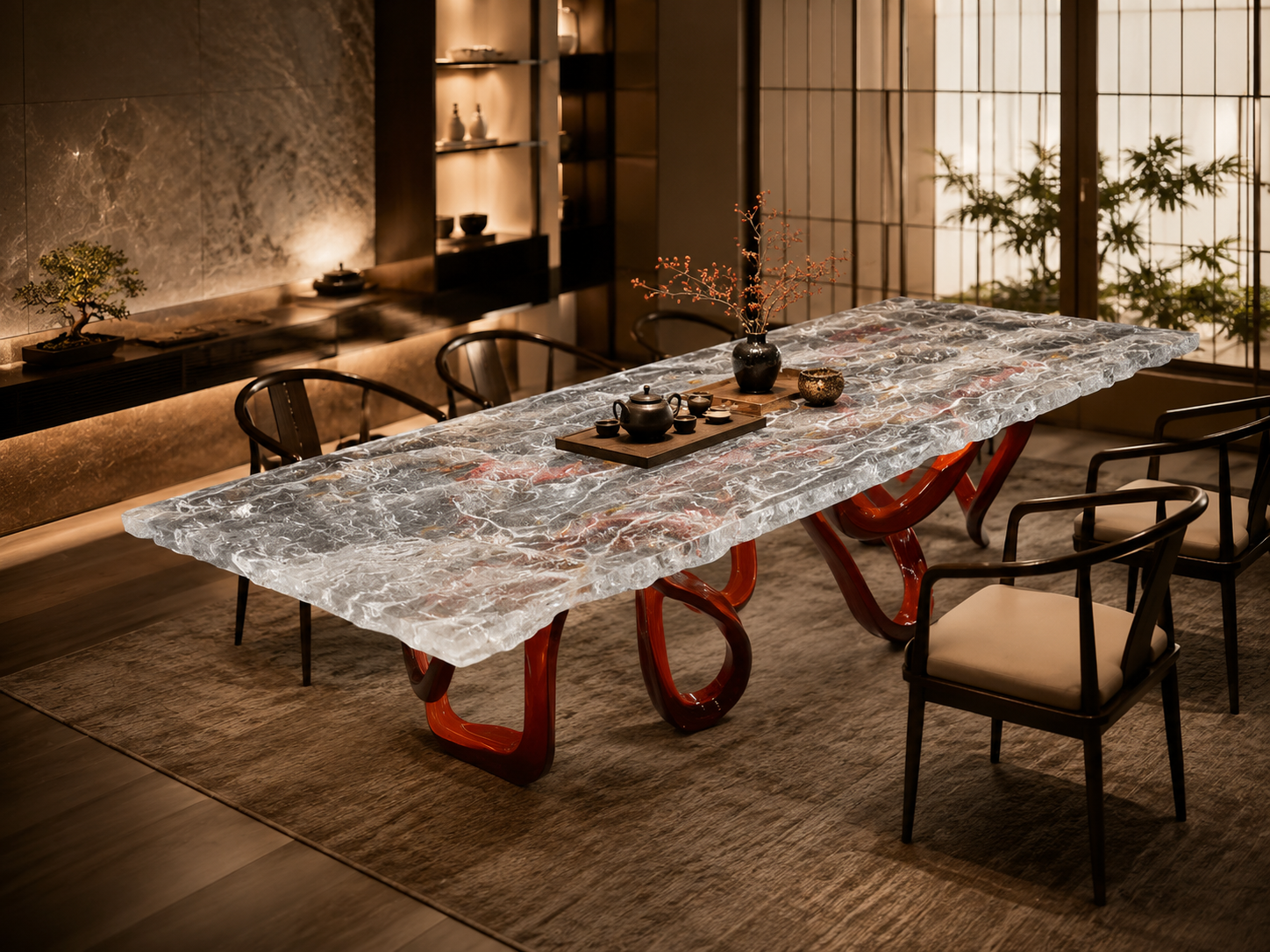
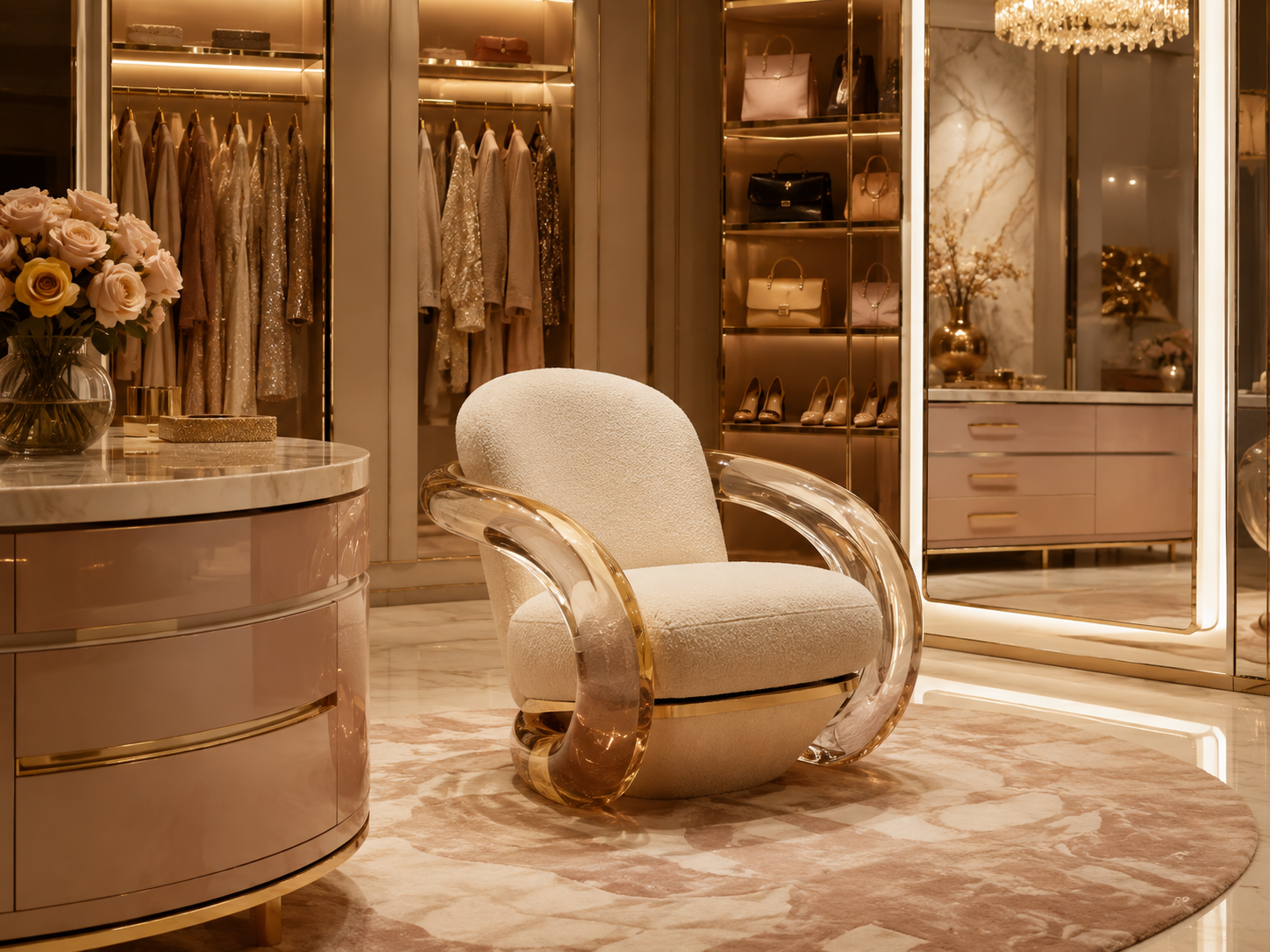
Commercial interiors are experienced before they are analyzed. A customer entering a luxury boutique, hotel lobby, restaurant, showroom, or high-end sales gallery rarely calculates floor area or studies a furniture specification. Instead, the person forms an immediate impression: the space feels open or crowded, calm or visually noisy, light or heavy, ordinary or distinctive.
This is what makes spatial perception commercially important.
Research shows that perceived spaciousness is not determined by physical dimensions alone. In a study published in Human Factors, participants evaluated virtual spaces with different sizes, lighting conditions, window sizes, textures, and amounts of furniture. Larger, brighter spaces with larger windows and less furniture were judged to be more spacious and were also more strongly preferred.
For designers, this creates an opportunity. Furniture does not simply occupy space; its transparency, mass, surface, reflectivity, color, and relationship with light can change how that space is perceived.
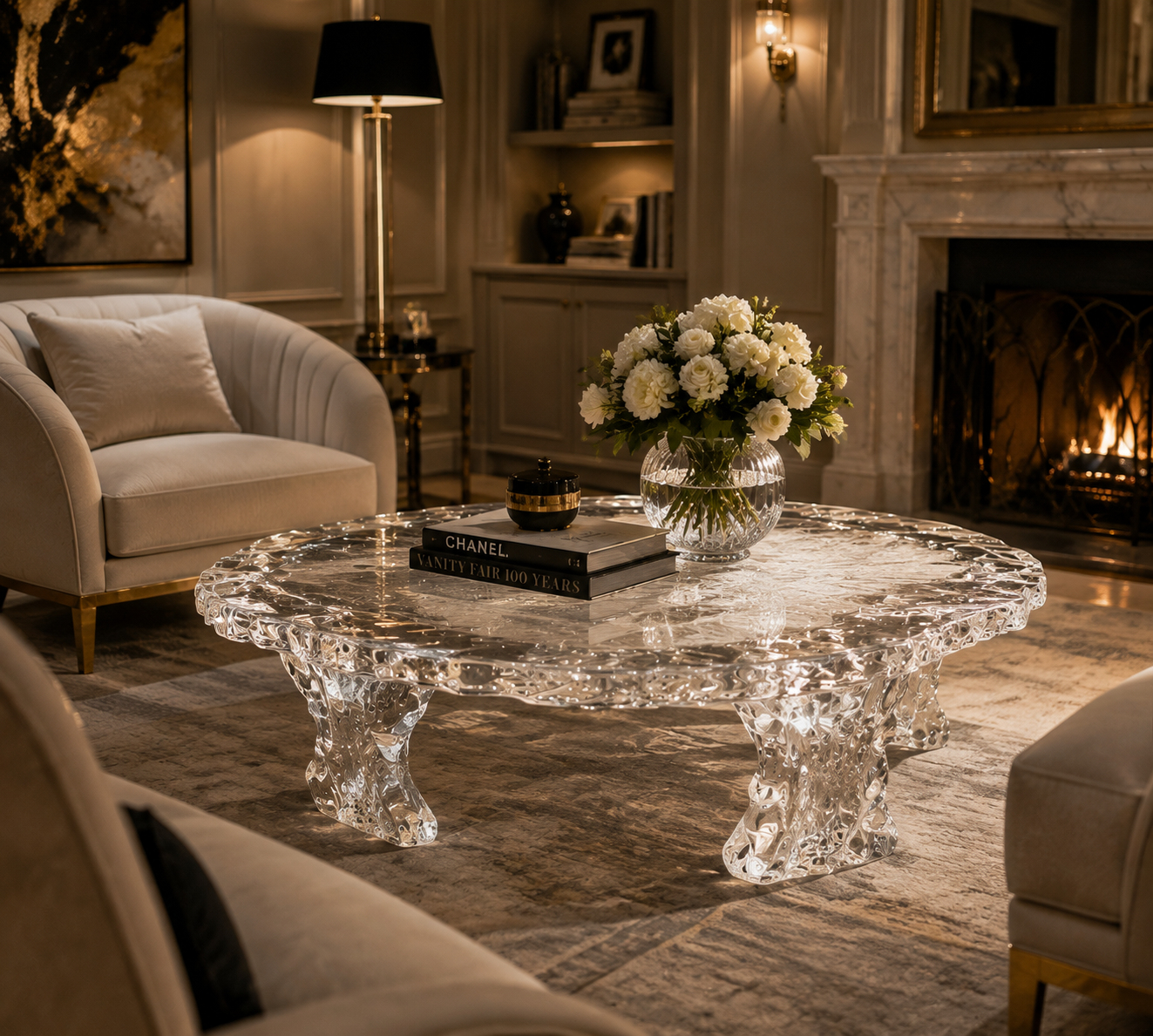
Synthetic crystal furniture, premium casting resin, and high-clarity platinum acrylic are particularly interesting in this context. They can create substantial physical forms while maintaining visual continuity, generate material depth without relying on heavy ornamentation, and interact with light in ways that make a commercial environment feel more layered and memorable.
Their value, therefore, goes beyond appearance.
1. Transparent Furniture Can Reduce Visual Weight Without Reducing Physical Presence
Every furniture piece has two kinds of mass: physical mass and perceived visual mass.
A solid walnut table, black stone counter, or lacquered cabinet may be beautifully designed, but it also creates a strong visual boundary. The viewer's sightline stops at the object. Flooring disappears behind it, architectural surfaces are interrupted, and large furniture volumes can make an already compact interior feel more densely occupied.
Transparent furniture behaves differently.
A synthetic crystal coffee table or platinum acrylic console may occupy almost exactly the same dimensions, yet the floor, wall, rug, merchandise, and surrounding architecture remain visible through much of the structure. The object is physically present but visually less obstructive.
This distinction matters because research on spatial perception shows that the amount and arrangement of furniture affect impressions of spaciousness. The Human Factors study by Saleheh Bokharaei and Jack Nasar found that participants judged environments containing less furniture as more spacious.
That does not mean commercial designers should simply remove furniture. Stores, hotels, restaurants, and showrooms require tables, displays, reception counters, seating, and functional surfaces.
The better question is how to provide those functions without creating unnecessary visual blockage.
Consider a luxury fashion boutique with limited floor area. A large opaque merchandise table in the center can divide the space visually. Replacing the heavy base with a thick, clear synthetic crystal or high-clarity platinum acrylic structure allows the designer to retain the required display surface while preserving more of the visual field.
In a hotel lounge, transparent side tables can sit beside substantial sofas without creating another layer of visual heaviness. In a jewelry boutique, clear consultation tables can give customers adequate working surfaces while maintaining visibility of surrounding showcases.
This creates one of the most useful perceptual characteristics of synthetic crystal furniture: substantial form without equivalent visual obstruction.
For high-end commercial projects, that balance can make the space feel both furnished and open.
2. Material Clarity Preserves Sightlines and Creates a Stronger Sense of Spatial Continuity
People understand space partly by following visual boundaries.
Research summarized by the University of Chicago on Arthur Stamps' work into spaciousness and enclosure found that factors such as walkable area, boundary height, boundary porosity, and boundary proximity influence how spacious or enclosed environments feel. Proximate boundaries, in particular, have a stronger impact on enclosure than distant ones.
Furniture is not the same as an architectural wall, but large opaque furniture can behave perceptually like a small boundary.
A solid reception desk blocks part of the floor and background. A dark retail fixture divides merchandise zones. Several heavy coffee tables create repeated interruptions between the viewer and the architecture.
Transparent furniture reduces some of those interruptions.
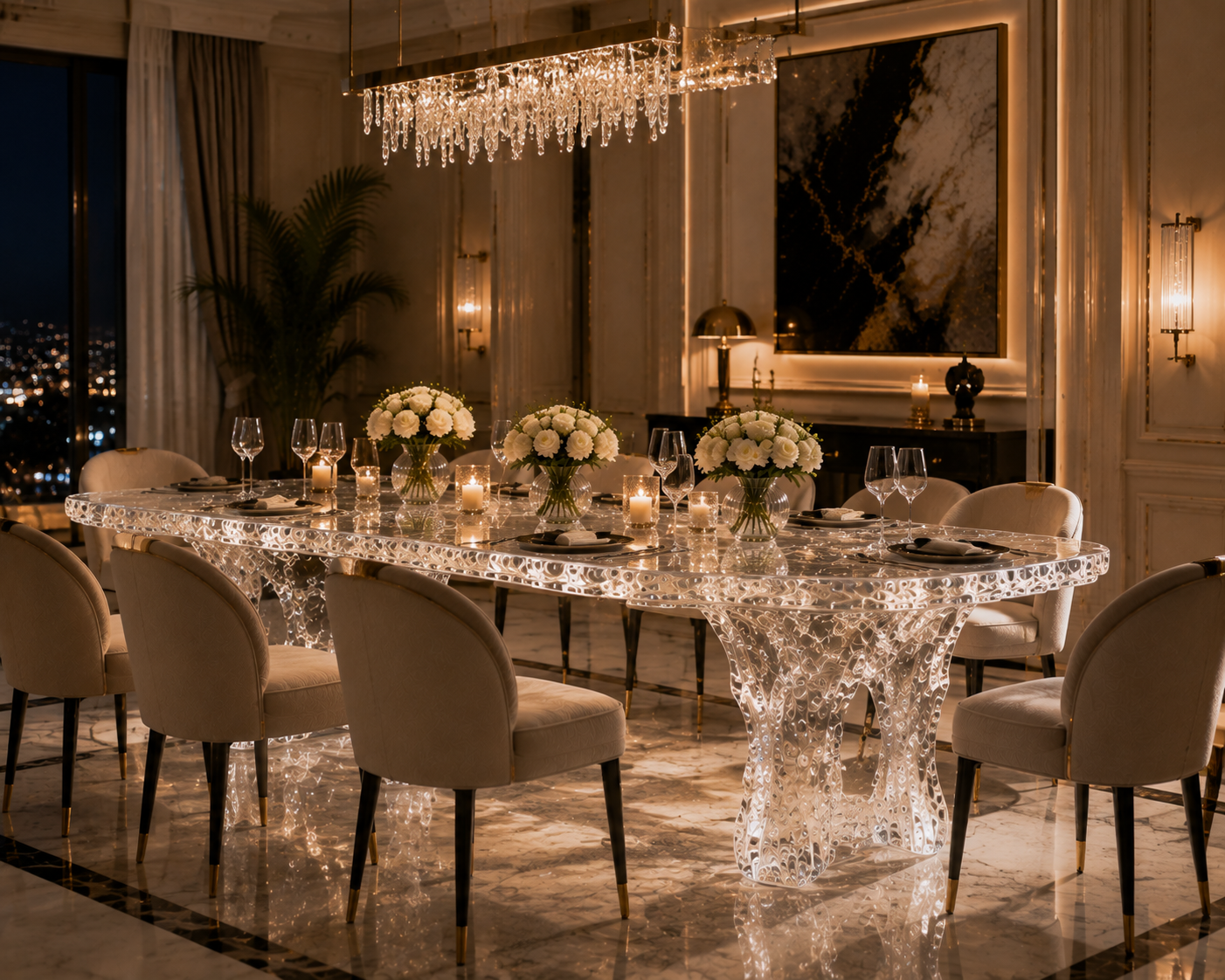
This is particularly relevant in spaces where the designer has already invested in premium architectural finishes. Imagine a luxury residential sales gallery with a book-matched stone floor. Placing a large opaque dining base over the center of the pattern conceals part of the material that was meant to be appreciated. A transparent synthetic crystal or platinum acrylic base allows the furniture to perform structurally while preserving the view through to the flooring.
The same principle applies to panoramic hotels and restaurants. When the commercial value of the interior depends partly on a city, ocean, garden, or skyline view, furniture should not unnecessarily compete with that view.
Material transparency becomes a spatial tool.
Röhm reports that clear PLEXIGLAS® PMMA products can achieve visible-light transmission of up to 92%, with the exact performance depending on product type and thickness. This figure should not be generalized to every acrylic product or every finished furniture piece, but it demonstrates the optical potential available in high-quality clear PMMA.
For premium acrylic furniture, clarity therefore has functional perceptual value. The objective is not simply to imitate glass. It is to create a piece that allows architecture, lighting, merchandise, and people to remain visually connected across the space.
When sightlines remain continuous, furniture feels more integrated into the environment rather than imposed upon it.
3. Thickness and Transparency Together Create Depth That Flat Surfaces Cannot Provide
Transparency is often misunderstood as invisibility.
In high-end furniture, the opposite can be true.
A thick transparent synthetic crystal block may be extremely noticeable precisely because customers can see into it. Polished edges, internal reflections, curved surfaces, color gradients, and changes in thickness create visual information at multiple depths.
Vision science helps explain why.
Roland Fleming's review in the Annual Review of Vision Science notes that people can infer a remarkable range of material properties visually and that material appearance emerges from complex interactions between lighting, shape, surface properties, and transparency.
A 2024 review in the same journal further emphasizes that the visual system derives both shape and material characteristics from structures including shading, specular reflections, and translucency.
This is why material depth matters in synthetic crystal and premium resin furniture.
A thin clear sheet may communicate transparency but relatively little optical richness. A thicker cast table leg, sculptural base, or resin block can create overlapping reflections and apparent layers. As the customer moves, these relationships change.
Premium resin can extend this effect beyond perfect clarity. Controlled translucency, smoke tones, amber coloration, cloudy gradients, mineral-like textures, metallic details, or artistic inclusions can make the customer visually explore the interior of the furniture rather than merely observe its surface.
For example, a luxury hotel might use a softly translucent amber resin console near the entrance. From a distance, it appears as a restrained sculptural volume. At closer range, changes in density and internal depth become visible. Under evening lighting, deeper areas appear darker while thinner sections transmit more light.
The customer receives several visual experiences from one object.
That creates perceptual richness without requiring complicated decoration.
In high-end commercial interiors, this type of controlled depth can make even simple furniture geometry feel bespoke and materially sophisticated.
4. Synthetic Crystal Changes With Light, Making the Space Feel More Dynamic
Space is never experienced under completely static conditions.
Daylight moves. Artificial lighting changes between daytime and evening settings. Customers approach objects from different directions. Reflections shift as people walk through the room.
Transparent and translucent furniture amplifies these changes.
Sylvia Pont's review in the Annual Review of Vision Science argues that the perception of light should be understood through its interaction with materials, shapes, and space rather than as an isolated lighting condition.
That interaction is fundamental to synthetic crystal furniture.
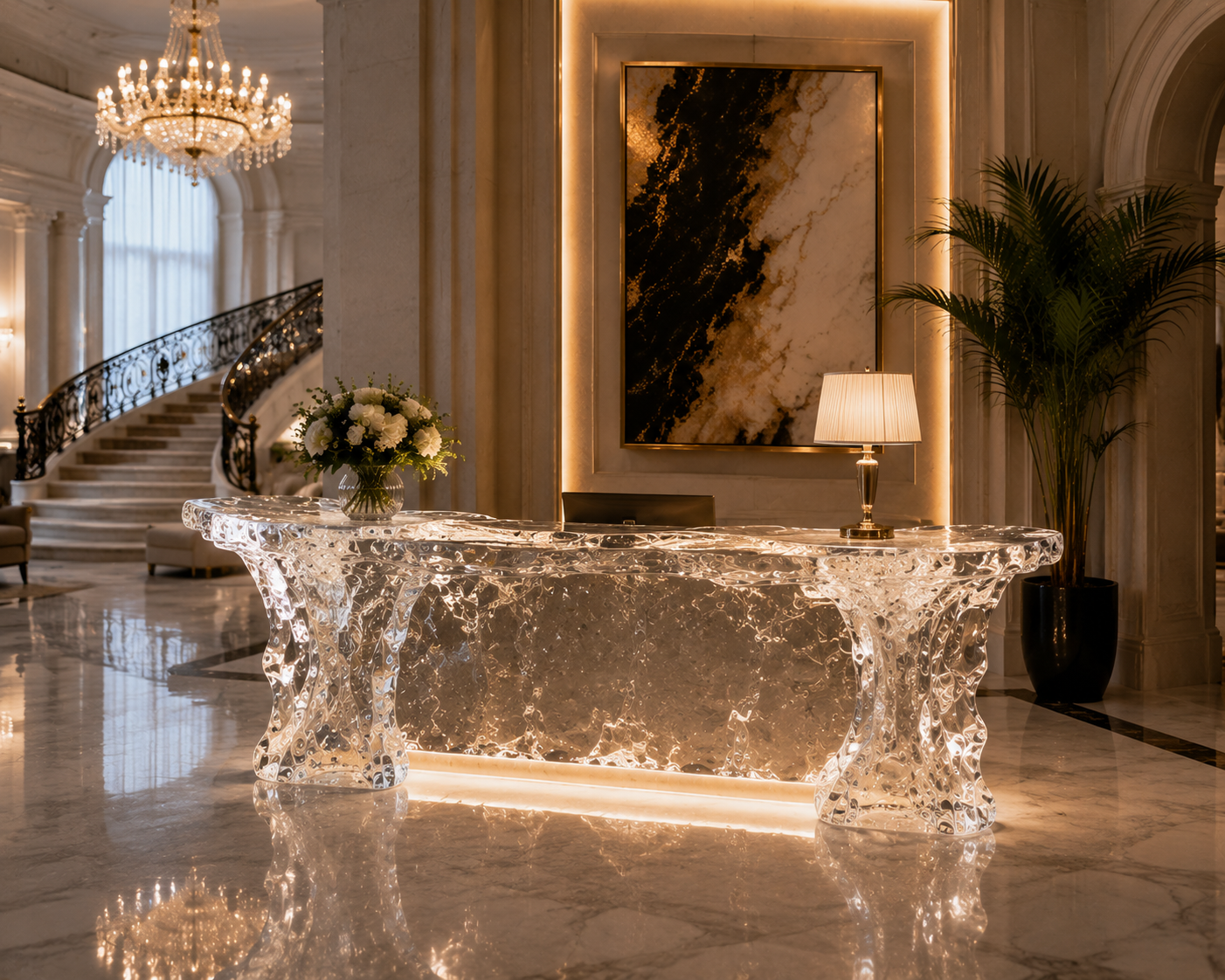
A clear console beside a window may look quiet when viewed straight on, yet produce a bright edge highlight when the customer changes position. A premium resin reception desk may appear relatively solid in daylight but develop a soft internal glow when evening lighting is introduced.
A study of light distribution and perceived spaciousness also found that illuminated walls can increase impressions of spaciousness and that different patterns of light and darkness can influence perceived width, height, and depth.
For commercial designers, the implication is that furniture and lighting should be developed together.
A platinum acrylic display pedestal can be positioned where edge highlights are visible without producing uncomfortable glare. A synthetic crystal table can sit beneath directional light that reveals polished geometry rather than uniformly flooding every surface. A translucent resin bar or reception counter can use integrated or concealed lighting to reveal material depth after sunset.
This approach is especially valuable in hospitality environments because the same physical interior may need different moods throughout the day.
The furniture does not need to move.
Light gives it another visual identity.
As a result, the customer perceives the space not as a collection of static objects but as an environment that changes through time and movement.
5. Transparent Furniture Can Support Merchandise and Architecture Instead of Competing With Them
In commercial design, furniture rarely exists for itself.
Its role is usually to support something more important: jewelry, fashion, cosmetics, cars, artwork, hospitality, architecture, or human interaction.
This is where visually lighter furniture can provide considerable value.
Imagine a jewelry display area containing highly detailed products, reflective metal finishes, stone flooring, brand graphics, and carefully controlled lighting. Heavy furniture introduces another visual layer the customer must process.
A high-clarity platinum acrylic pedestal or synthetic crystal display table can perform the functional role while becoming visually secondary in selected views. The merchandise appears to occupy more of the customer's attention.
In an automobile showroom, clear lounge tables allow customers to sit and discuss a vehicle without placing opaque visual barriers beside the car. In a luxury hotel, synthetic crystal side tables complement large upholstered seating while allowing textile, architecture, artwork, and lighting to remain dominant.
Premium resin is useful when complete visual disappearance would be undesirable. A custom translucent resin reception counter can establish a strong zone while remaining lighter than stone or timber. Brand colors can be integrated into the material itself, allowing the furniture to create identity without requiring additional printed graphics.
The broader point is spatial hierarchy.
Good design determines what should be noticed first, second, and third.
Research by Arthur Stamps involving 46 environments and 66 participants found that horizontal area had the strongest tested relationship with perceived spaciousness, while other physical properties also influenced perception. Actual square footage obviously remains fundamental, but furniture selection determines how much of that area people can visually understand.
Synthetic crystal furniture does not create additional floor area.
What it can do is allow more of the existing space to remain perceptually available.
That is a subtle but commercially meaningful distinction.

6. Spatial Perception Ultimately Becomes Brand Experience and Commercial Value
The strongest reason to think about spatial perception is not purely aesthetic.
Customers respond to how spaces make them feel.
Gensler's Experience Index combined ethnographic research with a nationwide survey of more than 4,000 respondents. It found that experiences in the “best-designed” spaces were rated nearly twice as highly as those in the “worst-designed” spaces. The research also reported that people were 10 times more likely to share an in-store experience on social media when stores contained unique design features.
This is where spatial perception becomes commercially relevant.
A store that feels open, carefully composed, and distinctive can reinforce premium brand positioning. A hotel lobby with strong visual continuity can feel calmer and more generous. A showroom where furniture does not visually obstruct the main product can make the experience easier to understand.
Synthetic crystal, premium resin, and platinum acrylic furniture can contribute to all of these outcomes when used selectively.
The key word is selectively.
Filling an entire commercial interior with transparent furniture does not automatically create sophistication. Too many glossy surfaces can produce visual noise. Excessive transparency may remove necessary hierarchy. Poor fabrication becomes particularly visible in clear materials, where scratches, joints, bubbles, polishing quality, and internal distortion are difficult to conceal.
The most effective approach is usually to identify where perceptual value matters most.
A transparent synthetic crystal table can preserve openness at the center of a boutique. A platinum acrylic console can create functional display space beside an important architectural view. A thick premium-resin reception desk can become the visual anchor of a lobby while still transmitting light. A sculptural resin table can introduce controlled color and depth into an otherwise restrained environment.
In each case, the furniture is doing more than occupying a position on a floor plan.
It is influencing how customers interpret that floor plan.
This is the deeper spatial value of synthetic crystal furniture.
Customers may never describe the experience using terms such as visual continuity, boundary perception, optical transmission, specular reflection, or material depth. They simply know that one space feels lighter, more open, more refined, or more memorable than another.
For architects, interior designers, brands, and furniture buyers, that perception is valuable because people do not remember commercial spaces as measurements—they remember how those spaces made them feel.
Synthetic crystal furniture can help shape that feeling by allowing physical presence and visual openness to exist at the same time.
And when transparency, material depth, lighting, craftsmanship, and architecture are designed as one system, the furniture stops being merely an object inside the space.
It becomes part of the way the space itself is perceived.
READ MORE:
- Lighting + Synthetic Crystal: How Light and Shadow Details Make Commercial Spaces More Attractive
- How Material Texture Shapes Brand Trust: Application Ideas for Synthetic Crystal Furniture in Commercial Spaces
- Make Your Store Unforgettable at First Sight: How Synthetic Crystal Furniture Becomes a Visual Focal Point
- Why Are Customers Drawn to Spatial Details? Understanding the Material and Light of Synthetic Crystal Furniture
- Synthetic Crystal Acrylic Furniture: How Innovative Materials Are Upgrading the Value of Furniture
- Why Transparent Furniture Is Moving from a Niche Design Choice to a High-End Trend
- Synthetic Crystal Acrylic Furniture: A New Design Language for Future High-End Spaces
- From Visual Appeal to Brand Value: The Long-Term Competitiveness of Synthetic Crystal Acrylic Furniture
- Synthetic Crystal Acrylic Furniture: Why High-End Projects Are Increasingly Focused on “Material Differentiation”


