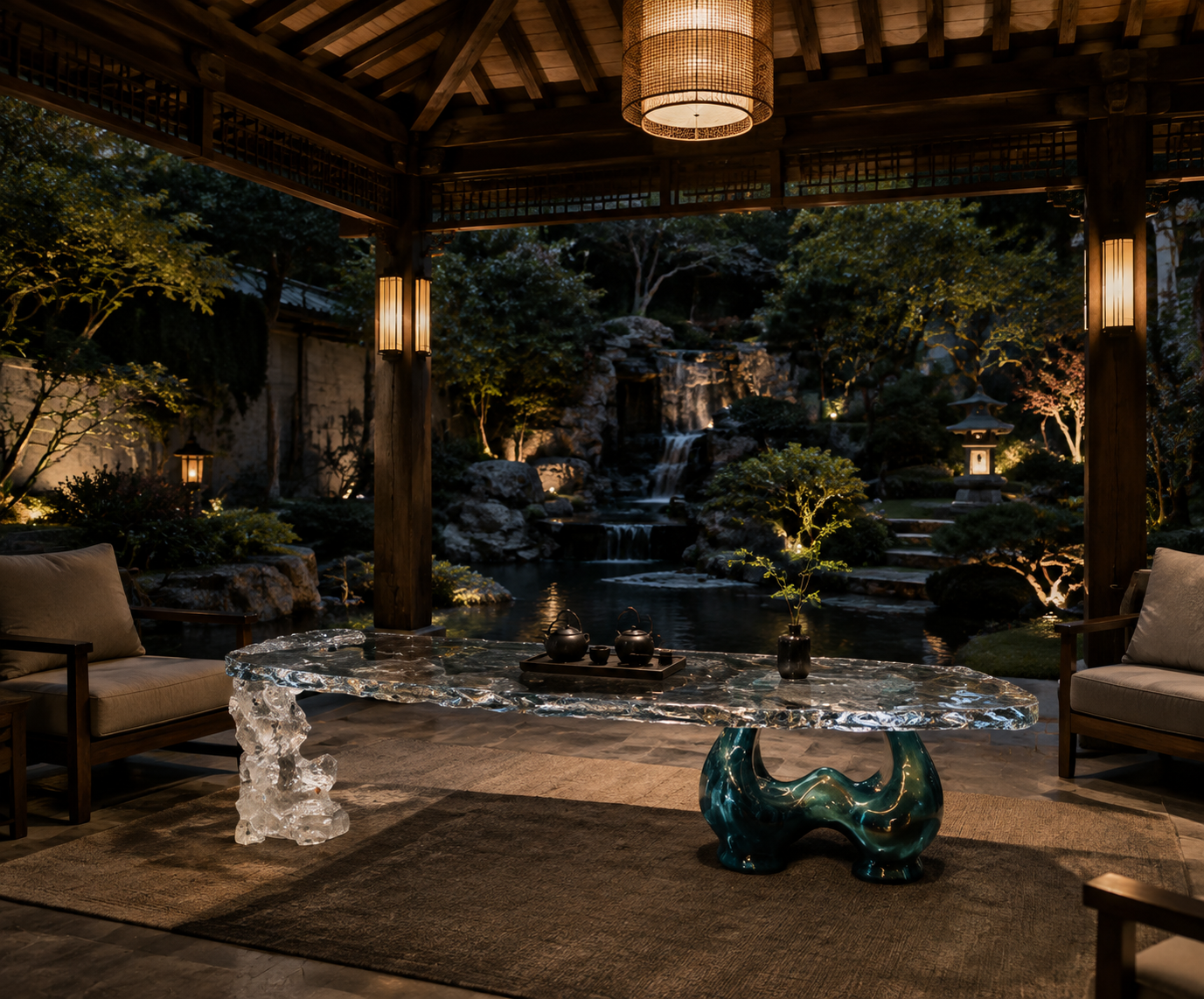
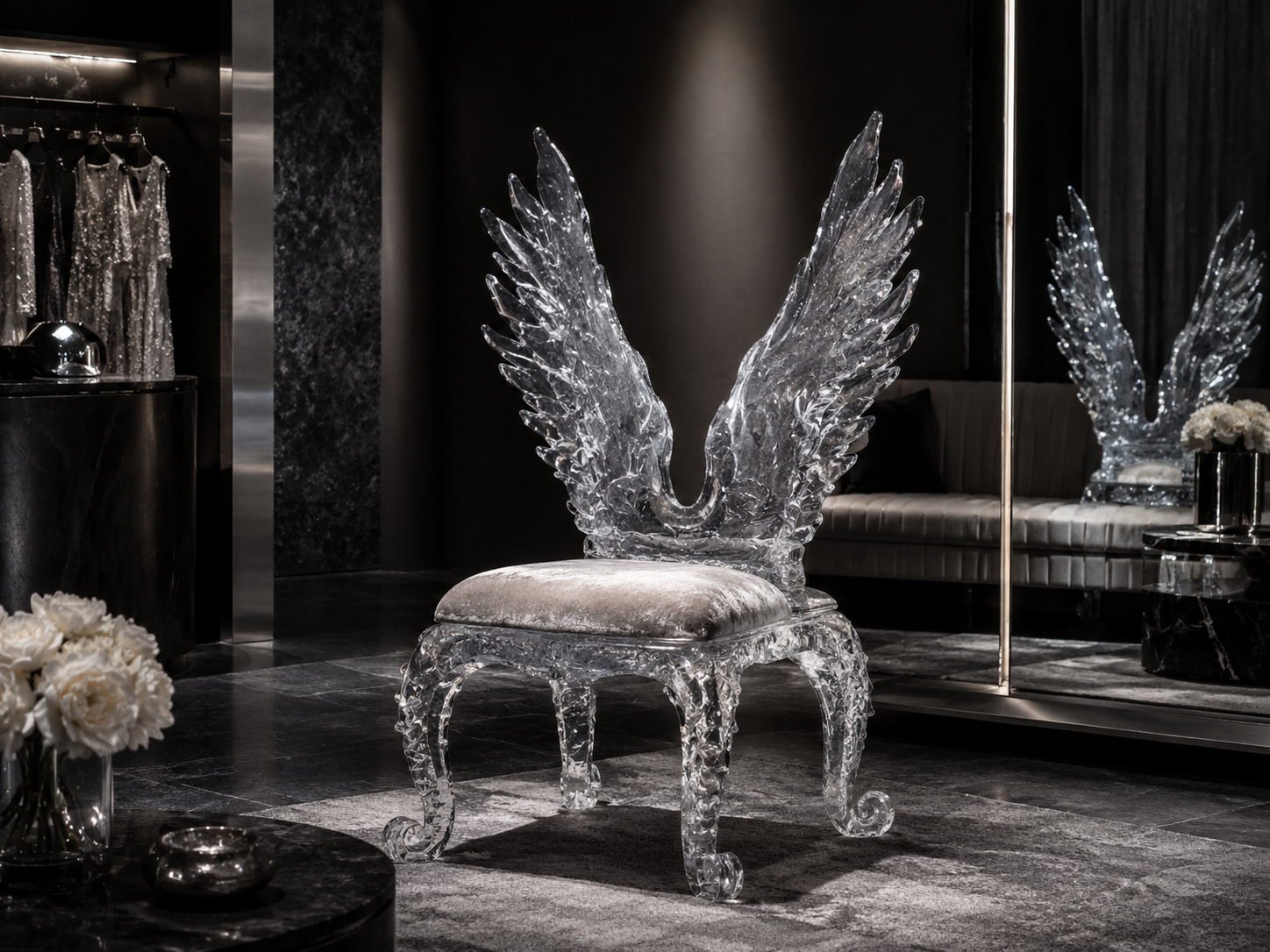
Walk into a successful luxury store, hotel lobby, restaurant, or showroom, and one thing quickly becomes clear: lighting is doing far more than helping people see.
It is directing attention, revealing materials, creating depth, separating important objects from their surroundings, and influencing how expensive—or ordinary—a space feels. This is particularly relevant when the interior contains transparent or translucent furniture. Synthetic crystal, premium casting resin, and high-clarity platinum acrylic do not have a fixed visual identity under every condition. Their appearance changes as light enters, reflects, refracts, scatters, or travels along their surfaces and edges.
That makes lighting part of the furniture itself.
Scientific research on material perception supports this idea. A review in the Annual Review of Vision Science explains that the human visual system infers material properties from complex interactions among lighting, shape, reflectance, texture, and transparency. We can often judge whether something appears glossy, smooth, hard, translucent, or polished before touching it.
For commercial designers and brands, the opportunity is therefore not simply to install brighter lights. It is to design a relationship between light, material, furniture geometry, customer movement, and brand atmosphere.
When these elements are coordinated, a synthetic crystal table can become more than a table. It can become a changing visual experience.
1. Light Does Not Simply Illuminate Material—It Determines How the Material Is Perceived
A premium material can lose much of its impact under poor lighting.
Place a beautifully polished synthetic crystal console beneath flat, uniform ceiling illumination and it may appear relatively ordinary. Move the same piece into a carefully designed lighting environment—with directional highlights, controlled background brightness, and enough contrast around the object—and its edges, depth, transparency, and geometry become far more noticeable.
The reason is perceptual.
Roland Fleming's research on material perception notes that material appearance cannot be separated easily from illumination and shape. A glossy or transparent object may look dramatically different when its geometry, viewing angle, or lighting changes. More recent research published in the Annual Review of Vision Science likewise emphasizes that specular reflections and shading work together to help the brain interpret both three-dimensional shape and material quality.
For synthetic crystal furniture, this means polished surfaces and thick edges are not decorative details alone. They create opportunities for light to reveal the construction.
Imagine a transparent console in the entrance of a luxury fashion boutique. Diffuse ambient lighting makes the overall space comfortable, while a narrow directional spotlight reaches the upper edge and one side of the console. Customers entering from different angles see highlights move across the material as they walk.
The furniture appears active even though it never moves.
The same principle works with premium resin. A completely transparent material emphasizes clarity and reflections; a translucent resin can soften and scatter light, producing a deeper, more atmospheric glow. Smoke, amber, champagne, blue, rose, or custom brand-colored resin can change further as the intensity and color of illumination change.
Research by Sylvia Pont on light and atmosphere argues that lighting should be understood through its interaction with materials, shapes, and space rather than as an isolated technical quantity.
That is an especially useful principle for high-end commercial interiors: do not select the furniture first and “add lighting” later. Design the two as one visual system.
2. Transparency, Thickness, and Polished Edges Give Designers More Ways to Work With Light
Transparent materials are unusual because light can interact with more than their visible exterior surface.
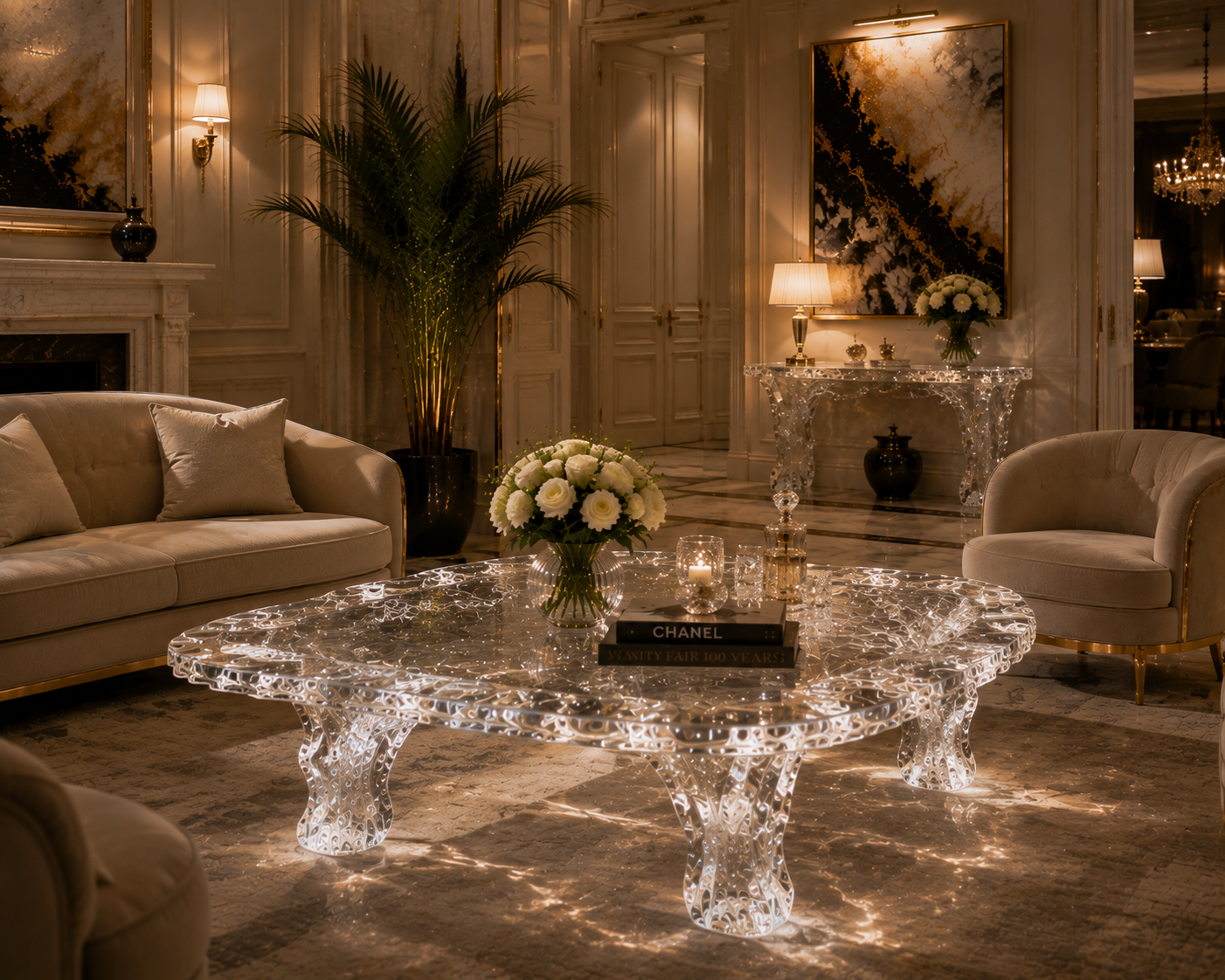
With timber or opaque stone, designers primarily work with surface reflection. With synthetic crystal and clear acrylic furniture, they can also use transparency, edge highlights, internal reflections, thickness, and the visual layering of objects behind the furniture.
The optical properties of PMMA illustrate the opportunity. Röhm reports that clear PLEXIGLAS® products can achieve visible light transmission of up to 92%, with very little visible-light absorption in the material itself. The manufacturer also notes that transmission depends on the specific product type and thickness.
This should not be interpreted as a specification for every acrylic furniture product, since formulations and production methods vary. It does, however, demonstrate why high-quality acrylic materials can work so effectively in lighting-led furniture design.
Consider a platinum acrylic table base in a luxury jewelry boutique. Instead of blocking the illuminated floor and showcases behind it, the structure allows much of the surrounding environment to remain visually continuous. At the same time, carefully finished edges can capture brighter lines of light, allowing customers to understand the thickness and geometry of the furniture.
This produces an interesting combination: the furniture is visually light but still physically substantial.
Thickness can become an advantage rather than something to hide. A large synthetic crystal leg or sculptural base can reveal greater optical depth than an extremely thin component. When placed near directional lighting, different surfaces may illuminate at different intensities, creating the impression of multiple transparent layers inside one solid form.
Premium resin creates even broader possibilities because complete transparency is not always necessary. Designers can intentionally use cloudiness, gradients, embedded textures, pigments, bubbles used as controlled artistic features, mineral-like effects, or translucent layers. When light passes through these features, the internal structure becomes visible.
This is why the most successful lighting for transparent furniture often highlights depth rather than brightness.
Customers should feel that there is something to discover as they approach the object.
3. Contrast Attracts Attention More Effectively Than Making the Entire Space Brighter
A common mistake in commercial interiors is to assume that more light automatically creates more attraction.
It does not.
If every surface is equally bright, nothing receives visual priority. The space may be highly illuminated yet still feel flat.
Retail lighting research provides useful evidence. A field study published in the Journal of Business Research observed 2,367 shoppers after supplemental lighting was temporarily installed on merchandise displays in two stores. The researchers found that supplemental lighting positively affected consumer behavior around the displays, although the effect depended on the display condition.
Another study investigating retail lighting and perceived brightness found that zonal lighting strategies could reduce overall room illuminance by approximately 30% compared with uniformly illuminated reference scenes while still being perceived as similarly bright by participants.
The practical implication is powerful: attraction often comes from lighting hierarchy, not maximum illumination.
This principle is particularly effective with synthetic crystal furniture.
Imagine a luxury cosmetics store with restrained ambient lighting. Instead of flooding the entire interior with high-intensity white light, the designer uses focused illumination around a transparent synthetic crystal product table. Bright polished edges become visible against the quieter background, while products placed on the table receive their own controlled illumination.
The customer immediately understands where to look.
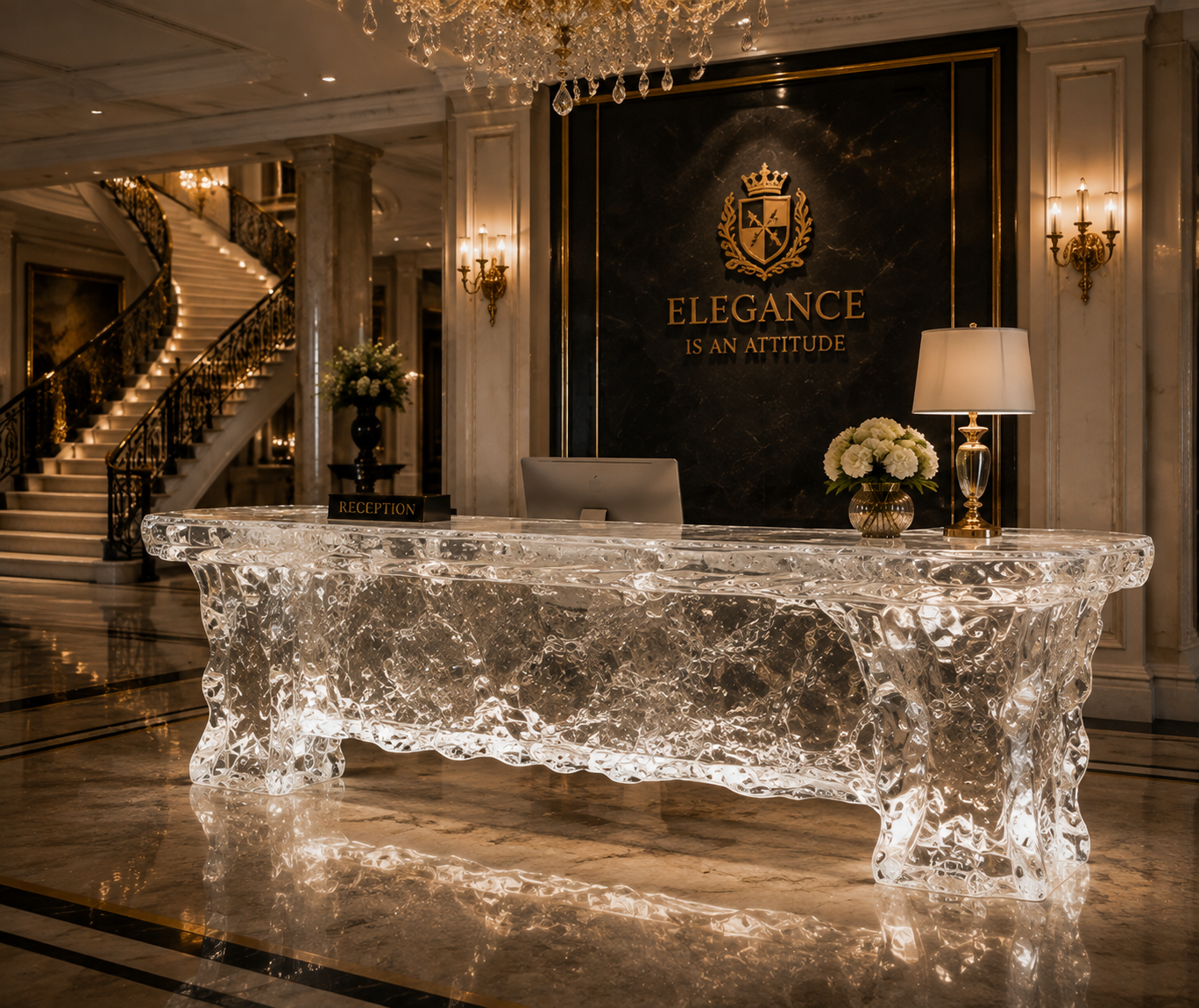
In a hotel lobby, the same technique could be applied to a premium resin reception counter. Rather than making the entire lobby equally bright, the reception desk can be given a warmer or more concentrated layer of illumination. The translucent material then appears to hold light, creating a visual destination for arriving guests.
This also allows retailers to create luxury through restraint. One illuminated synthetic crystal hero table can have greater impact than ten transparent furniture pieces under identical lighting.
Commercial attraction depends on hierarchy.
Light tells customers: look here first.
4. Color Temperature and Light Quality Can Change the Emotional Character of Crystal and Resin Furniture
Light intensity is only part of the story. Color quality also changes the way customers experience materials.
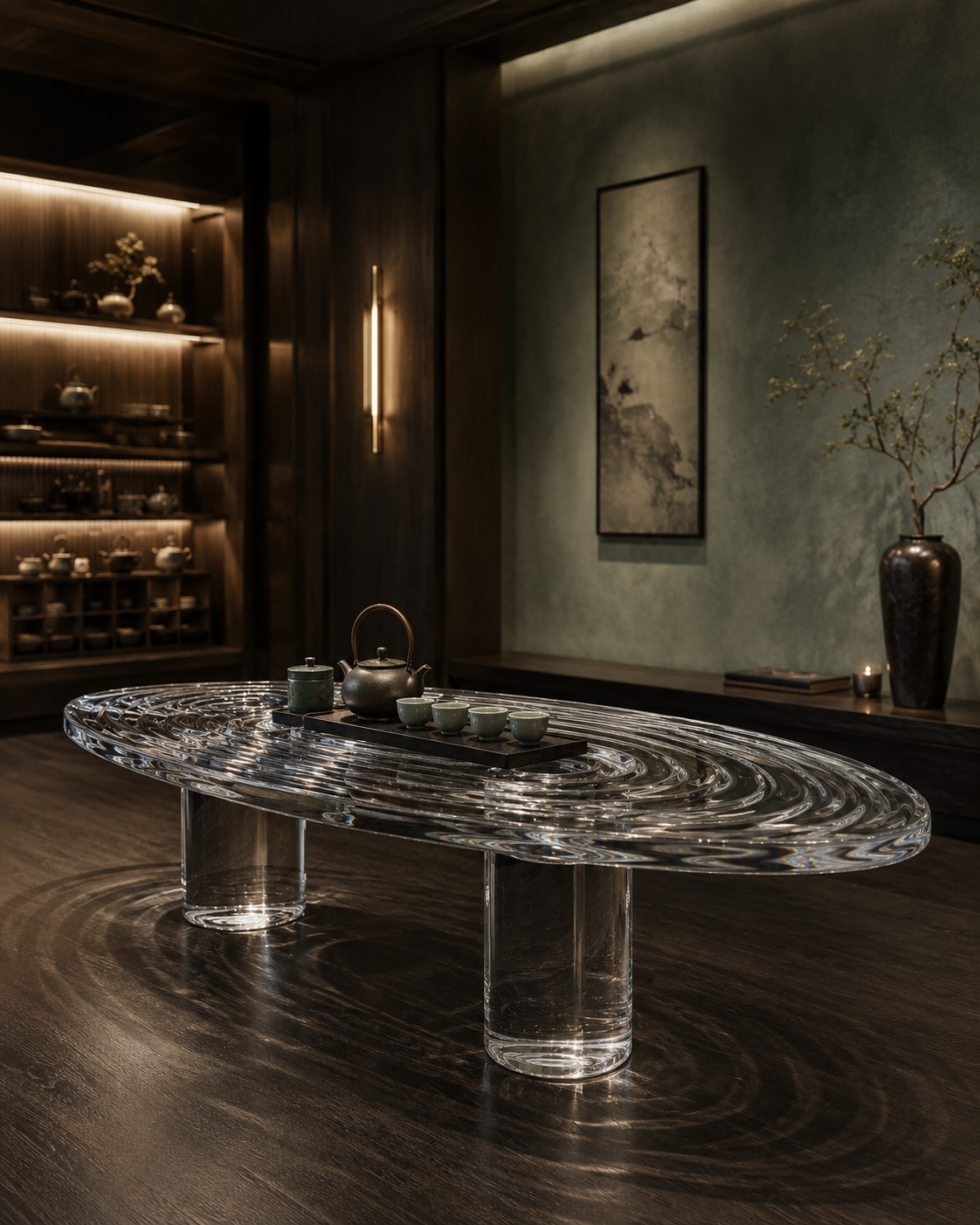
A crystal-clear acrylic table under cool illumination may feel precise, technical, and contemporary. Under warmer light, the same object may appear softer and more hospitality-oriented. Amber or champagne resin becomes especially rich under warm illumination, while cool blue or smoke-colored transparent furniture can become more architectural under neutral or cooler lighting.
Retail research has repeatedly demonstrated that lighting contributes to atmosphere.
A controlled study published in the Journal of Environmental Psychology placed 95 participants in a realistic three-dimensional simulated supermarket under three lighting environments. The researchers found that lighting could influence customers' perception of atmosphere and emotional experience and could itself communicate an image for the store.
Another study in the Journal of Interior Design found that color rendering and color temperature affected emotional reactions, perceptions, and approach-avoidance intentions, while also identifying cultural differences in those responses.
This is important for international commercial projects. There is no universal formula stating that one color temperature automatically feels “luxurious.” Lighting must fit the brand, merchandise, local audience, architecture, and material palette.
For a high-end technology showroom, a clear platinum acrylic reception table combined with controlled neutral-white illumination might communicate precision and innovation.
For a luxury hotel lounge, smoky or amber premium resin side tables under warmer lighting could support intimacy and comfort.
For a fashion flagship, a custom-colored synthetic crystal table could become more dramatic under directional light designed specifically around the brand palette.
The furniture therefore becomes a carrier of color without needing an opaque painted finish.
That distinction matters. With translucent resin or colored acrylic, customers see not only color on the object but color inside it. Light determines how deep, saturated, or luminous that color appears.
5. Successful Light-and-Crystal Design Must Control Glare as Carefully as It Creates Sparkle
Transparent and polished furniture can create beautiful highlights, but uncontrolled reflection can quickly become a problem.
There is an important difference between sparkle and glare.
Sparkle gives the eye a point of interest. Glare creates discomfort.
The International WELL Building Institute notes that glare can occur when high-intensity electric or natural light reflects from glossy surfaces at unfavorable angles. WELL also emphasizes balanced luminance and thoughtful surface reflectivity because much of the light people experience inside buildings reaches the eye after being reflected from surrounding surfaces.
This becomes particularly important when specifying polished synthetic crystal, high-gloss resin, or platinum acrylic furniture.
A spotlight aimed directly toward a glossy tabletop from the wrong angle can produce a distracting reflection in the customer's eyes. A transparent reception desk positioned opposite strong afternoon sunlight may appear beautiful in the morning but uncomfortable later in the day. Highly polished dining tables can reflect pendants or downlights so aggressively that the lighting becomes visually tiring.
Professional lighting design therefore requires testing the object from the customer's actual viewing positions.
Where will customers enter?
Where will they sit?
Where will staff stand?
From which direction will daylight arrive?
What happens to the furniture at noon, at sunset, and after dark?
Often the solution is not less interesting lighting, but better-controlled lighting: grazing light across an edge instead of pointing directly at the main surface, using diffused ambient illumination with selective accents, adjusting fixture angles, or illuminating translucent resin from behind rather than creating excessive front-surface reflections.
This creates a more sophisticated luxury effect.
The furniture appears luminous without looking aggressively shiny.
6. The Strongest Commercial Spaces Use Lighting and Synthetic Crystal to Create a Memorable Brand Moment
Ultimately, commercial lighting should do more than make furniture attractive. It should help customers remember the space.
Gensler's Experience Index research surveyed more than 4,000 people and found that experiences in the “best-designed” spaces were rated nearly twice as highly as those in the “worst-designed” spaces. The same research reported that customers were 10 times more likely to share an in-store experience on social media when the store contained unique design features.
Lighting and specialty furniture can create exactly this kind of recognizable feature.
A fashion store might become known for a monumental clear synthetic crystal table whose illuminated edges seem to float at night. A hotel may use a translucent premium-resin reception counter whose color gradually changes as daylight disappears. A jewelry boutique could combine platinum acrylic display furniture with focused light so that valuable products appear almost suspended inside the space.
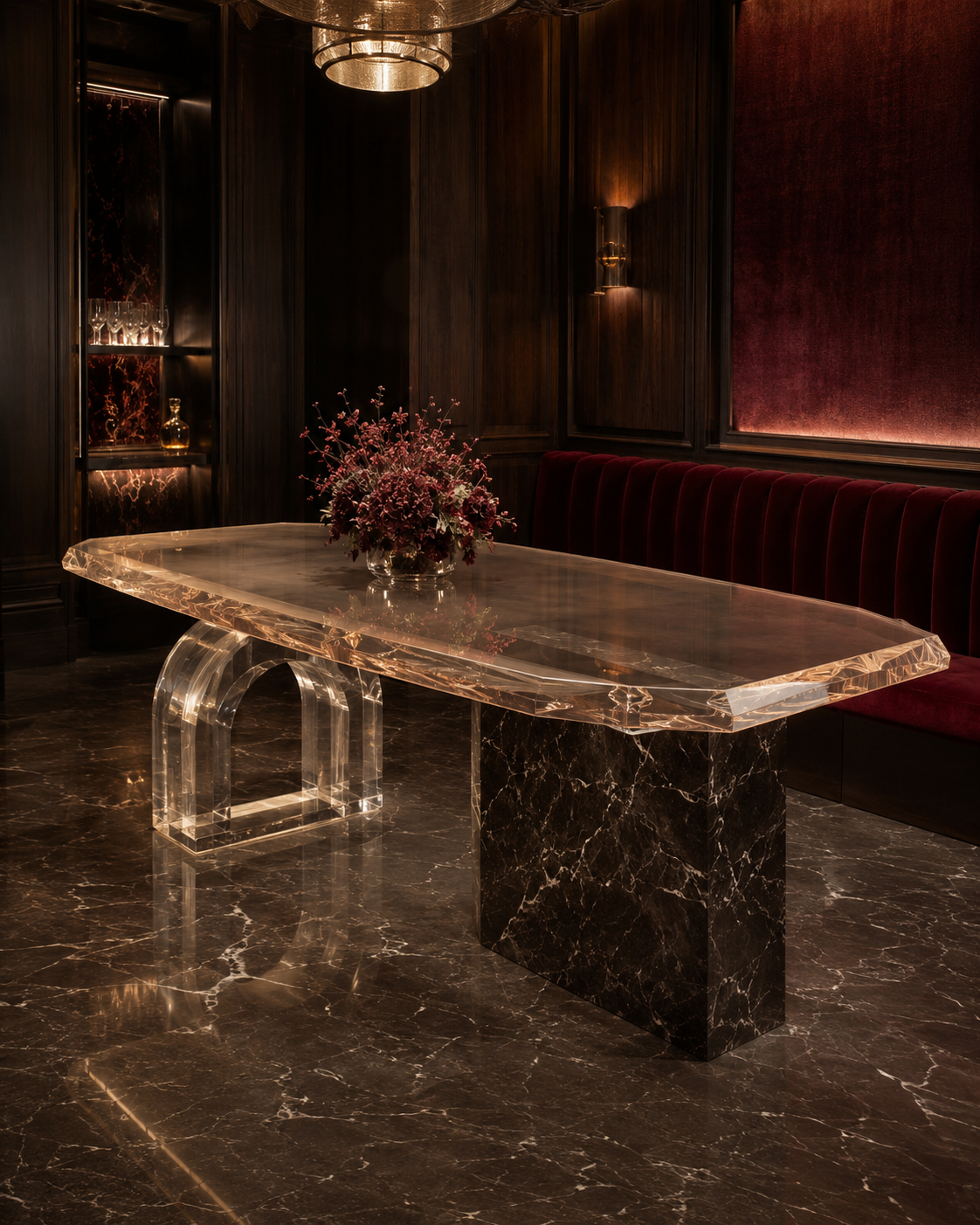
A restaurant could use an amber resin communal table beneath carefully positioned pendants, creating both a functional dining surface and a recognizable photographic background. A luxury property showroom might use a thick transparent dining base positioned above dramatic stone flooring, preserving the view of the floor while allowing light to trace the furniture's polished geometry.
The key is restraint.
Not every object needs to glow. Not every acrylic edge needs an LED. Not every table needs to become a sculpture.
The best strategy is often to identify one or two moments along the customer journey where material and light can create maximum emotional impact. The entrance, reception area, central merchandise zone, consultation table, VIP lounge, or checkout area may offer natural opportunities.
Furniture should also be designed for commercial reality. Lighting can reveal scratches, poor polishing, visible adhesive lines, uncontrolled bubbles, surface distortion, or inconsistent resin coloration just as effectively as it reveals craftsmanship. The stronger the lighting concept, the more important manufacturing quality becomes.
For producers of synthetic crystal, premium resin, and platinum acrylic furniture, this creates an important competitive distinction.
The value is not simply the ability to manufacture a transparent table.
It is the ability to understand how material thickness, polishing, curvature, transparency, pigmentation, joints, and internal effects will behave after the furniture enters a real lighting environment.
That is where product design becomes spatial design.
Customers rarely enter a store thinking about optical transmission, specular reflections, resin casting, edge polishing, or luminance contrast. But they respond to the result: a table that appears deeper than expected, a reception desk that seems to glow, an acrylic structure that almost disappears, or a polished edge that suddenly catches the light as they walk past.
Those small moments create attraction because they reward movement and attention.
And in a commercial environment competing for both physical visitors and digital visibility, that is the real power of combining light with synthetic crystal materials:
the furniture does not simply occupy the space—it changes with the space, helping customers notice it, experience it, photograph it, and remember it.
READ MORE:
- The Spatial Perception Value of Synthetic Crystal Furniture
- How Material Texture Shapes Brand Trust: Application Ideas for Synthetic Crystal Furniture in Commercial Spaces
- Make Your Store Unforgettable at First Sight: How Synthetic Crystal Furniture Becomes a Visual Focal Point
- Why Are Customers Drawn to Spatial Details? Understanding the Material and Light of Synthetic Crystal Furniture
- Synthetic Crystal Acrylic Furniture: How Innovative Materials Are Upgrading the Value of Furniture
- Why Transparent Furniture Is Moving from a Niche Design Choice to a High-End Trend
- Synthetic Crystal Acrylic Furniture: A New Design Language for Future High-End Spaces
- From Visual Appeal to Brand Value: The Long-Term Competitiveness of Synthetic Crystal Acrylic Furniture
- Synthetic Crystal Acrylic Furniture: Why High-End Projects Are Increasingly Focused on “Material Differentiation”


