In a crowded retail street, luxury mall, hotel lobby, or brand showroom, customers are exposed to hundreds of visual signals within minutes. Logos, digital screens, merchandise, lighting, signage, colors, fixtures, and people are all competing for attention. Yet after leaving, customers may remember only one or two details.
For a commercial space, that creates an important design question: what will customers remember about your store when they can no longer see it?
A memorable visual focal point can provide the answer.
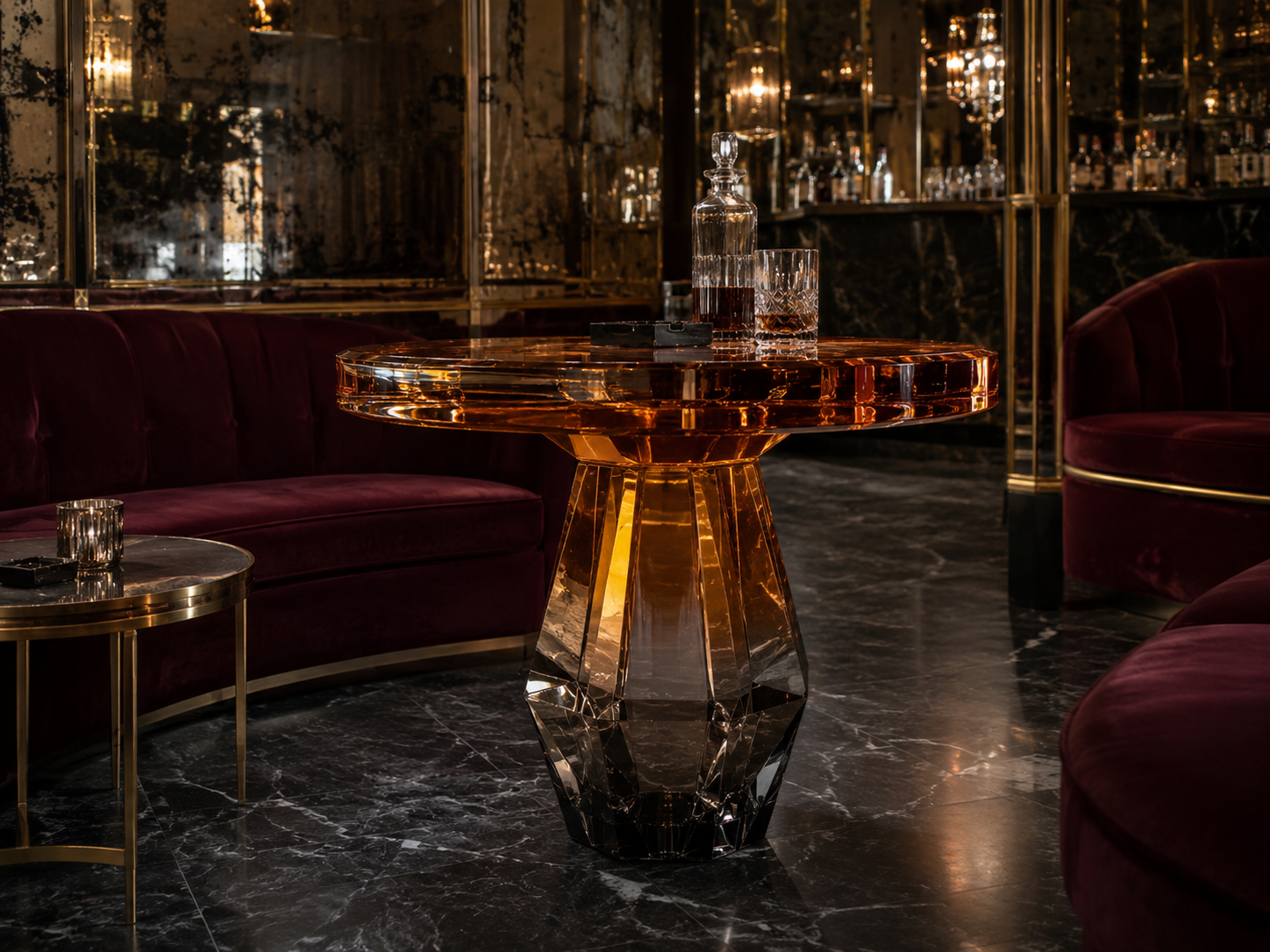
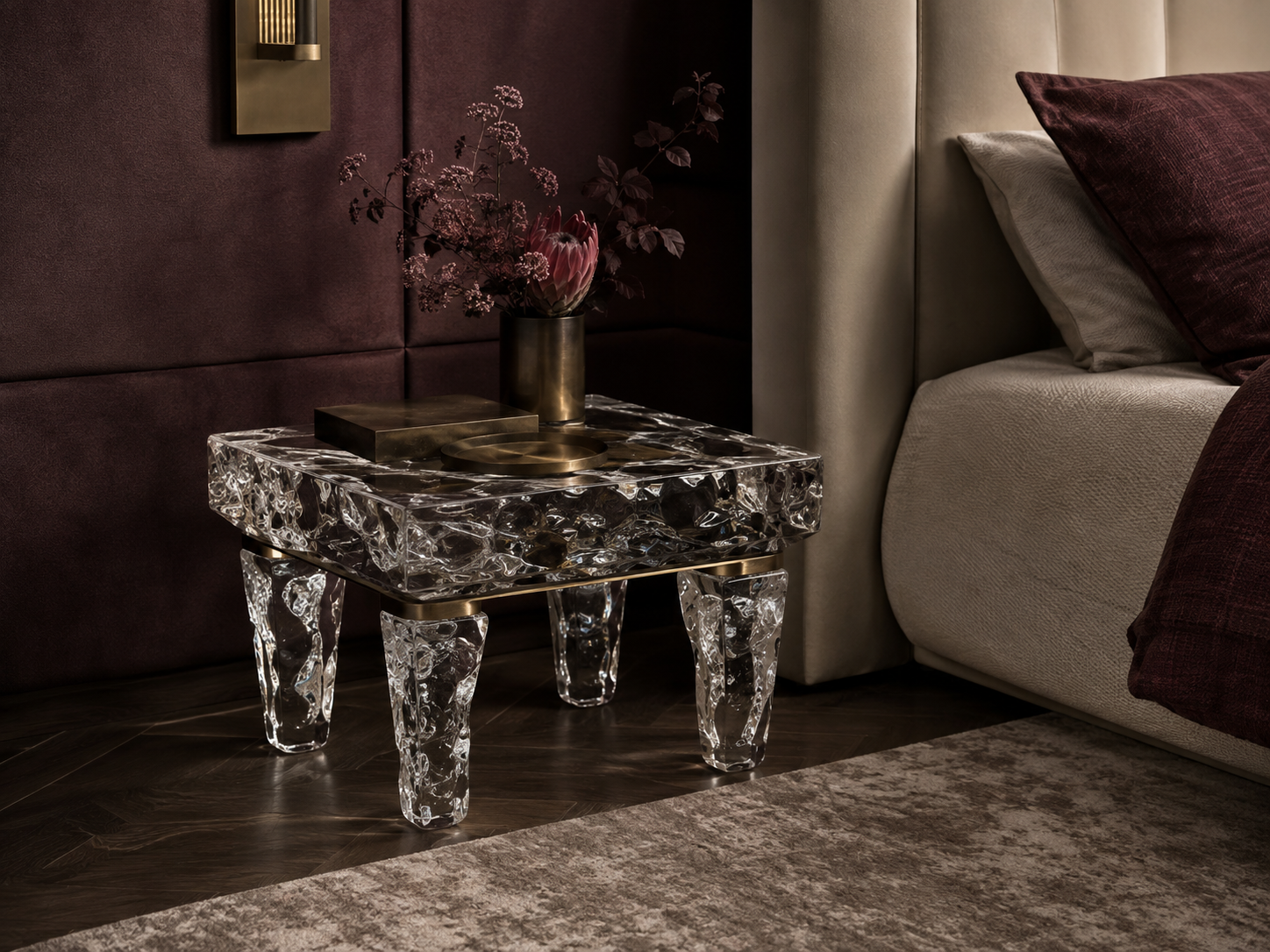
Rather than filling a space with decorative elements, many sophisticated interiors use one distinctive object to establish a visual anchor. A sculptural synthetic crystal table, a translucent premium-resin reception desk, or an optically clear platinum acrylic display can perform this role because these materials interact with light, surroundings, movement, and viewpoint in ways that conventional opaque furniture cannot.
The objective is not simply to create something “beautiful.” It is to create a detail customers notice quickly, associate with the brand, photograph naturally, and remember later.
1. Customers Cannot Notice Everything, So a Store Needs a Clear Visual Priority
Human attention is selective. Even when many objects are visible, the brain does not process all of them with equal priority.
A review published in Nature Human Behaviour explains that visual search is guided by factors including bottom-up visual salience, scene structure, previous experience, and the relevance or value of different objects. In other words, elements that differ meaningfully from their surroundings have a greater opportunity to attract attention.
Retail research reaches a similar conclusion. Eye-tracking studies published in the Journal of Retailing and Consumer Services found that consumers experience fragmented visual attention in stores and that physical characteristics such as shape and contrast can dominate the initial stage of visual search.
This is why a visually successful store does not necessarily contain more design elements. It usually contains a stronger hierarchy.
Imagine a fashion boutique where every wall is patterned, every display has a different color, several digital screens are moving simultaneously, and highly reflective furniture fills the floor. Individual objects may be expensive, but the customer's eye has no obvious destination.
Now imagine the opposite environment: restrained limestone flooring, neutral walls, carefully spaced merchandise, controlled architectural lighting, and one thick synthetic crystal display table positioned along the main sightline.
The table immediately acquires importance because it contrasts with its surroundings.
Transparency itself can become contrast. A large object that appears almost visually weightless is unexpected. Thick polished edges can capture narrow highlights. Internal reflections can change as customers walk past. If colored resin is used instead, a translucent amber, smoke, champagne, blue, or custom brand tone can create a controlled area of visual intensity.
The lesson for retailers is straightforward: the focal furniture should not compete with twenty other “focal points.”
A hero piece works because the surrounding space gives it permission to be noticed.
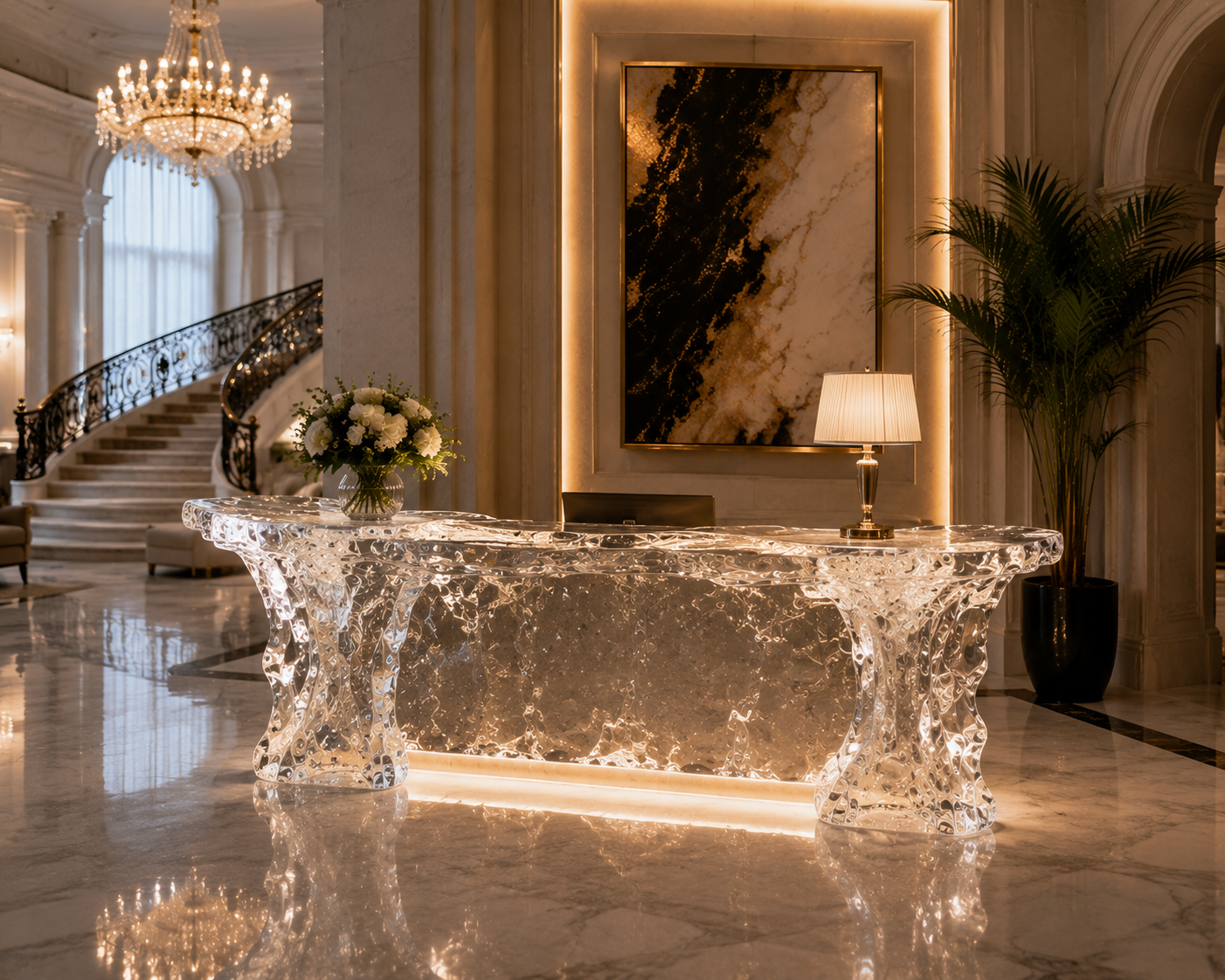
For a jewelry store, this might be a clear synthetic crystal consultation table. For a luxury hotel, it could be a monumental resin reception desk. For a beauty flagship, a platinum acrylic product island might become the visual center. For a fashion showroom, an oversized cast-resin table may act almost like sculpture.
Attention is limited. Good commercial design decides where that attention should go.
2. Synthetic Crystal Furniture Creates Attention Because Light Makes It Visually Dynamic
A conventional opaque table generally presents a relatively stable appearance. Its color and silhouette may change slightly with lighting, but the object remains visually solid.
Transparent and translucent materials behave differently.
Research on material perception by vision scientist Roland Fleming explains that people infer material qualities from complex relationships among lighting, shape, reflections, texture, and transparency. The appearance of glossy and transparent surfaces therefore changes significantly with illumination and viewpoint.
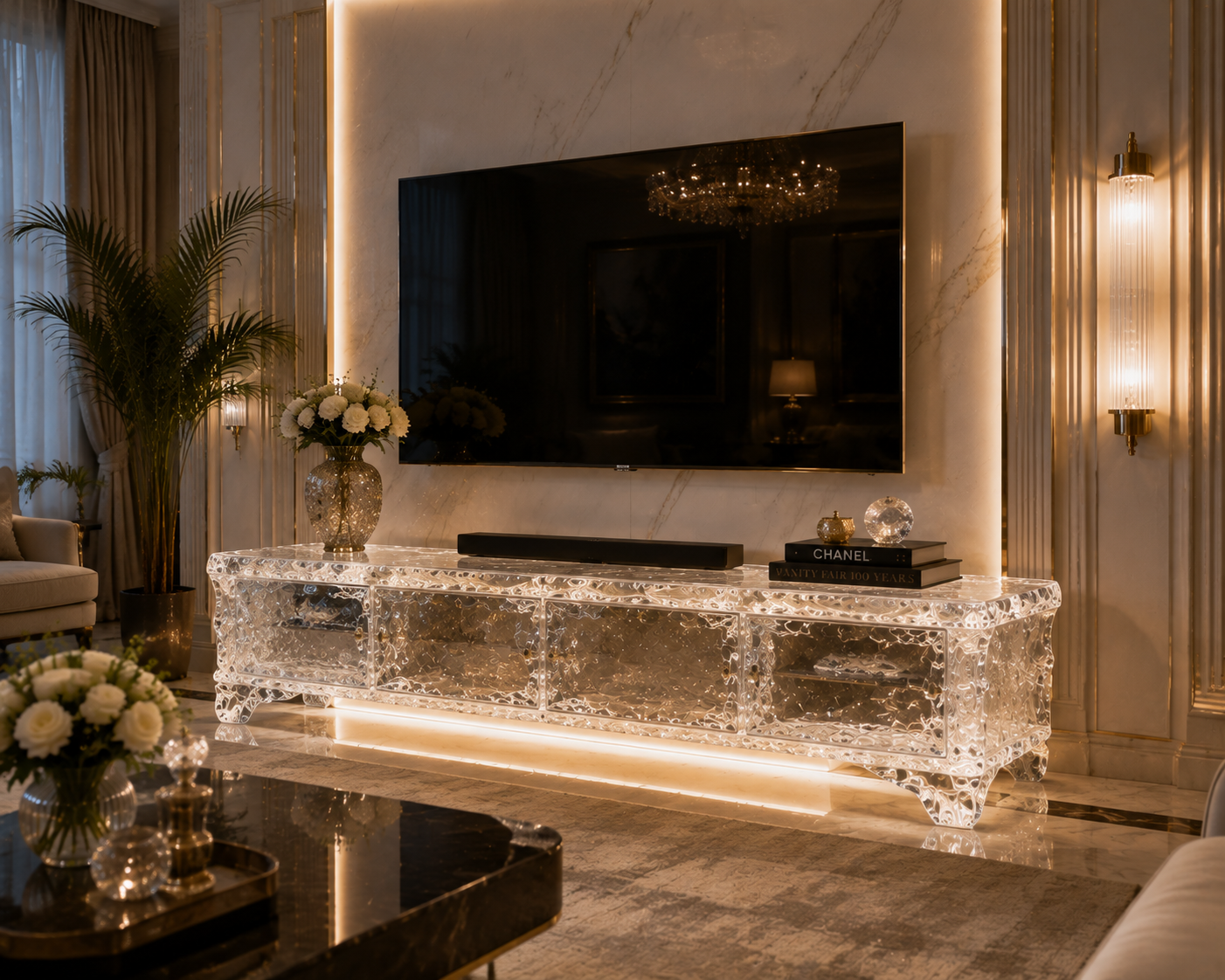
That characteristic gives synthetic crystal furniture an advantage as a spatial focal point: the furniture does not look exactly the same from every position.
A polished synthetic crystal console beside a storefront window may appear almost invisible when viewed frontally. When a customer moves several steps to the side, the same console may suddenly reveal a bright edge reflection. Under evening lighting, the object may take on an entirely different character.
Premium resin expands the possibilities further. Designers can work with translucency instead of complete transparency, creating cloudy effects, controlled pigments, mineral-like textures, embedded artistic elements, gradients, or layers of depth. Light passing through these structures can make the furniture appear internally dimensional rather than simply surface-decorated.
High-quality acrylic offers another type of optical performance. Röhm states that clear colorless PLEXIGLAS® PMMA can achieve visible light transmission of up to 92%, with the remaining reduction largely resulting from reflection at the entry and exit surfaces.
This does not mean every acrylic furniture product automatically achieves the same performance; thickness, formulation, fabrication, finishing, and coloration all matter. But it demonstrates why premium clear acrylic can create exceptional visual openness.
For commercial design, these properties allow furniture and lighting to be planned together.
A platinum acrylic pedestal can receive edge lighting. A translucent resin counter can be softly illuminated from behind. A thick synthetic crystal table leg can capture directional spotlights along polished surfaces. A colored resin bench can become deeper and warmer as evening lighting replaces daylight.
The result is valuable because the focal point remains visually fresh.
Customers walking through the space encounter slightly different reflections and depths from different angles. The object becomes an experience rather than a static fixture.
3. A Memorable Focal Point Needs Material Contrast, Not Simply a Complicated Shape
One of the easiest mistakes in designing statement furniture is assuming that memorable automatically means complicated.
It does not.
Visual salience depends heavily on context. A classic review in Nature Reviews Neuroscience notes that the same object can appear more or less salient depending on the surrounding visual environment.
This explains why an extremely simple transparent table can sometimes attract more attention than a highly decorative one.
Consider a boutique dominated by warm oak, textured fabric, travertine, and matte plaster. Introducing a single optically clear synthetic crystal table produces several contrasts simultaneously: transparent against opaque, polished against textured, visually cool against warm materials, and reflective against matte surfaces.
The furniture does not need excessive ornamentation because the material difference already creates visual tension.
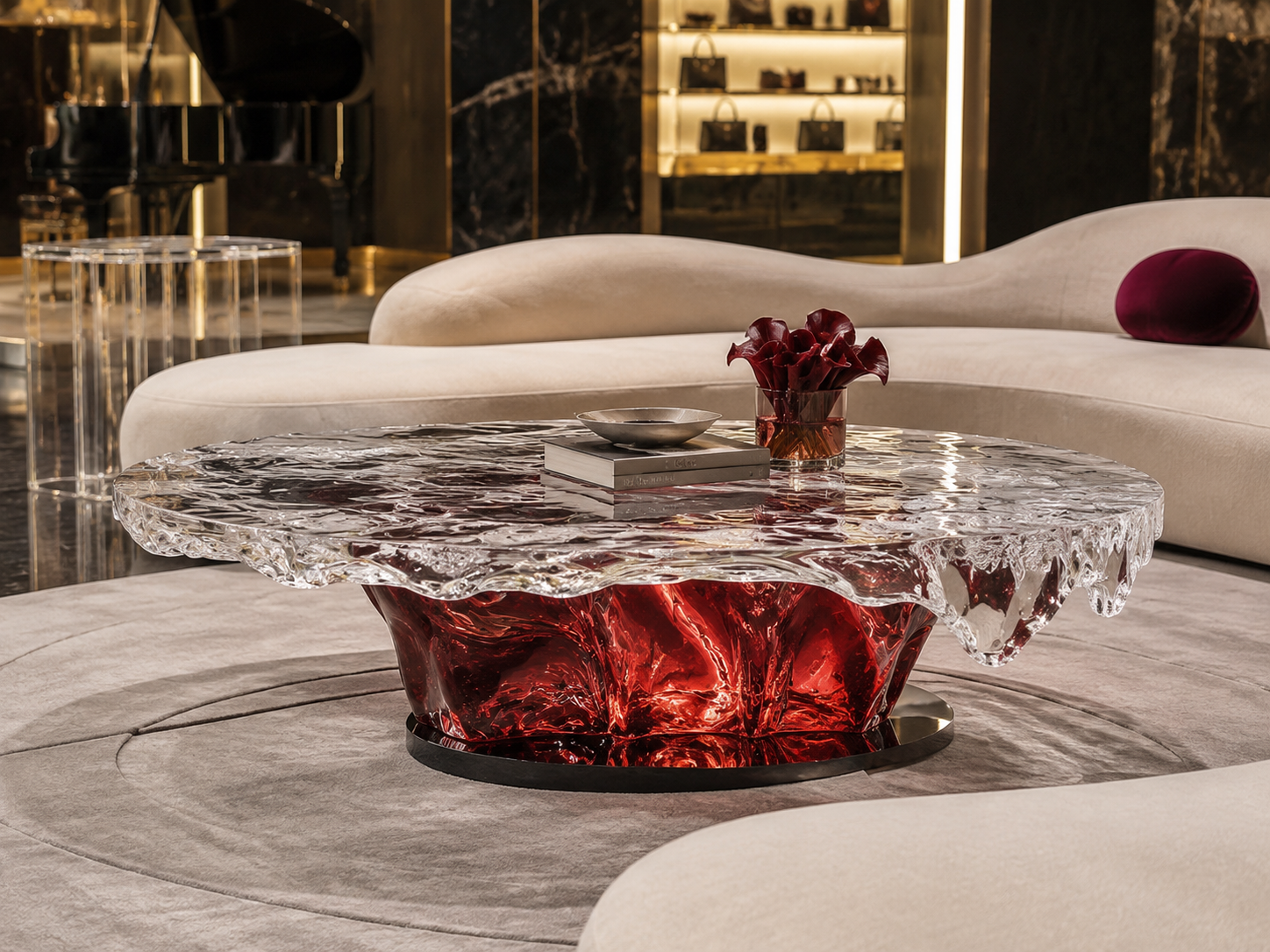
Premium resin can be used in the opposite way. In a minimal white interior, a deeply colored translucent resin table may become the strongest chromatic element in the entire room. Instead of adding colored walls, graphics, and decorations, the designer can concentrate the brand color into a single three-dimensional object.
For a luxury cosmetics store, imagine a softly rose-tinted resin consultation table surrounded by brushed metal and pale stone. For a high-end menswear store, smoke-colored synthetic crystal side tables could sit beside dark timber and leather seating. A futuristic technology showroom could use geometrically precise platinum acrylic furniture against anodized aluminum surfaces.
The material itself creates the distinction.
Scale is equally important.
A small transparent accessory placed among many products may disappear visually. A thicker console, oversized communal table, sculptural reception desk, or substantial acrylic base gives the material enough volume to reveal reflections and depth.
However, scale should not become obstruction.
One of the most useful properties of transparent furniture is that it can occupy significant physical space while preserving sightlines. Merchandise, flooring, architectural details, or views remain visible through or around the object.
That makes synthetic crystal and acrylic especially useful in commercial environments where a focal object must feel significant without behaving like a wall.
A successful hero piece therefore balances three elements: material distinction, sufficient scale, and visual restraint.
When those are coordinated correctly, complexity becomes optional.
4. A Strong Furniture Focal Point Can Become a Brand Memory, Not Just an Interior Feature
Getting attention is only the first step. The more commercially important question is whether customers remember what attracted them.
Recent research in Nature Reviews Psychology describes “memorability” as an intrinsic characteristic of visual stimuli and notes that the likelihood of remembering particular images or objects can show considerable consistency across different observers and tasks.
Earlier research on visual salience and memory has also found that highly salient objects in complex scenes can be recalled more often and earlier than low-salience objects.
For retailers, this suggests an opportunity: a focal piece can function as part of the brand's memory system.
Think about the difference between remembering “a luxury clothing store with nice furniture” and remembering “the store with the enormous transparent blue table.”
The second description contains a mental image.
That image has commercial value because it gives customers an easy visual shortcut back to the brand.
This is why custom furniture can be more powerful than selecting generic pieces from a catalog. A synthetic crystal table can use a proprietary proportion or sculptural base. Premium resin can incorporate a brand-specific color that is difficult to reproduce with ordinary finishes. Platinum acrylic can be fabricated into clean architectural forms that echo the geometry of packaging, logos, or product displays.
The furniture does not need to carry a large logo.
In fact, subtle brand coding can be more sophisticated.
A beauty brand known for translucent packaging could translate that language into resin furniture. A jewelry brand associated with a particular color could use a carefully controlled transparent tint. A technology company emphasizing precision might use exceptionally clean clear acrylic geometry and concealed connections.
Repeated across flagship stores, pop-ups, exhibitions, or showrooms, the furniture can eventually become part of a recognizable spatial identity.
The goal is similar to product design: customers should begin recognizing the brand language before they consciously read the name.
That is when furniture stops being simply an interior purchase and begins acting as a branding asset.
5. The Best Visual Focal Points Naturally Encourage Customers to Photograph and Share the Space
Physical retail now exists inside a digital ecosystem.
A customer may discover a store online, visit it physically, photograph an interior detail, post it on social media, and introduce the space to another potential customer who has never visited.
This makes visually distinctive interiors particularly valuable.
Gensler's Experience Index, based on a nationwide survey of more than 4,000 people together with ethnographic research, found that experiences in the “best-designed” spaces were rated nearly twice as highly as those in the “worst-designed” spaces. More significantly for retailers, people were 10 times more likely to share their in-store experiences on social media when stores contained unique design features.
That figure changes the business case for a statement furniture piece.
A synthetic crystal table is no longer only something customers see while visiting the store. If designed correctly, it can repeatedly appear in customer photographs, influencer content, press images, campaign shoots, event photography, and the brand's own social channels.
The National Retail Federation has also highlighted the growing importance of experiential retail. In its coverage of the 2024 Hot 25 Retailers, NRF described successful retailers as combining functionality, product, atmosphere, presentation, and emotional engagement to create stores customers actively look forward to visiting.
Furniture can contribute directly to this experience when it creates a natural photographic moment.
For example, a premium resin table near a mirror installation may produce layered reflections. A colored synthetic crystal bench in a flagship entrance can become an obvious place for visitors to sit and photograph themselves. A transparent acrylic product table can visually “float” merchandise in photographs instead of introducing a distracting base.
However, designing for social media should not mean creating a superficial photo prop.
The most successful objects work both on camera and in person.
They need convincing scale, clean details, polished surfaces, appropriate ergonomics, structural stability, and material depth. Customers standing next to the object will notice imperfections that may not appear in a rendering.
A commercially effective focal point therefore has two audiences: the person physically inside the space and the much larger audience who may encounter the space through that person's camera.
6. The Most Effective Strategy Is One Signature Piece in the Right Location, Designed for Real Commercial Use
The final question is practical: where should synthetic crystal, premium resin, or platinum acrylic furniture actually be placed?
The answer begins with the customer journey.
The strongest location is usually where customers naturally slow down, change direction, interact with staff, examine merchandise, or have an uninterrupted sightline.
In a fashion flagship, a synthetic crystal display table can be positioned where customers first transition from the entrance into the main collection. In a jewelry boutique, a premium clear acrylic or crystal consultation table can provide a distinctive centerpiece without visually blocking showcases. In a luxury hotel, a translucent resin reception desk can become the first recognizable object guests encounter.
Restaurants can use a colored resin communal table to define a social zone. Beauty stores can use clear acrylic product islands that allow packaging colors to dominate. Automobile showrooms can use transparent lounge tables to provide hospitality functions without competing visually with vehicles. Luxury residential sales galleries can use thick crystal-effect dining bases or consoles to emphasize craftsmanship while preserving views of stone flooring and architectural finishes.
Commercial practicality, however, must be part of the original design.
A reception counter requires different engineering from an occasional side table. High-contact surfaces need appropriate maintenance strategies. Furniture positioned beside direct sunlight or powerful artificial lighting needs suitable material specifications. Large transparent structures require careful attention to joints, edges, stability, fabrication tolerances, transportation, installation, and long-term appearance.
The visual focal point should survive reality.
That requirement is especially important because physical retail remains commercially significant. The National Retail Federation has reported that brick-and-mortar locations still account for roughly 70% of total retail sales, even as ecommerce continues to expand. More recent ICSC research also shows that consumers continue to value stores because they can immediately access, see, and try products in person.
Physical space therefore has something a digital storefront cannot fully reproduce: material presence.
Customers can walk around a synthetic crystal table. They can watch reflections change across its edges. They can see depth inside premium resin, touch a polished surface, and understand the physical scale of a platinum acrylic structure.
That sensory experience is precisely why a carefully designed furniture focal point can become so valuable.
The objective is not to make every piece in the store transparent, reflective, or dramatic. Overuse reduces impact. Instead, the most sophisticated strategy is often to identify the one location that deserves maximum visual attention and place a distinctive material experience there.
A single synthetic crystal table can become the object customers use to describe the store. A custom resin reception desk can become the background of thousands of photographs. A precisely fabricated platinum acrylic display can become a recognizable part of the brand's retail language.
Customers may forget the exact floor finish, ceiling height, or display system.
But give them one powerful image, and they may remember the entire store through it.
That is the real role of a visual focal point: not simply to be seen, but to make the brand difficult to forget.
READ MORE:
- Lighting + Synthetic Crystal: How Light and Shadow Details Make Commercial Spaces More Attractive
- The Spatial Perception Value of Synthetic Crystal Furniture
- How Material Texture Shapes Brand Trust: Application Ideas for Synthetic Crystal Furniture in Commercial Spaces
- Why Are Customers Drawn to Spatial Details? Understanding the Material and Light of Synthetic Crystal Furniture
- Synthetic Crystal Acrylic Furniture: How Innovative Materials Are Upgrading the Value of Furniture
- Why Transparent Furniture Is Moving from a Niche Design Choice to a High-End Trend
- Synthetic Crystal Acrylic Furniture: A New Design Language for Future High-End Spaces
- From Visual Appeal to Brand Value: The Long-Term Competitiveness of Synthetic Crystal Acrylic Furniture
- Synthetic Crystal Acrylic Furniture: Why High-End Projects Are Increasingly Focused on “Material Differentiation”


