In a commercial interior, customers begin judging a brand long before a salesperson speaks to them. They notice the reception desk, the weight of a door handle, the reflection on a display table, the finish of a chair, the lighting across a wall, and whether the materials around them feel deliberate or inexpensive.
These details become physical evidence of what the brand claims to represent.
This is especially important for luxury retail stores, hotels, showrooms, restaurants, beauty spaces, corporate reception areas, and premium residential sales centers. A brand may describe itself as precise, innovative, exclusive, artistic, or dependable, but customers instinctively ask another question: Does the space actually feel that way?
The 2026 Edelman Trust Barometer Special Report on brands, based on 17,688 respondents across 15 countries, found that 88% of consumers consider trusting a brand an important or critical purchase criterion, almost identical to product quality at 89% and value at 88%. Trust is therefore not an abstract branding concept; it sits beside quality and value at the center of purchase decisions.
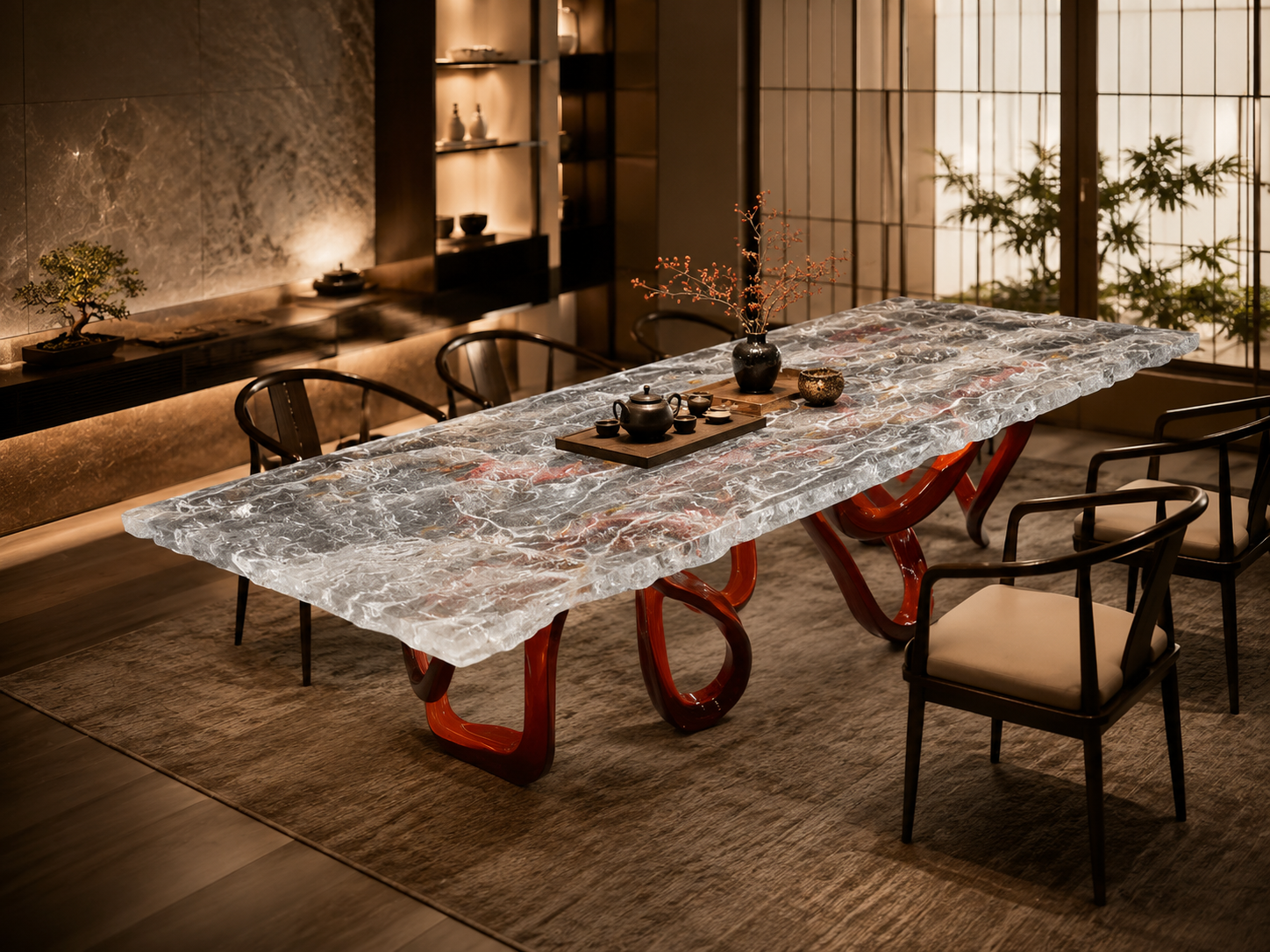
Materials are one of the most immediate ways a physical environment can make that trust visible. Synthetic crystal furniture, premium casting resin, and high-clarity platinum acrylic can be particularly effective because customers experience not only their shape, but also transparency, depth, reflection, polish, color, and interaction with light.
1. Material Quality Turns an Invisible Brand Promise Into Physical Evidence
Brand trust is fundamentally about reducing uncertainty. Customers want to believe that what a company promises in advertising will also appear in its products, services, and physical environment.
This is why material selection matters.
Imagine entering two premium beauty stores selling similarly priced products. One uses poorly finished transparent displays with visible scratches, cloudy edges, unstable joints, and inconsistent lighting. The other uses precisely polished crystal-clear pedestals, carefully cast translucent resin counters, restrained metal detailing, and lighting designed around each material.
Before examining the products, most customers will already have formed different expectations about the two brands.
The difference is not simply decoration. Materials create signals about competence, attention to detail, permanence, and investment.
The 2026 Edelman research is useful here because it shows how closely trust and quality are connected in purchase decisions. When trust matters to 88% of consumers and quality to 89%, brands cannot separate what they say from the quality customers physically experience.
For a luxury hotel, for example, a synthetic crystal reception table with substantial thickness, controlled transparency, carefully polished edges, and concealed structural connections can suggest precision and permanence. In a jewelry store, transparent platinum acrylic display furniture can communicate visual cleanliness while allowing the jewelry to remain dominant. In a fashion flagship, a sculptural premium-resin table with a custom pigment or translucent gradient can express creativity without relying on printed logos.
This is where furniture becomes part of brand communication.
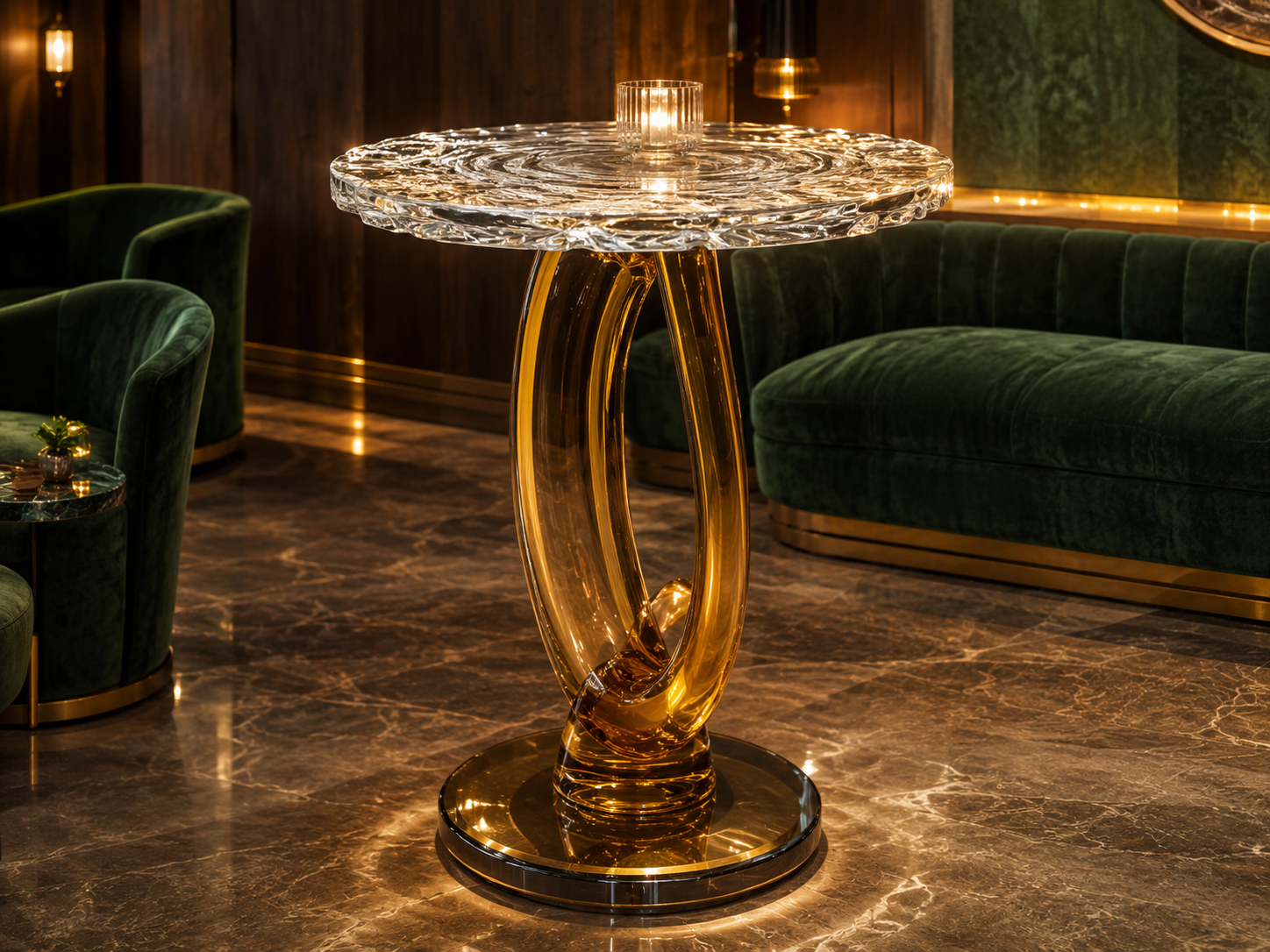
A company positioned around technological precision may benefit from clear geometry, optical transparency, and minimal joints. A hospitality brand communicating warmth might choose amber, champagne, smoke, or softly translucent resin. A fashion brand seeking experimentation could use oversized synthetic crystal forms or resin pieces with controlled artistic inclusions.
The strongest commercial interiors do not merely contain expensive materials. Their materials make the brand promise believable.
2. Customers Judge Material Quality Visually Before They Ever Touch It
One of the reasons material texture influences trust so strongly is that people are extraordinarily good at making rapid judgments about materials.
A 2025 review in Nature Reviews Psychology explains that humans can infer a wide range of material properties from a brief glance. We visually estimate whether something appears hard, soft, rough, smooth, glossy, transparent, or fragile before physical contact occurs.
Roland Fleming's review in the Annual Review of Vision Science makes a similar point: humans routinely infer physical and multisensory characteristics of surfaces simply from their appearance, even though what we see depends on complex interactions among lighting, shape, texture, and reflectance.
This has an important implication for commercial furniture: surface quality is communicating before the customer consciously analyzes it.
With transparent furniture, the effect can be even stronger because the viewer does not see only the outside surface. They see edges, internal depth, reflections, thickness, connections, and sometimes the architecture behind the object.
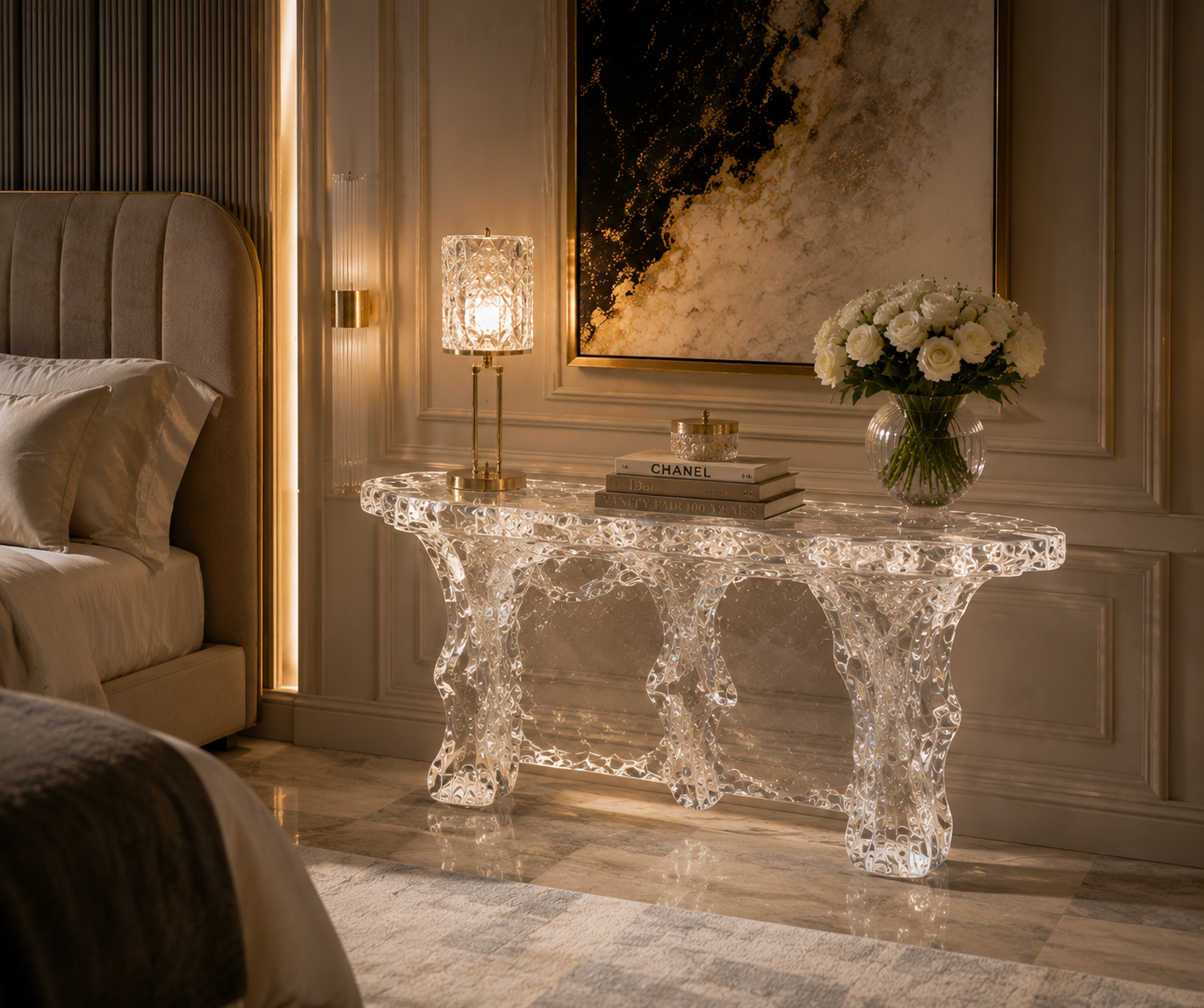
Consider a clear synthetic crystal console in a luxury fashion store. If its polished edges remain optically clean and the material has convincing depth, customers may read the piece as precise and substantial even if they cannot identify the material technically.
If the same piece contains uncontrolled haze, careless bonding, obvious machining marks, or distorted surfaces, those details may suggest lower manufacturing standards.
Premium resin offers another visual language. Rather than pursuing complete transparency, designers can use translucency, controlled color, cloudy layers, mineral-like effects, metallic elements, or carefully positioned inclusions to create depth. In hospitality or restaurant projects, this can make a table or counter feel more handcrafted and emotionally expressive.
High-clarity platinum acrylic works differently. Its strength is often visual restraint. Röhm, manufacturer of PLEXIGLAS® PMMA, reports light transmission of up to 92% for clear PMMA molding compounds. This optical clarity helps explain why high-quality acrylic can visually recede within a space while still forming substantial furniture structures.
The commercial lesson is simple: customers may never ask about refractive properties, resin chemistry, polishing methods, or transparency percentages. They still perceive their results.
3. Touch and Close-Range Inspection Determine Whether “Premium” Feels Credible
Visual impression attracts customers, but physical interaction often determines whether that impression survives.
Research published in the Journal of Consumer Research by Joann Peck and Suzanne Shu found across four studies that merely touching an object can increase feelings of ownership, and that this perceived ownership can influence valuation.
For commercial interiors, this matters because furniture is one of the few elements customers frequently encounter at close range.
They lean against reception counters. They place their hands on restaurant tables. They move chairs. They rest products on retail display surfaces. They sit beside side tables in hotel lounges. They examine the edge of a display pedestal while waiting for service.
At this distance, the difference between “luxury-looking” and genuinely premium becomes harder to hide.
A synthetic crystal table with beautifully finished corners, controlled joins, substantial material depth, and an even polished surface can reinforce the original visual impression. A premium resin counter with carefully resolved transitions and pleasant tactile qualities can make a bespoke interior feel intentional rather than decorative.
Conversely, material inconsistency creates distrust quickly. Sharp edges, unstable structures, poor bonding, visible scratches, mismatched coloration, or surfaces that deteriorate faster than expected contradict a premium brand message.
This is particularly relevant to luxury brands because higher prices raise expectations of coherence.
If a customer buys a five-figure watch from a counter that feels temporary, or checks into a five-star hotel whose feature furniture looks impressive in photographs but poorly finished at close range, the contradiction can subtly damage confidence.
Commercial furniture therefore needs to perform at two distances.
From across the room, it should support the visual identity of the brand. From 30 centimeters away, its surfaces, joints, edges, thickness, color, and stability should justify the promise.
For manufacturers working with synthetic crystal, premium resin, and platinum acrylic, this is why finishing quality should be treated as part of branding rather than simply production.

4. Transparent and Translucent Furniture Can Create Luxury Without Making a Space Feel Heavy
Commercial spaces face a difficult design problem: they often need distinctive furniture while still allowing products, architecture, merchandise, or people to remain the visual priority.
Transparent materials offer an unusual solution.
A large opaque display table can dominate a boutique simply because of its visual mass. A synthetic crystal or platinum acrylic table of similar dimensions can have substantial physical presence while allowing flooring, merchandise, lighting, and surrounding architecture to remain visible through it.
This makes transparent furniture particularly effective in stores where sightlines matter.
A jewelry boutique, for instance, may use high-clarity acrylic pedestals to keep attention on the product rather than its support structure. A fashion store can use synthetic crystal display tables that create strong light-catching edges without adding another heavy block of color. A luxury automobile showroom can introduce clear lounge tables that define hospitality zones without visually competing with vehicles.
The same principle works in hotel lobbies. Large spaces require furniture with sufficient scale, yet too many dark or opaque pieces can make the lobby feel crowded. Thick synthetic crystal side tables or transparent console bases can provide volume while preserving openness.
Premium resin creates another possibility because translucency allows designers to control how much an object visually disappears. A smoky resin reception desk, amber table, or softly clouded sculptural bench can retain more visual character than fully transparent acrylic while still interacting strongly with light.
This ability to control visual weight is useful because luxury is increasingly associated with editing rather than accumulation.
Gensler's Experience Index research, involving more than 4,000 respondents, found that people rated experiences in better-designed spaces substantially higher, with experiences in well-designed places averaging nearly twice the rating of poorly designed ones. The research also found that people were 10 times more likely to share an in-store experience on social media when the store contained unique design features.
A single memorable crystal furniture piece can therefore sometimes contribute more to brand differentiation than an interior filled with decorative objects.
5. The Best Commercial Applications Combine Material, Lighting, and Brand Character
Transparent furniture should never be specified in isolation from lighting.
The appearance of crystal, resin, and acrylic changes dramatically depending on illumination direction, intensity, color temperature, surface geometry, and the material behind the object. Vision research confirms that perceptions of properties such as gloss, transparency, and translucency are strongly affected by illumination and object geometry.
This creates considerable opportunities in commercial interiors.
In a cosmetics flagship, a clear synthetic crystal display table positioned beneath focused lighting can capture highlights along its polished edges while allowing illuminated products to remain visually dominant.
In a hotel lobby, a translucent resin reception counter can appear relatively calm during daylight and become warmer and deeper under evening architectural lighting. The same piece effectively changes character across the day.
A high-end restaurant might use amber or smoky premium resin tables to reinforce a warm evening atmosphere. A jewelry boutique could combine platinum acrylic display furniture with directional lighting to create an extremely clean visual environment. A luxury residential sales gallery may use a thick clear synthetic crystal dining base so that expensive stone flooring remains uninterrupted visually.
Even corporate environments can benefit. A technology company's reception area might use a geometrically precise clear acrylic desk to suggest openness and engineering precision. A beauty or fashion headquarters could use a custom-colored resin conference table as a recognizable brand object.
The important principle is not to maximize shine.
Too many reflective surfaces, uncontrolled spotlights, or excessive transparent furniture can produce glare and visual noise. The goal is hierarchy.
One hero piece may establish the identity of the reception area. A series of restrained acrylic pedestals may support merchandise. A colored resin communal table may become the social center of a hospitality environment.
Recent Gensler hospitality research emphasizes this idea of sensory coherence. Its 2026 analysis argues that memorable environments emerge when materiality, lighting, seating, acoustics, and other sensory cues reinforce the same emotional story. Consistency, rather than novelty alone, helps build trust over repeated visits.
That is exactly how specialty furniture should be approached: as part of a coordinated brand experience rather than an isolated decorative purchase.
6. Long-Term Brand Trust Comes From Consistency Between Appearance, Performance, and Story
The most successful commercial furniture does more than attract attention on opening day.
It continues to support the brand after thousands of customers have walked through the space.
This is where material strategy becomes operational rather than purely aesthetic.
A spectacular transparent table that scratches immediately, a resin counter that is difficult to maintain, or an acrylic installation whose joints were not properly engineered can eventually create the opposite of the intended luxury effect.
For commercial projects, designers and buyers therefore need to consider how the furniture will be used, cleaned, illuminated, approached, photographed, and maintained.
Reception desks experience repeated contact. Restaurant tables face intensive daily use. Retail pedestals are moved when collections change. Hotel furniture must remain presentable under constant inspection. Showroom furniture often appears in customer photographs and social media content.
Material choice should respond to those realities.
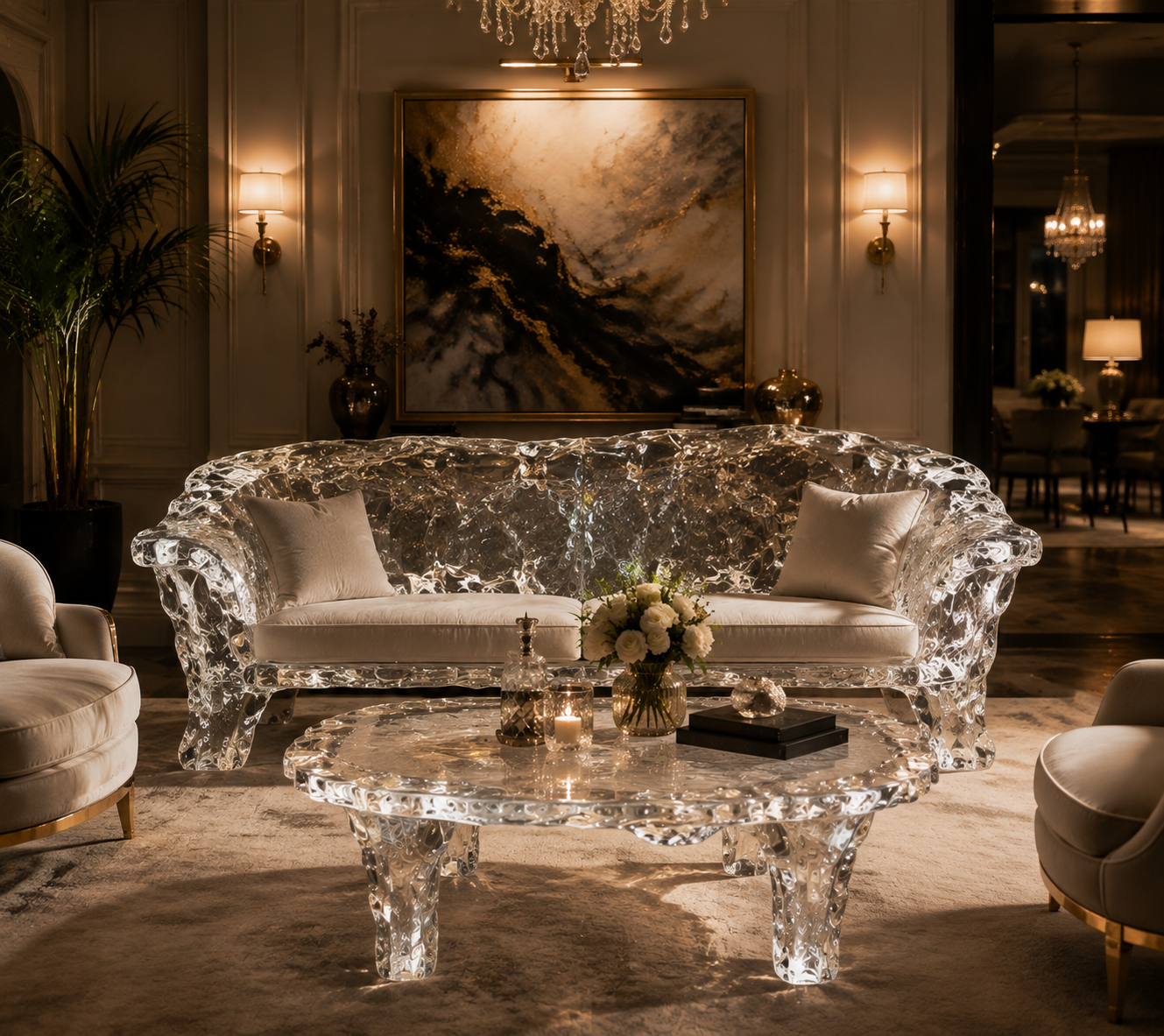
Synthetic crystal can be effective for statement consoles, sculptural bases, display tables, side tables, reception features, and large decorative furniture where transparency and light interaction are central to the design.
Premium resin is particularly suitable when the project requires bespoke pigmentation, translucency, artistic depth, unusual shapes, or a material identity that cannot easily be achieved with conventional timber, stone, or metal.
High-clarity platinum acrylic is valuable when designers want optical cleanliness, precise geometry, lighter visual mass, and furniture that supports rather than obstructs surrounding architecture or merchandise.
None should be selected simply because “transparent furniture looks luxurious.”
The material must express the correct brand character and maintain that impression in actual use.
This principle connects directly with what Gensler describes as consistency in experience design. Novelty may encourage a first visit, but coherent sensory experiences help encourage return, recognition, recommendation, and long-term attachment.
It also aligns with Edelman's 2026 finding that trust and relevance together strengthen consumer willingness to support brands as they grow. Trust creates confidence; relevance creates personal meaning.
For commercial interiors, materials sit directly between those two ideas.
A custom synthetic crystal table can make a brand recognizable. A distinctive resin reception counter can make it emotionally memorable. A precisely fabricated platinum acrylic display system can communicate discipline and product confidence.
But the strongest result occurs when the material does not merely look premium—it behaves like the brand claims to behave.
Customers may never know the technical name of the material. They may never understand the casting process, polishing sequence, transparency specification, or fabrication difficulty.
They simply experience the result.
And when the material quality, furniture detailing, lighting, architecture, and brand promise all tell the same story, the space begins to communicate something advertising alone cannot easily create:
This brand pays attention. This brand invests in quality. This brand can be trusted.

READ MORE:
- Lighting + Synthetic Crystal: How Light and Shadow Details Make Commercial Spaces More Attractive
- The Spatial Perception Value of Synthetic Crystal Furniture
- Make Your Store Unforgettable at First Sight: How Synthetic Crystal Furniture Becomes a Visual Focal Point
- Why Are Customers Drawn to Spatial Details? Understanding the Material and Light of Synthetic Crystal Furniture
- Synthetic Crystal Acrylic Furniture: How Innovative Materials Are Upgrading the Value of Furniture
- Why Transparent Furniture Is Moving from a Niche Design Choice to a High-End Trend
- Synthetic Crystal Acrylic Furniture: A New Design Language for Future High-End Spaces
- From Visual Appeal to Brand Value: The Long-Term Competitiveness of Synthetic Crystal Acrylic Furniture
- Synthetic Crystal Acrylic Furniture: Why High-End Projects Are Increasingly Focused on “Material Differentiation”


