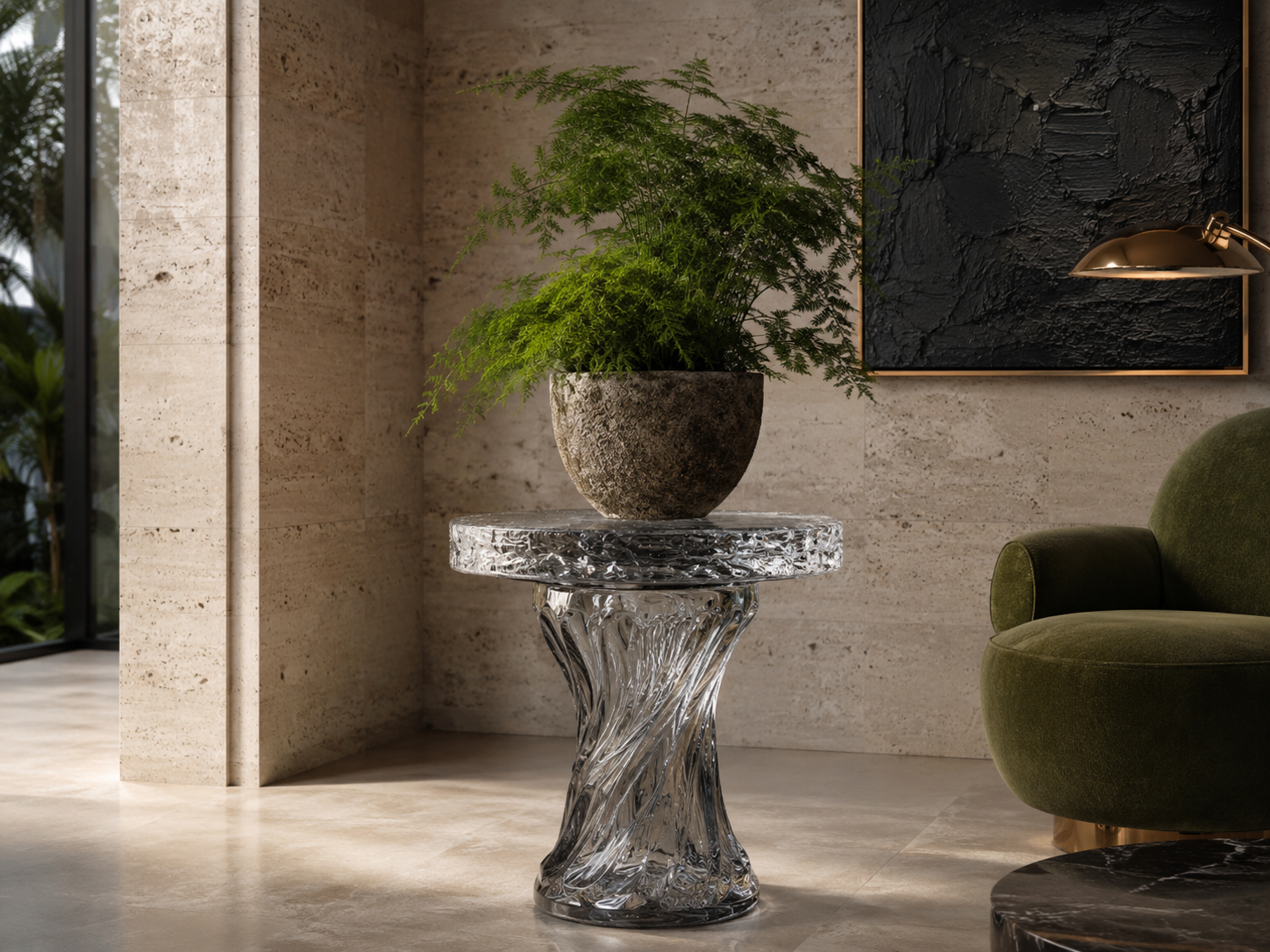
For many years, luxury furniture was primarily judged by what people could see immediately: shape, color, brand, craftsmanship, and overall visual impact. A beautiful dining table, console, chair, display cabinet, or decorative object could create an instant impression, and for many customers that impression was enough to influence a purchasing decision.
Today, however, the priorities of high-end customers are changing.
More sophisticated buyers, interior designers, architects, luxury retailers, hospitality groups, and private residential clients are beginning to ask deeper questions.
What is the furniture actually made from?
How stable is the material?
Will it remain clear after years of use?
Can it be produced in thick sections without losing optical quality?
How does it react to light?
Can it be repaired or repolished?
Does it support complex customization?
What separates high-quality acrylic furniture from cheaper transparent plastic products?
These questions show an important shift in the luxury furniture market. Premium customers are no longer satisfied with appearance alone. They increasingly want to understand the material itself.
This is one of the main reasons synthetic crystal acrylic furniture is receiving more attention.
High-quality acrylic can create a visual effect that is difficult to achieve with conventional wood, metal, glass, or ordinary plastics. It can appear transparent, luminous, architectural, minimal, sculptural, and almost weightless. At the same time, it offers designers considerable freedom in terms of thickness, form, polishing, color, embedded elements, and custom fabrication.
But not all acrylic is equal.
The final quality of acrylic furniture depends heavily on raw material purity, production method, thickness tolerance, bonding technology, machining accuracy, polishing, structural design, and finishing standards.
As high-end customers become more knowledgeable, they are beginning to recognize these differences.
1. Luxury Is Moving From Appearance to Material
The definition of luxury is becoming more sophisticated.
In the past, luxury was often associated with decoration. Expensive furniture frequently relied on carved details, rare woods, metallic finishes, elaborate fabrics, or visible craftsmanship. While these elements remain important, contemporary luxury is increasingly associated with restraint, precision, proportion, material quality, and design intelligence.
A simple object can now feel more luxurious than an ornate one if its material and execution are exceptional.
This change has created new opportunities for acrylic furniture.
At first glance, transparent acrylic furniture may appear visually simple. A clear acrylic coffee table, for example, may consist of only a few geometric surfaces. However, producing a truly premium result can be technically demanding.
The thickness must be consistent.
The surfaces must remain optically clear.
The edges must be properly polished.
Bonding lines should be controlled.
The structure must feel stable.
The proportions must be carefully considered.
The surface must reflect light cleanly without looking cloudy or cheap.
For this reason, material quality becomes highly visible in minimalist furniture.
When decoration is removed, there is nowhere for poor manufacturing to hide.
This is particularly important for high-end customers. They often examine details more carefully than mass-market buyers. They may look at the clarity of an edge, the optical distortion through a thick acrylic panel, the smoothness of a polished surface, the precision of a joint, or the way the object interacts with natural and artificial light.
In this market, acrylic is not simply a substitute for glass.
It becomes a design material in its own right.
High-quality synthetic crystal acrylic can create a clean, refined, contemporary visual language that works especially well in modern luxury interiors.
It can visually reduce the weight of large furniture pieces.
It can make small spaces appear more open.
It can allow artworks, rugs, flooring, and architectural details to remain visible.
It can also create dramatic visual contrasts when combined with stone, stainless steel, brass, wood, fabric, leather, or lighting.
For premium buyers, these effects are not merely decorative. They are part of the material experience.
2. The Optical Character of Acrylic Is Becoming a Luxury Feature
One of the strongest advantages of high-quality acrylic furniture is its relationship with light.
Transparent materials behave differently from opaque materials. Instead of simply reflecting light from the surface, they allow light to pass through, refract, scatter, and interact with edges and internal forms.
This gives acrylic furniture a special visual depth.
When thick acrylic is properly produced and polished, edges can appear brighter than the main surface because light is captured and redirected through the material. This can create a crystal-like visual effect, especially in tables, pedestals, decorative objects, shelving, furniture legs, and sculptural components.
This characteristic is particularly appealing in luxury spaces.
Consider a high-end apartment with natural stone flooring and panoramic windows. A heavy dark coffee table may visually dominate the room. A transparent acrylic table, by comparison, can maintain functionality while preserving a sense of openness.
In a luxury retail environment, acrylic display furniture can provide structure without competing visually with products.
In a gallery, it can support objects while maintaining visual neutrality.
In hospitality design, illuminated acrylic elements can create dramatic effects while remaining elegant and modern.
The premium appearance, however, depends strongly on material quality.
Lower-grade transparent plastics may display haze, optical distortion, inconsistent color, internal impurities, poor edge quality, or uneven transparency. These defects may not be obvious in small samples, but they become increasingly visible in large or thick furniture components.
This is why experienced buyers pay close attention to the source and grade of acrylic.
For high-end applications, transparency is not simply a functional property.
It is an aesthetic requirement.
The difference between ordinary transparent plastic and high-quality synthetic crystal acrylic can be similar to the difference between ordinary glass and carefully produced architectural glass. The basic category may appear similar, but performance, consistency, clarity, fabrication potential, and final appearance can vary significantly.
High-end customers are learning to recognize that difference.
.png)
3. Material Quality Determines Furniture Quality
Acrylic furniture is sometimes evaluated too simply.
People may ask only about thickness or dimensions. However, many other factors influence quality.
The first is the acrylic itself.
High-quality raw material generally provides better optical clarity, more consistent color, stronger mechanical properties, and better long-term appearance.
Material purity is especially important in transparent furniture because impurities can become visible.
The second factor is production method.
Different acrylic manufacturing processes can produce materials with different characteristics. For premium furniture, manufacturers need to select material specifications appropriate for machining, bonding, polishing, forming, and structural use.
The third factor is thickness.
Thick acrylic is attractive because it creates depth and visual weight while remaining transparent. However, thicker material also requires more sophisticated processing.
Cutting must be accurate.
Machining must avoid excessive stress.
Surfaces must be finished carefully.
Edges require multiple polishing stages.
Bonding methods must be selected according to structural and visual requirements.
Large pieces must also be designed to control bending and long-term deformation.
The fourth factor is craftsmanship.
Acrylic can look extremely luxurious when properly finished, but poor fabrication quickly reduces its visual value.
Visible glue lines, scratches, uneven polishing, cloudy edges, inaccurate joints, poorly aligned components, or inconsistent surface quality can make a premium material look inexpensive.
This is why high-end furniture clients increasingly ask about the manufacturer rather than simply the design.
They want to know whether the factory specializes in acrylic processing.
They may want to understand cutting equipment, CNC capabilities, polishing techniques, bending processes, bonding methods, quality inspection, packaging, and experience with customized projects.
For large commercial or hospitality projects, manufacturing consistency is particularly important.
One perfect prototype is not enough.
A supplier may need to produce ten, fifty, or hundreds of pieces while maintaining the same dimensions, transparency, surface quality, and finishing standard.
This is where production engineering becomes part of luxury quality.
4. High-End Buyers Think About Long-Term Value
Premium customers rarely evaluate furniture only according to purchase price.
They are more likely to consider total value over time.
This includes durability, maintenance, visual aging, repairability, replacement difficulty, and compatibility with the interior.
These considerations are especially important for luxury residences, hotels, restaurants, boutiques, showrooms, clubs, and corporate environments.
A product that looks impressive on installation day but deteriorates quickly can become expensive in the long term.
For acrylic furniture, one of the most common concerns is surface scratching.
Acrylic is not scratch-proof. Like many premium materials, it requires appropriate care. However, one advantage is that certain surface scratches can often be reduced or removed through professional polishing.
This can be valuable for high-end projects where furniture may remain in service for many years.
Another concern is yellowing.
Customers often ask whether transparent acrylic will maintain its clarity. The answer depends on material formulation, quality, environmental conditions, UV exposure, production standards, and application.
High-quality acrylic designed for demanding applications can maintain excellent visual performance for long periods when used and maintained correctly.
Structural stability is another major consideration.
Acrylic furniture must be designed according to load, span, thickness, bonding configuration, temperature conditions, and intended use.
A decorative pedestal has different requirements from a dining table.
A retail display shelf has different loading conditions from a side table.
A large console fabricated from thick acrylic requires different structural thinking from a small accessory.
High-end clients increasingly understand that good design is not simply about drawing an attractive form.
It requires knowledge of material behavior.
This is why collaboration between designers, engineers, manufacturers, and project managers becomes important.
The best luxury furniture pieces combine creativity with technical feasibility.
5. Customization Is Driving the Growth of Acrylic Furniture
One of the main reasons acrylic is becoming more important in premium interiors is customization.
Luxury customers increasingly want products that are not available in ordinary retail channels.
They want specific dimensions.
They want special proportions.
They may request custom colors.
They may combine acrylic with stainless steel, brass, wood, marble, stone, fabric, leather, lighting, or decorative inserts.
They may require an acrylic structure that matches an architectural space exactly.
This demand is common in several market segments.
Luxury Residential Interiors
Private clients may commission acrylic dining tables, coffee tables, console tables, side tables, benches, stools, shelves, display units, decorative screens, or custom accessories.
Transparent furniture can be particularly useful in luxury residences because it supports the architecture rather than visually competing with it.
For example, a clear acrylic console placed against a textured stone wall can provide function while allowing the wall to remain visually dominant.
A transparent dining table base can support a large tabletop without adding heavy visual mass.
A thick acrylic side table can appear almost sculptural when illuminated by natural light.
Hotels and Hospitality Projects
Hotels increasingly use distinctive furniture as part of their brand identity.
Lobby furniture, lounge tables, restaurant displays, decorative installations, bar elements, room furniture, and reception accessories may all be customized.
Acrylic offers designers the ability to create unique pieces that feel contemporary and photogenic.
This is especially relevant in hospitality because social media has changed how hotels are experienced.
Guests often photograph distinctive interiors.
Furniture that interacts dramatically with light, reflection, and architecture can become part of the hotel's visual identity.
Luxury Retail
Luxury stores need display systems that support products without distracting from them.
Transparent acrylic is well suited to this requirement.
It can be used for product risers, display cubes, shelves, showcases, podiums, counters, decorative structures, and branded installations.
Because acrylic can be machined into precise forms, designers can create highly customized merchandising systems.
Color can also be introduced when transparency is not required.
Frosted surfaces, tinted acrylic, colored blocks, and layered constructions can create different visual effects.
Interior Designers and Architects
Design professionals are often the first to recognize the potential of materials.
Instead of selecting only finished products from catalogs, they may begin with a concept and search for a manufacturer capable of realizing it.
For this type of work, material flexibility is extremely valuable.
Acrylic can be cut, polished, drilled, bonded, machined, formed, engraved, and combined with other materials.
This gives designers a wide creative vocabulary.
However, the more ambitious the design, the more important manufacturing knowledge becomes.
A beautiful rendering must eventually become a physical object.
Thickness, tolerances, stress, transportation, assembly, packaging, and installation all need to be considered.
For this reason, high-end clients increasingly value suppliers who can participate in technical development rather than simply manufacture according to drawings.
.png)
6. Material Transparency Will Shape the Future of Luxury Furniture
The growing interest in acrylic furniture reflects a larger transformation in consumer behavior.
High-end customers increasingly want transparency—not only visual transparency, but also information transparency.
They want to know what they are buying.
They want to understand the material.
They want to know how it was produced.
They may ask where it was manufactured.
They want to know whether the product can be customized.
They want realistic information about maintenance.
They want to understand expected performance.
This behavior can be seen across many luxury industries.
In fashion, customers ask about fibers, leather, stitching, and sourcing.
In watches, buyers care about movements and materials.
In automobiles, customers compare carbon fiber, aluminum, leather, composites, and engineering technologies.
In architecture, developers and designers increasingly specify materials according to technical performance rather than appearance alone.
Furniture is moving in the same direction.
This creates an advantage for manufacturers that can explain their materials clearly.
Simply calling a product “luxury acrylic furniture” is no longer enough.
Customers increasingly expect evidence.
They may want material specifications.
They may request samples.
They may compare edge clarity.
They may inspect polished surfaces.
They may ask about thickness options.
They may want prototype development before full production.
They may ask for photographs or videos of fabrication.
They may need packaging solutions suitable for international shipping.
They may want guidance about installation and maintenance.
These expectations are especially common among professional buyers.
For them, a furniture purchase may be part of a much larger project.
A delayed, damaged, inconsistent, or poorly manufactured product can affect an entire interior installation.
Therefore, material knowledge and manufacturing reliability become part of the supplier's value.
Why Synthetic Crystal Acrylic Is Attractive to Premium Buyers
Synthetic crystal acrylic occupies an interesting position in the material world.
It combines visual elegance with modern fabrication capability.
It can appear minimal yet luxurious.
It can be transparent yet substantial.
It can look almost invisible in one environment and highly sculptural in another.
It can support contemporary architectural interiors without creating visual heaviness.
Most importantly, it offers designers a degree of freedom that is difficult to achieve with many traditional materials.
For example, a thick transparent table leg can function structurally while creating the visual effect of a solid crystal block.
A console can appear to float against a wall.
A pedestal can support artwork while remaining visually neutral.
A large dining table base can provide strength without obscuring surrounding furniture.
A tinted acrylic panel can introduce color without eliminating transparency.
A polished block can become a decorative object even without additional ornament.
These qualities explain why synthetic crystal acrylic is increasingly found in high-end furniture projects.
However, the material alone does not guarantee luxury.
Luxury is created when material, design, engineering, fabrication, finishing, and context work together.
What High-End Customers Should Evaluate Before Purchasing Acrylic Furniture
As interest in acrylic furniture grows, buyers need better ways to evaluate quality.
The first question should be about the material grade.
Customers should understand whether the furniture is produced from material suitable for premium transparent applications.
The second consideration is visual clarity.
Large surfaces and thick sections should be inspected for haze, unwanted color, impurities, or distortion.
The third consideration is edge finishing.
Polished edges are often one of the easiest indicators of fabrication quality.
They should appear smooth, consistent, and visually clean.
The fourth consideration is construction.
Joints, bonding lines, fasteners, and structural connections should be carefully designed.
Furniture should not only look elegant but also feel stable during use.
The fifth consideration is surface quality.
Premium transparent surfaces easily reveal defects, so scratch control during manufacturing, inspection, packaging, shipping, and installation is critical.
The sixth consideration is supplier experience.
A manufacturer with experience in custom acrylic furniture is more likely to understand the technical issues associated with thick materials, large formats, complex shapes, bonding, polishing, and international logistics.
Finally, customers should consider after-sales support.
Maintenance advice, repair options, replacement components, packaging standards, and technical communication can all influence long-term satisfaction.
Conclusion
The growing popularity of synthetic crystal acrylic furniture among high-end customers is not simply a temporary design trend.
It reflects a deeper change in the luxury market.
Customers are becoming more material-conscious.
They are looking beyond shape and appearance.
They want to understand quality at a more fundamental level.
For acrylic furniture, this means clarity, purity, thickness, structural performance, polishing quality, craftsmanship, customization potential, durability, and long-term appearance are becoming increasingly important.
The most sophisticated buyers recognize that two transparent furniture pieces can look similar in photographs while being completely different in real-world quality.
The difference may come from raw material.
It may come from manufacturing precision.
It may come from polishing.
It may come from engineering.
It may come from experience.
For luxury residential projects, hospitality interiors, high-end retail environments, galleries, showrooms, and bespoke furniture collections, this distinction matters.
Synthetic crystal acrylic is increasingly attractive because it can create something rare in furniture design: visual lightness combined with physical presence.
It can disappear into a space or become the center of attention.
It can complement traditional materials or create an entirely contemporary aesthetic.
And as customers become more knowledgeable, the conversation will increasingly move away from one simple question—“Does this furniture look beautiful?”
Instead, premium buyers will ask:
What material made this beauty possible?
That question may ultimately define the next stage of the high-end acrylic furniture market.
READ MORE:
- Synthetic Crystal Acrylic Furniture: Differentiation Opportunities Worth Watching in the High-End Market
- Why Is “Transparent Texture” Becoming a New Direction in High-End Furniture Design?
- Synthetic Crystal Acrylic Furniture: Giving Spatial Design Stronger Visual Communication Power
- From Product Selling Points to Brand Storytelling: How Can Synthetic Crystal Acrylic Furniture Enhance Market Appeal?
- Quanto è sostenibile un mobile in acrilico? Le domande da fare prima di giudicarlo solo dal materiale
- Tavolo, console o complemento trasparente? Come capire dove l’acrilico valorizza davvero uno spazio — e dove è meglio evitarlo
- Graffi, impronte e opacizzazione: cosa succede davvero a un mobile in acrilico dopo anni di utilizzo?
- Dal campione all’installazione: come evitare ritardi, differenze di qualità e costi imprevisti negli arredi acrilici su misura
- Acrilico o "semplice plastica" ? I dettagli che fanno davvero la differenza in un mobile trasparente di alta gamma


