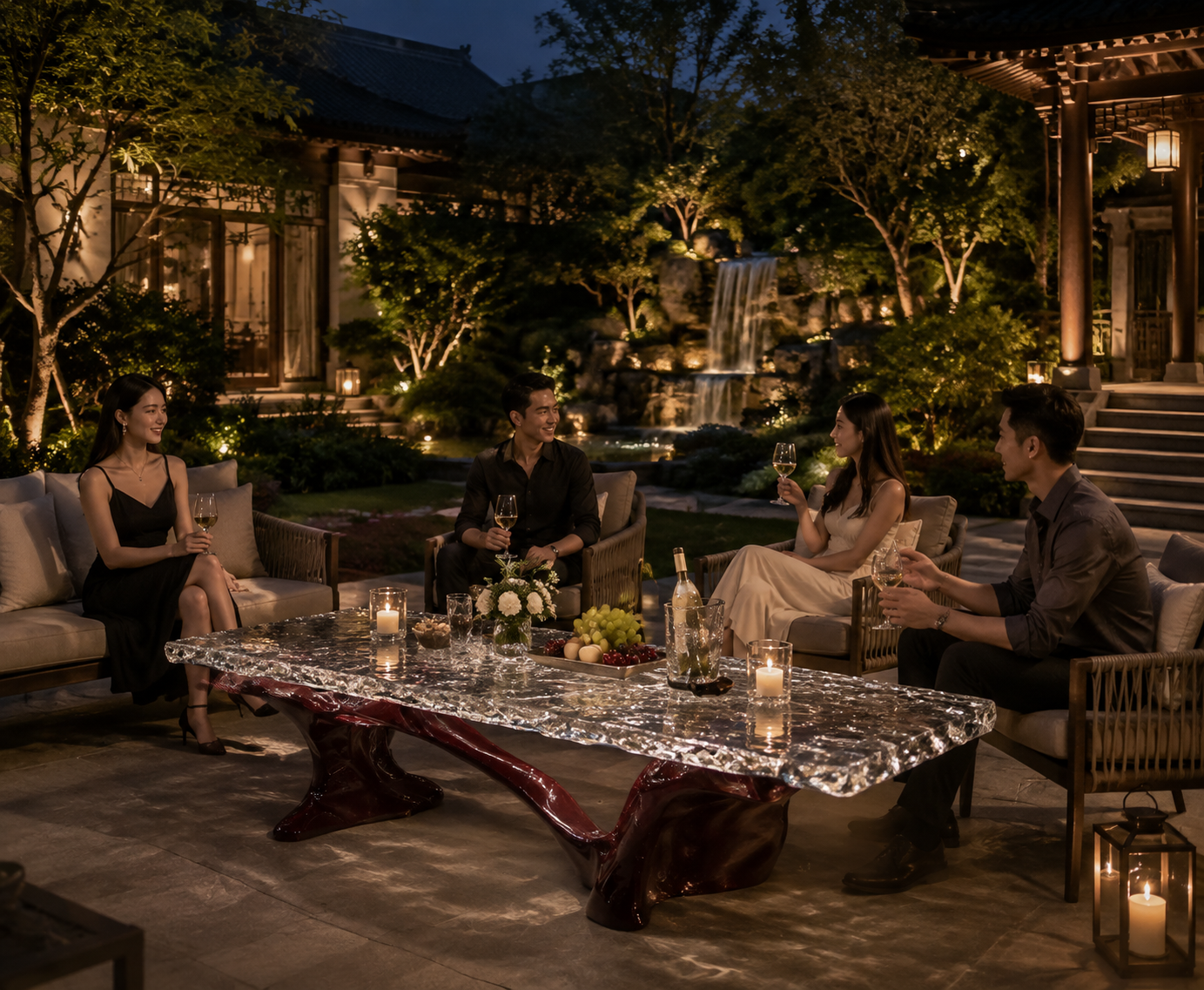
In the furniture market, having a good product is no longer enough.
A manufacturer may produce a clear acrylic table with excellent transparency, precise dimensions, polished edges, stable construction, and strong customization capabilities. From a production perspective, these are meaningful competitive advantages. Yet when several suppliers communicate the same message—high transparency, high quality, custom size, professional factory, competitive price—the differences between brands can quickly become difficult for customers to recognize.
This challenge is especially important in the high-end furniture market.
Premium customers do not simply buy functional objects. They often buy design identity, visual atmosphere, craftsmanship, individuality, cultural meaning, and emotional satisfaction. They want furniture to contribute to the character of a home, hotel, boutique, gallery, showroom, office, or hospitality space.
This is where brand storytelling becomes increasingly important.
For synthetic crystal acrylic furniture, the opportunity is particularly strong because the material itself already contains many qualities that can be transformed into a compelling story. Transparency can represent visual freedom. Crystal-like depth can communicate refinement. Precision polishing can express craftsmanship. Custom fabrication can symbolize individuality. Light interaction can become part of a brand's aesthetic language.
The challenge is to move from simply telling customers what the product has to showing them what the product means.
A brand that communicates only specifications may compete as a supplier.
A brand that connects material, design, craftsmanship, lifestyle, and customer experience can compete as a creator of value.
1. Moving Beyond Features: Why Product Advantages Alone Are No Longer Enough
Product selling points remain important.
Customers still want to know about material quality, thickness, transparency, production techniques, durability, packaging, customization, and delivery capability. These factors influence purchasing decisions, especially for professional buyers.
However, product specifications have become easier to copy in marketing.
One furniture company says its acrylic is highly transparent.
Another says its edges are hand polished.
A third promises custom sizes.
A fourth emphasizes factory-direct pricing.
After customers view enough similar websites, catalogs, advertisements, and social media posts, these statements begin to look almost identical.
This creates a problem.
When every supplier communicates similar advantages, customers often return to the easiest comparison: price.
For manufacturers trying to enter the premium market, this can be dangerous. Competing mainly on price makes it difficult to communicate the real value of better material, skilled labor, experienced technicians, advanced equipment, complex finishing, careful packaging, and reliable project management.
Brand storytelling provides a way to escape this cycle.
Instead of saying only, “Our acrylic furniture has high transparency,” a brand can explain why transparency matters.
It might describe how transparent furniture allows architecture to remain visible.
It might show how a clear table preserves the visual continuity of marble flooring.
It might demonstrate how sunlight travels through a polished acrylic edge and creates a crystal-like glow.
It might present transparency as a design philosophy based on lightness, openness, and visual balance.
The technical feature remains the same, but its meaning changes.
Likewise, customization can be described in more powerful terms.
“Custom size available” is functional.
“Furniture designed around the proportions, architecture, and personality of your space” is emotional.
The second message helps customers imagine ownership.
This difference is critical in luxury markets because high-end consumers rarely want to feel that they are buying a generic object.
They want something that belongs to their environment.
They want a product that feels considered.
They want to understand why it exists.
They want to know what makes it different from hundreds of visually similar alternatives.
Therefore, selling points should not disappear. Instead, they should become the foundation of a larger story.
Material quality becomes a story about clarity.
Precision becomes a story about craftsmanship.
Customization becomes a story about individuality.
Structural engineering becomes a story about confidence.
Design becomes a story about lifestyle.
This transformation allows a furniture brand to communicate at several levels simultaneously.
The rational customer sees technical value.
The designer sees aesthetic potential.
The project buyer sees manufacturing reliability.
The private client sees exclusivity.
The brand becomes more difficult to compare purely by price.
2. Turning Material Characteristics Into a Recognizable Brand Language
Every strong furniture brand needs a recognizable language.
For some companies, this language comes from wood craftsmanship.
For others, it comes from sculptural metalwork, minimalist geometry, upholstery, traditional joinery, sustainable materials, or experimental forms.
Synthetic crystal acrylic furniture has its own powerful visual vocabulary.
Transparency is the most obvious element.
A transparent object behaves differently from conventional furniture because it does not completely block the space behind it. It creates physical presence without the same degree of visual weight.
This can become a central brand idea.
A company might build its identity around “furniture that gives space back to the room.”
Another might focus on the relationship between furniture and light.
A third may emphasize the idea of turning functional furniture into transparent sculpture.
These concepts are stronger than repeatedly describing products as “clear acrylic furniture.”
The optical character of the material provides additional possibilities.
Thick acrylic can create depth.
Polished edges can capture light.
Curved forms can distort reflections.
Tinted acrylic can introduce color while preserving translucency.
Layered pieces can produce architectural effects.
Large transparent components can appear substantial and nearly invisible at the same time.
These contradictions are valuable for storytelling.
Luxury design often becomes memorable when it creates an unexpected experience.
Something can look visually light but feel physically substantial.
A table can have a dramatic volume while allowing the floor beneath it to remain visible.
A furniture leg can resemble a block of crystal.
A console can appear to float.
A pedestal can support an artwork while almost disappearing from the visual composition.
Such qualities allow acrylic furniture brands to develop a strong photographic identity.
This is particularly important in the digital market.
Customers now discover furniture through websites, Instagram, Pinterest, design platforms, online magazines, project photography, videos, and short-form content.
A distinctive material can help a product stand out immediately.
But consistency is essential.
If one campaign presents acrylic furniture as futuristic, another presents it as traditional, and another focuses only on low price, the brand identity becomes unclear.
A stronger strategy is to establish several recurring ideas.
For example, a brand might consistently communicate:
clarity,
light,
precision,
sculptural simplicity,
custom design,
and contemporary luxury.
These ideas can influence product photography, website layout, packaging, catalogs, showroom presentation, project descriptions, and sales communication.
Over time, customers begin to associate the visual language with the brand itself.
This is how a material becomes more than a material.
It becomes an identity.
.png)
3. Using Craftsmanship and Manufacturing Expertise to Build Trust
Many furniture manufacturers hide the production process.
Their marketing shows only finished products.
For synthetic crystal acrylic furniture, this may be a missed opportunity.
The manufacturing process contains some of the strongest evidence of value.
A customer looking at a finished transparent table may not understand how much work is required to create it.
They may not see the cutting accuracy.
They may not know how many polishing stages are required.
They may not understand the difficulty of creating visually clean joints.
They may not realize how carefully workers need to protect transparent surfaces from scratches.
They may not know how thickness influences structural performance.
They may not understand why packaging a large acrylic piece for international shipping requires special attention.
When this knowledge remains invisible, customers may assume the product is easy to manufacture.
That assumption reduces perceived value.
A strong brand can make craftsmanship visible.
For example, content can show how raw acrylic sheets or blocks are inspected before production.
Customers can see CNC machining.
They can see rough edges becoming progressively clearer through polishing.
They can see technicians checking joint alignment.
They can see protective films remaining on surfaces during production.
They can see finished pieces inspected under strong lighting.
They can see customized packaging prepared for international delivery.
This type of storytelling is particularly effective because it provides proof rather than simply making claims.
Instead of saying “high quality,” the brand shows quality being created.
Instead of saying “professional manufacturer,” it shows professional manufacturing.
Instead of saying “strict quality control,” it demonstrates inspection procedures.
For business-to-business buyers, this information can be extremely valuable.
Interior designers, architects, purchasing companies, hotel developers, retailers, and furniture distributors are not only interested in appearance. They also evaluate supplier risk.
Can the manufacturer interpret drawings correctly?
Can it produce consistent dimensions?
Can it manage unusual thicknesses?
Can it combine acrylic with metal or stone?
Can it solve structural problems?
Can it reproduce the approved sample in a larger production run?
Can it package products safely?
Can it communicate effectively during development?
These questions may not sound glamorous, but they strongly influence trust.
This is why manufacturing capability should become part of the brand narrative.
The factory is not simply where the furniture is produced.
It is where the promise of the brand becomes physical.
Craftsmanship can also humanize the company.
Furniture is created by people.
Polishers, CNC technicians, assemblers, engineers, designers, inspectors, project managers, and packaging teams all contribute to the final result.
Showing some of these people gives the brand a human dimension.
A customer can begin to understand that the product is not simply a piece of transparent material. It is the result of accumulated knowledge and repeated technical decisions.
This is especially powerful for custom furniture, where many details require judgment rather than automated mass production.
The more complex the product, the more valuable this expertise becomes.
4. Connecting Acrylic Furniture With High-End Lifestyles and Design Scenarios
Products become more desirable when customers can imagine them in real life.
For this reason, lifestyle storytelling is one of the most important tools for increasing market appeal.
Acrylic furniture should not always be photographed against a plain background.
Clean product photography is useful for showing dimensions, form, and construction. However, contextual photography helps customers understand emotional and spatial value.
Consider the difference between two presentations.
The first shows a transparent acrylic console on a white background.
The second shows the same console in a luxury apartment against a veined stone wall, with soft lighting, carefully selected artwork, and a sculptural object placed on top.
The product has not changed.
Its perceived value has.
Context tells the customer where the furniture belongs.
For high-end synthetic crystal acrylic furniture, several environments can be particularly effective.
Luxury Residences
Acrylic furniture can work well in contemporary apartments, villas, penthouses, waterfront homes, and large private residences.
Transparent furniture can preserve views, flooring patterns, rugs, architectural surfaces, and open layouts.
Marketing should show how the product contributes to the entire room rather than focusing exclusively on the object.
A clear dining table base can allow a stone tabletop to appear almost suspended.
A coffee table can provide function without covering an expensive rug.
A console can sit in front of a decorative wall without hiding it.
A bedside table can reflect surrounding light and reduce visual heaviness.
These are stories about interior experience.
Hotels and Hospitality
Hotels need memorable spaces.
Luxury hospitality projects often seek furniture that creates a strong visual identity while also supporting practical use.
Acrylic can be introduced in lobbies, lounges, suites, restaurants, bars, spas, boutiques, and reception areas.
A manufacturer can strengthen its positioning by presenting hotel projects as stories.
Instead of simply posting a photograph of a table, the brand can explain what the designer wanted to achieve.
Perhaps the goal was to maintain openness in a compact lounge.
Perhaps a transparent base was selected to avoid competing with the flooring.
Perhaps a tinted acrylic feature was designed to match the hotel's lighting concept.
This turns the product into part of a design solution.
Luxury Retail
Premium retail is another strong application.
Fashion, jewelry, cosmetics, watches, accessories, and collectible products often require display furniture that highlights merchandise rather than dominates it.
Transparent acrylic can support this objective.
The brand story can focus on visibility, precision, visual hierarchy, and merchandising flexibility.
This positions the furniture company not only as a manufacturer, but as a partner in retail experience.
Galleries and Art Spaces
Acrylic can also be associated with art.
Transparent pedestals, display structures, benches, and sculptural furniture can work particularly well in galleries and exhibition spaces.
When a furniture brand collaborates with artists, galleries, or exhibition designers, it gains additional cultural credibility.
The product begins to move from commercial furniture toward collectible design.
This can significantly increase brand perception.
5. Creating Emotional Value Through Customization and Customer Participation
Customization is one of the strongest competitive advantages available to synthetic crystal acrylic furniture manufacturers.
However, many companies communicate customization too simply.
They say:
custom size,
custom color,
custom shape,
OEM available.
These statements are useful, but they do not capture the emotional value of customization.
A better approach is to present customization as participation.
The customer becomes part of the design process.
Instead of selecting only from existing products, the customer can influence dimensions, proportions, materials, colors, finishes, structural details, and combinations.
This creates a stronger relationship between customer and product.
For private clients, customization can express personal taste.
For designers, it allows creative freedom.
For hotel projects, it supports brand identity.
For retailers, it enables display systems designed for specific merchandise.
For distributors, it creates exclusive collections.
For furniture brands, it allows products to adapt to different markets.
Acrylic is particularly suitable for this approach because it can be fabricated in many ways.
It can be transparent, frosted, tinted, colored, layered, polished, engraved, bent, bonded, or combined with other materials.
Metal can add contrast.
Wood can add warmth.
Stone can add visual weight.
Leather can soften the experience.
Lighting can transform transparent acrylic into a dramatic feature.
These combinations create opportunities for storytelling around collaboration.
A brand could document the journey from sketch to prototype.
It could show an architect's initial concept.
It could present material samples.
It could explain why a certain thickness was selected.
It could show the first prototype and the improvements made before final production.
It could then present the finished installation.
This sequence creates a complete narrative.
The customer sees not only the final furniture but also the thinking behind it.
Limited editions can further increase emotional appeal.
Acrylic furniture does not always need to be treated as an unlimited industrial product.
Designers can develop numbered collections, experimental colors, sculptural forms, special material combinations, or collaborative editions.
Scarcity can create stronger perceived value when it is supported by genuine design differentiation.
Designer partnerships can also be powerful.
A manufacturer may have excellent production capability but limited brand recognition.
A designer may have strong creative ideas but need technical support.
Collaboration can benefit both sides.
The manufacturer gains design authority.
The designer gains access to specialized fabrication.
The customer receives something distinctive.
These partnerships can generate stories that are more compelling than conventional product advertising.
.png)
6. Building a Long-Term Brand Story Instead of Competing Only on Price
The strongest market position is rarely built through one successful advertisement.
Brand value develops through consistency.
For synthetic crystal acrylic furniture companies, this means telling a coherent story over time.
The story should answer several questions.
What does the brand believe about furniture?
Why does it specialize in acrylic?
What type of customer does it serve?
What makes its manufacturing approach different?
What design principles guide its collections?
How does it approach customization?
What types of projects best represent its capabilities?
What experience should customers associate with the brand?
When these answers are clear, marketing becomes more focused.
Product pages become more than lists of specifications.
Project cases become evidence of expertise.
Factory videos become demonstrations of craftsmanship.
Material articles become educational content.
Designer interviews become expressions of philosophy.
Customer projects become stories of collaboration.
Social media becomes a consistent visual archive.
This is particularly important in international markets.
A buyer may discover a manufacturer without ever visiting the factory.
The brand's digital presence becomes the showroom.
Every photograph, video, project description, specification sheet, article, and message contributes to trust.
For this reason, brands should avoid communicating only when they want to sell something.
Educational content can have significant long-term value.
A company can explain how to evaluate acrylic clarity.
It can discuss thickness selection.
It can show different edge finishes.
It can compare transparent and tinted materials.
It can explain maintenance.
It can discuss packaging for large furniture.
It can show how acrylic works with stone, metal, or wood.
It can present completed hospitality or residential projects.
This content helps potential customers make better decisions.
At the same time, it positions the brand as a knowledgeable specialist.
Expertise becomes marketing.
Another important element is consistency between promise and delivery.
Brand storytelling cannot compensate for poor quality.
In fact, premium positioning creates higher expectations.
If a company presents itself as a luxury furniture specialist, customers will expect excellent communication, accurate samples, controlled quality, careful packaging, reliable schedules, and professional after-sales service.
Therefore, the strongest brand story is one that is supported by operational reality.
Marketing and manufacturing should tell the same story.
If the brand promises precision, the product must be precise.
If it promises customization, the development process must be flexible.
If it promises craftsmanship, the finish must prove it.
If it promises premium service, communication must reflect that standard.
This alignment creates credibility.
From a Furniture Product to a Brand Experience
The market opportunity for synthetic crystal acrylic furniture is larger than simply selling transparent tables and chairs.
The material has the potential to become part of a broader design experience.
A customer may first notice the furniture because of its transparency.
They may become interested because of the sculptural design.
They may investigate further because of the craftsmanship.
They may choose the brand because of customization.
They may recommend it because of service.
Each stage contributes to brand value.
This process changes the way companies should think about marketing.
The goal is not only to increase product visibility.
The goal is to create meaning around the product.
A premium acrylic dining table is not simply a flat surface supported by transparent legs.
It may represent openness.
It may preserve architectural space.
It may highlight the beauty of a stone top.
It may demonstrate advanced fabrication.
It may be designed specifically for one residence.
It may become a centerpiece around which family and guests gather.
The physical product remains important, but the story expands its value.
The Role of Visual Content in Brand Storytelling
Because acrylic is highly visual, photography and video are especially important.
Transparent materials can be difficult to photograph well.
Poor lighting may make acrylic appear cheap, flat, or almost invisible.
Professional lighting can reveal depth, reflections, polished edges, thickness, and interaction with the surrounding environment.
Brands should therefore treat photography as part of product development rather than an afterthought.
Detail shots can show craftsmanship.
Wide interior images can show spatial impact.
Close-up videos can capture light moving along polished edges.
Production footage can communicate technical expertise.
Before-and-after content can show how furniture changes a room.
Designer commentary can provide context.
Installation photographs can demonstrate project capability.
Together, these formats create a richer brand experience.
Video is particularly powerful because acrylic changes as the viewer moves.
Reflections shift.
Edges brighten.
Transparency reveals different backgrounds.
Curves distort surrounding objects.
These effects are difficult to communicate in a single static photograph.
For social media and website content, short videos can therefore become an important part of brand differentiation.
Building Appeal Across Different Customer Groups
A successful brand story should also recognize that different customers value different things.
Interior designers may care about creative freedom and technical collaboration.
Architects may focus on dimensions, tolerances, materials, and structural feasibility.
Hotel developers may prioritize consistency, deadlines, and project coordination.
Retailers may focus on display function and visual merchandising.
Distributors may care about collection potential and market differentiation.
Private customers may prioritize beauty, exclusivity, and personalization.
The same product can therefore be presented differently without changing the core identity of the brand.
For designers, the message may be: “Turn your concept into a manufacturable object.”
For private clients: “Create furniture designed specifically for your space.”
For hospitality: “Build memorable interiors with customized transparent forms.”
For luxury retail: “Display products without visual interference.”
For distributors: “Develop distinctive acrylic collections for your market.”
This approach allows the brand to remain consistent while speaking directly to different audiences.
Conclusion
Synthetic crystal acrylic furniture has strong natural advantages in the premium market.
It is visually distinctive.
It interacts beautifully with light.
It works well with contemporary architecture.
It can be customized extensively.
It can be combined with many materials.
It can appear minimal, sculptural, futuristic, elegant, or luxurious depending on how it is designed.
But these qualities create real market value only when customers understand them.
That is why the transition from product selling points to brand storytelling is so important.
Acrylic furniture companies should continue to communicate transparency, thickness, craftsmanship, polishing quality, customization, and manufacturing capability.
But they should connect these features to larger ideas.
Transparency can become a philosophy of visual openness.
Polishing can become evidence of craftsmanship.
Customization can become a personal design journey.
Manufacturing can become a story of precision.
Project experience can become proof of reliability.
Furniture can become part of a lifestyle.
When these elements are connected consistently, the brand becomes more than a supplier of products.
It becomes a source of design identity.
This distinction is especially valuable in markets where many manufacturers can produce similar forms.
A competitor may copy dimensions.
It may copy a table shape.
It may offer a similar material.
It may even offer a lower price.
What is much harder to copy is a complete brand identity built through years of consistent design, craftsmanship, customer experience, visual communication, and project credibility.
For synthetic crystal acrylic furniture, that is where the greatest opportunity may lie.
The future of the market will not belong only to companies that can manufacture transparent furniture.
It will increasingly belong to companies that can explain why their furniture matters, show how it transforms a space, demonstrate how it is made, and give customers a reason to remember the name behind the product.
The strongest market appeal is created when material becomes design, design becomes experience, and experience becomes story.
READ MORE:
- Synthetic Crystal Acrylic Furniture: Differentiation Opportunities Worth Watching in the High-End Market
- Why Is “Transparent Texture” Becoming a New Direction in High-End Furniture Design?
- Synthetic Crystal Acrylic Furniture: Giving Spatial Design Stronger Visual Communication Power
- Synthetic Crystal Acrylic Furniture: Why Are More High-End Customers Starting to Care About the Material Itself?
- Quanto è sostenibile un mobile in acrilico? Le domande da fare prima di giudicarlo solo dal materiale
- Tavolo, console o complemento trasparente? Come capire dove l’acrilico valorizza davvero uno spazio — e dove è meglio evitarlo
- Graffi, impronte e opacizzazione: cosa succede davvero a un mobile in acrilico dopo anni di utilizzo?
- Dal campione all’installazione: come evitare ritardi, differenze di qualità e costi imprevisti negli arredi acrilici su misura
- Acrilico o "semplice plastica" ? I dettagli che fanno davvero la differenza in un mobile trasparente di alta gamma


