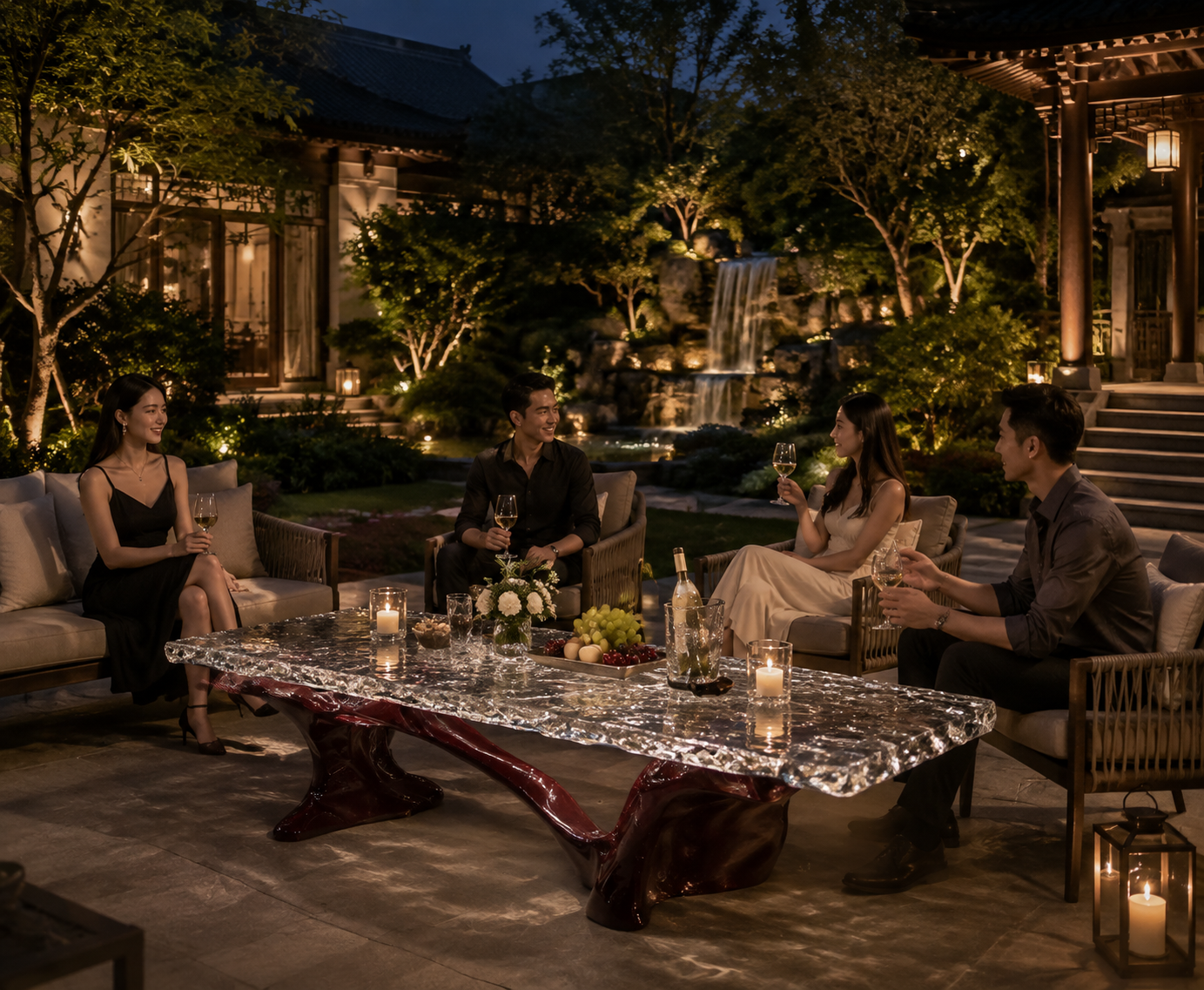
Interior design is no longer judged only by whether a space is beautiful, functional, or comfortable.
Today, spaces also need to communicate.
A luxury hotel lobby needs to communicate its positioning within seconds.
A retail store needs to communicate the character of its brand.
A high-end residence should express the personality and lifestyle of its owner.
A showroom needs to communicate product value.
A restaurant wants customers to remember its atmosphere.
A gallery needs to create an environment that supports the objects being exhibited without competing with them.
In all these situations, spatial design has become a form of visual communication.
Furniture plays an important role in this process.
Tables, chairs, consoles, pedestals, benches, shelves, display structures, and decorative furniture are no longer viewed only as functional objects. Their materials, proportions, colors, transparency, reflections, and relationships with architecture influence how people understand the entire space.
This is one reason synthetic crystal acrylic furniture has become increasingly relevant in contemporary interiors.
Unlike conventional opaque materials, acrylic interacts strongly with its environment.
It allows light to pass through.
It reflects surrounding colors.
It can reveal architectural surfaces behind it.
Its polished edges can capture light.
Its thickness can create a crystal-like depth.
Its transparency can make a physically substantial piece appear visually light.
Its surface can change depending on the viewer's position.
These qualities give designers a powerful tool.
Synthetic crystal acrylic furniture can do more than occupy space.
It can help the space communicate.
1. Why Visual Communication Has Become Essential in Interior Design
Modern audiences experience spaces differently from previous generations.
People no longer encounter a hotel, restaurant, store, residence, or exhibition only in person.
They often see it first through a screen.
A customer may discover a hotel through Instagram.
A buyer may discover a furniture collection through Pinterest.
A client may choose a restaurant after seeing interior photographs online.
An interior designer may evaluate a manufacturer through project images.
A luxury property may be marketed through professional photography and video long before the potential buyer enters the building.
This has changed the role of interior design.
A space needs to work physically, but it also needs to communicate visually.
The strongest interiors can often be recognized immediately.
They have a clear identity.
Their material choices feel intentional.
Their furniture supports the architectural concept.
Their lighting creates a recognizable atmosphere.
Their colors and textures form a coherent language.
A single photograph can communicate whether a space feels luxurious, artistic, minimal, contemporary, warm, futuristic, exclusive, playful, or sophisticated.
Furniture is essential to this visual language.
Imagine two rooms with the same architecture.
One contains heavy dark furniture.
The other uses transparent acrylic furniture with polished surfaces and carefully considered proportions.
The spatial experience can become completely different.
Opaque furniture creates visual mass.
Transparent furniture allows the eye to continue through the object.
This affects how large, open, and layered the space feels.
In luxury interiors, this difference can be particularly important.
Many premium spaces already contain valuable visual elements: marble flooring, textured walls, architectural lighting, custom rugs, artwork, panoramic windows, decorative ceilings, or sculptural staircases.
Furniture should not necessarily hide these features.
In some situations, it should allow them to remain visible.
Synthetic crystal acrylic furniture is particularly effective because it can provide physical function while reducing visual obstruction.
A transparent coffee table can sit above an expensive rug without hiding its pattern.
An acrylic console can stand against a decorative wall without covering the surface.
A clear pedestal can support a sculpture without introducing another dominant material.
A transparent dining table base can carry a large tabletop while preserving visual openness.
This ability to remain present without becoming visually heavy gives acrylic furniture an unusual communication advantage.
The furniture contributes to the design without always demanding attention.
When designers want it to become a focal point, however, the same material can also become highly dramatic.
This dual character makes acrylic particularly interesting.
It can disappear.
It can attract attention.
It can do both at the same time.
2. How Synthetic Crystal Acrylic Changes the Perception of Space
Materials influence how people perceive space.
Dark materials often create visual weight.
Reflective materials can increase brightness.
Natural materials can introduce warmth.
Soft materials can reduce acoustic and visual hardness.
Transparent materials create another type of effect.
They alter the relationship between object and background.
This is one of the most important characteristics of synthetic crystal acrylic furniture.
A conventional table visually separates the viewer from the space behind it.
A transparent table allows those layers to remain connected.
This continuity can make interiors appear more open.
It is particularly useful in smaller rooms, narrow spaces, or interiors where designers want to emphasize architecture rather than furniture volume.
But transparency alone does not explain the full visual potential of acrylic.
Thickness is equally important.
Thin acrylic can appear light and minimal.
Thick acrylic can appear luxurious and sculptural.
When thick clear acrylic is properly manufactured and polished, the material develops visual depth.
Edges can capture and redirect light.
Certain angles may appear brighter.
The object can sometimes resemble glass or crystal while maintaining its own distinct character.
This gives designers a way to create visual richness without adding decoration.
Instead of using ornament, the material itself becomes the visual effect.
A simple geometric table can become memorable because of the way light passes through its legs.
A rectangular console can feel more sophisticated because thick acrylic edges produce a luminous appearance.
A pedestal can transform as daylight changes throughout the day.
This is particularly valuable in modern luxury design.
Contemporary interiors often avoid excessive decoration.
They rely instead on proportion, materials, surfaces, lighting, and details.
Synthetic crystal acrylic fits naturally into this approach.
Reflection also contributes to its visual power.
Transparent acrylic does not disappear completely.
Its surfaces catch highlights.
Its edges define form.
Objects behind it may appear slightly altered.
Lighting can create subtle reflections.
The result is visually dynamic.
The furniture changes depending on the environment.
In daylight, it may appear clean and nearly invisible.
Under warm evening lighting, its edges may glow.
Near colored surfaces, it can pick up surrounding tones.
With architectural lighting, it can become almost jewel-like.
This responsiveness allows furniture to participate actively in the atmosphere of a room.
It is not simply placed into the interior.
It interacts with it.
.png)
3. Using Acrylic Furniture to Strengthen Visual Focal Points
Every successful interior needs visual hierarchy.
Some elements should remain quiet.
Others should attract attention.
If everything competes for attention, the room becomes confusing.
If nothing creates emphasis, the room may feel unmemorable.
Furniture can help designers establish this hierarchy.
Synthetic crystal acrylic is especially useful because it can create focal points without relying on heavy mass.
Consider a large coffee table made from thick transparent acrylic.
Its dimensions may be substantial, yet the transparency prevents it from visually dominating the entire seating area.
The object feels important because of its scale and material quality, but it still allows the surrounding rug, seating, flooring, and architecture to remain visible.
This creates a different type of luxury.
The impact comes from precision and presence rather than visual heaviness.
Sculptural acrylic furniture can create even stronger focal points.
Curved legs, stacked transparent forms, irregular geometries, layered panels, colored sections, or combinations of clear and frosted surfaces can transform furniture into functional sculpture.
This approach is particularly effective in entrance areas, hotel lobbies, galleries, luxury retail environments, executive offices, and large residential living rooms.
A single distinctive piece can become a visual anchor.
Designers can use it to organize the composition of the entire room.
For example, a custom acrylic console in a hotel lobby may align with architectural lighting and artwork.
A sculptural table in a luxury residence may become the central object around which seating is arranged.
A transparent pedestal in a boutique can highlight a premium product while supporting the store's overall design language.
An acrylic reception feature can reinforce a brand's contemporary identity.
Because acrylic is highly customizable, the focal point does not need to come from a standard catalog product.
The furniture can be designed specifically for the space.
Dimensions can respond to architecture.
Proportions can align with walls or flooring.
Color can match a brand identity.
Thickness can be selected according to visual impact.
Curves can reflect architectural geometry.
Metal, stone, wood, or lighting can be integrated.
This gives designers much greater control over how furniture communicates.
The product becomes part of the architectural composition.
4. Creating More Shareable and Photogenic Interior Environments
Visual communication has become closely connected with photography and social media.
This is particularly important for hospitality, retail, restaurants, exhibitions, real estate, and lifestyle brands.
A successful interior may be experienced by thousands of people online who never physically visit the location.
This means photogenic design has commercial value.
Synthetic crystal acrylic furniture performs well in this environment because it creates strong visual effects without overwhelming photographs.
Transparent furniture allows more architectural information to remain visible within an image.
A photographer can capture the furniture while still showing flooring, walls, rugs, and surrounding objects.
This creates more layered compositions.
Acrylic also interacts strongly with lighting, which can make photographs more visually interesting.
Polished edges may create highlights.
Thick transparent sections can produce depth.
Reflections can add complexity.
Colored acrylic can create accents without introducing opaque blocks.
In video, the effect can be even stronger.
As the camera moves, reflections change.
Background objects shift behind transparent surfaces.
Edges become brighter or darker depending on angle.
The material appears dynamic.
This creates content that is well suited to short-form video platforms and digital campaigns.
For hotels, this can be valuable.
Guests increasingly photograph beautiful interiors and share them online.
Distinctive furniture can become part of the property's visual identity.
A recognizable acrylic table in a lobby or lounge may appear repeatedly in guest photographs.
Over time, that object can become associated with the hotel itself.
The same principle applies to restaurants.
A memorable transparent bar feature, dining table, or decorative installation can become part of the customer's visual experience.
In luxury retail, acrylic display furniture can help products remain visually dominant while still creating sophisticated surroundings.
Transparent pedestals and display tables allow merchandise to appear as the main focus.
This is especially useful for jewelry, fashion accessories, cosmetics, watches, art objects, and collectible products.
For exhibitions and galleries, acrylic can support display without introducing unnecessary visual interference.
The result is a material that performs well both in physical space and in digital representation.
That combination is becoming increasingly important.
A good interior is no longer designed only for the people standing inside it.
It is also designed for the camera.
5. Combining Acrylic With Other Materials to Build Stronger Design Narratives
One of the most effective ways to increase the visual communication power of acrylic furniture is to combine it with contrasting materials.
Transparency becomes more noticeable when placed next to opacity.
Smooth surfaces become more interesting when paired with texture.
Modern materials become richer when combined with natural ones.
Synthetic crystal acrylic can therefore act as a visual bridge between different materials.
Acrylic and Stone
Stone communicates permanence, weight, and natural variation.
Acrylic communicates clarity, lightness, and precision.
When the two are combined, the contrast can be powerful.
A marble tabletop supported by a transparent acrylic base may appear to float.
The stone remains visually dominant, while the acrylic provides structural support without adding heavy visual mass.
This combination works particularly well in luxury dining tables, consoles, side tables, and hospitality furniture.
Acrylic and Metal
Metal introduces strength, precision, and contrast.
Brass can add warmth and luxury.
Stainless steel can create a modern technical appearance.
Black metal can provide graphic definition.
When combined with acrylic, metal details can visually outline the transparent object.
This helps designers create stronger compositions.
Acrylic and metal also work well in retail, hospitality, and modern residential interiors.
Acrylic and Wood
Wood introduces warmth and natural character.
Acrylic provides visual lightness.
The combination can prevent transparent furniture from feeling too cold or technical.
For example, a solid wood top on clear acrylic legs can create a balance between traditional craftsmanship and contemporary design.
This can be especially effective in residential spaces where designers want modern clarity without losing warmth.
Acrylic and Fabric or Leather
Soft materials create another type of contrast.
An acrylic chair or bench with upholstered elements can combine visual lightness with comfort.
Leather can add sophistication.
Textiles can introduce color and softness.
These combinations can help acrylic furniture enter spaces where fully transparent pieces might otherwise feel too minimal.
Acrylic and Lighting
Lighting may be the most dramatic combination.
Because acrylic can transmit and reflect light, integrated or nearby lighting can change the character of the furniture significantly.
Edges can glow.
Transparent surfaces can pick up colored light.
Layered acrylic can create depth.
Acrylic components can become part of a lighting concept rather than simply furniture.
This is particularly useful in hotels, bars, boutiques, night-time hospitality environments, exhibitions, and experiential spaces.
When materials are combined thoughtfully, furniture begins to communicate a richer story.
Acrylic may represent clarity.
Stone represents permanence.
Wood represents warmth.
Metal represents precision.
Fabric represents comfort.
Light represents atmosphere.
The designer can control the balance between these meanings.
This creates a stronger and more recognizable spatial narrative.
.png)
6. Turning Furniture Into a Medium for Brand and Spatial Communication
The most important change in contemporary furniture design is that furniture is increasingly becoming a communication medium.
This is particularly clear in commercial projects.
A luxury fashion store does not choose furniture only because it needs tables.
The tables contribute to brand perception.
A five-star hotel does not choose lobby furniture only because guests need somewhere to sit.
The furniture helps communicate the hotel's identity.
A corporate showroom does not select display structures only because products need support.
The materials and forms influence how visitors perceive the company.
Synthetic crystal acrylic gives brands an unusual opportunity because the material has a strong contemporary identity.
It can communicate innovation.
It can communicate clarity.
It can communicate precision.
It can communicate exclusivity when used in thick, highly polished, customized forms.
It can also communicate experimentation when used with color, curves, or complex sculptural geometry.
For luxury brands, this flexibility is valuable.
Acrylic furniture can be customized to match visual identity.
A brand color can appear through tinted acrylic.
A logo may be integrated through engraving or embedded elements.
Furniture proportions can respond to a retail concept.
Transparent surfaces can support product presentation.
Custom lighting can reinforce atmosphere.
Instead of purchasing generic furniture, the company can create pieces that belong specifically to its environment.
This makes the interior more memorable.
The same approach can be used in high-end residential projects.
A private residence also communicates identity, although the audience may be smaller.
The design reflects the owner's preferences.
Custom acrylic furniture can express a desire for minimalism, contemporary luxury, art, lightness, or individuality.
Because pieces can be produced to specific dimensions, they can respond directly to architecture.
This is particularly useful in complex spaces.
A console can be designed exactly for a wall.
A coffee table can match the proportions of a seating arrangement.
A dining base can support a custom stone slab.
A transparent bench can preserve a view.
A pedestal can be built around a specific artwork.
Customization improves function, but it also improves communication.
The furniture feels intentional.
Visual Communication Through Material Consistency
One dramatic furniture piece can attract attention.
But strong spatial identity usually requires consistency.
If acrylic appears repeatedly in carefully selected locations, it can become part of the design language.
For example, a hotel might use transparent acrylic in lobby tables, display pedestals, suite furniture, and decorative installations.
The pieces do not need to be identical.
What connects them is the material.
This repetition builds recognition.
A luxury retailer could use the same tinted acrylic across product displays, counters, and visual merchandising elements.
A residence might repeat clear acrylic in side tables, consoles, and decorative furniture.
This creates coherence.
Material consistency helps visitors understand the space subconsciously.
They may not consciously think, “This design uses acrylic repeatedly.”
Instead, they experience the environment as connected.
This is the same principle used in branding.
Repeated visual elements create recognition.
In interior design, materials can perform the same function as colors, logos, or typography.
Why Manufacturing Quality Matters for Visual Communication
The visual power of synthetic crystal acrylic depends strongly on manufacturing quality.
Transparent materials reveal imperfections easily.
A scratch that might be almost invisible on opaque furniture can become obvious on a clear surface.
Poorly polished edges reduce the crystal-like effect.
Uneven bonding lines interrupt visual clarity.
Incorrect dimensions can make a minimalist piece look unrefined.
For this reason, craftsmanship is not separate from visual communication.
It directly affects it.
Premium acrylic furniture requires careful material selection.
Cutting needs to be accurate.
Machining needs to control stress.
Edges may require several stages of finishing.
Bonding must be visually clean.
Surfaces need protection throughout production.
Final inspection should identify scratches, marks, haze, and alignment problems.
Packaging must also protect the product until installation.
A beautifully designed transparent table that arrives damaged cannot communicate luxury.
Manufacturing quality therefore becomes part of the design strategy.
This is particularly important for designers and architects working with custom manufacturers.
The original concept may depend on transparency, precision, and minimal detailing.
Any production defect becomes highly visible.
Manufacturers with strong acrylic processing experience are better positioned to translate design intent into a finished object.
Acrylic Furniture as a Tool for Memorable Experiences
Ultimately, strong visual communication is about memory.
People remember unusual experiences.
They remember dramatic lighting.
They remember beautiful materials.
They remember objects they have not seen before.
Furniture can contribute to this memory.
A transparent acrylic table beneath a dramatic chandelier may become the image a guest remembers from a hotel.
A sculptural acrylic display may become the visual signature of a boutique.
A clear dining table base may become the defining feature of a luxury residence.
An illuminated acrylic installation may become the most photographed element of an exhibition.
These moments create value beyond function.
They turn furniture into experience.
For commercial environments, memorable design can strengthen marketing.
Customers take photographs.
Guests share videos.
Design publications feature projects.
Social media users circulate images.
The physical space generates digital visibility.
In this way, visual communication can extend far beyond the building itself.
One carefully designed object may appear in thousands of photographs.
This gives furniture a new role.
It can become part of a communication strategy.
Designing for Both Physical and Digital Experience
Designers increasingly need to consider two audiences.
The first audience experiences the space physically.
They notice scale, comfort, movement, texture, and atmosphere.
The second audience experiences it through images.
They notice composition, contrast, color, form, and visual uniqueness.
The best furniture can perform well for both.
Synthetic crystal acrylic is particularly suitable because its visual character changes according to viewing angle.
A person walking around the object experiences changing reflections.
A photographer can capture depth through transparent layers.
A videographer can show movement through the material.
A designer can create compositions in which foreground and background remain visually connected.
This gives acrylic strong potential in an era where physical and digital design increasingly overlap.
The Importance of Customization
Standard products can solve standard problems.
But memorable spaces often require non-standard solutions.
Customization allows acrylic furniture to respond to the specific communication goals of a project.
For a hotel, the furniture may need to reflect brand colors.
For a luxury residence, it may need to coordinate with a rare stone slab.
For a boutique, dimensions may depend on merchandise.
For a gallery, transparency may need to support artwork.
For a corporate showroom, furniture may need to communicate technological sophistication.
Acrylic can be adapted through dimensions, thickness, shape, color, finish, engraving, bending, layering, and material combinations.
This flexibility gives designers more control.
Instead of adjusting the space around available furniture, furniture can be developed around the space.
The result is more integrated design.
Conclusion
Synthetic crystal acrylic furniture offers something increasingly valuable to contemporary interior design: the ability to combine physical function with strong visual communication.
Its transparency can make interiors feel more open.
Its thickness can create crystal-like depth.
Its polished surfaces can interact dramatically with light.
Its visual lightness allows architecture, artwork, flooring, and decorative surfaces to remain visible.
Its sculptural potential can create memorable focal points.
Its customization capability allows furniture to become part of a unique spatial identity.
Its performance in photography and video makes it particularly relevant in a world where interiors are increasingly experienced online.
For hotels, restaurants, luxury residences, boutiques, galleries, showrooms, commercial spaces, and branded environments, these advantages can have real value.
Furniture is no longer simply something placed inside a room.
It can communicate positioning.
It can communicate personality.
It can communicate quality.
It can communicate innovation.
It can create content.
It can support branding.
It can become part of the memory people take away from a space.
That is the deeper opportunity behind synthetic crystal acrylic furniture.
The material is not only transparent.
It can make the design message more visible.
When material selection, craftsmanship, lighting, customization, architecture, and storytelling work together, acrylic furniture can transform from a functional object into a powerful visual communication tool.
And in a market where attention is increasingly valuable, that ability may become one of the material's strongest competitive advantages.
READ MORE:
- Synthetic Crystal Acrylic Furniture: Differentiation Opportunities Worth Watching in the High-End Market
- Why Is “Transparent Texture” Becoming a New Direction in High-End Furniture Design?
- From Product Selling Points to Brand Storytelling: How Can Synthetic Crystal Acrylic Furniture Enhance Market Appeal?
- Synthetic Crystal Acrylic Furniture: Why Are More High-End Customers Starting to Care About the Material Itself?
- Quanto è sostenibile un mobile in acrilico? Le domande da fare prima di giudicarlo solo dal materiale
- Tavolo, console o complemento trasparente? Come capire dove l’acrilico valorizza davvero uno spazio — e dove è meglio evitarlo
- Graffi, impronte e opacizzazione: cosa succede davvero a un mobile in acrilico dopo anni di utilizzo?
- Dal campione all’installazione: come evitare ritardi, differenze di qualità e costi imprevisti negli arredi acrilici su misura
- Acrilico o "semplice plastica" ? I dettagli che fanno davvero la differenza in un mobile trasparente di alta gamma


