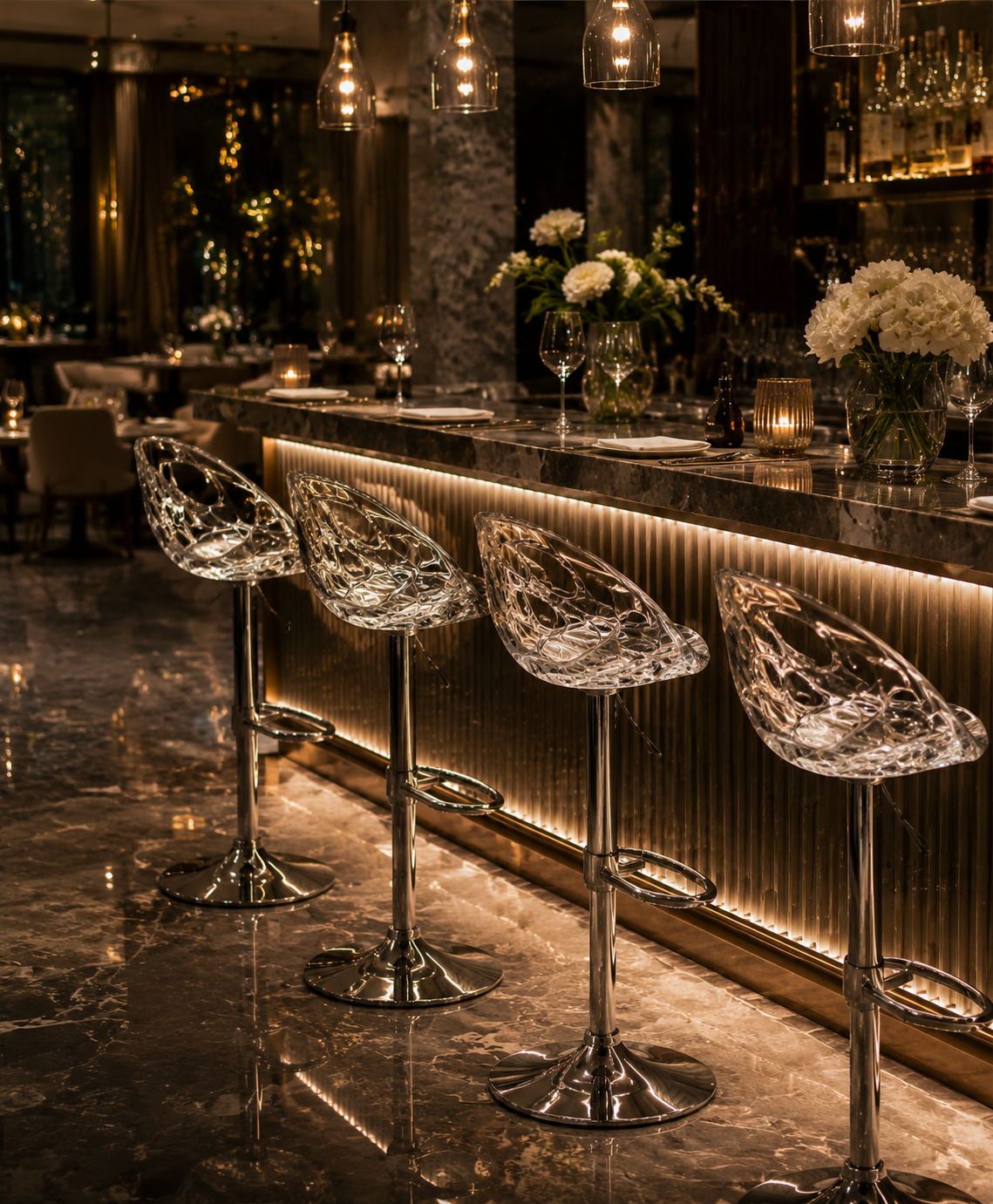
For many years, luxury furniture was associated with visible weight.
Thick wood, carved details, heavy upholstery, dark finishes, large proportions, decorative metalwork, and expensive natural materials were often used to communicate status and value.
The visual message was clear: luxury should look substantial.
Today, that definition is changing.
A growing number of high-end interior projects are moving toward a very different aesthetic.
Furniture is becoming lighter in appearance.
Shapes are becoming cleaner.
Materials are being used with greater restraint.
Instead of filling a room with visual mass, designers are increasingly interested in preserving openness.
This shift is helping transparent and translucent materials gain a stronger position in premium furniture design.
Clear acrylic, synthetic crystal acrylic, glass-like polymers, transparent resin, crystal-inspired materials, and combinations of transparent components with stone, metal, wood, or fabric are appearing more frequently in luxury interiors.
This trend is not simply about creating furniture that people can see through.
The deeper attraction comes from what transparency does to the entire spatial experience.
Transparent furniture can occupy physical space without creating the same visual obstruction as opaque furniture.
It can reveal flooring.
It can preserve views.
It can interact with lighting.
It can support artwork without competing with it.
It can make heavy materials appear lighter.
It can create depth without adding visual complexity.
Most importantly, transparent texture is becoming associated with a new type of luxury.
Instead of communicating value through decoration, it communicates value through material quality, precision, proportion, light, restraint, and craftsmanship.
This change reflects broader developments in architecture, interior design, luxury consumption, and visual culture.
As high-end customers become more design-conscious, they increasingly pay attention not only to what furniture looks like, but also to how it behaves within a space.
That is where transparency becomes especially powerful.
1. From Heavy Luxury to Visual Lightness
Luxury design has always changed with culture.
At different times, luxury has been expressed through ornament, rarity, craftsmanship, scale, material cost, technological innovation, or exclusivity.
Contemporary luxury is increasingly defined by clarity and confidence.
A space no longer needs to contain many decorative elements to feel expensive.
In fact, some of the most sophisticated interiors are visually restrained.
They rely on a smaller number of well-designed objects.
Materials are selected carefully.
Proportions are controlled.
Details are precise.
Lighting is intentional.
Nothing feels accidental.
In this environment, visually heavy furniture can sometimes interrupt the architecture.
A large dark coffee table can block the pattern of a custom rug.
A thick console can hide an expensive stone wall.
A bulky dining table base can make an elegant room feel crowded.
A large display structure can compete with the objects it is meant to present.
Transparent furniture offers another solution.
It allows designers to provide function without introducing the same degree of visual weight.
A clear table can occupy the same physical area as an opaque one, yet the room may still feel larger because the eye can continue through the furniture.
This creates a sense of visual freedom.
That quality has become especially important in high-end residential design.
Luxury homes often include open-plan layouts, large windows, long sightlines, panoramic views, custom flooring, artwork, and architectural surfaces.
Designers do not always want furniture to interrupt these elements.
Transparent pieces can help preserve them.
This is one reason transparent coffee tables, consoles, dining table bases, side tables, benches, pedestals, and decorative objects have become increasingly attractive.
They support the interior without overpowering it.
The concept is similar to modern architecture.
Many contemporary buildings use large expanses of glass because transparency creates openness and visual continuity.
Furniture is beginning to follow the same principle.
Instead of treating transparency only as a property of windows and partitions, designers are applying it to objects within the room.
This creates a more unified spatial language.
The result is not emptiness.
It is controlled presence.
A transparent object is still visible.
Its edges, reflections, thickness, and proportions define its form.
But it does not dominate in the same way as an opaque block.
This balance between presence and disappearance is one of the strongest reasons transparent texture feels modern.
2. Transparency Creates a Stronger Relationship Between Furniture and Space
Traditional furniture is usually understood as an independent object.
A wooden table has its own color and texture.
A leather chair has its own visual identity.
A metal cabinet creates a strong physical boundary.
Transparent furniture behaves differently.
Its appearance depends heavily on its environment.
The same clear acrylic table can look completely different in two interiors.
Placed over a dark rug, its edges and reflections become more dramatic.
Placed in front of a stone wall, the pattern of the stone remains visible through the furniture.
Placed near a window, natural light may travel through the material and brighten polished edges.
Placed under warm lighting, the transparent structure may take on softer reflections.
This means the furniture becomes part of a visual system rather than simply an object placed inside the room.
That relationship is especially valuable in luxury interiors because high-end spaces often contain multiple carefully selected materials.
Marble, natural stone, metal, wood, glass, textiles, artwork, lighting, and architectural surfaces all compete for attention.
A good designer needs to control this competition.
Transparent furniture can act almost like a pause between stronger materials.
It provides function without adding another dominant surface.
For example, consider a luxury living room with a richly patterned rug.
If the coffee table is made from solid dark wood, much of the rug disappears beneath it.
If the table is transparent, the rug remains part of the visual composition.
The furniture does not replace the design underneath it.
It reveals it.
The same principle applies to flooring.
In many high-end interiors, floors are important design features.
Natural stone, terrazzo, decorative tiles, parquet, or custom rugs may be expensive and visually significant.
Transparent furniture allows more of that investment to remain visible.
This ability to preserve architectural and decorative features increases the overall sense of coherence.
Transparency also affects depth.
Opaque objects divide a room into foreground and background.
Transparent objects allow those layers to overlap visually.
This can make a space feel more complex without feeling more crowded.
Designers can create multiple visual layers while maintaining openness.
That is particularly useful in smaller luxury apartments, boutique spaces, galleries, and refined commercial interiors.
Transparent furniture can also create interesting relationships with artwork.
A clear pedestal can support sculpture while remaining visually neutral.
An acrylic console can sit beneath artwork without creating a strong competing color.
A transparent bench can be placed in a gallery while maintaining focus on the exhibition.
For this reason, transparent materials often appear in spaces where visual hierarchy matters.
The furniture is present, but the environment remains important.
.png)
3. Material Quality Is Turning Transparency Into a Premium Experience
Transparency alone does not create luxury.
This is one of the most important distinctions in high-end furniture.
A transparent material can look sophisticated, but it can also look inexpensive.
The difference depends heavily on quality.
In premium furniture, clarity matters.
Material purity matters.
Thickness matters.
Edge polishing matters.
Surface protection matters.
Bonding quality matters.
Machining accuracy matters.
The smallest imperfection can become highly visible because transparent surfaces reveal everything.
This creates an interesting paradox.
Transparent furniture often looks simple, but producing it well can be technically demanding.
Minimalism increases the importance of execution.
A clear acrylic table with a simple geometric design may appear straightforward.
But if the edges are cloudy, the joints are uneven, the surfaces are scratched, or the dimensions are inaccurate, the product immediately loses its premium character.
There is nowhere for poor craftsmanship to hide.
High-quality transparent furniture therefore depends on precision.
Thick acrylic is a good example.
When a thick transparent section is produced and polished correctly, it can create a crystal-like visual depth.
Light may collect along the edges.
The material can appear luminous.
The object feels substantial even though it remains visually open.
This combination of weight and transparency creates a distinctive luxury effect.
However, if the material contains impurities or poor optical consistency, the same thickness can exaggerate flaws.
The difference becomes especially noticeable in large furniture pieces.
This is why high-end clients increasingly care about the material itself.
They want to know whether the acrylic is suitable for premium applications.
They want to understand whether the manufacturer has experience with thick sections.
They may examine how joints are bonded.
They may inspect polishing quality.
They may compare surface clarity.
They may ask how scratches are controlled during production and transport.
In other words, transparency turns manufacturing into part of the aesthetic.
With opaque furniture, some structural details can be hidden.
With transparent furniture, technical quality becomes visible.
This can actually increase the perceived value of excellent craftsmanship.
A perfectly polished edge becomes a design feature.
A clean joint becomes evidence of precision.
Uniform clarity becomes a sign of material quality.
The absence of defects becomes part of luxury.
This is why transparent texture is increasingly appealing to sophisticated customers.
It looks simple, but achieving that simplicity requires control.
4. Transparent Furniture Matches the Needs of Modern Luxury Lifestyles
Luxury lifestyles have changed.
High-end customers increasingly value flexibility, openness, personalization, and visual calm.
Many modern homes are designed around large windows, open layouts, integrated living areas, and carefully curated objects.
Furniture needs to support these environments.
Transparent furniture fits naturally into this lifestyle.
In a luxury apartment, it can help maintain openness.
In a villa, it can preserve views.
In a penthouse, it can prevent furniture from visually competing with skyline windows.
In a compact high-end residence, it can make the room feel less crowded.
The same advantages apply to hotels.
Contemporary hospitality spaces often combine architecture, lighting, artwork, and furniture into a highly coordinated experience.
Lobby furniture needs to create identity while supporting circulation.
Transparent tables and consoles can provide function without blocking sightlines.
In hotel suites, acrylic furniture can make rooms feel more spacious.
In lounges, it can help designers create layered compositions.
Luxury retail is another important application.
Retail environments need furniture that supports merchandise.
Transparent display furniture is particularly useful because it can provide structure without dominating the product.
Jewelry, cosmetics, watches, fashion accessories, and collectible objects can remain the main visual focus.
The transparency of the furniture reinforces the idea that the merchandise is important.
Galleries and exhibitions also benefit from this quality.
Acrylic pedestals and display structures can support artworks while remaining visually quiet.
This is especially valuable when designers want display furniture to disappear as much as possible.
Offices and showrooms are also adopting more transparent materials.
Premium corporate environments often want to communicate innovation and modernity.
Transparent furniture can help create that impression.
It can suggest precision, technology, openness, and forward-looking design.
For all these applications, customization is important.
High-end spaces rarely rely completely on standard products.
Designers may need specific dimensions, thicknesses, colors, proportions, or combinations of materials.
Acrylic is highly adaptable.
It can be cut, polished, bent, bonded, engraved, frosted, tinted, layered, or combined with metal, stone, wood, fabric, and lighting.
This flexibility makes transparent furniture especially suitable for bespoke design.
A piece can be developed specifically for one wall.
One stone slab.
One retail display.
One hotel lobby.
One artwork.
One interior concept.
This degree of integration is increasingly important in the luxury market.
The furniture feels less like a product purchased from a catalog and more like part of the architecture.
5. Photography, Social Media, and Visual Culture Are Accelerating the Trend
Another major reason transparent texture is becoming more popular is the rise of visual media.
Interior design today is constantly photographed.
Hotels promote themselves through imagery.
Restaurants depend on social media visibility.
Retail stores are designed with photography in mind.
Luxury residences are marketed through professional images and video.
Designers build reputations through online project portfolios.
Furniture therefore needs to perform both physically and visually.
Transparent materials have several advantages in photography.
First, they allow more of the background to remain visible.
This is useful because interior photographs often need to communicate the entire space.
An opaque object can block important flooring, architecture, or decorative details.
A transparent object creates less visual interruption.
Second, acrylic interacts strongly with light.
Polished surfaces can create highlights.
Thick edges can catch reflections.
Curved pieces can distort the environment in interesting ways.
Tinted transparent materials can introduce color while maintaining visual depth.
These effects can make photographs more dynamic.
Video makes the material even more powerful.
A static image captures one angle.
Video reveals how the material changes as the camera moves.
Reflections shift.
Edges brighten and darken.
Objects behind transparent surfaces move visually.
Curves distort the background.
The furniture appears alive.
This makes acrylic particularly suitable for short-form videos, project presentations, digital marketing, and social media content.
For hospitality brands, this has commercial value.
A visually distinctive lobby or restaurant interior may be shared repeatedly by guests.
If a transparent sculptural table becomes part of the most photographed area, it also becomes part of the hotel's identity.
For retailers, a distinctive acrylic display may appear in customer photographs.
For luxury residences, transparent furniture can help photographs feel more spacious and refined.
For designers, visually unique acrylic pieces can strengthen portfolio images.
The relationship between physical design and digital visibility is now stronger than ever.
Furniture that performs well in both worlds becomes more valuable.
This is one reason transparent texture has moved from niche design choice to broader trend.
.png)
6. Transparency Is Evolving From a Material Feature Into a Design Philosophy
Perhaps the most important development is that transparency is no longer being treated only as a material characteristic.
It is becoming a design philosophy.
At a deeper level, transparency represents several ideas that align strongly with contemporary luxury.
It represents openness.
It represents lightness.
It represents precision.
It represents restraint.
It allows other materials to remain visible.
It creates visual continuity.
It reduces unnecessary visual mass.
It can make a room feel more flexible.
These qualities reflect the direction of many modern interior projects.
High-end design is increasingly less about adding more and more objects.
It is about controlling relationships.
Furniture, architecture, light, art, and materials need to work together.
Transparent furniture supports this approach because it can connect elements rather than separate them.
This does not mean every piece of furniture should become transparent.
In fact, transparency becomes most powerful when used selectively.
Contrast is important.
A clear acrylic base becomes more noticeable beneath a heavy stone tabletop.
A transparent chair becomes more interesting beside a textured wall.
An acrylic coffee table becomes more elegant when placed near upholstered seating.
A clear pedestal gains importance when it supports a visually strong artwork.
Transparency works because it creates tension with opacity.
That relationship allows designers to create richer interiors.
The future of transparent furniture will likely depend on increasingly sophisticated combinations.
Clear acrylic may be paired with colored acrylic.
Transparent surfaces may be combined with brushed metal.
Crystal-like blocks may support marble.
Frosted sections may create privacy or softness.
Embedded lighting may transform transparent materials at night.
Layered construction may produce optical effects.
Custom engraving or textures may add depth.
These possibilities allow transparency to move far beyond simple clear furniture.
It becomes a flexible design system.
Transparent Texture and the New Meaning of Luxury
One of the strongest reasons for this trend is the changing meaning of luxury itself.
Modern luxury increasingly values things that are difficult to imitate convincingly.
Precision is one example.
Material purity is another.
Custom dimensions, sophisticated engineering, excellent surface finishing, and thoughtful integration with architecture are also important.
Transparent furniture highlights all of these qualities.
Poor quality becomes visible quickly.
Good quality becomes equally visible.
This makes transparency an honest material language.
There is less opportunity to hide defects behind paint, veneers, or decorative surfaces.
The structure itself becomes part of the appearance.
For premium customers, that honesty can be attractive.
A perfectly finished transparent object can communicate confidence.
It does not need unnecessary decoration.
The material, form, and craftsmanship are enough.
This aligns with the broader movement toward quiet luxury.
Quiet luxury does not always announce itself through logos or decoration.
It is often recognized through quality, proportion, detail, and material sophistication.
Transparent acrylic furniture can fit naturally into this category when it is designed and manufactured correctly.
Transparency and Customization
Customization will also play an important role in the future of transparent furniture.
Because acrylic can be fabricated into many forms, designers are not limited to simple clear tables.
They can create curved structures.
Layered compositions.
Colored transparent blocks.
Sculptural bases.
Large-format panels.
Integrated lighting.
Mixed-material furniture.
Custom pedestals.
Retail installations.
Hospitality features.
Architectural furniture.
This opens opportunities for brands and designers to create recognizable visual identities.
A hotel could develop a signature family of transparent furniture.
A luxury retailer could use a specific tinted acrylic throughout its stores.
A designer could create a collection based on thick crystal-like forms.
A private residence could commission furniture designed around architectural sightlines.
The more specific the design becomes, the stronger the emotional connection can be.
The furniture stops feeling generic.
It belongs to the space.
Transparency as Emotional Experience
Furniture is not only visual.
It also creates emotion.
Transparent furniture can change the psychological feeling of a room.
A heavy space may feel lighter.
A small room may feel more open.
A highly decorated interior may feel less crowded.
A luxury space may feel more contemporary.
The material can also create a sense of curiosity.
People often notice transparent furniture because it behaves differently from familiar materials.
They may examine the edges.
They may look through the object.
They may notice reflections.
They may walk around it to understand its form.
This creates interaction.
The furniture becomes an experience rather than simply a functional object.
In high-end design, experience matters.
Customers remember unusual material moments.
Guests remember a dramatic transparent table in a hotel lobby.
Visitors remember a sculptural display in a boutique.
Homeowners remember the way light moves through a custom acrylic console.
These memories add value to the space.
Why Manufacturing Expertise Will Become More Important
As transparent furniture becomes more ambitious, manufacturing expertise will become increasingly important.
Simple products can be produced by many suppliers.
Complex high-end furniture requires deeper technical knowledge.
Thick acrylic must be handled correctly.
Large pieces require structural planning.
Curves need controlled forming.
Bonded joints need visual precision.
Mixed materials require careful connection details.
Surfaces must be protected.
Packaging needs to prevent scratching and impact damage.
International projects require reliable dimensional consistency.
The visual simplicity of acrylic furniture can hide a complicated production process.
For designers and buyers, supplier selection therefore becomes critical.
The manufacturer is not merely producing a shape.
It is translating a transparent design concept into a physical object.
That requires experience.
High-end clients will increasingly evaluate manufacturers based on technical capability as well as price.
This will further separate premium transparent furniture from ordinary transparent products.
Conclusion
“Transparent texture” is becoming a new direction in high-end furniture design because it responds to several major changes happening at the same time.
Luxury interiors are becoming visually lighter.
Customers want more openness.
Designers want furniture that works with architecture instead of blocking it.
Premium buyers care more about material quality and craftsmanship.
Hotels, retailers, galleries, and residences need stronger visual identity.
Photography and social media are influencing how spaces are designed.
Customization is becoming more important.
And contemporary luxury is moving away from excessive decoration toward precision, material quality, and thoughtful restraint.
Transparent furniture sits at the intersection of all these changes.
It can make spaces feel larger.
It can reveal valuable architectural details.
It can create crystal-like visual depth.
It can support artwork and products without competing with them.
It can create memorable photographs and videos.
It can be customized for specific interiors.
It can communicate both minimalism and luxury.
Most importantly, it offers designers a new way to think about furniture.
Instead of treating furniture as a solid object that divides space, transparency allows furniture to become part of the space itself.
That is why the trend is likely to continue.
The future of high-end furniture may not be defined by heavier materials, more decoration, or larger forms.
It may increasingly be defined by the opposite:
greater clarity,
greater precision,
greater visual lightness,
and stronger relationships between material, architecture, and light.
In this context, transparency is no longer simply something you can see through.
It is becoming something designers can communicate through.
READ MORE:
- Synthetic Crystal Acrylic Furniture: Differentiation Opportunities Worth Watching in the High-End Market
- Synthetic Crystal Acrylic Furniture: Giving Spatial Design Stronger Visual Communication Power
- From Product Selling Points to Brand Storytelling: How Can Synthetic Crystal Acrylic Furniture Enhance Market Appeal?
- Synthetic Crystal Acrylic Furniture: Why Are More High-End Customers Starting to Care About the Material Itself?
- Quanto è sostenibile un mobile in acrilico? Le domande da fare prima di giudicarlo solo dal materiale
- Tavolo, console o complemento trasparente? Come capire dove l’acrilico valorizza davvero uno spazio — e dove è meglio evitarlo
- Graffi, impronte e opacizzazione: cosa succede davvero a un mobile in acrilico dopo anni di utilizzo?
- Dal campione all’installazione: come evitare ritardi, differenze di qualità e costi imprevisti negli arredi acrilici su misura
- Acrilico o "semplice plastica" ? I dettagli che fanno davvero la differenza in un mobile trasparente di alta gamma


