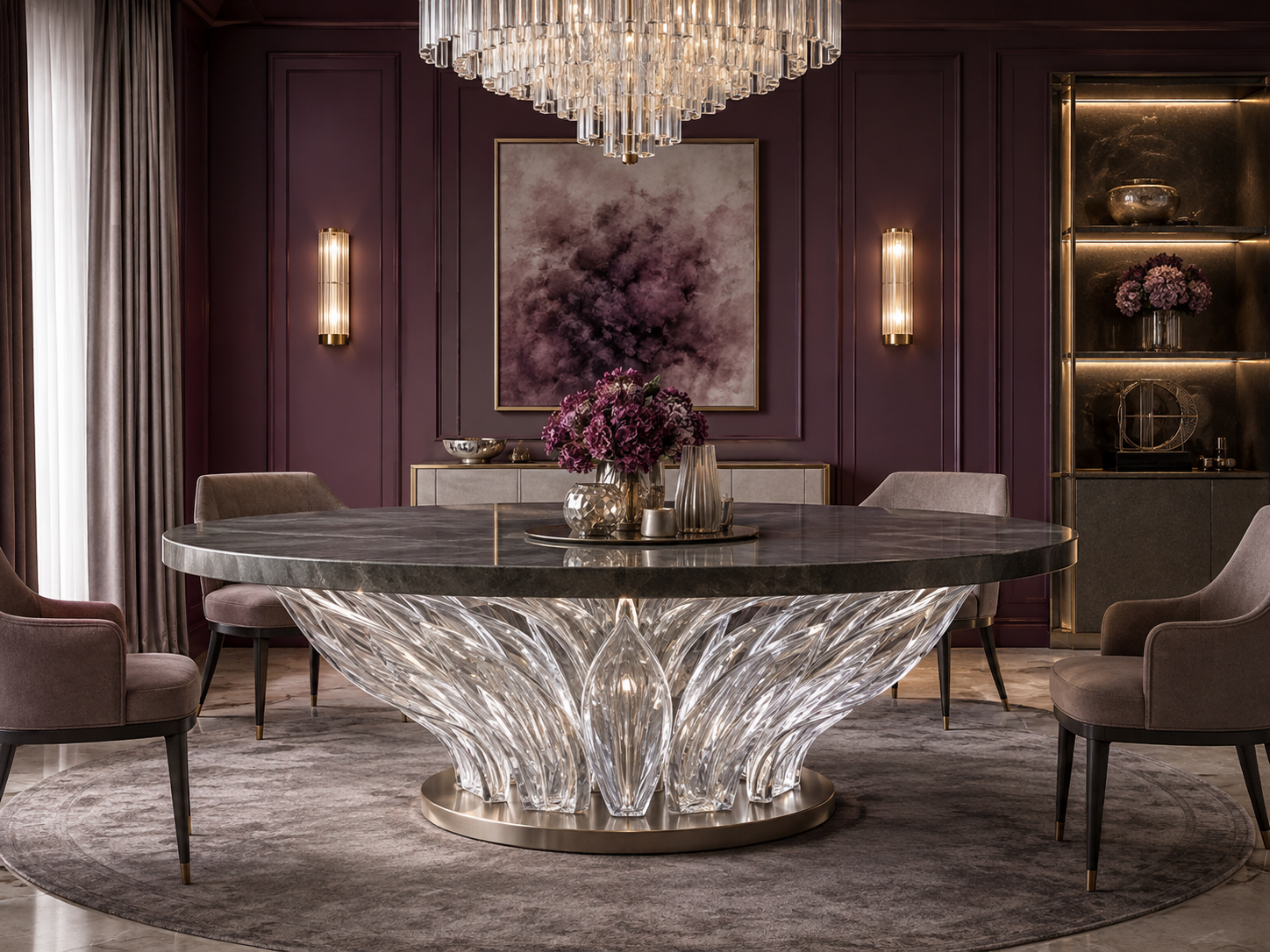
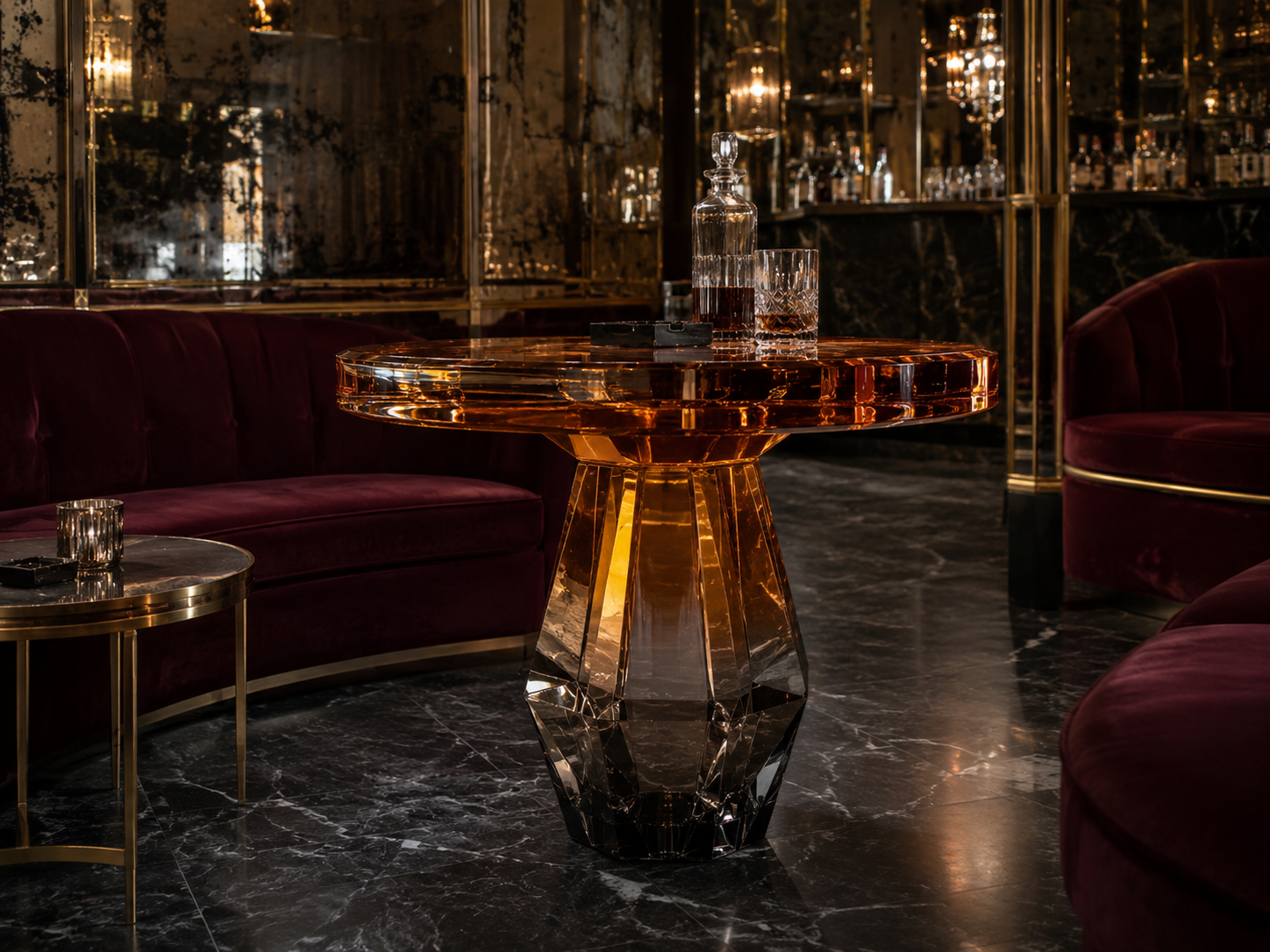
A space can look expensive on opening day and strangely ordinary two years later. The layout has not changed. The furniture may still be fashionable. Yet something feels different: transparent surfaces have become slightly cloudy, edges have lost their sharpness, colored pieces no longer interact with light in the same way, and small scratches have accumulated into a dull surface. What disappeared was not the design concept. It was the material quality that made the design convincing.
This is why the real measure of premium furniture is not how impressive it looks when it leaves the showroom. It is how well that impression survives sunlight, cleaning, touching, moving, temperature changes and daily use.
For hotels, luxury residences, flagship stores, clubs and high-end commercial interiors, furniture therefore has a “visual shelf life.” Materials such as synthetic crystal, premium casting resin and platinum-grade acrylic are increasingly relevant because they can create optical depth, sculptural form and visual lightness that conventional furniture materials cannot easily reproduce. But the difference between an object that continues to feel luxurious and one that ages prematurely lies in material formulation, processing, finishing and maintenance—not transparency alone.
1. Luxury Is Not a First Impression; It Is a Material Performance Over Time
Furniture is often selected through photographs, samples and showroom presentations. Under controlled lighting, almost any polished transparent surface can look impressive. The real test begins after installation.
Consider a transparent console in a luxury hotel lobby. Every day it may encounter sunlight from a curtain wall, fingerprints, housekeeping chemicals, luggage contact and changes in temperature. A resin dining table in a restaurant faces repeated wiping, spilled beverages and abrasion. A sculptural synthetic-crystal side table in a residence may experience fewer impacts, but its optical clarity must remain convincing for years because every imperfection becomes visible.
This is where the concept of “premium” changes. Premium is not simply a higher price, greater thickness or more dramatic design. It is the ability of a material to maintain its intended appearance and function through its expected service life.
The consequences of short-lived furniture are larger than a styling problem. According to the U.S. Environmental Protection Agency, approximately 12.1 million tons of furniture and furnishings entered the U.S. municipal solid-waste stream in 2018. About 80.1% of that material was landfilled. When furniture loses its aesthetic value before it loses its basic structural function, premature replacement becomes part of both the economic and environmental cost of an interior.
The U.S. Green Building Council makes a similar point in its guidance on durable purchasing: long-lasting products extend replacement cycles, reduce waste sent to landfills and incinerators, and can reduce costs.
For a designer or procurement team, the important question is therefore no longer, “Does this table look luxurious today?” It is, “What will this table look like after thousands of cleaning cycles, years of daylight exposure and continuous interaction with people?”
That question should be asked before the purchase order is signed.
2. With Transparent Furniture, Optical Quality Is the Luxury—and Any Aging Becomes Visible
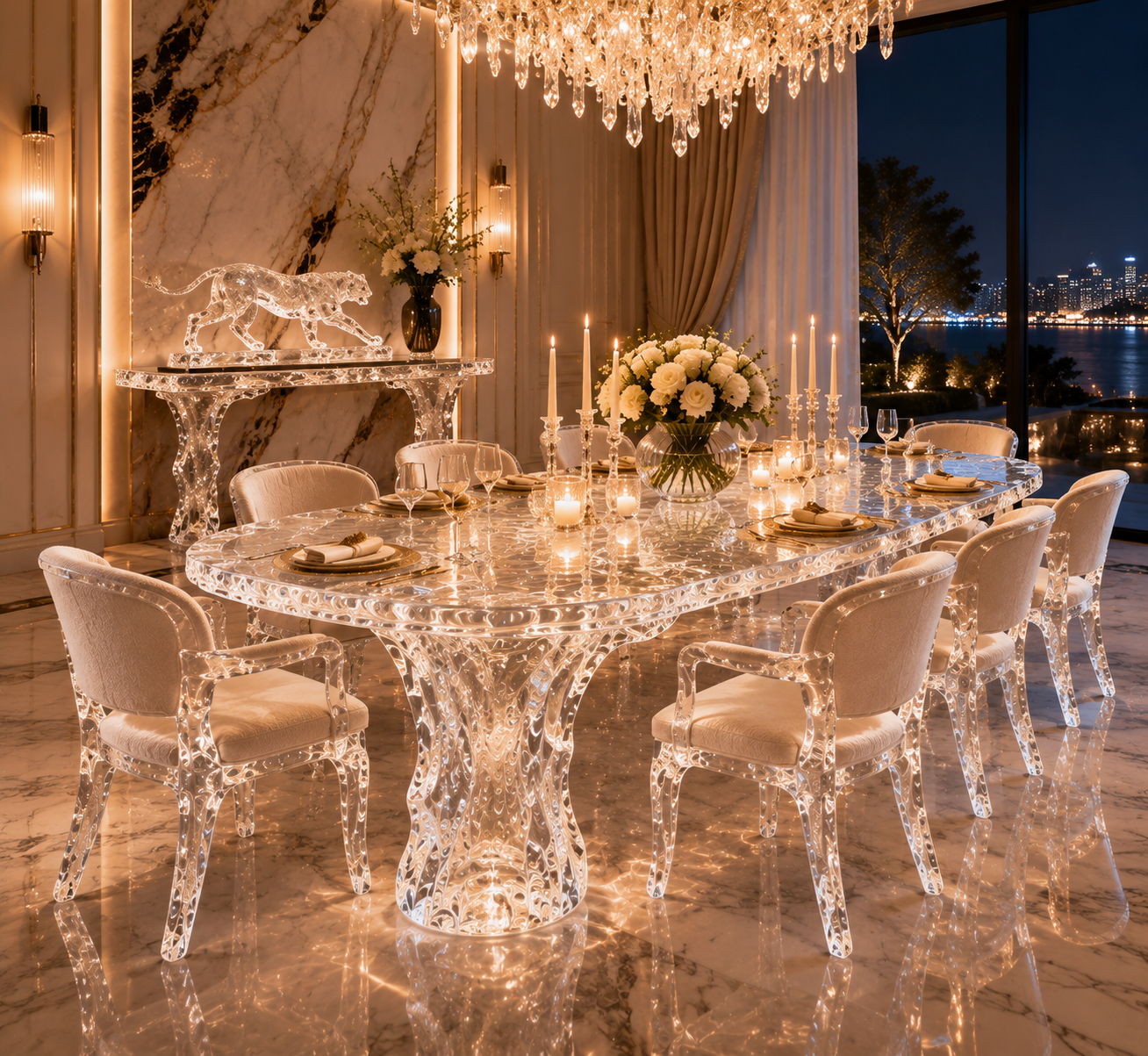
Transparent furniture has almost nowhere to hide imperfections. In wood, subtle scratches can blend into grain. In stone, natural variation can disguise small changes. In highly polished transparent materials, however, haze, micro-scratches, inclusions, edge distortion and yellowing directly affect the perception of quality.
This is why optical performance matters so much in premium acrylic, synthetic crystal and clear resin furniture.
ASTM International maintains ASTM D1003 specifically for measuring haze and luminous transmittance in transparent plastics. The standard explains that scattered light can create a hazy or smoky appearance and identifies haze and light-transmission measurements as valuable tools for quality control and material specification. In other words, “crystal clear” does not have to remain a subjective marketing phrase; important aspects of clarity can be measured.
The same principle applies to aging. ASTM G154 provides procedures for exposing materials to controlled ultraviolet light, moisture and heat to evaluate changes associated with weathering and end-use conditions. For high-end furniture manufacturers, UV testing, color-change evaluation and optical inspection are particularly relevant when producing clear, lightly tinted or jewel-toned pieces intended for interiors with substantial daylight.
Established PMMA technology illustrates what premium acrylic performance can look like when the formulation is engineered for optical stability. PLEXIGLAS, for example, reports visible-light transmission of up to 92% for certain clear products and, depending on product and market, guarantees high light transmission for decades. These figures apply specifically to that manufacturer’s tested products rather than to every acrylic sheet, but they demonstrate why acrylic grade and formulation matter.
The implication for platinum-grade acrylic furniture is important. A thick acrylic coffee table or console should not be judged only by its appearance in a new sample. The buyer should care about raw-material consistency, transparency through thick sections, color neutrality, internal stress, edge polishing, surface treatment and long-term UV performance.
When transparency is the design language, optical stability is not a technical detail. It is the product.
3. Synthetic Crystal and High-End Resin Can Age Beautifully—but “Resin” Is Not One Material
One of the most common mistakes in furniture sourcing is treating “resin” as if it described a single level of quality. It does not.
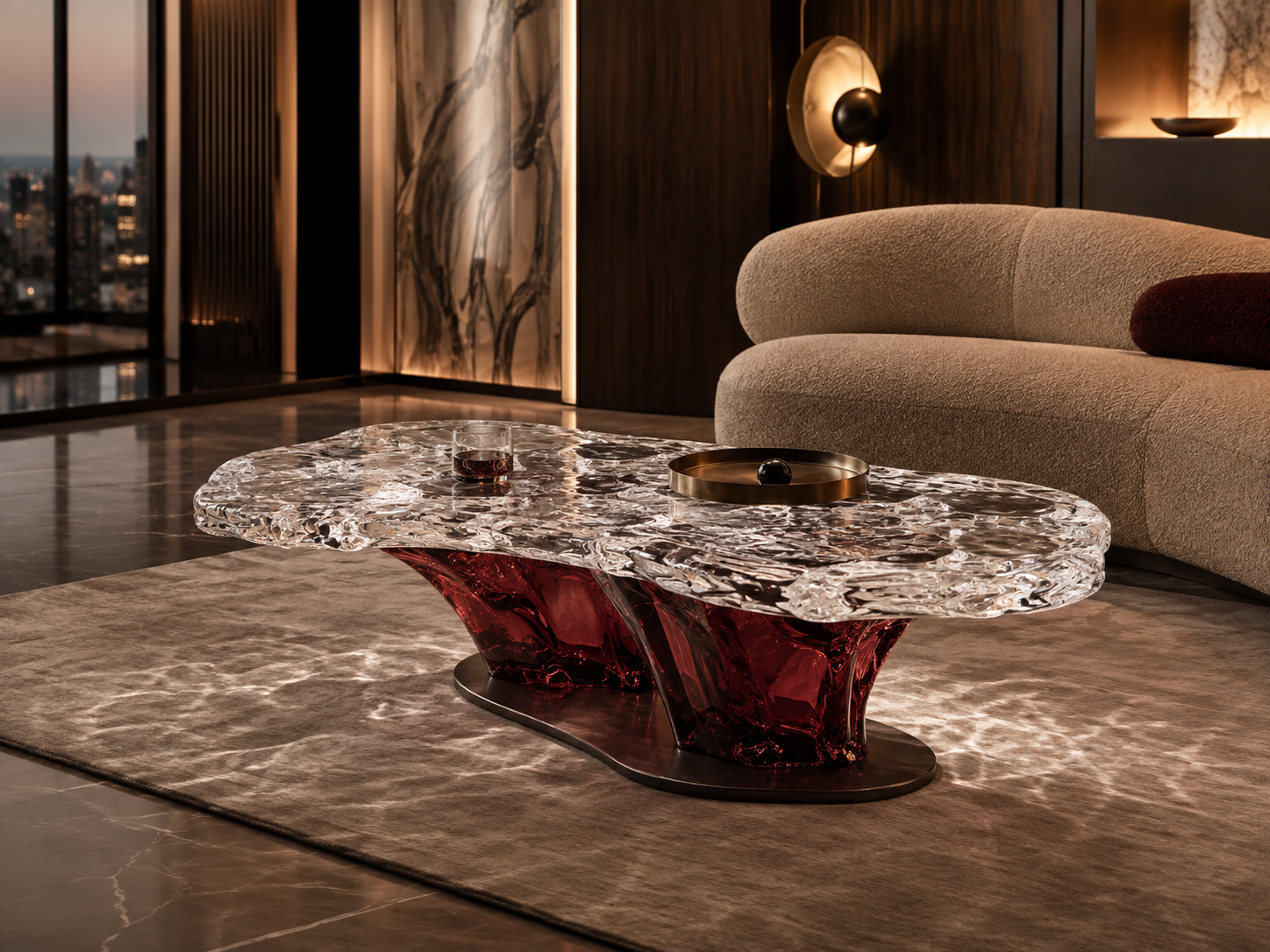
Different resin systems, pigments, fillers, additives, curing methods and finishing processes can produce dramatically different results. Two visually similar tables may behave very differently after several years of exposure to daylight and use. One may maintain depth, gloss and color; another may gradually become warmer, hazier or more visibly scratched.
Museum conservation research illustrates why formulation matters. The Canadian Conservation Institute notes that light and ultraviolet radiation can damage polymers and their colorants, coatings and stabilizers, with possible effects including discoloration, yellowing, reduced strength, embrittlement and cracking. This does not mean polymer furniture is inherently short-lived. It means that material selection, UV stabilization, pigments and intended exposure conditions have to be engineered rather than assumed.
High-end resin furniture should therefore be understood as a controlled material system. Casting quality determines whether bubbles and inclusions look intentional or defective. Correct curing influences dimensional and surface stability. Pigment quality affects how color develops under light. Polishing determines whether thick sections produce genuine optical depth rather than simply a glossy outer skin.
Synthetic crystal—especially engineered crystal-like casting materials used for furniture legs, pedestals, sculptural bases and decorative components—works on the same principle. Its luxury comes from the interaction between depth, refraction, color and precision. A poorly finished edge can immediately make an expensive object appear mass-market; a cleanly cast and expertly polished volume can make light itself part of the furniture.
There is also significant design history behind this approach. The Museum of Modern Art holds Shiro Kuramata’s celebrated 1988 Miss Blanche Chair, made with artificial flowers embedded in acrylic resin. MoMA describes the flowers as appearing to float within the transparent body of the chair. Decades earlier, designers were already experimenting with Plexiglas: MoMA’s collection includes Gilbert Rohde’s circa-1938 stainless-steel and Plexiglas chair.
Transparent polymers, in other words, are not merely a temporary furniture trend. At their best, they have been part of serious design experimentation for generations.
4. The “Shelf Life” of a Luxury Surface Is Decided by Details People Notice Without Realizing It
Customers rarely describe premium furniture in technical language. They do not normally walk into a room and say, “The haze value of this table appears too high.” They simply feel that one piece looks sophisticated and another looks cheaper.
That judgment often comes from details measured in millimeters.
The polish on an acrylic edge changes how light travels through a table. A poorly resolved joint interrupts the illusion of a monolithic transparent structure. Uneven resin coloration becomes more obvious in daylight. Small bubbles may be desirable when deliberately incorporated into an artistic casting, but random defects in a supposedly crystal-clear surface immediately communicate inconsistent manufacturing.
Surface care also determines how long those details survive. Architectural Digest’s guidance on acrylic furniture emphasizes microfiber cleaning, products formulated for plastics and appropriate polishing methods for minor scratches, while warning against unsuitable cleaners that can damage clarity. This is a practical reminder that premium furniture must be designed not only for ownership, but for maintenance.
That distinction is especially important in hospitality and retail environments. A hotel may have multiple housekeeping teams. A flagship store may clean display furniture several times per day. If the material requires unrealistic care, its showroom appearance may be impossible to preserve operationally.
Good manufacturers therefore think beyond the sale. A platinum acrylic console, premium resin dining table or synthetic-crystal pedestal should have an appropriate care protocol from the beginning. The manufacturer should understand which cleaning agents are compatible, whether superficial marks can be professionally polished, how edges respond to repeated contact and what type of maintenance restores rather than damages the finish.
Luxury that cannot survive ordinary maintenance is fragile luxury. For serious projects, serviceability is part of material quality.
5. Material Quality Must Match the Real Environment, Not the Rendering
A material can be excellent and still be wrong for a particular application.
The polished clear pedestal that performs beautifully in a private dressing room may not be the best specification for a high-traffic restaurant entrance. A deeply colored resin piece beside a large south-facing window has different requirements from the same material in an interior corridor. A sculptural acrylic dining base must be evaluated differently from a decorative object that is rarely touched.
This is why successful premium furniture projects begin with use conditions rather than aesthetics alone.
Designers should consider where daylight enters, how frequently the furniture will be touched, whether children or luggage will contact it, what cleaning procedures the facility uses, and whether surfaces are expected to remain pristine or develop a controlled patina. Material thickness, structural engineering, joining methods and finishes then follow the actual environment.
Indoor environmental quality is another part of the equation, especially for resin-based and composite furniture. UL notes that people in industrialized societies spend approximately 90% of their time indoors and explains why furniture and building-material emissions have become an important indoor-air-quality consideration. Its GREENGUARD programs evaluate product emissions, including VOCs. ANSI/BIFMA’s furniture sustainability framework likewise includes testing requirements for low-emitting furniture.
For premium resin and synthetic-material furniture, this means specifications should eventually go beyond visual claims. Serious international buyers increasingly expect technical documentation appropriate to the intended market and project: material identification, relevant test reports, emissions information when applicable, manufacturing consistency and clear maintenance guidance.
That documentation may never appear in the finished room. But it is part of what allows the room to continue looking as sophisticated as the original rendering promised.
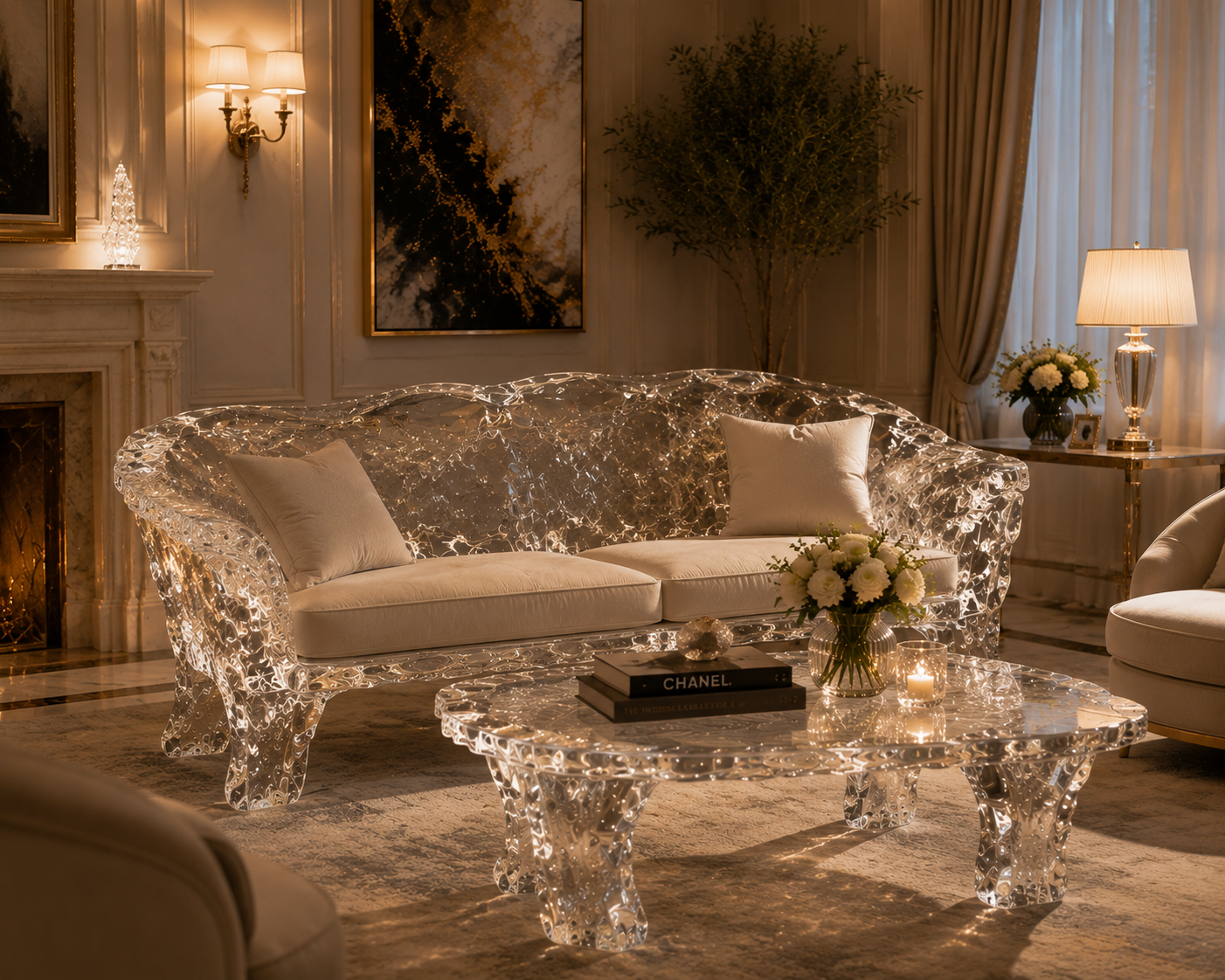
6. The Most Sustainable Luxury Furniture May Be the Furniture You Do Not Need to Replace
There is a commercial reason to think about material longevity before discussing sustainability: replacement is expensive.
Replacing a statement table in a private home is inconvenient. Replacing furniture across 150 hotel rooms, an international retail network or a multi-floor corporate project involves procurement, shipping, installation, downtime and disposal. The purchase price of the replacement item is only part of the actual cost.
Material longevity therefore becomes a form of risk management.
USGBC research on embodied carbon notes that interior elements may have typical service lives of roughly 12 to 15 years and that, over the life of a building, repeated replacement of interior elements can create significant cumulative impacts. The organization specifically identifies furniture among the products where reuse and longer service should receive greater attention.
This changes how high-end furniture should be evaluated. The “better value” piece is not automatically the cheaper one, and the “more sustainable” piece is not automatically the one with the most fashionable environmental label. A piece that maintains its appearance, can be properly maintained, works across changing interior schemes and remains desirable for longer may avoid multiple replacement cycles.
Transparent materials can perform particularly well in this role when they are designed and manufactured correctly. Architectural Digest has highlighted how clear acrylic and related transparent furniture visually recede within a room and can work across different decorative styles. That visual neutrality can extend design relevance: a well-proportioned clear console or sculptural acrylic table can remain useful even when surrounding colors, textiles and artwork change.
This is where premium synthetic crystal, high-end resin and platinum-grade acrylic furniture can move beyond novelty. Synthetic crystal can bring jewel-like depth to bases and architectural furniture without relying on ornament. Resin can create controlled translucency, embedded effects and sculptural volumes that would be difficult to achieve with conventional materials. Premium acrylic can deliver transparency and visual lightness while allowing substantial, highly precise forms.
But the lasting value of all three materials depends on the same discipline: specify the right formulation, control the casting and fabrication process, test what matters, perfect the finish, design for the real environment and provide realistic maintenance instructions.
A luxurious interior does not truly prove itself when the project photographer arrives. It proves itself years later, when guests still notice the clarity of a table, when light still travels cleanly through a polished edge, when color still feels intentional, and when the furniture still belongs in the space rather than looking like something waiting to be replaced.
The real question is therefore not, “How luxurious does this furniture look?”
It is, “How long can the material keep that luxury alive?”
For high-end spaces, that may be one of the most important material decisions a designer, buyer or owner makes.
READ MORE:
- Beyond Decoration: How Statement Furniture Pieces Shape Brand Identity for Hotels, Retail Spaces, and Luxury Homes
- Why Some Transparent Furniture Looks Expensive While Others Feel Ordinary: A Buyer's Guide to Quality Differences
- How Luxury Interior Designers Use Transparent Materials to Create More Sophisticated Spaces
- What Makes Synthetic Crystal Furniture Valuable? Understanding the Details Behind Premium Transparent Designs
- Why High-End Buyers Are Rethinking Acrylic Furniture: From "Plastic Alternative" to Modern Luxury Material
- How Can One Piece of Furniture Change the Feel of an Entire Space? Understanding the Details of Luxury Through Synthetic Crystal
- If You Want a Commercial Space to Look Premium for Years, Furniture Materials Matter More Than Fashionable Styles
- Reducing Visual Aging: How Synthetic Crystal Furniture Keeps Spaces Light, Transparent, and Modern
- Why Are More High-End Spaces Turning to Synthetic Crystal Furniture? It Is About Much More Than Transparency


