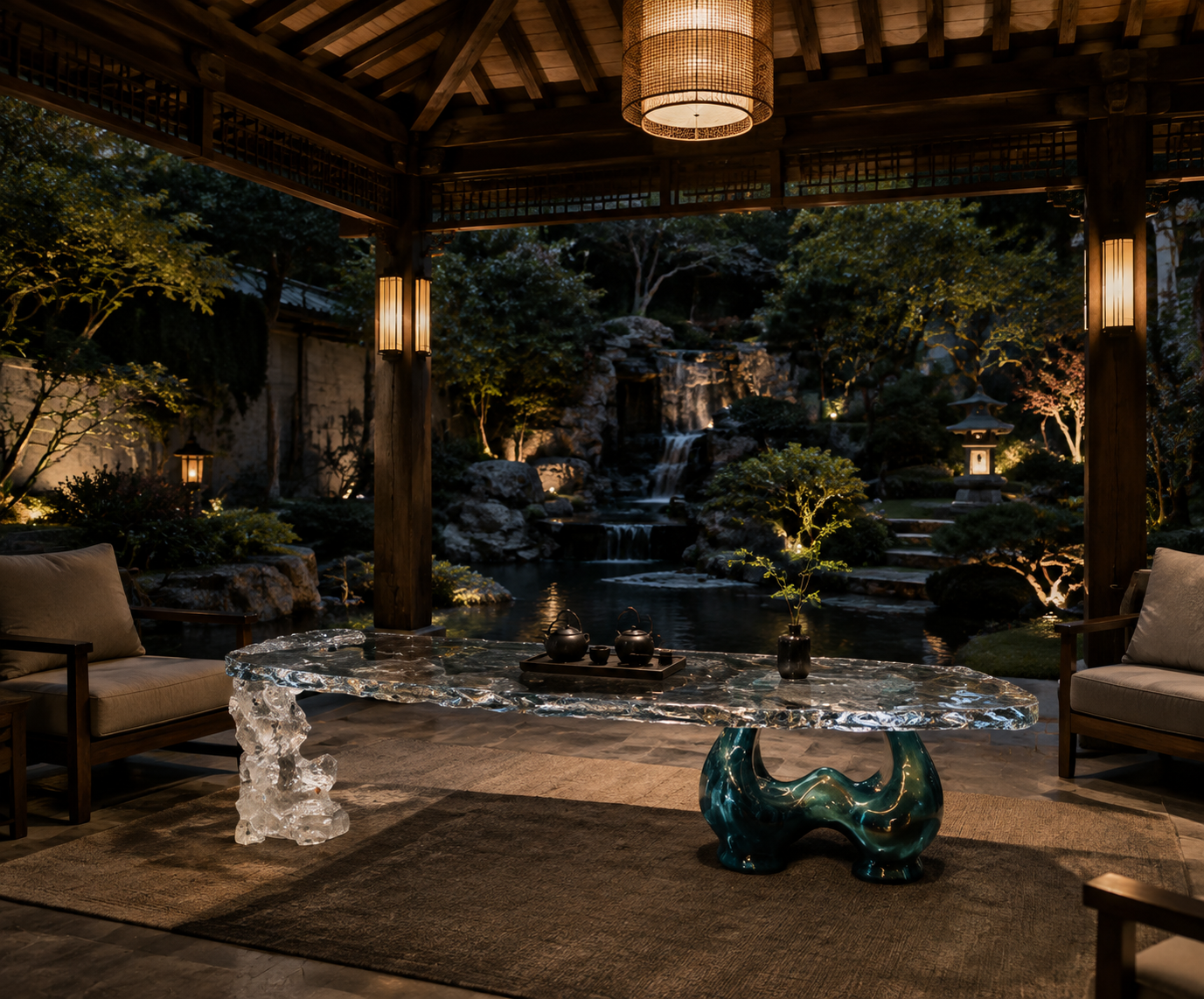
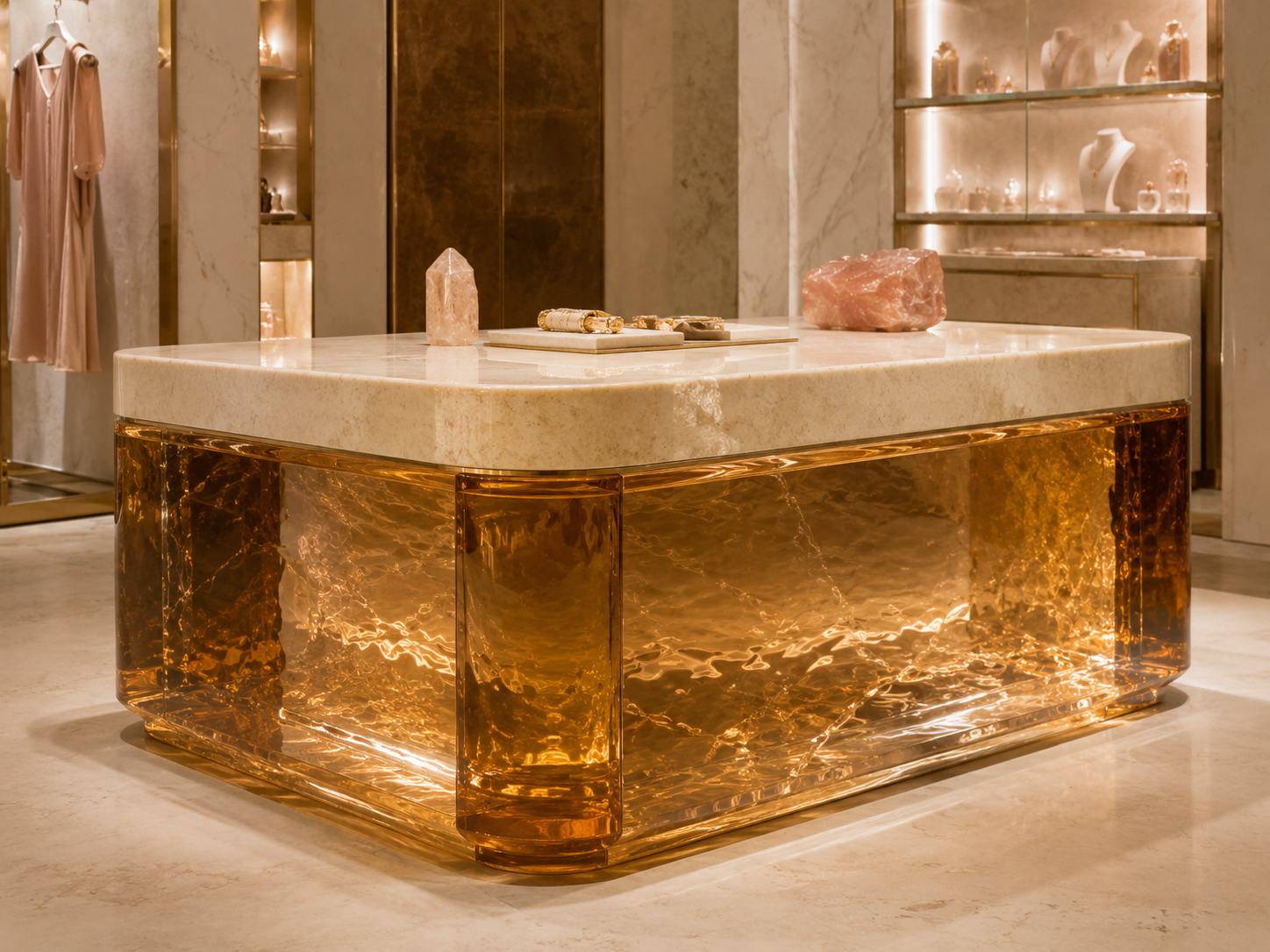
A luxury interior is rarely defined by the number of expensive objects inside it. In many of the most successful hotel lobbies, flagship stores, private residences, clubs, and showrooms, the opposite is true: relatively few pieces of furniture carry a disproportionate amount of visual responsibility.
A single coffee table can make the surrounding sofa look more refined. A sculptural console can make an ordinary circulation area feel architectural. A transparent dining-table base can completely change the perceived weight of a stone tabletop. In luxury retail, one carefully designed pedestal can influence how valuable the product displayed on it appears.
This is why furniture material deserves much more attention than it often receives.
Synthetic crystal, high-end casting resin, and premium or platinum-grade acrylic are especially interesting because their effect is not limited to color or shape. Transparency, optical depth, edge quality, internal reflections, surface polish, thickness, and the way light travels through the material all contribute to how the entire surrounding space is perceived.
In other words, the difference between furniture that merely looks expensive and furniture that makes a space feel expensive is often hidden in details.
1. A Premium Piece of Furniture Changes the Visual Weight of Everything Around It
One of the first things people perceive when entering an interior is not the price of the furniture, but its visual weight.
A dark timber table, a marble pedestal, and a transparent synthetic crystal table of identical dimensions can occupy exactly the same physical volume while creating completely different impressions. The opaque pieces stop the eye. The transparent piece allows flooring, walls, rugs, lighting, and other furniture to remain visible through or around it.
That difference can influence the entire composition.
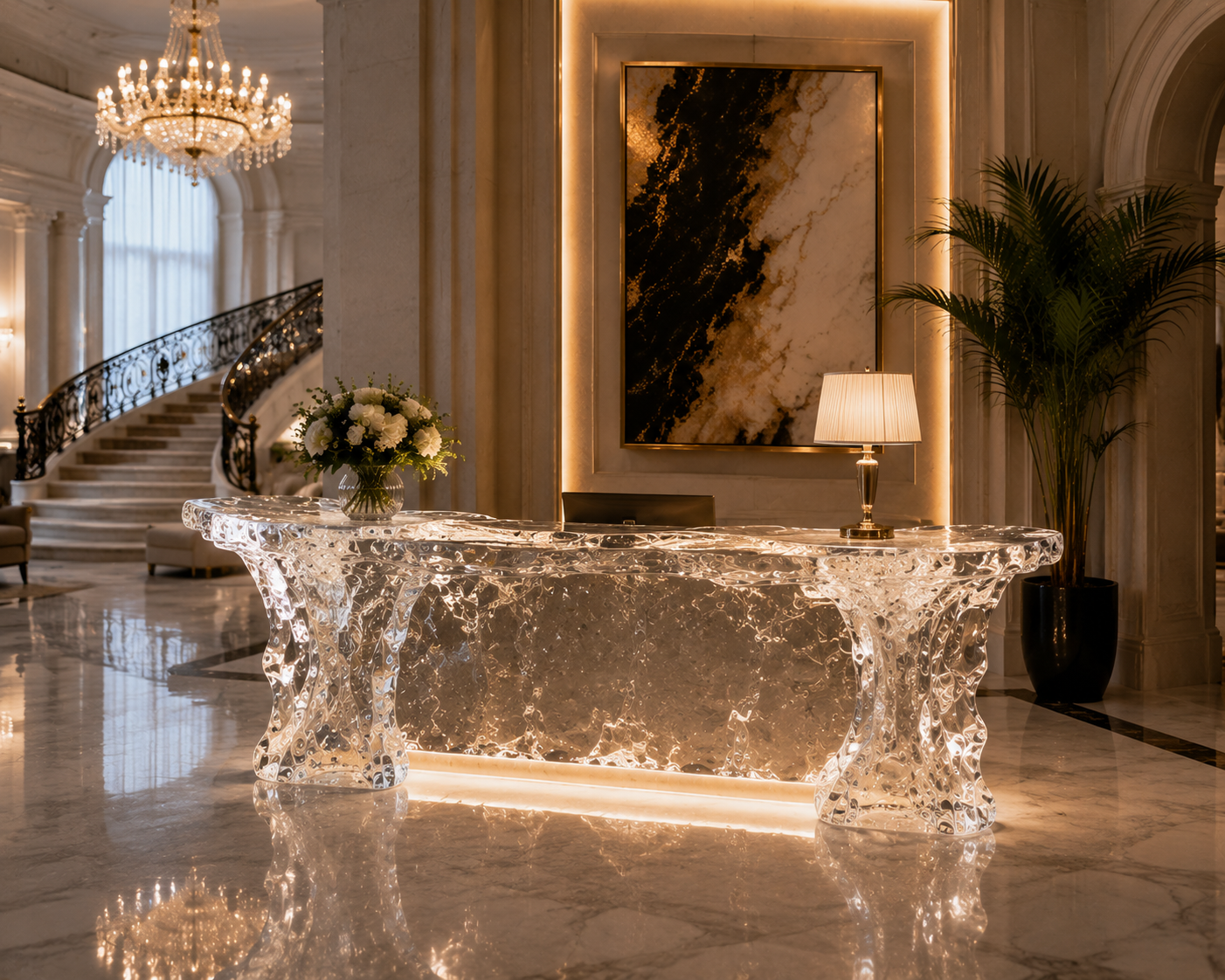
Imagine a luxury hotel lobby with book-matched stone flooring. If a large opaque coffee table is positioned in the center, part of that expensive floor visually disappears. Replace the same table with a substantial synthetic crystal or platinum acrylic design, and the furniture remains physically present while allowing the architecture to continue visually through it.
This does not mean transparent furniture should disappear completely. In high-end furniture, one of the most interesting effects is the balance between physical mass and visual lightness.
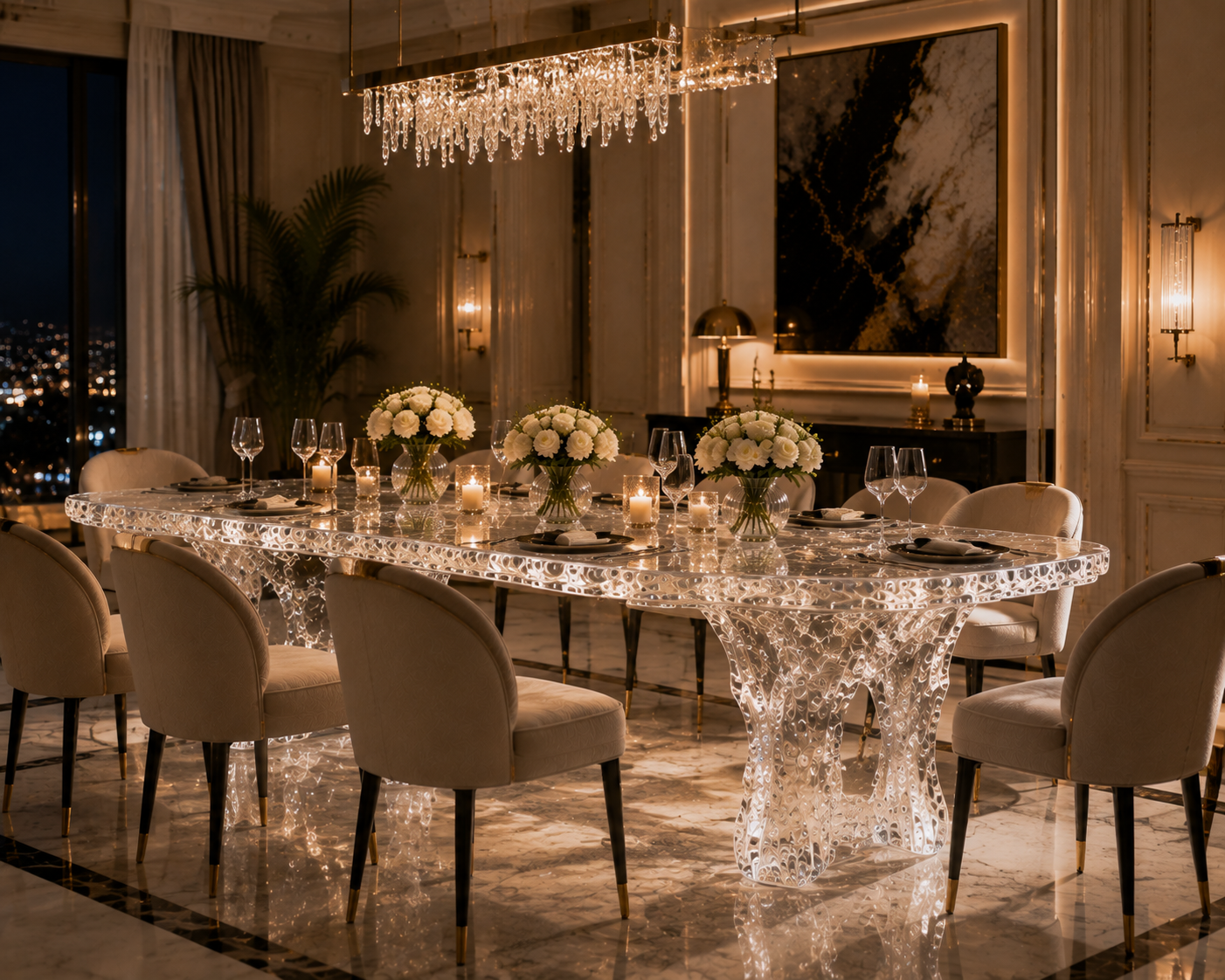
A thick synthetic crystal pedestal can weigh significantly and feel solid when touched, yet appear much lighter than a stone block of the same dimensions. A large high-end resin coffee table can function almost like sculpture without making the seating area feel crowded. A transparent acrylic dining base can visually support a heavy marble top while making the top appear to float.
This relationship between mass and transparency is one reason a single piece can affect the perceived sophistication of an entire room.
It also explains why transparent materials have an established place in serious design history rather than simply being a recent social-media trend. The Museum of Modern Art's collection includes Shiro Kuramata's 1988 Miss Blanche Chair, made from acrylic resin, aluminum, and synthetic roses. MoMA describes the artificial roses as appearing to float inside the transparent acrylic body and notes the painstaking process required to position them while the resin hardened.
The importance of this example is not simply historical. It demonstrates how transparency can turn the volume inside a piece of furniture into part of the design.
For contemporary synthetic crystal furniture, that same principle allows designers to create objects that are visually substantial without making the room feel heavy.
2. In Transparent Furniture, “Luxury” Is Often an Optical Detail
When people compare two transparent tables, they may struggle to explain why one looks significantly more expensive.
The difference is often optical.
Transparency is not binary. A material is not simply clear or unclear. Haze, light transmission, thickness, internal inclusions, surface finish, polishing quality, color neutrality, and edge treatment all affect how the finished furniture appears.
ASTM International's D1003 standard exists specifically to measure haze and luminous transmittance in transparent plastics. ASTM explains that scattered light can produce a hazy or smoky appearance and states that haze and light-transmittance data are particularly useful for quality control and material specification.
That technical measurement translates directly into perceived quality.
For example, a thin transparent sample may look perfectly acceptable in a showroom. Once the same material is used to cast or fabricate a thick table leg, pedestal, or sculptural block, even slight haze or coloration may become much more obvious.
This is why high-end synthetic crystal and premium resin furniture must be evaluated in finished dimensions rather than through small material chips alone.
The behavior of engineered PMMA provides a useful reference point. PLEXIGLAS reports visible-light transmission of up to 92% for certain clear products. Its technical information also explains that thickness makes optical performance increasingly important, using thick aquarium panels as an example of applications where high transmission helps avoid unwanted color cast or opacity. These specifications relate to PLEXIGLAS products specifically and should not be treated as performance claims for all acrylic furniture, but they demonstrate why raw-material quality matters.
The same logic applies to what is sometimes marketed as platinum acrylic. “Platinum acrylic” is not, by itself, a universal international material standard. A professional buyer should look behind the name and ask about the actual PMMA grade, optical data, fabrication process, thickness, polishing standard, and long-term performance.
In true luxury furniture, the material should become more impressive the closer the client looks.
That is what allows one transparent table to elevate an entire interior while another simply looks like a piece of clear plastic.
3. Edges, Joints, and Polishing Often Reveal Quality Before the Furniture Design Does
Luxury is frequently communicated through details people notice without consciously identifying them.
A customer may never say, “The edge polishing on this console is excellent.” They simply feel that the object is more refined.
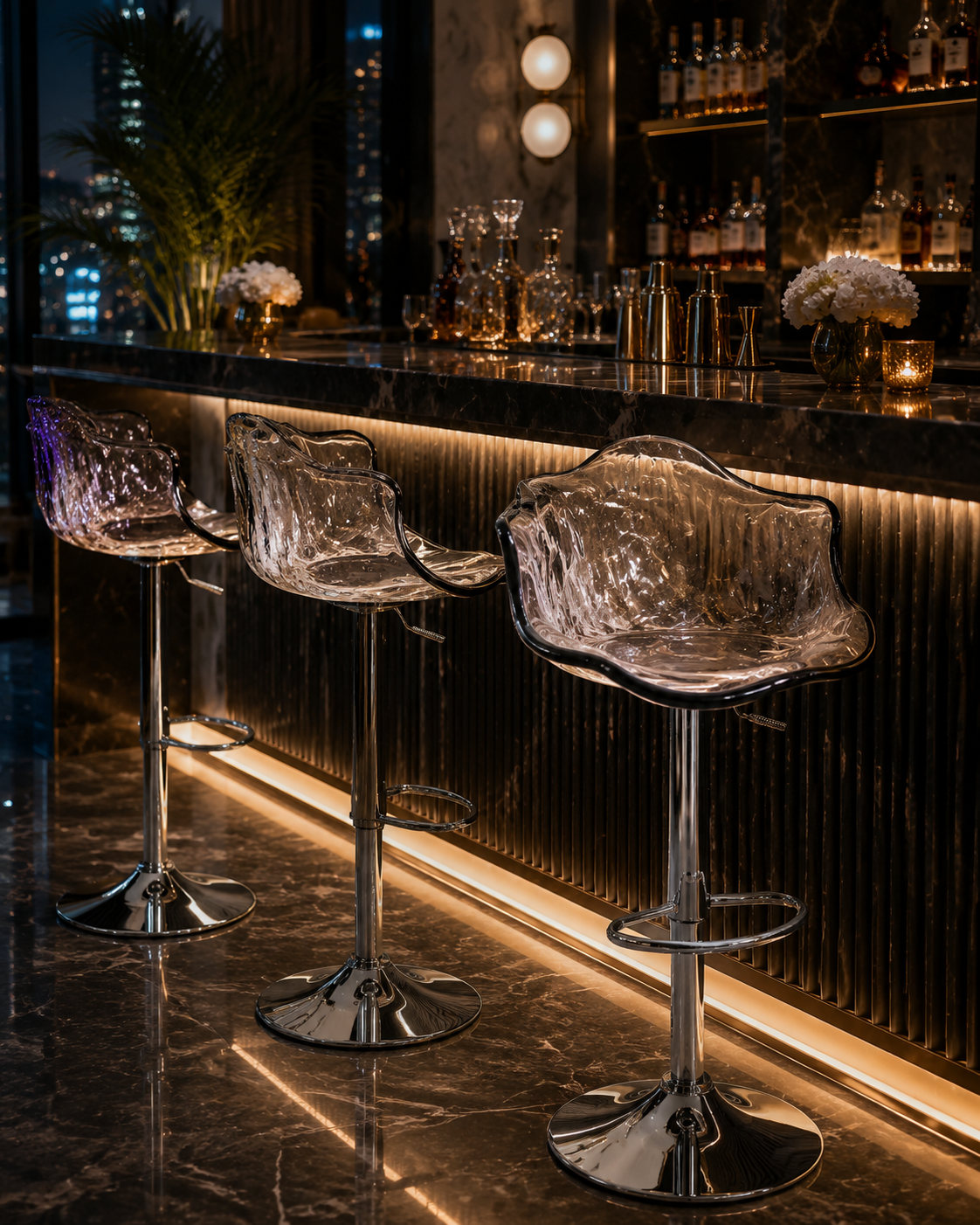
Transparent furniture amplifies this effect because edges and joints interact strongly with light. A beautifully polished acrylic edge can appear brighter than the flat surface because light is captured and reflected along its perimeter. A precisely finished synthetic crystal corner can behave almost like the facet of a gemstone. By contrast, uneven sanding marks, cloudy edges, visible adhesive lines, poorly aligned joints, or uncontrolled bubbles can immediately reduce the perceived quality of the entire piece.
This becomes especially important with thick furniture.
Consider a clear platinum acrylic console. From a distance, its form may appear extremely simple: perhaps two vertical legs and one horizontal surface. There is nowhere for manufacturing imperfections to hide. The apparent simplicity actually increases the precision required.
High-end resin furniture presents a different challenge. Casting can create forms that would be difficult to achieve through sheet fabrication, but the quality of the mold, curing process, pigment distribution, bubble control, sanding, and multi-stage polishing all become visible in the finished surface.
A deliberate bubble effect can be beautiful. Random bubbles in a supposedly crystal-clear table may look like manufacturing defects. A controlled color gradient can feel artistic. Uneven pigmentation caused by poor process control can make the same object look inexpensive.
This is why the value of synthetic crystal furniture cannot be judged only by the raw material.
Manufacturing transforms the material into luxury.
The same material system can produce a basic decorative object or a gallery-level furniture piece depending on the control of casting, machining, joining, and finishing.
For architects and interior designers, this has an important practical implication: when selecting custom transparent furniture, reviewing full-size production samples, edge details, joints, color references, and polished finishes can be more informative than reviewing rendered images alone.
Renderings communicate shape.
Craftsmanship determines whether the finished room still communicates the same level of quality.
4. High-End Resin and Synthetic Crystal Allow Color to Exist Inside the Material, Not Simply on Its Surface
Color is another reason one piece of furniture can transform an entire room.
Conventional furniture usually receives color on the surface. Timber is stained. Metal is powder-coated or plated. Walls are painted. Upholstery receives its appearance from fabric.
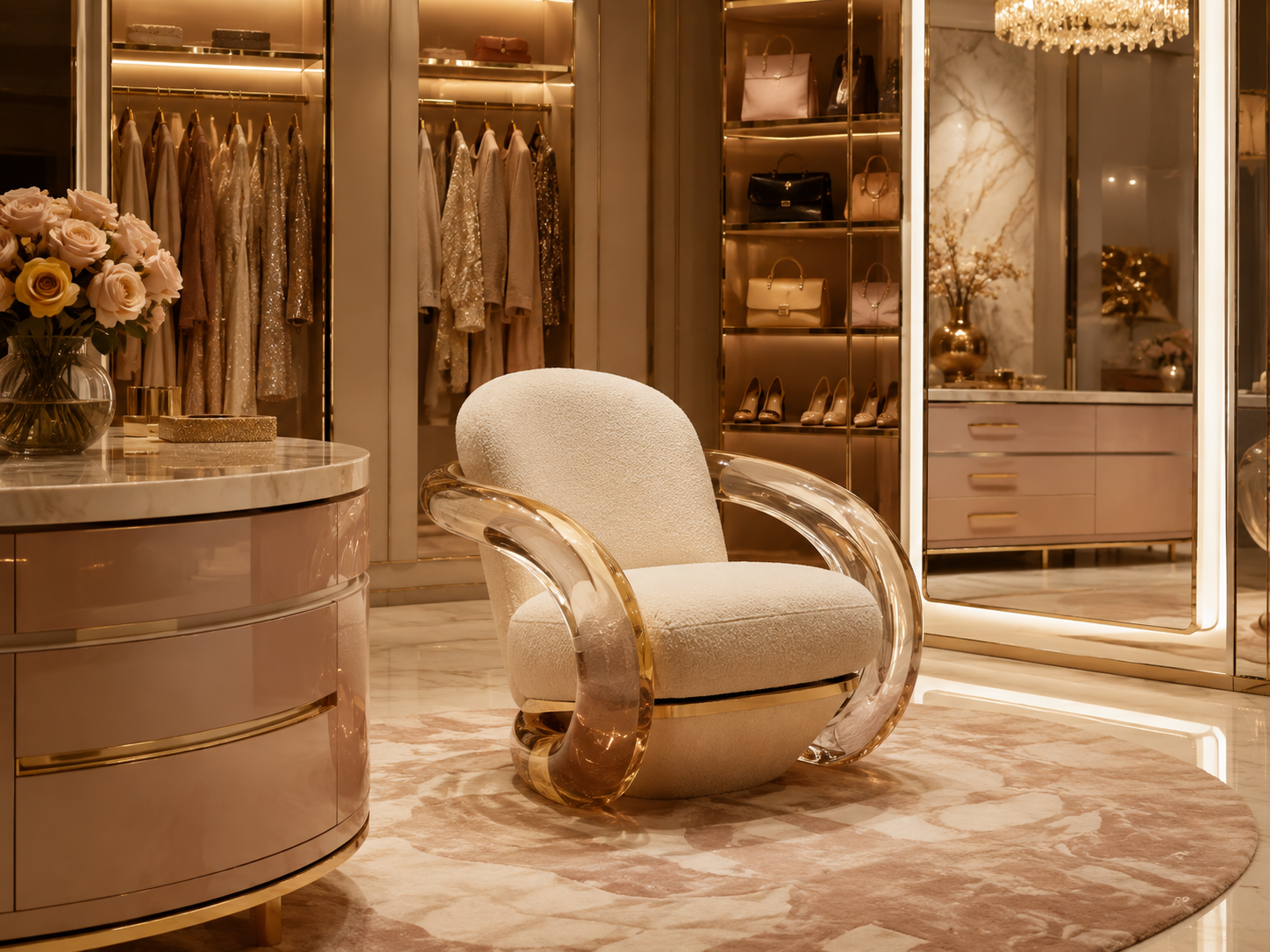
High-end casting resin and synthetic crystal can behave differently because color can exist throughout the volume of the object.
This opens a much broader design vocabulary.
A resin console can move gradually from transparent to amber. A synthetic crystal side table can contain a smoke tone that becomes darker as material thickness increases. Champagne, cognac, emerald, sapphire, rose, gray, or custom brand colors can interact with daylight and architectural lighting in ways that opaque coatings cannot reproduce.
The effect changes depending on viewing angle.
This means a piece of furniture is no longer simply “blue” or “amber.” It may look almost clear from one direction, saturated from another, and luminous when backlit.
The internal volume can also contain decorative elements, textures, controlled bubbles, metallic details, layered color, or other intentionally embedded effects. Kuramata's Miss Blanche Chair remains an important design-history example precisely because the flowers were suspended inside the acrylic resin rather than applied to its exterior.
For contemporary hospitality and luxury retail projects, this ability can become a branding tool.
Imagine a jewelry boutique using pale champagne synthetic crystal display pedestals that subtly echo the brand's packaging. A hotel might commission translucent amber resin side tables that become warmer beneath evening lighting. A premium beauty brand could use lightly tinted platinum acrylic consoles that visually connect product displays without adding heavy blocks of color.
One carefully chosen piece can therefore influence the perceived color temperature of an entire zone.
However, long-term color stability also matters.
The Canadian Conservation Institute notes that light and ultraviolet radiation can affect polymers, colorants, coatings, and stabilizing additives. Possible visible effects include discoloration and yellowing, while different polymers show significantly different sensitivities. Its conservation guidance places PMMA among materials with relatively low sensitivity to sunlight and UV compared with many other plastics.
For high-end resin and synthetic crystal furniture, this reinforces an important point: beautiful color is only genuinely premium when its formulation is appropriate for the intended environment.
Material chemistry is part of the design.
5. The Quality of Furniture Is Also Determined by How It Looks After Years of Touching and Cleaning
A spectacular table on installation day is not necessarily a successful luxury product.
Commercial furniture has to survive people.
In hotels, restaurants, boutiques, clubs, galleries, and corporate reception areas, furniture may be touched and cleaned multiple times every day. Bags are placed on surfaces. Displays are moved. Housekeeping staff use cleaning products. Fine scratches accumulate. Edges receive repeated contact.
All of this affects the perception of the surrounding space.
In February 2026, BIFMA published its updated G8.1-2026 Furniture Surfaces guideline. The organization explains that the guideline is intended to help manufacturers, specifiers, and end users evaluate how furniture surfaces perform when exposed to commonly used cleaning, sanitizing, and disinfecting products, and its scope now explicitly includes commercial environments in addition to healthcare settings.
That is highly relevant to transparent furniture.
Clear surfaces can reveal fine abrasion and chemical damage much more easily than heavily patterned or textured materials. This means maintenance cannot be treated as an afterthought.
If a synthetic crystal coffee table is going into a five-star hotel lobby, the manufacturer and buyer should understand how it should be cleaned. If a platinum acrylic display table will be wiped dozens of times per day, cleaning-agent compatibility matters. If a high-end resin console eventually develops superficial marks, the possibility of professional sanding or repolishing may significantly extend its aesthetic life.
UV performance deserves similar attention.
PLEXIGLAS, for example, publishes a 30-year guarantee for specified clear products against visible yellowing and for retention of high transparency. Its detailed guarantee states that new clear material can provide light transmission of up to 92%, depending on product and design, with a defined limited reduction after 30 years. Again, these are manufacturer-specific figures rather than universal acrylic performance claims, but they illustrate the difference between a generic material description and documented performance.
For high-end furniture, this distinction is essential.
Premium should describe how a material performs over time, not merely how impressive it looks in a product photograph.
6. The Best Statement Furniture Elevates a Space Without Forcing the Entire Space to Follow It
A truly valuable piece of furniture should be memorable without making the rest of the interior difficult to change.
This is where synthetic crystal, high-end resin, and platinum acrylic furniture can have a strategic advantage.
A strongly trend-driven sofa or patterned cabinet may dictate the colors, forms, and decorative language around it. If the space is renovated, that furniture can quickly become incompatible.
Transparent or carefully tinted furniture is often more adaptable.
A clear synthetic crystal console can work beside beige limestone, dark marble, colored glass, timber paneling, or metallic finishes. A platinum acrylic dining base can remain in place even if the chairs, rug, lighting, and tabletop are changed. A restrained smoke or champagne resin table can interact with several generations of color palettes rather than one specific decorative scheme.
That adaptability matters economically because furniture replacement has a real material cost.
The U.S. Environmental Protection Agency reports that approximately 12.1 million tons of furniture and furnishings entered the U.S. municipal solid-waste stream in 2018, representing 4.1% of total municipal solid waste. EPA estimates that 80.1% of furniture and furnishing waste in that category was landfilled.
The U.S. Green Building Council also points to the cumulative effects of replacing interior elements. One report notes that with typical interior service cycles estimated at roughly 12 to 15 years, cumulative embodied carbon associated with repeated interior replacement over a building's life could equal or exceed the initial carbon footprint of its structure and enclosure. The report specifically identifies furniture as an area where reuse and reduced replacement deserve attention.
For luxury projects, therefore, timelessness has practical value.
A well-designed synthetic crystal table should not be selected simply because transparent furniture is fashionable. It should be selected because the material complements architecture instead of hiding it, because its optical quality rewards close inspection, because its fabrication demonstrates precision, because its color responds intelligently to light, and because it has the potential to remain useful even when the room around it evolves.
That is how one piece of furniture can influence the feeling of an entire space.
It does not need to shout.
Sometimes a perfectly polished edge, a block of transparent material catching afternoon light, or a heavy stone tabletop that appears almost weightless above a platinum acrylic base is enough to make people perceive the whole room differently.
In genuinely high-end interiors, luxury is rarely created by adding more.
It is created when every visible detail gives the impression that nothing was chosen casually.
And with synthetic crystal furniture, many of those most important details are found not only on the surface, but inside the material itself.
READ MORE:
- Beyond Decoration: How Statement Furniture Pieces Shape Brand Identity for Hotels, Retail Spaces, and Luxury Homes
- Why Some Transparent Furniture Looks Expensive While Others Feel Ordinary: A Buyer's Guide to Quality Differences
- How Luxury Interior Designers Use Transparent Materials to Create More Sophisticated Spaces
- What Makes Synthetic Crystal Furniture Valuable? Understanding the Details Behind Premium Transparent Designs
- Why High-End Buyers Are Rethinking Acrylic Furniture: From "Plastic Alternative" to Modern Luxury Material
- If You Want a Commercial Space to Look Premium for Years, Furniture Materials Matter More Than Fashionable Styles
- Reducing Visual Aging: How Synthetic Crystal Furniture Keeps Spaces Light, Transparent, and Modern
- Why Are More High-End Spaces Turning to Synthetic Crystal Furniture? It Is About Much More Than Transparency
- How Long Does Luxury Last? Why Furniture Materials Determine a Space's "Visual Shelf Life"


