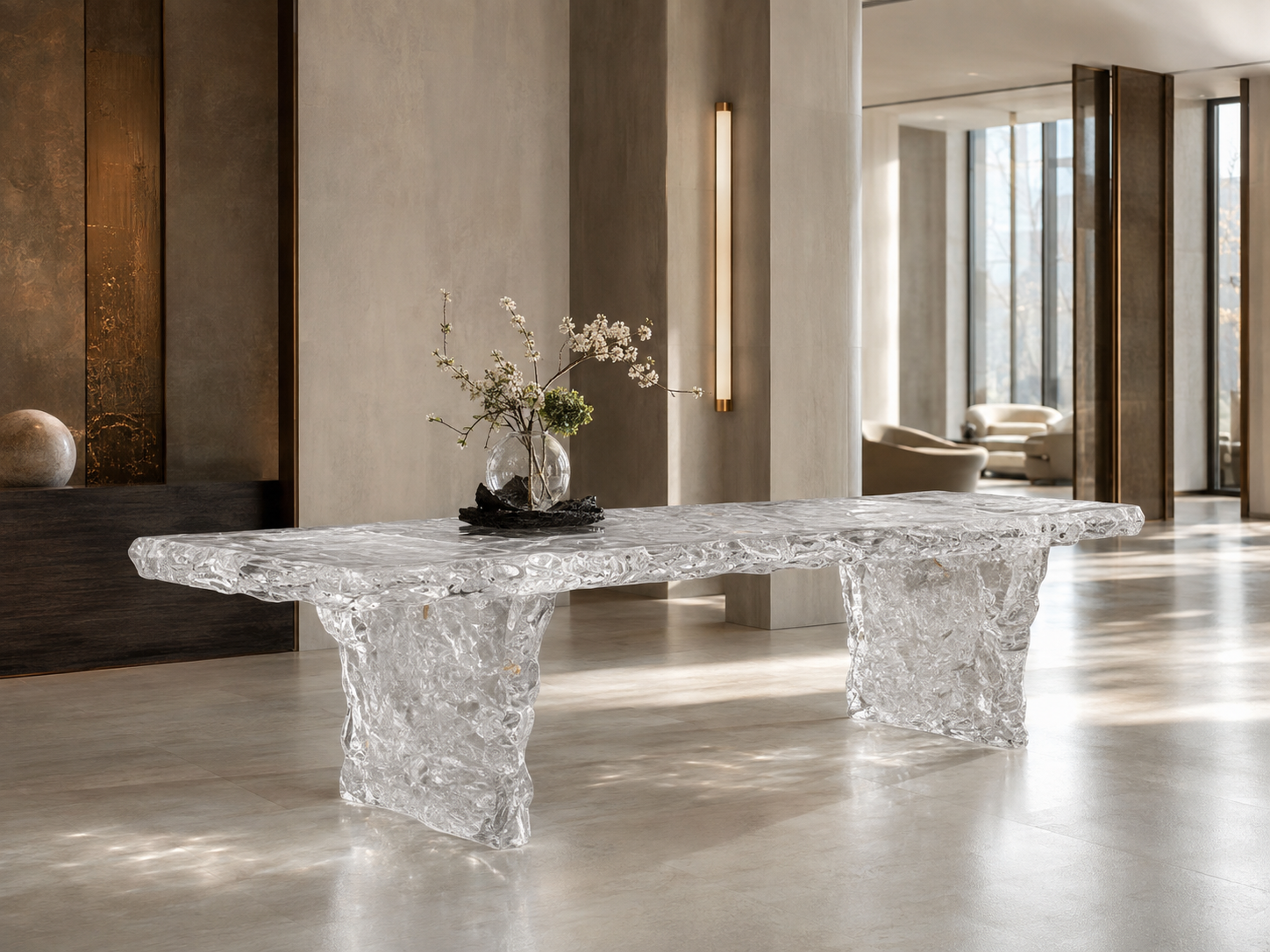
Clear furniture is often described as invisible, minimal, or visually light. But in a well-designed interior, it is rarely truly invisible.
Under different lighting conditions, transparent furniture can shift from subtle to dramatic, from almost colorless to richly reflective, and from visually weightless to surprisingly sculptural. A clear table that looks calm in daylight may develop luminous edges in the evening. A transparent console placed beneath warm lighting can appear softer and more luxurious, while the same piece under cool directional light may feel sharper, cleaner, and more architectural.
This is one of the most fascinating qualities of high-end synthetic crystal furniture: light does not simply illuminate it. Light becomes part of the material experience.
For interior designers, architects, hospitality developers, retailers, and homeowners, understanding this relationship can completely change how transparent furniture is specified and positioned. The final appearance of a synthetic crystal table, console, chair, pedestal, or decorative installation is influenced not only by its form and craftsmanship, but also by the direction, intensity, color temperature, and surrounding environment of the light.
In luxury interiors, this relationship can turn a functional piece of furniture into a changing visual feature that feels different throughout the day.
Clear Furniture Is Never Just "Clear"
At first glance, transparent furniture seems simple.
There is no visible grain, no upholstery pattern, and often no strong surface color. This can create the impression that clear furniture is neutral and predictable.
In reality, it is highly responsive.
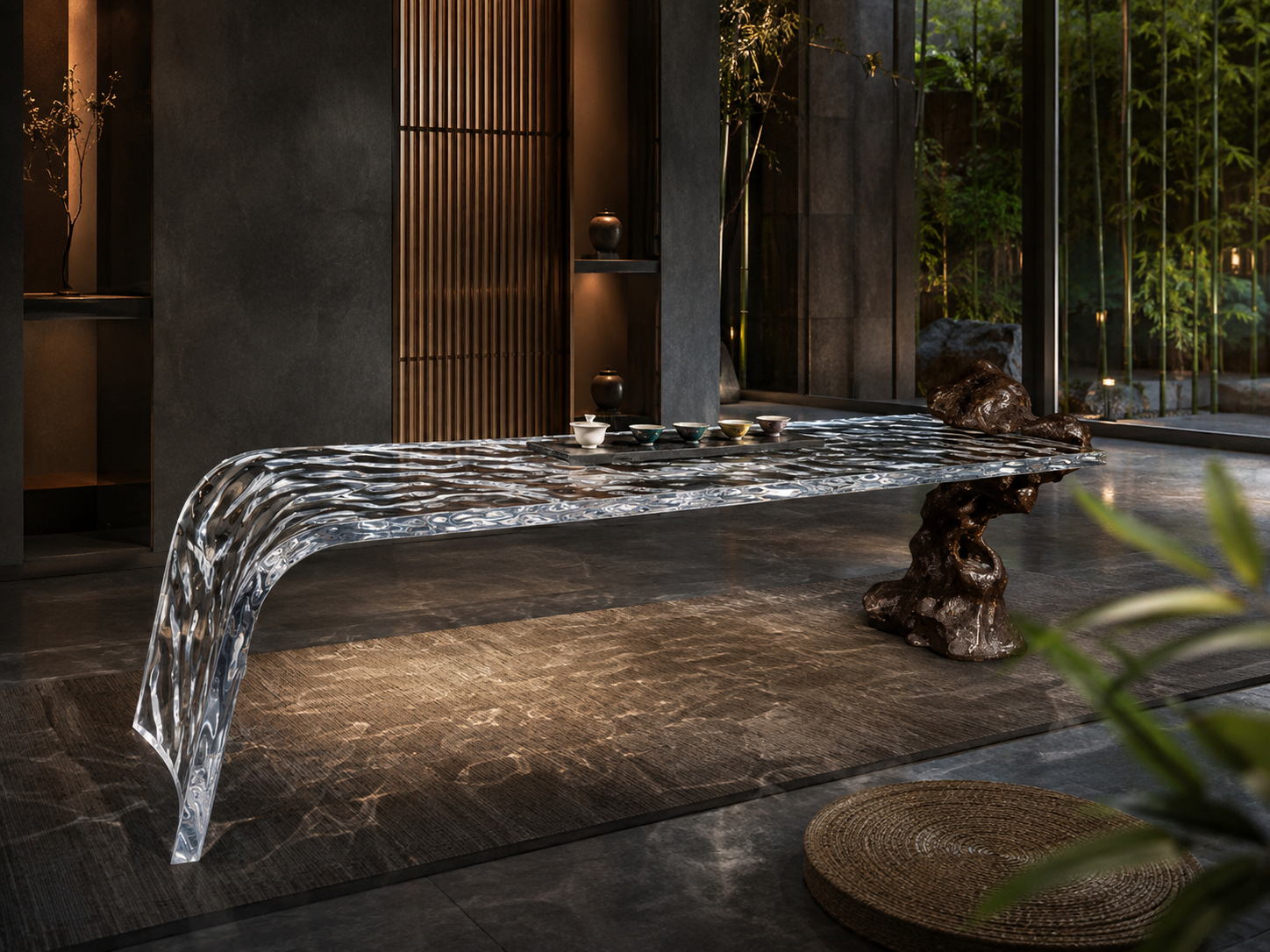
The appearance of a transparent object depends heavily on what surrounds it. Flooring, walls, nearby furniture, natural daylight, decorative lighting, reflections, shadows, and even the colors of objects placed on or behind it can influence what the viewer sees.
High-quality synthetic crystal does not exist visually in isolation.
It borrows color from its environment.
It catches light from nearby fixtures.
It reflects architectural surfaces.
It reveals the space behind it.
This is why two identical pieces of clear furniture can look completely different in two different rooms.
One may appear almost invisible.
The other may become the strongest visual feature in the space.
Lighting is often the reason.
Natural Daylight Reveals the Purest Side of Synthetic Crystal
Natural daylight is one of the best ways to experience premium transparent materials.
When daylight enters through large windows, it can reveal the clarity, surface quality, thickness, and proportions of synthetic crystal furniture in a very direct way.
Morning light tends to be softer and more directional. It may create gentle highlights along polished edges without producing excessive reflection.
Midday sunlight can be much stronger. Under bright conditions, the furniture may appear exceptionally clean and crisp, while shadows and reflections become more defined.
Later in the day, sunlight often becomes warmer. This can introduce subtle golden tones into otherwise clear surfaces.
Although the synthetic crystal itself has not changed color, the visual experience changes significantly.
This is one of the reasons transparent furniture works so well in luxury residences, villas, penthouses, boutique hotels, and commercial interiors with generous natural light.
The piece participates in the changing atmosphere of the space.
It looks slightly different at 9 a.m., 2 p.m., and sunset.
That movement gives the furniture a sense of life.
Warm Light Can Make Clear Furniture Feel Softer and More Luxurious
Warm lighting is commonly used in luxury hospitality, residential interiors, restaurants, lounges, and intimate commercial spaces.
Its softer tone can completely change the emotional character of synthetic crystal furniture.
Under warm illumination, clear furniture often feels less technical and more inviting.
Polished edges may take on subtle amber or golden reflections. Thick sections can appear deeper and more dimensional. Nearby brass, bronze, timber, leather, or warm-toned stone may visually transfer some of their color into the transparent material.
This creates an elegant interaction.
The furniture remains clear, but it no longer feels visually cold.
A synthetic crystal coffee table beside beige upholstery and warm wall lighting can appear refined and calm.
A transparent console near brass fixtures may reflect small areas of gold, making the piece feel more connected to the surrounding luxury finishes.
This ability to absorb the visual atmosphere of a room is one of the reasons synthetic crystal is so versatile.
It does not need a permanent color to contribute color.
Cool Lighting Creates a More Architectural Effect
Cooler lighting produces a very different result.
Under cooler white light, synthetic crystal furniture tends to appear sharper, cleaner, and more precise.
This can be particularly effective in contemporary retail stores, art galleries, modern offices, technology showrooms, beauty spaces, and minimalist interiors.
Instead of emphasizing warmth, cool lighting emphasizes clarity.
Edges may appear more defined.
Geometric forms become stronger.
Reflections can feel more controlled and graphic.
For a luxury retail environment, this can create an almost gallery-like presentation.
A clear synthetic crystal pedestal under cool directional lighting can appear visually precise while allowing the displayed object to remain the primary focus.
A transparent reception table in a contemporary office can reinforce a feeling of modernity and technical sophistication.
The material is the same.
The emotional message changes with the light.
Edge Lighting Reveals the Hidden Depth of Transparent Furniture
One of the most dramatic effects occurs when light interacts with polished edges.
The main surface of synthetic crystal may appear nearly invisible from certain angles, while the edges suddenly become bright and visually concentrated.
This contrast reveals something people often overlook: transparent furniture has physical depth.
Thickness becomes visible through light.
The effect is particularly noticeable in substantial tabletops, thick legs, sculptural bases, and layered structures.
A large transparent table with carefully polished edges can appear almost weightless in the center while showing brilliant lines around its perimeter.
This creates a fascinating balance between disappearance and presence.
From one angle, the furniture feels quiet.
Move a few steps, and the same piece becomes much more noticeable.
For designers, this creates opportunities to make furniture feel dynamic without adding decorative elements.
The light creates the decoration.
Thickness Changes How Light Travels Through the Material
Not all transparent furniture reacts to light in the same way.
Material thickness plays a major role.
Thin components often feel delicate and visually understated. Light passes through them with less obvious depth.
Thicker synthetic crystal produces a more sculptural effect.
As light interacts with greater material volume, edges become more prominent and optical depth becomes easier to perceive.
This is why thick transparent furniture often feels particularly luxurious when it is manufactured well.
There is an appealing contradiction.
The furniture has physical mass, yet because it is transparent, it does not create the same visual heaviness as stone or solid wood.
Lighting emphasizes this contradiction.
A thick synthetic crystal table leg illuminated from the side can look substantial and almost architectural. Yet the room remains visible through it.
This combination of mass and transparency is difficult to replicate with conventional materials.
Directional Lighting Can Turn Furniture Into a Focal Point
Lighting direction can determine whether a piece of furniture disappears into the background or becomes the center of attention.
Direct light creates stronger highlights and shadows.
Indirect light creates softer transitions.
Side lighting can emphasize thickness.
Overhead lighting may reveal the surface and objects placed on top.
Backlighting can create dramatic silhouettes and glowing edges.
Designers can use these effects intentionally.
Imagine a transparent console against a textured wall.
With ordinary ambient lighting, it may feel quiet and elegant.
Introduce carefully placed side lighting, and its polished edges begin to catch the light. The contrast between the clear material and textured background becomes stronger.
Suddenly, the furniture feels more like an installation than a conventional console.
This is especially useful in hotel lobbies, luxury lounges, flagship stores, restaurants, and private clubs where designers want selected furniture pieces to create memorable visual moments.
Backlighting Can Make Synthetic Crystal Appear Almost Luminous
Backlighting is one of the most powerful techniques for transparent furniture.
When light comes from behind or beneath a clear object, the material can appear to hold light inside itself.
The effect can range from subtle to theatrical.
A synthetic crystal pedestal placed in front of an illuminated wall can develop bright contours.
A transparent reception feature with concealed lighting can seem almost luminous.
A clear side table positioned near a decorative floor light may produce unexpected highlights and reflections.
This effect should be used carefully.
In high-end interiors, excessive illumination can make transparent furniture feel commercial or decorative rather than refined.
The strongest results usually come from restraint.
The goal is not necessarily to make the entire piece glow.
It may be more effective to reveal only certain edges, corners, or internal transitions.
Luxury often comes from controlled emphasis.
Shadows Give Transparent Furniture More Physical Presence
It may seem surprising, but shadows are extremely important when designing with clear furniture.
Because the object itself is visually light, its shadow can help define its physical presence.
Under strong directional light, a transparent table can cast surprisingly structured shadows onto the floor.
These shadows may reveal the geometry of the furniture more clearly than the furniture itself.
As the light changes, the shadow changes too.
In a space with large windows, this effect can evolve throughout the day.
Morning sunlight may cast long geometric shapes.
At midday, the shadow becomes tighter.
In late afternoon, it stretches again and may pick up the warmer atmosphere of the room.
This creates a second, temporary version of the furniture on the floor.
For designers interested in creating layered environments, this is an often-overlooked opportunity.
Reflections Can Make a Simple Form Feel More Complex
One of the strengths of synthetic crystal is that a relatively simple form can produce a surprisingly complex visual experience.
Reflections multiply information.
A transparent surface may reflect a chandelier while also showing the wall behind it.
An edge may catch a bright highlight while the main panel nearly disappears.
Nearby colors can appear as small fragments within the furniture.
As people move around the room, these reflections shift.
The furniture therefore feels more dynamic than an opaque object of the same shape.
This is particularly powerful in luxury spaces because visual complexity is created without physical clutter.
The design can remain minimal.
The environment provides the richness.
Colored Lighting Can Transform Clear Furniture Without Changing the Furniture
One of the most flexible characteristics of clear synthetic crystal furniture is that it can take on different visual identities through colored light.
This is particularly relevant in hospitality, events, luxury retail, entertainment spaces, clubs, and experiential environments.
A clear table under neutral light may look refined and understated during the day.
At night, controlled colored lighting can completely change its presence.
Soft blue light can create a cooler, more futuristic effect.
Warm amber light can create intimacy.
Subtle pink or violet tones can introduce a more expressive atmosphere.
The important point is that the furniture itself does not need to be permanently colored.
Lighting allows designers to change the mood while keeping the furniture visually adaptable.
For commercial spaces that transition between different atmospheres, this flexibility can be extremely valuable.
The Floor Beneath the Furniture Matters More Than Most People Expect
Because clear furniture allows the viewer to see through it, the floor becomes part of the furniture composition.
A synthetic crystal coffee table on polished marble will look very different from the same table on dark timber.
On light stone, the furniture may almost disappear.
On a dark floor, the transparent surfaces and edges may become more obvious.
On patterned flooring, the furniture can allow decorative details to remain uninterrupted.
Lighting amplifies these differences.
A polished stone floor may create secondary reflections beneath the furniture.
Wood may introduce warmer tones.
Carpet can reduce reflection and make the synthetic crystal itself appear more pronounced.
This means designers should never consider transparent furniture without considering the surface beneath it.
The floor is effectively visible through the design.
Walls and Background Colors Influence Perceived Clarity
The background behind transparent furniture also changes how it appears.
Against a white wall, a clear console may feel extremely subtle.
Against a dark wall, polished edges and reflections can become dramatically stronger.
Against textured stone or plaster, the furniture allows the background to remain visible while introducing another layer of depth.
Lighting determines how strongly these relationships appear.
A spotlight on the wall behind a synthetic crystal console can create contrast that defines the furniture without illuminating it directly.
A darker environment can make reflected highlights more noticeable.
A bright environment can make the entire piece feel lighter.
For designers, this means placement can be as important as the furniture itself.
Artificial Lighting Can Make Imperfections More Visible
Transparent furniture is unforgiving.
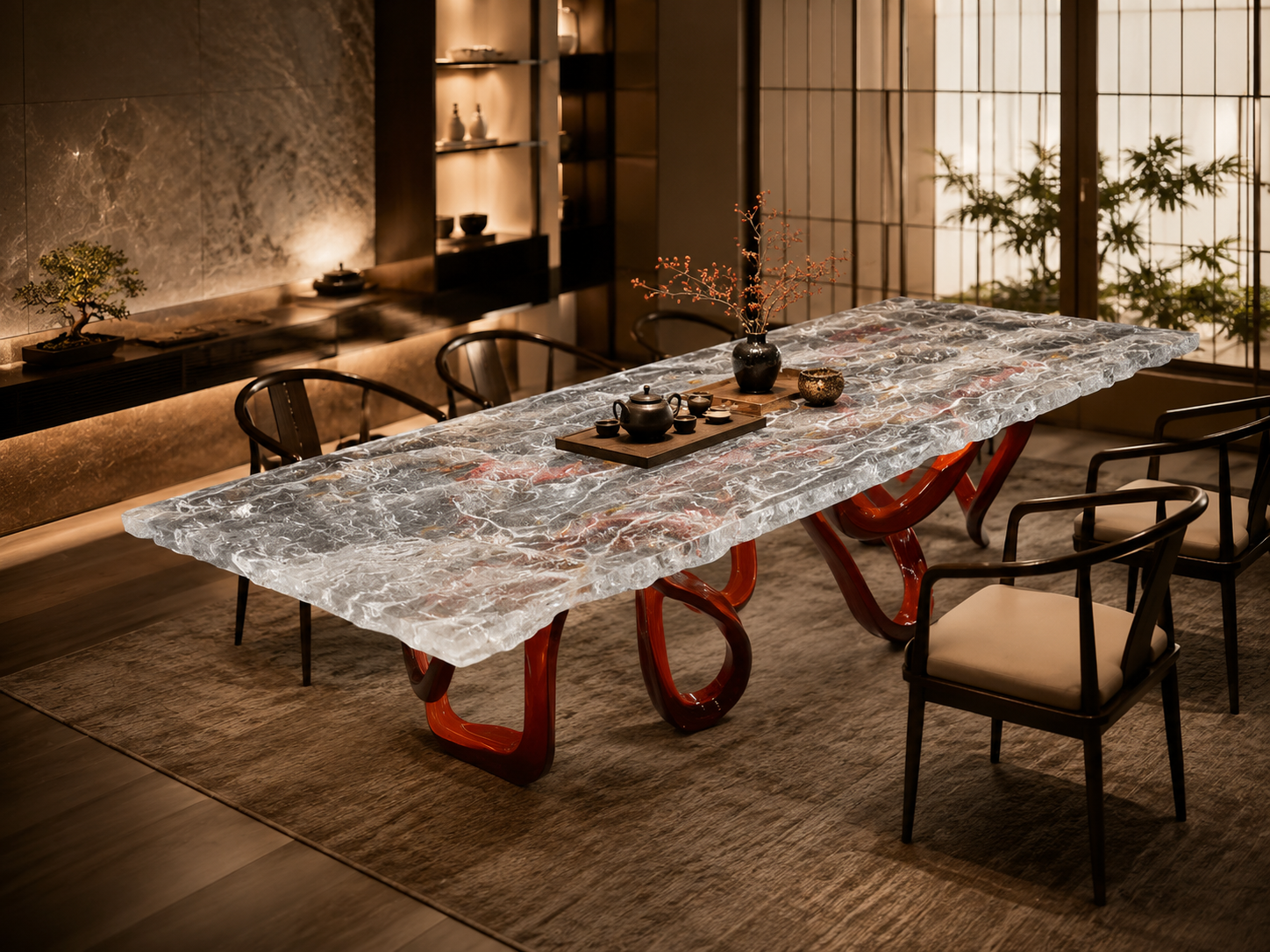
Strong artificial lighting can reveal imperfections that may be less obvious under softer conditions.
Scratches, inconsistent polishing, rough edges, visible bonding, or surface distortion can become more noticeable when light strikes the material from specific angles.
This is one of the key differences between ordinary clear furniture and high-end synthetic crystal furniture.
Premium pieces must perform under difficult lighting conditions.
A luxury hotel may use dramatic spotlights.
A retail store may have bright product illumination.
A private residence may combine chandeliers, wall lights, concealed LEDs, and daylight.
The furniture needs to look refined under all of them.
This is why material quality and craftsmanship matter so much.
Light does not create quality.
It reveals it.
Polishing Determines Whether Light Looks Elegant or Distracting
The quality of polishing directly influences the way light behaves.
A well-polished synthetic crystal edge can produce clean, controlled highlights.
A poorly finished edge may scatter light unevenly and appear cloudy.
The difference can be immediately visible.
This is especially important on thicker components.
Because thick edges have greater visual presence, their finishing becomes a major part of the overall design.
In high-end furniture, edge polishing is not merely a technical finishing process.
It is an optical design decision.
When done correctly, it can make a simple transparent form appear jewel-like.
Clear Furniture Can Change Character From Day to Night
One of the most compelling reasons to use synthetic crystal furniture in luxury interiors is its ability to shift character over time.
During the day, a clear table in front of large windows may feel fresh, open, and visually quiet.
As daylight fades and artificial lighting becomes dominant, the same table begins to reveal another personality.
Edges become brighter.
Reflections become more pronounced.
Nearby lighting fixtures appear within the material.
Shadows become deeper.
The furniture gains presence.
This day-to-night transformation is especially relevant in hospitality projects.
A hotel lobby needs to feel welcoming during the day and sophisticated at night.
A restaurant may need to transition from lunch to evening service.
A luxury lounge may become more atmospheric after sunset.
Synthetic crystal can respond to these changes naturally.
This Is Why Transparent Furniture Photographs Differently at Different Times
Anyone who has photographed transparent furniture knows that it can be challenging.
The same piece can appear almost invisible in one photograph and dramatically reflective in another.
Lighting angle is often responsible.
For luxury brands, hotels, furniture companies, designers, and homeowners sharing interiors online, this matters.
A carefully lit synthetic crystal piece can look exceptionally striking in photographs.
Its transparency creates visual layers.
Its edges create highlights.
The surrounding interior remains visible through it.
This makes the furniture ideal for editorial-style interior photography when the lighting is carefully controlled.
It also makes transparent furniture highly shareable on visual platforms such as Facebook, Instagram, Pinterest, and design-focused media.
People often stop scrolling when an image creates a small moment of visual confusion: “How is that table standing there?” or “Is that glass, crystal, or something else?”
Curiosity creates attention.
Why Crystal-Like Furniture Works So Well in Boutique Hotels
Boutique hotels need memorable design details.
They cannot rely entirely on scale or standardized luxury.
They need character.
Synthetic crystal furniture helps create this character because it changes according to the environment around it.
A custom table beneath a distinctive chandelier can become a recognizable feature of the lobby.
A clear console near a dramatic wall can create a sophisticated visual layer.
A sculptural transparent piece in a suite can maintain openness while adding personality.
Lighting allows these objects to evolve throughout the guest experience.
A visitor may see the furniture differently when checking in during the afternoon than when returning later in the evening.
This creates a subtle sense of discovery.
Luxury Retail Can Use Light to Make Products Appear More Important
Retail designers often need furniture to support merchandise without competing with it.
Synthetic crystal is particularly effective for this purpose.
Under carefully controlled lighting, transparent display tables and pedestals can appear understated while directing attention toward the product.
The support structure almost disappears.
The merchandise becomes visually dominant.
For jewelry, handbags, watches, cosmetics, accessories, art objects, and collectible products, this can create a powerful presentation.
At the same time, edge reflections and material clarity maintain a premium atmosphere.
The furniture is visible enough to feel luxurious, but transparent enough to let the product lead.
Restaurants and Lounges Can Create a More Dynamic Evening Atmosphere
Evening hospitality spaces depend heavily on lighting.
Restaurants, lounges, bars, and private clubs often use low ambient light combined with more focused decorative sources.
In these environments, synthetic crystal furniture can become unexpectedly dramatic.
Small points of light may appear as reflections within the material.
Candlelight may create warm highlights.
Decorative pendants may be reflected across transparent surfaces.
Edges may seem to glow against darker surroundings.
This can make the furniture feel more atmospheric without requiring ornate design.
A simple transparent table can become visually rich because the environment is reflected inside it.
Clear Furniture Helps Lighting Remain Visible
Opaque furniture can block light and interrupt sightlines.
Transparent furniture allows lighting effects to continue through the space.
This is useful when a designer wants decorative flooring, illuminated walls, architectural features, or low-level lighting to remain visible.
A synthetic crystal table placed above a beautifully lit floor does not conceal the effect.
A transparent console in front of a feature wall allows the wall to remain part of the visual experience.
In this sense, transparent furniture can support lighting rather than compete with it.
Material Quality Becomes More Important as Lighting Becomes More Sophisticated
Modern luxury interiors are using increasingly sophisticated lighting systems.
Concealed LEDs, architectural spotlights, wall washing, integrated lighting, tunable color temperature, and programmable scenes are becoming more common.
As lighting becomes more precise, material quality becomes more visible.
This raises expectations for transparent furniture.
High-end synthetic crystal must be selected and fabricated carefully because every lighting scenario can reveal something different.
A surface that looks acceptable under general lighting may show inconsistencies under directional light.
An edge that appears ordinary in daylight may become the focal point at night.
The better the lighting design, the less room there is for mediocre craftsmanship.
Designers Should Think About Furniture and Lighting Together
One of the most effective approaches is to consider synthetic crystal furniture during the lighting design process rather than after lighting has already been finalized.
The designer can ask:
Where will the strongest natural light come from?
Which edges should catch light?
Should the furniture appear subtle or dramatic at night?
Is there a textured wall behind it?
Will there be warm or cool illumination?
Does the piece need to photograph well?
Will guests see it primarily during the day or evening?
These questions can influence furniture position, thickness, geometry, and even finishing.
When lighting and furniture are developed together, the final result feels intentional.
Synthetic Crystal Is More Than a Transparent Substitute
It is tempting to think of transparent furniture simply as an alternative to glass or opaque materials.
That misses its greatest design advantage.
High-end synthetic crystal can become a medium for light.
Its value is not only in what you can see through it.
Its value is also in what happens inside, around, and across it when lighting changes.
Edges become visible.
Reflections appear.
Colors shift.
Backgrounds move through the furniture.
Shadows create secondary forms.
This gives designers a much richer set of possibilities.
Choosing the Right Manufacturer Matters
For designers working with lighting-sensitive transparent furniture, manufacturing quality is critical.
Material clarity needs to be consistent.
Edges must be polished carefully.
Bonding should be refined.
Surfaces must be finished to a standard suitable for strong architectural lighting.
Dimensions and proportions need to be accurate.
Large custom pieces may also require careful planning for transportation and installation.
An experienced synthetic crystal furniture manufacturer should understand that the product will not be evaluated only under factory lighting.
It may ultimately sit beneath a hotel chandelier, beside floor-to-ceiling windows, under retail spotlights, or within a highly controlled residential lighting scheme.
The finished piece has to perform visually in the real environment.
The Most Luxurious Effects Are Often the Most Subtle
Transparent furniture does not need dramatic colored lighting or obvious illumination to feel special.
Sometimes the most refined effect is simply a narrow highlight running along a polished edge.
Or a soft reflection of a chandelier.
Or the warm tone of sunset appearing briefly inside a clear table leg.
These small moments are often what make synthetic crystal furniture feel sophisticated.
The material rewards attention.
It reveals more as people move around it and as the lighting changes.
This is very different from furniture whose appearance remains almost identical under every condition.
Conclusion: Light Does Not Just Reveal Transparent Furniture, It Redesigns It
Clear furniture is never visually static.
Every change in daylight, color temperature, direction, shadow, reflection, and surrounding material can influence how synthetic crystal is perceived. A piece can feel quiet in the morning, crisp in bright afternoon light, warm at sunset, and dramatically sculptural under evening illumination.
This is why high-end synthetic crystal furniture has such potential in luxury residences, boutique hotels, restaurants, retail stores, lounges, and other design-led environments. Its transparency does not make it disappear; instead, it allows the interior itself to participate in the furniture's appearance.
For designers, the opportunity is far more interesting than simply choosing a clear table or console. By considering lighting, thickness, placement, edge finishing, background materials, and viewing angles together, a transparent object can become one of the most dynamic elements in the room.
And the next time a clear piece of furniture suddenly seems to change color, gain depth, or almost glow as evening arrives, ask yourself one question: are you looking at the furniture, or are you seeing what the light has turned it into?
READ MORE:
- Why Product Photography Can Misrepresent the True Quality of Clear Acrylic Furniture
- When Should Acrylic Furniture Be the Focal Point—and When Should It Stay Visually Quiet?
- What Buyers Often Overlook When Ordering Large Acrylic Furniture for International Projects
- Why the Same Acrylic Table Can Look Sophisticated in One Room and Out of Place in Another
- Le 4 domande che i designer di hotel fanno più spesso quando scelgono mobili in cristallo sintetico
- I 3 problemi dei materiali che preoccupano di più negli upgrade alberghieri: quali può risolvere l’arredo in cristallo sintetico?
- Da una lobby ordinaria a uno spazio premium: come tavolini da caffè e side table in cristallo sintetico diventano il punto focale del design alberghiero
- Creating a Memorable Hotel Space Without an Expensive Renovation: A Light-Touch Upgrade Strategy with Synthetic Crystal Furniture
- Budget limitato: come aumentare il valore percepito della lobby di un hotel con arredi in cristallo sintetico


