When people shop for transparent luxury furniture, they tend to ask predictable questions.
How clear is it?
How thick is the material?
Will it yellow?
Is it strong enough?
Will it scratch?
That last question usually receives the most attention. Yet for anyone buying a serious piece of high-end synthetic crystal furniture, it may not actually be the most important question.
A better question is this:
What happens after a scratch appears?
Because almost every material placed into a real interior eventually shows evidence of use. Stone can stain or chip. Wood can dent. Metal can develop fine abrasions. Lacquer can lose its perfect surface. Glass can scratch, and when damage becomes severe enough, replacement may be the only practical answer.
Luxury furniture should not be judged by pretending that normal life will never touch it.
It should be judged by what happens when it does.
This is where repairability becomes one of the most overlooked differences between ordinary transparent furniture and genuinely high-end synthetic crystal furniture.
For interior designers, collectors, hospitality buyers, luxury homeowners, and anyone specifying furniture for a long-term project, repairability affects much more than appearance. It influences lifecycle cost, serviceability, sustainability, ownership experience, and even whether a piece still feels valuable ten years after installation.
The first scratch, in other words, tells you surprisingly little.
What matters is what the furniture maker can do next.
The Luxury Furniture Industry Talks About Durability, But Not Enough About Recovery
“Durable” is one of the most overused words in furniture marketing.
A product may be described as durable because it can support substantial weight. Another may be called durable because its material resists moisture. A third may earn the description because its surface performs well during normal use.
But physical strength and surface perfection are not the same thing.
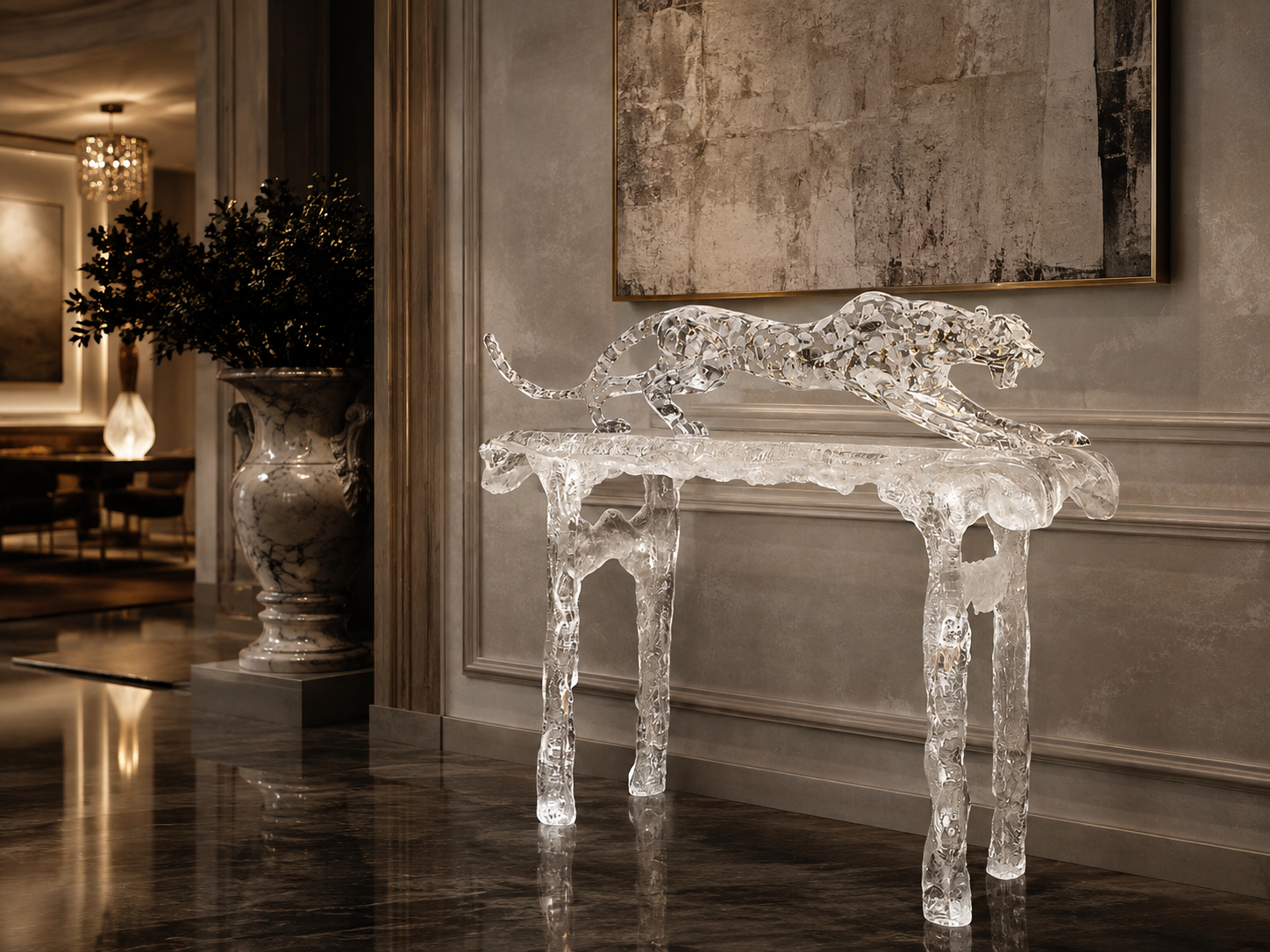
A beautifully engineered synthetic crystal console may remain structurally solid for many years while gradually accumulating tiny surface marks from everyday interaction. A coffee table can remain perfectly stable while receiving micro-scratches from decorative objects being moved across its top. A chair can maintain its form while small traces of use appear around frequently touched areas.
This does not necessarily mean the furniture has failed.
It means the furniture is being used.
The more meaningful measure of quality is whether those signs of use can be managed without compromising the original design.
That distinction matters enormously in the luxury market.
When a low-cost piece becomes visibly worn, replacing it may be expected. When a bespoke or architecturally significant piece becomes worn, replacement is often the least attractive solution.
The client may have chosen a particular proportion for the room. The designer may have developed the surrounding composition around it. The dimensions may have been customized. The transparency may have been selected to preserve a sightline. The piece may even have become visually inseparable from the project itself.
At that point, the question is no longer simply, “Is this material scratch-resistant?”
The real question becomes, "Can this furniture be restored?"
A Scratch Is Not a Single Type of Damage
One reason buyers misunderstand transparent furniture is that the word “scratch” makes every surface mark sound equally serious.
They are not.
There is a major difference between a faint micro-abrasion visible only under angled light and a deep groove that has physically removed material.
There is also a difference between a mark on a broad exposed surface and damage near a bonded joint, edge, structural connection, special finish, decorative inclusion, or highly detailed fabricated area.
This is why professional evaluation matters.
Light surface marks on appropriate uncoated areas may often be addressed through specialist polishing processes. More noticeable scratches may require progressively more involved restoration techniques. Deep damage, structural damage, or marks affecting joints and complex features should be assessed by an experienced fabricator rather than treated as a DIY polishing project.
That last point is especially important.
A premium piece of transparent furniture should never be approached like an inexpensive plastic accessory.
Aggressive polishing, excessive heat, improper abrasives, unsuitable solvents, or careless sanding can change optical consistency and create a larger visual problem than the original scratch.
Professional repair is not simply about making a mark disappear.
It is about restoring clarity while preserving geometry, reflections, edges, surface uniformity, and the visual character of the entire piece.
And on high-end synthetic crystal furniture, those details are exactly what the buyer paid for.
Why Repairability Begins Long Before the Furniture Is Scratched
The ability to restore a piece is not created on the day damage happens.
It begins at the design and manufacturing stage.
This is a point sophisticated buyers should understand.
Two transparent tables can look nearly identical in a photograph yet behave very differently after years of use because their construction, material quality, fabrication methods, edge treatment, bonding, finishing, and overall engineering are different.
Luxury furniture is not merely the shape you see.
It is also the hidden logic behind the shape.
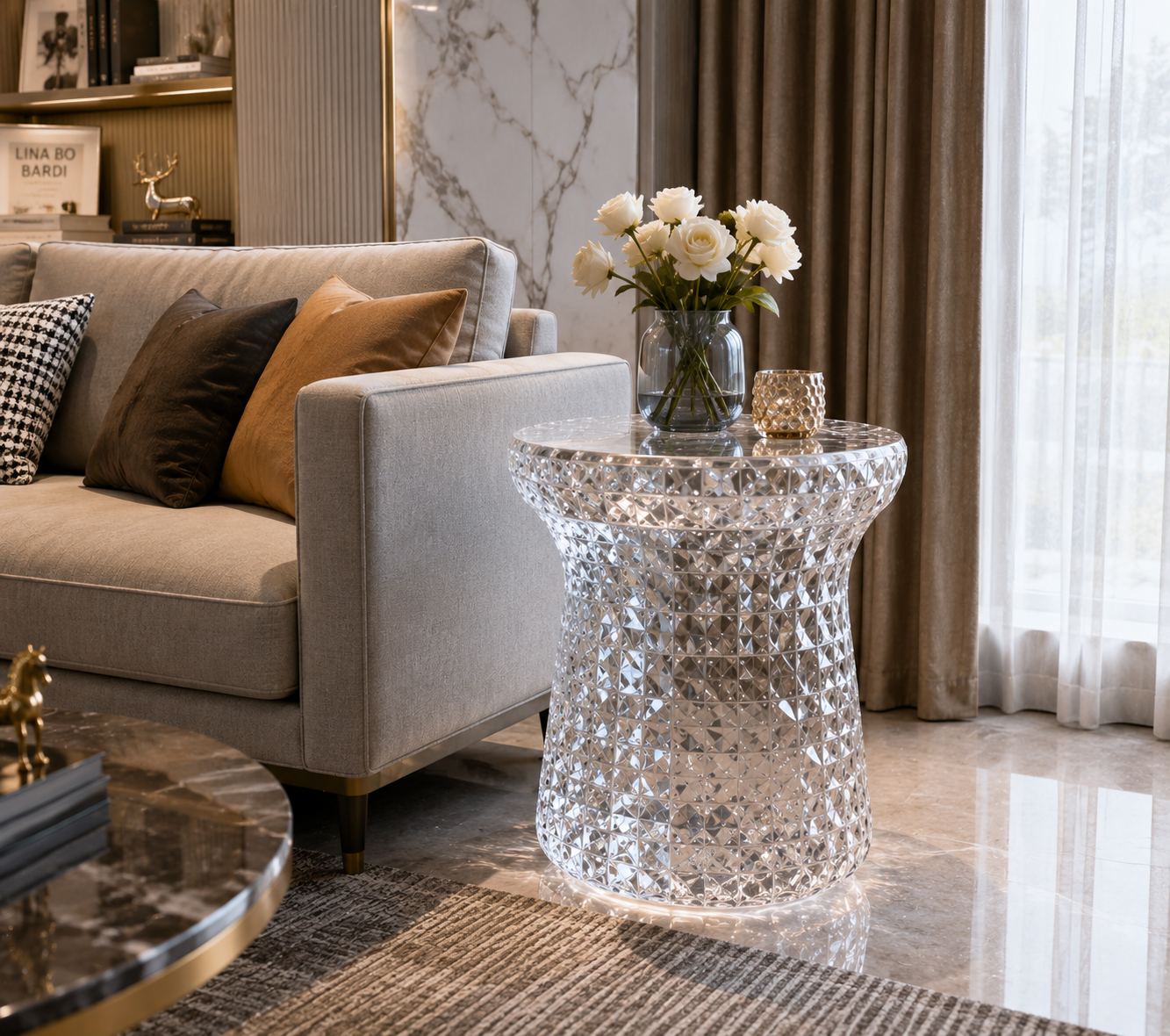
Consider a seemingly simple synthetic crystal side table. Its long-term serviceability may be influenced by the thickness of each component, how loads are distributed, where joints are located, how edges are finished, how accessible exposed surfaces are for refinishing, and whether the original manufacturer understands how to restore the same level of optical finish later.
Good manufacturers therefore think beyond the showroom moment.
They think about the second year.
The fifth year.
The tenth year.
They consider not only how a piece leaves the workshop, but how it can continue to live successfully in a real interior.
That is a fundamentally different approach from designing furniture primarily to look impressive on the day it is delivered.
The Most Expensive-Looking Furniture Is Not Always the Most Repairable
This is one of the uncomfortable truths of luxury furniture purchasing.
Visual drama can be created relatively quickly.
Long-term quality cannot.
A highly polished transparent surface photographs beautifully. Thick material looks substantial. Dramatic curves, sculptural forms, color effects, and unusual silhouettes can all make an immediate impression.
But photographs rarely reveal how a piece was fabricated.
They do not tell you how carefully edges were finished.
They do not show whether internal optical consistency was maintained.
They do not explain the bonding process.
They do not tell you whether the workshop can later reproduce the finish of the original surface.
And they certainly do not tell you what happens if the furniture returns for restoration several years later.
For designers sourcing expensive synthetic crystal furniture, those questions deserve more attention.
Luxury should include a plan for imperfection.
Not because a premium product is expected to fail, but because premium products should be worth maintaining.
Think About a Scratch the Way You Think About Fine Wood Furniture
There is a useful comparison here.
People who buy fine wood furniture generally understand that the surface may evolve.
A dining table may receive a small mark. A cabinet may develop a slight abrasion. A vintage piece may carry evidence of decades of use.
Yet buyers do not automatically conclude that wood is an unsuitable furniture material.
Why?
Because there is a well-established culture of maintenance, refinishing, restoration, and preservation around high-quality wood furniture.
We understand that a valuable object deserves care.
Transparent furniture deserves the same maturity of thinking.
Synthetic crystal furniture is often photographed in pristine architectural spaces, which can create an unrealistic expectation that its surface must remain visually untouched forever.
But luxury interiors are not museums.
People put books on consoles.
They move sculptures.
Children touch tables.
Housekeepers clean surfaces.
Hotels reset rooms.
Retail spaces change displays.
Restaurants serve hundreds of guests.
Design objects exist in environments where contact is unavoidable.
A well-made piece should therefore be evaluated not only by how perfectly it enters that environment, but also by how intelligently it can be maintained within it.
Repairability Changes the Economics of Luxury Furniture
Imagine two transparent coffee tables.
The first costs less initially but has limited restoration support. After several years of intensive use, the surface becomes visibly worn. The owner begins considering replacement.
The second costs more, but it was engineered and manufactured by a specialist capable of inspecting, refinishing, polishing, repairing, or replacing appropriate components when necessary.
Which one is actually more expensive?
Purchase price alone cannot answer that question.
For a residential buyer, this may mean preserving a favorite centerpiece instead of searching for a replacement that never feels quite right.
For an interior designer, it may mean protecting the integrity of a carefully composed room years after project completion.
For hotels, restaurants, luxury retail, showrooms, and other commercial environments, the implications become even greater.
Furniture in these spaces experiences repeated cleaning, frequent contact, and considerably more daily interaction than most residential pieces.
Replacing custom furniture every time visible wear becomes unacceptable can be disruptive and expensive.
Repairability changes the equation.
Instead of asking only about initial cost, professional buyers can begin thinking in terms of cost per year of visual performance.
That is a much more sophisticated way to evaluate premium furniture.
Repairability Is Also a Design Issue
Transparent furniture has a unusual relationship with space.
Unlike an opaque cabinet or solid stone pedestal, a synthetic crystal piece interacts with whatever is behind, beneath, and around it.
Light passes through it.
Flooring remains visible.
Architectural lines continue beyond it.
Color from surrounding materials enters the composition.
Reflections change as the viewer moves.
This visual lightness is one of the reasons designers choose transparent furniture in the first place.
But it also means that surface quality matters.
On a dark timber table, a faint mark may disappear into the grain. On highly transparent furniture, certain marks may become noticeable when daylight or directional lighting hits them from a particular angle.
Restoration therefore requires sensitivity.
The goal is not simply to reduce the scratch.
The goal is to preserve the way light travels across and through the object.
For a premium manufacturer, repair work is partly technical and partly visual.
The technician needs to understand what the designer was trying to achieve.
When Should You Call a Professional?
A minor mark does not always require dramatic intervention.
In fact, unnecessary repair can be as problematic as neglect.
The first step should usually be identifying what you are actually seeing.
Is it dirt?
Residue?
A transfer mark from another object?
A very shallow abrasion?
A deeper scratch?
Damage to a special surface treatment?
A mark close to a joint or edge?
Different situations require different responses.
Owners should also remember that synthetic crystal furniture should be cared for according to the manufacturer's specific instructions. Transparent polymer surfaces should not automatically be cleaned like window glass, and aggressive household chemicals or abrasive cleaning materials may be unsuitable.
If a scratch is deep, covers a large area, sits near an important joint, affects a complex fabricated detail, or appears on a specially treated surface, professional assessment is the safer approach.
The best restoration is often the one that uses the least aggressive process necessary.
Buyers Should Ask About After-Sales Restoration Before Ordering
This may be the single most useful takeaway for anyone specifying high-end synthetic crystal furniture.
Ask about repairability before you buy.
Not afterward.
A serious supplier should be able to have a meaningful conversation about care and long-term service.
You can ask what happens if light scratches appear after several years of use.
Ask whether the manufacturer provides professional polishing or restoration.
Ask whether the piece needs to be returned to the workshop or whether certain maintenance can be performed locally.
Ask how deep scratches are evaluated.
Ask whether replacement components can be produced for customized furniture.
Ask what cleaning products should be avoided.
Ask whether the construction of the piece has been designed with future restoration in mind.
Even the way a manufacturer answers these questions can tell you something about the level of craftsmanship behind the product.
A company focused only on making a sale may keep returning to appearance.
A company that actually understands its material will usually be comfortable talking about what happens years later.
Designers Have Even More Reason to Care
For interior designers, specifying furniture creates a responsibility that extends beyond installation photography.
Clients remember how a project performs.
A spectacular transparent dining table may look extraordinary on completion day, but the designer may receive a very different phone call three years later:
“There are scratches. What can we do?”
Having a useful answer matters.
This is why repairability can become part of the specification process.
Designers already ask detailed questions about upholstery performance, stone sealing, outdoor finishes, wood movement, lighting maintenance, replacement lamps, hardware, and fabric cleaning.
Transparent furniture deserves the same attention.
Knowing that a synthetic crystal piece can be professionally assessed and, where appropriate, restored gives the designer a much stronger position when recommending an investment-level product.
It turns aftercare from an awkward future problem into part of the original design strategy.
Hotels and Luxury Retail Should Treat Repairability as a Procurement Requirement
The argument becomes even stronger in commercial projects.
Picture a transparent console in a luxury hotel lobby.
Thousands of guests may pass it every month.
Objects are moved across it.
Staff clean it repeatedly.
Luggage may occasionally make contact.
Seasonal styling changes.
Photography happens around it.
Eventually, signs of use are inevitable.
Now imagine that the console was custom-made to fit a specific architectural bay. Replacing it means repeating measurements, production, quality control, packaging, international transport, installation, and possibly temporary disruption to the space.
A restoration pathway may be far more efficient.
The same applies to high-end boutiques, jewelry stores, galleries, private clubs, hospitality suites, and flagship showrooms.
For these clients, repairability is not simply a sustainability story.
It is operational resilience.
Repairability Can Be More Sustainable Than Disposable Perfection
Sustainability discussions in furniture often focus on what a product is made from.
That matters.
But it is only part of the story.
How long can the product remain useful?
Can visible wear be corrected?
Can components be serviced?
Will the owner still want the piece after ten years?
Can it adapt to another interior rather than being discarded?
A product that remains desirable and serviceable for a long time can challenge the culture of short replacement cycles.
This becomes particularly relevant in luxury furniture because high-end objects require significant design, fabrication, labor, packaging, transportation, and installation.
Preserving them makes sense.
There is something inherently contradictory about purchasing an expensive piece designed to look timeless and then treating the first visible sign of use as the end of its useful life.
True luxury should be more resilient than that.
The Craftsmanship You Cannot See May Matter Most
When viewing synthetic crystal furniture in a showroom, buyers naturally focus on transparency, scale, silhouette, color, and finish.
But some of the most important qualities are invisible.
They are embedded in process.
Precision cutting.
Controlled machining.
Careful bonding.
Accurate alignment.
Edge finishing.
Surface refinement.
Structural engineering.
Quality inspection.
Packaging.
Installation planning.
And eventually, restoration knowledge.
A manufacturer that understands the complete lifecycle of the material develops a different relationship with every piece it produces.
The product is not merely completed.
It is serviceable.
That difference becomes visible only later.
Sometimes years later.
Can Restored Synthetic Crystal Furniture Look New Again?
This is the question everyone eventually wants answered.
The most accurate answer is: it depends on the damage.
Certain superficial scratches and fine abrasions on suitable surfaces can often be significantly reduced or removed through proper professional refinishing and polishing. More serious scratches may require progressively more extensive work. Damage around specialized finishes, edges, bonds, structural elements, or complex geometry needs individual evaluation.
Not every kind of damage should be promised away.
That would not be credible.
But the important point is that scratching does not automatically mean the end of a premium synthetic crystal piece.
In many cases, there is a meaningful difference between a surface that is damaged and a piece of furniture that is ruined.
Experienced fabricators understand that difference.
And informed buyers should understand it too.
Prevention Still Matters
Repairability does not mean furniture should be treated carelessly.
Preventing unnecessary damage remains the best strategy.
Use appropriate pads beneath decorative objects.
Lift objects instead of dragging them.
Keep abrasive dust and grit away from the surface.
Follow the manufacturer's recommended cleaning method.
Use clean, soft materials for routine care.
Be particularly careful in commercial environments where the same furniture may be cleaned by many different staff members.
And make sure housekeeping or facilities teams receive care instructions.
Many surface problems are not caused by dramatic accidents.
They are caused by repeated small mistakes.
A contaminated cleaning cloth.
An unsuitable chemical.
A ceramic accessory dragged two centimeters each day.
A decorative arrangement repeatedly repositioned without protective pads.
Proper care prevents many of these issues before restoration is ever needed.
The Definition of “Like New” Is Changing
There is another, more philosophical question worth considering.
Should luxury furniture always look untouched?
For some pieces, absolutely. Their beauty depends on optical perfection, and maintaining that finish is part of ownership.
But the broader design world is also becoming more comfortable with longevity.
We celebrate the patina of leather.
We admire aged bronze.
We appreciate antique timber.
We value stone that carries subtle evidence of time.
Transparent furniture occupies a fascinating position in this conversation because its visual identity is associated so strongly with purity and clarity.
That makes repairability especially valuable.
It gives owners a choice.
They can allow subtle signs of life to remain, or they can restore the surface when the visual standard of the project demands it.
Luxury is partly about having that choice.
The Better Question Is Not “Will It Scratch?”
No responsible furniture maker should promise that a frequently used surface will remain untouched forever.
That is not how real interiors work.
The more intelligent conversation begins after accepting that reality.
How does the material respond to use?
How should it be maintained?
What can be restored?
Who performs the restoration?
Can the manufacturer support the piece years later?
Was the furniture engineered with its future in mind?
These questions reveal much more about quality than a simple scratch-resistance claim.
A high-end synthetic crystal table is not valuable merely because it looks flawless on delivery day.
It becomes truly valuable when its design, material, craftsmanship, and after-sales support allow it to remain beautiful long after that day has passed.
What Designers Should Look for in High-End Synthetic Crystal Furniture
For designers and buyers comparing suppliers, visual appearance should be only the beginning.
Look closely at material clarity and consistency.
Study the edges.
Examine joints from several angles.
Look at reflections across large surfaces.
Ask about material thickness relative to the structure.
Discuss installation.
Understand cleaning requirements.
Request care instructions.
And above all, ask what the manufacturer recommends when real-world wear eventually appears.
That conversation separates decorative transparency from serious furniture making.
Because once the initial excitement of a new piece has passed, what remains is craftsmanship.
Furniture Should Be Designed for Its Second Life, Not Just Its First Photograph
Social media has changed the way furniture is evaluated.
A new table arrives.
The protective packaging comes off.
The room is styled.
The lighting is perfect.
The photographer captures the piece before anyone has touched it.
That image becomes the product's public identity.
But perhaps we are judging luxury furniture at the easiest possible moment.
The more meaningful photograph might be taken five or ten years later.
After the dinners.
After the parties.
After the hotel guests.
After the house moves.
After the cleaning.
After the accidental scratch.
After restoration.
If the furniture still looks exceptional then, we finally know what we bought.
That is why repairability deserves to become part of the luxury furniture conversation.
Not because scratches are desirable, and not because every type of damage can magically disappear, but because an object worth investing in should also be worth maintaining.
When designers choose synthetic crystal furniture, they are choosing more than transparency. They are choosing how an object interacts with architecture, how it captures light, how it preserves visual space, and how it contributes to an interior without visually weighing that interior down.
Those decisions deserve furniture engineered for a long life.
So the next time you evaluate a transparent console, dining table, bench, pedestal, coffee table, or sculptural piece, do not stop at asking how beautiful it looks today.
Ask what happens after the first scratch, ask who can bring the surface back, and ask whether the maker designed the piece knowing that someday you would make that call—because the most revealing test of luxury furniture may not be how perfectly it arrives, but whether it is still worth restoring after the room, the client, and the story around it have all had time to change.
READ MORE:
- Thicker Is Not Always Better: How Acrylic Thickness Changes Proportion, Weight, Cost, and Visual Quality
- Acrylic Furniture in Hotels and Restaurants: What Changes When a Piece Is Used 100 Times a Day?
- The Hidden Cost of Shipping Transparent Furniture: Why Packaging Quality Is Part of Product Quality
- Why Does the Same Clear Furniture Look Different Under Daylight, Warm Lighting, and Showroom LEDs?
- Hotel, ristoranti e residenze: come utilizzare il cristallo sintetico nei diversi progetti?
- Come evitare che gli elementi in cristallo risultino kitsch? Tre principi per integrarli negli interni contemporanei
- Anche i piccoli spazi possono sembrare sofisticati: come utilizzare il cristallo sintetico con leggerezza
- Luce + cristallo sintetico: come creare interni con maggiore profondità e stratificazione?
- Oltre la pietra naturale: perché i designer stanno iniziando a guardare al cristallo sintetico?


