Clear furniture is often described as visually “neutral.”
That description is convenient, but it is not entirely accurate.
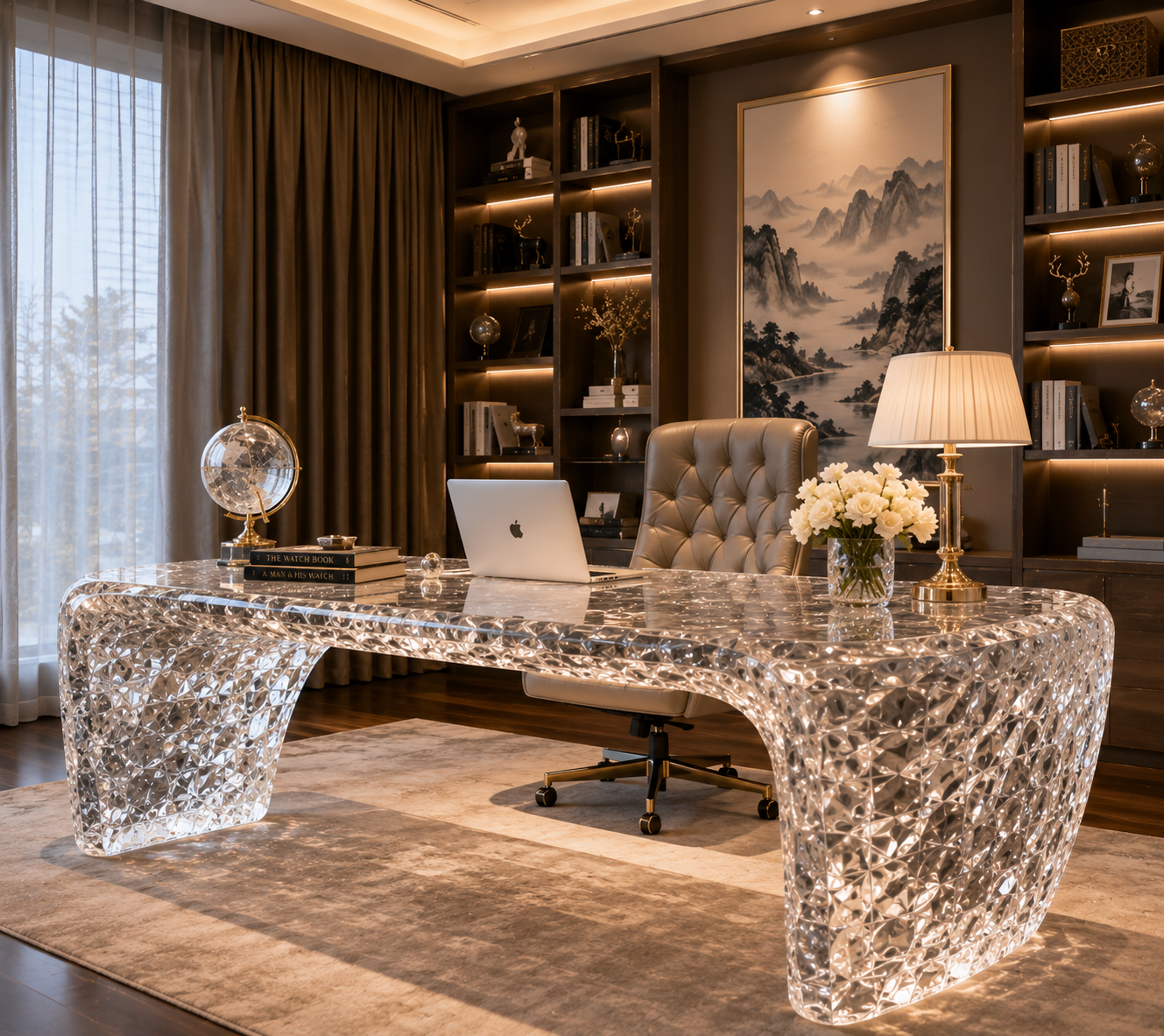
A high-end synthetic crystal console may look almost weightless beside a large window in the morning, warmer and more sculptural under evening lighting, and dramatically sharper beneath showroom LEDs. The furniture itself has not changed, yet the way we perceive it has.
This is not a contradiction.
It is a defining characteristic of transparent furniture.
Unlike opaque materials, synthetic crystal does not simply reflect light from its surface. It interacts with light through reflection, transmission, refraction, edge illumination, internal depth, surrounding color, and background contrast. As lighting conditions change, these visual relationships change as well.
That means the same piece of furniture can appear cooler, warmer, brighter, softer, heavier, lighter, clearer, or more dimensional depending on the environment around it.
For designers, architects, collectors, hospitality buyers, and anyone specifying premium transparent furniture, this matters more than it may initially seem.
The question is not merely whether a piece is "clear."
The better question is: How will this piece behave in the actual light of the room where it will live?
Clear Furniture Does Not Exist Visually on Its Own
An opaque table can dominate a space through color, texture, mass, and silhouette.
A synthetic crystal table behaves differently.
Its visual identity is partly determined by what surrounds it.
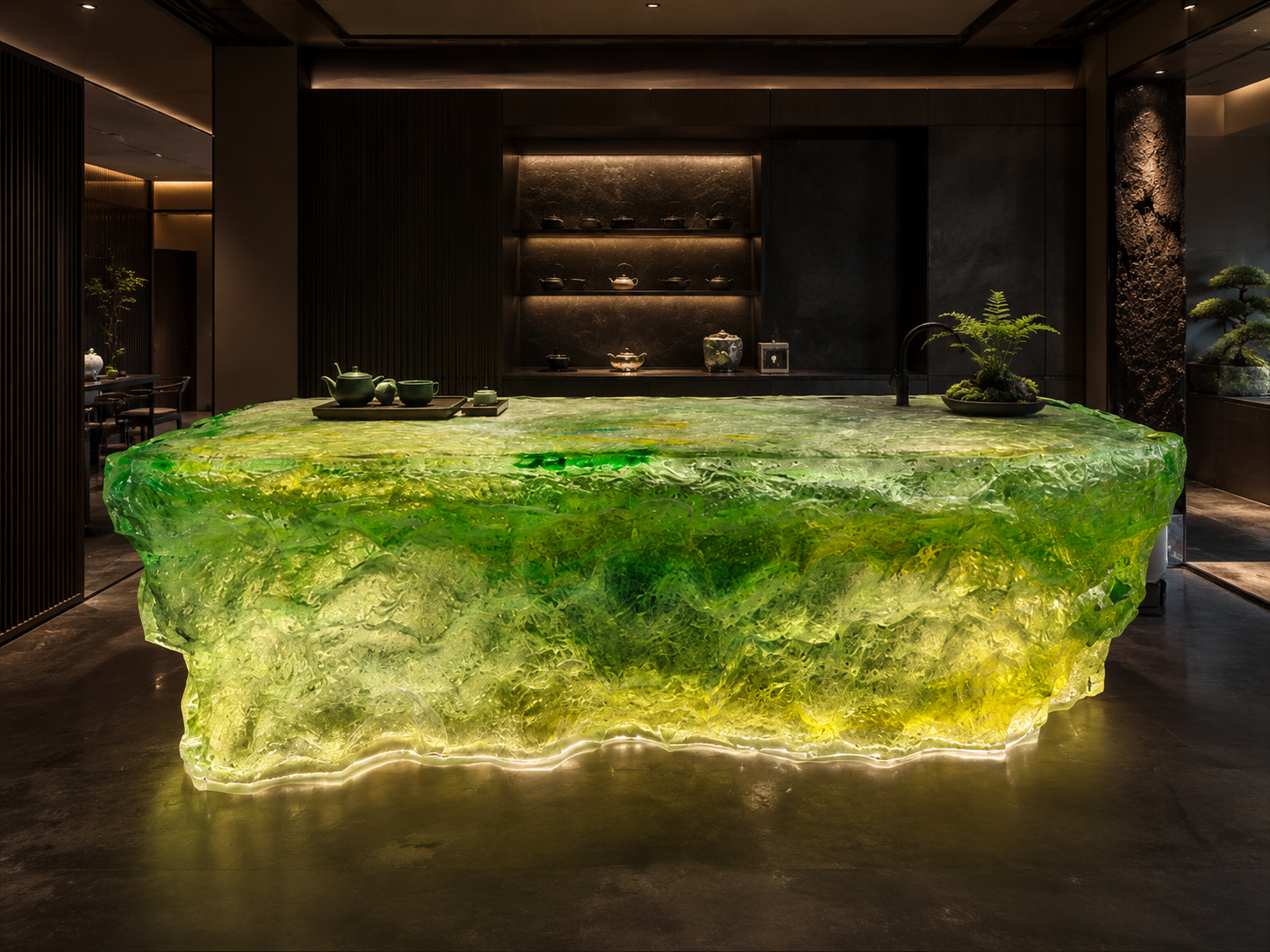
Place it on pale limestone and it may seem almost invisible.
Place the same table on dark timber and its edges may become much more pronounced.
Position it near a curtain wall and daylight may pass through it, softening its visual weight.
Move it into a room with directional warm lighting and its polished edges may appear golden or amber-toned.
Put it beneath cool showroom LEDs and the same surfaces may suddenly look crisper, more graphic, and more architectural.
This is why transparent furniture is unusually responsive to interior context.
It does not simply occupy a room.
It participates in the room’s lighting system.
Daylight Reveals More Than Just Transparency
Natural daylight is often considered the most honest lighting condition for evaluating clear furniture.
That is partly true.
Daylight, especially diffuse daylight, can reveal the optical quality of synthetic crystal with remarkable clarity. Large transparent surfaces may appear cleaner, deeper, and more open because the full spectrum of natural light allows subtle differences in clarity, surface finish, and edge treatment to become visible.
But daylight is not one fixed condition.
Morning light is different from afternoon light.
A north-facing room behaves differently from a west-facing room.
Cloudy daylight differs from direct sun.
Summer light differs from winter light.
A synthetic crystal dining table installed beside floor-to-ceiling glazing may appear soft and almost ethereal on an overcast morning, then become highly reflective when direct afternoon sun enters the room.
The furniture is the same.
The optical environment is not.
This is one reason design professionals should avoid judging clear furniture from a single photograph taken under one lighting condition.
A single image captures only one version of the piece.
Direct Sunlight Creates Stronger Contrast
When direct sunlight strikes synthetic crystal, the visual result can be significantly more dramatic.
Edges may appear brighter.
Polished surfaces can produce stronger highlights.
Internal reflections become more noticeable.
Shadows may become sharper.
The geometry of the furniture may suddenly appear more defined.
This can be especially striking in sculptural pieces, thick-section furniture, pedestal forms, or designs that use large solid volumes.
A thick synthetic crystal side table that feels almost invisible under diffuse daylight may become much more architectural when direct sunlight creates bright edge lines and distinct shadow patterns.
This is not a flaw.
It is part of the material’s visual behavior.
In fact, many designers select transparent furniture precisely because it can shift between presence and disappearance throughout the day.
Warm Lighting Changes Perceived Color
One of the most common surprises for clients occurs in the evening.
A piece that looked cool and highly transparent in daylight may appear warmer under decorative lighting.
The explanation is straightforward.
Warm light sources contain more energy in warmer visible wavelengths, which affects how materials and surrounding surfaces are perceived. Even highly clear synthetic crystal can appear visually warmer because it is reflecting and transmitting light from lamps, wall finishes, timber, fabrics, and nearby objects.
The material itself has not necessarily changed color.
The environment has changed the light entering and leaving the viewer’s eye.
This distinction is important.
In a room lit primarily at 2700K or 3000K, polished synthetic crystal edges may pick up soft golden tones. If the furniture sits beside walnut, bronze, leather, or warm stone, these colors can be visually introduced into the transparent volume through reflection and refraction.
The result may feel richer and more atmospheric than the same object under cooler light.
Warm Light Can Make Transparent Furniture Feel More Luxurious
Luxury interiors rarely rely on brightness alone.
They rely on atmosphere.
Warm lighting often lowers contrast, softens hard transitions, and emphasizes depth rather than clinical clarity. In such environments, synthetic crystal furniture can take on a more sophisticated visual role.
Instead of looking purely transparent, the piece may appear luminous.
Edges may glow subtly.
Curved forms may become more fluid.
Polished surfaces may reflect nearby warm light sources in a way that makes the object feel almost jewel-like.
This can be especially effective in residential living rooms, private dining rooms, hotel suites, cocktail lounges, luxury boutiques, and high-end hospitality spaces.
For these projects, “maximum clarity” is not always the only goal.
The relationship between clarity and atmosphere can be equally important.
Showroom LEDs Tell a Different Story
Showrooms are often designed to make products look precise.
The lighting is controlled.
The color temperature is selected carefully.
Fixtures are positioned to create highlight.
Backgrounds are simplified.
Ambient variables are reduced.
This can make high-end synthetic crystal furniture look exceptionally sharp.
Under bright, well-positioned LEDs, polished edges may become highly defined. Transparent planes can appear optically clean. Reflections become easier to control. The overall geometry of the piece may look more precise and deliberate.
This is excellent for presenting craftsmanship.
But buyers should remember that the showroom is not the final environment.
A piece displayed beneath cool-white directional LEDs may behave differently when moved into a home illuminated by warm decorative lamps.
This is not a reason to distrust the showroom.
It is simply a reason to interpret showroom appearance correctly.
Color Temperature Matters
One of the most useful concepts for designers specifying transparent furniture is color temperature.
Color temperature is commonly measured in Kelvin.
Lower values, such as 2700K or 3000K, are generally perceived as warmer.
Higher values, such as 4000K or 5000K, appear cooler or more neutral.
Transparent furniture tends to reveal these changes more visibly than many opaque materials because it interacts with the surrounding light in multiple ways.
Under warmer light, synthetic crystal may pick up cream, amber, bronze, beige, or timber tones from the room.
Under cooler light, it may appear cleaner, more blue-white, or more architectural.
Neither effect necessarily indicates a change in material quality.
What you are seeing is the combined effect of the light source, the surrounding palette, the background, and the furniture itself.
Color Rendering Also Matters
Two light sources can have similar color temperatures and still make materials look different.
This is where color rendering becomes important.
Lighting with better color rendering tends to reveal surrounding materials more faithfully. If synthetic crystal is reflecting fabrics, timber, stone, metal, or artwork, the quality of the lighting will influence how natural those colors appear inside and around the transparent form.
This is particularly relevant in luxury interiors where the material palette has been carefully curated.
A transparent console beside a richly veined stone wall may look completely different under poor-quality lighting than under high-quality architectural illumination.
The furniture is not simply reflecting light.
It is reflecting the entire design language of the room.
Background Color Can Matter as Much as the Light Source
A transparent object never has a truly independent visual color.
What lies behind it matters.
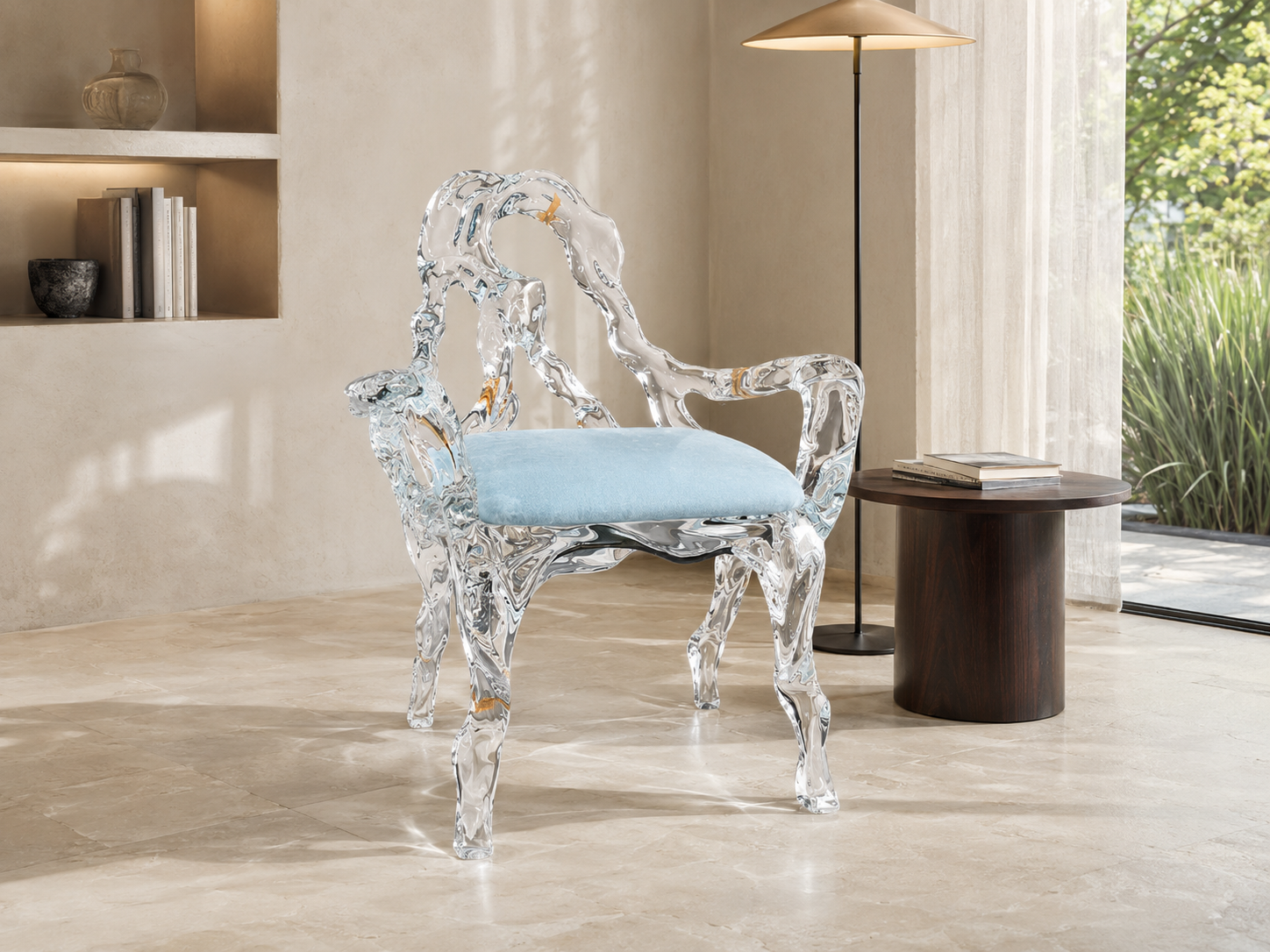
A synthetic crystal chair placed in front of a white wall may almost disappear.
Move it in front of a dark lacquer panel and its outline can become dramatically stronger.
Place it beside a saturated artwork and some of that color may seem to enter the chair visually.
Position it in front of greenery and subtle green tones may become more noticeable through the transparent surfaces.
This is why samples should ideally be evaluated against the actual project palette.
A piece that appears almost colorless in isolation may behave differently once surrounded by real materials.
Floor Materials Change the Perception of Clear Furniture
The floor is especially influential because transparent furniture often reveals so much of it.
A clear coffee table placed over pale travertine may feel visually light and almost suspended.
The same design placed over dark oak may gain stronger contrast.
Over a patterned rug, it may visually frame the pattern rather than conceal it.
Over polished stone, reflections may multiply.
Over matte flooring, the object may appear calmer.
For this reason, transparent furniture should often be selected with the floor in mind.
The floor is not simply beneath the furniture.
Visually, it becomes part of the furniture.
Edge Treatment Becomes More Visible Under Certain Lighting
One of the clearest indicators of craftsmanship in premium synthetic crystal furniture is edge quality.
Under some lighting conditions, edges are barely noticeable.
Under others, they become the dominant visual feature.
Directional LEDs can create strong bright lines along polished edges.
Low-angle sunlight may emphasize every transition.
Warm accent lighting can make edges glow.
This makes edge finishing especially important in high-end work.
Poorly finished edges may remain unnoticed under flat light but become obvious under strong directional lighting.
Excellent edges, by contrast, become part of the beauty of the piece.
This is why precision finishing matters even on areas that appear visually quiet during fabrication.
Lighting can reveal them later.
Thickness Changes Optical Behavior
A thin transparent panel and a thick synthetic crystal slab do not look the same, even if both are technically clear.
Thickness changes how much material light travels through.
It changes edge visibility.
It changes internal reflections.
It changes perceived mass.
It can also influence how surrounding colors appear within the object.
This is why substantial synthetic crystal furniture often has a stronger sculptural presence than thinner transparent furniture.
A thick dining table leg, pedestal, or monolithic base can catch and redirect light in ways that make it appear almost luminous from some angles.
At other angles, it may become visually quiet.
The design therefore changes as the viewer moves.
Curves Behave Differently From Flat Planes
Curved synthetic crystal furniture can be especially sensitive to lighting.
A flat panel reflects light in a relatively predictable direction.
A curve creates a changing angle across its entire surface.
That means highlights move.
Reflections stretch.
Backgrounds distort slightly.
Edge brightness shifts as the viewer walks around the piece.
Under showroom lighting, these effects may look highly controlled.
Under daylight, they may become softer and more dynamic.
Under warm evening lighting, the same curve may create subtle gradients rather than sharp reflections.
This is one reason sculptural transparent furniture can feel so different in person compared with photographs.
It is not a static visual object.
It changes with movement and light.
Photography Often Simplifies What the Eye Sees
This is particularly relevant in the age of online furniture sourcing.
Transparent furniture is difficult to photograph accurately.
Cameras compress dynamic range.
Reflections may be edited.
Backgrounds may be simplified.
Lighting may be carefully positioned to emphasize transparency while minimizing glare.
Exposure can alter perceived clarity.
White balance can shift perceived color temperature.
A professionally photographed synthetic crystal table may therefore appear different when viewed in a real interior.
This does not necessarily mean the image is misleading.
It means that photography can only capture one interpretation of a highly light-responsive material.
Designers should therefore treat images as references, not complete evidence.
Samples Are More Valuable Than People Realize
For major projects, material samples can be extremely useful.
But even samples should be tested intelligently.
Do not examine a synthetic crystal sample only under office lighting.
Take it near a window.
View it in direct and indirect daylight.
Place it beside the actual timber, stone, fabric, and metal finishes being used in the project.
Look at it under the lighting temperature specified for the room.
View it against both light and dark backgrounds.
Check it from multiple angles.
The goal is not simply to ask, “Is this clear?”
The goal is to understand how the material will participate in the completed interior.
Lighting Design and Furniture Specification Should Not Be Separated
In many projects, lighting and furniture are specified at different stages.
That is practical, but transparent furniture reveals why those decisions are connected.
A designer may select a sculptural synthetic crystal console because it feels visually light in the concept render.
Later, the lighting designer may introduce narrow-beam fixtures that create strong highlights across the object.
The final result may be more dramatic than the original concept.
That may be desirable.
Or it may not.
The important point is that transparent furniture should be considered as part of the lighting composition.
Where will the fixtures be?
At what angle will light strike the surface?
What will be reflected?
Will the piece sit near glazing?
Will it receive direct sun?
Will decorative lighting be visible through it?
Will bright sources create distracting glare?
These are design questions, not merely technical questions.
Retail Environments Use This Effect Deliberately
Luxury retail provides some of the best examples of lighting interacting with transparent furniture.
In a boutique, synthetic crystal plinths and display tables can be used to support products without visually competing with them.
But they are rarely treated as invisible objects.
Lighting is often positioned deliberately so that edges catch light while the central mass remains visually open.
This creates a subtle sense of presence.
The display structure is visible enough to feel luxurious, but transparent enough to keep attention on the product.
This balance is difficult to achieve with opaque materials.
The ability to control visual presence through lighting is one of the strongest advantages of high-quality transparent furniture.
Hospitality Projects Face More Complex Lighting Conditions
Hotels, restaurants, clubs, and lounges often transition dramatically from day to night.
A lobby may receive intense daylight in the morning and rely almost entirely on decorative lighting in the evening.
A synthetic crystal console in that lobby therefore needs to work in multiple visual identities.
During the day, it may feel light and architectural.
At night, it may become reflective, warmer, and more decorative.
Designers should anticipate this transformation.
The question is not which version is correct.
Both are.
The piece simply has different expressions under different conditions.
Residential Clients Should Evaluate Furniture at the Time They Actually Use the Room
This is an often-overlooked point.
Many clients select furniture during the daytime.
But they may use the room most often at night.
A dining table may be chosen in a bright showroom at 2 p.m. and then used primarily under warm pendant lighting at 8 p.m.
A console may be inspected under showroom LEDs but installed in a hallway with wall sconces.
A coffee table may be viewed under daylight but live in a room with dimmable ambient lighting.
For high-value purchases, the relevant question is not simply how the furniture looks when you buy it.
It is how it will look when you actually live with it.
There Is No Single “Correct” Appearance
Buyers sometimes worry when transparent furniture looks slightly different between locations.
This concern is understandable, especially in premium projects where consistency matters.
But not every visual difference indicates inconsistency in the material.
Light changes appearance.
Background changes appearance.
Viewing angle changes appearance.
Surrounding finishes change appearance.
Thickness changes appearance.
Reflection changes appearance.
This is why serious manufacturers and designers evaluate material under controlled conditions when assessing quality.
It is also why clients should avoid comparing one showroom photograph with one residential photograph and assuming the furniture itself must be different.
Context matters.
High-End Synthetic Crystal Furniture Should Be Designed for Light
The best transparent furniture is not designed as though lighting is irrelevant.
It is designed with light in mind.
The thickness of the material.
The edge geometry.
The direction of polished planes.
The scale of the piece.
The position of joints.
The relationship between solid and open volumes.
All of these decisions affect how the object responds to illumination.
This is where furniture design begins to overlap with architectural thinking.
A successful transparent piece does not merely have a shape.
It has an optical behavior.
This Is Why Customization Matters
For custom projects, understanding the final environment can improve the design.
A piece intended for a bright coastal residence may benefit from different proportions or visual emphasis than a piece designed for a dark hospitality interior.
A console positioned against pale stone behaves differently from one placed against smoked timber.
A display pedestal under gallery lighting has different requirements from a dining table in a warm residential setting.
Customization allows the furniture maker to consider these differences rather than treating every transparent piece as visually identical.
That is one of the distinctions between commodity production and project-based craftsmanship.
The Best Way to Judge Clear Furniture Is to See It Change
If possible, do not evaluate high-end synthetic crystal furniture under only one lighting condition.
Watch it change.
See it in daylight.
See it under warm lighting.
See it under focused LEDs.
Walk around it.
Look through it toward different backgrounds.
Observe the edges.
Notice how reflections move.
Pay attention to how the furniture becomes more visible in some moments and almost disappears in others.
That changeability is not a weakness.
It is one of the material’s most sophisticated qualities.
Transparent Furniture Is Never Just Transparent
This is the deeper design lesson.
Clear furniture does not remove itself from an interior.
It interacts with the interior in a more complex way.
It borrows color from nearby materials.
It captures light.
It preserves views.
It reflects architecture.
It intensifies edges.
It changes throughout the day.
It becomes warmer at night.
It responds to movement.
It allows the same object to have several visual identities without physically changing.
That makes synthetic crystal furniture especially powerful in interiors where designers want presence without heaviness.
The Most Important Question Is Not “How Clear Is It?”
Clarity matters.
Material quality matters.
Fabrication matters.
Surface finish matters.
But in a completed interior, transparency is never judged in isolation.
The final appearance is the result of the furniture, lighting, architecture, background, finishes, and viewer all working together.
This is why specifying high-end synthetic crystal furniture should involve more than selecting a shape from a catalog.
Designers should think about where it will sit, what will surround it, what lighting will reach it, and how the space will change from morning to evening.
When those decisions are aligned, transparent furniture can do something few other materials can achieve: it can remain physically substantial while visually adapting to the room around it.
And perhaps that is the real reason clear furniture continues to fascinate designers—not because it disappears, but because the same object can become a different piece of furniture every time the light changes, which raises a more interesting question: when you specify transparency, are you choosing a material, or are you actually designing with light?
READ MORE:
- Thicker Is Not Always Better: How Acrylic Thickness Changes Proportion, Weight, Cost, and Visual Quality
- Acrylic Furniture in Hotels and Restaurants: What Changes When a Piece Is Used 100 Times a Day?
- The Hidden Cost of Shipping Transparent Furniture: Why Packaging Quality Is Part of Product Quality
- What Happens After a Scratch? The Repairability of High-End Acrylic Furniture Matters More Than Most Buyers Realize
- Hotel, ristoranti e residenze: come utilizzare il cristallo sintetico nei diversi progetti?
- Come evitare che gli elementi in cristallo risultino kitsch? Tre principi per integrarli negli interni contemporanei
- Anche i piccoli spazi possono sembrare sofisticati: come utilizzare il cristallo sintetico con leggerezza
- Luce + cristallo sintetico: come creare interni con maggiore profondità e stratificazione?
- Oltre la pietra naturale: perché i designer stanno iniziando a guardare al cristallo sintetico?


