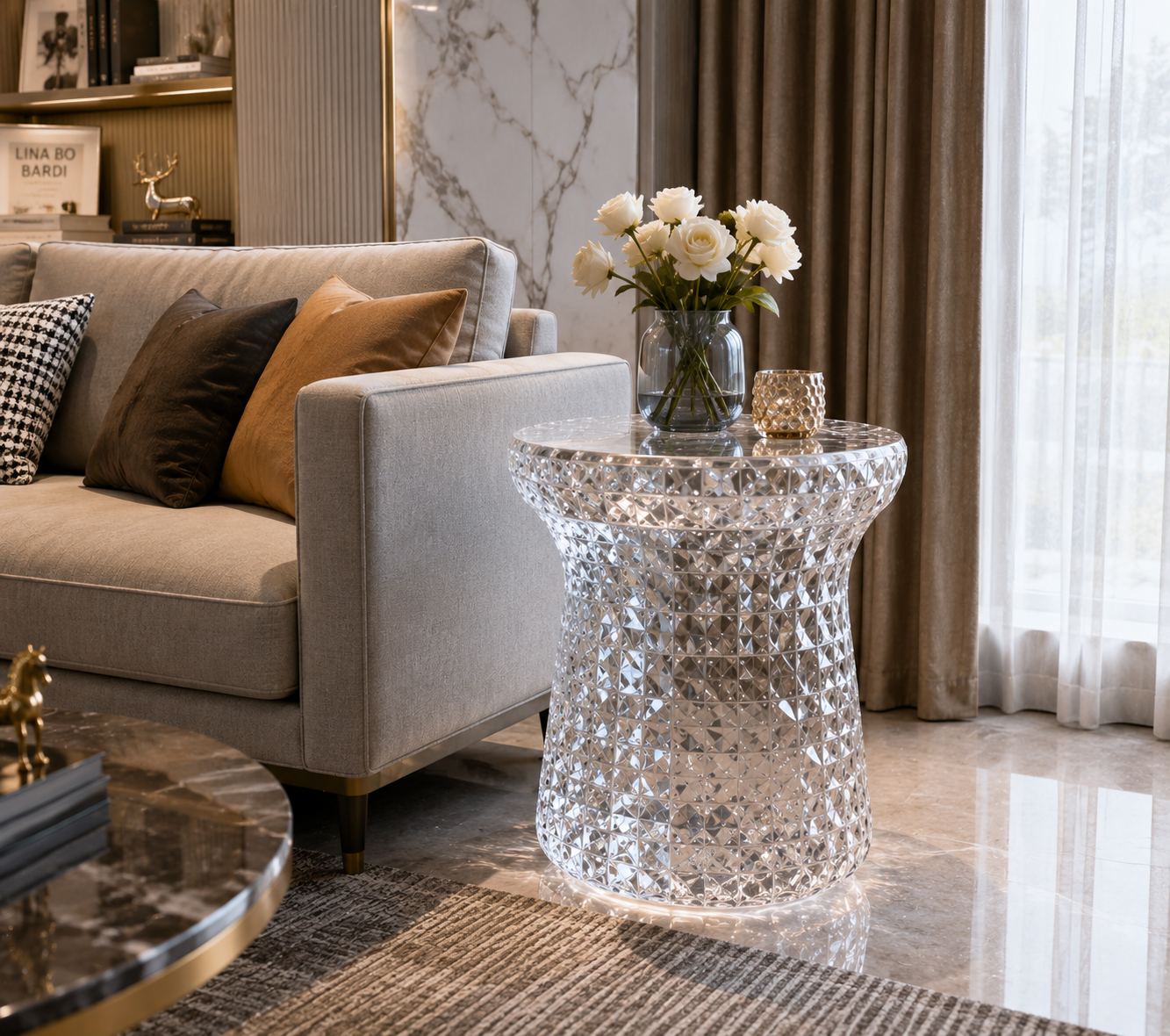
A piece of transparent furniture can look almost effortless in a hotel lobby, restaurant dining room, cocktail lounge, or luxury retail-style hospitality interior.
It reflects light without visually blocking the space.
It can make a compact room feel more open.
It can introduce sculptural form without adding visual heaviness.
It can sit beside stone, timber, metal, leather, and textile finishes without competing with them.
This is one reason high-end synthetic crystal furniture has become so attractive in hospitality design.
But there is an important difference between furniture that looks beautiful in a residential setting and furniture that performs successfully in a commercial one.
Frequency.
A console in a private home may be touched a few times a day.
A side table in a hotel lobby may be touched dozens of times before lunch.
A restaurant table may be cleaned and reset after every seating.
A transparent luggage bench may experience constant contact with bags, zippers, wheels, keys, belts, cleaning cloths, and hands.
A piece in a busy hospitality space can easily experience the equivalent of months of residential use in a very short period.
So the real question is not simply whether acrylic or synthetic crystal furniture is suitable for hotels and restaurants.
The more useful question is:
What changes when the furniture is used 100 times a day?
The answer affects material selection, fabrication, maintenance, detailing, cleaning protocols, after-sales service, and the total cost of ownership.
For hospitality projects, durability is not one characteristic.
It is a system.
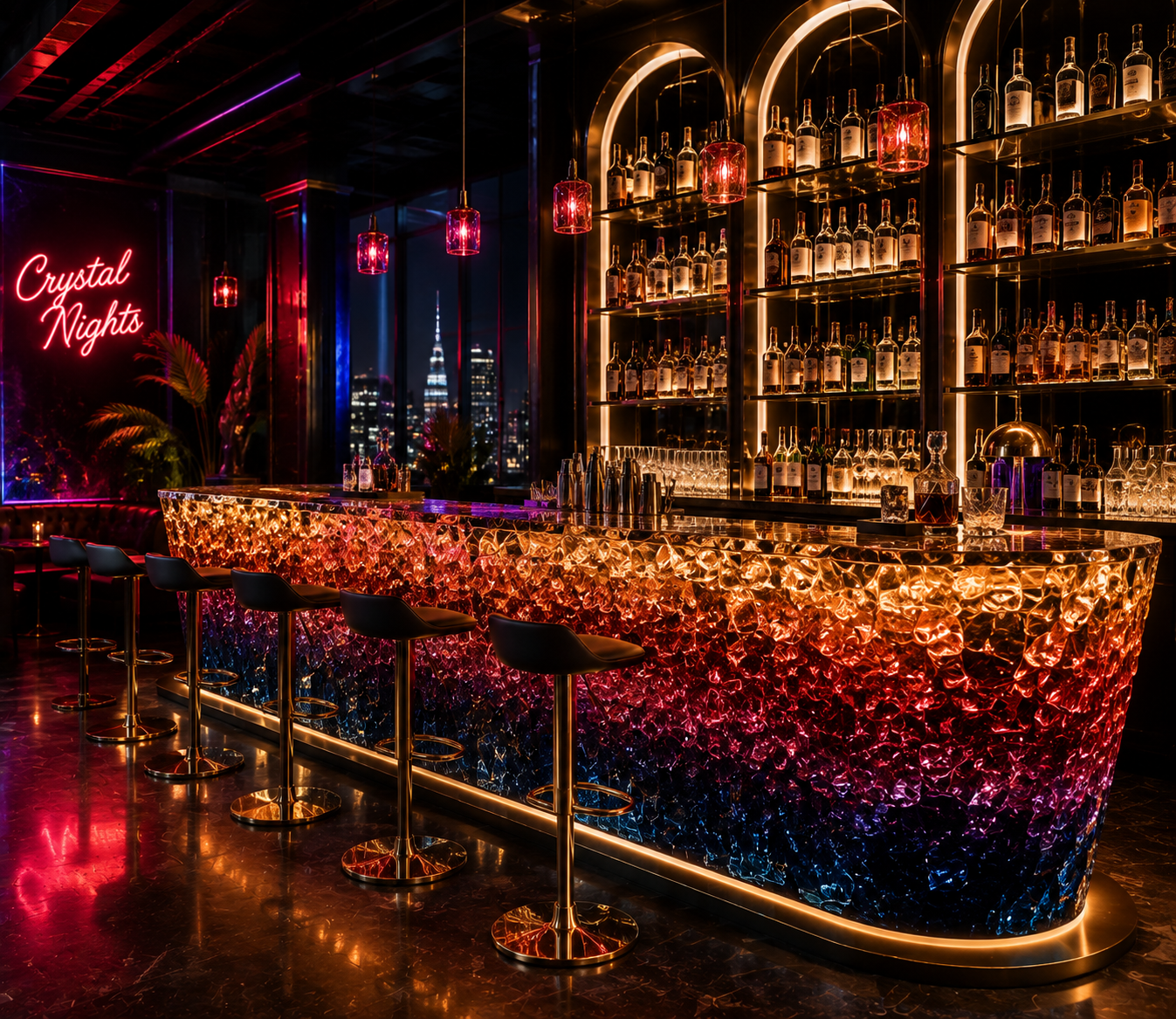
Commercial Use Changes the Meaning of “Durable”
In residential furniture, durability is often discussed in broad terms.
Will the table hold weight?
Will the joints remain stable?
Will the material last for years?
Will the finish stay attractive?
These are still important in hospitality.
But commercial environments add another layer.
The furniture must perform under repetition.
That repetition changes the way wear develops.
A single cleaning cycle is harmless.
Thousands of cleaning cycles matter.
Moving one decorative object across a surface once may leave no visible trace.
Moving the same object twice a day for two years can create a wear pattern.
One guest placing a handbag on a side table is insignificant.
Hundreds of guests doing the same thing every week is different.
Hospitality durability is therefore less about surviving one dramatic event and more about surviving continuous small events.
That distinction should influence how furniture is designed and specified.
One Hundred Uses a Day Is Not an Exaggeration
Consider a busy hotel lobby.
Guests arrive in the morning.
Luggage is placed beside seating areas.
Coffee cups sit on tables.
Phones are put down.
Children touch surfaces.
Staff rearrange decorative objects.
Housekeeping wipes everything.
A meeting group gathers.
Afternoon guests arrive.
Evening drinks begin.
Night staff clean again.
By the end of one day, a transparent coffee table or console may have experienced dozens or even hundreds of individual interactions.
Restaurants can be even more demanding.
A table may be set, used, cleared, wiped, reset, and used again multiple times during a single service.
A host stand may be touched continuously.
A lounge table may receive glasses, menus, plates, handbags, phones, and decorative accessories throughout the day.
This is why hospitality furniture should never be evaluated only by showroom appearance.
It should be evaluated by how that appearance responds to repetition.
The Biggest Challenge Is Often Surface Wear, Not Structural Failure
High-quality synthetic crystal furniture can be engineered to handle substantial structural demands.
In many hospitality applications, the first signs of age are therefore more likely to appear visually than structurally.
Fine surface abrasions.
Cleaning-related haze.
Small scratches.
Marks around frequently used areas.
Changes in gloss.
Localized wear where objects are repeatedly placed.
These are not necessarily signs that the furniture was poorly made.
They are signs that the surface has entered a high-contact environment.
The challenge is managing them intelligently.
In luxury hospitality, the visual standard is often extremely high. A table can remain structurally perfect but still require attention because the surface no longer matches the design expectation of the property.
This is why surface maintenance needs to be considered before installation, not after wear becomes noticeable.
Cleaning Frequency Changes Everything
A private client may clean a coffee table a few times a week.
A hospitality surface may be cleaned several times in a single day.
That difference has enormous consequences.
Cleaning is one of the most common points where material performance and operational behavior meet.
The synthetic crystal itself may be high quality, but inappropriate cleaning methods can still damage the finish over time.
Abrasive cloths.
Dirty cleaning materials.
Improper chemicals.
Repeated dry wiping.
Aggressive scrubbing.
Solvent-containing products.
All can create unnecessary surface problems.
In a commercial setting, the issue is rarely one dramatic mistake.
It is repetition.
A slightly unsuitable cleaning method repeated every day can gradually change a surface that initially looked flawless.
This is why hospitality projects need maintenance protocols, not just care recommendations.
Housekeeping Is Part of the Furniture Specification
This may sound unusual, but for high-end transparent furniture it is true.
The long-term appearance of a piece may depend partly on people who were never involved in the design process.
Housekeepers.
Cleaning contractors.
Restaurant staff.
Facilities teams.
Night maintenance crews.
Banquet staff.
Their daily actions can have as much influence on the appearance of the furniture as the original manufacturing quality.
This is why care instructions need to be practical.
A maintenance guide that stays inside a procurement file is not enough.
The people actually cleaning the furniture need to know what to use, what not to use, and how to handle the surface.
For premium hospitality projects, a short training session or clearly written maintenance procedure can prevent years of unnecessary wear.
The Wrong Cloth Can Become a Design Problem
Transparent furniture exposes cleaning mistakes quickly.
A cloth carrying grit from another surface can create fine abrasions.
A towel used first on stone or metal and then on synthetic crystal may transfer particles.
Repeated circular rubbing with an unsuitable material may alter the visual uniformity of a polished surface.
This is why dedicated cleaning cloths can matter.
It sounds like a small operational detail.
But hospitality quality is often protected by small operational details.
The same principle applies to the entire cleaning system.
Clean tools.
Correct products.
Correct sequence.
Correct pressure.
Correct frequency.
If these are controlled, the furniture has a much better chance of maintaining its original appearance.
Restaurants Create Unique Risks
Restaurants are particularly demanding because furniture is exposed to more than frequent contact.
There are also food and beverage spills.
Condensation from glasses.
Grease.
Sauces.
Wine.
Coffee.
Cleaning chemicals.
Heat from serving items.
Ceramic tableware.
Metal cutlery.
Decorative objects.
And constant resetting.
Each of these creates a different type of interaction.
The furniture may be wiped while still wet.
Items may be dragged rather than lifted during busy service.
Cleaning may happen quickly because the next guest is waiting.
Staff may prioritize speed over ideal handling.
This is not criticism.
It is simply the reality of hospitality operations.
Furniture intended for restaurants therefore needs to be designed around real service behavior rather than ideal behavior.
Design Details Become More Important Under Repetition
A detail that seems minor in a showroom can become significant after thousands of uses.
Consider edges.
An exposed polished edge may look beautiful, but if it sits in a high-contact location it may receive constant impact from bags, chairs, serving equipment, or cleaning tools.
Consider seams.
If a complex joint traps dust or residue, staff may clean it more aggressively.
Consider feet.
If furniture is moved frequently for cleaning, floor contact points need to withstand repeated repositioning.
Consider proportions.
A projecting corner that looks elegant in a rendering may become vulnerable in a busy circulation route.
Consider access.
If a table is difficult to clean around, staff may develop shortcuts that affect both furniture and surrounding finishes.
High-use environments magnify details.
This is why hospitality furniture should be designed not only for appearance, but for behavior.
Furniture Placement Can Matter as Much as Material Choice
A perfectly fabricated piece can age poorly if placed in the wrong location.
For example, a synthetic crystal side table beside a lounge chair may perform well for years.
Place the same table directly in a luggage traffic path and its exposure changes completely.
A transparent console against a wall may experience relatively controlled contact.
Move it into the center of a hotel lobby and it becomes accessible from all directions.
A pedestal used for decorative flowers may remain pristine.
The same pedestal used as an informal drinks ledge may receive constant contact.
This means designers should evaluate use patterns, not just floor plans.
Where will guests walk?
Where will bags be placed?
Where will housekeeping equipment pass?
Where will food and drinks be served?
Where will furniture be moved?
The answers can influence both design and material strategy.
The Most Vulnerable Surface Is Often the One Nobody Discusses
When specifying transparent furniture, people usually focus on the top.
That makes sense.
The top is visible and frequently used.
But other surfaces can experience heavy wear too.
Front edges.
Lower corners.
Chair arms.
Shelf edges.
Base areas near cleaning equipment.
Areas where luggage rests.
Undersides that staff grip when moving furniture.
These contact points should be considered during product development.
Hospitality durability often depends on identifying where human behavior repeatedly touches the furniture.
A good design anticipates those contact zones.
Scratch Resistance Is Only Part of the Question
Buyers often ask, “Will it scratch?”
In a commercial environment, that question is too simple.
Almost any highly finished furniture surface can show signs of repeated use.
A more useful discussion includes several questions.
How easily can minor wear be managed?
What cleaning practices reduce scratching?
Can the surface be professionally restored?
Which parts are most exposed?
Can protective accessories be used in high-contact areas?
How should staff move objects across the surface?
What does the manufacturer recommend after several years of intensive use?
This broader view is more realistic.
The goal is not to pretend wear will never happen.
The goal is to manage wear so the furniture remains visually appropriate for the property.
Repairability Matters More in Hospitality Than in Residential Projects
In a private home, a small scratch may be accepted.
In a luxury hotel lobby, the same scratch may become part of a brand experience.
That changes the threshold for intervention.
Hospitality operators may need furniture that can be maintained, refinished, polished, repaired, or serviced when necessary.
This is where repairability becomes a valuable part of product quality.
A piece that can be professionally restored may have a longer useful visual life than a cheaper piece that needs complete replacement once the surface shows wear.
For high-end projects, that difference can be significant.
Replacing custom furniture is not only a material expense.
It may involve new production, freight, customs, storage, installation, project coordination, and temporary disruption to operations.
Restoration can sometimes provide a more efficient pathway.
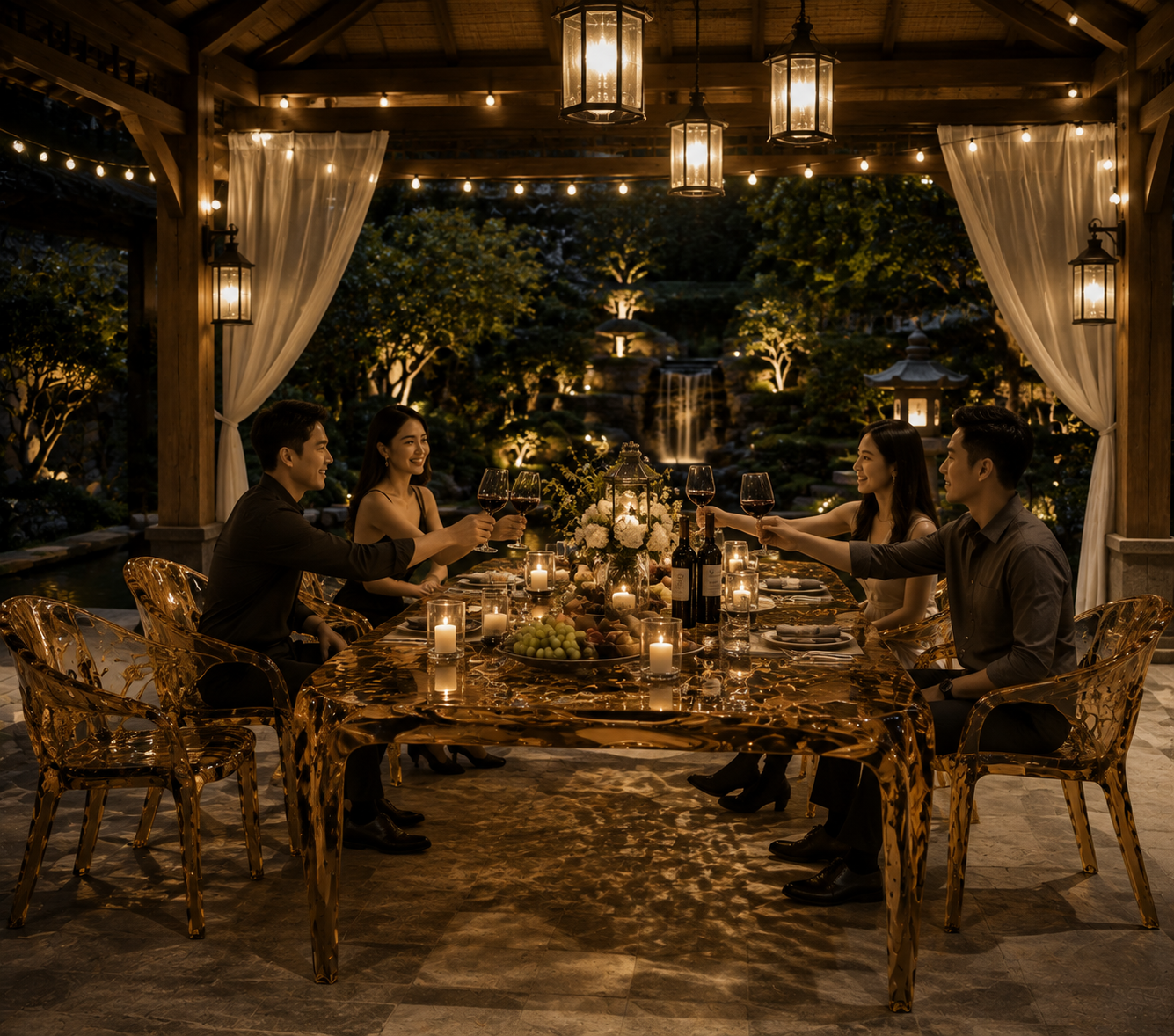
Lifecycle Cost Is More Important Than Purchase Price
Hospitality procurement often begins with unit cost.
But a lower initial price does not necessarily mean lower total cost.
Consider two transparent tables.
One is inexpensive but difficult to maintain and effectively disposable when the surface deteriorates.
The other costs more but has better fabrication quality, more thoughtful detailing, appropriate care guidance, and a realistic restoration pathway.
After five years of intensive use, the second may prove more economical.
This is why lifecycle cost matters.
Purchase price.
Maintenance cost.
Cleaning requirements.
Restoration options.
Replacement frequency.
Freight.
Installation.
Downtime.
All should be considered together.
The most expensive furniture is not always the piece with the highest initial price.
Sometimes it is the piece that needs to be replaced too soon.
High Traffic Makes Consistency More Important
Hotels and restaurants often use furniture in multiples.
Ten side tables.
Twenty dining tables.
Dozens of seating pieces.
Multiple consoles across several floors.
This makes consistency important.
The pieces need to match not only at installation, but through use.
If one table shows wear much faster than the others, the difference becomes visible.
If maintenance procedures vary between departments, appearance may become inconsistent.
If replacement pieces are ordered later, they should integrate with the existing furniture.
For manufacturers, this means documentation and process control matter.
Material consistency.
Finish consistency.
Edge quality.
Construction methods.
Care guidance.
All influence long-term project coherence.
Replacement Parts Can Be Valuable
For certain furniture designs, modularity can improve serviceability.
A replaceable top.
A removable shelf.
Separate hardware.
Independent structural components.
Not every piece should be modular, and many sculptural designs depend on seamless construction.
But where appropriate, replaceable elements can extend service life.
This is especially useful in hospitality projects where one damaged component should not necessarily require replacing an entire piece.
Again, this is a design decision that needs to happen before production.
Serviceability begins at the drawing stage.
Hotels Need Furniture That Can Survive Operational Cleaning
Hotel environments have their own maintenance rhythm.
Lobby tables are cleaned repeatedly.
Housekeeping equipment passes through corridors.
Furniture may be moved during events.
Banquet setups change.
Public areas are refreshed seasonally.
Large groups can transform usage patterns instantly.
The furniture needs to survive not only guests, but hotel operations.
This means stability matters.
Weight matters.
Ease of movement matters.
Surface care matters.
Access for cleaning matters.
If a beautiful object is extremely difficult for staff to maintain, that difficulty eventually becomes visible in the space.
Good hospitality design respects operations.
Restaurants Add Speed to the Equation
The restaurant industry adds another factor:
Time pressure.
During service, staff do not have unlimited time to treat every table like a museum object.
They clear quickly.
They wipe quickly.
They reset quickly.
Furniture that requires excessively delicate daily handling may create a mismatch between product and environment.
High-end synthetic crystal furniture can work beautifully in restaurants, but expectations and maintenance systems need to be realistic.
Protective pads beneath decorative objects can help.
Clear rules about lifting rather than dragging tabletop accessories can help.
Appropriate cleaning products can help.
Staff education can help.
And product design can reduce vulnerable details.
The best result comes when furniture and operations are designed to support each other.
Luxury Does Not Mean Fragile
There is a persistent misconception that luxury furniture should be treated as delicate.
Some pieces are delicate.
But high-end commercial furniture should not rely on constant fear.
Guests should be able to use it.
Staff should be able to maintain it.
The product should have enough structural and visual resilience to operate in the environment for which it was specified.
This is especially important for synthetic crystal furniture.
Its refined transparency can make it appear visually delicate even when the structure is substantial.
A well-engineered piece can combine elegance with real functional strength.
That contrast is part of its appeal.
Hospitality Designers Should Specify the Usage Scenario
One of the best questions a furniture manufacturer can ask is:
“How will this piece actually be used?”
Not simply where will it go.
How will it be used?
Will guests place luggage on it?
Will drinks be served?
Will children interact with it?
Will it be moved every night?
Will it be cleaned five times a day?
Will decorative objects remain in one place?
Will staff use it during events?
Will it sit beside a pool, bar, entrance, elevator, or buffet?
The more accurately the use scenario is understood, the better the furniture can be designed.
Commercial furniture should respond to behavior, not just dimensions.
Mock-Ups Can Be Extremely Valuable
For large hospitality projects, a mock-up or sample installation can reveal issues before full production.
Designers can examine scale.
Lighting.
Surface response.
Cleaning access.
Movement.
Guest interaction.
Traffic flow.
A mock-up may show that a corner is too exposed.
A table may need to move slightly away from circulation.
A cleaning method may need adjustment.
A protective accessory may be recommended.
These are inexpensive discoveries before mass production.
They are expensive discoveries afterward.
Lighting Can Make Wear More Visible
Transparent furniture interacts strongly with lighting.
This means surface wear can become more or less visible depending on the project’s lighting design.
Directional spotlights may reveal fine scratches that disappear under diffuse lighting.
Low-angle daylight may emphasize surface marks.
Warm lighting may soften some visual irregularities.
Bright cool LEDs may make them more apparent.
This is another reason designers and manufacturers should consider the final environment when setting expectations for maintenance.
The same level of wear can look different in two different interiors.
Dark Backgrounds Can Increase Visual Contrast
The background behind clear furniture also matters.
Against pale flooring or walls, certain marks may be less noticeable.
Against dark stone, timber, or textiles, edge definition and surface reflections may become stronger.
This does not mean dark interiors are unsuitable for synthetic crystal.
Quite the opposite.
The contrast can look exceptional.
But it can also make the visual quality of the surface more important.
Hospitality designers should think about furniture, lighting, and background as one optical composition.
Food and Beverage Environments Need Clear Care Procedures
Restaurant operators should ideally know how to respond to common situations.
Spilled coffee.
Wine.
Grease.
Condensation.
Sticky residue.
Food oils.
Cleaning residue.
The appropriate response is usually much simpler when the spill is handled correctly and promptly.
Problems often develop when staff improvise with whatever chemical happens to be nearby.
This is why care guidance should be available where the furniture is actually used.
A premium surface should not depend on staff guessing correctly.
Furniture Movement Is Another Major Source of Wear
Hotels and restaurants move furniture more often than many residential clients realize.
Tables are repositioned.
Private dining rooms are reconfigured.
Lobby furniture is adjusted for events.
Cleaning crews move pieces.
Seasonal displays change.
Repeated movement creates its own risks.
Furniture may be dragged rather than lifted.
Corners may contact walls.
Bases may scrape flooring.
Staff may grip vulnerable areas.
For larger synthetic crystal pieces, proper handling instructions are useful.
Sometimes the most important maintenance rule has nothing to do with cleaning.
It is simply knowing how to move the furniture correctly.
The First Year Should Be Observed Carefully
For important hospitality projects, the first year of operation can provide valuable information.
Where does wear appear first?
Which pieces are moved most often?
Which cleaning teams need additional guidance?
Which surfaces receive unexpected contact?
Are guests using furniture differently from the design assumption?
This feedback can improve both maintenance and future specifications.
Hospitality design is rarely static.
Buildings teach us how people actually use them.
Furniture does too.
A Good Manufacturer Should Be Able to Discuss Real Use
One of the clearest differences between a decorative supplier and a project-oriented furniture manufacturer is the quality of the conversation.
A project manufacturer should be comfortable discussing more than appearance.
Traffic.
Cleaning.
Loads.
Handling.
Installation.
Surface care.
Restoration.
Packaging.
Replacement.
Commercial usage.
These topics are not separate from design.
They are part of design.
For high-end hospitality projects, the supplier should understand that a beautiful piece is expected to perform after the opening photography is finished.
Longevity Is Part of the Guest Experience
Guests may never know what material a table is made from.
They may never ask how it was fabricated.
They may never see the care instructions.
But they experience quality indirectly.
They notice whether a lobby feels polished.
Whether furniture looks tired.
Whether surfaces feel clean.
Whether details appear cared for.
Whether the space still feels premium several years after opening.
This is why maintenance and lifecycle performance ultimately become part of brand experience.
A luxury hotel cannot rely only on expensive materials.
Those materials must continue to look intentional.
Designers Should Think Beyond Opening Day
Hospitality projects naturally focus on launch.
The opening date.
The photography.
The first guests.
The press coverage.
But commercial interiors begin their real life after opening day.
That is when the repeated use starts.
That is when cleaning routines become established.
That is when furniture begins interacting with thousands of people.
The most successful pieces are those that still make sense long after the initial presentation is over.
This is the standard high-end synthetic crystal furniture should be designed to meet.
The Best Commercial Furniture Is Designed for Repetition
A hotel or restaurant does not need furniture that survives one perfect interaction.
It needs furniture that can survive the same interaction again and again.
A glass placed down.
A surface wiped.
A chair moved.
A bag set aside.
A menu picked up.
A guest leaning against an edge.
A staff member rearranging a room.
The individual action is small.
The number of repetitions is enormous.
This is why hospitality quality is often revealed through repetition rather than impact.
The strongest commercial products are not necessarily the ones that appear indestructible.
They are the ones whose design, materials, construction, care strategy, and serviceability all anticipate repeated real-world use.
What Changes When a Piece Is Used 100 Times a Day?
Almost everything becomes more important.
Surface quality becomes maintenance quality.
Cleaning instructions become operational instructions.
Edge design becomes contact management.
Repairability becomes asset management.
Furniture placement becomes risk management.
Manufacturer support becomes lifecycle support.
And purchase price becomes only one part of the cost.
This does not mean synthetic crystal furniture should be avoided in high-use environments.
It means it should be specified intelligently.
Its transparency, visual lightness, sculptural potential, and ability to interact with light can make it exceptionally effective in hotels and restaurants.
But premium hospitality design requires more than beautiful material.
It requires understanding what happens after the hundredth guest, the thousandth cleaning cycle, and the tenth furniture reset.
The question is not whether the piece can look extraordinary on opening day.
The real test is whether the designer, manufacturer, operator, and maintenance team have worked together well enough that it still looks intentional after years of daily contact.
And perhaps that is the most useful way to judge luxury hospitality furniture: not by how perfectly it photographs before the first guest arrives, but by what it still looks like after the ten-thousandth guest has already left.
READ MORE:
- Thicker Is Not Always Better: How Acrylic Thickness Changes Proportion, Weight, Cost, and Visual Quality
- The Hidden Cost of Shipping Transparent Furniture: Why Packaging Quality Is Part of Product Quality
- Why Does the Same Clear Furniture Look Different Under Daylight, Warm Lighting, and Showroom LEDs?
- What Happens After a Scratch? The Repairability of High-End Acrylic Furniture Matters More Than Most Buyers Realize
- Hotel, ristoranti e residenze: come utilizzare il cristallo sintetico nei diversi progetti?
- Come evitare che gli elementi in cristallo risultino kitsch? Tre principi per integrarli negli interni contemporanei
- Anche i piccoli spazi possono sembrare sofisticati: come utilizzare il cristallo sintetico con leggerezza
- Luce + cristallo sintetico: come creare interni con maggiore profondità e stratificazione?
- Oltre la pietra naturale: perché i designer stanno iniziando a guardare al cristallo sintetico?


