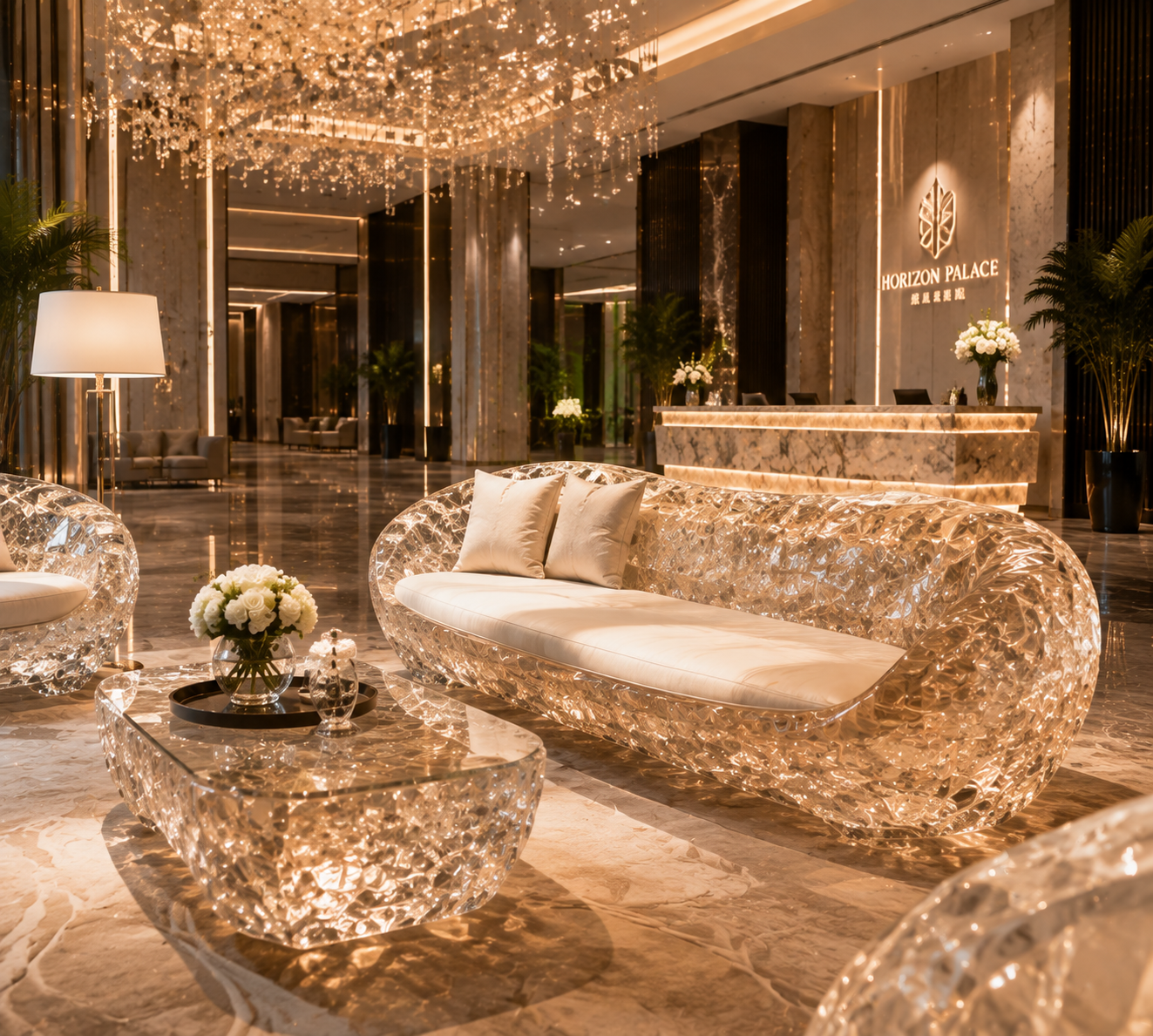
In luxury transparent furniture, thickness is one of the first things buyers notice.
A thick tabletop feels substantial.
A heavy transparent base looks architectural.
A deep synthetic crystal panel catches light differently from a thin one.
And because visual mass is often associated with quality, buyers can easily assume that thicker automatically means better.
But in high-end transparent furniture, that assumption can be misleading.
Thickness affects almost everything.
It changes proportion.
It changes weight.
It changes cost.
It changes fabrication difficulty.
It changes how light travels through the material.
It changes how edges read visually.
It changes how a piece relates to the room around it.
And beyond a certain point, additional thickness may make a design less elegant rather than more luxurious.
This is why experienced designers and manufacturers do not begin with the question, “How thick can we make it?”
They begin with a more useful question:
What thickness does this design actually need?
For high-end synthetic crystal furniture, the best answer is rarely the largest number.
It is the thickness that creates the right balance between structure, proportion, visual clarity, manufacturing logic, and long-term use.

Thickness Is a Design Decision, Not Just a Material Specification
When furniture is made from timber or metal, clients often understand that dimension must relate to structure and scale.
A narrow metal frame can look elegant.
A thick timber slab can feel monumental.
Neither is automatically superior.
Transparent furniture should be understood in the same way.
The thickness of synthetic crystal is part of the visual language of the piece.
A slim console top can feel refined and almost weightless.
A thick top can feel sculptural and substantial.
A thin vertical panel may almost disappear.
A thick vertical panel may become a visible optical volume.
These are different design effects.
The right choice depends on what the furniture is trying to achieve.
Is the piece meant to disappear into the architecture?
Is it supposed to function as a transparent sculpture?
Should it feel delicate?
Should it feel monumental?
Should the viewer notice the material itself, or mainly the objects around it?
Thickness changes the answer.
Why Buyers Associate Thickness With Luxury
There are understandable reasons why thick transparent furniture often feels premium.
Material volume is visible.
The edge becomes more dramatic.
The object feels heavier and more substantial.
Thick sections can create strong internal reflections.
The furniture may look more difficult to manufacture.
And in some cases, thicker components are genuinely required for structural performance.
All of these factors create a psychological association between thickness and value.
But luxury is not simply material quantity.
A beautifully proportioned 30 mm component may look far more sophisticated than an unnecessarily heavy 60 mm component.
The same principle exists in architecture.
A building does not become better because every structural member is oversized.
Good design comes from control.
Furniture is no different.
Proportion Changes Before Strength Becomes the Main Issue
One of the first consequences of increased thickness is visual proportion.
Imagine a transparent console with a very slim overall silhouette.
If the top becomes too thick, it may visually dominate the legs.
If the legs are increased to match, the entire piece becomes heavier.
The geometry shifts.
What began as a light architectural object can quickly become bulky.
The reverse is also true.
A very large dining table with an extremely thin-looking top may feel visually under-scaled, even if the structure performs adequately.
This is why thickness should be considered in relation to total dimensions.
Length matters.
Width matters.
Height matters.
Leg scale matters.
Edge profile matters.
The relationship between components matters.
Good proportion is relational.
A thickness that looks substantial on a small side table may look surprisingly delicate on a three-meter dining table.
Scale Changes the Meaning of Thickness
This is one of the most important ideas in custom furniture.
Numbers do not exist visually by themselves.
Twenty millimeters can look thick in one design and thin in another.
Forty millimeters can feel elegant in one proportion and clumsy in another.
The eye reads relationships.
For example, a compact synthetic crystal pedestal with a thick top may look intentional because the entire object is dense and sculptural.
But apply the same top thickness to a long, narrow console and the top may begin to overpower the rest of the design.
This is why experienced manufacturers often evaluate thickness together with drawings, dimensions, spans, and final use.
Material selection should respond to scale.
More Thickness Means More Weight
This sounds obvious, but the practical consequences are often underestimated.
When the thickness of a transparent component increases, its weight rises significantly because more material is being added across the entire surface area.
For small furniture, that may not matter much.
For large furniture, it can matter enormously.
A thick synthetic crystal dining table top can become very heavy.
That affects handling.
It affects packaging.
It affects freight.
It affects installation.
It affects how many people are needed to move the piece.
It may influence whether the furniture can be carried through stairs or lifted into position safely.
It can even affect whether certain floors, plinths, or support systems need additional consideration.
Weight is therefore not just a manufacturing issue.
It is part of the user experience.
Excessive Weight Can Make Luxury Furniture Less Practical
There is a point where impressive weight becomes inconvenient weight.
This is especially true in hospitality, retail, exhibition, and residential environments where furniture may occasionally need to be moved.
A side table that requires four people to reposition may not be practical.
A console that is too heavy for normal installation equipment can increase project complexity.
A dining table that cannot be moved without specialized handling may become difficult during renovations, floor maintenance, or relocation.
Some clients like the permanence of heavy furniture.
Others need flexibility.
The correct thickness should reflect that reality.
The goal is not to make the furniture as light as possible.
The goal is to avoid unnecessary mass.
Weight Also Changes Shipping Cost
For international furniture projects, thickness affects logistics directly.
More material usually means more weight.
More weight can mean higher freight costs.
It may require stronger crates.
More internal support may be needed.
Handling equipment may change.
Air freight can become significantly more expensive.
Even sea freight can be affected because crate construction and total gross weight increase.
For a single small table, this may be manageable.
For a project involving dozens of pieces, it can become a serious budget consideration.
This is why procurement teams should look beyond unit price.
A thicker piece can increase cost in several stages, not just at the manufacturing stage.
Material Cost Rises Faster Than Buyers Sometimes Expect
When people request a thicker version of a table, they may imagine a relatively small price difference.
But increasing thickness can add a large amount of material.
On a broad surface, even a modest increase can represent a substantial increase in volume.
That added volume influences raw material cost.
It can also influence machining time.
Polishing time.
Handling time.
Crating requirements.
Shipping weight.
Production risk.
In other words, thickness does not affect only one line of the cost structure.
It affects the entire chain.
This is why asking for more thickness “just to make it feel premium” can be an expensive decision if the design does not actually benefit from it.
The Relationship Between Thickness and Strength Is Not Always Linear in Design Terms
Thicker material can increase stiffness and structural capability in many applications.
But furniture engineering is more complex than simply increasing one dimension.
Span length matters.
Support location matters.
Load distribution matters.
Joint design matters.
Orientation matters.
Geometry matters.
How the material is connected matters.
A well-engineered piece can sometimes achieve excellent performance through intelligent structure rather than excessive thickness.
Conversely, adding material without addressing poor structural logic does not automatically create a better product.
This is why structural decisions should come from engineering rather than visual assumption.
Transparent Furniture Makes Thickness Highly Visible
With opaque materials, thickness may be partly concealed.
With synthetic crystal, it becomes a visual event.
The viewer can see through the volume.
Edges reveal depth.
Reflections multiply.
Light travels through the material.
Nearby colors may appear inside the transparent mass.
This makes thickness far more expressive than a simple measurement.
A thick clear edge can look almost jewel-like.
A thinner edge can feel sharper and more architectural.
Neither effect is universally better.
They serve different aesthetics.
Thick Edges Can Become a Major Design Feature
One of the reasons designers choose thick synthetic crystal is the beauty of the edge.
Under daylight, a polished edge can create bright linear highlights.
Under warm lighting, it may appear softer and more luminous.
Under directional LEDs, it can become highly graphic.
The edge may even become more visually noticeable than the broad transparent surface itself.
This can be beautiful.
But it also means that increasing thickness changes the furniture’s personality.
A thicker edge creates stronger visual presence.
If the goal is near invisibility, too much thickness may work against the concept.
Thin Does Not Necessarily Mean Cheap
This is another misconception.
Buyers sometimes associate thin transparent furniture with lower quality because inexpensive products often use thinner material to reduce cost.
But premium thin-section furniture can require exceptional precision.
When the design is intentionally slim, every alignment becomes more visible.
Edges need to be extremely clean.
Joints need to be controlled.
Proportions need to be exact.
Deflection must be considered carefully.
The piece cannot rely on brute mass to create presence.
A refined thin design can therefore be more difficult to execute well than a visually heavy one.
Luxury is not defined by thickness.
It is defined by intention and execution.
Very Thick Material Can Introduce Optical Complexity
Another important factor is visual quality.
As transparent material becomes thicker, light travels through more material.
The viewer may begin to notice subtle changes in tone, internal reflections, edge concentration, and optical depth.
This is not necessarily negative.
In fact, it can create the rich visual character associated with sculptural transparent furniture.
But it means that thickness affects perceived color and clarity.
A thin transparent panel and a very thick block may not appear identical even when produced from the same high-quality material.
The thicker object has more optical depth.
This is one reason material samples should be evaluated at a thickness relevant to the final product.
A Small Sample Can Be Misleading
Imagine selecting synthetic crystal based on a thin sample.
It appears almost perfectly colorless.
Then the final furniture is manufactured using a much thicker section.
The result may appear visually deeper.
Edges may become more noticeable.
Subtle tonal characteristics may become easier to see.
This does not necessarily indicate a quality problem.
It may simply be the optical consequence of increased material thickness.
For important projects, buyers should understand that material appearance is thickness-dependent.
A sample should ideally represent the real application as closely as possible.
Thickness Changes How Color Appears
This becomes especially important with tinted synthetic crystal furniture.
A light smoke tone in a thin sample may become significantly deeper in a thick block.
A subtle amber can become richer.
A pale blue can become more saturated at the edge.
A soft rose tone may appear stronger when viewed through a thicker section.
Designers using color need to account for this.
Selecting a color only from a flat sample may not accurately predict the final visual effect.
Thickness and color work together.
Thickness Can Affect the Balance Between Transparency and Presence
Transparent furniture often succeeds because it sits between visibility and invisibility.
The piece is physically present but visually light.
Thickness controls that balance.
Thin components may allow architecture, flooring, and surrounding furniture to remain dominant.
Thick components may pull more attention toward the synthetic crystal itself.
This can be desirable in a statement piece.
For example, a thick sculptural coffee table can become the focal point of a room without using color or ornament.
But in a delicate interior, the same degree of visual mass may feel excessive.
The material should support the design concept.
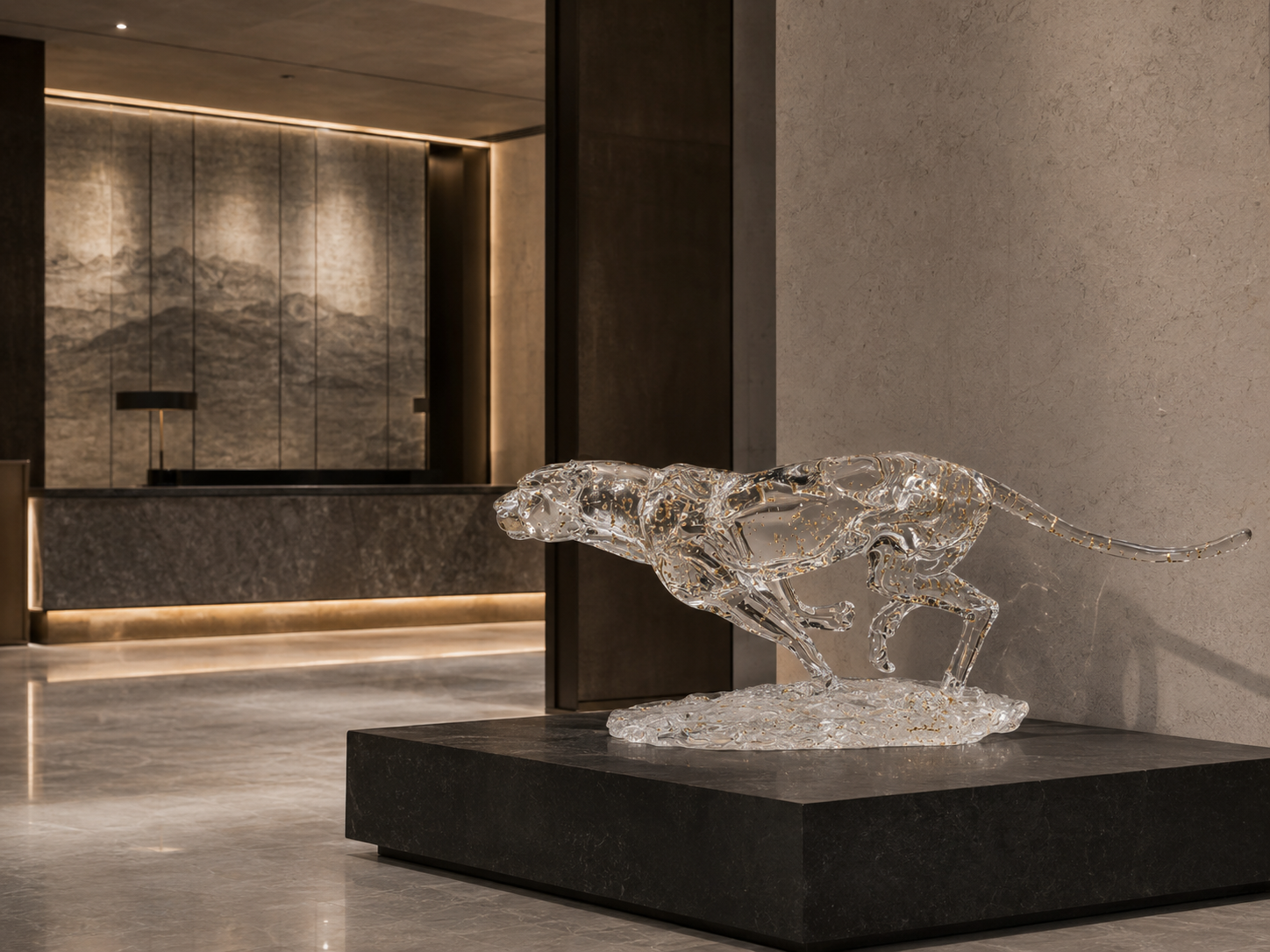
Furniture Should Not Be Thick Everywhere
One sophisticated approach is to vary thickness according to function and visual hierarchy.
Not every component needs the same dimension.
A top may require one thickness.
A structural support may require another.
A decorative element may be slimmer.
An integrated base may be heavier to create stability.
This allows the designer to control both performance and visual balance.
Uniform thickness can sometimes make transparent furniture feel mechanical.
Variation can create refinement.
The key is consistency of intent.
Joint Design Becomes More Important as Components Get Thicker
Large transparent sections can create beautiful seamless-looking structures, but thick components also introduce challenges at joints.
The connection has to handle more weight.
Alignment becomes critical.
Any visual inconsistency may become more noticeable because thick edges amplify the joint area.
Bonding surfaces must be controlled.
Handling during fabrication becomes more difficult.
This is another reason why thicker construction is not automatically easier or better.
It can require more technical skill.
Large Thickness Requires Better Fabrication Control
As material dimensions increase, production becomes more demanding.
Cutting must remain accurate.
Machining must remain stable.
Edges need consistent finishing.
Surfaces need to remain clean.
Heavy components must be handled without damage.
Assembly becomes more difficult.
Polishing can require more time.
Large transparent surfaces can expose small inconsistencies that might be less obvious in opaque furniture.
For high-end synthetic crystal pieces, fabrication quality becomes increasingly important as the scale and thickness increase.
Material alone does not create luxury.
Processing does.
Thickness Can Change the Appearance of Curves
Curved transparent furniture behaves differently from flat furniture.
When material is thick, curves can create strong lens-like visual effects.
Backgrounds may appear distorted.
Reflections may stretch.
Highlights may move dramatically as the viewer changes position.
This can be beautiful in sculptural work.
But it needs to be intentional.
A curve that looks subtle in a thin component can become visually powerful when executed in a thicker section.
Designers should think about optical behavior as well as geometry.
Thick Transparent Furniture Needs Space Around It
A visually substantial synthetic crystal piece often benefits from negative space.
If placed in a crowded room, thick transparent furniture may lose some of its impact.
The object needs light.
It needs viewing distance.
It needs surrounding contrast.
This is especially true for monolithic coffee tables, thick pedestals, sculptural benches, and architectural consoles.
The larger the optical mass, the more the environment matters.
A piece that looks exceptional in a spacious showroom may feel heavier in a compact residential room.
Scale and placement must be considered together.
Minimal Interiors Can Amplify Thickness
In very minimal interiors, every dimension becomes more noticeable.
A thick transparent table in a room with pale stone, simple walls, and limited decoration may appear highly sculptural.
The clarity allows the object to remain visually quiet, but the thickness gives it authority.
This contrast can be extremely effective.
However, if every component is oversized, the refinement can disappear.
Minimalism depends on restraint.
Transparent furniture does too.
Maximum Thickness Can Reduce Elegance
There is often a point where extra material stops adding value.
The table begins to feel too heavy.
The legs look oversized.
The edge dominates the composition.
The piece becomes difficult to move.
The shipping cost rises.
The fabrication complexity increases.
Yet the user may gain little functional benefit.
This is where more becomes less.
High-end design often depends on knowing when to stop.
Designers Should Ask What the Thickness Is Doing
A useful design question is:
What purpose does this thickness serve?
Is it structural?
Is it visual?
Is it optical?
Is it needed for stability?
Is it creating a deliberate monumental effect?
Is it necessary because of the span?
Is it required by the geometry?
If there is no clear answer, the thickness may be unnecessary.
Every dimension in a premium piece should have a reason.
The Same Thickness Does Not Work for Every Product Category
A dining table has different requirements from a side table.
A console has different requirements from a bench.
A display pedestal has different requirements from a chair.
A luggage bench has different requirements from a decorative plinth.
Load, span, contact, usage frequency, scale, and handling all vary.
Therefore, there should not be one universal “luxury thickness.”
The appropriate dimension is product-specific.
This is particularly important in custom manufacturing.
Hospitality Projects Need to Think About Weight Early
Hotels and restaurants should consider the operational consequences of very thick transparent furniture.
Will staff need to move it?
Will banquet teams reposition it?
Will housekeeping clean underneath it?
Will it pass through service elevators?
Will flooring tolerate frequent movement?
Will delivery teams have sufficient equipment?
A piece may look incredible in a rendering but become operationally difficult if these questions are ignored.
Commercial design needs beauty and practicality at the same time.
Residential Buyers Have Different Priorities
A private residence may allow more freedom.
A heavy synthetic crystal dining table may remain in one position for years.
A sculptural coffee table may be selected mainly for visual impact.
Shipping and installation happen once.
In these cases, substantial thickness can be highly successful.
But even residential buyers should consider future relocation.
Can the furniture be moved if the home changes?
Can it pass through doors?
Can it be disassembled?
Will specialized lifting be required?
These questions are easier to answer before the furniture is made.
Cost Should Be Evaluated Against Visual Benefit
In luxury design, spending more is sometimes justified.
But the additional cost should create additional value.
If increasing thickness improves proportion, optical depth, stability, and visual presence, the extra cost may be worthwhile.
If it simply adds weight without improving the design, it may not be.
This is where good specification becomes important.
The goal is not cost reduction.
The goal is value optimization.
Premium furniture should spend material where the material makes a difference.
Thickness Should Be Discussed With the Manufacturer, Not Chosen From Habit
Designers often arrive with a preferred thickness based on previous projects.
That is a useful starting point.
But it should not automatically become the final specification.
Different spans.
Different geometries.
Different assembly methods.
Different usage scenarios.
Different colors.
Different shipping conditions.
All can influence the recommendation.
A manufacturer with real experience in synthetic crystal furniture should be able to explain the consequences of changing thickness.
Not simply quote the price difference.
That conversation is valuable.
A Good Supplier Should Sometimes Recommend Less Material
This may sound counterintuitive from a commercial perspective.
Why would a manufacturer recommend a thinner option if thicker material costs more?
Because a project-oriented manufacturer should be protecting the design, not simply maximizing material volume.
If a proposed thickness makes the furniture visually awkward, excessively heavy, difficult to ship, or unnecessarily expensive, a responsible supplier should say so.
This is one of the ways buyers can identify genuine technical expertise.
The best advice is not always the most expensive advice.
Mock-Ups Can Resolve Thickness Questions Quickly
When proportions are difficult to judge from drawings, physical mock-ups can be extremely useful.
Even partial prototypes can reveal whether an edge feels too heavy.
A sample corner can demonstrate optical depth.
A scaled model can show the relationship between top and legs.
A full-size component can help designers understand weight and visual presence.
This is particularly valuable for custom projects with unusual dimensions.
Some decisions are easier to see than calculate.
Renderings Can Understate Visual Mass
Computer renderings are useful, but transparent materials can be difficult to represent accurately.
Thickness may appear lighter on screen than in reality.
Edges may look cleaner.
Reflections may be simplified.
Optical depth may be reduced.
The material may appear almost invisible even when the final physical object will have substantial presence.
Designers should therefore be careful when approving thickness based only on digital images.
Real material behaves in real light.
Lighting Changes How Thickness Is Perceived
A thick transparent edge can almost disappear under diffuse daylight.
Under directional lighting, it may become extremely bright.
Warm lighting may make the material feel richer.
Cool LEDs may emphasize precision.
Dark backgrounds can make thick edges more visible.
Pale backgrounds can reduce contrast.
This means the same furniture can appear heavier or lighter depending on the room.
Thickness should therefore be evaluated in relation to lighting and context.
The Goal Is Controlled Presence
Perhaps this is the best way to think about synthetic crystal thickness.
The objective is not maximum transparency.
It is not maximum mass.
It is controlled presence.
The furniture should be visible enough to express its design.
Transparent enough to preserve openness.
Substantial enough to feel intentional.
Light enough to remain elegant.
Strong enough for its purpose.
Practical enough to install and use.
This balance is what separates a sophisticated piece from one that simply uses a lot of material.
Luxury Is About Precision, Not Excess
There is a larger design principle here.
Luxury is often misunderstood as more.
More material.
More thickness.
More weight.
More visual impact.
But some of the most refined objects in design history are powerful because nothing is unnecessary.
Every dimension feels considered.
Every proportion feels resolved.
Every material is used deliberately.
High-end synthetic crystal furniture should follow the same principle.
Its value does not come from proving how much material can be used.
Its value comes from using the material intelligently.
The Best Thickness Is the One You Stop Noticing
When a transparent piece is beautifully proportioned, the viewer may never think consciously about thickness.
They simply feel that the furniture looks right.
The top does not feel too heavy.
The legs do not feel too thin.
The edge does not overwhelm the room.
The object has presence without visual weight.
The structure feels believable.
The light behaves beautifully.
That apparent simplicity is often the result of many technical decisions.
Thickness is one of them.
What Should Buyers Ask Before Approving a Thickness?
Instead of asking whether a thicker option is available, buyers should ask what changes when thickness changes.
How much additional weight will it add?
How will the proportion change?
Will the extra thickness improve structural performance?
Will it change the appearance of the color?
Will edge reflections become stronger?
Will freight cost increase significantly?
Will installation require additional equipment?
Will the furniture still suit the scale of the room?
These questions lead to better decisions than simply requesting “the thickest possible version.”
The Real Luxury Is Getting the Proportion Right
A premium transparent piece succeeds when material, geometry, structure, and space feel connected.
Sometimes that requires substantial thickness.
Sometimes it requires restraint.
A monumental synthetic crystal coffee table may need deep material volume to achieve its sculptural identity.
A refined console may need the opposite.
Neither approach is more luxurious by definition.
What matters is whether the thickness serves the concept.
This is why experienced designers rarely judge material dimensions in isolation.
They judge the entire object.
Thicker Is Not Always Better
Thickness can create strength.
It can create optical depth.
It can create visual drama.
It can communicate permanence.
But it can also create unnecessary cost, excessive weight, difficult logistics, awkward proportion, and visual heaviness.
The challenge is not deciding whether thick synthetic crystal is good or bad.
The challenge is understanding when thickness adds genuine value.
High-end furniture should not be designed according to the idea that more material automatically means more quality.
It should be designed according to proportion, function, context, engineering, and visual intent.
The most sophisticated transparent furniture often feels inevitable, as though every dimension could only have been exactly what it is.
And that may be the most revealing question to ask before approving your next custom piece: if removing a few millimeters would make the furniture lighter, more elegant, easier to ship, and just as strong, what exactly are those extra millimeters really adding?
READ MORE:
- Acrylic Furniture in Hotels and Restaurants: What Changes When a Piece Is Used 100 Times a Day?
- The Hidden Cost of Shipping Transparent Furniture: Why Packaging Quality Is Part of Product Quality
- Why Does the Same Clear Furniture Look Different Under Daylight, Warm Lighting, and Showroom LEDs?
- What Happens After a Scratch? The Repairability of High-End Acrylic Furniture Matters More Than Most Buyers Realize
- Hotel, ristoranti e residenze: come utilizzare il cristallo sintetico nei diversi progetti?
- Come evitare che gli elementi in cristallo risultino kitsch? Tre principi per integrarli negli interni contemporanei
- Anche i piccoli spazi possono sembrare sofisticati: come utilizzare il cristallo sintetico con leggerezza
- Luce + cristallo sintetico: come creare interni con maggiore profondità e stratificazione?
- Oltre la pietra naturale: perché i designer stanno iniziando a guardare al cristallo sintetico?


