Introduction
In today’s premium furniture and interior market, product quality alone is no longer enough to guarantee strong brand differentiation.
Many manufacturers can produce well-made tables, chairs, consoles, shelving systems, display units, and decorative furniture. Many brands can offer premium materials, attractive finishes, and competitive specifications. As product standards improve across the market, the difference between one brand and another increasingly depends on something more difficult to copy: a recognizable visual language.
This is where synthetic crystal acrylic furniture has unique potential.
Transparent acrylic furniture is not simply another material category. When it is carefully designed, engineered, polished, proportioned, and customized, it can become a powerful tool for expressing brand identity.
Its transparency creates visual lightness.
Its polished edges interact with light.
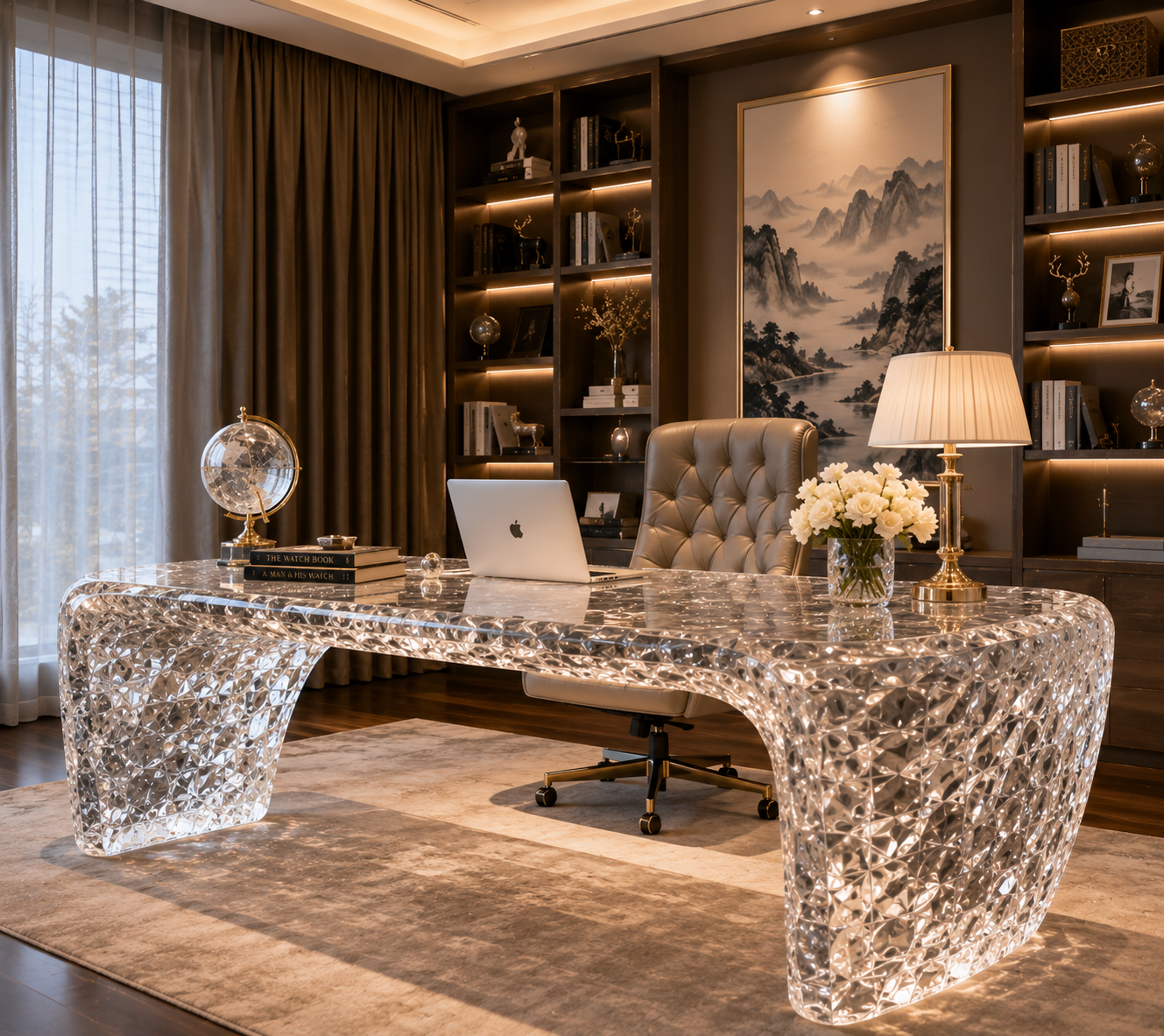
Its thickness produces crystal-like depth.
Its surfaces can appear minimal, futuristic, elegant, artistic, or architectural.
Its form can be customized to match a brand’s personality.
And because it works differently from conventional wood, metal, stone, or upholstered furniture, it can create a visual impression that is immediately distinctive.
For luxury furniture brands, fashion retailers, hotels, galleries, premium showrooms, design studios, property developers, and commercial spaces, this matters.
Consumers may forget technical specifications.
They may not remember the exact thickness of a tabletop or the name of a finishing process.
But they often remember how a space made them feel.
They remember an unusual transparent console at the entrance.
They remember a crystal-like display table under focused lighting.
They remember a sculptural acrylic chair that appeared almost weightless.
They remember the atmosphere.
This is the real value of visual language.
Synthetic crystal acrylic furniture can help a brand move from simply selling products to creating a recognizable design world.
The following six areas explain how this material can become a practical strategy for building stronger brand differentiation.
1. Why Visual Language Has Become a Core Part of Brand Competition
A strong brand is not created only through a logo, name, color palette, or advertising campaign.
It is also created through repeated visual experiences.
For furniture, hospitality, retail, and interior brands, physical environments are especially important because customers interact directly with materials, proportions, surfaces, lighting, and objects.
Products Are Becoming Easier to Compare
Digital marketplaces, social media, international sourcing, and global manufacturing have made product comparison easier than ever.
A buyer searching for a coffee table, console, display pedestal, dining chair, or shelving system can often find hundreds of similar products within minutes.
This creates pressure.
If products look similar, buyers are more likely to compare them mainly by price.
If products look distinctive, the comparison changes.
Customers begin to compare design identity, emotional appeal, craftsmanship, exclusivity, and brand meaning.
This is why unique visual language has become commercially important.
A brand that develops a recognizable acrylic furniture style can reduce direct comparison with generic alternatives.
Visual Identity Creates Faster Recognition
Recognition is one of the foundations of branding.
When customers repeatedly see similar design characteristics, they begin to associate those characteristics with a specific brand.
This could include:
distinctive transparent forms,
thick crystal-like edges,
specific geometric proportions,
sculptural acrylic bases,
polished radius corners,
signature tinted finishes,
combinations of acrylic and metal,
floating visual effects,
or consistent display structures.
Over time, these elements can become recognizable.
The product starts to communicate the brand before the customer even sees the logo.
This is particularly powerful in premium markets.
Luxury brands often rely on subtle recognition rather than excessive branding.
A recognizable silhouette, material combination, or construction detail can communicate identity more effectively than a large printed logo.
Brand Value Is Increasingly Emotional
Premium customers do not only purchase based on function.
They also purchase based on emotion.
They may want furniture that feels sophisticated.
They may want a retail environment that feels exclusive.
They may want a hotel lobby that feels memorable.
They may want a showroom that communicates innovation.
They may want a home that appears modern but not ordinary.
Synthetic crystal acrylic furniture can contribute to these emotional goals because it produces visual effects that are difficult to achieve with conventional materials.
It can look present and absent at the same time.
It can feel substantial while remaining visually light.
It can appear futuristic without becoming cold.
It can look luxurious without relying on traditional decorative language.
These contradictions give designers a large emotional vocabulary.
Differentiation Must Be Difficult to Copy
True brand differentiation should not depend on one isolated feature.
If a competitor can copy it easily, the advantage may disappear quickly.
A stronger strategy is to create a complete system.
For example, a brand may develop a consistent approach involving:
specific acrylic thicknesses,
characteristic proportions,
unique joint details,
custom colors,
signature curves,
metal accents,
lighting integration,
display methods,
and coordinated architectural elements.
Competitors may copy one table.
But copying an entire visual system is much more difficult.
This is how furniture becomes part of brand strategy rather than simply product inventory.
2. Transparency and Light: Building a Recognizable Acrylic Aesthetic
The strongest visual characteristic of synthetic crystal acrylic is its relationship with transparency and light.
This gives brands an opportunity to develop an aesthetic that feels very different from conventional furniture categories.
Transparency Creates a Distinctive Presence
Transparent furniture behaves differently from opaque furniture.
It occupies physical space while allowing visual information to continue through it.
This creates a special effect.
A transparent console may appear almost invisible from one angle but strongly reflective from another.
A thick acrylic table may seem light because it is clear, yet substantial because of its mass.
A transparent chair may allow the architectural background to remain visible, creating a layered composition.
These characteristics make acrylic ideal for brands that want to communicate modernity, purity, precision, experimentation, or luxury.
Light Can Become Part of Brand Design
Lighting and acrylic work naturally together.
Instead of treating lighting as a separate interior element, designers can use it to strengthen the identity of the furniture.
Polished acrylic edges can catch light.
Thick sections can create internal reflections.
Colored transparent acrylic can change character under different lighting temperatures.
Directional spotlights can emphasize edges and forms.
Indirect illumination can create subtle glowing effects.
This means a brand can create a repeatable lighting language around its furniture.
For example, a luxury retail brand could consistently use clear acrylic displays with warm edge lighting.
A technology-focused brand could use thick transparent forms with cooler lighting.
A hospitality brand could combine smoked acrylic with soft indirect illumination.
When these visual patterns appear across multiple locations, they become part of the brand experience.
Crystal-Like Depth Suggests Premium Quality
One of the key advantages of substantial acrylic is its optical depth.
Thin transparent material may appear functional.
Thick, well-finished acrylic can appear sculptural.
This difference is critical.
When edges are polished correctly, thicker acrylic can create a sense of depth similar to crystal.
Light moves through the material.
Reflections appear at the edges.
The furniture changes as the viewer moves around it.
This visual richness can communicate premium value without adding excessive decoration.
For high-end brands, this is particularly useful because modern luxury often favors restraint.
Instead of covering a product with decorative details, the material itself becomes the decoration.
Transparency Can Express Different Brand Personalities
Acrylic does not have only one aesthetic.
Clear acrylic can express purity and modernity.
Smoked acrylic can feel more dramatic.
Warm tinted acrylic can feel elegant and intimate.
Bright colored transparent acrylic can feel artistic or fashion-forward.
Frosted acrylic can feel soft and architectural.
Highly polished thick acrylic can feel luxurious and jewel-like.
This gives brands flexibility.
The same material family can support very different identities.
The important point is consistency.
A brand should not simply use acrylic because it is fashionable.
It should define how acrylic supports its specific personality.
.png)
3. Form, Proportion, and Detail: Turning Furniture Into Brand Symbols
Material alone does not create a brand identity.
Form is equally important.
Two brands can use the same acrylic but create completely different visual languages through shape, proportion, edge treatment, and construction details.
Silhouette Creates Recognition
One of the easiest ways to recognize a product is through silhouette.
A distinctive outline can become a visual signature.
This is common in fashion, automotive design, lighting, and architecture.
It can also be applied to acrylic furniture.
A brand may develop:
a specific curved console profile,
a unique angular table base,
an exaggerated thick slab,
a floating shelf composition,
a recognizable pedestal form,
or a repeated rounded geometry.
When the same design principles appear across several products, the collection becomes coherent.
This coherence creates brand memory.
Proportion Communicates Positioning
Proportion strongly influences how furniture feels.
Thin, delicate acrylic can feel light and minimal.
Thick, oversized acrylic can feel bold and luxurious.
Long horizontal proportions may feel architectural.
Compact geometric forms may feel contemporary.
Soft curves may feel elegant or playful.
The brand should define which proportions support its positioning.
For example, a luxury furniture brand may use thick acrylic and generous dimensions to communicate material richness.
A minimalist brand may use thinner profiles and precise geometry.
A fashion-oriented brand may use exaggerated curves or unexpected forms.
The same material can therefore communicate different levels of energy, refinement, and exclusivity.
Edge Details Can Become Signature Features
Small details can be powerful brand identifiers.
A repeated edge radius, beveled profile, polished corner, embedded hardware detail, or visible connection method can become recognizable.
This is especially important with transparent furniture because construction details remain visible.
Instead of hiding them, designers can turn them into features.
A connection can become part of the aesthetic.
A polished edge can become part of the visual identity.
A metal insert can create contrast.
A layered joint can create depth.
These details make the product feel intentional.
Minimal Forms Require Higher Precision
Simple furniture is often harder to differentiate than decorative furniture.
However, minimal acrylic furniture offers a special advantage.
Because transparency reveals imperfections, high precision becomes visible.
A perfectly aligned joint.
A clean edge.
A balanced thickness.
A smooth curve.
A flawless polished surface.
These details communicate quality even when the design itself is simple.
This makes acrylic especially suitable for brands that want to position themselves around refined minimalism.
The furniture does not need excessive ornament.
Precision becomes the ornament.
4. Customization: Transforming Acrylic Furniture Into a Unique Brand Asset
Customization is one of the strongest tools for brand differentiation.
Standard products can be copied and compared.
Customized design allows a brand to create a more exclusive visual system.
Custom Furniture Can Match Brand Architecture
Retail stores, hotels, restaurants, showrooms, galleries, and offices often have unique architectural environments.
Furniture can be designed specifically for these spaces.
Acrylic tables can match the proportions of a retail floor plan.
Display pedestals can align with wall panels.
Console tables can fit architectural niches.
Shelving systems can follow a merchandising grid.
Reception elements can integrate with lighting or signage.
When furniture is designed as part of the architecture, the entire environment feels more coherent.
This coherence strengthens brand identity.
Custom Color Creates Exclusive Recognition
Color can be extremely powerful.
Even subtle acrylic tints can significantly change the personality of a product.
A brand could develop a signature smoky gray.
Another could use warm amber.
A fashion brand might use transparent red or blue.
A beauty brand could use soft rose tones.
A luxury hospitality project might use bronze-tinted acrylic.
When a color is repeated across displays, furniture, accessories, and architectural elements, it becomes recognizable.
This creates a stronger visual link between the physical space and the brand.
Mixed Materials Expand Brand Expression
Acrylic can be combined with many other materials.
This allows brands to create unique material formulas.
Examples include:
clear acrylic with brushed brass,
smoked acrylic with blackened steel,
crystal acrylic with white marble,
tinted acrylic with stainless steel,
acrylic with walnut,
acrylic with leather,
acrylic with premium upholstery.
A consistent combination can become part of the brand’s design DNA.
For example, a brand known for clear acrylic and polished brass may become visually recognizable through that pairing.
A different brand may use thick smoked acrylic with dark metal for a more architectural identity.
Bespoke Development Creates Exclusivity
Custom development can go beyond dimensions and colors.
Acrylic furniture can be designed specifically around:
product merchandising,
customer circulation,
lighting,
photography,
events,
window displays,
seasonal installations,
hotel guest experiences,
art presentation,
or brand storytelling.
This creates furniture that competitors cannot easily purchase from the same catalog.
The result is stronger exclusivity.
For premium brands, exclusivity supports perceived value.
Customers are more likely to remember a space that contains objects they have not seen elsewhere.
5. Creating Consistent Brand Experiences Across Retail, Hospitality, and Commercial Spaces
A strong visual language becomes more powerful when it can be repeated across multiple touchpoints.
Synthetic crystal acrylic furniture can help create consistency without making every location look identical.
Luxury Retail
In retail, acrylic furniture can support the product rather than compete with it.
Transparent displays allow merchandise to remain visually dominant.
Acrylic platforms can make products appear to float.
Clear shelving can reduce visual clutter.
Crystal-like pedestals can create a more premium presentation.
A brand can repeat these elements across multiple stores.
The exact dimensions may change, but the visual language remains recognizable.
This creates consistency.
Hospitality
Hotels and restaurants depend heavily on atmosphere.
Acrylic furniture can be used in:
lobbies,
suites,
lounges,
bars,
reception areas,
VIP rooms,
restaurants,
spas,
and event spaces.
A hospitality brand can develop signature pieces that appear across different properties.
For example, a distinctive acrylic side table or console may become part of the hotel’s interior identity.
Guests may not consciously recognize the design system, but repeated visual details create familiarity.
Corporate and Commercial Spaces
Companies increasingly use interior design to communicate culture and positioning.
Acrylic furniture can support brands that want to appear innovative, creative, premium, or technologically advanced.
Reception furniture, display systems, meeting areas, product showcases, and decorative installations can all use a consistent acrylic language.
This is particularly relevant for:
technology brands,
design companies,
fashion businesses,
beauty brands,
luxury real estate firms,
creative agencies,
and premium service providers.
Exhibitions and Pop-Up Spaces
Temporary spaces offer another opportunity.
Exhibitions, trade shows, product launches, and pop-up stores need strong visual impact.
Acrylic furniture can create a memorable environment without excessive visual weight.
Because transparent elements work well with lighting and product display, they can adapt to many campaign themes.
A brand can maintain its core acrylic language while changing graphics, products, and colors around it.
This creates both flexibility and consistency.
.png)
6. From Product Design to Brand Memory: How Acrylic Furniture Builds Long-Term Differentiation
The strongest brands are remembered.
This memory does not come from one advertisement or one product.
It comes from repeated, coherent experiences.
Synthetic crystal acrylic furniture can contribute to this process by creating distinctive visual moments.
Memorable Design Creates Emotional Recall
People often remember unusual visual experiences.
A thick transparent table under dramatic lighting.
A curved acrylic display carrying luxury accessories.
A clear chair that almost disappears into the architecture.
A sculptural console reflecting the surrounding interior.
These moments create memory.
If customers repeatedly associate these experiences with one brand, the material becomes part of brand recall.
Distinctive Furniture Strengthens Photography and Digital Content
Physical spaces now exist online as much as offline.
Retail stores, hotels, showrooms, restaurants, and luxury residences are constantly photographed and shared.
This changes the role of furniture.
Furniture must work in person and on camera.
Acrylic furniture is particularly effective in photography because transparency creates depth.
Polished edges catch light.
Reflections add visual complexity.
Background architecture remains visible.
The product can appear different depending on angle and lighting.
This gives brands more opportunities to create distinctive visual content.
Brand Differentiation Can Support Premium Pricing
When products look generic, customers compare prices.
When products feel unique, customers compare value.
Distinctive design can therefore support stronger pricing.
A custom acrylic furniture collection may be more expensive than a standard alternative, but the premium can be justified through:
design exclusivity,
custom dimensions,
craftsmanship,
material quality,
visual impact,
brand consistency,
and customer experience.
This is particularly important for premium markets where emotional value matters.
Consistency Builds Long-Term Equity
A visual language becomes valuable when it is repeated consistently.
This does not mean producing the same furniture forever.
It means maintaining recognizable principles.
A brand can update collections while preserving:
transparency,
crystal-like thickness,
specific proportions,
signature colors,
characteristic curves,
mixed-material combinations,
or distinctive construction details.
Over time, these principles become associated with the brand.
That association is difficult for competitors to replace.
Acrylic Can Become Part of Brand DNA
The ultimate goal is not to make customers think, “This brand uses acrylic.”
The stronger goal is to make them think, “This design feels like that brand.”
At that stage, the material has moved beyond function.
It has become part of identity.
This is how synthetic crystal acrylic furniture can create real competitive differentiation.
Conclusion
Synthetic crystal acrylic furniture offers far more than transparency.
Its true strategic value lies in its ability to create a distinctive visual language.
Through transparency, light, thickness, polished edges, customized forms, material combinations, and carefully controlled proportions, acrylic furniture can help brands build spaces and products that feel recognizable and difficult to imitate.
For furniture brands, this can reduce direct price competition.
For luxury retailers, it can create more memorable product presentation.
For hotels and restaurants, it can strengthen atmosphere.
For commercial brands, it can communicate innovation and sophistication.
For designers and architects, it can become a flexible tool for expressing identity.
Most importantly, synthetic crystal acrylic furniture can connect individual products into a larger brand system.
A table is no longer only a table.
A display pedestal is no longer only a support.
A console is no longer only a functional surface.
Each piece can become part of a repeated visual experience.
And when customers encounter the same design principles across stores, hotels, showrooms, digital content, exhibitions, and products, those principles begin to create memory.
This is where brand differentiation becomes powerful.
Competitors may copy a shape.
They may copy a material.
They may even copy a specific product.
But it is much harder to copy a complete design language that combines material, proportion, craftsmanship, lighting, color, architecture, and brand storytelling.
That is why synthetic crystal acrylic furniture has growing strategic value in the premium market.
It offers brands an opportunity to create furniture that is not only functional and beautiful, but recognizable.
In an increasingly crowded marketplace, recognition is one of the most valuable assets a brand can build.
And when transparency becomes identity, furniture becomes more than a product.
It becomes a visual signature.
READ MORE:
- From Acrylic to Synthetic Crystal: How Can Transparent Furniture Create More Depth and Stronger Product Differentiation?
- How Can Furniture Feel Lighter in Small Spaces? Design Strategies Using Transparent Materials and Synthetic Crystal Elements
- Where Does Synthetic Crystal Furniture Work Best? Applications for Living Rooms, Hotels, Weddings and Commercial Spaces
- How Can Ordinary Furniture Look More Premium? Three Upgrade Directions from Hardware and Materials to Crystal Elements
- Why More Designers Are Paying Attention to Transparent Furniture: From Spatial Perception to Product Premium
- Synthetic Crystal Acrylic Furniture: An Innovative Direction Worth Watching in the Future High-End Furniture Market
- Why Are More High-End Design Projects Choosing Crystal-Grade Acrylic as a Core Material?
- From Transparent Material to Premium Experience: How Synthetic Crystal Acrylic Furniture Enhances Product Value
- Synthetic Crystal Acrylic Furniture: Why Is It Becoming the “Texture Upgrade Solution” for High-End Spaces?


