Introduction
Material selection plays a decisive role in high-end interior design.
In luxury residences, five-star hotels, flagship retail stores, premium showrooms, galleries, restaurants, corporate headquarters, and bespoke commercial projects, designers are no longer choosing materials only according to function or cost. Every surface, structure, and piece of furniture is expected to contribute to the overall spatial experience.
This is one reason crystal-grade acrylic is gaining increasing attention.
For many years, acrylic was often viewed primarily as a practical transparent material. Today, however, advances in material quality, fabrication techniques, polishing, bonding, machining, forming, and customized production have significantly expanded its role.
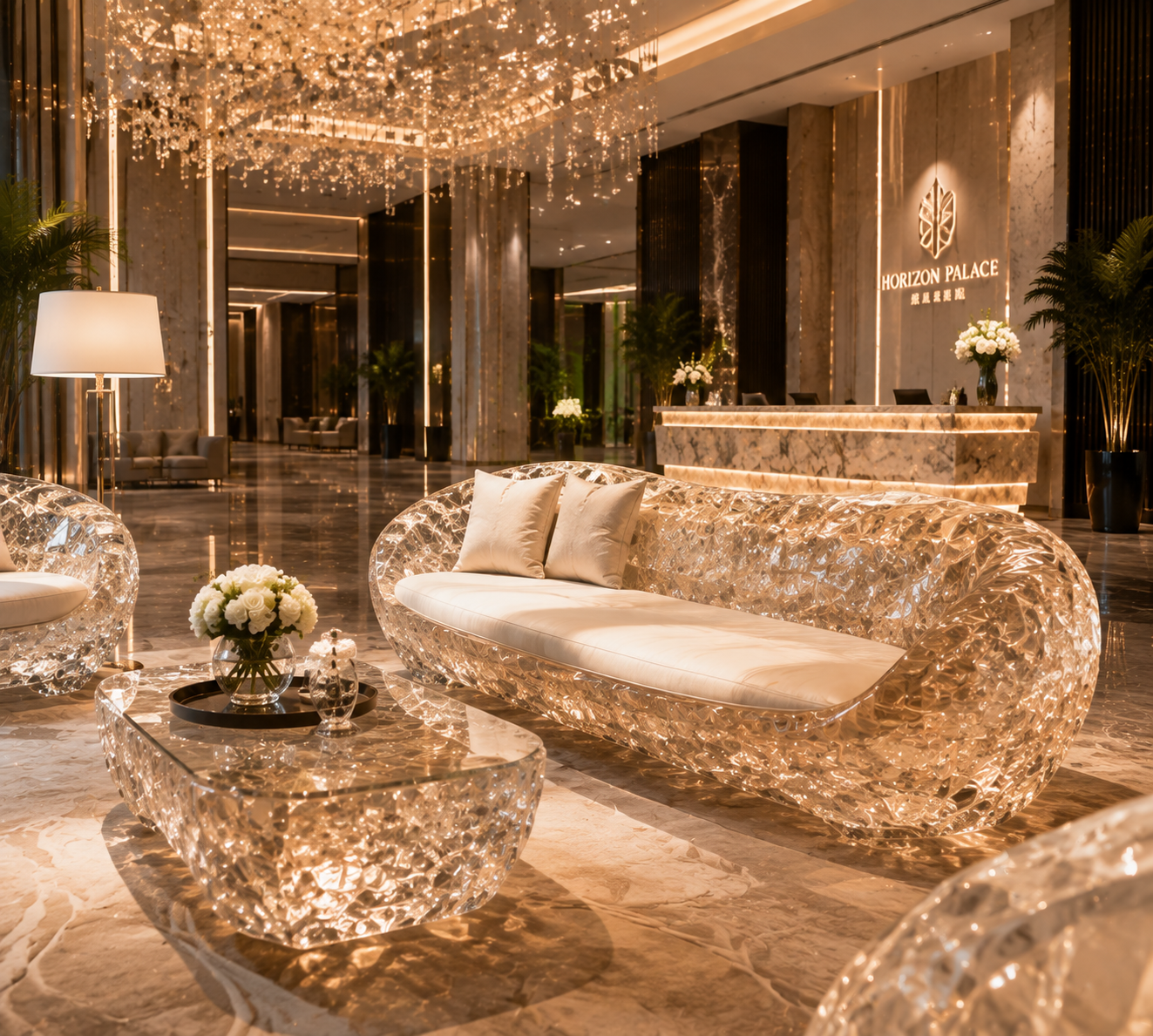
High-quality acrylic can now be used to create furniture and interior elements with exceptional clarity, substantial thickness, refined surfaces, and sophisticated optical depth.
When properly processed, crystal-grade acrylic can appear almost jewel-like.
It can transmit light.
It can reflect surrounding colors.
It can create visual depth without adding unnecessary heaviness.
It can support sculptural forms while preserving a sense of openness.
And unlike many conventional luxury materials, it can visually disappear when designers want the surrounding architecture to remain dominant.
These qualities make crystal-grade acrylic particularly attractive to designers who are searching for a more contemporary definition of luxury.
Modern luxury is increasingly associated with precision, restraint, customization, spatial clarity, material contrast, and memorable experience.
Crystal-grade acrylic responds naturally to all of these priorities.
The material is therefore moving beyond its traditional role as an alternative to glass or plastic sheet.
In many high-end projects, it is becoming a core design material.
The following six areas explain why.
1. Crystal-Grade Acrylic Redefines the Visual Expression of Modern Luxury
Luxury design is changing.
Traditional luxury interiors often emphasized visible richness through dark wood, polished stone, decorative metal, leather, elaborate craftsmanship, and ornamental detail.
These materials remain highly valuable, but contemporary luxury increasingly takes a different direction.
Many premium spaces now prioritize clean architecture, carefully controlled proportions, sophisticated lighting, fewer but better objects, and materials that create atmosphere without overwhelming the room.
Crystal-grade acrylic fits naturally into this design language.
Luxury Without Visual Heaviness
One of acrylic's strongest advantages is its ability to provide physical presence without creating the same visual weight as an opaque material.
Consider a large coffee table.
A solid stone table may create a powerful luxury impression, but it also occupies a significant visual area.
A thick acrylic table can have a similarly substantial scale while remaining visually transparent.
The viewer can still see the rug, flooring, sofa, architecture, and surrounding space through the furniture.
This creates an unusual combination:
material substance without visual heaviness.
For high-end interiors, this balance can be extremely valuable.
The furniture remains important, but the room feels more open.
Minimalism Can Still Feel Expensive
Minimalist design can sometimes appear too simple when materials lack depth.
Crystal-grade acrylic solves this problem by adding complexity through optical behavior rather than decoration.
A transparent table may have a very simple shape, yet the polished edges, internal reflections, light refraction, and thickness create visual richness.
The result is minimal but not empty.
Simple but not ordinary.
Modern but still luxurious.
This is one reason designers can use crystal-grade acrylic in sophisticated interiors without relying on decorative ornament.
The material itself becomes part of the visual experience.
Transparency Communicates Precision
High-end products often communicate quality through detail.
In transparent furniture, details cannot easily be hidden.
The viewer can see edges, joints, thicknesses, connections, alignment, surface quality, and construction methods.
This transparency creates a higher requirement for precision.
When the craftsmanship is excellent, the result can feel highly refined.
Clean joints, carefully polished surfaces, accurate dimensions, and balanced proportions communicate a strong sense of control.
In premium environments, this precision becomes part of the luxury message.
A Contemporary Alternative to Conventional Luxury Materials
Designers are also searching for materials that distinguish new projects from traditional interiors.
If every high-end space uses the same combinations of marble, brass, wood, and upholstery, visual differentiation becomes more difficult.
Crystal-grade acrylic introduces a different character.
It can make familiar materials feel more contemporary.
A marble top supported by transparent acrylic may appear lighter.
Brass details can look warmer and more decorative beside clear acrylic.
Walnut may feel more modern when combined with transparent structural elements.
In this way, acrylic can refresh the visual language of established luxury materials.
2. Exceptional Transparency and Light Interaction Create Stronger Spatial Experiences
High-end design is not only about individual objects.
It is about how people experience the entire space.
Crystal-grade acrylic is particularly valuable because transparency and light interaction can change the perception of an interior.
Transparency Preserves Sightlines
In luxury interiors, architects and designers often invest heavily in flooring, walls, views, artwork, lighting, and custom architectural details.
Opaque furniture can interrupt these elements.
Transparent furniture can preserve them.
For example, a crystal-grade acrylic coffee table placed over a custom rug allows the rug pattern to remain visible.
A transparent console placed in front of a decorative wall minimizes obstruction.
Acrylic dining chairs can reduce visual density around a large table.
Clear display pedestals allow artwork and products to remain the primary focus.
This makes the material ideal for spaces where visual continuity matters.
Light Becomes an Active Design Element
Crystal-grade acrylic does not simply allow light to pass through.
It interacts with light.
Polished edges may become brighter under directional illumination.
Thick acrylic can create internal reflections.
Curved surfaces may distort and redirect light.
Transparent layers can produce subtle optical effects.
During the day, natural light can create changing reflections as the sun moves.
At night, artificial lighting can transform the same furniture into a more dramatic object.
This means acrylic furniture may appear different throughout the day.
The material becomes dynamic rather than static.
Thick Acrylic Creates Crystal-Like Depth
Thickness is one of the factors that separates ordinary transparent products from premium acrylic furniture.
A thin panel may appear functional.
A substantial block of highly polished acrylic can appear architectural.
The larger material depth allows light to travel through the object in more complex ways.
Edges become more visible.
Reflections become more dramatic.
The object gains a stronger three-dimensional presence.
A thick acrylic base may resemble a transparent block of crystal.
A substantial chair leg can look almost sculptural.
A large acrylic slab can create a sense of weight while remaining visually open.
This contradiction is especially appealing in luxury environments.
Acrylic Can Make Spaces Feel Larger
Transparent furniture does not physically enlarge a room, but it can reduce visual interruption.
This is particularly important in high-end urban residences, luxury apartments, hotel suites, boutiques, and compact commercial spaces.
A room filled with opaque objects may feel crowded even when the furniture is appropriately sized.
Replacing selected pieces with transparent acrylic can create a cleaner visual field.
The eye can travel farther.
Flooring appears more continuous.
Architectural lines remain clearer.
The space can therefore feel more open and controlled.
In premium design, this sense of openness contributes directly to perceived quality.

3. Design Flexibility Makes Acrylic Ideal for Bespoke High-End Projects
Customization has become one of the defining characteristics of luxury.
High-end clients increasingly expect furniture and interior elements that respond specifically to their space, brand, lifestyle, or architectural concept.
Crystal-grade acrylic is well suited to this requirement.
Custom Dimensions
Standard furniture does not always work in custom-designed environments.
A console may need to fit precisely between two architectural features.
A hotel lobby may require unusually long tables.
A retail store may need display furniture aligned with a specific merchandising grid.
A luxury residence may require a coffee table designed around a custom sectional sofa.
A gallery may need pedestals tailored to individual artworks.
Acrylic furniture can be developed according to these project-specific requirements.
Width, depth, height, thickness, spacing, and structural configuration can all be customized.
This allows the furniture to become part of the architecture rather than an object added afterward.
Custom Forms
Acrylic also gives designers considerable freedom in form.
Depending on production methods and structural requirements, the material can be used to create:
geometric tables,
curved consoles,
sculptural chairs,
layered display structures,
rounded benches,
transparent shelving,
thick block-like pedestals,
floating visual forms,
nested tables,
decorative installations.
This flexibility is valuable because premium projects increasingly seek unique visual identities.
Designers are not limited to standard rectangular forms.
They can use acrylic to explore a wide range of architectural and artistic expressions.
Custom Color and Transparency
Although clear acrylic is the most recognizable option, luxury projects can also explore different visual effects.
Smoked acrylic can create a more dramatic atmosphere.
Bronze or amber tinting can complement warm interiors.
Soft colors can create a more fashion-oriented appearance.
Frosted surfaces can reduce transparency and create diffusion.
Colored transparent acrylic can be used for artistic or branded environments.
This creates a broad design vocabulary.
The material can adapt to the identity of the project instead of forcing the project to adapt to one fixed appearance.
Custom Details Create Exclusivity
Luxury is often found in details.
Acrylic furniture can be customized through:
polished radius corners,
beveled edges,
embedded metal elements,
special joints,
mixed finishes,
engraved details,
layered construction,
integrated lighting,
custom hardware,
brand-specific proportions.
These details help transform a standard furniture category into a unique product.
For premium clients, this exclusivity creates value.
A bespoke acrylic piece designed specifically for one hotel, residence, boutique, or showroom is far more difficult to compare with mass-produced alternatives.
4. Compatibility With Premium Materials Expands Creative Possibilities
Crystal-grade acrylic is powerful on its own, but one of its greatest strengths is its ability to work with other materials.
This makes it particularly valuable in sophisticated interiors where designers want contrast.
Acrylic and Marble
Marble communicates permanence, natural variation, and physical weight.
Acrylic communicates transparency, lightness, and modern precision.
When combined, the two materials create a strong visual contrast.
A marble tabletop supported by transparent acrylic can appear almost suspended.
An acrylic base can reduce the visual heaviness of a stone surface.
This combination is particularly effective in luxury residential and hospitality interiors.
Acrylic and Metal
Acrylic also works well with brass, stainless steel, bronze, chrome, and other metal finishes.
Brass can introduce warmth and decorative elegance.
Stainless steel can create a cooler contemporary effect.
Dark metal can provide architectural contrast.
Because acrylic is visually neutral, it allows metal details to become more noticeable without creating visual competition.
A carefully designed combination can therefore feel both modern and luxurious.
Acrylic and Wood
Wood brings warmth, grain, and natural character.
Transparent acrylic introduces visual lightness.
Together, they can balance traditional and contemporary design.
Walnut combined with clear acrylic may feel sophisticated and modern.
Light oak paired with transparent acrylic can create a softer minimalist aesthetic.
This is especially useful for designers who want to introduce acrylic without making the interior feel too cold.
Acrylic and Upholstery
Transparent structures can also make upholstered furniture appear lighter.
An acrylic base beneath a bench or chair can create the impression that the upholstered volume is floating.
This approach can work particularly well in bedrooms, dressing rooms, hospitality spaces, and luxury retail environments.
The softness of fabric contrasts with the hardness and clarity of acrylic.
The combination adds material complexity without creating visual heaviness.
Acrylic as a Transitional Material
In many interiors, acrylic can function as a bridge between other materials.
It can connect stone with metal.
It can balance wood with glass.
It can reduce the visual weight between large upholstered pieces.
It can create breathing space between highly decorative elements.
This transitional role is important.
High-end interiors often contain many premium materials.
Without careful control, the result can become visually crowded.
Acrylic can help create balance.
5. Precision, Durability, and Manufacturing Quality Support Professional Project Requirements
Luxury projects demand more than attractive appearance.
Professional designers, architects, developers, procurement teams, and contractors also require consistency, structural reliability, predictable production, appropriate packaging, and long-term support.
Crystal-grade acrylic can meet these expectations when it is engineered and manufactured correctly.
Material Quality Matters
Not all acrylic products create the same result.
High-end applications require careful consideration of material clarity, surface quality, thickness, consistency, and suitability for the intended use.
The difference is especially visible in transparent furniture.
Any cloudiness, uneven finishing, scratches, poorly polished edges, or inaccurate joints may become noticeable.
For this reason, high-quality raw material is the starting point rather than the final guarantee.
The manufacturing process is equally important.
Precision Fabrication Defines the Final Result
Cutting, machining, drilling, forming, bonding, polishing, and assembly all influence the appearance of acrylic furniture.
A premium table with poor alignment will not feel luxurious.
A beautifully designed chair with visible bonding defects will lose perceived value.
A crystal-like pedestal requires precise surface finishing.
Manufacturing quality therefore becomes part of design quality.
For professional buyers, experienced fabrication also reduces project risk.
Structural Engineering Must Match the Application
Acrylic furniture should be designed according to actual usage.
A decorative display pedestal has different requirements from a chair.
A small side table has different structural demands from a long dining table.
Thickness, span, connection points, support geometry, and expected loads should all be evaluated.
When engineering decisions are appropriate, acrylic can provide a strong balance between visual elegance and functional performance.
Maintenance Is Predictable
Like other premium materials, acrylic requires correct care.
Suitable cleaning materials should be used.
Abrasive contact should be minimized.
Appropriate cleaners should be selected.
Protective handling is especially important for polished transparent surfaces.
These requirements are manageable when users receive clear maintenance instructions.
Professional care helps preserve the clarity and finish of the furniture.
Packaging and Logistics Are Part of Quality
Premium acrylic products also need appropriate protection during transportation.
Transparent polished surfaces can reveal handling damage immediately.
Manufacturers therefore need suitable packaging systems.
Depending on the product, this may include protective film, soft wrapping, foam, reinforced corners, custom cartons, or wooden crates.
Good packaging protects not only the furniture but also the customer's perception of the brand.
A premium product should arrive looking premium.

6. From Material Selection to Brand Experience: Why Acrylic Is Becoming a Strategic Design Choice
The most important reason crystal-grade acrylic is gaining popularity may be that it contributes to more than furniture design.
It contributes to experience.
High-end projects increasingly aim to create environments that people remember, photograph, share, and associate with a specific brand or lifestyle.
Crystal-grade acrylic can support these goals.
Luxury Retail Needs Memorable Presentation
Retail environments need furniture that supports the merchandise.
Clear acrylic is particularly effective because it can remain visually quiet while still appearing refined.
Luxury handbags, jewelry, watches, cosmetics, accessories, and fashion products can be displayed on transparent pedestals and tables without unnecessary visual competition.
Products may appear almost suspended.
Lighting can pass around them.
The architecture remains visible.
This can increase the perceived sophistication of the merchandising environment.
Hospitality Brands Need Distinctive Atmospheres
Hotels, restaurants, clubs, and lounges compete through experience.
Furniture is an important part of that experience.
A distinctive acrylic console in a lobby may become part of the hotel's visual identity.
Transparent side tables may make lounge seating feel more spacious.
Custom acrylic installations can interact with lighting to create memorable moments.
These details contribute to atmosphere.
And atmosphere contributes to brand value.
Acrylic Works Well in Photography and Digital Media
Modern interiors are frequently experienced through images before people visit them in person.
A hotel may be discovered through social media.
A restaurant may attract customers through photography.
A retail brand may showcase a flagship store online.
Transparent acrylic performs well in these environments because it can create depth and reflections without completely blocking the background.
Polished edges catch light.
Multiple layers remain visible.
Different camera angles produce different visual effects.
This makes acrylic particularly valuable in spaces designed to be photographed.
The Material Can Become Part of Brand Identity
When used consistently, acrylic can become part of a recognizable design language.
A brand may repeatedly use:
thick crystal-clear forms,
rounded transparent edges,
smoked acrylic,
acrylic with brass,
sculptural clear pedestals,
floating visual structures,
transparent furniture under signature lighting.
Over time, these design principles can become associated with the brand.
At that point, acrylic is no longer simply a construction material.
It becomes part of brand identity.
It Supports Premium Differentiation
Perhaps most importantly, crystal-grade acrylic helps high-end projects differentiate themselves.
Many interiors already use premium stone, metal, wood, leather, and glass.
Acrylic introduces something less conventional.
It can make familiar luxury materials feel new.
It can create unexpected transparency.
It can reduce visual weight.
It can transform lighting.
It can create sculptural objects that feel modern and exclusive.
In highly competitive premium markets, these differences matter.
Clients are not always searching for the most expensive material.
They are searching for the material that produces the most appropriate experience.
Crystal-grade acrylic can often provide exactly that.
Conclusion
The increasing use of crystal-grade acrylic in high-end design projects is not the result of one single advantage.
It is the result of several qualities working together.
The material offers transparency without fragility of visual expression.
It can create substantial forms without creating excessive visual weight.
It interacts with light.
It preserves architectural sightlines.
It supports custom dimensions and sculptural design.
It combines effectively with marble, metal, wood, upholstery, and other premium finishes.
It can be manufactured with exceptional precision.
And it can become part of a complete brand experience.
These qualities are especially relevant to contemporary luxury.
Today's premium spaces increasingly value restraint, personalization, craftsmanship, openness, material contrast, and memorable experiences.
Crystal-grade acrylic responds naturally to these expectations.
For designers, it provides creative freedom.
For architects, it preserves spatial clarity.
For manufacturers, it offers opportunities for customized production.
For luxury retailers, it supports sophisticated merchandising.
For hospitality brands, it contributes to atmosphere.
For homeowners, it creates furniture that feels distinctive without overwhelming the room.
For premium brands, it can become part of a recognizable visual identity.
This explains why more high-end design projects are choosing crystal-grade acrylic as a core material rather than simply an accessory material.
Its value does not come from transparency alone.
Its value comes from what transparency allows designers to achieve.
It can make heavy materials feel lighter.
It can make small spaces feel more open.
It can make simple forms feel more refined.
It can turn lighting into part of the furniture.
It can transform functional objects into sculptural statements.
And it can help a space communicate modern luxury without relying on excessive decoration.
As high-end interior design continues to move toward more personalized, visually controlled, and experience-driven environments, crystal-grade acrylic is likely to become even more important.
The material represents a powerful combination of aesthetics, engineering, customization, and brand potential.
For this reason, choosing crystal-grade acrylic is no longer simply a material decision.
For many premium projects, it is becoming a strategic design decision.
READ MORE:
- From Acrylic to Synthetic Crystal: How Can Transparent Furniture Create More Depth and Stronger Product Differentiation?
- How Can Furniture Feel Lighter in Small Spaces? Design Strategies Using Transparent Materials and Synthetic Crystal Elements
- Where Does Synthetic Crystal Furniture Work Best? Applications for Living Rooms, Hotels, Weddings and Commercial Spaces
- How Can Ordinary Furniture Look More Premium? Three Upgrade Directions from Hardware and Materials to Crystal Elements
- Why More Designers Are Paying Attention to Transparent Furniture: From Spatial Perception to Product Premium
- Synthetic Crystal Acrylic Furniture: An Innovative Direction Worth Watching in the Future High-End Furniture Market
- Synthetic Crystal Acrylic Furniture: Creating Brand Differentiation Through a Distinctive Visual Language
- From Transparent Material to Premium Experience: How Synthetic Crystal Acrylic Furniture Enhances Product Value
- Synthetic Crystal Acrylic Furniture: Why Is It Becoming the “Texture Upgrade Solution” for High-End Spaces?


