Introduction
The high-end furniture market is entering a new stage of development.
For many years, luxury furniture was defined by familiar materials such as solid wood, marble, metal, leather, glass, and premium textiles. These materials remain important, but the market is changing. Designers, architects, luxury brands, hotel developers, retailers, and private clients are increasingly looking for materials that can deliver more than traditional craftsmanship alone.
They want furniture that feels lighter.
More customized.
More visually distinctive.
More suitable for photography and digital media.
More adaptable to different interior styles.
More connected with lighting and technology.
And more capable of supporting unique brand experiences.
This shift is creating new opportunities for synthetic crystal acrylic furniture.
Acrylic has long been used in furniture and display applications, but its role is evolving. High-clarity acrylic, substantial material thickness, advanced polishing, CNC machining, forming, bonding, tinting, digital design, and hybrid construction are allowing manufacturers to create furniture that looks increasingly sophisticated.
The result is a category that can combine transparency with sculpture, minimalism with luxury, precision with customization, and visual lightness with strong material presence.
In the future high-end furniture market, synthetic crystal acrylic furniture is likely to move beyond the simple category of “clear furniture.”
Instead, it may become part of a broader innovation movement involving optical design, mixed materials, smart furniture, custom manufacturing, sustainable development, and brand-specific spatial solutions.
This matters because the furniture market is becoming more competitive.
Mass production is increasingly efficient.
Design trends spread quickly.
Products can be copied rapidly.
Customers have access to more choices than ever before.
Under these conditions, future growth will depend on differentiation.
Brands that can combine material innovation, design creativity, manufacturing capability, and customer experience will have a stronger position.
Synthetic crystal acrylic furniture has the potential to become one of these differentiated categories.
The following six areas represent some of the most important directions worth watching.
1. Material Innovation: From Transparency to Advanced Optical Performance
The first major innovation direction is the material itself.
In the past, acrylic furniture was often valued primarily because it was transparent.
In the future, transparency alone will not be enough.
Premium buyers will expect more sophisticated optical and surface performance.
Higher Clarity and Crystal-Like Depth
One important direction is the continued improvement of visual clarity.
In high-end furniture, the difference between ordinary transparent material and premium crystal-like acrylic can be significant.
High-quality material combined with precision polishing can create a sense of optical depth that feels more like crystal than conventional plastic.
This becomes especially powerful when thicker sections are used.
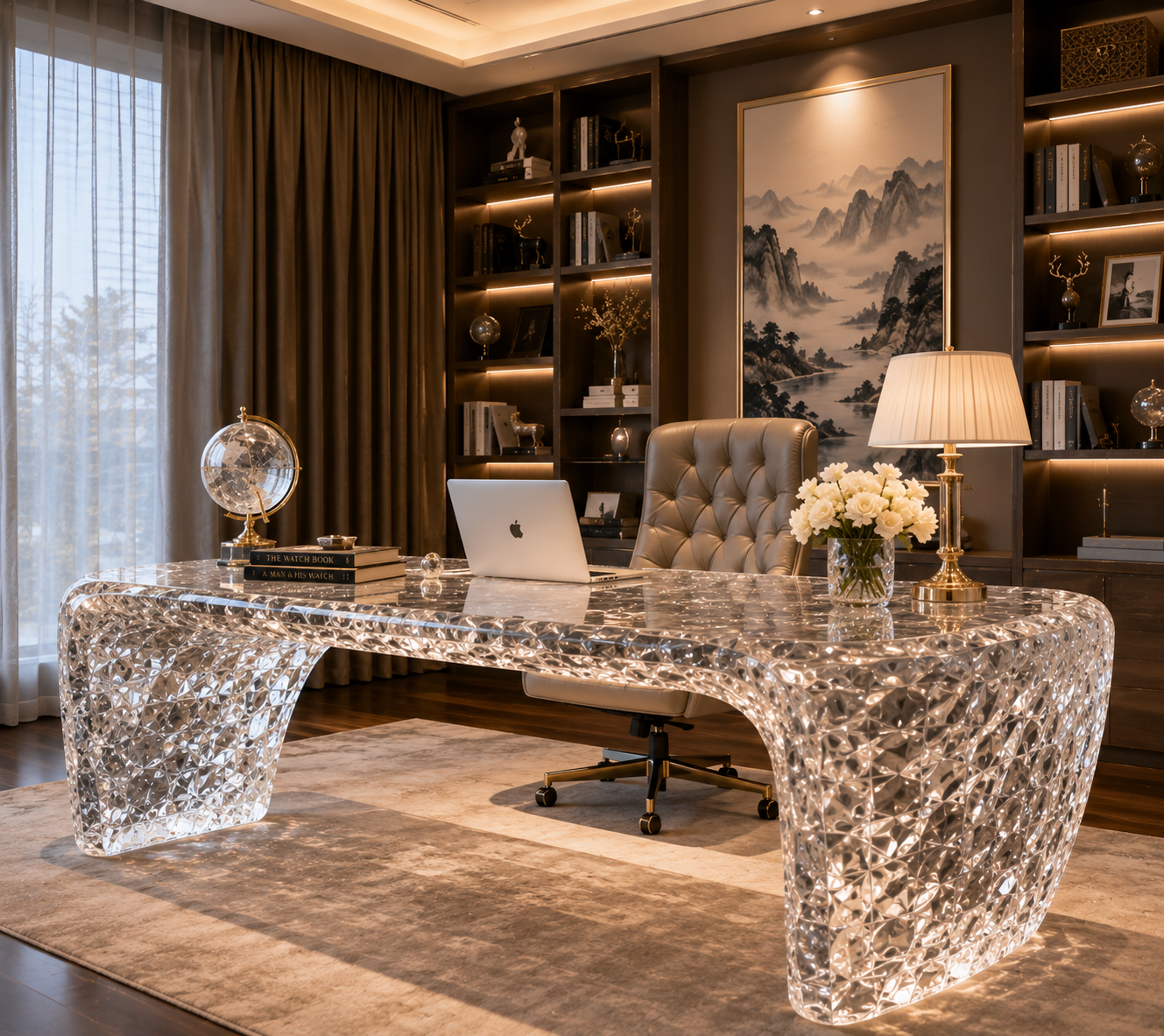
A substantial acrylic table leg can appear like a transparent architectural column.
A large polished block can create jewel-like reflections.
A thick tabletop can produce visual depth along its edges.
These qualities help the material communicate luxury.
In the future, premium acrylic furniture is likely to emphasize clarity, thickness, and optical quality as major selling points.
Tinted and Gradient Acrylic
Clear furniture will remain important, but color is likely to become a larger innovation area.
Designers are already interested in smoked acrylic, warm amber tones, bronze effects, soft gray transparency, artistic colors, and more experimental finishes.
Future products may use:
gradient transparency,
layered color,
two-tone acrylic,
embedded color zones,
frosted transitions,
translucent finishes,
artistic tint combinations.
These effects can help acrylic furniture move beyond a minimalist aesthetic.
A tinted acrylic console may feel more luxurious.
A colored transparent table may work in fashion retail.
A gradient pedestal may become an artistic statement.
This creates new possibilities for both residential and commercial design.
Surface Innovation
Another important area is surface treatment.
High-gloss polished acrylic is the most recognizable finish, but future premium furniture may increasingly explore combinations of polished, frosted, matte, textured, and engraved surfaces.
These combinations create contrast within the same material.
For example, a clear polished structure may be combined with frosted decorative panels.
Acrylic edges may remain highly polished while selected surfaces receive a softer satin finish.
Textured acrylic could introduce a tactile element without losing transparency entirely.
This would expand the emotional range of the material.
Optical Effects as Design Features
Acrylic also has potential for more experimental optical design.
Designers may explore layered transparent structures, internal reflections, distorted views, refracted light, curved optical forms, and embedded decorative details.
Instead of simply making the furniture disappear visually, designers can deliberately use transparency to create optical complexity.
This represents an important shift.
The material is no longer only transparent.
Transparency itself becomes an active design tool.
2. Design Innovation: Sculptural Forms, Mixed Materials, and New Aesthetic Languages
The second major innovation direction is form.
Future acrylic furniture will likely become more sculptural and less dependent on basic geometric shapes.
From Simple Boxes to Sculptural Furniture
Traditional acrylic furniture has often used straightforward forms because they clearly demonstrate transparency.
Tables, consoles, and shelving units were frequently constructed using simple rectangular panels.
This language will continue, but premium designers are likely to push the material toward more expressive shapes.
Future products may include:
curved monolithic tables,
sculptural chair bases,
transparent arches,
layered geometric forms,
asymmetrical consoles,
organic silhouettes,
floating structures,
oversized acrylic blocks,
artistic display furniture.
These designs can turn furniture into visual sculpture.
This is especially relevant in luxury hotels, high-end residences, showrooms, galleries, flagship stores, and branded interiors.
Mixed Materials Will Become More Important
Acrylic is unlikely to dominate future luxury spaces by itself.
Its real power may come from how effectively it combines with other premium materials.
Acrylic and marble can create a contrast between visual lightness and physical weight.
Acrylic and brass can combine modern clarity with warm luxury.
Acrylic and stainless steel can feel architectural and contemporary.
Acrylic and wood can balance transparency with natural warmth.
Acrylic and upholstery can create seating that appears visually lighter.
Acrylic and stone can produce dramatic structural contrast.
Future product design will likely focus more heavily on these hybrid combinations.
Mixed materials allow brands to create more recognizable furniture collections.
They also make acrylic easier to integrate into different interior styles.
A New Language of Modern Luxury
Contemporary luxury is moving away from excessive decoration.
Many premium spaces now emphasize:
material quality,
proportion,
spatial openness,
lighting,
craftsmanship,
custom details,
restraint.
Acrylic fits naturally into this language.
It does not need to be heavily decorated.
A perfectly polished edge can become the detail.
A thick transparent slab can become the focal point.
A carefully controlled curve can create visual identity.
This is particularly important for brands that want to communicate modern luxury rather than traditional luxury.
Furniture as Architecture
Another direction is the increasing overlap between furniture and architecture.
Custom acrylic elements may become integrated into:
reception counters,
partitions,
shelving walls,
feature displays,
benches,
lighting structures,
exhibition installations,
architectural screens.
This could expand the market beyond individual furniture products.
Acrylic manufacturers may increasingly become project solution providers rather than simply furniture suppliers.
.png)
3. Customization and Digital Manufacturing: The Rise of Bespoke Acrylic Furniture
Customization is already important in the luxury market, but it is likely to become even more central.
Premium customers increasingly expect products that are designed specifically for their space, brand, project, or lifestyle.
Synthetic crystal acrylic furniture is well positioned for this trend.
Custom Dimensions Will Become Standard in Premium Projects
High-end interiors often have unique architectural conditions.
Standard furniture dimensions may not work.
A luxury residence may require a coffee table designed around a custom sofa.
A hotel lobby may require an unusually long console.
A boutique may need displays tailored to product dimensions.
A gallery may require custom pedestals for specific artworks.
Acrylic furniture can be manufactured according to these needs.
As digital measurement, 3D modeling, and CNC production become more accessible, custom dimensions may become faster and more efficient.
Digital Design Enables More Complex Forms
Modern manufacturing tools allow designers to develop more sophisticated acrylic structures.
3D modeling can help test proportions.
Digital fabrication can improve accuracy.
CNC machining can create precise curves, joints, holes, recesses, and structural components.
This allows more complex designs to move from concept to production.
Future acrylic furniture may therefore become more technically ambitious.
Rapid Prototyping Supports Innovation
Luxury projects often require samples and prototypes before final production.
Digital manufacturing can make this process more efficient.
Designers can test:
scale,
thickness,
color,
edge treatment,
joint methods,
mixed-material connections,
structural balance.
This reduces risk.
It also helps brands develop more original collections.
A prototype can reveal visual or structural problems before full production begins.
Small-Batch Luxury Production
The future premium furniture market may rely less on very large production runs.
Instead, limited editions and smaller custom series may become more valuable.
Synthetic crystal acrylic furniture is suitable for this model.
A brand could produce a limited collection for one hotel.
A retailer could create exclusive acrylic displays for one flagship store.
A furniture company could launch a numbered series of sculptural transparent tables.
Small-batch manufacturing supports exclusivity.
Exclusivity supports premium positioning.
Personalization Creates Emotional Value
Customization is not only technical.
It creates emotional connection.
Customers are more likely to value a product designed specifically for them.
This may include:
custom dimensions,
personalized colors,
engraved details,
unique material combinations,
project-specific forms,
limited-edition designs.
In the high-end market, emotional value can be just as important as functional value.
4. Smart Integration: Lighting, Technology, and Interactive Furniture Experiences
One of the most exciting future directions is the integration of technology.
Acrylic is particularly suitable for this because it interacts strongly with light.
Integrated Lighting
Transparent furniture can become more dynamic when lighting is integrated into the design.
LED systems can highlight edges.
Indirect light can make thick acrylic glow.
Colored lighting can change the mood of the furniture.
Light can be integrated into pedestals, tables, shelves, counters, and display structures.
This has strong potential in:
luxury retail,
hospitality,
entertainment spaces,
exhibitions,
galleries,
branded interiors.
The furniture becomes part of the lighting design.
Programmable Visual Effects
Future furniture may use programmable lighting to change appearance according to time, event, season, or brand campaign.
A boutique display could shift color during a product launch.
A hotel bar could change lighting throughout the evening.
An exhibition pedestal could respond to different artworks.
Acrylic provides an ideal medium because light can travel through and around the material.
Interactive Retail Furniture
Luxury retail is increasingly focused on experience.
Furniture may become part of interactive merchandising.
Future acrylic displays could potentially integrate:
digital screens,
sensors,
lighting controls,
interactive product information,
wireless charging,
hidden electronic components.
The transparency of acrylic can create a futuristic visual language suitable for beauty, fashion, jewelry, technology, and automotive retail.
Smart Residential Furniture
Technology integration may also appear in residential furniture.
Acrylic side tables could include wireless charging.
Consoles could integrate hidden lighting.
Display shelving could use sensor-controlled illumination.
Home bars or entertainment furniture could combine transparent structures with smart lighting systems.
These features could help acrylic furniture move into a new category of premium functional design.
Technology Should Remain Invisible
The most successful luxury technology is often subtle.
Cables, sensors, and electronic components should not destroy the clean appearance of the furniture.
This creates a technical challenge.
But it also creates an opportunity.
Manufacturers that can integrate technology while preserving the crystal-like purity of the material may develop a strong competitive advantage.
5. Sustainability and Lifecycle Value: A New Standard for Premium Furniture
Sustainability will increasingly influence luxury furniture purchasing.
High-end customers, architects, developers, and hospitality brands are paying greater attention to material responsibility, product longevity, repairability, packaging, and lifecycle value.
Acrylic furniture will need to respond to these expectations.
Longevity Is Part of Sustainability
Sustainable furniture is not only about recycled content.
A product that remains useful for many years also creates value.
Clear acrylic furniture has an advantage because its visual neutrality allows it to adapt to different interior styles.
A transparent side table can work in a warm interior today and a cooler minimalist interior in the future.
This flexibility may extend the design life of the product.
Repair and Refinishing
Depending on the surface condition, some acrylic products may be polished or professionally refinished.
This can potentially extend product life.
Instead of replacing furniture because of minor surface issues, owners may be able to restore it.
Future premium brands could turn this into a service.
Professional refinishing, maintenance, and refurbishment could become part of after-sales support.
Responsible Manufacturing
Manufacturers may also focus more on:
reducing material waste,
improving cutting efficiency,
recycling production offcuts where feasible,
optimizing energy use,
reducing unnecessary packaging,
developing more efficient production processes.
In premium markets, manufacturing transparency may become part of brand storytelling.
Packaging Innovation
Acrylic furniture requires strong surface protection during shipping.
This can create significant packaging demand.
Future suppliers may need to develop packaging systems that balance product protection with reduced material waste.
Reusable crates, optimized foam structures, recyclable packaging materials, and smarter transport design may become more important.
Sustainability as a Luxury Value
Luxury is increasingly being redefined.
In the future, premium products may be judged not only by how expensive they look, but also by how intelligently they are made.
A beautifully designed product with a long useful life, repair potential, efficient production, and responsible packaging may have stronger market value.
This creates a new opportunity for acrylic furniture brands to combine aesthetics with lifecycle thinking.
.png)
6. Market Transformation: Why Acrylic Furniture May Become a Strategic Growth Category
The final innovation direction is market positioning.
Synthetic crystal acrylic furniture may develop from a niche category into a broader strategic segment of premium furniture.
Several market forces support this possibility.
Luxury Customers Want Distinction
The premium market depends on differentiation.
Customers do not want spaces that look identical to everyone else's.
They want furniture that feels distinctive.
Acrylic offers an immediate visual difference compared with traditional wood, stone, or metal furniture.
When designed well, this difference can create stronger emotional impact.
Designers Want Flexible Materials
Interior designers need materials that can adapt to many concepts.
Acrylic can support minimalist, artistic, modern, glamorous, futuristic, and luxury environments.
Its ability to combine with other materials makes it even more flexible.
This increases its usefulness across different projects.
Hospitality Needs Memorable Experiences
Hotels and restaurants compete through atmosphere.
Furniture helps create that atmosphere.
A custom acrylic console, illuminated pedestal, transparent bar element, or sculptural table can become a memorable feature.
As hospitality brands invest more in distinctive interiors, demand for custom materials may grow.
Retail Needs Visually Strong Displays
Luxury retail is becoming increasingly experience-driven.
Furniture must support both physical shopping and digital photography.
Transparent furniture performs well in this environment.
It allows merchandise to remain visible.
It interacts with lighting.
It can appear sophisticated on camera.
This makes acrylic particularly relevant to fashion, jewelry, beauty, watches, accessories, and premium lifestyle retail.
Social Media Rewards Photogenic Design
Furniture is no longer experienced only in physical spaces.
It also appears in photography, video, social media, brand campaigns, and digital portfolios.
Acrylic has strong visual potential in these formats.
Reflections, transparency, light, and layered depth can create images that look distinctive.
This can increase the marketing value of the furniture.
Manufacturers Can Move Up the Value Chain
For manufacturers, acrylic furniture offers an opportunity to move away from simple product competition.
Instead of competing only on price, suppliers can compete through:
material quality,
custom design,
engineering,
polishing,
complex fabrication,
lighting integration,
project service,
prototyping,
packaging,
installation support.
This changes the business model.
The supplier becomes a design and project partner.
That can support higher-value customer relationships.
A Strategic Category for Premium Brands
For furniture brands, acrylic can also become part of a distinctive collection strategy.
A brand may develop a recognizable series based on:
thick transparent structures,
signature colors,
sculptural forms,
mixed materials,
limited editions,
integrated lighting,
artistic collaborations.
This can help build long-term identity.
The strongest opportunity is not simply to sell acrylic furniture.
It is to build a recognizable design language around it.
Conclusion
Synthetic crystal acrylic furniture is entering an important period of innovation.
The category is no longer defined only by transparency.
Its future value will come from how successfully manufacturers and designers combine material quality, optical performance, sculptural design, customization, technology, sustainability, and brand experience.
Material innovation can create greater clarity, color depth, surface contrast, and optical effects.
Design innovation can turn simple transparent furniture into sculptural objects.
Digital manufacturing can make customized production more efficient.
Smart lighting and technology can create interactive experiences.
Lifecycle thinking can strengthen long-term product value.
And premium market trends can position acrylic furniture as a differentiated category rather than a niche alternative.
This is why synthetic crystal acrylic furniture deserves attention in the future high-end furniture market.
It responds to several important changes happening at the same time.
Customers want personalization.
Designers want flexible materials.
Luxury brands want stronger visual identity.
Hotels want memorable experiences.
Retailers want photogenic environments.
Manufacturers want higher-value products.
Acrylic has the potential to connect all of these demands.
Its greatest strength is its versatility.
It can disappear visually or become the focal point.
It can look minimal or artistic.
It can feel light or substantial.
It can work alone or combine with marble, metal, wood, upholstery, and lighting.
It can serve residential, hospitality, retail, commercial, gallery, and exhibition environments.
This flexibility gives it long-term innovation potential.
The next generation of acrylic furniture will likely look very different from the simple transparent products of the past.
It may become more sculptural.
More colorful.
More customized.
More integrated with technology.
More sustainable.
More closely connected with architecture and brand experience.
For designers, this creates a new creative platform.
For manufacturers, it creates a new premium product direction.
For brands, it creates an opportunity for differentiation.
For buyers, it creates access to furniture that is more personalized and visually distinctive.
The future of high-end furniture will not be defined by one material alone.
But synthetic crystal acrylic is likely to become one of the materials worth watching closely.
Its combination of transparency, precision, customization, technology, and visual impact gives it a unique position.
And as luxury furniture continues to evolve from product ownership toward complete spatial and emotional experience, synthetic crystal acrylic furniture may become an increasingly important part of that transformation.
READ MORE:
- From Acrylic to Synthetic Crystal: How Can Transparent Furniture Create More Depth and Stronger Product Differentiation?
- How Can Furniture Feel Lighter in Small Spaces? Design Strategies Using Transparent Materials and Synthetic Crystal Elements
- Where Does Synthetic Crystal Furniture Work Best? Applications for Living Rooms, Hotels, Weddings and Commercial Spaces
- How Can Ordinary Furniture Look More Premium? Three Upgrade Directions from Hardware and Materials to Crystal Elements
- Why More Designers Are Paying Attention to Transparent Furniture: From Spatial Perception to Product Premium
- Why Are More High-End Design Projects Choosing Crystal-Grade Acrylic as a Core Material?
- Synthetic Crystal Acrylic Furniture: Creating Brand Differentiation Through a Distinctive Visual Language
- From Transparent Material to Premium Experience: How Synthetic Crystal Acrylic Furniture Enhances Product Value
- Synthetic Crystal Acrylic Furniture: Why Is It Becoming the “Texture Upgrade Solution” for High-End Spaces?


