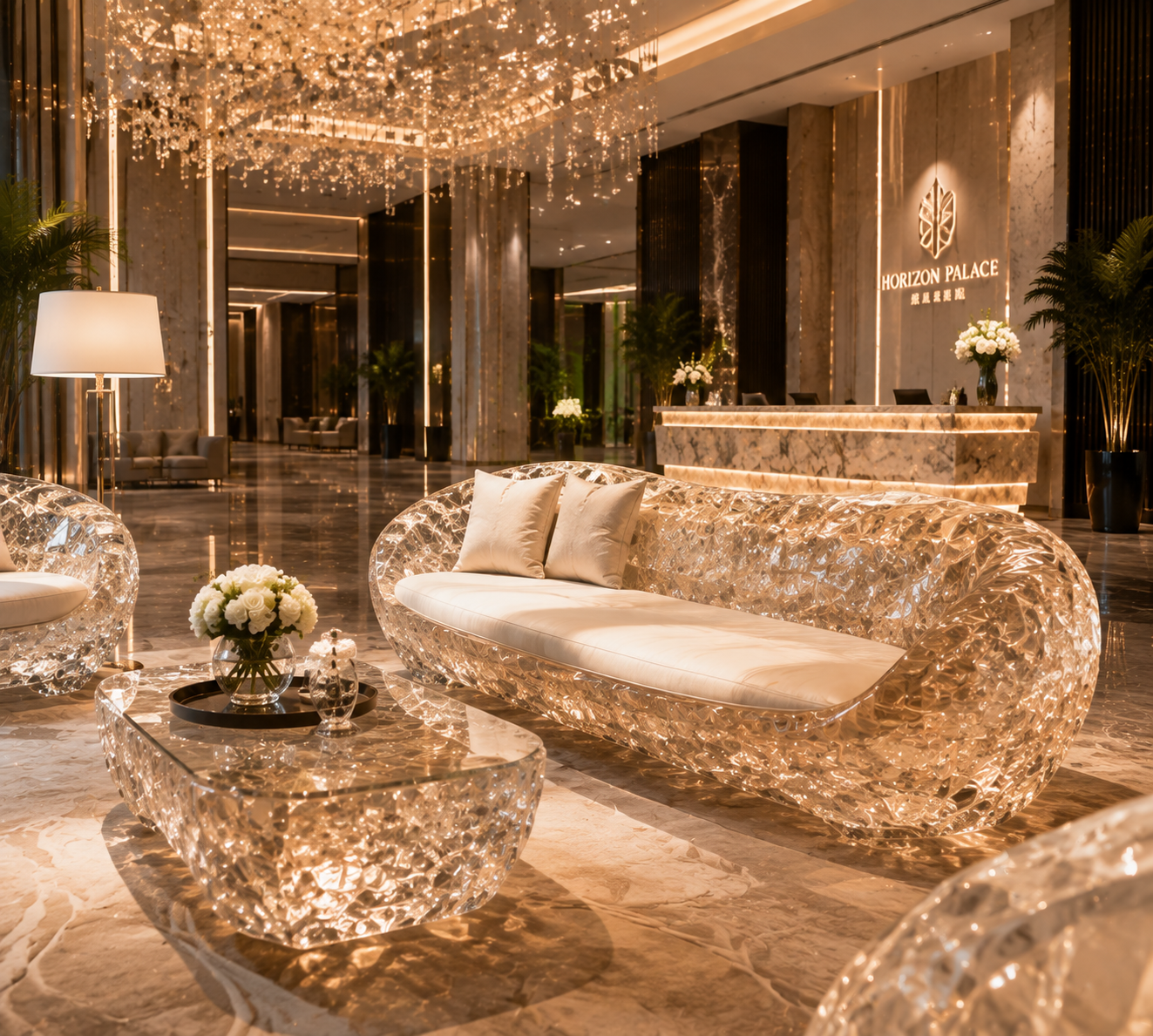
Transparent furniture is no longer simply associated with the “invisible chair” or the minimalist acrylic table that became popular in contemporary interiors decades ago. A more sophisticated shift is taking place. Designers are increasingly exploring transparency as a spatial device, an optical material, a storytelling medium, and, in the right context, a way to create higher-value furniture.
This shift can be seen across residential interiors, luxury retail, hospitality projects and collectible design. Clear acrylic, colored resin, synthetic crystal-style casting and other high-clarity materials are being used not simply because they look modern, but because they interact with architecture differently from conventional wood, stone or metal furniture.
For manufacturers working with synthetic crystal, premium resin and high-clarity or platinum-grade acrylic furniture, this creates an important opportunity. The real value of these materials is not “they are transparent.” The value lies in what transparency allows a designer to do with light, volume, visual weight and customization.
Understanding that distinction is also the key to understanding why some transparent furniture remains a commodity while other pieces achieve significant product premiums.
1. Transparency Is Becoming a Spatial Tool, Not Just a Furniture Style
One of the most practical reasons designers use transparent furniture is simple: furniture occupies physical space, but it does not necessarily have to occupy the same amount of visual space.
A solid dark console, cabinet or coffee table creates an obvious visual boundary. A transparent console of the same dimensions can perform the same physical function while allowing flooring, wall finishes, rugs, artwork and architectural details to remain visible through the object. The furniture is still present, but its perceived visual mass is reduced.
Research supports the broader relationship between furniture and perceived spaciousness. A study published in PLOS ONE examined how furnishing influences the perceived dimensions and spaciousness of interior environments. In one experiment, furnished model rooms were judged as less spacious than unfurnished rooms, although the effect was not reproduced in the study’s virtual-reality experiment. The researchers therefore highlighted the importance of context and perception rather than suggesting a simple universal rule.
More directly relevant to transparent design, a 2025 study published in the Journal of the Korea Furniture Society surveyed 180 respondents to investigate visual experiences created by transparent materials. The researchers identified effects including visual ambiguity, refraction, illusion, spatial expansion and depth. Importantly, they concluded that transparency alone was not enough: the strongest spatial effects depended on the interaction of transparency with light, structural layering and the surrounding environment.
This distinction matters enormously for furniture design. A transparent table should not simply be thought of as a table made from clear material. It can become part of the visual architecture of a room.
Consider a luxury apartment with highly figured marble flooring. A conventional solid coffee table may cover one of the most expensive surfaces in the project. A high-clarity acrylic or synthetic crystal coffee table allows the floor to remain visually continuous. In a hotel lobby, a transparent console can provide functional display space without creating another heavy horizontal barrier. In a compact urban residence, transparent side tables and benches can preserve long sightlines that make the interior feel less congested.
Designers are therefore not necessarily choosing transparency because they want furniture to disappear. They are choosing it because they want greater control over what remains visually dominant in the room.
2. Light Turns Transparent Furniture into an Active Material
The second reason transparent furniture is becoming more interesting is that light changes its appearance throughout the day.
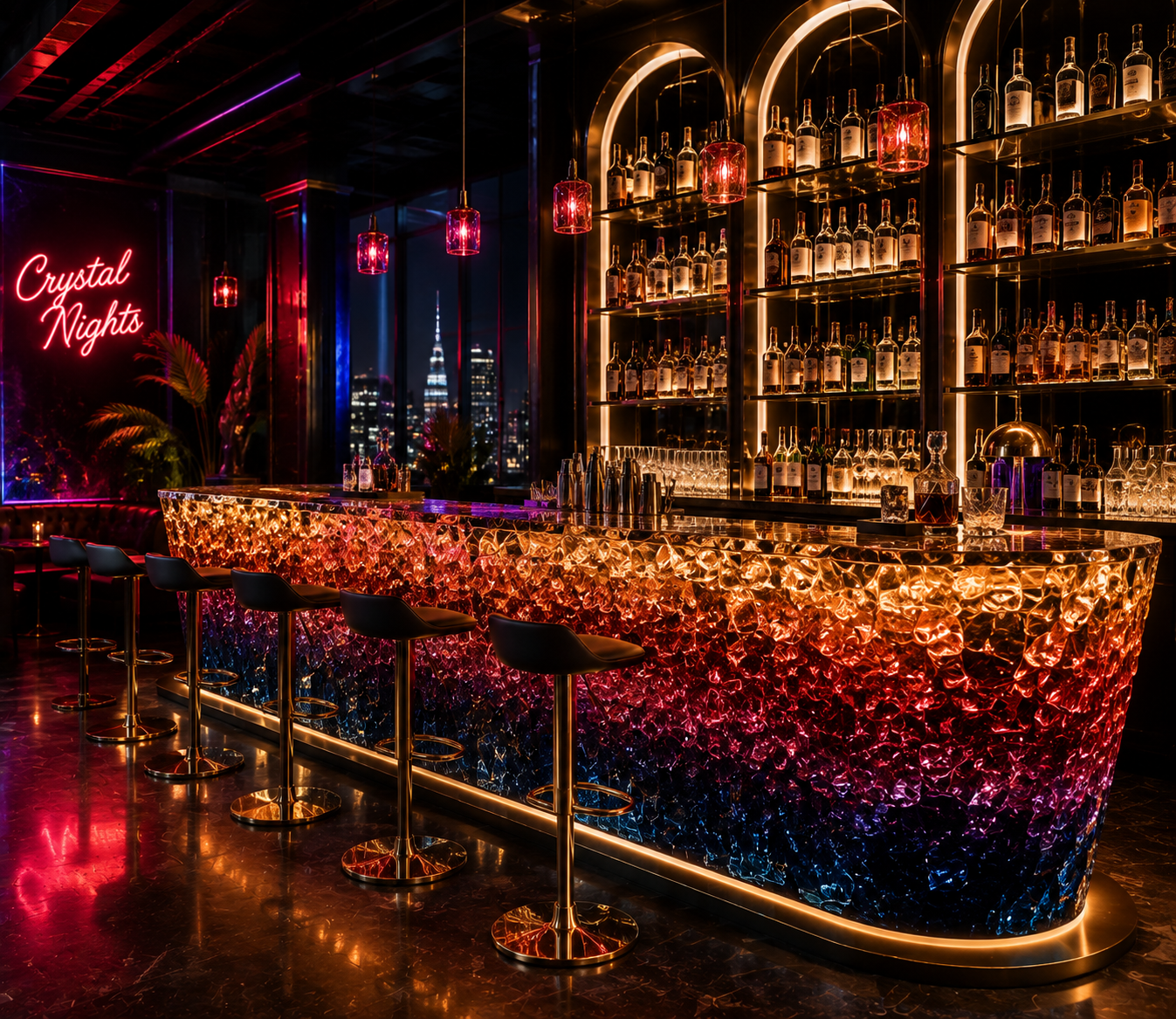
Wood primarily reflects light from its surface. Stone reveals pattern and texture. Metals can reflect their surroundings. Transparent and translucent materials behave differently because light can enter, pass through, reflect internally, refract through edges and interact with pigment or embedded elements inside the material.
That makes transparency less like a conventional surface finish and more like an optical design tool.
Material quality becomes critical here. Röhm states that clear PLEXIGLAS acrylic can achieve visible-light transmission of up to approximately 92 percent. The company also notes that clear-transparent grades can retain very high light transmission over long-term exposure because of the UV stability of the material. These figures should not be applied automatically to every acrylic product on the market, but they demonstrate what high-quality PMMA can achieve when optical clarity is engineered correctly.
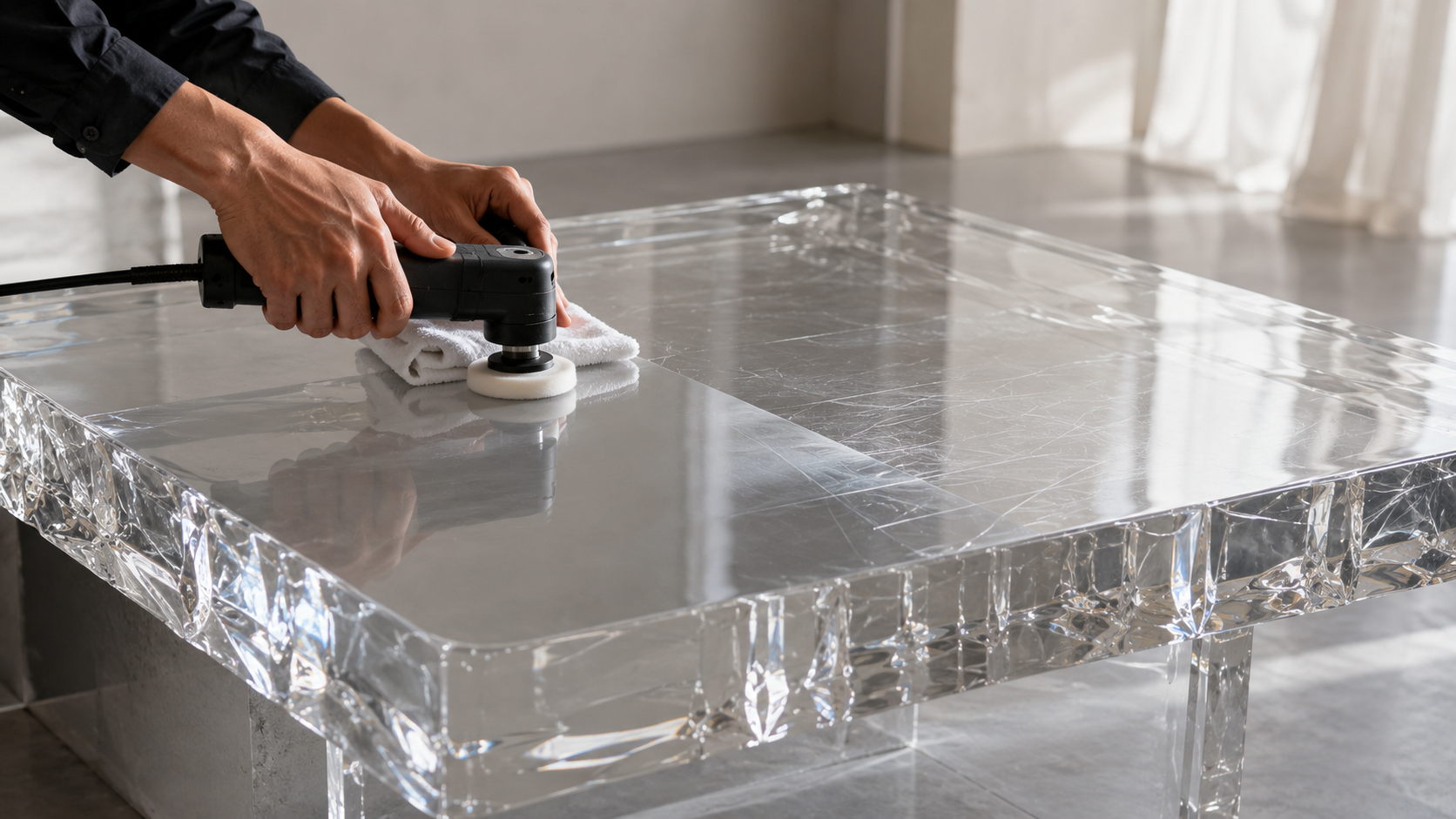
For high-end furniture, this difference becomes especially visible in thick sections. A poorly processed transparent material may look acceptable in a thin panel but reveal haze, bubbles, distortion, inconsistent color or dull edges when used in a substantial table leg, sculptural pedestal or thick tabletop.
Premium transparent furniture therefore depends on more than the raw sheet or resin. Edge polishing, casting control, bonding, machining, pigment consistency and internal clarity all affect the final optical result.
This is where synthetic crystal, premium casting resin and platinum-grade high-clarity acrylic can each create different design languages.
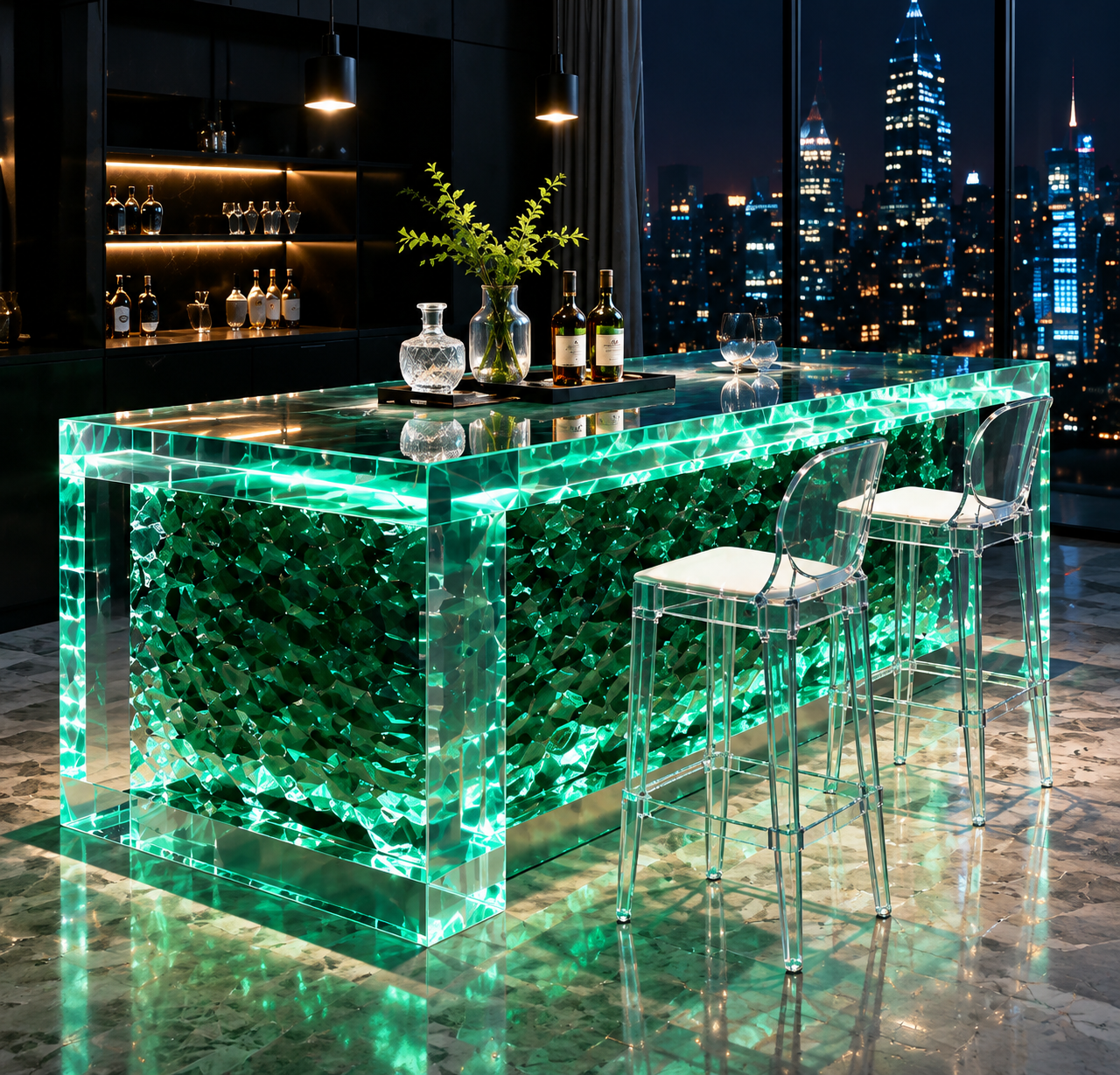
A highly transparent acrylic console can deliver precise geometry and crisp polished edges. A premium resin table can use gradients, translucent colors and layered casting to create depth. A synthetic crystal-style block can be designed to produce a jewel-like appearance in which light appears to sit inside the object rather than merely reflect from its surface.
Lighting adds another dimension. A transparent side table positioned near a window changes according to daylight conditions. A resin console placed beneath architectural lighting can create colored shadows. Thick polished edges can appear dramatically brighter than the central surface. In retail environments, light can travel through transparent display furniture instead of being blocked by it.
For designers, the product is therefore no longer simply “clear furniture.” The furniture becomes an instrument for manipulating light.
3. Transparent Furniture Is Moving from Invisible Minimalism to Collectible Design
Historically, transparent furniture was often marketed around invisibility: a chair that visually disappears, a table that makes a small room look cleaner, or an acrylic base that imitates glass without using glass.
Contemporary collectible design demonstrates a very different direction. Transparency is increasingly being used to create objects that are deliberately noticeable.
Wallpaper* highlighted this development in a March 2026 profile of Italian design duo Draga & Aurel. Resin is central to the studio's work, where it is combined with pigment, bronze, brass, cast glass, concrete and reclaimed surfaces. Their “Transparency Matters” collection explored relationships among clear materials, color, volume, light and refraction rather than treating transparency as visual absence.
The history of collectible design provides an even stronger example. Japanese designer Shiro Kuramata's iconic Miss Blanche chair embedded artificial red roses inside thick acrylic resin sections. Phillips described the demanding production process, in which acrylic resin had to be poured in stages while individual flowers were positioned during curing. Only 56 examples were produced between 1988 and 1998, and versions of the chair entered major museum collections including the Museum of Modern Art in New York and the Vitra Design Museum. In a 2020 Phillips sale, one example carried an estimate of £200,000–£300,000.
The lesson for today's manufacturers is not that every resin chair can command an art-market price. It is that an industrial-looking transparent material can become a precious object when concept, technical difficulty, craftsmanship and scarcity come together.
This changes the opportunity for synthetic crystal and resin furniture.
Instead of producing only colorless tables, manufacturers can collaborate with designers on controlled gradients, embedded textures, colored layers, sculptural castings and intentionally different levels of transparency. A coffee table might transition from crystal clear to smoke gray. A console could contain suspended metallic elements. A pedestal could appear almost colorless from the front but reveal a concentrated tone through its polished edge.
Transparency then stops being the absence of decoration. The material itself becomes the decoration.
This is particularly relevant to luxury furniture because affluent clients increasingly expect objects that cannot be easily compared with mass-market products. A standard transparent table can be compared on dimensions and price. A technically complex resin object with distinctive optical behavior is much harder to substitute.
That differentiation creates room for premium positioning.
4. Transparent Furniture Solves Real Problems in Retail, Hospitality and Residential Projects
Designers rarely specify materials purely because they are fashionable. A material becomes useful when it solves a project problem while supporting the concept.
Transparent furniture can perform particularly well when the designer wants to divide, display or furnish a space without visually closing it.
A useful commercial example appeared in ArchDaily's coverage of FATHOM's Hair Salon 1975 in Hiroshima. The project used 34 large transparent acrylic panels to establish a minimalist environment influenced by the visual language of record stores. Transparent acrylic elements were also suspended to softly divide different functions while preserving layered views through the interior. The architects specifically described transparency and openness as part of the desired spatial experience.
That logic can be applied directly to furniture.
Luxury boutiques need display tables that support products without competing with them. Jewelry stores want pedestals that emphasize jewelry rather than heavy fixtures. Hotel lobbies often require substantial tables while still preserving circulation and sightlines. Galleries may need functional furniture that does not interrupt art. Residential designers may want to furnish a room without obscuring a custom rug, sculptural staircase or panoramic view.
Transparent consoles, dining tables, coffee tables, stools, benches, display plinths and shelving can address those requirements.
This is also why transparent furniture works particularly well when mixed with visually heavier materials. A solid marble block beside a crystal-clear resin table makes both materials more expressive. A transparent acrylic console against textured plaster lets the wall remain visible. A colored resin table positioned next to natural oak creates contrast between optical depth and tactile warmth.
The strongest interiors therefore do not necessarily use transparency everywhere.
Instead, designers use transparent furniture selectively to establish hierarchy. Some pieces visually anchor the room; others allow the eye to travel through them.
That selective approach is commercially important. Manufacturers should not sell transparent furniture as a universal replacement for wood, glass or metal. They should show designers where transparency performs better than those materials.
The question is not, “Would you like an acrylic table?”
A more useful design question is, “What part of the space do you want the furniture to reveal rather than cover?”
5. The Material and Manufacturing Quality Determine Whether Transparency Looks Premium or Cheap
Transparency is unusually unforgiving.
On an opaque product, certain internal imperfections are invisible. In a clear product, many manufacturing decisions remain exposed. Bubbles, bonding marks, inconsistent polishing, scratches, haze, distortion, contamination and color variation can immediately influence perceived quality.
This is why premium transparent furniture requires designers and manufacturers to discuss material specifications much earlier in the process.
Synthetic crystal-style materials can be especially effective for heavy, sculptural pieces where depth and jewel-like internal effects are important. Premium resin provides enormous creative freedom for casting, pigment, layering, inclusions and unusual geometries. High-clarity cast acrylic or platinum-grade acrylic is highly suitable when the design requires precise dimensions, clean transparency, polished edges and a controlled contemporary appearance.
These categories should not be presented as interchangeable. Their value comes from selecting the material according to the desired effect, structure, manufacturing process and project environment.
For example, a designer developing a perfectly geometric transparent console may prioritize optical clarity, dimensional accuracy and highly polished edges. Another designer creating an artistic side table may deliberately want clouds, gradients or controlled internal textures in resin. A hotel project may prioritize repeatability and maintenance, while a limited-edition collectible piece may accept more complex hand-finishing in exchange for a unique visual result.
Technical confidence also contributes directly to product value.
Designers specifying transparent furniture for high-end projects will want to understand questions such as long-term yellowing, scratch resistance, cleaning requirements, structural capacity, joint design, thickness limitations, color consistency and repairability. For commercial applications, relevant fire and building-code requirements may also need to be considered depending on location and use.
This aligns with a broader shift identified by the American Society of Interior Designers. ASID's 2025 Trends Outlook emphasized the growing importance of combining contemporary design priorities with sustainability, longevity and timeless craftsmanship. It also noted consumer interest in objects with stronger narratives and handcrafted qualities.
For a premium furniture manufacturer, this means the sales proposition should extend beyond the material name.
“Made from premium resin” is not enough.
A more credible premium proposition explains what the manufacturer can control: clarity, casting thickness, color matching, polishing, custom dimensions, embedded elements, joint quality, prototype development and consistency between approved samples and final production.
In high-end transparent furniture, precision is part of the aesthetic.
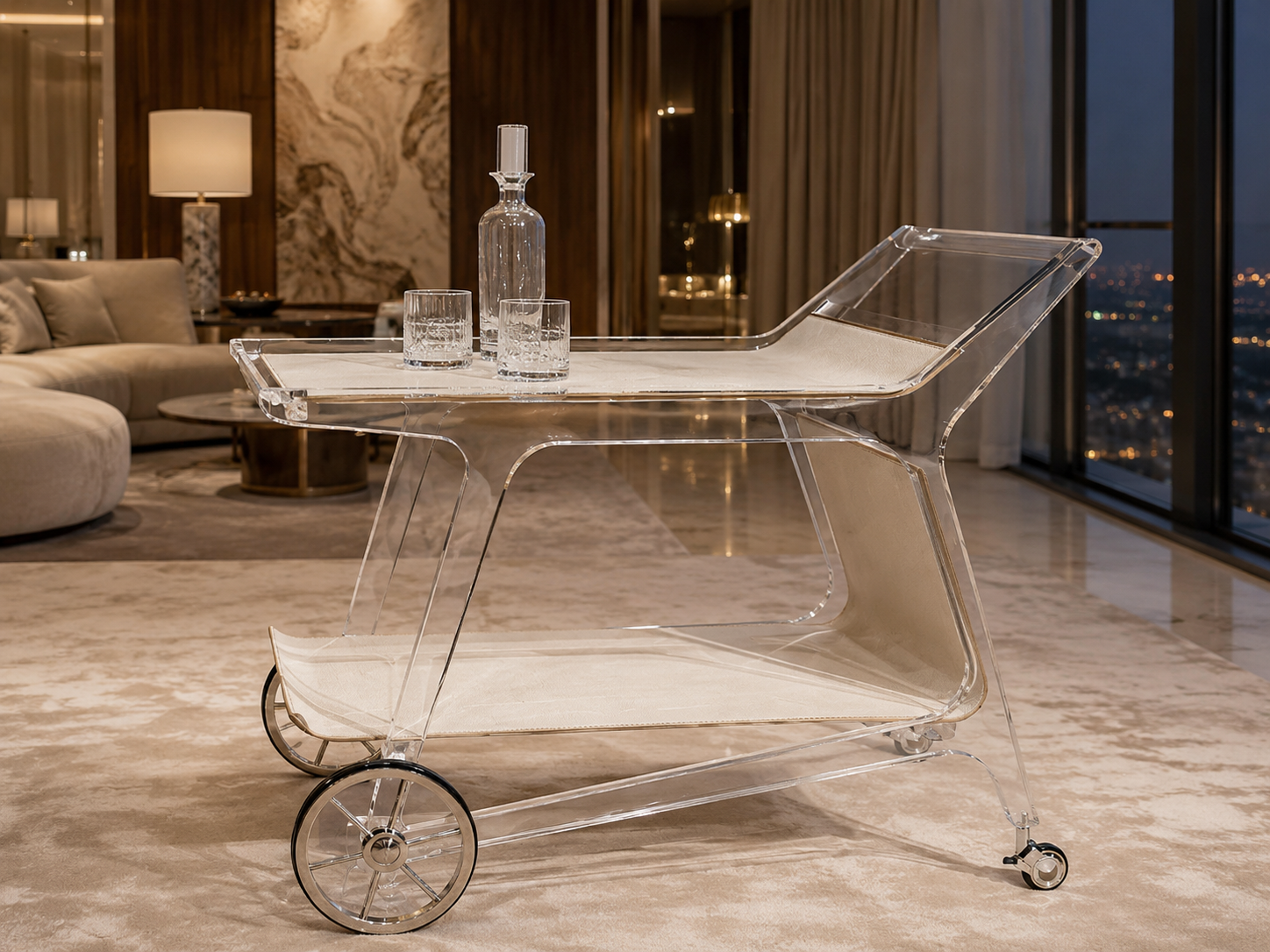
6. Transparent Furniture Can Command a Premium When Its Value Is Explained Beyond Material Cost
The final question is commercial: why would a client pay significantly more for transparent furniture when inexpensive acrylic products already exist?
Because the premium market does not price furniture only according to kilograms of material.
Grand View Research valued the global luxury furniture market at approximately USD 31.1 billion in 2024 and projects it to reach about USD 39.8 billion by 2030, representing a 4.2 percent compound annual growth rate. The research also identifies exclusivity, individual style, craftsmanship and demand for distinctive furnishings among the factors supporting luxury furniture consumption.
The collectible-design market provides another useful signal. Christie's reported that its June 2026 New York Design sale achieved approximately USD 20.16 million, with an 89 percent sell-through rate by lot. This does not mean all furniture is becoming collectible, nor does it specifically measure transparent furniture. It does, however, illustrate continued demand for design objects whose value extends beyond basic function.
Transparent furniture can participate in this value system when several layers of value are combined.
The first is spatial value: the object performs its function without visually overwhelming the interior. The second is optical value: light, color, reflection and refraction give the product an appearance that conventional opaque furniture cannot easily reproduce. The third is customization value: dimensions, colors, gradients, inclusions and transparency levels can be developed specifically for a project. The fourth is manufacturing value: thick casting, invisible or highly controlled joints, precision polishing and complex fabrication demand technical expertise. The fifth is emotional value: the piece can feel closer to a sculpture or collectible object than standardized furniture.
This is the central sales opportunity for manufacturers of synthetic crystal, premium resin and platinum-grade acrylic furniture.
Do not sell a transparent coffee table primarily as “a clear coffee table.”
Sell the reason the designer needs it.
It may preserve the visual continuity of an expensive stone floor. It may allow daylight to pass through a compact room. It may create a jewel-like focal point without adding opaque visual mass. It may allow a luxury retailer to display products against an uninterrupted architectural background. It may give a designer access to custom gradients and dimensions unavailable from catalog furniture. Or it may become a statement object whose optical complexity makes the interior memorable.
That is where product premium begins.
The growing interest in transparent furniture is therefore not simply another aesthetic cycle. The most interesting development is that transparency is being treated as a design capability rather than a color choice. When designers can control clarity, light, depth, color and form—and when manufacturers can reliably turn those concepts into technically refined furniture—transparent materials move beyond novelty.
They become tools for shaping space, creating identity and building value.
And that is precisely why high-quality synthetic crystal, premium resin and high-clarity acrylic furniture have an opportunity to occupy a much more valuable position in contemporary interiors than the traditional category of “clear furniture.”

READ MORE:
- From Acrylic to Synthetic Crystal: How Can Transparent Furniture Create More Depth and Stronger Product Differentiation?
- How Can Furniture Feel Lighter in Small Spaces? Design Strategies Using Transparent Materials and Synthetic Crystal Elements
- Where Does Synthetic Crystal Furniture Work Best? Applications for Living Rooms, Hotels, Weddings and Commercial Spaces
- How Can Ordinary Furniture Look More Premium? Three Upgrade Directions from Hardware and Materials to Crystal Elements
- Synthetic Crystal Acrylic Furniture: An Innovative Direction Worth Watching in the Future High-End Furniture Market
- Why Are More High-End Design Projects Choosing Crystal-Grade Acrylic as a Core Material?
- Synthetic Crystal Acrylic Furniture: Creating Brand Differentiation Through a Distinctive Visual Language
- From Transparent Material to Premium Experience: How Synthetic Crystal Acrylic Furniture Enhances Product Value
- Synthetic Crystal Acrylic Furniture: Why Is It Becoming the “Texture Upgrade Solution” for High-End Spaces?


