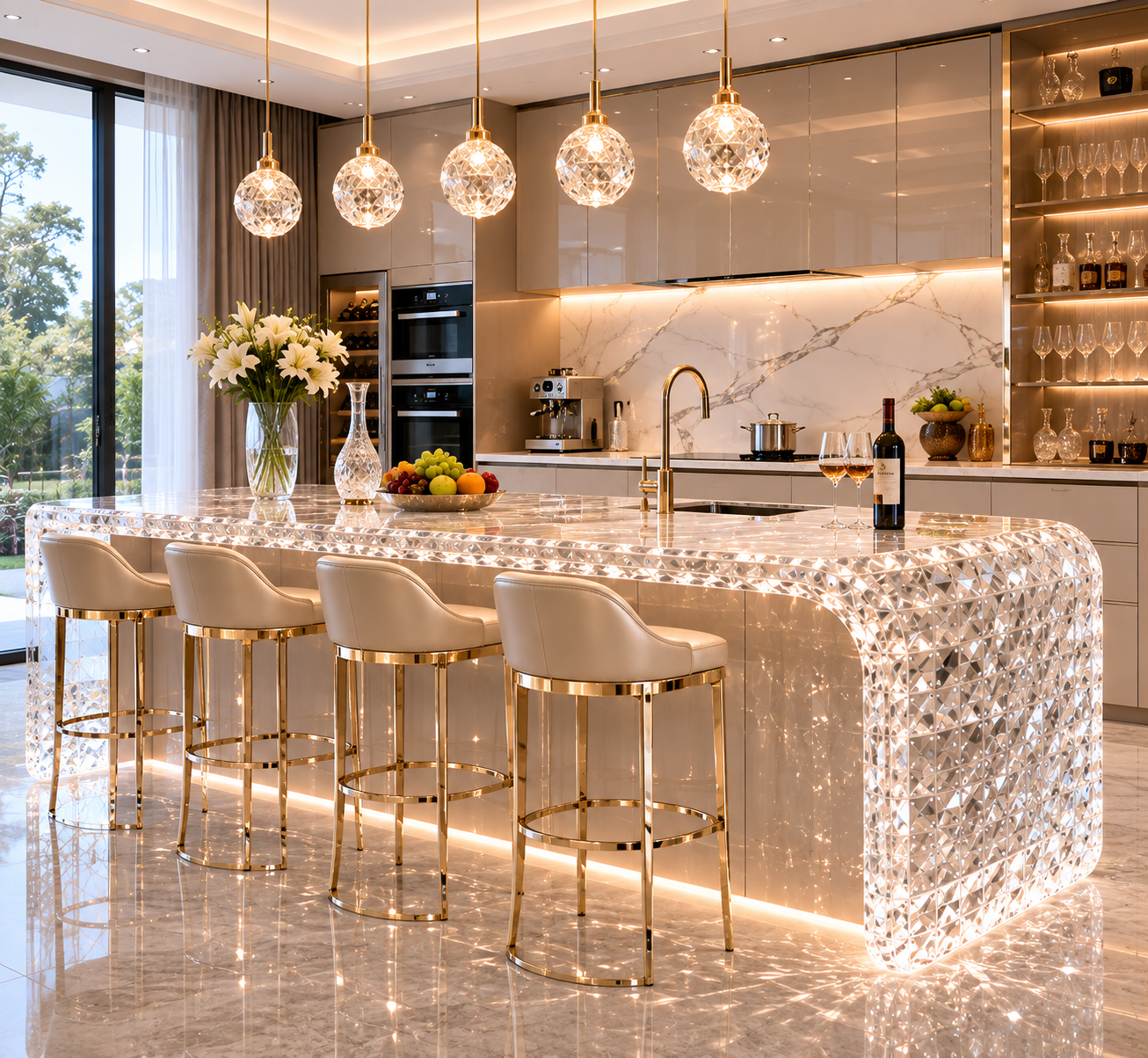
For decades, luxury interiors were defined by a familiar material vocabulary: solid wood, marble, brass, leather, glass, and polished stone. These materials remain important, but the definition of luxury is changing. Today’s most sophisticated spaces are no longer judged only by the rarity or weight of their materials. They are judged by originality, visual impact, precision, atmosphere, and the ability to create an experience that feels unmistakably contemporary.
This shift is one reason acrylic furniture and, increasingly, synthetic crystal furniture are gaining attention in high-end interiors. Designers, architects, hospitality groups, luxury retailers, and private clients are discovering that transparent and semi-transparent materials can do something traditional furniture often cannot: occupy space without visually closing it, reflect and transmit light, support sculptural forms, and create a sense of refinement without relying on ornament.
For premium projects, synthetic crystal is especially compelling. It combines clarity, visual depth, precision fabrication, and customization potential in a way that feels both architectural and decorative. Rather than imitating traditional luxury, it introduces a new language of luxury built around light, purity, geometry, and craftsmanship.

Luxury Is Becoming More Visual, More Experiential, and Less Conventional
High-end interiors have always evolved with architecture, technology, and cultural taste. In earlier periods, luxury was often associated with complexity: carved surfaces, layered finishes, rare woods, heavy textiles, and visible ornamentation. Contemporary luxury often moves in the opposite direction. It favors cleaner lines, fewer materials, sharper proportions, and stronger focal points.
In this environment, every object must justify its presence. A console table, dining table, side table, bench, pedestal, or display unit is no longer just a functional piece. It becomes part of the visual identity of the space.
This is where synthetic crystal furniture stands apart. Instead of dominating a room through mass, it can dominate through light. Instead of adding visual weight, it can create visual tension through transparency. Instead of competing with architectural details, it can reveal them.
For designers working on penthouses, villas, luxury hotels, flagship stores, showrooms, private clubs, and high-end commercial environments, that flexibility is extremely valuable.
Why Traditional Materials Can Feel Limiting in Contemporary Projects
Traditional materials are not becoming obsolete. Marble still communicates permanence. Wood brings warmth. Metal adds structure and detail. Glass delivers clarity. But each material also comes with constraints.
Heavy stone can make a space feel visually dense. Dark wood can reduce perceived openness. Metal can feel cold if overused. Conventional glass offers transparency, but it may not provide the same sculptural presence, edge character, thickness, or fabrication flexibility desired for statement furniture.
Luxury projects increasingly require materials that work across multiple design goals at once. A piece may need to feel substantial without appearing bulky, minimal without looking generic, decorative without becoming excessive, and technically precise without feeling industrial.
High-end synthetic crystal furniture addresses these requirements in a distinctive way. It can be thick and visually powerful while still allowing light to pass through. It can have a monolithic presence without the heaviness of stone. It can appear almost invisible from one angle and intensely luminous from another.
That ability to change with the environment gives it a dynamic quality that traditional materials rarely achieve on their own.
Transparency Creates Space Instead of Taking It Away
One of the strongest advantages of transparent furniture is its effect on spatial perception. Large furniture pieces usually interrupt sightlines. They create boundaries, visual blocks, and areas of density. In a compact luxury apartment, boutique, hotel suite, or gallery-like residence, too much visual mass can weaken the architecture.
A transparent or crystal-clear piece behaves differently. The eye continues through the object. Flooring remains visible. Wall treatments remain visible. Architectural lighting continues to define the room. The furniture is present, but it does not visually compress the space.
This makes transparent furniture for luxury interiors especially attractive for projects where openness is part of the concept. A synthetic crystal console can sit against a dramatic stone wall without hiding it. A clear dining table can support a powerful arrangement of chairs without making the room feel crowded. A sculptural pedestal can display an object while remaining visually secondary to the piece it supports.
In other words, synthetic crystal does not simply fill space. It helps preserve space.
Light Becomes Part of the Furniture
Traditional furniture is usually illuminated from the outside. Synthetic crystal furniture interacts with light more actively. Its surfaces, thicknesses, edges, and internal clarity influence how light is reflected, refracted, and transmitted.
Under natural daylight, a crystal-clear table may feel light and almost architectural. Under warm evening lighting, the same piece can become richer and more dramatic. Edge highlights may intensify. Reflections may shift as people move through the room. Nearby materials may appear through the piece and become part of its visual composition.
For hospitality and retail environments, this is especially valuable because atmosphere changes throughout the day. A luxury hotel lobby needs to feel elegant in morning light and dramatic at night. A flagship store may rely on controlled lighting to direct attention toward products. A private residence may use layered lighting to shift from open and bright to intimate and theatrical.
Synthetic crystal furniture responds beautifully to these changes, which is why it works so well in environments where lighting is considered part of the design rather than simply a functional requirement.
Sculptural Freedom Is Redefining Statement Furniture
Modern luxury clients increasingly want pieces that cannot be found in a standard catalog. They want furniture that feels commissioned, site-specific, and visually memorable.
Synthetic crystal supports this demand because it can be used to create bold geometries, thick transparent structures, layered components, monolithic forms, precise cutouts, and refined edge treatments. Depending on the design and manufacturing process, it can be shaped into forms that range from strict architectural minimalism to expressive sculptural compositions.
This creates new possibilities for custom synthetic crystal furniture, including dining tables, coffee tables, side tables, consoles, benches, stools, desks, display plinths, shelving, decorative screens, and specialty installations.
The result is furniture that functions more like an architectural object. A well-designed synthetic crystal piece can become the focal point of a room without relying on excessive decoration. Its form, proportion, thickness, and transparency become the design.
Synthetic Crystal Offers a More Elevated Visual Language Than Ordinary Clear Furniture
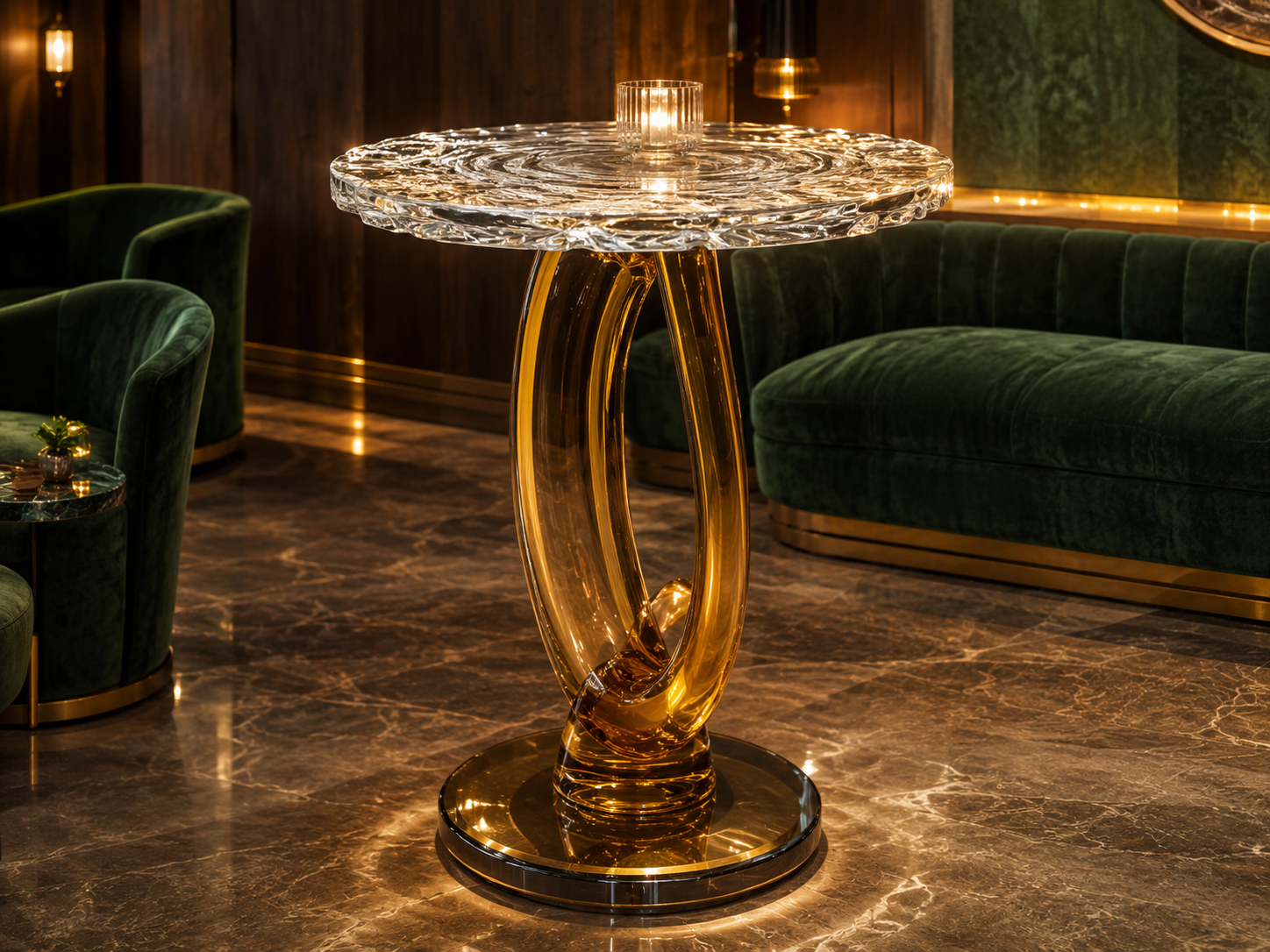
Not all transparent furniture communicates the same level of quality. For premium buyers, clarity alone is not enough. The material must look refined at close range. Edges must be controlled. Joints must be precise. Proportions must feel intentional. Surfaces must contribute to a consistent luxury finish.
This is where the distinction between ordinary mass-market transparent furniture and premium synthetic crystal furniture becomes important.
High-end synthetic crystal pieces are valued for the way they handle thickness, depth, and optical presence. A substantial transparent component can create a jewel-like visual effect that thin, lightweight clear furniture cannot replicate. The piece feels more permanent, more architectural, and more intentional.
In luxury interiors, these small differences matter. Premium design is often judged not from ten meters away, but from fifty centimeters away. The edge quality, polishing, joining, balance, and finish all influence whether a piece feels genuinely high-end.
Customization Is Becoming a Core Requirement in High-End Projects
Luxury interiors rarely succeed through generic furniture alone. Designers often need specific dimensions, proportions, finishes, or structural solutions to fit the architecture. This is especially true in bespoke residences, hospitality projects, flagship retail spaces, and branded commercial environments.
Bespoke synthetic crystal furniture can be developed around the exact needs of the project. Dimensions can be adjusted to suit circulation. Shapes can be coordinated with architectural geometry. Thickness can be chosen for a stronger or lighter visual effect. Clear components can be paired with metal, stone, upholstery, or other materials to create a more complex composition.
This customization capability allows designers to treat furniture as part of the architectural system rather than as an object added after the space is complete.
For developers and design studios, that creates greater creative control. For private clients, it creates exclusivity. The finished piece belongs to the space because it was designed for the space.
Acrylic Furniture and Synthetic Crystal Furniture Serve Different Design Intentions
Acrylic furniture has already established itself as a useful choice in modern interiors because it is lightweight in appearance, versatile, and compatible with contemporary design. It is often used when designers want transparency, simplicity, or a reduced visual footprint.
Synthetic crystal furniture builds on that transparent aesthetic but is frequently selected for projects where the desired effect is more luxurious, substantial, and sculptural. The emphasis moves from invisibility toward optical depth and presence.
In practical design terms, acrylic furniture can be ideal for clean modern spaces, decorative accents, and lighter visual applications. Synthetic crystal becomes especially compelling when the piece itself must communicate prestige.
A thick synthetic crystal dining table, for example, can feel almost like a block of light. A console with substantial transparent legs can appear solid and weightless at the same time. A crystal pedestal can make a displayed object feel more important without distracting from it.
For this reason, the material is increasingly relevant to luxury furniture design rather than simply transparent furniture design.
It Pairs Exceptionally Well With Other Premium Materials
One of the strongest qualities of synthetic crystal is that it rarely needs to compete with surrounding materials. Instead, it can amplify them.
Next to marble, it creates contrast between visual weight and visual lightness. Beside brushed metal, it introduces softness and reflection. With leather or textile upholstery, it allows texture to become more noticeable. Against dark timber, it creates a dramatic transition between opacity and transparency.
This is especially useful in refined interiors where too many opaque materials can make a space feel layered but heavy. Synthetic crystal provides a visual pause. It introduces clarity between stronger textures and allows premium materials to breathe.
Designers can also use it strategically to connect different finishes within one room. Because the material is visually neutral, it can sit beside warm, cool, matte, polished, dark, or light surfaces without creating unnecessary color conflict.
Retail and Hospitality Projects Benefit From Its Visual Impact
Luxury hotels, restaurants, lounges, showrooms, and flagship stores depend on memorable visual moments. Guests and customers experience the space quickly, often forming an impression within seconds. Furniture therefore becomes part of the brand experience.
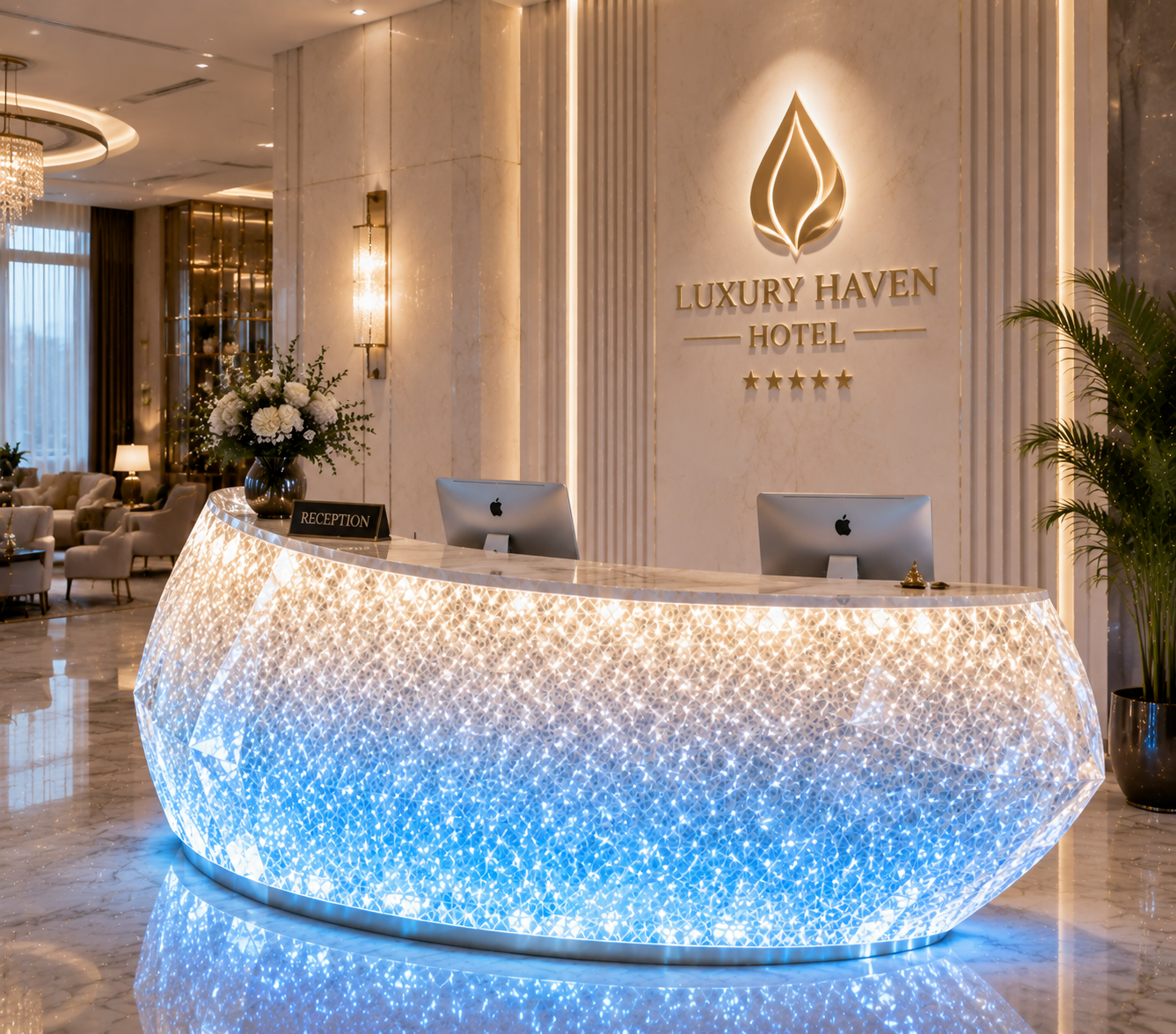
Luxury synthetic crystal furniture is particularly effective in these environments because it photographs well, reacts strongly to controlled lighting, and can support distinctive custom forms. A crystal console in a hotel entrance, a transparent display table in a luxury boutique, or a sculptural reception-side piece can become an instantly recognizable design feature.
For retail, transparency is also practical from a visual merchandising perspective. Clear display structures can elevate products without surrounding them with visual clutter. For hospitality, transparent statement pieces can create sophistication while maintaining openness in high-traffic areas.
In both cases, the furniture contributes to atmosphere without overwhelming the architecture.
Minimalism Is Becoming More Materially Sophisticated
Minimalism is often misunderstood as simply using fewer things. In high-end design, it is more accurately about controlling every visible decision. When there are fewer objects in a room, the quality of each object becomes more important.
A minimalist space cannot hide poor proportions or ordinary materials behind decoration. The furniture must perform visually on its own.
This is one reason modern synthetic crystal furniture works so well in sophisticated minimalist interiors. Its appeal comes from proportion, transparency, detail, and craftsmanship rather than surface ornament.
A simple crystal table can look exceptionally refined when the thickness, edge polish, dimensions, and joinery are carefully resolved. The design may appear simple, but achieving that simplicity at a luxury level requires precision.
For architects and designers who value reduction, this is a major advantage.
High-End Buyers Are Looking for Materials That Feel Less Familiar
Luxury is partly about quality, but it is also about distinction. When a material becomes common, it can lose some of its ability to surprise.
Wood, stone, brass, and glass remain beautiful, but they are also expected. Synthetic crystal offers a different visual experience. Many clients have seen marble dining tables. Fewer have experienced a substantial synthetic crystal table designed as a central architectural feature.
This sense of unfamiliarity creates value. It gives designers a way to build memorable interiors without resorting to excessive decoration or unusual color.
For clients seeking something refined but different, designer synthetic crystal furniture provides a strong answer. It feels contemporary without being trend-dependent, decorative without being ornate, and exclusive without needing to rely on obvious branding.
Precision Manufacturing Matters More Than the Material Name
Choosing synthetic crystal is only the beginning. The final result depends heavily on manufacturing quality.
Premium transparent furniture exposes every detail. With opaque furniture, some structural elements can be concealed. With crystal-clear furniture, poor joining, uneven polishing, imprecise alignment, or inconsistent finishing can be immediately visible.
That means the manufacturer must control fabrication carefully from material selection through cutting, forming, polishing, assembly, inspection, packaging, and delivery.
For custom luxury furniture, communication is equally important. Drawings, dimensions, load requirements, edge treatments, component relationships, and installation conditions should be considered early in the development process.
When executed properly, the finished object appears effortless. But that visual simplicity is the result of highly controlled production.
What Designers Should Consider When Specifying Synthetic Crystal Furniture
For professional projects, material selection should always begin with the intended use. A decorative side table has different requirements from a large dining table, commercial display platform, or hospitality installation.
Designers should consider scale, thickness, structural support, edge treatment, traffic level, surrounding finishes, lighting conditions, maintenance expectations, and transport access. The visual concept should be developed together with practical fabrication requirements.
It is also important to think about how the piece will be experienced from multiple angles. Because transparent furniture reveals more of its structure, details that would normally be hidden become part of the design. Connections, transitions, intersections, and proportions must therefore be resolved carefully.
For custom projects, close collaboration between the designer and synthetic crystal furniture manufacturer can significantly improve the final result.
From Furniture to Architectural Feature
The most interesting use of synthetic crystal is not simply to replace a wooden or glass table with a transparent version. The greater opportunity is to rethink what the furniture can become.
A console can appear to emerge from the architecture. A thick clear base can create the impression that a stone top is floating. A transparent bench can divide a space without visually separating it. A crystal display structure can elevate an object while nearly disappearing around it.
This is the point where furniture becomes architecture.
For high-end interiors, that transition is increasingly important. Clients are not only buying individual products; they are buying a complete visual experience. Furniture must support the story of the space, the identity of the brand, and the emotional atmosphere of the project.
Custom synthetic crystal furniture gives designers another tool for building that experience.
The Future of Luxury Furniture Is About Material Contrast
The rise of synthetic crystal does not mean traditional materials are disappearing. In fact, the strongest interiors will often combine them.
The future of luxury furniture is likely to be defined by contrast: transparent with opaque, light with heavy, polished with textured, minimal with expressive, natural with engineered.
Synthetic crystal fits perfectly into this direction because it creates contrast without introducing visual noise. It can make marble look heavier, metal look sharper, upholstery feel softer, and lighting feel more dimensional.
That makes it more than a trend material. It is a design instrument.
Why Synthetic Crystal Furniture Belongs in the New Luxury Vocabulary
Luxury interiors are becoming more personal, more architectural, and more focused on experience. Buyers still value craftsmanship and premium materials, but they are also asking for originality, customization, visual openness, and stronger relationships between furniture and space.
Synthetic crystal answers these expectations with a unique combination of clarity, depth, sculptural potential, and compatibility with other premium materials. It can be subtle or dramatic, almost invisible or intensely luminous. It works in minimalist residences, bold hospitality environments, luxury retail spaces, and bespoke commercial projects because it adapts to the design language around it.
For architects, interior designers, developers, and private clients who want furniture to do more than fill a room, synthetic crystal offers a new way to think about presence. The next generation of luxury spaces may not be defined by what they add, but by how intelligently they use light, transparency, and material contrast—and the most unforgettable piece in the room may be the one that seems to disappear until the light finds it.
Related Product, Service, and Audience Terms: synthetic crystal furniture, acrylic furniture, luxury furniture, custom synthetic crystal furniture, bespoke crystal furniture, transparent furniture, high-end furniture, designer furniture, modern luxury furniture, crystal dining table, crystal coffee table, crystal console table, crystal side table, crystal desk, crystal bench, crystal pedestal, transparent dining table, transparent console, acrylic dining table, acrylic console table, custom furniture manufacturing, bespoke furniture design, luxury furniture manufacturer, synthetic crystal furniture manufacturer, custom furniture supplier, hospitality furniture, hotel furniture, luxury retail furniture, showroom furniture, villa furniture, penthouse furniture, high-end residential furniture, luxury interior design furniture, architectural furniture, statement furniture, sculptural furniture, premium transparent furniture, interior designers, architects, luxury property developers.
SEO Keywords: synthetic crystal furniture, acrylic furniture, luxury furniture, high-end synthetic crystal furniture, premium synthetic crystal furniture, custom synthetic crystal furniture, bespoke synthetic crystal furniture, designer synthetic crystal furniture, modern synthetic crystal furniture, luxury synthetic crystal furniture, synthetic crystal furniture manufacturer, synthetic crystal furniture supplier, acrylic furniture manufacturer, transparent furniture, premium transparent furniture, transparent furniture for luxury interiors, crystal furniture, crystal dining table, synthetic crystal dining table, crystal coffee table, synthetic crystal coffee table, crystal console table, synthetic crystal console table, acrylic dining table, acrylic coffee table, acrylic console table, luxury dining table, modern luxury furniture, bespoke luxury furniture, custom luxury furniture, high-end furniture manufacturer, designer furniture manufacturer, hospitality furniture, luxury hotel furniture, luxury retail furniture, showroom furniture, villa furniture, penthouse furniture, statement furniture, sculptural furniture.
Tag: acrylicfurniture
READ MORE:
- Why Material Consistency Defines Quality in Premium Synthetic Crystal Furniture
- What to Consider Before Specifying Custom Transparent Furniture at Scale
- The Business Value of Statement Synthetic Crystal Furniture in Luxury Spaces
- How Synthetic Crystal Furniture Protects Design Vision from Concept to Installation
- Come i mobili in cristallo sintetico stanno diventando la nuova tendenza nel design degli spazi di lusso
- Dal mobile ordinario al punto focale artistico: come il cristallo sintetico aumenta il valore degli spazi contemporanei
- Anche i piccoli spazi possono avere un'anima di lusso: tecniche di design con mobili in cristallo sintetico
- Non solo elementi decorativi: come i mobili in cristallo sintetico combinano estetica e funzionalità
- Trasformazione degli spazi: come i mobili in cristallo sintetico creano un'atmosfera di lusso e raffinatezza


