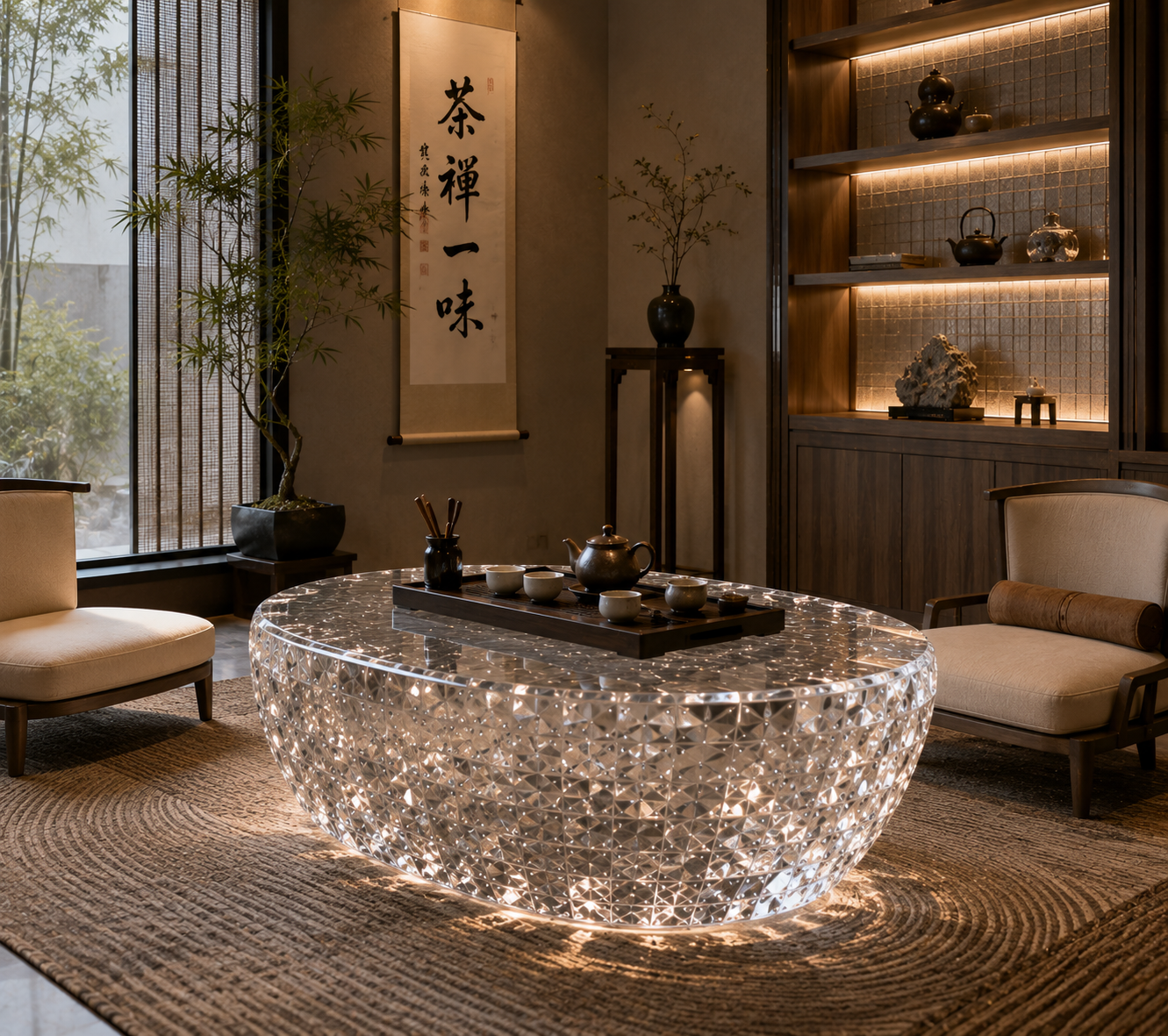
In luxury interiors, the hardest part is often not creating a compelling concept. The real challenge is protecting that concept as it passes through dozens of technical decisions. A sketch becomes a drawing, a drawing becomes a prototype, a prototype becomes a production specification, and the specification must survive fabrication, transport, installation, lighting conditions, cleaning, and daily use. At every step, small compromises can quietly change the result.
This is why material selection has become a strategic design decision rather than a late-stage procurement choice. For projects that rely on transparency, sculptural form, controlled reflections, visual lightness, or seamless detailing, synthetic crystal furniture can give designers more control over the final appearance than conventional material combinations.
Why Design Intent Is Often Lost After Approval
Design teams usually approve a concept based on a specific relationship between proportion, surface quality, color, light, and surrounding architecture. The problem is that those relationships are sensitive. A small change in thickness can alter visual weight. A different adhesive line can interrupt transparency. A poorly matched joint can create distortion. A substituted material can shift color temperature. Hardware selected only for convenience can become visually dominant.
These changes may appear minor from a manufacturing perspective, but together they can weaken the original design language. In a premium space, the eye notices inconsistency quickly because the whole environment is expected to feel deliberate.
For this reason, designers are increasingly evaluating materials according to how well they preserve intent during execution, not only how attractive they look in a sample. Custom synthetic crystal furniture is particularly relevant when the design depends on precise edges, substantial transparent volumes, clean transitions, or controlled optical effects.
Shape Retention Is a Design Issue, Not Only an Engineering Issue
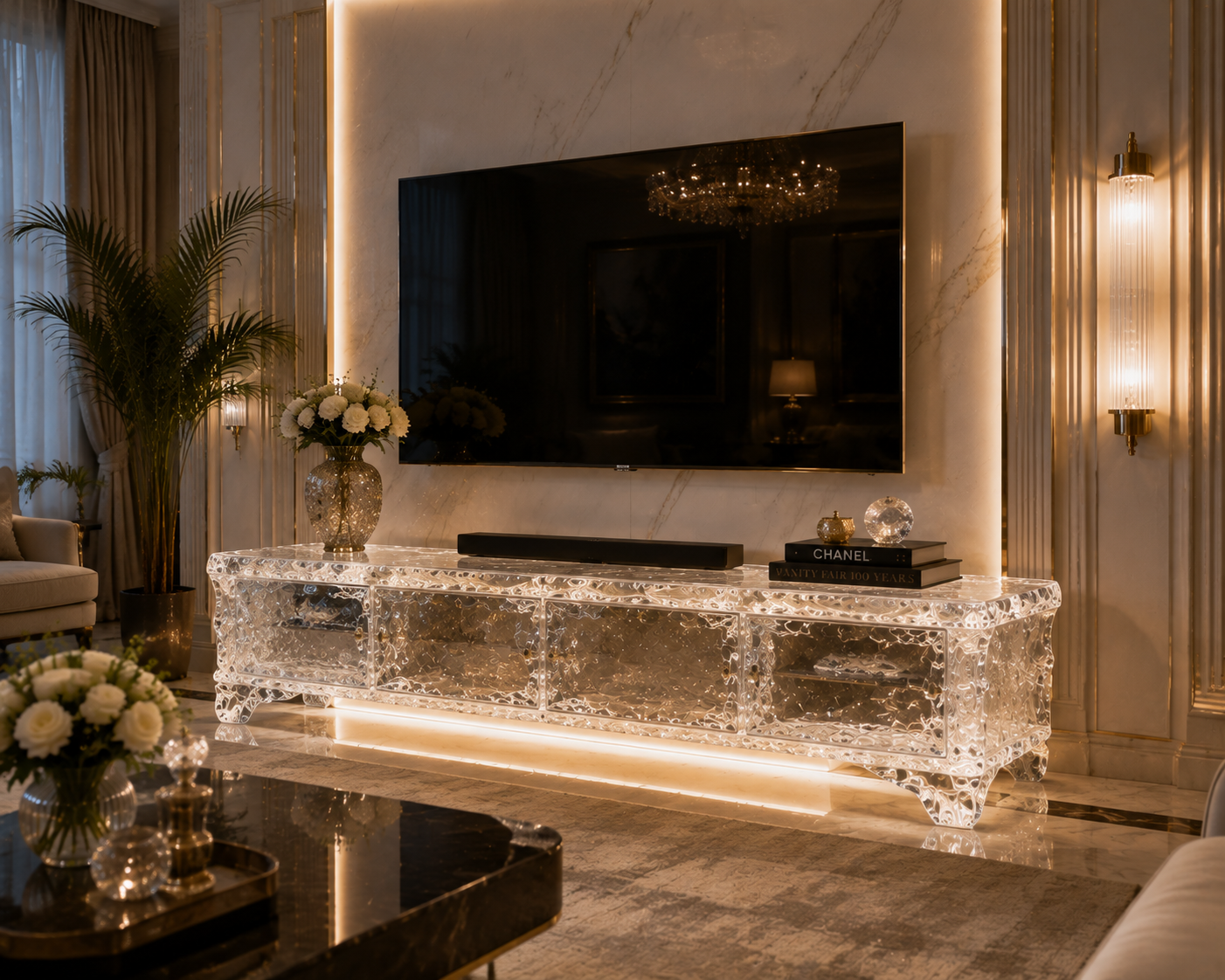
Many statement pieces are defined by silhouette. Curved consoles, thick sculptural legs, faceted bases, monolithic side tables, transparent partitions, illuminated counters, and geometric seating elements all depend on shape remaining faithful to the original drawings.
If the production method forces the fabricator to simplify curves, reduce thickness, introduce visible metal supports, or divide a form into too many sections, the design may remain technically functional while losing its character. A well-developed synthetic crystal furniture system allows the structure, optical behavior, and fabrication process to be considered together from the beginning.
This matters because the most successful premium objects are not created by treating design and manufacturing as separate stages. They are created when both are developed around the same material logic.

Transparency Requires Precision
Transparent furniture is unforgiving. Opaque finishes can hide internal joints, small alignment errors, reinforcement, and finishing transitions. Transparent materials reveal nearly everything. That makes production quality part of the visual identity of the piece.
In high-end transparent furniture, the viewer may be able to see through multiple layers, edges, junctions, internal interfaces, or light paths. Any inconsistency becomes easier to notice. This is one reason why premium transparent projects require stricter standards for cutting, polishing, bonding, machining, assembly, and final inspection.
With synthetic crystal furniture, design teams can specify how edges should catch light, how thick volumes should read from different angles, and where joints must remain visually quiet. The material is not simply a substitute for glass or acrylic; in the right application, it becomes a medium for controlling depth, clarity, and presence.
Material Choice Influences Detail Preservation
Design intent often lives in details that are easy to underestimate during value engineering. Radius transitions, recessed lines, stepped profiles, embedded elements, custom colors, layered effects, and integrated lighting may represent a small percentage of the production cost but a large percentage of the visual impact.
When the chosen material cannot support these details efficiently, teams may begin removing them. Once enough details disappear, the final product can feel generic even if its general shape is still recognizable.
Advanced custom synthetic crystal furniture can help protect these details because it supports controlled machining, shaping, polishing, color development, embedded visual features, and integration with other materials. This gives designers more options before they are forced to simplify a concept.
Consistency Across Multiple Pieces Matters
One prototype can look excellent. A larger project is more difficult. Hotels, restaurants, retail flagships, clubs, residential developments, and commercial lobbies may require dozens or hundreds of related pieces. The challenge shifts from making one beautiful object to producing a consistent family of objects.
For luxury furniture programs, consistency includes more than dimensional accuracy. It can also involve clarity, tint, edge finish, gloss level, color saturation, hardware alignment, bonding appearance, and the way light moves through the material.
Reliable synthetic crystal furniture production therefore depends on repeatable material preparation and process control. When those systems are stable, designers can expand a concept across a project without the visual identity changing from piece to piece.
The Relationship Between Material and Lighting
Luxury spaces are designed around light. Natural daylight, warm architectural lighting, decorative fixtures, hidden LEDs, reflections from metal, and darker surrounding finishes can all change how transparent objects are perceived.
A material that looks neutral in a factory may look colder, warmer, cloudier, or more reflective in the finished environment. For this reason, designers should evaluate synthetic crystal furniture not only under production lighting but also in conditions that approximate the project.
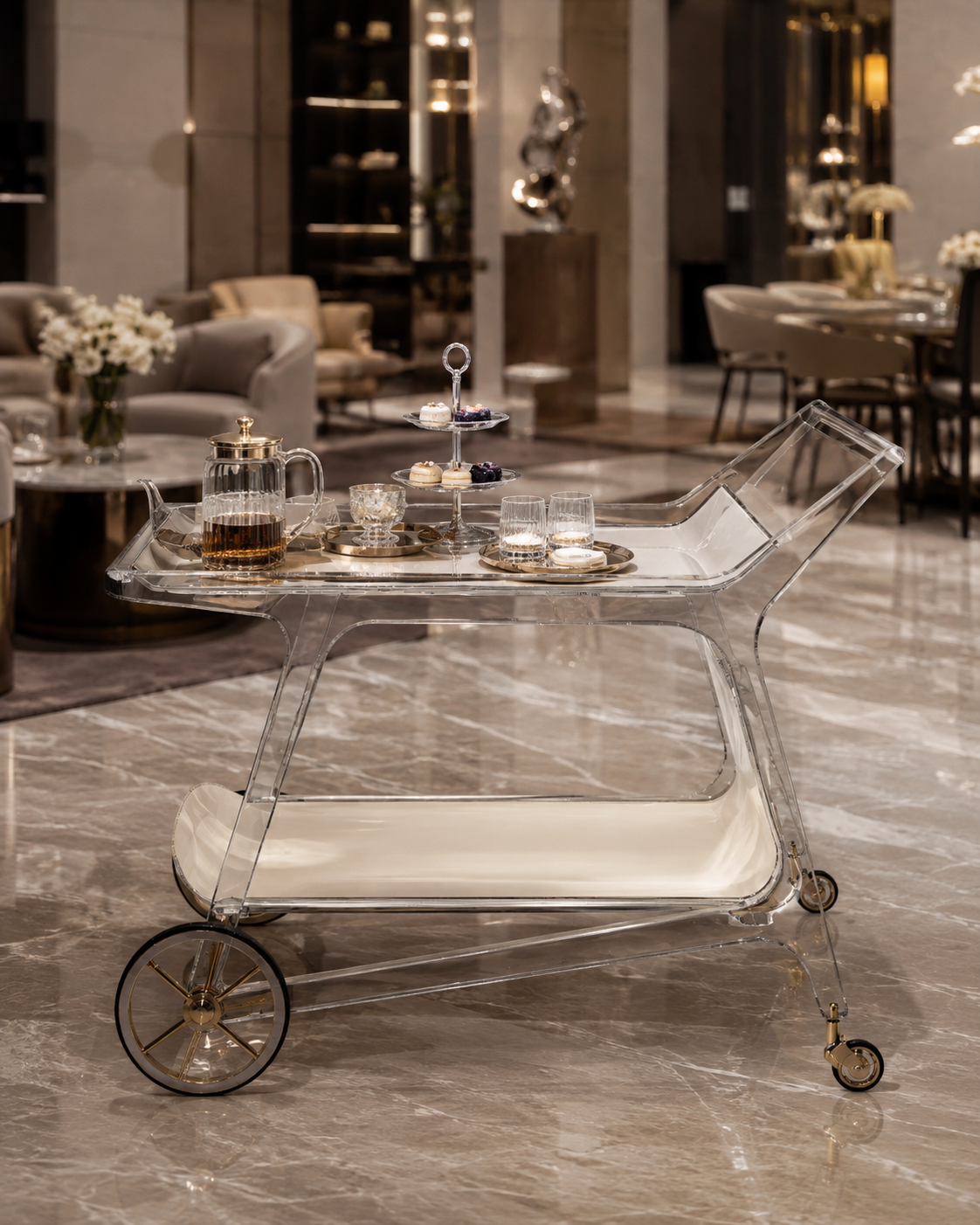
Large transparent masses can act almost like architectural lenses. They can create depth, highlight edges, soften visual weight, and allow surrounding finishes to remain visible. This is especially useful when designers want furniture to feel substantial without visually blocking the room.
Reducing Last-Minute Design Compromises
Late-stage changes are expensive because they affect more than cost. They can reduce coherence. When a piece must be redesigned after engineering, procurement, or installation planning has already begun, the new solution often focuses on solving the immediate problem rather than preserving the original visual idea.
Early collaboration with a qualified custom furniture manufacturer can reduce this risk. The manufacturer should review key issues such as minimum radii, unsupported spans, stress points, bonding locations, transport dimensions, lifting methods, protective packaging, installation sequence, and maintenance access before final drawings are frozen.
This type of early technical dialogue allows the designer to make informed adjustments while the concept is still flexible. It is one of the most effective ways to keep premium furniture from becoming visually diluted during production.
Prototyping Should Test More Than Appearance
A prototype is often treated as a visual approval sample, but for complex statement furniture, it should also test engineering, assembly, handling, surface durability, cleaning behavior, and installation logic.
A successful prototype should answer practical questions. Can the piece be moved safely through the building? Are lifting points discreet? Do transparent junctions remain clean after assembly? Are polished surfaces sufficiently protected during transport? Can hotel or retail staff maintain the surface without specialist intervention? Does lighting reveal any unexpected distortion?
By testing these conditions before mass production, project teams protect both design quality and schedule.
Why Synthetic Crystal Can Be Valuable in Hospitality Furniture
In hospitality furniture, visual impact and operational practicality must coexist. A dramatic lobby table or reception feature may be photographed hundreds of times, but it must also survive high traffic, repeated cleaning, luggage contact, staff movement, and frequent guest interaction.
This is where synthetic crystal furniture can offer a useful balance. It can deliver the visual purity expected in a luxury setting while allowing complex forms that would be difficult or impractical in natural crystal or other rigid transparent materials.
The result is not simply a transparent object. It is a piece that can be engineered around the way the space actually operates.
Protecting Brand Identity Through Material Consistency
For global hospitality and retail brands, furniture often carries part of the brand language. A signature curve, a particular transparent tone, a recurring faceted form, or a recognizable combination of crystal-like transparency and metal may appear across multiple locations.
When these details vary too much from site to site, brand consistency weakens. High-quality luxury furniture manufacturing therefore requires documentation that goes beyond basic dimensions. Surface expectations, optical quality, acceptable tolerances, finish references, packaging standards, and installation details should all be defined.
For repeat programs, synthetic crystal furniture can become a controlled design system rather than a one-off decorative experiment.
Material Selection Should Begin Earlier
One of the most common mistakes in custom projects is choosing the aesthetic first and asking the material to solve everything later. A stronger process reverses that logic. Designers can define the emotional and visual objective, then test which material system best supports the required geometry, durability, finish, and production scale.
When transparent furniture is central to the concept, material testing should begin during design development. This gives the team time to compare thickness, edge behavior, color, polish, joining techniques, lighting effects, and structural solutions before final approvals.
This approach also makes value engineering more intelligent. Instead of removing design features at the end, teams can optimize the construction method while keeping the visual outcome intact.
What Project Teams Should Ask a Manufacturer
Before approving a supplier for custom synthetic crystal furniture, project teams should ask how the manufacturer controls raw material consistency, dimensional tolerance, color matching, polishing quality, bonding appearance, packaging, and final inspection. They should also ask how the supplier manages engineering drawings, prototype feedback, revisions, and installation coordination.
For large premium furniture packages, communication discipline is as important as fabrication capability. A supplier may have strong workshop skills but still create project risk if drawing revisions are not controlled or if production changes are made without clear approval.
The best manufacturing partner understands that the goal is not simply to produce an object. The goal is to preserve the designer's intention while making that intention practical, repeatable, and durable.
From Concept to Built Reality
High-end design succeeds when the finished environment still carries the clarity of the original idea. That requires more than creativity. It requires a material system that can hold shape, detail, optical quality, and finish through the full execution process.
When specified and engineered correctly, synthetic crystal furniture gives designers a powerful way to combine sculptural freedom with controlled production. It can support dramatic forms, visual transparency, integrated lighting, consistent finishes, and repeatable quality across complex projects. For architects, interior designers, developers, and hospitality teams, the real value is not only how the material looks on day one, but how effectively it protects the design vision from the first drawing to the final installation.
If your next project depends on a form, detail, or transparent effect that cannot afford to be compromised, the most important design decision may be the material system you choose before production even begins.
Related SEO terms: synthetic crystal furniture, custom synthetic crystal furniture, luxury furniture, transparent furniture, statement furniture, hospitality furniture, premium furniture, custom furniture manufacturer, synthetic crystal table, synthetic crystal console, synthetic crystal chair, synthetic crystal bench, crystal-look furniture, transparent luxury furniture, custom hotel furniture, bespoke furniture, sculptural furniture, designer furniture, luxury hotel furniture, commercial furniture, lobby furniture, reception furniture, high-end furniture, custom transparent table, transparent console table, crystal furniture manufacturer, premium interior furniture, custom hospitality furniture, contract furniture, furniture prototyping, furniture engineering, furniture quality control, furniture material consistency, furniture fabrication, custom furniture production, interior design materials, architectural furniture, luxury retail furniture, hotel lobby furniture, project furniture supplier
READ MORE:
- Why Material Consistency Defines Quality in Premium Synthetic Crystal Furniture
- What to Consider Before Specifying Custom Transparent Furniture at Scale
- The Business Value of Statement Synthetic Crystal Furniture in Luxury Spaces
- Why High-End Spaces Are Moving Beyond Traditional Materials to Acrylic and Synthetic Crystal Furniture
- Come i mobili in cristallo sintetico stanno diventando la nuova tendenza nel design degli spazi di lusso
- Dal mobile ordinario al punto focale artistico: come il cristallo sintetico aumenta il valore degli spazi contemporanei
- Anche i piccoli spazi possono avere un'anima di lusso: tecniche di design con mobili in cristallo sintetico
- Non solo elementi decorativi: come i mobili in cristallo sintetico combinano estetica e funzionalità
- Trasformazione degli spazi: come i mobili in cristallo sintetico creano un'atmosfera di lusso e raffinatezza


