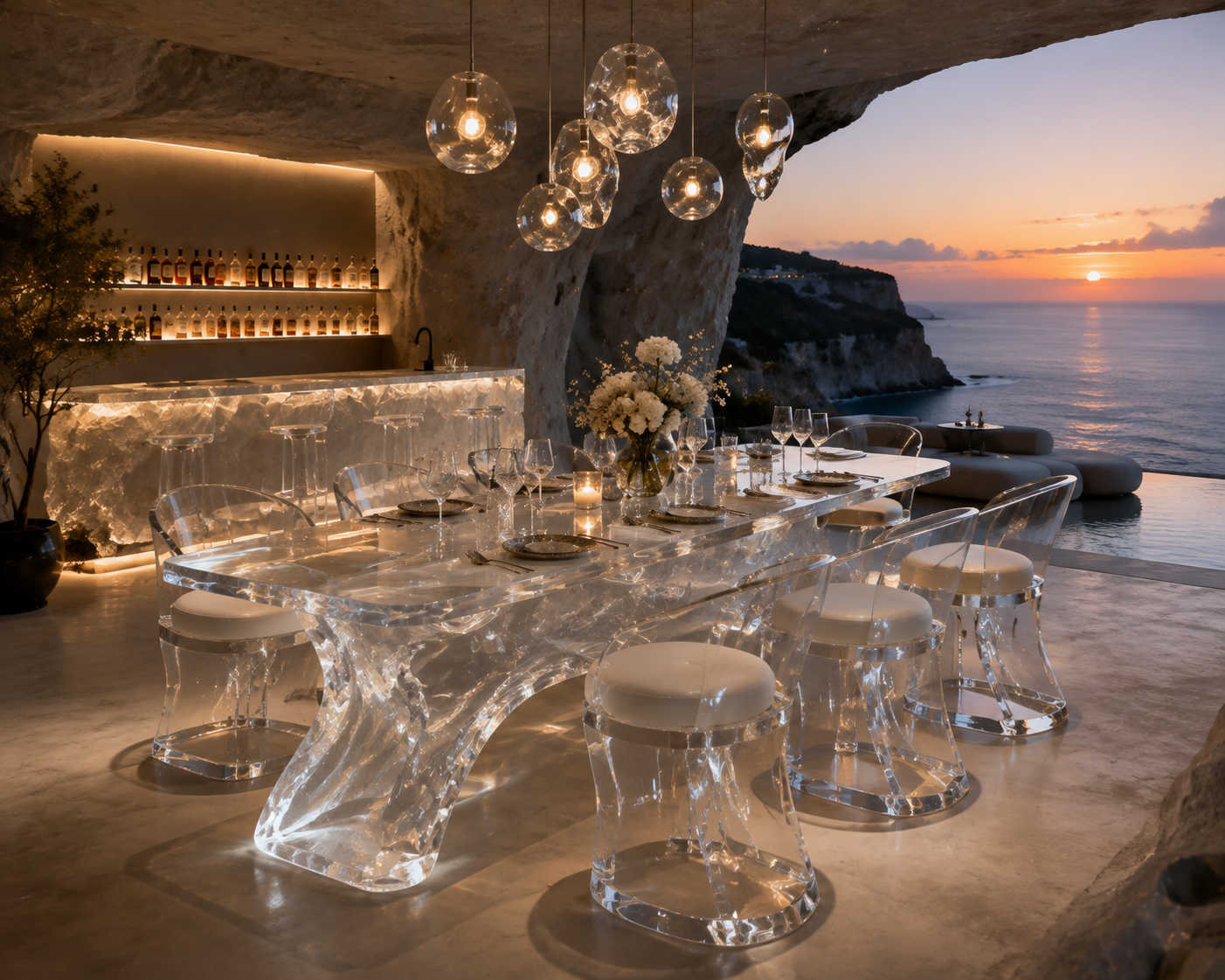
Competition in the premium furniture market is becoming more intense.
New collections appear quickly. Design references travel globally through social media, exhibitions, interior design platforms, and international trade shows. Forms that once seemed unique can be imitated within a short period of time. Colors change with trends. Decorative details can be copied. Even complete furniture concepts may quickly appear across multiple suppliers.
For this reason, high-end product differentiation can no longer depend only on appearance.
Brands need deeper sources of competitive value.
One of those sources is material.
In recent years, acrylic furniture has developed into a more sophisticated design category. High-quality transparent furniture is no longer used only to create visual novelty. When combined with controlled material quality, precise manufacturing, custom engineering, refined polishing, and thoughtful design, crystal acrylic furniture can become a powerful tool for premium positioning.
This creates an important opportunity for furniture manufacturers and brands.
Synthetic crystal acrylic can help products feel lighter, cleaner, more architectural, and more distinctive. It can support contemporary luxury interiors while remaining highly adaptable. It can be customized in size, thickness, form, color, and material combination. It can also be used in residential, hospitality, retail, commercial, and exhibition environments.
Most importantly, acrylic creates differentiation at multiple levels at the same time.
It can differentiate through visual appearance.
It can differentiate through craftsmanship.
It can differentiate through customization.
It can differentiate through technical complexity.
It can differentiate through service.
And it can differentiate through brand storytelling.
These qualities make synthetic crystal acrylic furniture an increasingly valuable breakthrough point for companies seeking to move beyond ordinary competition.
1. Material Differentiation Is Becoming More Important Than Visual Novelty
For many years, furniture differentiation was driven heavily by form.
A chair with an unusual curve could attract attention.
A table with a distinctive base could become recognizable.
A cabinet with a special surface finish could create a strong first impression.
But as global design references have become more accessible, form alone has become easier to reproduce.
This is why material differentiation is becoming more important.
High-end customers increasingly notice what a product is made from, how the material looks, how it feels, how it interacts with light, and whether it creates a believable sense of value.
This is where luxury acrylic furniture can create a strong advantage.
Acrylic is visually unusual because it combines physical mass with optical lightness.
A thick transparent table leg can feel substantial while remaining visually unobtrusive.
A clear console can occupy a large area without making the room appear crowded.
A sculptural acrylic base can create strong visual presence without blocking surrounding architecture.
This contradiction makes acrylic highly attractive in premium interiors.
The material can feel both strong and light.
Visible and invisible.
Modern and timeless.
Decorative and architectural.
The effect becomes even more powerful when material quality is high.
Optical clarity matters.
Surface consistency matters.
Thickness matters.
Edge treatment matters.
Internal transparency matters.
Polishing matters.
Customers may not always describe these elements technically, but they often perceive the result instinctively.
A premium acrylic product feels different from a basic transparent product.
This distinction is critical for brands seeking differentiation.
If acrylic is treated only as a low-cost alternative to glass or as a decorative plastic, the commercial value remains limited.
If it is treated as a premium design material, the positioning changes.
The product can enter conversations about modern luxury, visual purity, spatial openness, customization, and craftsmanship.
This shift allows brands to compete on more than price.
Material differentiation can also support stronger collection design.
For example, a furniture brand could develop a recognizable series using thick crystal acrylic combined with polished metal details.
Another could build a collection around tinted acrylic and natural stone.
A hospitality supplier could specialize in large-format acrylic console tables and decorative furniture.
A luxury retailer could use custom transparent fixtures as part of its visual identity.
In each case, acrylic becomes more than a material.
It becomes a signature.
That is one of the most important opportunities for premium acrylic furniture.
When the material itself becomes recognizable, it contributes to brand differentiation before the customer even examines the details.
2. Precision Craftsmanship Turns Acrylic Into a Premium Product
Acrylic can look simple.
That simplicity is deceptive.
Transparent furniture often requires more production discipline than opaque furniture because imperfections are difficult to hide.
A visible scratch may immediately affect the appearance.
An uneven edge can interrupt reflections.
A poorly polished surface can make the product feel inexpensive.
A bonding line can become visually distracting.
Misaligned parts can destroy the clean geometry of the design.
This means craftsmanship plays an unusually important role in crystal acrylic furniture.
Precision cutting is one of the first requirements.
Dimensions need to be controlled carefully, especially when multiple acrylic components are assembled into one structure.
Edges must remain straight and consistent.
Corners must align correctly.
The geometry of the finished piece needs to feel intentional.
Polishing is equally important.
A high-quality polished edge can create a crystal-like effect, catching light and visually emphasizing material thickness.
Poor polishing has the opposite effect.
It can make premium acrylic appear dull, uneven, or unfinished.
Bonding also requires technical control.
Transparent joints leave little room for error.
The objective is often to create strong connections while maintaining a visually clean appearance.
This requires experience, process consistency, and attention to detail.
Machining introduces another layer of complexity.
Premium acrylic products may require CNC work, drilling, recesses, curves, channels, hardware integration, or complex three-dimensional forms.
Each additional process increases the importance of technical understanding.
Bending and forming can create sculptural furniture, but they also require controlled production methods to achieve consistent curves and dimensions.
All of this means manufacturing quality can become a major source of differentiation.
In many markets, companies compete by offering similar-looking products at lower prices.
Premium suppliers can take a different approach.
They can compete on visible precision.
For high-end buyers, precision communicates value.
A clean joint shows control.
A polished edge shows refinement.
A consistent curve shows engineering.
A stable structure shows technical competence.
A flawless surface shows care.
These details contribute to the customer's perception long before they understand the manufacturing process.
For B2B buyers, the importance is even greater.
A furniture brand or designer may invest heavily in product development, photography, retail presentation, and marketing.
They cannot afford inconsistent production.
This makes dependable manufacturing capability a strategic asset.
The strongest acrylic furniture manufacturers can therefore position themselves as precision specialists rather than commodity producers.
That positioning creates a more defensible competitive advantage.
Designs can be copied.
But consistently producing those designs to a high standard is more difficult.
.png)
3. Customization Creates Stronger Product Identity
The premium furniture market is becoming increasingly personalized.
Customers want furniture that fits specific rooms.
Interior designers want products that match specific concepts.
Hotels need furniture adapted to brand standards.
Retailers want fixtures that reflect their visual identity.
Luxury furniture brands want proprietary products that cannot easily be compared with competitors.
All of these needs create opportunities for custom acrylic furniture manufacturing.
Acrylic is highly suitable for customized development because designers can modify many variables.
They can change dimensions.
They can increase or reduce thickness.
They can adjust transparency.
They can introduce tinted color.
They can create frosted surfaces.
They can combine clear and colored components.
They can design sharp geometric structures.
They can develop curved or sculptural forms.
They can integrate metal, stone, wood, glass, or upholstery.
This flexibility makes acrylic especially valuable for projects where standard furniture does not provide enough differentiation.
Customization also creates commercial advantages.
A standard product is easy to compare.
If ten suppliers offer similar clear side tables, buyers can focus heavily on price.
A custom product changes the comparison.
A table with a unique proportion, special acrylic thickness, integrated metal support, and custom stone top requires more specific capability.
The conversation moves away from “Who is cheapest?”
It becomes “Who can produce this correctly?”
That is a much stronger position for premium suppliers.
Customization can also help brands build exclusive collections.
A furniture company might develop a series of luxury acrylic furniture with proprietary curves and finishes.
A designer might create a limited-edition transparent dining table.
A hotel group could develop custom furniture for multiple locations.
A retailer might create a recognizable display system using acrylic and metal.
These products are harder to replace because they are connected to specific design intent.
Customization also encourages collaboration.
The supplier may become involved earlier in product development.
Instead of receiving only a purchase order, the manufacturer may review sketches, CAD files, reference images, and technical requirements.
The manufacturer may recommend material thickness.
It may suggest changes to improve stability.
It may develop prototypes.
It may test different bonding methods.
It may coordinate hardware.
It may adjust packaging based on final dimensions.
At this stage, the supplier becomes part of the design process.
That creates stronger customer relationships.
It also increases switching costs.
A customer who has successfully developed a complex product with one supplier may prefer to continue working with that supplier for future collections.
This creates long-term value.
For manufacturers, this means customization should not be viewed only as a production challenge.
It should be treated as a business model.
The ability to support one-off pieces, low-volume luxury production, prototypes, private-label collections, and project-specific products can become a core competitive advantage.
4. Mixed-Material Design Expands Luxury Possibilities
Acrylic does not need to work alone.
In fact, some of the most interesting opportunities for product differentiation come from combining acrylic with other materials.
Mixed-material design can create stronger contrast, richer visual experiences, and more complex product identities.
Acrylic and marble are a powerful combination.
Marble is visually dense, natural, patterned, and heavy.
Acrylic is clear, modern, light, and visually open.
When combined carefully, the two materials create tension.
A transparent acrylic base can make a marble tabletop appear to float.
A thick clear pedestal can support stone while preserving visibility around it.
Acrylic and brass create another luxury direction.
Warm metal adds richness and decorative detail, while acrylic maintains modern clarity.
This combination can work well in consoles, side tables, dining tables, benches, display furniture, and decorative objects.
Acrylic and stainless steel create a cleaner architectural effect.
The result can feel contemporary, precise, and minimal.
Acrylic and wood provide balance between modernity and warmth.
Clear components can reduce the visual heaviness of solid wood furniture, while timber adds natural texture to transparent forms.
Acrylic and leather create opportunities for seating and office furniture.
Transparent legs or structural components can visually lighten upholstered pieces.
Acrylic and glass can create layered transparency.
Different reflective properties can produce subtle visual depth.
These combinations expand the possibilities of high-end furniture.
They also help brands create products that are more difficult to commoditize.
Mixed-material furniture requires coordination.
Different materials behave differently.
They have different tolerances.
Different expansion characteristics.
Different weights.
Different fastening requirements.
Different surface sensitivities.
This creates technical challenges, but those challenges can become competitive barriers.
A supplier who can successfully coordinate acrylic, metal, stone, wood, and upholstery is offering more than material processing.
It is offering integrated furniture manufacturing.
This can significantly increase commercial value.
Mixed-material design also helps acrylic enter more product categories.
Instead of being limited to clear coffee tables and chairs, acrylic can become part of dining furniture, bedroom furniture, office furniture, hospitality furniture, retail fixtures, decorative displays, luxury accessories, and architectural elements.
This diversification is important.
A broader application range allows manufacturers to serve more customer groups.
It also gives brands more opportunities to build complete collections.
For example, a premium furniture brand could create a collection that includes an acrylic-and-marble dining table, an acrylic-and-leather bench, a transparent console with brass details, and a crystal acrylic side table.
The acrylic becomes the visual thread connecting the collection.
This creates stronger brand coherence.
That is a major form of differentiation.
5. B2B Services Can Become a Major Source of Differentiation
In premium furniture, the physical product is only part of the customer experience.
This is particularly true in B2B markets.
Interior designers, architects, furniture brands, hotel developers, retailers, contractors, wholesalers, and distributors all evaluate suppliers through more than product appearance.
They also evaluate reliability.
Communication.
Technical support.
Sampling.
Documentation.
Lead times.
Quality consistency.
Packaging.
Project coordination.
Problem-solving.
This creates an opportunity for acrylic furniture OEM and acrylic furniture ODM suppliers.
A manufacturer that provides strong professional service can become more valuable than a competitor offering a lower price.
Consider a furniture brand developing a new acrylic collection.
The brand may need initial feasibility feedback.
Then CAD review.
Then samples.
Then changes to dimensions.
Then revised prototypes.
Then packaging tests.
Then production approval.
Then repeat orders.
If the manufacturer manages these stages effectively, it creates confidence.
That confidence has commercial value.
The same applies to hospitality projects.
A hotel may need custom dimensions, finish samples, mock-ups, room-specific quantities, packaging coordination, and phased delivery.
A supplier who understands project requirements can reduce risk for the customer.
Retail projects have similar needs.
A luxury boutique may require custom displays that fit exact store layouts.
The furniture may need to coordinate with lighting, product merchandising, and architectural finishes.
Acrylic manufacturers capable of understanding these requirements can move into higher-value project work.
B2B service also creates differentiation because it is harder to copy than a product image.
A competitor may reproduce the appearance of a table.
But replicating a supplier's project management, technical communication, sample development, production consistency, and export experience is more difficult.
For this reason, premium manufacturers should treat service as part of the product.
The quotation is part of the product.
The drawing is part of the product.
The sample is part of the product.
The inspection process is part of the product.
The packaging is part of the product.
The delivery coordination is part of the product.
Each interaction contributes to the customer's perception of professionalism.
This matters especially in international business.
Buyers may never visit the factory before placing an order.
Their confidence depends heavily on communication and documentation.
Manufacturers who respond clearly, provide accurate information, explain technical limitations, and maintain reliable production standards can build stronger relationships.
Over time, these relationships can produce repeat business.
A single project may lead to a second project.
A successful prototype may become a product line.
A hotel customer may expand to new locations.
A furniture brand may increase its collection.
A distributor may develop exclusive regional products.
This recurring value is one of the strongest reasons B2B capability should be considered a core differentiator.
.png)
6. Brand Storytelling Converts Manufacturing Capability Into Market Value
A company may have excellent manufacturing capability and still struggle to achieve premium positioning.
The reason is simple.
Customers cannot value what they do not understand.
This is why storytelling matters.
For premium acrylic furniture, brand communication should explain more than appearance.
It should explain material quality.
It should explain craftsmanship.
It should explain design logic.
It should explain customization.
It should explain engineering.
It should explain why the product is different.
For example, instead of simply saying that a table is made from acrylic, a brand can explain the importance of high optical clarity.
It can show how thick acrylic interacts with light.
It can explain how edges are polished.
It can demonstrate the precision required to create clean joints.
It can show prototypes.
It can present custom project development.
It can highlight combinations with stone, brass, wood, or leather.
It can document the production process.
These stories help customers understand value.
This is particularly important because acrylic can be misunderstood.
Some buyers may associate it only with simple plastic furniture.
Premium brands need to change that perception.
They need to show that material category and product quality are not the same thing.
Acrylic can be basic.
It can also be highly refined.
The difference lies in material grade, thickness, design, manufacturing, finishing, engineering, and presentation.
Strong storytelling allows companies to communicate this difference.
Case studies are especially useful.
A manufacturer can show how a custom table was developed from a designer's concept.
It can explain how structural challenges were solved.
It can show how acrylic was combined with marble.
It can document prototype development.
It can present the final product in the completed interior.
This creates credibility.
Behind-the-scenes content can also strengthen positioning.
Photographs of polishing, machining, bonding, bending, inspection, and packaging demonstrate real capability.
Technical articles can help B2B buyers understand manufacturing decisions.
Design-focused content can attract architects and interior designers.
SEO content can help international buyers discover the company through searches such as custom acrylic furniture, luxury acrylic furniture supplier, acrylic furniture manufacturer, acrylic furniture OEM, and bespoke acrylic furniture.
All of this converts manufacturing capability into market visibility.
That conversion is essential.
Capability without communication remains hidden.
Communication without capability lacks credibility.
The strongest brands combine both.
In the future, premium differentiation will increasingly depend on this combination.
A company should not only make better furniture.
It should make the reasons for that quality easy to understand.
Conclusion
Synthetic crystal acrylic furniture is emerging as a powerful new breakthrough for high-end product differentiation.
Its value comes from much more than transparency.
At the material level, acrylic offers a distinctive balance between visual lightness and physical presence.
At the design level, it allows brands to create clean, modern, sculptural, and highly adaptable furniture.
At the manufacturing level, it rewards precision and makes craftsmanship visible.
At the customization level, it supports unique dimensions, colors, forms, finishes, and material combinations.
At the B2B level, it creates opportunities for OEM, ODM, private-label development, prototyping, hospitality projects, retail installations, and designer collaborations.
At the branding level, it provides a strong story around clarity, craftsmanship, innovation, customization, and modern luxury.
Together, these advantages create a much stronger competitive position than visual novelty alone.
This is particularly important as the furniture market becomes more crowded.
Shapes can be copied.
Trends can be followed.
Images can be imitated.
But a complete system of material expertise, manufacturing precision, customization, design integration, professional service, and brand credibility is much harder to reproduce.
That is where the real opportunity lies.
The future of crystal acrylic furniture will belong to companies that understand that differentiation is not created by one feature.
It is created by the relationship between many details.
Material quality.
Optical clarity.
Thickness.
Edge finishing.
Structural engineering.
Mixed-material integration.
Customization.
Production consistency.
Packaging.
Service.
Storytelling.
Each detail strengthens the next.
For premium furniture manufacturers and brands, this creates a clear strategic direction.
Do not treat acrylic as simply another material.
Treat it as a platform for differentiation.
Use it to create products that look different.
Use manufacturing precision to make them feel different.
Use customization to make them difficult to compare.
Use mixed materials to expand their design language.
Use professional B2B services to create long-term customer relationships.
And use strong storytelling to explain why the product deserves premium attention.
When all of these elements work together, acrylic furniture moves far beyond transparency.
It becomes a source of design identity.
A source of manufacturing credibility.
A source of commercial differentiation.
And ultimately, a source of sustainable premium value.
READ MORE:
- From Living Room to Terrace: How Crystal-Like Furniture Works Across Indoor and Outdoor Design
- Beyond Wood and Metal: What Distinctive Materials Can Make Outdoor Furniture Stand Out?
- 2026 Design Inspiration: Where Synthetic Crystal Furniture Works Best in Commercial and Residential Spaces
- Why More Designers Are Bringing "Crystal-Like Furniture" Into Modern Interiors
- High-End Spaces Do Not Have to Be Complicated: How Transparent Materials Elevate Interior Design
- Synthetic Crystal Acrylic Furniture: Giving Modern Spaces Stronger Visual Impact
- Why Crystal-Grade Acrylic Is Becoming an Innovative Material in the Eyes of Designers
- From Transparent Aesthetics to Commercial Competitiveness: Future Opportunities for Synthetic Crystal Acrylic Furniture
- Synthetic Crystal Acrylic Furniture: Why High-End Customers Increasingly Value the “Sense of Worth” Created by Materials


