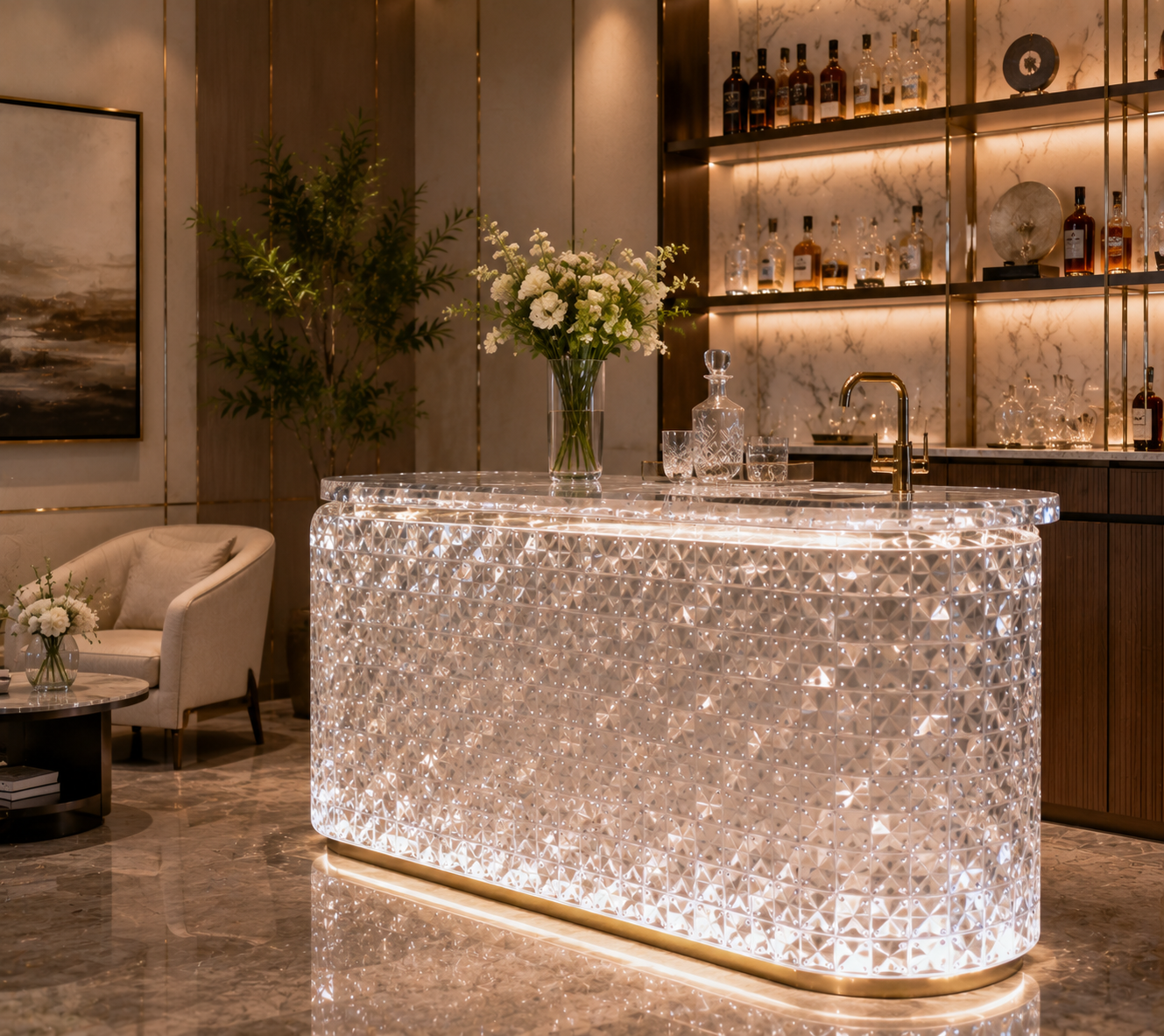
For decades, transparent furniture has occupied a distinctive place in contemporary interior design. It has often been chosen because it feels light, modern, clean, and visually unobtrusive. Acrylic tables, chairs, consoles, benches, display stands, and decorative objects have been used to reduce visual heaviness while preserving function.
But the market is changing.
Today, the future of acrylic furniture is no longer defined only by transparency.
The most important opportunities increasingly come from the relationship between aesthetics and commercial capability. High-end customers want products that are visually sophisticated, but they also expect customization, reliable manufacturing, material quality, technical support, consistent finishing, project coordination, and long-term supplier capability.
This changes the competitive landscape for crystal acrylic furniture.
A manufacturer that only produces clear furniture in standard shapes may still serve part of the market, but the strongest opportunities are developing in more complex areas: custom design, luxury interiors, mixed-material furniture, hospitality projects, retail environments, private-label production, premium residential projects, and international B2B supply.
In other words, transparent aesthetics may attract attention, but commercial competitiveness determines whether that attention becomes sustainable business.
The following six areas represent some of the most important future opportunities for synthetic crystal acrylic furniture.
1. Transparent Aesthetics Is Evolving Into a Distinctive Luxury Language
Transparency was once treated mainly as a decorative characteristic.
A transparent chair looked modern because it was visually unusual. A clear side table created a floating effect. An acrylic console made a small room feel less crowded. These qualities are still valuable, but premium interior design is beginning to use transparency in a more sophisticated way.
The most successful luxury acrylic furniture is not simply transparent.
It uses transparency as a design language.
This means carefully controlling thickness, proportion, reflection, edge treatment, surface quality, curvature, geometry, and the relationship between the furniture and surrounding materials.
In a high-end interior, a thick clear acrylic base can create a strong physical presence while remaining visually light. A sculptural acrylic table can interact with natural light and decorative lighting throughout the day. A polished edge can create a crystal-like highlight. A transparent furniture piece can preserve the visibility of marble flooring, artistic rugs, wall panels, or architectural details.
This makes crystal acrylic furniture particularly valuable in contemporary luxury spaces.
Modern high-end interiors often seek balance rather than excess. Designers may combine stone, metal, wood, leather, glass, textiles, and artwork within the same environment. If every furniture item is visually heavy, the space can become crowded.
Acrylic provides contrast.
It can function almost like visual breathing space.
A transparent coffee table between two large sofas allows the rug below to remain visible. A clear console placed against an expressive wall surface does not hide the architecture. Acrylic dining chair components can reduce the visual density around a large table. Transparent display structures can support luxury products without competing with them.
The opportunity for manufacturers is therefore to move beyond basic transparency.
Future premium acrylic furniture should focus on intentional optical effects, refined geometry, balanced thickness, and high-quality finishing.
This will also influence product photography and marketing.
Instead of presenting acrylic furniture against plain white backgrounds only, brands can show how the material interacts with real luxury environments. Light, reflection, spatial openness, and mixed materials should become part of the visual story.
This transition is important because it changes acrylic from a material category into a design identity.
And once a material becomes part of a recognizable design language, it creates stronger opportunities for premium pricing, customization, collaboration, and brand differentiation.
2. Customization Is Creating New Value for High-End Projects
Standardized products remain important for retail markets, but many of the strongest opportunities in high-end furniture are connected to customization.
Premium residential projects rarely operate according to perfectly standard dimensions.
Luxury hotels have specific design concepts.
Boutiques require furniture that reflects brand identity.
Showrooms need display structures adapted to products.
Architects may require furniture to fit unusual spaces.
Interior designers often want specific thicknesses, colors, curves, proportions, or material combinations.
This makes customization one of the most important growth opportunities for acrylic furniture manufacturers.
Acrylic is particularly suitable for this shift because it offers significant design flexibility.
Manufacturers can explore clear, tinted, frosted, colored, layered, curved, faceted, or sculptural forms. Acrylic components can be combined with metal, stone, glass, leather, wood, and other materials. Different thicknesses can create different visual and structural effects.
For high-end buyers, these possibilities make the material more attractive.
But customization also changes the role of the supplier.
A factory that only receives a standard order is mainly a production source.
A supplier that can review drawings, evaluate structure, suggest thickness, recommend manufacturing processes, create prototypes, develop samples, solve technical problems, and coordinate final production becomes a project partner.
That distinction has commercial value.
Interior designers and furniture brands often need suppliers who understand design intent, not merely dimensions.
Suppose a designer creates a transparent console with a thick acrylic body, brass accents, and a stone top.
The supplier needs to consider more than appearance.
How will the acrylic support the stone?
How should the components connect?
How can the joint remain visually clean?
What thickness is appropriate?
How can the product be packaged safely?
What tolerances are needed when acrylic meets metal?
How should the surface be protected during assembly?
These questions turn manufacturing into a technical service.
That is why custom acrylic furniture manufacturing can become a higher-value business than selling standardized products.
The commercial opportunity is especially strong for companies that can support small-batch premium production.
Luxury projects do not always require thousands of identical pieces. Sometimes the order may involve dozens of highly customized units. In other cases, a successful prototype may later develop into a larger product series.
Manufacturers that are flexible enough to handle both stages can create long-term relationships with brands and project clients.
Customization also supports differentiation.
When many competitors can produce a simple clear table, price becomes a major purchasing factor.
When the product involves proprietary design, custom structure, specialized finishing, unusual dimensions, or mixed materials, competition becomes more focused on capability.
That is a much stronger position for suppliers seeking sustainable margins.
.png)
3. Manufacturing Capability Is Becoming a Competitive Barrier
Transparent materials are visually unforgiving.
This is one of acrylic's greatest challenges—and one of its greatest commercial opportunities.
When furniture is opaque, manufacturers can sometimes hide internal structures, fastening points, minor surface inconsistencies, or assembly details.
With clear acrylic, many of these details remain visible.
Poor edge finishing can immediately reduce perceived quality.
Inconsistent polishing can affect reflections.
Visible bonding lines can distract from the design.
Scratches or surface damage can become obvious under light.
Misalignment can make a simple geometric product look unbalanced.
For this reason, manufacturing capability is becoming a serious competitive barrier in the acrylic furniture industry.
The technical requirements may include CNC machining, precision cutting, drilling, polishing, bonding, bending, forming, surface finishing, assembly, structural testing, inspection, and protective packaging.
Not every factory can perform these processes at the same level.
The premium market notices the difference.
A well-produced acrylic coffee table may appear extremely simple, but simplicity increases the importance of precision. If four thick transparent panels form the structure, their alignment, edge quality, internal clarity, and connection all become part of the visible product.
This means manufacturing excellence directly affects design value.
For suppliers, investment in process control can therefore support stronger commercial positioning.
Quality control should examine more than basic dimensions.
Premium production may require inspection of transparency, edge consistency, scratches, visual distortion, bonding quality, surface cleanliness, structural stability, and packaging protection.
Packaging is particularly important.
A perfectly produced acrylic product can lose its value if it arrives with damage or surface marks. International orders, hospitality projects, and B2B customers may require especially careful protective systems.
This creates another opportunity for differentiation.
Suppliers that understand export logistics, protective films, customized packaging, corner protection, carton engineering, wooden crates, and assembly instructions can provide greater confidence to international buyers.
The same principle applies to repeat production.
Furniture brands need consistency.
If the first sample looks excellent but the production batch varies in clarity, finish, dimension, or color, the supplier becomes difficult to trust.
Therefore, future commercial competitiveness will depend increasingly on process repeatability.
This is particularly important for acrylic furniture OEM and acrylic furniture ODM programs.
Brands that outsource production are placing their own reputation in the hands of the manufacturer.
For them, reliable quality is not a technical detail. It is a business requirement.
Manufacturers that recognize this can position themselves not as low-cost producers, but as reliable production partners for premium markets.
4. Cross-Material Design Expands Acrylic Furniture Applications
Acrylic becomes even more powerful when it is not used alone.
One of the most important future opportunities lies in cross-material design.
This means combining acrylic with other materials to create products that are more visually sophisticated, structurally versatile, and commercially distinctive.
Acrylic and marble are one example.
The transparent quality of acrylic creates visual lightness, while marble introduces natural pattern, weight, and luxury association. Together, they can create tables, consoles, pedestals, and display furniture with strong premium appeal.
Acrylic and metal create another direction.
Stainless steel, brass, aluminum, or powder-coated metal can provide structural reinforcement and decorative contrast. Metal can introduce precision, warmth, industrial character, or glamour depending on the finish.
Acrylic and wood create a different emotional balance.
Wood brings natural warmth and texture, while acrylic brings clarity and modernity. This combination can work especially well in contemporary residential furniture where designers want warmth without excessive visual heaviness.
Acrylic and leather can also support luxury seating, benches, desks, and accessories.
The transparency of the acrylic structure can make upholstered elements appear lighter and more sculptural.
These combinations significantly expand the design vocabulary of premium acrylic furniture.
They also expand the range of applications.
Instead of competing only in the transparent table market, acrylic manufacturers can participate in dining collections, lounge furniture, hotel furniture, retail displays, luxury accessories, office furniture, decorative partitions, shelving, lighting structures, and architectural installations.
Cross-material products are also harder to commoditize.
A simple clear side table is relatively easy for competitors to reproduce.
A custom acrylic and marble console with integrated metal detailing requires multiple capabilities, careful coordination, and stronger technical communication.
This creates commercial protection.
Manufacturers who want to develop this opportunity may need to build partnerships with suppliers specializing in stone, metal, wood, upholstery, or hardware.
The strongest companies may eventually operate as integrated furniture solution providers rather than single-material processors.
This is especially relevant in B2B projects.
Designers and developers often prefer fewer suppliers when those suppliers can coordinate multiple materials effectively.
A manufacturer capable of integrating acrylic with complementary materials can therefore become more valuable within the project supply chain.
Cross-material design also supports stronger product storytelling.
Customers can understand contrast.
They can see the relationship between transparency and stone, transparency and metal, transparency and natural wood.
This makes products easier to position as intentional design objects rather than generic acrylic furniture.
In the future, the most commercially successful crystal acrylic furniture may not necessarily be completely transparent.
Instead, acrylic may become the defining visual element within a broader material composition.
5. B2B Markets Offer Significant Growth Potential
The future of synthetic crystal acrylic furniture is not limited to direct-to-consumer retail.
Some of the most important commercial opportunities exist in B2B markets.
These include interior design firms, architecture studios, furniture brands, hotels, resorts, restaurants, luxury property developers, retailers, boutiques, department stores, exhibition companies, commercial contractors, and furniture distributors.
Each of these customer groups has different needs.
Interior designers may need one-off custom pieces.
Furniture brands may require OEM production.
Hotels may need repeated units for guestrooms or public spaces.
Retailers may require display furniture.
Developers may need products across multiple properties.
Distributors may prefer standardized collections with private-label possibilities.
This variety creates significant opportunity for manufacturers with flexible capabilities.
The most valuable B2B suppliers do more than provide prices.
They help customers reduce uncertainty.
For example, an international furniture brand may need support with technical drawings, samples, packaging, quality standards, repeat production, and delivery schedules.
A hotel project may require custom dimensions, finish approval, mock-ups, and coordination with other materials.
A boutique may need specialized display structures that reflect the brand's visual identity.
In all these cases, product quality is only one part of the purchasing decision.
Communication quality matters.
Engineering support matters.
Consistency matters.
Responsiveness matters.
Packaging matters.
Documentation matters.
This is why B2B development can transform the commercial model of an acrylic furniture manufacturer.
Instead of competing for isolated retail orders, the company can develop long-term customer relationships.
One successful project may lead to additional rooms, additional stores, new product collections, or future developments.
This recurring business can be much more valuable than a single transaction.
OEM and private-label opportunities are particularly important.
Many furniture brands have strong design and marketing capabilities but do not manufacture acrylic internally.
They need production partners capable of translating ideas into finished products while maintaining confidentiality, consistency, and quality.
Acrylic specialists can fill this gap.
ODM represents another opportunity.
Manufacturers with internal design capability can create product concepts that customers adapt, brand, or distribute in different markets.
This requires stronger design awareness, but it can create additional value beyond pure manufacturing.
Global B2B buyers are also becoming more sophisticated when evaluating suppliers.
They increasingly look at production capacity, quality management, customization ability, export experience, communication, lead-time reliability, and technical expertise.
Therefore, the future of custom acrylic furniture manufacturing depends partly on professionalizing the entire customer experience.
A supplier may produce excellent furniture, but if quotations are unclear, drawings are inaccurate, samples are inconsistent, or communication is slow, commercial opportunities can still be lost.
The companies that combine craftsmanship with professional B2B service will be better positioned to capture premium global demand.
.png)
6. The Future Will Be Defined by Brand, Technology, and Material Storytelling
As acrylic furniture becomes more visible in premium markets, competition will increase.
This means product appearance alone will become less effective as a differentiator.
A clear table can be copied.
A transparent chair can be imitated.
A simple geometric form may quickly appear across many suppliers.
The long-term advantage will come from building capabilities that are harder to duplicate.
Brand is one of them.
A strong brand gives customers a reason to remember the company beyond individual products.
For manufacturers, brand positioning does not necessarily mean becoming a consumer luxury brand.
It can mean developing a clear B2B identity.
A company might become known for thick crystal acrylic furniture, custom hotel projects, mixed-material design, highly polished finishing, complex curved structures, private-label manufacturing, or small-batch luxury customization.
Specialization can create credibility.
Technology is another competitive factor.
Advanced machining, digital modeling, prototyping, better polishing methods, improved bonding techniques, precision inspection, and more efficient production planning can all improve quality and reduce risk.
Technology can also support greater customization.
Digital drawings and 3D models make it easier to communicate complex structures before production begins.
Prototypes allow customers to test design concepts.
CNC machining can improve repeatability.
Improved process control can help manufacturers handle more sophisticated products.
But perhaps the most underestimated opportunity is material storytelling.
Customers need to understand why premium acrylic furniture is valuable.
If the only message is “this furniture is transparent,” the product may be easy to compare on price.
But if the brand explains optical clarity, material thickness, precision finishing, hand polishing, structural engineering, customization, quality inspection, and project-specific production, the customer begins to understand the expertise behind the object.
This is especially important for luxury furniture.
Luxury is rarely created by raw material alone.
It is created through choices.
Why this thickness?
Why this proportion?
Why this edge?
Why this combination of acrylic and metal?
Why this polishing process?
Why this custom structure?
The answers form the product story.
Manufacturers that communicate these decisions can strengthen perceived value.
Content marketing can play an important role.
Articles, case studies, project photographs, behind-the-scenes production images, material comparisons, technical explanations, and design stories can help buyers understand what distinguishes one supplier from another.
For international B2B markets, this also supports search visibility.
Buyers looking for acrylic furniture manufacturers, custom acrylic furniture, luxury acrylic furniture suppliers, acrylic furniture OEM, or bespoke acrylic furniture are often searching for more than a product.
They are searching for capability.
A strong digital presence should therefore show both products and processes.
The manufacturer should demonstrate what it can make, how it makes it, who it serves, and what types of projects it can support.
This combination of brand, technology, and storytelling will become increasingly important as competition grows.
Conclusion
The future of synthetic crystal acrylic furniture will not be determined by transparency alone.
Transparency remains one of the material's greatest visual strengths, but commercial success will increasingly depend on what manufacturers and brands build around that strength.
The opportunity begins with aesthetics.
Crystal-like clarity, visual lightness, polished surfaces, and sculptural forms can create strong appeal in contemporary interiors.
But the next stage is customization.
Customers want furniture designed for specific spaces, brands, and project requirements.
Then comes manufacturing capability.
Precision cutting, polishing, bonding, machining, bending, assembly, quality control, and protective packaging determine whether a design concept can become a premium product.
Cross-material integration creates another layer of opportunity.
Combining acrylic with marble, metal, wood, leather, glass, and textiles expands both product categories and visual possibilities.
B2B markets then create scale and long-term commercial value.
Furniture brands, designers, hotels, retailers, developers, and distributors all need suppliers who can offer more than standard products.
Finally, branding and material storytelling turn capability into market recognition.
This progression explains why acrylic furniture is moving from a decorative niche toward a more strategically important furniture category.
The companies with the greatest future potential will not necessarily be those that produce the largest number of transparent products.
They will be the companies that understand how to convert material advantages into customer advantages.
They will know how to combine design with engineering.
They will know how to combine customization with repeatable production.
They will know how to combine craftsmanship with professional B2B service.
They will know how to combine transparency with stronger brand identity.
And most importantly, they will understand that the real value of crystal acrylic furniture is not simply that customers can see through it.
The real value lies in everything customers can see behind it: design thinking, precision, manufacturing expertise, customization capability, and commercial reliability.
That is where transparent aesthetics becomes commercial competitiveness.
READ MORE:
- From Living Room to Terrace: How Crystal-Like Furniture Works Across Indoor and Outdoor Design
- Beyond Wood and Metal: What Distinctive Materials Can Make Outdoor Furniture Stand Out?
- 2026 Design Inspiration: Where Synthetic Crystal Furniture Works Best in Commercial and Residential Spaces
- Why More Designers Are Bringing "Crystal-Like Furniture" Into Modern Interiors
- High-End Spaces Do Not Have to Be Complicated: How Transparent Materials Elevate Interior Design
- Synthetic Crystal Acrylic Furniture: Giving Modern Spaces Stronger Visual Impact
- Why Crystal-Grade Acrylic Is Becoming an Innovative Material in the Eyes of Designers
- Synthetic Crystal Acrylic Furniture: A New Breakthrough for High-End Product Differentiation
- Synthetic Crystal Acrylic Furniture: Why High-End Customers Increasingly Value the “Sense of Worth” Created by Materials


