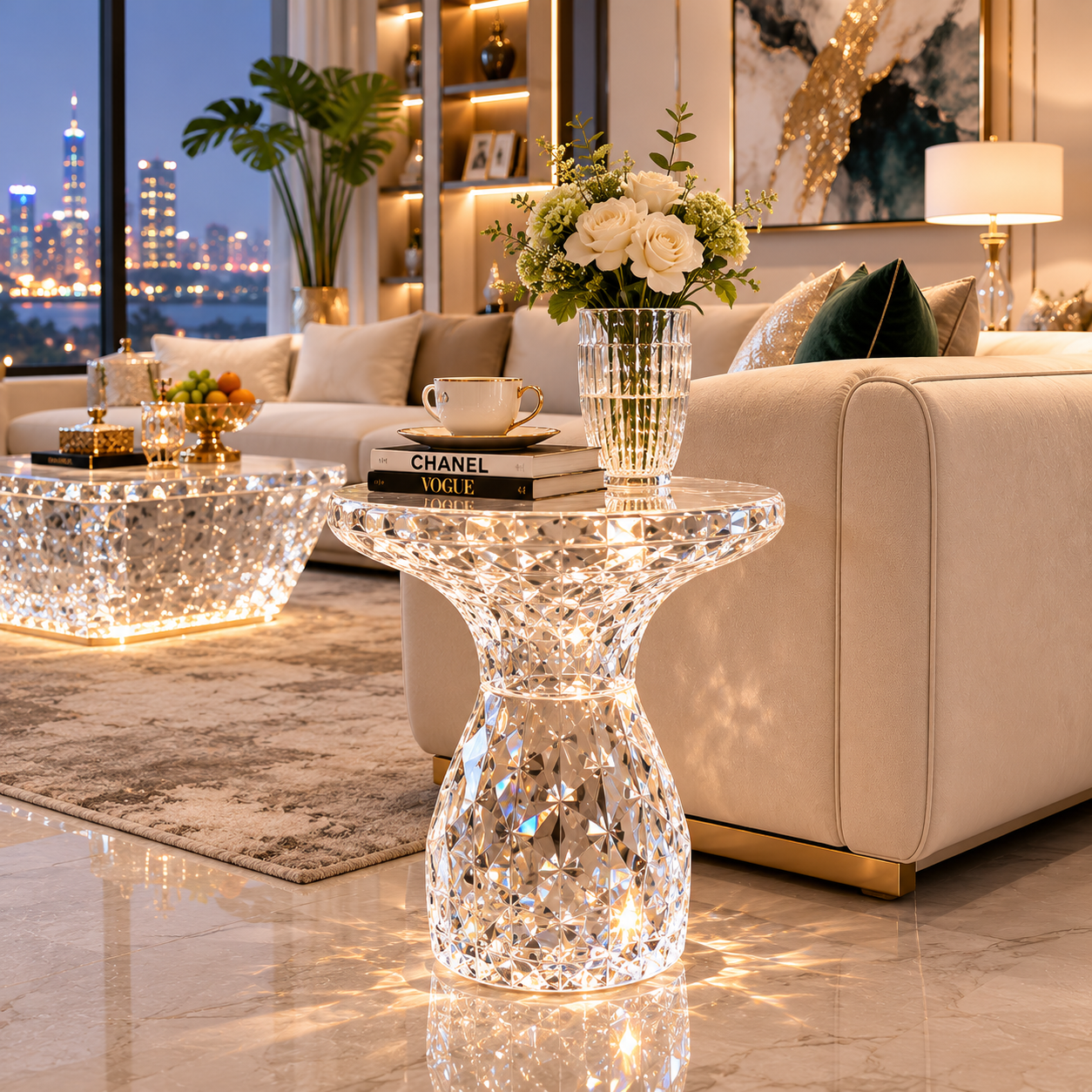
Modern interior design increasingly depends on contrast.
Designers want spaces to feel open, but not empty.
Minimal, but not cold.
Luxurious, but not visually overloaded.
Architectural, but still comfortable.
This balance is difficult to achieve with furniture alone.
Traditional materials such as wood, marble, metal, leather, and fabric can create warmth, weight, texture, and luxury, but when too many visually dense materials are placed together, a space can quickly feel crowded.
This is one reason synthetic crystal acrylic furniture is gaining greater attention.
High-quality acrylic furniture introduces a very different kind of visual presence.
It occupies physical space, yet allows the eye to see through it.
It can be thick and substantial while still appearing visually light.
It can reflect surrounding light without creating the same mirror-like effect as metal.
It can support stone, glass, or decorative objects while allowing those elements to remain visually dominant.
For designers, this creates an unusual opportunity.
Acrylic can add furniture to a room without necessarily adding visual congestion.
At the same time, carefully designed crystal acrylic furniture can become highly expressive.
Polished edges can catch light.
Thick transparent surfaces can create optical depth.
Curved sections can distort reflections.
Layered components can create visual complexity.
Sculptural structures can appear almost weightless.
In modern interior environments, these characteristics can dramatically strengthen visual impact.
The material does not need bright colors or excessive ornamentation to attract attention.
Its impact can come from clarity, proportion, transparency, geometry, reflection, and interaction with the surrounding space.
This is why crystal acrylic is increasingly being used not simply as a transparent furniture material, but as a strategic design tool.
1. Transparency Creates a More Powerful Sense of Space
One of the greatest strengths of transparent furniture is its ability to reduce visual interruption.
Every piece of furniture affects how a room is perceived.
A solid table creates a visual block.
A large cabinet changes sightlines.
An upholstered chair adds volume.
A stone pedestal introduces visual weight.
These effects are not necessarily negative. In many interiors, they are essential.
But modern design often requires a more delicate balance.
Designers may want furniture to perform its function without hiding important surfaces or architectural elements.
Acrylic makes this possible.
Consider a living room centered around a highly detailed rug.
If a large opaque coffee table is placed in the middle of the room, a significant portion of the rug disappears visually.
A clear acrylic coffee table creates a different effect.
The table remains physically present, but the rug continues to contribute to the overall composition.
The furniture and flooring can be read at the same time.
This creates stronger visual continuity.
The same principle applies to decorative flooring.
In luxury interiors with marble, terrazzo, natural stone, or custom wood patterns, designers often want the floor to remain visible.
Transparent acrylic furniture preserves that visibility.
Acrylic also works well against feature walls.
A clear console placed in front of stone, textured plaster, decorative panels, wallpaper, or artwork allows the background to remain visually important.
This can be particularly useful in smaller rooms.
When floor area is limited, furniture cannot simply be removed.
The room still needs tables, chairs, storage, and practical surfaces.
But visual obstruction can be reduced.
This is why luxury acrylic furniture can make compact interiors feel more open.
It creates physical functionality without producing the same level of visual density as opaque alternatives.
In larger spaces, transparency serves a different purpose.
Hotel lobbies, showrooms, galleries, high-end boutiques, and luxury residences often rely on carefully planned sightlines.
Designers may want the eye to move across a room toward artwork, architecture, lighting, landscaping, or another focal point.
Acrylic furniture supports this visual movement.
Instead of interrupting the space, it participates in it.
This relationship between object and background is what makes transparency so powerful.
The furniture does not merely exist in front of the interior.
It allows the interior to pass visually through it.
That can make the space feel larger, more layered, and more sophisticated.
2. Light and Reflection Turn Furniture Into a Visual Experience
Transparency alone does not explain the visual power of crystal acrylic.
Light is equally important.
High-quality crystal acrylic furniture interacts continuously with both natural and artificial light.
During daylight hours, sunlight may pass through the material and create highlights along polished edges.
In the evening, interior lighting can produce reflections on flat surfaces or illuminate thicker sections.
Spotlights can emphasize faceted details.
Indirect lighting can create softer optical effects.
Curved acrylic components may distort surrounding reflections in subtle ways.
The furniture can therefore change visually throughout the day.
This is valuable in modern interiors because lighting is no longer treated as a purely functional element.
Lighting is part of spatial design.
Architects and interior designers use concealed lighting, pendant fixtures, spotlights, wall washers, decorative lamps, and daylight control to create atmosphere.
Acrylic furniture can actively participate in this lighting system.
A thick polished edge can act almost like a line of light.
A clear sculptural table base may become more visible when illuminated from the side.
A transparent pedestal beneath a decorative object can reflect both the object and the surrounding room.
This creates a richer visual experience than a completely matte surface.
Optical depth is particularly important.
Thin transparent material can appear almost invisible.
Thick acrylic behaves differently.
Its edges become more prominent.
Light enters and exits the material at different angles.
Internal reflections become more noticeable.
The result can feel similar to crystal or glass sculpture.
For premium acrylic furniture, this optical depth is often one of the main sources of perceived value.
A thick side table or console does not need complex decoration.
The material itself becomes the decoration.
This allows designers to create impact through simplicity.
Instead of adding ornament to the surface, they can use transparency, thickness, geometry, and light.
The result often feels more architectural.
This is particularly compatible with modern luxury design, where excessive decoration may feel less sophisticated than controlled material expression.
Lighting also affects colored and tinted acrylic.
Smoky gray, amber, bronze, blue, or other translucent tones can appear differently under different light temperatures.
A tinted table may look subtle in daylight and much more dramatic under evening lighting.
This gives designers another tool for controlling atmosphere.
Acrylic therefore does not simply reflect the lighting design.
It becomes part of it.
.png)
3. Sculptural Forms Give Modern Interiors Stronger Focal Points
Modern interiors often need focal points.
A completely neutral space can feel calm, but it can also feel anonymous.
Designers frequently introduce one or two strong pieces to create identity.
Traditionally, that might be an artwork, chandelier, sculptural chair, stone table, or decorative object.
Sculptural acrylic furniture provides another possibility.
The material can be cut, bonded, bent, polished, machined, layered, and formed into a wide variety of shapes.
This allows designers to go beyond simple clear rectangles.
Curved bases can create a sense of movement.
Faceted forms can generate optical reflections.
Layered acrylic can produce depth.
Asymmetrical components can create tension.
Geometric structures can feel highly architectural.
What makes these forms especially interesting is transparency.
A large sculptural object made from an opaque material may dominate the room.
The same scale in clear acrylic can feel much lighter.
This allows designers to create visually ambitious forms without overwhelming the space.
For example, a large transparent console may contain substantial material volume, but it does not visually block the wall behind it.
A sculptural dining table base can create drama while preserving open sightlines beneath the tabletop.
A curved acrylic chair may feel expressive without adding the visual weight of a fully upholstered form.
This is a major advantage in modern interiors.
It allows minimalism and drama to coexist.
Designers do not need to choose between simplicity and expression.
Acrylic can create both.
The form may be simple but visually powerful because of thickness.
Or the form may be complex but remain visually light because of transparency.
This versatility makes crystal acrylic useful across many design languages.
In a minimalist residence, the furniture may use simple clear geometry.
In a fashion boutique, the acrylic may be tinted, curved, or highly sculptural.
In a luxury hotel, it may be combined with metal and stone to create a more formal visual identity.
In an art-focused space, transparent pedestals and display furniture can support objects without competing with them.
This makes acrylic particularly attractive to designers who want unique focal pieces.
It also creates opportunities for custom manufacturing.
Because sculptural designs are often project-specific, custom acrylic furniture can become part of a broader architectural concept rather than a standard product inserted after the interior is completed.
4. Mixed-Material Combinations Increase Contrast and Luxury
One of the strongest ways to increase visual impact is through contrast.
Designers use contrast between light and dark.
Smooth and textured.
Heavy and light.
Natural and synthetic.
Warm and cool.
Transparent and opaque.
Crystal acrylic is especially effective because it can create several of these contrasts simultaneously.
Acrylic and marble are a classic example.
Marble feels dense, natural, heavy, and permanent.
Acrylic feels light, transparent, precise, and contemporary.
When combined, each material makes the other more noticeable.
A marble tabletop placed on a transparent acrylic base can appear to float.
The acrylic reduces the perceived visual weight of the stone while making its pattern more prominent.
Acrylic and brass create another strong combination.
Brass introduces warmth, color, and luxury.
Clear acrylic provides visual openness.
Small brass details can appear especially prominent because they are not surrounded by another opaque structure.
Acrylic and stainless steel create a cooler, more architectural effect.
This combination is particularly suitable for contemporary interiors, offices, hospitality spaces, and modern retail environments.
Acrylic and wood offer a different balance.
Wood introduces grain, warmth, and natural variation.
Acrylic introduces clarity and technical precision.
Together, they can prevent a space from feeling either too cold or too traditional.
Acrylic and leather are particularly useful in seating.
Leather provides tactile quality and comfort, while clear supports or legs reduce visual density.
This can make large upholstered forms feel lighter.
The same principle can be applied to textiles, glass, stone, mirrors, and decorative metals.
Mixed-material design is especially useful for high-end acrylic furniture because it helps move the product beyond the idea of “clear plastic furniture.”
The acrylic becomes one component within a sophisticated material composition.
This changes perception.
The customer sees a furniture piece designed through contrast rather than a product defined by only one material.
For brands, this also creates stronger differentiation.
A company can develop a recognizable design language using crystal acrylic combined with specific materials.
One brand might focus on acrylic and marble.
Another might use acrylic and brass.
Another could combine acrylic with natural wood.
The transparent material becomes a visual signature across the collection.
This creates coherence while allowing individual products to remain different.
In luxury design, this kind of consistency is extremely valuable.
5. Acrylic Strengthens High-End Residential and Commercial Spaces
The visual advantages of acrylic become particularly important in high-end environments where every design decision contributes to an overall experience.
In luxury residences, acrylic furniture can help create openness without sacrificing function.
A transparent coffee table can preserve the visual importance of a rug.
Acrylic dining chairs can reduce density around a large table.
A clear console can maintain visual access to decorative wall surfaces.
Acrylic side tables can provide practical surfaces without making seating areas feel crowded.
In bedrooms and dressing rooms, transparent furniture can help preserve calm and visual simplicity.
In luxury hotels, acrylic can create a different kind of value.
Public spaces such as lobbies, lounges, bars, restaurants, and suites often need furniture with strong visual identity.
At the same time, these environments must remain open and welcoming.
Crystal acrylic furniture can help achieve this balance.
A dramatic transparent console or sculptural side table can become memorable without visually closing the space.
Retail applications are equally important.
Luxury boutiques and showrooms need furniture that supports products rather than competing with them.
Transparent display stands, pedestals, shelving, tables, and fixtures allow merchandise to remain the focus.
This makes acrylic especially valuable for fashion, jewelry, cosmetics, accessories, and premium lifestyle products.
In galleries and exhibition spaces, transparency can create visual neutrality.
A clear pedestal can elevate an object without introducing another strong material.
This helps maintain attention on the artwork or product.
Hospitality projects also benefit from customization.
A hotel may need acrylic furniture in specific dimensions.
A restaurant may need custom tables or decorative elements.
A boutique may require fixtures adapted to its merchandising system.
A showroom may need modular transparent displays.
This creates opportunities for custom acrylic furniture manufacturing.
The manufacturer can work with designers to develop products that respond directly to the architecture.
This is particularly valuable for brands because the furniture can become part of the customer's memory of the space.
A distinctive transparent table, counter, pedestal, or console may become a recognizable visual element.
In commercial interiors, furniture is not only functional.
It communicates identity.
This is why acrylic can have commercial value beyond its material characteristics.
It can help create a more memorable environment.
.png)
6. Precision Manufacturing Determines the Final Visual Impact
The visual potential of acrylic is significant, but achieving that potential depends heavily on manufacturing.
Transparent materials expose quality.
A scratch is easier to see.
An uneven joint is more obvious.
Poor polishing becomes visible under light.
Inconsistent thickness can affect optical appearance.
Misalignment can destroy geometric precision.
This is why premium acrylic furniture requires careful fabrication.
Material quality is the starting point.
High optical clarity creates a cleaner visual result.
The acrylic should support the intended level of transparency and visual consistency.
Cutting must then be precise.
Poorly cut edges affect assembly and polishing.
In geometric furniture, even small dimensional errors can become visible when components meet.
Polishing is especially important.
The edge of thick acrylic can become one of the most visually attractive parts of the product.
When polished correctly, it can appear bright, smooth, and crystal-like.
When finished poorly, the entire product may feel less premium.
Bonding requires similar care.
Transparent furniture often depends on joints that are visually exposed.
The objective is therefore not only structural strength.
The connection must also support the visual design.
Machining expands the range of possibilities.
CNC processes can create recesses, openings, curves, channels, detailed geometry, and hardware locations with greater precision.
This helps designers develop products that would be difficult to achieve through basic fabrication methods.
Bending and forming also require technical control.
Curved acrylic can create elegant furniture, but inconsistent heating or forming can distort the geometry.
High-level manufacturing helps preserve design intention.
Assembly is another important stage.
Transparent furniture must often appear simple and perfectly aligned.
This simplicity depends on careful production.
Packaging should also be treated as part of quality.
A flawless acrylic product can lose visual value immediately if it arrives scratched or damaged.
Protective film, surface protection, reinforced packaging, corner protection, crates, and careful handling may all be necessary depending on the product.
For international B2B buyers, these capabilities are extremely important.
Designers and brands need confidence that the product they approve as a sample can be reproduced consistently.
This is where manufacturing becomes part of the visual impact.
Customers may first notice the transparency.
But what they are really seeing is quality control.
They are seeing machining accuracy.
They are seeing polishing.
They are seeing careful assembly.
They are seeing craftsmanship.
For luxury acrylic furniture, visual impact is therefore not created by design alone.
It is created by the relationship between design and manufacturing.
Conclusion
Synthetic crystal acrylic furniture is becoming increasingly important in modern interiors because it provides something that many traditional materials cannot easily offer: strong visual presence without excessive visual weight.
Its transparency helps spaces feel open.
Its optical clarity preserves views of flooring, walls, architecture, and decorative surfaces.
Its interaction with light creates reflections, highlights, and visual depth.
Its sculptural possibilities allow designers to create dramatic furniture without overwhelming the room.
Its compatibility with marble, metal, wood, leather, glass, and textiles creates powerful material contrast.
And its adaptability makes it suitable for luxury residences, hotels, boutiques, restaurants, showrooms, galleries, offices, exhibitions, and other high-end commercial spaces.
This combination gives crystal acrylic furniture a unique role in contemporary design.
It does not simply occupy space.
It changes how space is perceived.
A transparent table can make a room feel larger.
A thick acrylic base can make stone appear to float.
A polished edge can transform light into a design detail.
A sculptural transparent structure can create a focal point while preserving openness.
This is why acrylic can create visual impact without relying on excessive decoration.
Its effect comes from material behavior.
From transparency.
From thickness.
From reflection.
From proportion.
From precision.
For designers, these characteristics create flexibility.
Acrylic can become almost invisible when the interior needs calm.
It can become expressive when the interior needs drama.
It can support natural materials.
It can contrast with metal.
It can strengthen lighting concepts.
It can create customized furniture for highly specific spaces.
Most importantly, it can help balance one of the central challenges of modern interior design: how to create spaces that feel visually powerful without becoming visually crowded.
That balance is especially important in premium environments.
Luxury today is often less about adding more elements and more about controlling them carefully.
Materials need to work together.
Furniture needs to support architecture.
Lighting needs to strengthen surfaces.
Objects need to have presence without competing unnecessarily.
Crystal acrylic fits naturally into this design philosophy.
But achieving a premium result requires more than selecting a transparent material.
Manufacturing precision is essential.
Optical clarity, machining, polishing, bonding, bending, assembly, surface protection, and quality control all determine how sophisticated the finished product appears.
Acrylic reveals these details more clearly than many opaque materials.
This makes it challenging.
It also makes it valuable.
When the craftsmanship is excellent, the quality becomes visible.
For furniture brands, designers, and manufacturers, this creates a meaningful opportunity.
Premium acrylic furniture can become more than a category of transparent products.
It can become a platform for modern luxury.
A way to create distinctive collections.
A tool for increasing spatial openness.
A medium for sculptural experimentation.
A bridge between natural and synthetic materials.
And a powerful method for giving modern interiors stronger visual impact.
READ MORE:
- From Living Room to Terrace: How Crystal-Like Furniture Works Across Indoor and Outdoor Design
- Beyond Wood and Metal: What Distinctive Materials Can Make Outdoor Furniture Stand Out?
- 2026 Design Inspiration: Where Synthetic Crystal Furniture Works Best in Commercial and Residential Spaces
- Why More Designers Are Bringing "Crystal-Like Furniture" Into Modern Interiors
- High-End Spaces Do Not Have to Be Complicated: How Transparent Materials Elevate Interior Design
- Why Crystal-Grade Acrylic Is Becoming an Innovative Material in the Eyes of Designers
- Synthetic Crystal Acrylic Furniture: A New Breakthrough for High-End Product Differentiation
- From Transparent Aesthetics to Commercial Competitiveness: Future Opportunities for Synthetic Crystal Acrylic Furniture
- Synthetic Crystal Acrylic Furniture: Why High-End Customers Increasingly Value the “Sense of Worth” Created by Materials


