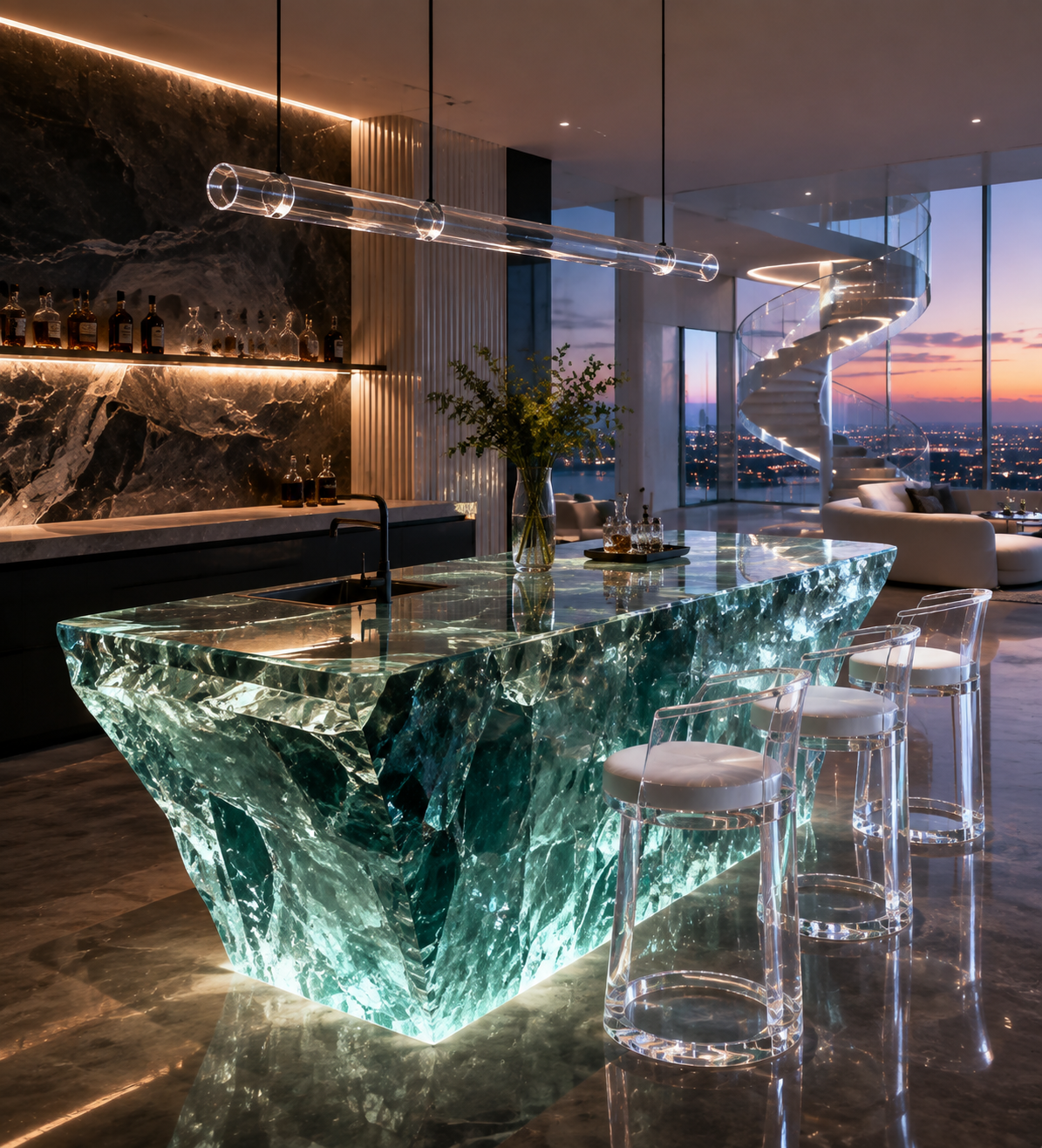
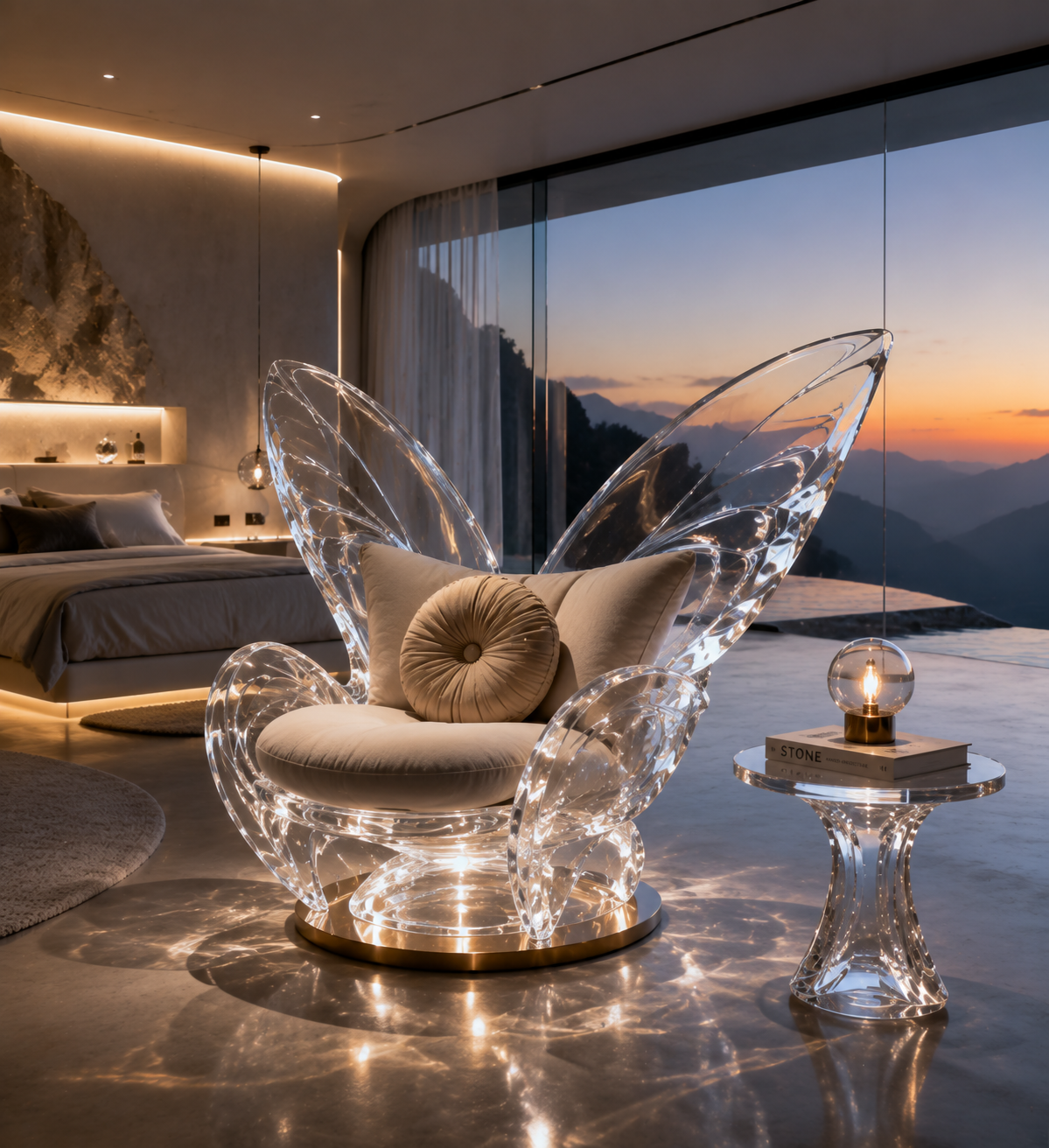
For decades, transparent furniture was often treated as a clever visual trick: a clear chair for a small apartment, a Lucite console in a glamorous entryway, or an acrylic coffee table that seemed to disappear over a patterned rug. Today, however, something more interesting is happening. Designers are moving beyond simply “clear” furniture and embracing a broader crystal-like aesthetic built around transparency, refraction, color, depth and sculptural form.
At major design fairs and in collectible-design galleries, the material vocabulary now ranges from colored glass and Lucite to high-end resin, synthetic crystal and premium acrylic materials. Architectural Digest identified expressive glass as one of the notable directions at Milan Design Week 2025, while Wallpaper* has continued to document designers using jewel-like resin, acrylic resin and translucent materials as serious sculptural media rather than inexpensive substitutes for glass.
So why is crystal-like furniture becoming increasingly relevant to modern interiors? The answer has less to do with transparency alone and more to do with how contemporary spaces are changing.
1. Crystal-Like Furniture Fits the Shift From Minimalism to Expressive Modernism
One reason crystal-like furniture feels particularly relevant now is that modern interiors are becoming more expressive. The highly restrained version of minimalism that dominated residential and hospitality design for years is giving way to spaces with stronger personality, richer material combinations and more collectible objects.
The 1stDibs 2025 Designer Trends Survey, based on responses from 643 interior designers, illustrates this shift clearly. Thirty-three percent of respondents selected maximalism as a leading direction for 2025, while another 33 percent favored eclecticism. Curved and irregular forms were selected by 47 percent of respondents as a furniture and décor trend expected to gain popularity. Meanwhile, 62 percent of designers said they planned to purchase more artisan furniture.
These numbers help explain why the new generation of crystal-look furniture is different from the transparent acrylic furniture associated with purely minimalist interiors. In fact, the same 1stDibs survey placed conventional acrylic relatively low among individual material trends. That distinction is important. Designers are not necessarily asking for more generic clear plastic furniture; they are looking for objects with greater material character.
A thick synthetic-crystal console with a subtle champagne tint, for example, behaves very differently from a thin transparent acrylic table. A cast high-end resin side table containing controlled color gradients or internal textures becomes closer to a functional sculpture. A platinum acrylic dining-table base with polished, optically clear edges can introduce a jewelry-like quality without making the entire room visually heavy.
This is why “crystal-like” should be understood as a design language rather than a single material category. The most successful pieces combine optical clarity with scale, craftsmanship, sophisticated color and unusual geometry. They provide the drama that expressive contemporary interiors demand while remaining visually lighter than solid marble, dark timber or fully upholstered furniture.

2. Transparency Creates Visual Space Without Removing Function
Crystal-like furniture also responds to a very practical interior-design problem: how do you add furniture without making a room feel more crowded?
Transparent and translucent materials allow designers to maintain sightlines through a space. Architectural Digest has specifically recommended clear furniture for compact rooms because acrylic, Lucite and glass pieces reduce visual clutter and allow flooring, rugs and surrounding finishes to remain visible. 1stDibs has reported similar observations from interior designers; designer Amy Lau, for example, has described using Lucite tables so that visually important rugs remain visible beneath the furniture.
That advantage remains highly relevant even as apartment sizes fluctuate. RentCafe's 2026 analysis of Yardi Matrix data found that studios and one-bedroom units together represented 52.9 percent of apartments completed in the U.S. in 2025. In space-constrained markets, the numbers are even more striking: Seattle's apartments averaged only about 645 square feet in the study.
A conventional solid coffee table occupies both physical space and visual space. A crystal-clear or lightly tinted table occupies essentially the same footprint but allows the eye to continue through it. In a high-rise apartment, this can preserve the relationship between furniture and a skyline view. In a hotel lobby, transparent side tables can add useful surfaces without interrupting circulation visually. In a luxury boutique, a crystal-like pedestal can support merchandise while allowing the product, rather than the fixture, to remain the focus.
Premium acrylic demonstrates the optical potential particularly well. POLYVANTIS reports that clear PLEXIGLAS® PMMA products can reach visible-light transmittance of up to 92 percent. Certain clear products are also guaranteed to retain up to 90 percent light transmission after 30 years, depending on product type and region.
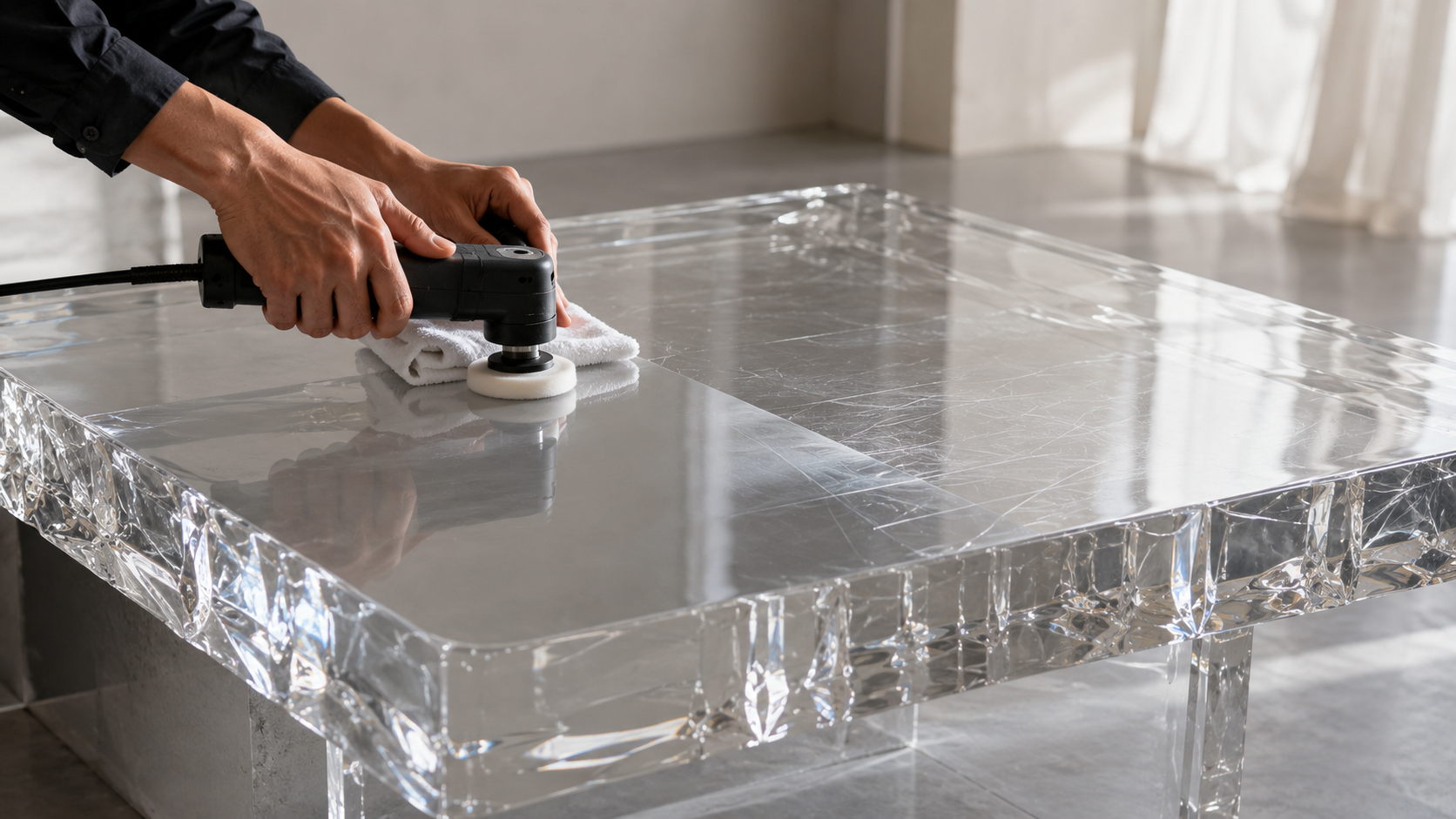
These figures should not automatically be applied to every acrylic product, but they demonstrate why optical-grade material selection matters. For manufacturers working with platinum acrylic or premium synthetic crystal, clarity, color consistency, polished edges and resistance to yellowing are not minor technical details. They determine whether a finished piece reads as luxury furniture or simply transparent plastic.
3. Designers Increasingly Want Furniture That Behaves Like Art
Another important change is the growing overlap between furniture, sculpture and collectible design. A coffee table is no longer always selected simply because a room needs somewhere to place a book. In premium residential, hospitality and retail projects, furniture is increasingly expected to contribute to the narrative of the interior.
Resin has played a significant role in this development. Gaetano Pesce famously experimented with resin formulations in his Pratt Chairs, demonstrating how changes in chemistry could transform the same basic form from unstable object to functional seat to sculpture. Architectural Digest later documented new versions produced in transparent resins, reinforcing resin's position as a legitimate collectible-design medium.
The movement continues today. Wallpaper* reported in 2024 on Korean designer Seungjin Yang's balloon furniture, made by coating balloon forms with epoxy resin, describing the works as increasingly collectible. More recently, the publication highlighted Draga & Aurel's jewel-like resin furniture and their ongoing exploration of transparency, light and color.
At Rossana Orlandi Gallery during Milan Design Week 2025, Draga & Aurel showed the Phebe pendant in Lucite and epoxy resin and the Cadre sideboard with an acrylic-resin structure. The designers described their work as an interaction among transparency, layered materials, color, changing light and viewpoint.
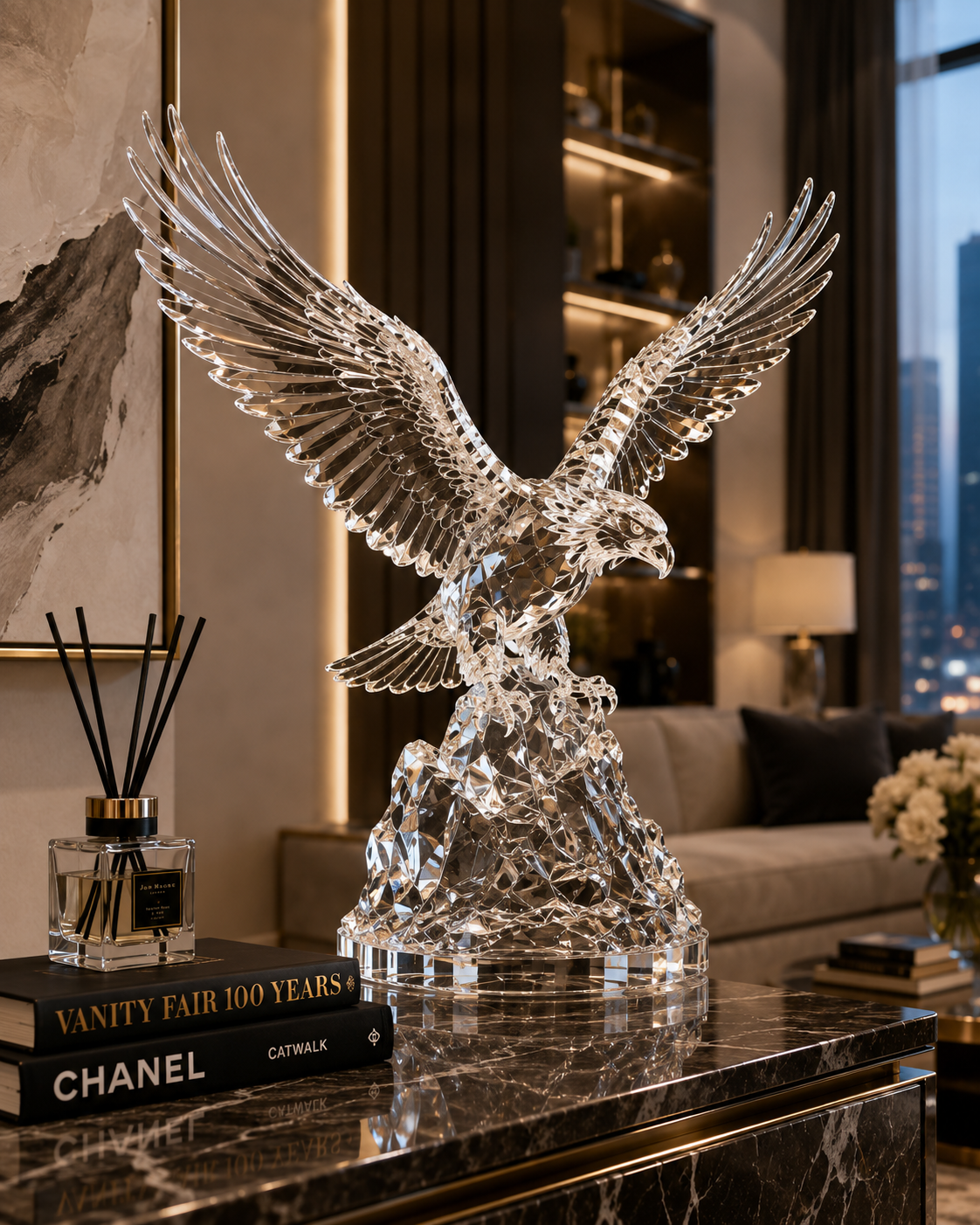
This is precisely where high-end resin and synthetic-crystal furniture have an advantage. Casting makes it possible to create substantial monolithic volumes, softly diffused transparency, embedded color, controlled bubbles, layered effects and forms that would be difficult or prohibitively expensive to execute in natural crystal.
A resin console can therefore be both architectural and artistic. A synthetic-crystal coffee table can function as the visual center of a living room without relying on ornament. A platinum acrylic bench can have a simple silhouette yet become visually complex as light moves through its thickness.
For designers, that combination is valuable: one object can satisfy both the functional furniture brief and the client's desire for something memorable.
4. New Material Possibilities Give Designers More Control Over Light, Color and Form
Natural crystal and specialty glass can produce extraordinary effects, but they also impose limitations involving weight, fabrication, size and complex geometry. Advanced polymers and casting technologies give furniture designers another toolkit.
This does not mean every resin or acrylic material is interchangeable. “Synthetic crystal” describes an aesthetic effect more than a universal technical specification. A professional buyer will want to know the actual material system, whether the piece uses PMMA, polyester resin, epoxy resin or another formulation, because optical performance, UV stability, hardness, repairability and long-term aging can differ substantially.
The creative possibilities, however, are significant.
At Design Miami 2024, Theoreme Editions presented furniture exploring materials including colored crystal and translucent cerulean resin, placing resin directly beside materials traditionally associated with luxury craftsmanship. At Alcova Miami 2025, Wallpaper* highlighted designer Adrian Cruz's translucent resin furniture combined with richly veined onyx, including a sculptural console with a purple resin top.
These combinations reveal an important direction for contemporary furniture: designers no longer have to choose between natural and synthetic materials. High-end resin can be paired with stone. Crystal-clear acrylic can sit beside brushed stainless steel. Tinted synthetic crystal can contrast with walnut, brass or leather. Platinum acrylic can form the visually weightless structural base beneath a stone tabletop.
Light adds another layer. Clear material can transmit it; frosted material can diffuse it; colored resin can filter it; thick polished edges can catch and concentrate it. As a result, the furniture changes throughout the day.
This makes material development part of the design process itself. Instead of asking only, “What shape should this table be?” designers can ask, “What should happen when sunlight enters this edge at 4 p.m.?” or “How should the color appear under warm hotel lighting?”
For a premium manufacturer, this creates opportunities well beyond standard clear furniture. Custom tinting, oversized casting, gradient effects, embedded textures, satin-versus-polished finishes and controlled translucency can all become design tools—provided that production consistency and engineering remain strong enough for professional specifications.
5. Crystal-Like Materials Match the Growing Demand for Experiential Interiors
Modern interiors are increasingly designed to be experienced—and photographed—not merely furnished. Luxury retail stores, restaurants, hotels, galleries and high-end residences all need moments that create identity.
Transparent and refractive furniture works particularly well in these environments because it reacts to its surroundings instead of visually separating itself from them. The same console may appear almost invisible against daylight, saturated with color beside an illuminated wall, and reflective under evening lighting.
This quality connects furniture with broader developments in contemporary visual culture. In 2025, designer Sabine Marcelis created luminous installations at Apple Park using materials including prismatic polyester resin, colored glass and acrylic. Wallpaper* described how the works filter and reflect light and change in relation to the environment.
That project is not furniture, but it demonstrates the cultural relevance of the same optical language: transparency, refraction, layering and luminous color are increasingly being used to create immersive experiences.
Furniture allows designers to introduce that language at a human scale.
Imagine a hotel reception area with a thick amber synthetic-crystal console that catches morning sunlight. In a luxury fashion boutique, transparent platinum-acrylic display tables can support products without competing with them visually. A restaurant can use jewel-toned resin side tables to create pools of color under carefully controlled lighting. In a residential project, a substantial crystal-look dining base can produce a sculptural statement while preserving views through an open-plan living space.
Because these materials respond so strongly to lighting, photography and surrounding color, they are also particularly effective in projects where visual identity matters commercially. A conventional table may simply complete the room. A well-designed crystal-like table can become the image people remember—and potentially the image they share.
That distinction explains why designers increasingly treat these pieces as focal points rather than neutral accessories.

6. The Future Belongs to Crystal-Like Furniture That Can Be Properly Specified
Visual impact may attract the designer, but technical credibility determines whether a material is actually specified for a serious project.
This is becoming increasingly important as major architecture and interior-design firms strengthen requirements around material health, environmental performance and documentation. In 2024, Gensler expanded its Product Sustainability Standards to include furniture as part of a program covering 20 building-product categories. Gensler notes that these standards can influence the approximately 1.25 billion square feet of projects the firm designs annually.
The ANSI/BIFMA e3 Furniture Sustainability Standard is another important indicator. BIFMA describes it as a leading framework for evaluating environmental, health, wellness and social impacts in furniture, and revisions approved in 2025 introduced updated requirements involving areas such as material health and chemical optimization.
For manufacturers of synthetic crystal, high-end resin and platinum acrylic furniture, the message is clear: premium appearance needs to be supported by premium documentation.
Designers increasingly need information about material composition, structural performance, UV behavior, VOC emissions, maintenance, repair, recycled content and end-of-life options. UL Solutions, for example, notes that its GREENGUARD program uses established testing methods for chemical emissions and is relevant to furniture as well as plastics, coatings and other components.
Circularity is also becoming more technically achievable for some acrylic systems. POLYVANTIS states that PMMA can be recycled through multiple processes and launched a European closed-loop program in 2025 to collect and reintegrate acrylic production waste. Its PLEXIGLAS® proTerra products can incorporate approximately 90 percent recycled material in certain applications.
None of this means that resin or acrylic furniture is automatically sustainable. A credible sustainability claim depends on the actual formulation, manufacturing process, lifespan, recycled content, repair strategy and recovery infrastructure.
But this is also where high-end manufacturers can separate themselves from low-cost transparent furniture.
The next generation of crystal-like furniture will succeed because it combines optical beauty with engineering, craftsmanship and specification-grade performance. Designers are not simply looking for furniture that is clear. They are looking for materials that manipulate light, reduce visual weight, create emotional impact and give a project an identity.
When synthetic crystal has real depth, when high-end resin is carefully cast and finished, and when premium or platinum acrylic delivers consistent optical quality, these materials stop behaving like substitutes.
They become a distinct category of contemporary luxury furniture in their own right.
READ MORE:
- From Living Room to Terrace: How Crystal-Like Furniture Works Across Indoor and Outdoor Design
- Beyond Wood and Metal: What Distinctive Materials Can Make Outdoor Furniture Stand Out?
- 2026 Design Inspiration: Where Synthetic Crystal Furniture Works Best in Commercial and Residential Spaces
- High-End Spaces Do Not Have to Be Complicated: How Transparent Materials Elevate Interior Design
- Synthetic Crystal Acrylic Furniture: Giving Modern Spaces Stronger Visual Impact
- Why Crystal-Grade Acrylic Is Becoming an Innovative Material in the Eyes of Designers
- Synthetic Crystal Acrylic Furniture: A New Breakthrough for High-End Product Differentiation
- From Transparent Aesthetics to Commercial Competitiveness: Future Opportunities for Synthetic Crystal Acrylic Furniture
- Synthetic Crystal Acrylic Furniture: Why High-End Customers Increasingly Value the “Sense of Worth” Created by Materials


