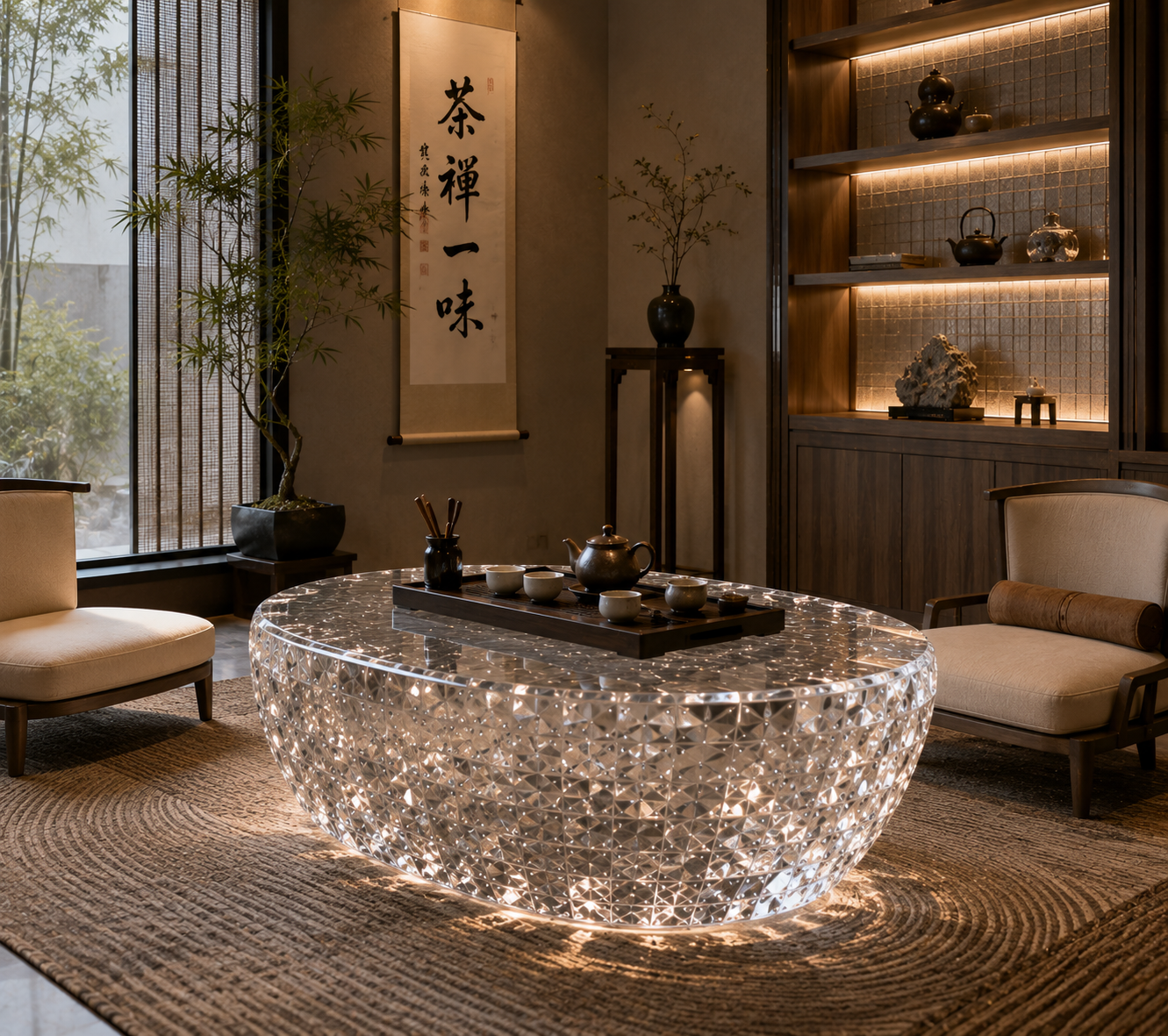
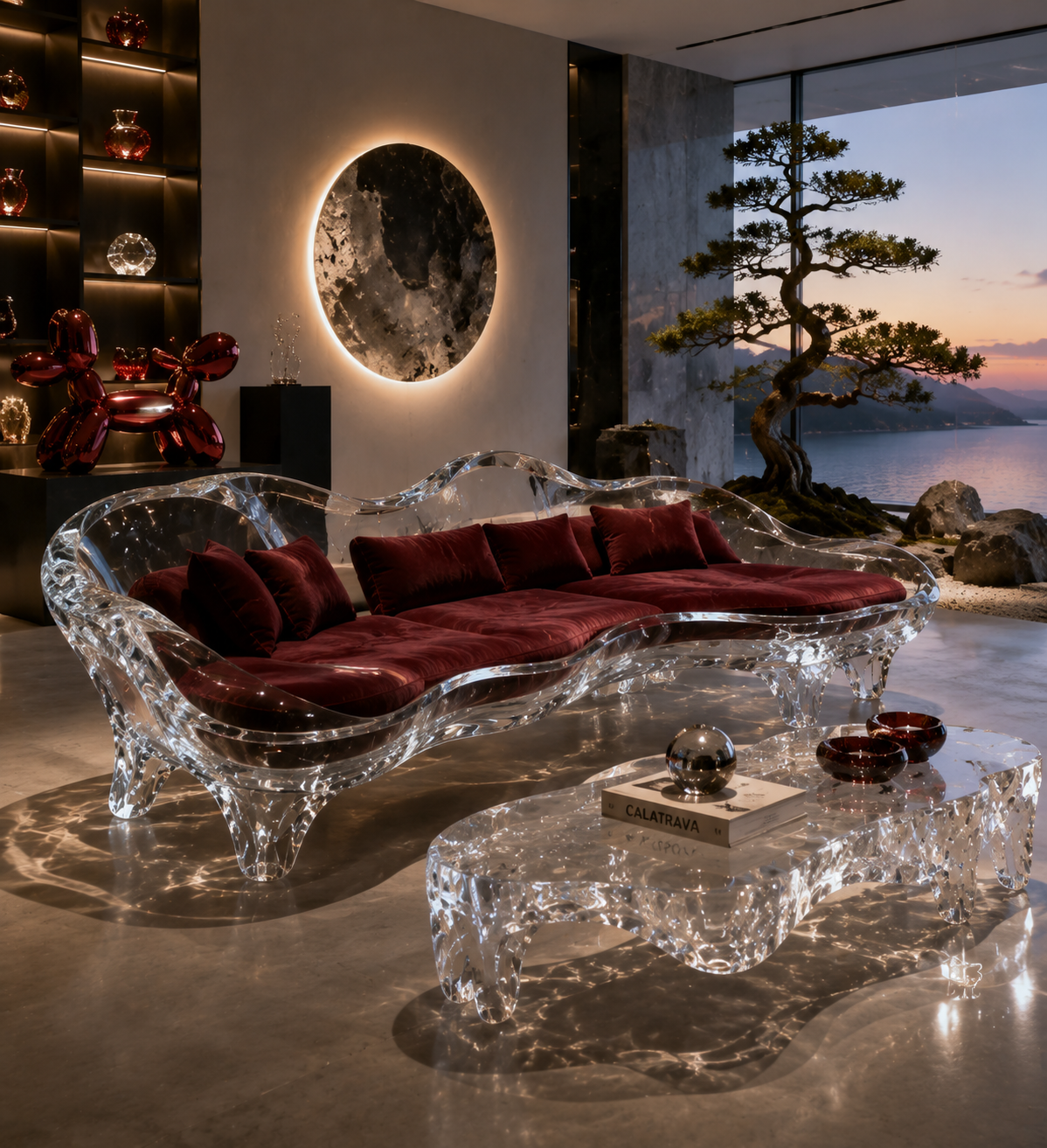
The boundary between indoor and outdoor living is becoming increasingly difficult to see—and that is exactly what many architects and interior designers want.
Large sliding doors now connect living rooms directly to terraces. Hotel lounges flow into pool decks. Dining spaces continue beneath pergolas, while outdoor seating areas are increasingly furnished with the level of detail once reserved for interiors. In this environment, designers need furniture that can visually connect both sides of the architecture rather than making the terrace feel like a completely separate design project.
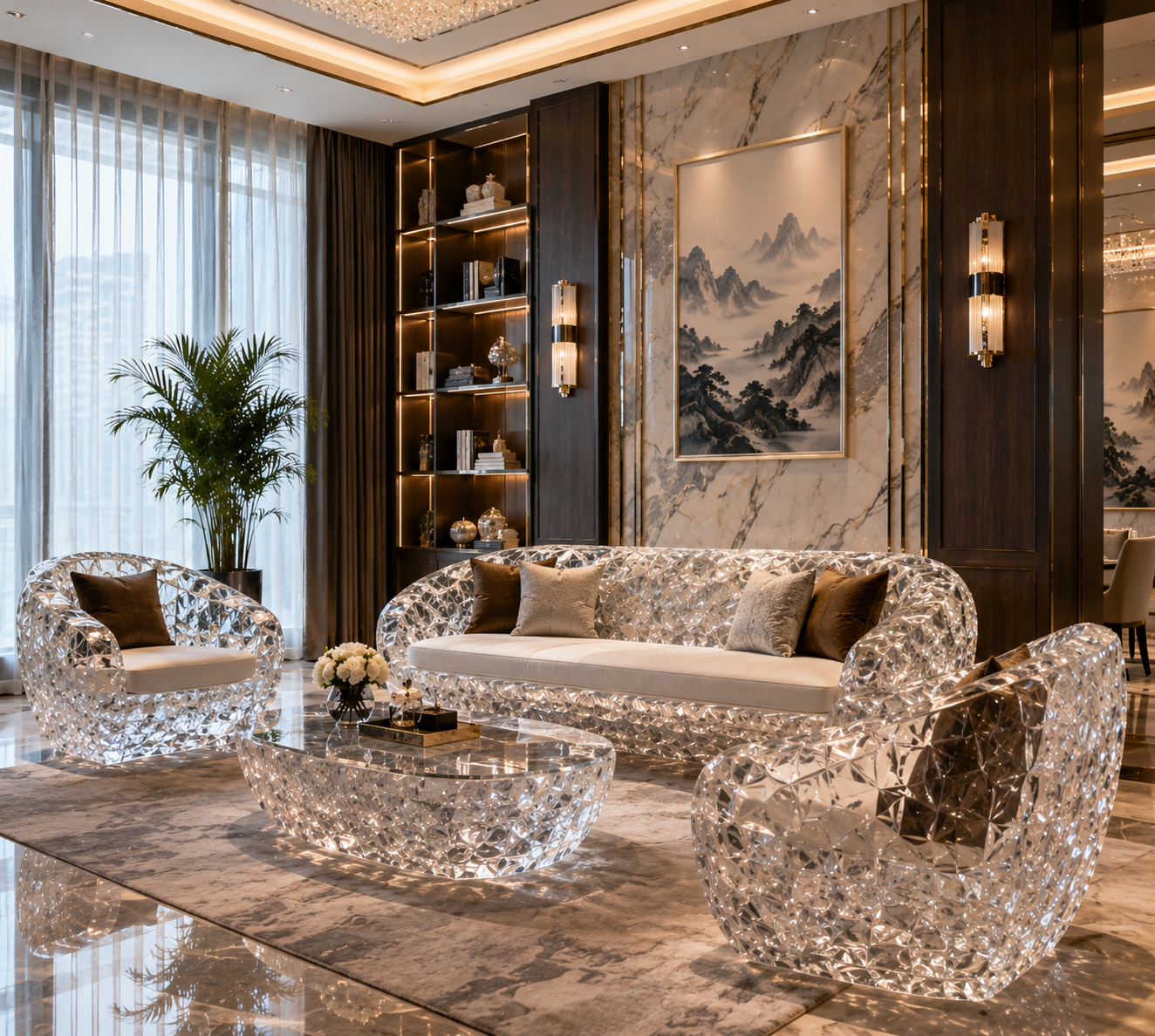
This is where crystal-like furniture—made from materials such as synthetic crystal, high-end resin and premium or platinum acrylic—has an unusual advantage. Transparency, translucency and refracted light allow these pieces to respond to marble, timber, stone, water, planting and changing daylight without visually overwhelming them.
Yet there is an important distinction between furniture that merely looks suitable outdoors and furniture that is actually engineered to remain outdoors.
Sunlight, temperature changes, moisture, cleaning chemicals and coastal environments can affect polymers very differently. Consequently, the best indoor-outdoor crystal furniture is not created by simply moving an indoor acrylic coffee table onto a terrace. It comes from combining the right material formulation, optical quality, structural engineering and finishing system with a design language that can move naturally from one environment to another.
For designers and manufacturers, understanding that distinction is becoming increasingly important.
1. Indoor-Outdoor Living Is No Longer a Secondary Design Trend
The first reason crystal-like furniture is relevant to both interiors and terraces is straightforward: clients increasingly expect these spaces to function as one continuous living environment.
The American Institute of Architects' Home Design Trends Survey tracks preferences through a panel of more than 300 residential architecture firms. In its 2025 survey, outdoor living spaces—including patios, decks and covered outdoor rooms—recorded a net 55% of respondents reporting increasing popularity over decreasing popularity. Blended indoor-outdoor spaces, such as kitchens opening to terraces and large operable glass walls, registered a net 40%.
The trend is also visible in how people actually furnish renovated outdoor areas. The 2026 U.S. Houzz Outdoor Trends Study, based on 1,191 homeowners with recent or planned exterior projects, found that 83% of renovated outdoor living spaces include a lounge or seating area. Seventy-one percent contain a sofa or lounge chairs, while 55% include a coffee table or side table. Outdoor lighting is present in 66% of renovated lounge areas.
Those numbers are significant for furniture designers. A terrace is no longer simply a place for two utilitarian chairs and a weatherproof table. It is increasingly expected to provide the same hierarchy found in an interior: seating, occasional tables, lighting, decorative objects and focal furniture.
That change favors materials capable of creating visual continuity.
Imagine a living room with a clear platinum acrylic coffee table positioned beside a floor-to-ceiling sliding door. Outside, a slightly tinted synthetic-crystal side table can repeat the same optical language beside an outdoor sofa. The two pieces do not need to be identical. Their relationship comes from transparency, thickness, polished edges and the way they interact with light.
This approach is particularly effective in luxury residential and hospitality design because it connects spaces without filling every zone with matching furniture. The architecture remains continuous while the furniture adapts to the specific demands of each environment.
Crystal-like furniture therefore works less as a single product category and more as a material bridge between indoors and outdoors.
2. Transparency Makes Both Living Rooms and Terraces Feel More Open
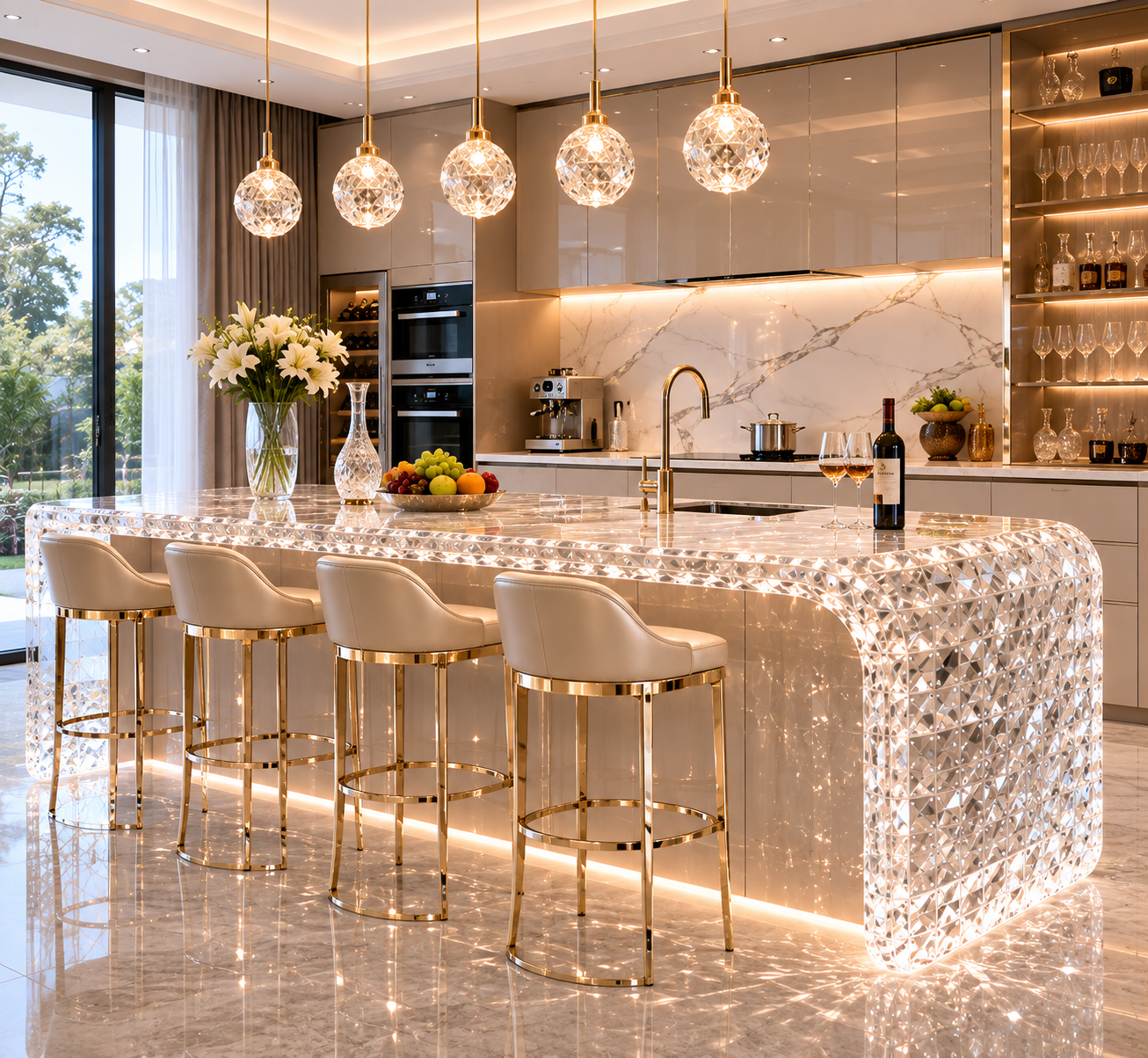
One of the most valuable characteristics of transparent furniture is that it occupies physical space without creating the same degree of visual weight as an opaque object.
Inside a living room, that can preserve sightlines across rugs, flooring and architectural details. On a terrace, it can preserve something even more valuable: the landscape.
A heavy stone or solid timber table placed directly in front of a coastal view, garden or swimming pool inevitably interrupts part of that view. A clear or translucent table can provide the same usable surface while allowing the eye to travel through or around it.
This becomes particularly powerful when architecture already emphasizes openness.
AIA's survey data shows that outdoor rooms and blended indoor-outdoor configurations remain among the most requested exterior residential features. Houzz's 2026 study similarly found that 25% of outdoor renovators were motivated by making their spaces more accommodating, while 71% hired professional help for their outdoor projects—a record level in that study.
The implication is that outdoor spaces are increasingly being professionally composed rather than filled casually.
Consider a high-rise penthouse terrace. A conventional dark coffee table can create a strong horizontal block between the seating and skyline. A substantial clear acrylic or synthetic-crystal table can retain that function while reducing visual interruption. Beside a pool, a pale-blue translucent resin side table can visually connect with the water instead of competing against it. Indoors, the same design language can be repeated in a console, dining-table base or sculptural pedestal.
Optical quality becomes especially important here.
POLYVANTIS reports that colorless PLEXIGLAS® PMMA can achieve visible-light transmission of up to 92%. The company also states that almost all of its clear-transparent PLEXIGLAS® products are engineered for long-term UV stability, with certain products retaining high light transmission under a 30-year warranty.
Those specifications refer specifically to PLEXIGLAS® products and should not be generalized to every acrylic on the market. They nevertheless demonstrate an important principle for premium furniture manufacturing: transparent does not automatically mean optically equivalent.
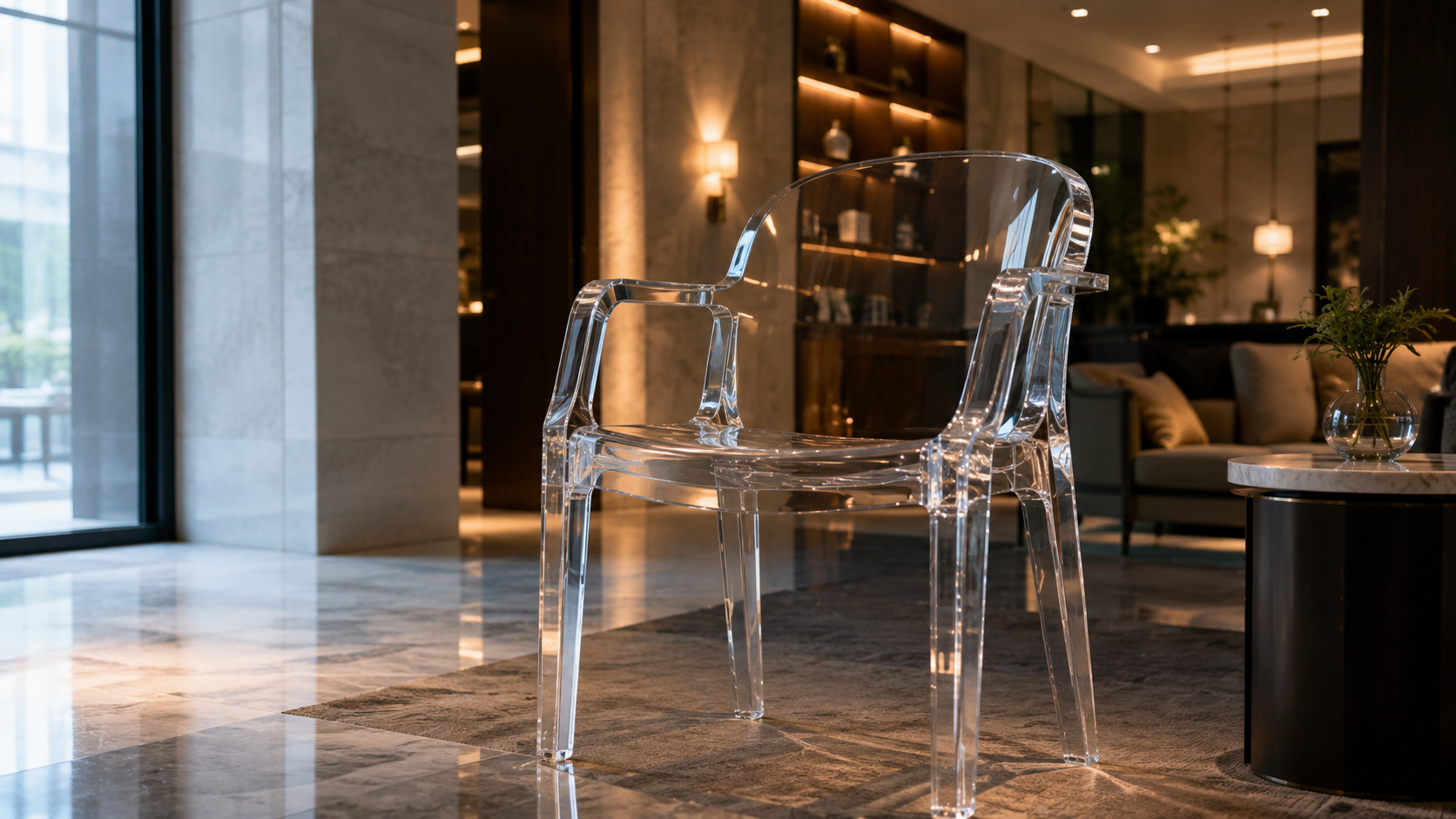
For high-end platinum acrylic furniture, clarity, thickness consistency, edge polishing, internal stress control and color stability determine whether a piece looks architectural and jewel-like or simply plastic.
3. The Same Crystal Look Requires Different Engineering Outdoors
A crystal-like side table in a living room and one on an exposed terrace may look almost identical. Technically, however, they live very different lives.
Indoor furniture experiences relatively controlled temperature, humidity and UV exposure. Outdoor furniture may be exposed to direct solar radiation, rain, thermal cycling, dust, pollutants, cleaning agents and—in coastal projects—salt-laden air.
For that reason, specifying “resin” or “acrylic” is not enough.
PMMA is particularly interesting for outdoor applications because certain grades can offer strong inherent weathering performance. POLYVANTIS describes its PLEXIGLAS® acrylic as UV-stable throughout the material rather than relying exclusively on a surface UV coating. According to the manufacturer, virtually all colorless transparent solid sheets, blocks, tubes and rods covered by its guarantee resist visible yellowing and maintain high transparency for up to 30 years.
Resin requires even more careful specification.
A 2022 study published in Polymer Testing examined epoxy and vinyl-ester resins under thermal, ultraviolet and natural aging conditions. Researchers found that UV and aging can create chromophores through oxidation, producing yellowing, while environmental exposure can become more complicated when moisture and wet-dry cycles are involved.
This does not mean high-end resin cannot be used outdoors. It means outdoor resin furniture must be formulated for outdoor use rather than assumed to be weather-resistant because it is resin.
For a synthetic-crystal console intended for a covered hotel terrace, the manufacturer might select a UV-resistant resin system, evaluate color shift through accelerated-weathering testing, protect metal inserts against corrosion and design joints so that water does not remain trapped. A poolside side table may require a different specification because it receives stronger direct sunlight and frequent contact with chlorinated water.
The same principle applies to platinum acrylic. The premium designation alone should never be treated as proof of outdoor performance. Designers should ask for the actual PMMA grade, UV/weathering documentation, recommended temperature range and maintenance requirements.
That level of transparency in specification is what turns an attractive furniture object into a product suitable for professional architectural projects.
4. Crystal-Like Materials Change Character as Light Changes From Interior to Exterior
Few furniture materials interact with light as dynamically as transparent and translucent polymers.
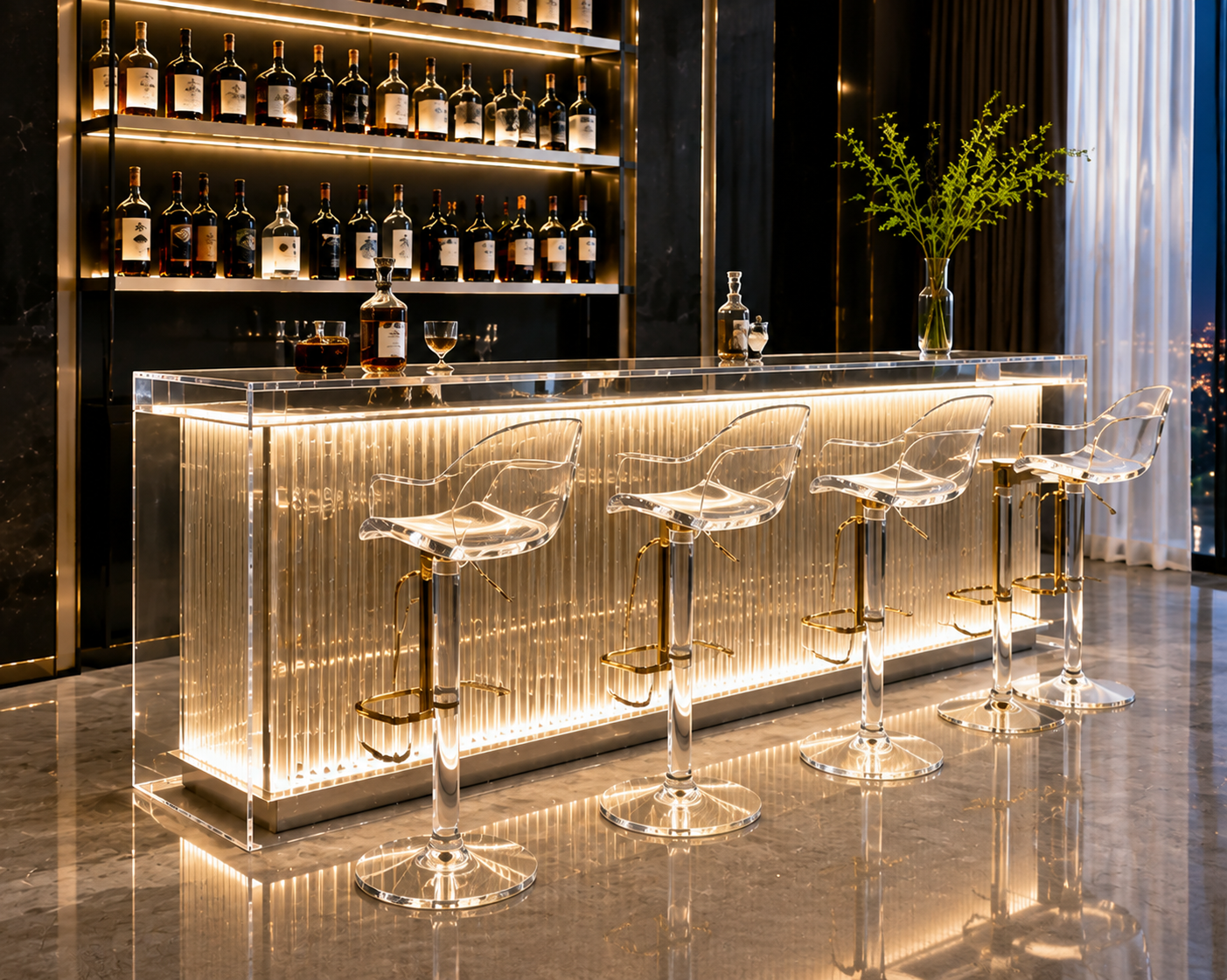
Inside, a crystal-like table may receive controlled illumination from windows, pendant lights or concealed LEDs. Outdoors, it experiences continually changing daylight. Morning sun can illuminate the polished edge of a clear acrylic bench; strong midday light can make a colored resin table appear almost luminous; sunset can transform a champagne-tinted synthetic-crystal console into a warm glowing volume.
For designers, this means the same furniture language can create two different emotional effects without losing continuity.
A transparent platinum acrylic console in a living room may almost disappear against pale limestone during the day. Positioned outside, a related table with greater thickness can refract sunlight and create sharper reflections on the terrace floor. A smoky gray synthetic-crystal coffee table can appear sophisticated and restrained indoors, while the same tone outside may reflect blue sky and surrounding greenery.
This is particularly useful in hospitality.
Hotel designers often need a lounge to feel coherent from the lobby through to the pool terrace. Using identical furniture everywhere can feel repetitive, while completely changing materials can fracture the experience. Crystal-like furniture provides a third option: maintain the optical vocabulary while adjusting form, color and performance.
Current outdoor design is already moving in this direction. Houzz's coverage of the 2025 High Point Market observed that outdoor furniture is increasingly adopting the curves, comfort and visual sophistication traditionally associated with indoor collections, supported by advances in outdoor materials.
Lighting also matters commercially. Houzz's 2026 outdoor study found lighting in 66% of renovated outdoor lounge spaces. When a side table or pedestal is translucent, that lighting can become part of the furniture experience rather than simply illuminating its surface.
For manufacturers of high-end resin and synthetic crystal, this opens opportunities beyond conventional clear furniture. Amber, smoke, ice blue, emerald, blush and gradient casting can be used to coordinate with architectural lighting and landscape palettes. Frosted zones can diffuse light, while polished zones create sharper optical reflections.
The furniture is no longer simply sitting in the light.
It is actively designing with it.
5. Indoor-Outdoor Versatility Works Best When Furniture Is Designed as a Family
The most convincing way to bring crystal-like furniture from the living room to the terrace is not to make every product universally portable. It is to develop an indoor-outdoor design family.
This distinction matters.
A sculptural high-end resin dining table designed exclusively for an interior may prioritize exceptional clarity, deep casting and an elaborate polished surface. Its outdoor counterpart may use a related silhouette and color but require different resin chemistry, hardware, tolerances and finishing.
Likewise, a platinum acrylic coffee table in a living room may feature highly polished complex edges and hidden connections. A terrace version might require water-shedding geometry, outdoor-compatible fixings and design allowances for greater temperature variation.
The aesthetic remains consistent even when the engineering changes.
In practice, this allows designers to create sophisticated transitions. A clear synthetic-crystal console can stand behind a sofa indoors; beyond the glass wall, two tinted resin side tables repeat its proportions beside outdoor lounge chairs. A transparent acrylic dining base inside can be echoed by acrylic or weather-stable crystal-look pedestals on the terrace. A translucent resin bench in a hotel lobby can establish a material story that continues as smaller accent tables by the pool.
This strategy also answers an important commercial question: where does crystal-like furniture deliver the greatest value?
It is rarely necessary for every object to be transparent. In fact, the effect is usually stronger when crystal-like pieces are used selectively alongside natural materials.
Clear acrylic beside travertine creates contrast between visual weight and visual lightness. Amber resin against teak introduces warmth without imitating wood. A synthetic-crystal side table beside boucle seating indoors can be repeated outdoors against performance upholstery and planting. Transparent forms near water can echo reflections without resorting to obvious nautical themes.
The result feels curated rather than themed.
For custom furniture manufacturers, this approach also creates significant flexibility. A single collection language can generate coffee tables, consoles, side tables, benches, stools, dining bases, display pedestals and decorative objects while adapting material specifications to the exposure conditions of each project.
That is far more valuable to architects than simply selling “an acrylic table.”
6. The Future of Indoor-Outdoor Crystal Furniture Will Be Specification-Driven
As crystal-like furniture enters more luxury homes, resorts, restaurants and public-facing spaces, appearance alone will not be enough.
Professional designers increasingly require evidence.
They need to know what the material actually is, how it responds to UV exposure, whether a colored resin will change over time, what cleaning products can be used, whether scratches can be repolished, how structural loads have been considered and what environmental documentation is available.
The industry is moving strongly toward this level of accountability. BIFMA describes the ANSI/BIFMA e3 Furniture Sustainability Standard as a leading framework for evaluating environmental, health, wellness and social impacts associated with furniture. Its revised standard, approved by ANSI in 2025, added updated requirements including chemical optimization and a new LEVEL 4 tier.
UL Solutions also notes that GREENGUARD Certification uses established testing methods for furniture chemical emissions and that chemical-compliance testing can extend to plastics, coatings, fabrics and other furniture components.
Major design practices are pushing manufacturers in the same direction. Gensler's Product Sustainability Standards apply sustainability criteria across product categories used in the roughly 1.25 billion square feet of projects the firm touches annually. When Gensler expanded the initiative in 2024, it reported that more than 2,800 products had already been evaluated for compliance.
For synthetic-crystal, high-end resin and platinum acrylic manufacturers, this represents an opportunity rather than simply another requirement.
The strongest future supplier will be able to show designers not only beautiful photographs but also material identification, UV and accelerated-weathering results where appropriate, load information, care instructions, finish tolerances, color-control standards, packaging methods and project-specific recommendations.
This is especially important for furniture moving between interior and exterior environments.
A designer should be able to ask, “Can this table remain on an uncovered terrace in Miami?” or “Will this resin maintain its color beneath Mediterranean sun?” and receive an answer based on the exact material and testing—not a generic statement that the product is “weather-resistant.”
That credibility is ultimately what separates decorative transparent furniture from high-end architectural furniture.
Crystal-like materials are uniquely suited to today's indoor-outdoor spaces because they can preserve views, manipulate light, complement natural materials and establish continuity without visual heaviness. But their greatest potential appears when optical beauty is combined with material science.
From a living-room coffee table to a hotel terrace console, from a platinum acrylic dining base to a sculptural synthetic-crystal poolside table, the objective is no longer simply to make furniture look transparent.
It is to create furniture that belongs naturally on both sides of the glass.
READ MORE:
- Beyond Wood and Metal: What Distinctive Materials Can Make Outdoor Furniture Stand Out?
- 2026 Design Inspiration: Where Synthetic Crystal Furniture Works Best in Commercial and Residential Spaces
- Why More Designers Are Bringing "Crystal-Like Furniture" Into Modern Interiors
- High-End Spaces Do Not Have to Be Complicated: How Transparent Materials Elevate Interior Design
- Synthetic Crystal Acrylic Furniture: Giving Modern Spaces Stronger Visual Impact
- Why Crystal-Grade Acrylic Is Becoming an Innovative Material in the Eyes of Designers
- Synthetic Crystal Acrylic Furniture: A New Breakthrough for High-End Product Differentiation
- From Transparent Aesthetics to Commercial Competitiveness: Future Opportunities for Synthetic Crystal Acrylic Furniture
- Synthetic Crystal Acrylic Furniture: Why High-End Customers Increasingly Value the “Sense of Worth” Created by Materials


