Luxury interiors are often associated with abundance: rare stone, custom millwork, dramatic lighting, art collections and furniture from multiple design periods. Yet some of the most sophisticated rooms achieve their impact through the opposite approach. Instead of continuously adding visible mass, designers carefully decide what should command attention—and what should quietly support it.
Transparent and translucent materials are particularly effective in this kind of design.
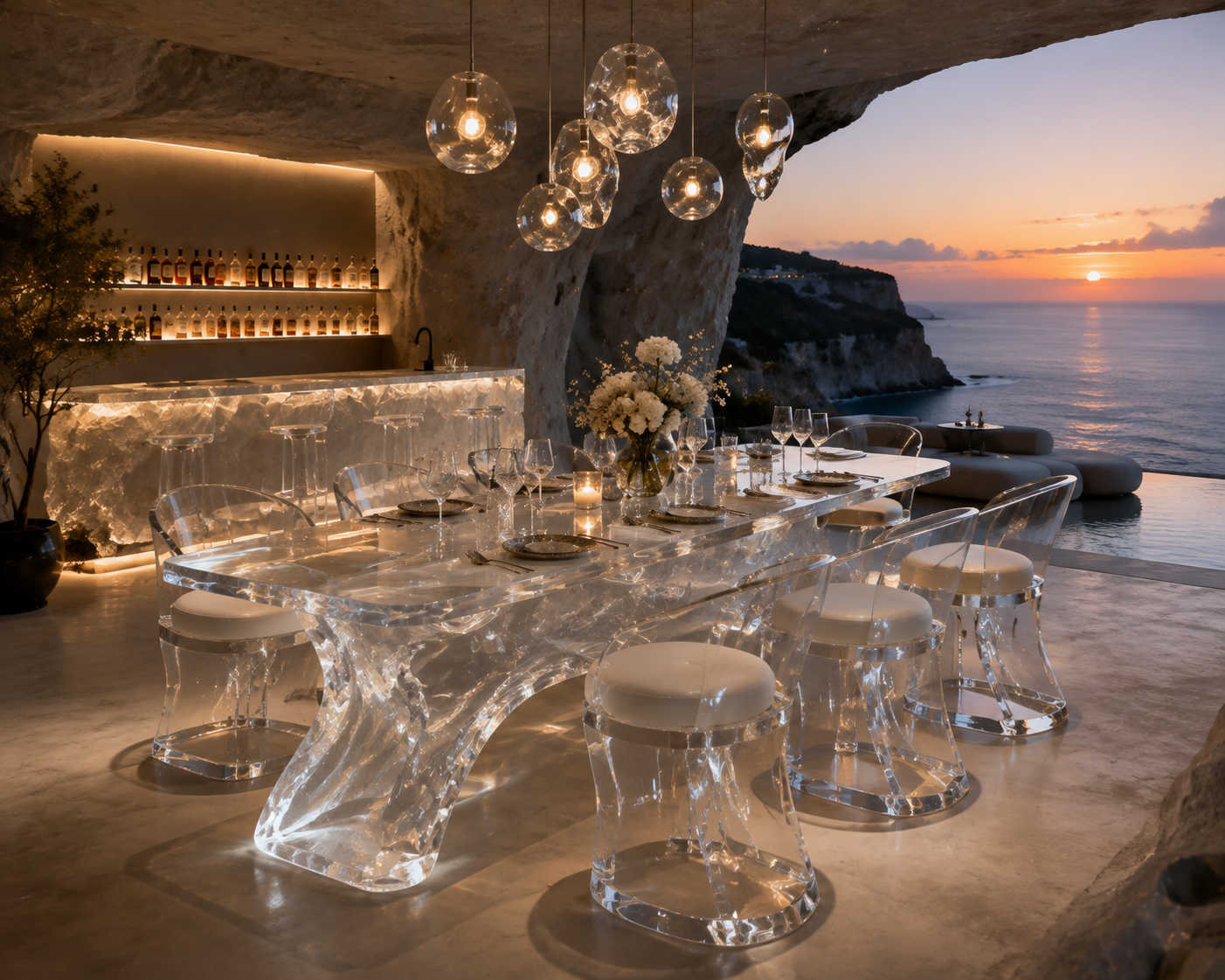
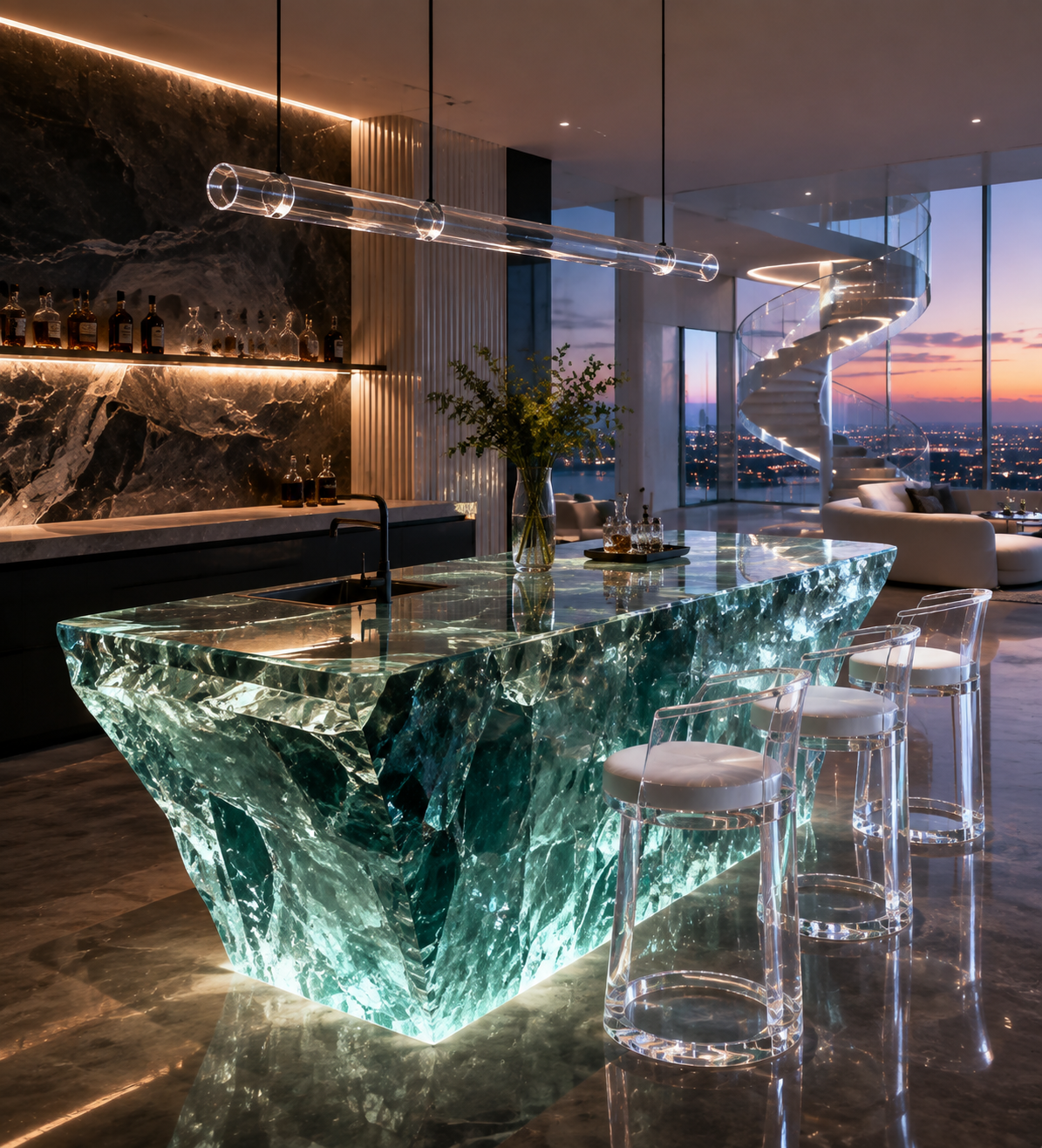
A synthetic-crystal coffee table, high-end resin console or platinum acrylic dining-table base can perform the same practical role as conventional furniture while creating far less visual interruption. At the same time, thickness, pigmentation, refraction and highly polished surfaces can turn these pieces into sculptural objects.
This is an important distinction. Transparent furniture is not automatically luxurious. A generic thin acrylic table can look inexpensive just as easily as an overdecorated room can look expensive without feeling sophisticated. High-end design depends on proportion, material quality, craftsmanship, context and restraint.
Interestingly, current design data suggests that the market is moving simultaneously toward richer interiors and more carefully selected objects. The 1stDibs 2026 Designer Trends Survey found that 39% of participating designers expected maximalism to remain popular. Yet designers interviewed by the platform also emphasized that successful layering depends on restraint and intentional composition rather than simply adding more things. Furniture customization also remains an important part of professional designers' sourcing strategies.
That combination helps explain the growing relevance of transparent materials. They allow a designer to introduce something distinctive without making the room feel unnecessarily complicated.
1. Transparency Reduces Visual Weight Without Removing Function
Every piece of furniture has two dimensions in a room: its physical footprint and its visual footprint.
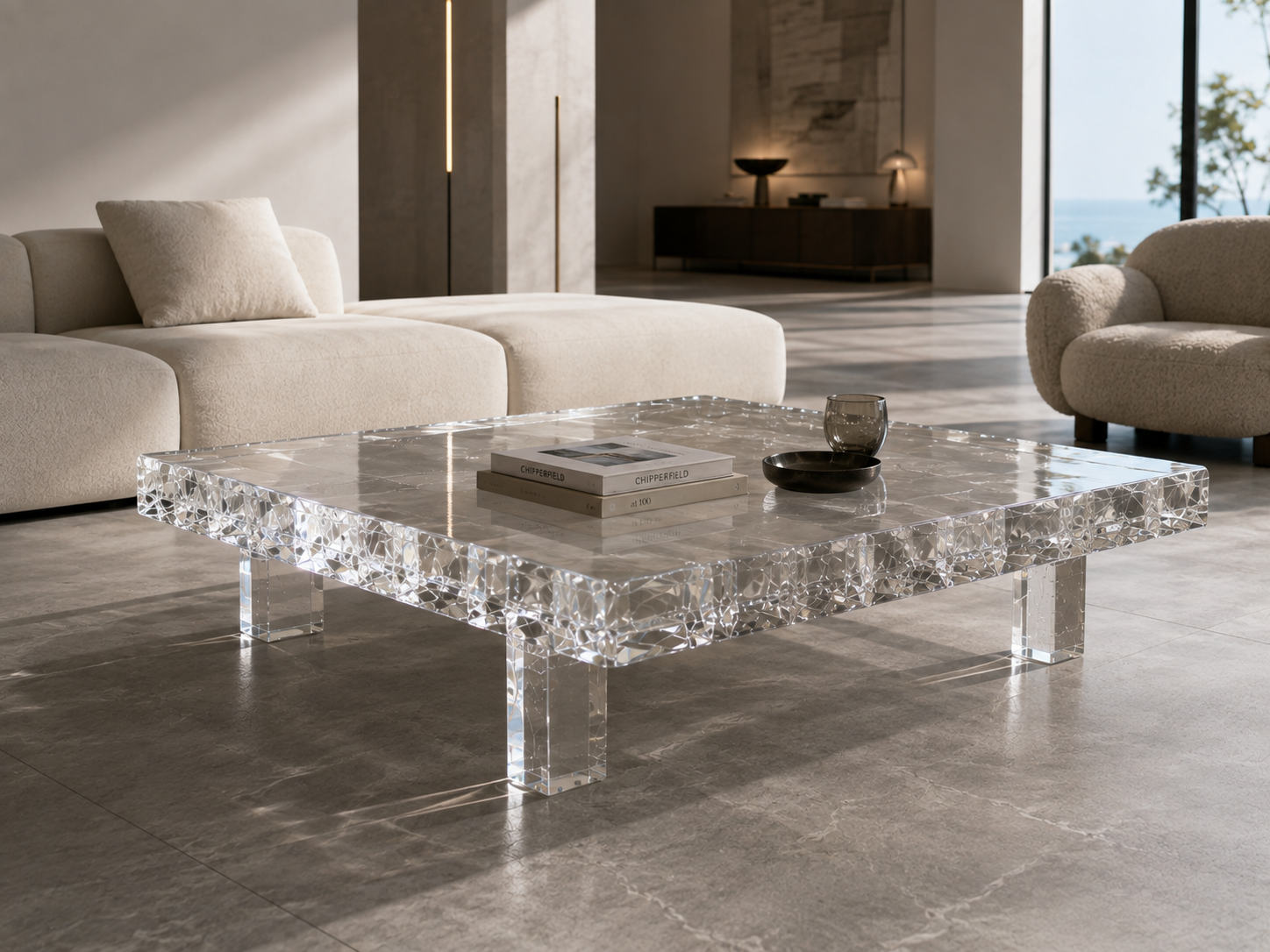
A coffee table measuring 120 centimeters across occupies the same amount of floor area whether it is made from dark walnut, travertine or transparent acrylic. Visually, however, those three objects behave very differently.
An opaque table creates a clearly defined mass. It interrupts flooring, hides part of the rug beneath it and becomes another solid form for the eye to process. A transparent table allows those elements to remain visible through the furniture.
Architectural Digest has specifically highlighted this advantage, noting that clear acrylic, Lucite and glass furniture can reduce visual clutter and help small rooms feel more open because surrounding surfaces remain visible. The publication has also documented transparent furniture in sophisticated residential interiors ranging from Manhattan apartments to California homes, demonstrating that the principle is not limited to compact or inexpensive spaces.
The same concept becomes even more useful in luxury interiors because high-end spaces often already contain materials worth seeing.
Imagine a hand-knotted rug beneath a coffee table. A large solid table covers part of the pattern; a clear synthetic-crystal table allows the craftsmanship beneath it to remain part of the composition. Place a platinum acrylic console in front of book-matched marble, and the wall can remain visually continuous. Use transparent dining-table bases underneath a sculptural stone top, and the tabletop appears lighter without compromising its physical scale.
This is why transparent furniture should not always be described as “invisible.” The best pieces are not invisible. They are visually light but materially present.
Thickness can produce refraction. Polished edges can catch sunlight. A slightly smoky synthetic crystal can create depth while maintaining sightlines. A pale amber high-end resin table can contribute color without becoming another opaque block.
For designers, the advantage is straightforward: the room can contain substantial, functional furniture without feeling crowded by it.
That is particularly valuable in high-end spaces where architecture, art, rugs and natural materials already deserve attention.

2. Transparent Furniture Allows Expensive Materials to Remain the Hero
Luxury design is often less about how many premium materials are used and more about establishing hierarchy among them.
If a room contains strongly veined Calacatta marble, handcrafted timber panels, a collectible painting and a statement rug, every additional object does not need to compete for attention. In fact, adding another heavily patterned or visually dense piece of furniture can weaken the overall composition.
Transparent materials provide designers with a way to create contrast without creating competition.
Architectural Digest has shown clear acrylic furniture used specifically alongside richly colored upholstery, dark flooring, artwork and patterned rugs. Because the furniture produces relatively little visual blockage, existing materials can continue to define the room.
This principle is particularly useful when working with stone.
A sculptural marble side table beside a marble fireplace may create too much visual weight. Replacing that table with a clear or lightly tinted synthetic-crystal piece creates separation between the two materials. Similarly, a high-end resin console positioned against a textured stone wall can introduce smoothness and luminosity without covering the character of the stone behind it.
Wood benefits from the same contrast. Walnut, oak and teak provide natural grain and warmth; platinum acrylic provides optical clarity and precision. Used together, each material makes the other easier to appreciate.
This strategy aligns with the broader direction of contemporary high-end interiors. The 1stDibs 2025 Designer Trends Survey, which included responses from 643 registered interior designers, found strong interest in eclectic interiors and mixed materials. It also found that 86% of designers planned to source custom work and 62% expected to favor artisanal production over mass manufacturing.
That data is particularly relevant to transparent furniture.
Interestingly, conventional acrylic ranked very low as a broad material trend in the same survey. This suggests that the opportunity is not necessarily in filling rooms with generic acrylic products. It is in producing special, customized transparent objects that complement richer materials.
A thick synthetic-crystal console with controlled coloration is not simply an alternative to a wooden console. A hand-cast resin side table with layers of pigment can behave almost like a piece of mineral specimen. A precisely fabricated platinum acrylic table base can support stone while visually disappearing beneath it.
In high-end interiors, transparency works best when it makes everything around it look more intentional.
3. Light Becomes a Design Material Rather Than Just Illumination
Opaque furniture receives light.
Transparent furniture can transmit, reflect, refract and filter it.
That difference explains why crystal-like materials often appear much more sophisticated in a real interior than they do in a catalog photograph against a white background.
Clear PMMA demonstrates the optical potential of this material family. POLYVANTIS states that colorless PLEXIGLAS® acrylic can achieve visible-light transmission of approximately 92%. The company also produces PMMA in numerous colors, surfaces and light-guiding configurations. These specifications apply to its own products rather than every acrylic material, but they demonstrate how dramatically material quality can influence optical performance.
In furniture, this creates another layer of design possibilities.
A thick platinum acrylic table leg can collect light along its edges, making a simple rectangular geometry appear almost illuminated. A smoky synthetic-crystal side table can become darker where material overlaps, producing gradients without printed decoration. A high-end resin console containing amber pigment may appear almost neutral in indirect daylight but become warm and saturated under evening lighting.
Designers Draga & Aurel provide a useful real-world example. Wallpaper* has repeatedly documented the studio's exploration of resin, Lucite and transparent materials. At Milan Design Week 2025, the designers presented pieces including a Lucite-and-epoxy-resin pendant and a sideboard with an acrylic-resin structure. They described their work as constantly changing according to light, viewpoint and surrounding space.
Their more recent work continues the same exploration. Wallpaper* described the studio's resin furniture as jewel-like, while a 2026 feature highlighted a resin coffee table whose layered pigments interact with changing light and give the surface an almost geological quality.
This is precisely why transparent furniture does not need excessive ornament.
Color can exist inside the material instead of on top of it. Depth can replace surface decoration. Refraction can replace pattern.
A seemingly simple coffee table can therefore produce multiple visual experiences as someone walks around it or as daylight changes during the day.
Complexity remains—but it comes from the material rather than from excessive styling.
.png)
4. Simple Forms Can Feel More Sculptural When the Material Has Depth
A common misunderstanding in luxury furniture is that a premium object needs a complicated silhouette.
Often, the opposite is true.
When a material has enough optical character, simple geometry gives that character more room to communicate. A rectangular block of high-end resin can be more compelling than a highly ornamental table because the viewer notices thickness, transparency, suspended pigment and internal depth.
This is one reason resin has become an established material in collectible design.
Wallpaper* has documented designer Wonmin Park's translucent resin furniture for years. His well-known Haze and Unfocused collections use relatively restrained geometries constructed from pigmented resin slabs. Instead of relying on decorative carving or complex embellishment, the pieces create atmosphere through intersecting translucent surfaces and subtle color. Park has described transparency, color and material possibilities as central reasons for working with resin.
Gaetano Pesce approached resin differently but reached a related conclusion. His experimental furniture and objects demonstrated how polymers could be manipulated through color, casting and irregularity in ways that conventional furniture materials could not easily reproduce. Wallpaper* documented his semi-transparent polyurethane-resin work for Cassina, where color and transmitted light became central parts of the visual effect.
These examples matter because they position resin far beyond the idea of a cheap substitute for glass.
For a manufacturer working with synthetic crystal and high-end resin, the opportunity is therefore not to imitate natural crystal as closely as possible in every product. The greater opportunity is to exploit properties that casting and advanced polymers make possible.
A monolithic console can contain a controlled gradient from clear to smoke. A side table can resemble a block of frozen water. A dining-table base can incorporate subtle champagne coloration that becomes stronger at thicker intersections. A bench can combine matte surfaces with polished edges so that the same object appears soft from one direction and sharply refractive from another.
The form itself can remain remarkably simple.
That simplicity is not a lack of design. It is a decision to place the material at the center of the design.
In premium spaces, that can look much more sophisticated than adding unnecessary decorative features.
5. Transparent Pieces Create Breathing Space Around Art, Furniture and Architecture
One of the most difficult tasks in designing an expensive interior is knowing when to stop.
A homeowner may own important paintings, sculptures, collectible chairs, handmade rugs and decorative objects. A hotel may have dramatic architecture, custom lighting and heavily textured surfaces. Each individual element can be exceptional, yet the room can still fail if everything demands attention simultaneously.
Transparent furniture can function as a form of visual punctuation.
A 2025 feature from 1stDibs examining interiors designed around large-scale art showed how restrained surroundings can allow artworks to dominate. In one Manhattan living room by David Kleinberg Design Associates, the palette was deliberately kept quiet so the artwork could remain central to the experience.
The principle applies equally to furniture selection.
If a major painting hangs above a sofa, a visually heavy coffee table in front of it can establish another competing focal point. A crystal-clear or lightly tinted table creates function and physical presence while preserving the hierarchy.
This does not mean every supporting object should disappear. The aim is balance.
A platinum acrylic side table beside a sculptural lounge chair can emphasize the chair's silhouette. A transparent synthetic-crystal pedestal underneath an artwork can make the object appear almost suspended. A high-end resin console in a quiet mineral color can complement a dramatic wall finish without becoming another pattern.
The psychological dimension of spatial experience is also receiving greater attention within the furniture and interiors industry. In 2025, BIFMA published a discussion on neuroaesthetics developed with experts from design, academia and industry. The organization emphasized that interior environments affect emotion, behavior and well-being through elements including lighting, color, orientation and sensory experience.
This reinforces an important point: design quality is not measured by the number of visible elements.
Even maximalist interiors require hierarchy. In fact, the 1stDibs 2026 survey found 39% of designers expecting maximalism to remain popular, but designers interviewed for the study described successful maximalism as thoughtful layering supported by restraint and intention.
Transparent furniture is valuable precisely because it can operate in both minimalist and layered spaces.
It can disappear when the room needs calm and become luminous when the room needs a focal point.
6. True Luxury Comes From Material Quality, Customization and Precision—not Transparency Alone
The biggest mistake a furniture brand can make is assuming that clear automatically means premium.
It does not.
A transparent product exposes almost everything: scratches, cloudy polishing, bubbles that were not intentionally controlled, poorly finished joints, inconsistent thickness, visible adhesive and inaccurate fabrication. An opaque coating can conceal imperfections. Crystal-clear material often magnifies them.
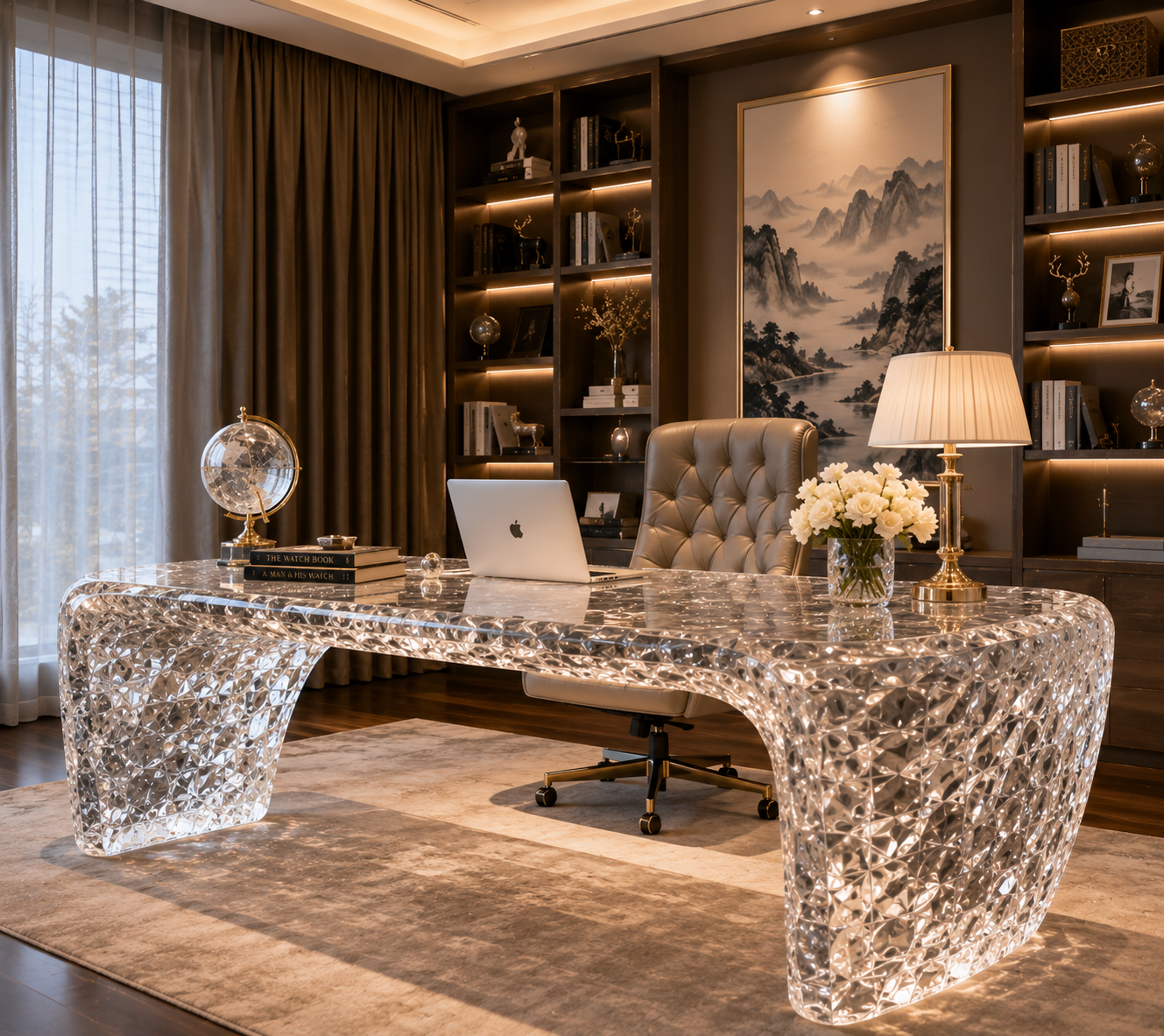
This is why the difference between commodity acrylic furniture and high-end synthetic-crystal, resin or platinum acrylic furniture is largely a difference in execution.
Material selection matters first. For acrylic products, designers should understand the actual PMMA grade and relevant optical, UV and physical characteristics rather than relying purely on marketing terms. Resin systems likewise differ substantially in clarity, hardness, color stability and long-term performance.
Fabrication matters just as much. Thick acrylic components require precise machining and polishing if edges are intended to create a crystal-like effect. Large resin castings require control over curing, shrinkage, color distribution and internal defects. Connections and metal inserts must be considered structurally rather than added as an afterthought.
And increasingly, documentation matters.
Gensler's Product Sustainability Standards demonstrate how seriously major architecture firms now evaluate interior materials. The firm's framework covers high-impact products and furniture, with more than 8,800 products currently reported as vetted through the GPS program. Gensler evaluates factors including carbon, health and lifecycle impacts when considering materials.
Furniture-industry standards are moving in the same direction. BIFMA explains that its LEVEL certification evaluates furniture against the ANSI/BIFMA e3 Sustainability Standard through environmental, health and social-impact criteria. The e3-2024 revision received ANSI approval in April 2025 and introduced updated requirements involving areas such as material health and responsible packaging.
For manufacturers targeting luxury residential, hospitality, retail and commercial projects, this means good photography is only the beginning.
Professional designers may also want technical drawings, material composition, load information, finish tolerances, maintenance guidance, UV information where relevant, chemical-emissions documentation and customization capabilities.
This is where premium transparent furniture can establish a much stronger position.
The objective should not be to sell another “clear acrylic table.” It should be to provide designers with a precisely engineered material object: perhaps a platinum acrylic coffee table with exceptionally polished edges, a hand-cast high-end resin console with controlled coloration, or a synthetic-crystal dining base designed specifically around a custom stone top.
The most convincing high-end interiors rarely feel as though someone simply added more expensive things.
They feel edited.
Every material has a purpose. Every object has enough space around it to be understood. Light is allowed to move through the room, architecture remains visible, important artworks retain hierarchy, and furniture contributes without creating unnecessary noise.
Transparent materials are uniquely suited to this approach because they can combine two qualities that appear contradictory: presence and absence.
They can be physically substantial yet visually light, geometrically simple yet optically complex, quiet from a distance yet remarkably detailed when viewed closely.
That is why synthetic crystal, high-end resin and platinum acrylic deserve to be considered not simply as alternatives to glass or conventional furniture materials, but as independent tools for contemporary luxury design.
Sometimes the most effective way to make a space look more sophisticated is not to add another layer.
It is to make the layers already there easier to see.
READ MORE:
- From Living Room to Terrace: How Crystal-Like Furniture Works Across Indoor and Outdoor Design
- Beyond Wood and Metal: What Distinctive Materials Can Make Outdoor Furniture Stand Out?
- 2026 Design Inspiration: Where Synthetic Crystal Furniture Works Best in Commercial and Residential Spaces
- Why More Designers Are Bringing "Crystal-Like Furniture" Into Modern Interiors
- Synthetic Crystal Acrylic Furniture: Giving Modern Spaces Stronger Visual Impact
- Why Crystal-Grade Acrylic Is Becoming an Innovative Material in the Eyes of Designers
- Synthetic Crystal Acrylic Furniture: A New Breakthrough for High-End Product Differentiation
- From Transparent Aesthetics to Commercial Competitiveness: Future Opportunities for Synthetic Crystal Acrylic Furniture
- Synthetic Crystal Acrylic Furniture: Why High-End Customers Increasingly Value the “Sense of Worth” Created by Materials


