In luxury residences, boutique commercial interiors, art galleries, hotel lobbies, and modern offices, a “sense of transparency” has become one of the key indicators of spatial quality. Many people simply understand transparency as “using large areas of glass,” “making the space brighter,” or “removing visual barriers.” However, true high-end transparency is not merely about being see-through, nor does it mean replacing every wall with glass. It is a comprehensive spatial experience: sightlines can extend naturally, light can flow freely, materials do not feel heavy, and spatial boundaries exist without creating pressure.
The sense of transparency in a high-end space comes from the combined effect of material selection, lighting design, structural proportion, and detail execution. Among them, glass, acrylic, metal, translucent materials, and the way they are combined determine whether a space feels merely “bright” or truly “light, refined, and layered.”
1. The “Sense of Transparency” in High-End Spaces Is Not Simply About Being Transparent
Many spaces look bright, but they do not necessarily feel premium. Some interiors use large amounts of transparent materials, yet they appear cold, cheap, or visually chaotic. This proves that transparency is not equal to high transparency itself. Instead, it depends on whether the material can create a better visual order within the space.
True transparency is first reflected in the extension of sightlines. When people enter a space, if their view is blocked by heavy walls, bulky furniture, or complicated decorations, the space may feel cramped even if it is not small. On the contrary, when partitions, furniture, or display structures use transparent or translucent materials, different areas can be visually connected, creating a stronger sense of openness.
Secondly, transparency is closely related to light. After natural light enters an interior, it needs to be refracted, reflected, or diffused through material surfaces so that the space becomes bright and soft. Excellent transparent materials do not simply allow light to pass through; they also help control the quality of light. For example, ultra-clear glass maintains high light transmission, frosted glass softens the light, and acrylic creates a lighter visual effect while maintaining clarity.
In addition, high-end spaces pursue “lightness” rather than “emptiness.” This lightness comes from material thickness, edge treatment, structural proportion, and finishing details. If a glass partition has heavy frames and messy hardware, it will weaken the premium feeling even if the material is transparent. On the other hand, an acrylic furniture piece with a clean form, clear edges, and accurate proportions can reduce visual pressure and make the space appear more open.
Therefore, transparency is essentially the feeling that a space has been visually opened up. Materials are only the means to achieve this effect.
2. Glass: The Most Fundamental Yet Most Design-Sensitive Transparent Material
Glass is the most common transparent material in interior design, and it is also one of the easiest materials to misuse. Its advantages are obvious: high transparency, stable material performance, a smooth surface, and wide applicability. It can be used for partitions, doors and windows, railings, display cabinets, staircases, wall decorations, and many other scenarios.
In high-end spaces, commonly used glass types include ultra-clear glass, tempered glass, laminated glass, wired glass, and decorative glass. Ultra-clear glass has a lower iron content, so it appears clearer and cleaner than ordinary glass, which often has a greenish tint. It is suitable for premium displays, shop windows, partitions, and furniture tops. Tempered glass offers better strength and safety, making it suitable for doors, partitions, shower rooms, and railings. Laminated glass contains an interlayer between two sheets of glass, so even if it breaks, the fragments are less likely to scatter. It is often used in spaces with higher safety requirements.
The most important function of glass is to divide space while maintaining visual connection. For example, using a glass partition between a living room and a study allows the two functional areas to remain independent without creating a closed feeling. In commercial interiors, glass display cabinets make products the visual focus while reducing the presence of the display equipment itself. In staircases or mezzanine areas, glass railings reduce structural heaviness and make the space feel lighter.
However, glass is not a universal solution. First, it can easily create a cold atmosphere. If a space uses too much glass without balancing it with wood, fabric, warm lighting, or soft lines, the overall feeling may become too rigid. Second, glass requires high construction precision. Edge treatment, joints, and hardware selection all affect the final result. In premium interiors, glass applications often emphasize slim frames, concealed connections, and clean finishing details rather than simply increasing the glass area.
In other words, glass can make a space more transparent, but whether it feels high-end depends on restraint in design and precision in detail.
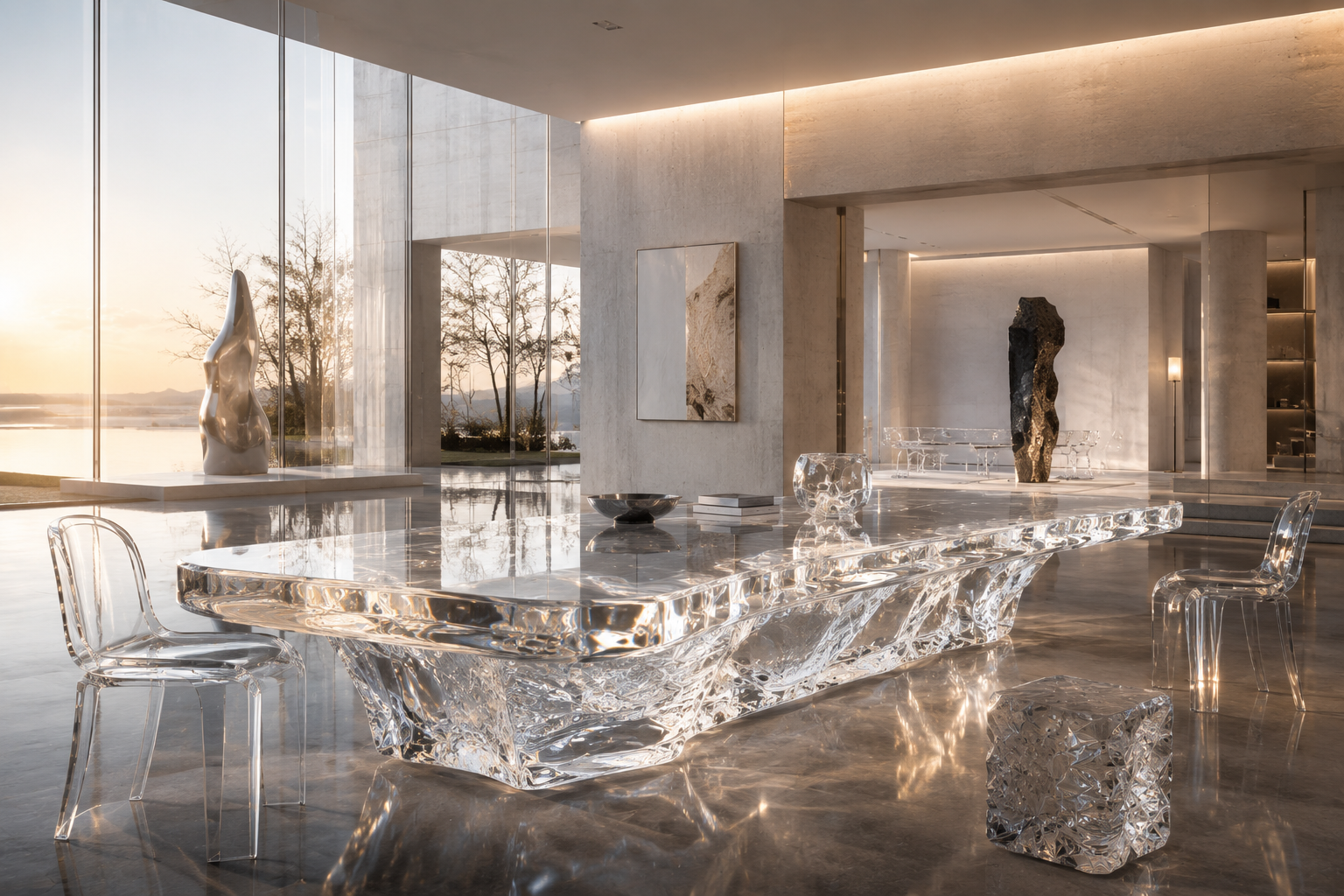
3. Acrylic: A Lighter and More Flexible High-End Transparent Choice Than Glass
Besides glass, acrylic is also an important material for creating transparency in spaces. Many people still associate acrylic with signage, display boards, or small decorative items. However, in modern interior design, high-quality acrylic is now widely used in furniture, display stands, art installations, lighting, partitions, and commercial display systems.
The greatest advantage of acrylic is that it looks visually close to glass, but it is lighter, easier to process, and more flexible in form. High-transparency acrylic has a clear visual appearance and can give furniture or installations a “floating” effect. For example, transparent acrylic chairs, acrylic side tables, acrylic display stands, and acrylic bookshelves can meet functional needs while avoiding the strong visual volume of traditional wooden or metal furniture.
This feature is especially suitable for small apartments, luxury residences, modern living rooms, boutique retail spaces, and art exhibition environments. In limited spaces, traditional furniture can easily create a crowded feeling, while acrylic furniture allows sightlines to pass through, reducing visual obstruction and making the space appear larger. In commercial spaces, acrylic display stands can highlight the products themselves without stealing attention, making them ideal for jewelry, perfume, cosmetics, artworks, and fashion items.
Another advantage of acrylic is its strong formability. It can be thermoformed, engraved, polished, colored, frosted, and processed into different shapes. From fully transparent to translucent, from colorless to lightly tinted, acrylic can be customized according to the spatial style. Compared with glass, acrylic is more suitable for curves, arcs, irregular structures, and lightweight installations, which makes it highly expressive in spaces that pursue artistic and design-oriented effects.
However, acrylic also requires attention to quality and maintenance. Low-quality acrylic may yellow, scratch easily, or have unclear edges. In high-end spaces, acrylic should usually be made from high-transparency sheets, with careful attention paid to edge polishing, thickness proportion, and surface protection. Only when the material itself is pure and the craftsmanship is refined can acrylic present a truly premium transparent effect.
From the perspective of spatial language, glass tends to express architectural and structural qualities, while acrylic emphasizes lightness and artistic expression. They are not substitutes for each other, but can be combined according to different functional needs.
4. Combining Metal with Transparent Materials to Create Refined and Restrained Luxury
A transparent space does not mean that every material must be see-through. In fact, truly high-end spaces often need structural lines to establish order, and metal is one of the ideal materials to pair with transparent elements.
Glass and acrylic are light and clean by nature, but without frames and detail control, a space can easily feel loose or undefined. Metal provides clear lines, boundaries, and structural support. Stainless steel, aluminum alloy, black titanium, brass, brushed metal, and other metal finishes are often combined with glass or acrylic in partition frames, display structures, furniture legs, door frames, lighting, and decorative trims.
In modern high-end spaces, the combination of black metal and glass is very common. Black lines can strengthen the spatial outline and give glass partitions a stronger architectural quality while maintaining transparency. Brass or champagne-toned metal is more suitable for light luxury interiors, creating a refined and warm contrast with transparent materials. Stainless steel works well in minimalist, modern, and technology-inspired spaces, especially when combined with transparent acrylic or ultra-clear glass for a clean and sharp effect.
When metal is paired with transparent materials, proportion control is crucial. If the metal lines are too thick, they weaken the lightness of the transparent material. If there are too many lines, the space becomes visually complicated. High-end spaces usually emphasize slim frames, narrow lines, concealed connections, and unified colors. For example, a glass partition may retain only necessary vertical structural lines, allowing the space to be divided without becoming heavy.
In furniture design, the combination of metal and acrylic is also very expressive. A transparent acrylic tabletop with slim metal supports can create a light yet stable visual effect. An acrylic display box with a metal base can enhance the refinement of product presentation. A transparent chair back combined with metal legs can balance functionality and aesthetics.
Therefore, metal is not the opposite of transparency. When used properly, it gives transparent materials clearer boundaries, stronger order, and a more restrained high-end character.
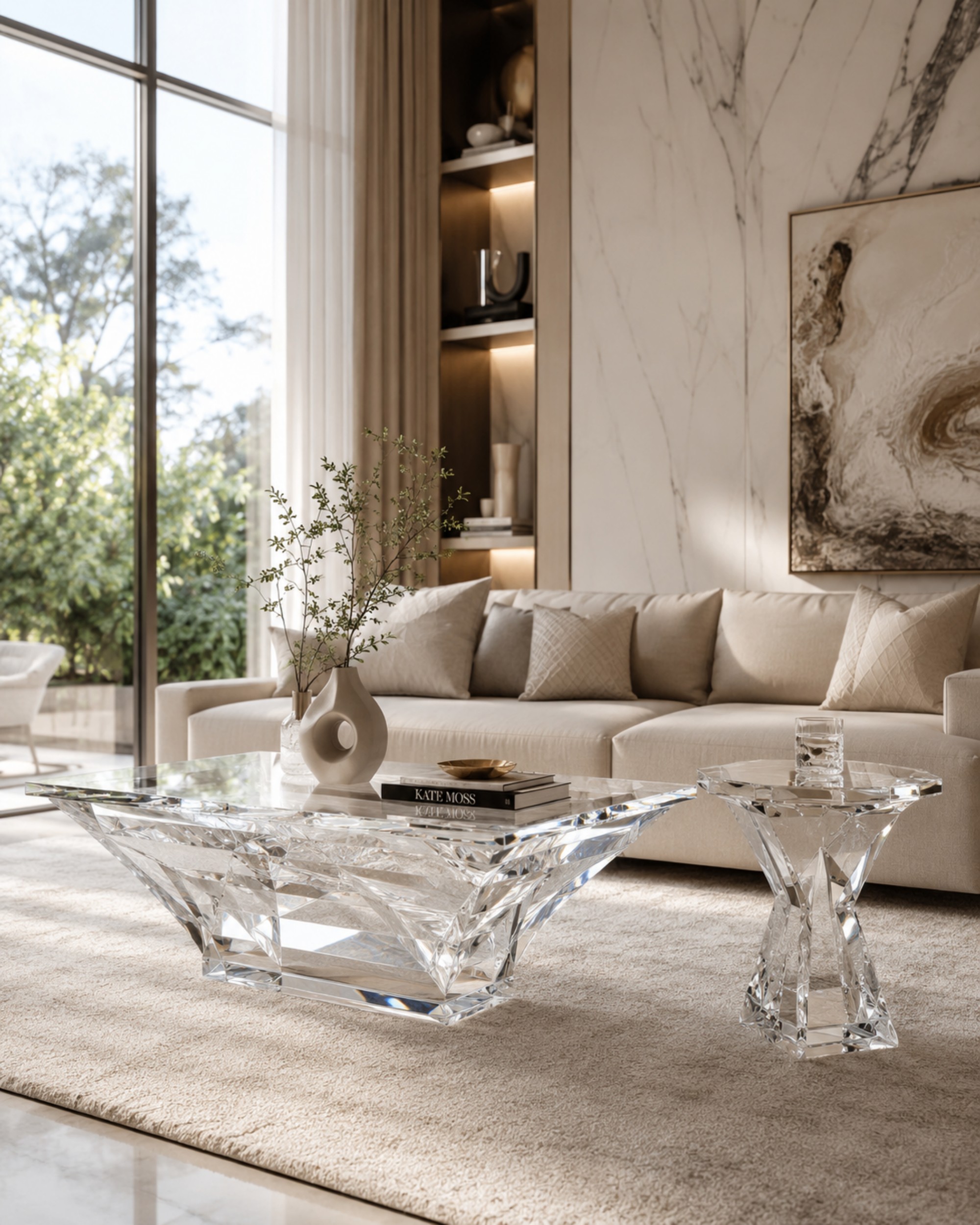
5. Translucent Materials: Creating a Soft, Misty, and Layered Spatial Atmosphere
Not every space is suitable for complete transparency. Some areas need both daylight and privacy. They need openness, but not full exposure. In these situations, translucent materials become an important choice for creating a premium sense of transparency.
Common translucent materials include fluted glass, frosted glass, wired glass, translucent acrylic, light-transmitting stone, polycarbonate panels, and certain resin-based materials. Their shared feature is that they allow light to pass through while blurring visibility, creating a soft, misty, and layered visual effect.
Fluted glass has been widely used in residential and commercial spaces in recent years. Its vertical texture visually extends height while partially blocking sightlines. When used for bathroom doors, kitchen partitions, entryway screens, or wardrobe doors, fluted glass balances daylight and privacy. Frosted glass is more suitable for areas that require soft light, such as office partitions, meeting rooms, studies, and bathrooms. It reduces direct visual disturbance and makes the space feel calmer.
Translucent acrylic is lighter than glass and easier to process into different forms. It can be used for light boxes, partitions, display installations, art walls, and brand space design. Especially in commercial spaces, translucent acrylic combined with lighting can create a soft glowing effect, giving the space a more futuristic and artistic atmosphere.
The value of translucent materials lies in creating a state where light can be seen, but boundaries are not fully exposed. This condition is especially suitable for high-end interiors because it does not reveal everything as completely transparent materials do, nor does it block the space entirely like a solid wall. It preserves imagination and makes the space more layered.
However, translucent materials should not be overdecorated. Overly complex textures, messy colors, or excessive use can make the space look cheap. A premium translucent effect usually comes from low-saturation colors, simple textures, soft lighting, and accurate proportions.
6. True High-End Transparency Comes from the Combined Effect of Materials, Light, and Proportion
Materials are the foundation of transparency, but they are not everything. Whether a space feels high-end ultimately depends on the coordination of materials, lighting, proportion, color, and function.
First, materials should be selected according to the function of the space. Open areas such as living rooms, studies, and exhibition halls can use more glass and acrylic. Areas that require privacy, such as bathrooms, bedrooms, and meeting rooms, are more suitable for translucent materials. Commercial display spaces can combine acrylic, glass, and metal to make the product the visual focus.
Second, lighting must be carefully considered. Transparent materials amplify the effect of light, but they also expose lighting problems. If the lighting is too cold, the space can feel sterile. If the light source is poorly positioned, glass or acrylic surfaces may produce harsh reflections. Therefore, high-end spaces often use indirect lighting, linear lights, concealed light strips, and focused accent lighting to work with transparent materials, making the light softer and more layered.
Third, the number of materials should be controlled. Too many transparent materials can make a space feel unstable and thin, while too many solid materials can compress the sense of openness. A more mature approach is to use transparent materials in key positions, such as partitions, furniture, display structures, or local decorative elements, and then balance them with wood, stone, fabric, or metal. This keeps the space transparent while preventing it from feeling too weak.
Finally, details determine quality. Whether the glass edges are clean, whether the acrylic is clear, whether the metal finishing is refined, and whether translucent materials work well with lighting all affect the final result. High-end quality is often not determined by one expensive material, but by the accurate handling of every joint, corner, and proportion.
Conclusion
The “sense of transparency” in a high-end space is not simply created by using transparent materials. It is achieved by reorganizing the relationship between people and space through material transparency, reflection, lightness, and layering.
Glass provides clarity, openness, and architectural expression. Acrylic brings lightness, flexibility, and modernity. Metal strengthens structure, lines, and refinement. Translucent materials soften light, protect privacy, and create spatial depth. Each material plays a different role, and when combined properly, they can create the transparent effect that high-end spaces require.
Excellent transparent design does not make people focus only on the material itself. Instead, it allows them to feel that the space has become more open, comfortable, orderly, and refined. Materials are only the means; the final result is a bright, light, restrained, and high-quality spatial experience.
Contact
LinkedIn: https://www.linkedin.com/in/adtender-zyra/?locale=zh_CN
Facebook: https://www.facebook.com/profile.php?id=61586259131631
Instagram: https://www.instagram.com/zzzzyyrraa4/
YouTube: https://www.youtube.com/@ZZZZyra-k7w
Office: (904) 258-3290
WhatsApp/Wechat: +86 18923188839


