Commercial furniture is often judged in the first three seconds. A hotel lobby chair must look inviting. A retail display table must make products feel premium. An office reception desk must communicate order and confidence before anyone says a word. Appearance matters because commercial interiors are part of brand language. But in real projects, furniture that is only “beautiful on opening day” can become expensive quickly. In busy commercial spaces, the real value of furniture is proven after months and years of use: when surfaces are cleaned every day, when chairs are dragged across floors, when sunlight hits display fixtures, when customers spill coffee, when staff reconfigure layouts, and when maintenance teams need fast solutions without disrupting operations.
That is why long-term commercial furniture value should be measured through three practical lenses: durability, easy maintenance, and anti-aging performance. These factors determine whether a piece of furniture continues to support the business or quietly becomes a source of repair cost, visual fatigue, safety risk, and replacement waste.
Authoritative data reinforces this point. The U.S. Environmental Protection Agency classifies furniture and furnishings as durable goods and reports that durable goods generated 57.1 million tons of municipal solid waste in 2018, including furniture, appliances, carpets, tires, and other long-life products. Within this category, furniture and furnishings are a major bulky waste stream, which means short replacement cycles are not only a procurement issue but also an environmental issue. BIFMA, the Business and Institutional Furniture Manufacturers Association, also maintains safety, performance, and sustainability standards for commercial furniture, showing that the industry itself treats furniture as an engineered product rather than a decorative afterthought. Meanwhile, facility management organizations such as IFMA frame maintenance, janitorial operations, space utilization, and budget planning as measurable management issues, not background tasks. In other words, the long-term value of furniture is created where design, materials, maintenance, operations, and sustainability meet.
1. Long-Term Value Begins With Total Cost, Not Purchase Price
In commercial projects, the cheapest quotation can look attractive during procurement, especially when a store, office, showroom, restaurant, clinic, or hotel must open on schedule. Yet the lowest purchase price often hides future costs. A chair that needs replacement after one busy season is not inexpensive. A table surface that stains easily may require extra cleaning time, refinishing, protective coverings, or early replacement. A display fixture that yellows under lighting can weaken brand presentation and force visual merchandising teams to redesign the space sooner than planned.
A more accurate approach is to evaluate total cost of ownership. This includes purchase price, installation, cleaning labor, repair frequency, replacement parts, operational disruption, end-of-life disposal, and the lost value caused by poor appearance. Government and institutional buyers often use this logic. The U.S. General Services Administration states that one of its acquisition goals is to deliver best value in terms of cost, quality, and service for federal agencies and taxpayers. This “best value” principle is directly relevant to commercial furniture selection: a product is valuable when it performs well over its intended life, not merely when it looks affordable on an invoice.
Consider a café that buys lightweight tables with low-grade finishes. On opening day, the layout looks clean and modern. After six months, hot cups leave rings, edges chip, and staff begin placing temporary covers on the tabletops. The café then pays twice: first for the original furniture and again through visual decline, customer dissatisfaction, repair work, and eventual replacement. By contrast, a more durable surface with better edge treatment, moisture resistance, and easier cleaning may cost more at the start but reduce interruptions and preserve the original design intent.
For commercial buyers, the correct question is not “Which furniture looks best in the catalog?” but “Which furniture will still look aligned with the brand after thousands of interactions?” Long-term value begins when procurement teams connect aesthetics to service life.
2. Durability Protects the Business From Daily Commercial Stress
Commercial furniture faces usage conditions that residential furniture rarely experiences. A chair in a waiting area may support dozens of users every day. A retail table may be touched, leaned on, cleaned, and repositioned repeatedly. A hotel lobby bench may carry luggage, handbags, children, and high traffic throughout the day. In coworking spaces, furniture must survive constant movement and different user habits. In restaurants, it must tolerate impact, moisture, grease, and cleaning chemicals.
Durability therefore has to be engineered into the furniture from the beginning. It is not limited to “strong material.” It includes structural design, joint quality, load-bearing capacity, edge protection, surface hardness, scratch resistance, moisture resistance, chemical resistance, hardware quality, and replaceable components. A beautiful piece with weak joints is a liability. A premium-looking surface that cannot handle cleaning chemicals is not suitable for a busy public environment. A display stand that flexes under product weight can create safety and brand risks at the same time.
This is where industry standards matter. BIFMA sponsors and maintains safety, performance, and sustainability standards for furniture, including standards used to test seating, storage, tables, and other business and institutional furniture. Such standards are important because they help buyers move beyond subjective impressions. Instead of relying only on photos or showroom feel, project teams can ask suppliers for evidence: load testing, stability testing, impact performance, material specifications, and compliance documentation.
In practical terms, durability decisions should be connected to the actual use scenario. A boutique showroom may prioritize scratch-resistant transparent acrylic display furniture because it creates a light visual effect while allowing products to stand out. A school or training center may need tables with reinforced frames and easily replaceable glides. A clinic may need seating with strong frames and surfaces that tolerate frequent cleaning. A hotel may choose furniture with robust edge details because luggage impact is predictable. Different spaces have different stress patterns, and good specification begins by identifying those patterns before the order is placed.
Durability is also a form of operational insurance. When furniture performs reliably, staff do not need to remove damaged pieces, apologize to customers, improvise repairs, or rearrange layouts around weak products. The space stays consistent. The brand experience stays controlled. The facility team can plan maintenance instead of reacting to emergencies.
3. Easy Maintenance Turns Furniture Into an Operational Advantage
Easy maintenance is often underestimated because it does not look glamorous in a design rendering. However, in commercial spaces, cleaning and maintenance happen every day. Surfaces are wiped, disinfected, dusted, moved, inspected, and sometimes repaired outside business hours. A material that looks impressive but requires delicate handling may not be realistic for a high-traffic environment.
The U.S. Centers for Disease Control and Prevention explains that cleaning and disinfecting are effective ways to prevent the spread of illness and disease, and that in most situations cleaning with soap and water can remove germs. For commercial furniture, the lesson is not that every space should be treated like a hospital; the lesson is that cleanability is part of user trust. In restaurants, clinics, offices, salons, educational spaces, and retail environments, customers notice sticky surfaces, dust in seams, cloudy display cases, stained upholstery, and damaged edges. Clean furniture communicates professionalism.
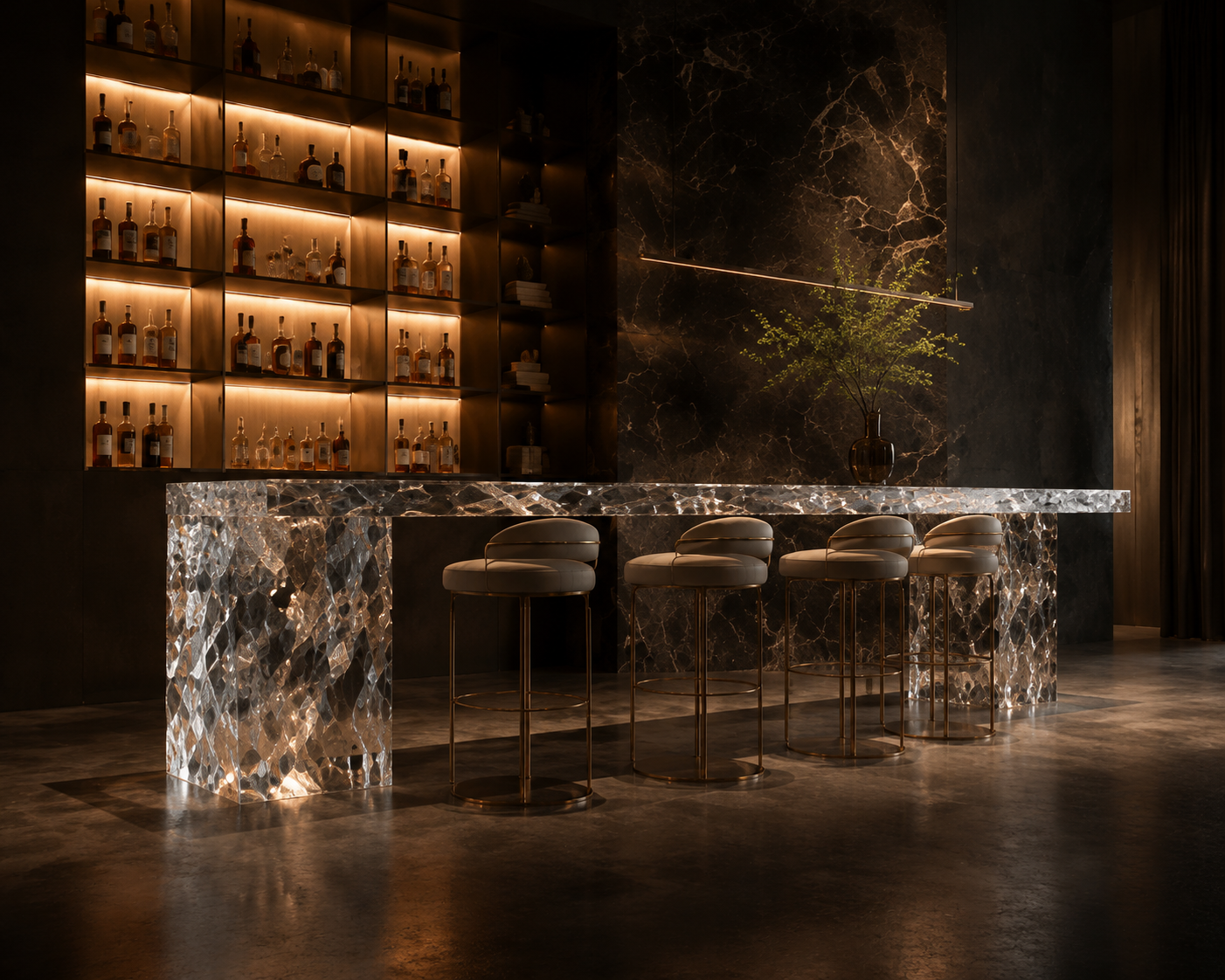
Easy maintenance depends on both material and design. Smooth non-porous surfaces are generally easier to wipe than deeply textured surfaces. Rounded edges can reduce dirt accumulation and chipping. Removable cushions or panels can simplify repair. Transparent acrylic furniture, when specified correctly, can be useful in retail and display environments because it can create a clean visual profile and allow quick inspection of dust, fingerprints, and scratches. Metal frames with quality powder coating can resist wear in public seating. High-pressure laminates, compact boards, treated woods, and engineered surfaces may perform well when matched to the right use case.
Design details can either help or punish maintenance teams. Narrow gaps, complex grooves, exposed fasteners, absorbent edges, and unnecessary decorative seams may collect dust and require extra labor. In a store, that extra labor may reduce staff time available for sales. In a restaurant, it may delay table turnover. In an office, it may increase facility service costs. In a hotel, it may affect room readiness or lobby presentation.
Easy maintenance also supports sustainability. Furniture that can be cleaned, repaired, and refreshed is more likely to remain in service. A scratched panel that can be replaced is better than a whole fixture that must be discarded. A modular reception counter that accepts new surface panels can adapt to brand updates without a full rebuild. A display system with standardized parts can move between stores instead of being thrown away after one campaign.
The best maintenance strategy begins before purchase. Buyers should request cleaning instructions, chemical compatibility guidance, spare-part availability, and realistic care requirements. If a supplier cannot explain how the furniture should be maintained, the buyer should treat that as a risk signal. In commercial furniture, ease of cleaning is not a minor convenience; it is a daily operating cost.
4. Anti-Aging Performance Preserves Brand Image Over Time
Commercial interiors age in public. A private home can tolerate small imperfections because only a few people see them. A commercial space is different. Customers, partners, employees, and visitors continuously evaluate the environment. Faded colors, yellowed surfaces, warped panels, cloudy transparent materials, peeling finishes, loose edges, and stained upholstery can make a business feel careless even when the service is strong.
Anti-aging performance refers to how well furniture resists the visible and functional effects of time. This includes UV resistance, color stability, yellowing resistance, moisture stability, oxidation resistance, coating adhesion, deformation control, and resistance to repeated cleaning. For transparent or light-colored materials, anti-yellowing is especially important. For outdoor or near-window installations, UV exposure must be considered. For food and beverage spaces, moisture and heat resistance are critical. For retail display furniture, clarity, edge quality, and surface condition affect product presentation directly.
ISO 15686, the international standard series on service life planning for buildings and constructed assets, identifies general principles and a systematic framework for service life planning across a life cycle. Although it is written for buildings and constructed assets, the logic applies well to commercial interiors: performance should be planned, not hoped for. If a furniture item is expected to remain in service for years, then aging factors must be considered during specification.
A realistic example is a luxury cosmetics store using transparent display blocks and shelves. The design may depend on clarity, reflection, and a sense of cleanliness. If low-quality material yellows under lighting, the product display begins to look old and the merchandise may appear less premium. Another example is a sunny office reception area with upholstered seating. If the fabric fades unevenly, visitors may assume the entire workplace is poorly maintained. In restaurants, tabletops that swell at the edges after repeated wiping can create an impression of low hygiene, even if the kitchen is well managed.
Anti-aging performance is not only about appearance. It can also affect safety and function. Warped panels may create instability. Brittle plastic components may crack. Corroded hardware may loosen. Coatings that peel can expose substrates to moisture and accelerate damage. Once aging begins, deterioration often becomes faster because damaged areas collect dirt, absorb moisture, or experience more friction.
To protect long-term value, buyers should ask suppliers about UV testing, material grade, coating system, edge sealing, cleaning compatibility, and expected service environment. For acrylic furniture, this may include questions about material thickness, manufacturing method, polishing quality, stress cracking risk, and whether the piece is intended for indoor, outdoor, display, hospitality, or heavy-use environments. For wood-based products, moisture protection and edge banding are essential. For metal products, corrosion resistance and coating quality matter. For upholstery, abrasion rating, stain resistance, and cleanability should be documented.
Anti-aging furniture helps the business maintain a consistent visual standard. Instead of spending money to recover from decline, the business preserves the value of the original interior investment.
5. Standards, Sustainability, and Waste Data Make the Business Case Stronger
Professional buyers increasingly need to justify furniture decisions to more than one stakeholder. Designers care about aesthetics. Finance teams care about budget. Facility managers care about maintenance. Sustainability teams care about waste and carbon. Operations teams care about downtime. Store managers care about practical use. Customers care about experience. Good commercial furniture must satisfy all of these perspectives.
This is why standards and data are powerful. BIFMA’s role in developing furniture safety, performance, and sustainability standards gives buyers a practical framework for asking better questions. The ANSI/BIFMA e3 Furniture Sustainability Standard and LEVEL certification program also connect commercial furniture to broader sustainability conversations. In 2026, BIFMA announced alignment work with USGBC and the International WELL Building Institute around furniture sustainability across LEED and WELL programs, showing that furniture is now part of healthier and more sustainable interior strategy rather than a purely decorative purchase.
Waste data also matters. The EPA’s durable goods data shows that large, long-life products create significant municipal solid waste. Furniture is bulky, difficult to handle, and often expensive to remove. When commercial furniture is replaced too quickly, the cost is not limited to a new purchase. There may be disposal fees, logistics, downtime, and environmental impact. UNEP’s circularity platform emphasizes a shift away from the linear “take-make-waste” model toward reuse, repair, remanufacture, and recycling. This is directly relevant to commercial furniture because the most sustainable product is often the one that remains useful, repairable, and adaptable for longer.
Embodied carbon is another emerging concern. Research and professional discussions on commercial interiors increasingly point out that furniture contributes to the environmental footprint of fit-outs. MSR Design’s work on embodied carbon in commercial furniture highlights the need to measure furniture categories such as seating, tables, lounge furniture, shelving, and workstations more carefully. While the data set for furniture is still developing, the direction is clear: frequent replacement makes environmental performance worse, and longer service life can support lower-impact operations.
For a business, these sustainability arguments can also become financial arguments. Durable, repairable, and maintainable furniture reduces replacement frequency. Modular systems reduce waste during renovation. Standardized parts simplify inventory. Timeless materials reduce the need for frequent redesign. When sustainability and operations point in the same direction, the furniture decision becomes easier to defend.
6. How to Specify Commercial Furniture for Long-Term Value
The most reliable way to avoid short-lived furniture is to specify performance before appearance becomes the only decision factor. Commercial buyers should begin with a use map. Who will use the furniture? How often? Will it be moved? Will it face sunlight? Will it contact food, cosmetics, chemicals, water, luggage, carts, or heavy products? Will customers sit on it, lean on it, photograph it, or treat it as part of the brand experience? The answers should shape the material, structure, finish, and maintenance plan.
Next, buyers should define performance requirements. For seating, ask about frame strength, load testing, stability, upholstery abrasion, and replacement parts. For tables, ask about surface hardness, edge sealing, heat resistance, stain resistance, and cleaning compatibility. For display fixtures, ask about weight capacity, scratch resistance, clarity, yellowing resistance, lighting exposure, and modularity. For acrylic commercial furniture, ask whether the supplier understands thickness selection, bonding quality, polishing standards, packaging protection, and installation conditions. A visually clear acrylic display is only successful when it remains clear, stable, and easy to maintain throughout its service life.
Buyers should also request samples and test them realistically. A small sample can be cleaned with the same products used by staff. It can be exposed to light, touched with oily hands, placed under merchandise, or checked for fingerprints. This is not overcautious; it is practical risk control. Many furniture failures are predictable before installation if the project team tests the sample against real operating conditions.
Supplier capability is another important factor. A strong supplier should provide material specifications, care instructions, production quality control, packaging methods, installation guidance, and after-sales support. In large commercial projects, consistency matters as much as creativity. A chain store, hotel group, office campus, or clinic network needs repeatable quality across multiple locations. If the supplier cannot deliver consistent finish, color, size, spare parts, and documentation, the buyer may face long-term inconsistency.
Finally, commercial furniture should be reviewed through a lifecycle checklist: expected service life, cleaning method, repair options, replaceable components, relocation potential, disposal plan, and brand relevance. A good-looking product that fails this checklist may be a short-term decoration. A product that passes it becomes a long-term asset.
Conclusion: Beauty Opens the Door, Performance Keeps the Value
Commercial space furniture must be attractive, but beauty alone is not enough. In real business environments, furniture is touched, cleaned, moved, exposed, loaded, photographed, and judged every day. Durability protects the business from failure. Easy maintenance reduces operating pressure. Anti-aging performance preserves brand image. Standards and data help buyers make decisions that are defensible, measurable, and sustainable.
The strongest commercial interiors are not built around furniture that simply looks good in a rendering. They are built around furniture that continues to look good, function well, clean easily, and support the business after years of use. For offices, hotels, retail stores, restaurants, clinics, galleries, salons, and public spaces, long-term value comes from choosing furniture as an operational asset. When design, material quality, maintenance planning, and lifecycle thinking work together, furniture becomes more than decoration. It becomes part of the business infrastructure.


