Frequent after-sales repairs are not simply a “service department problem.” In the transparent furniture category, repeated repair requests usually reveal a deeper mismatch among material selection, structural design, production control, cleaning method, logistics protection and user scenario. Synthetic crystal, resin and acrylic furniture can all look clean, luxurious and contemporary in a showroom. Yet their long-term behavior is different. Some products chip at the edges, some yellow under light, some develop stress cracks around bonded joints, and some become cloudy after the wrong cleaning agent is used. When repair frequency rises, the practical question should not be “Which material is perfect?” The better question is: “Which material is suitable for this usage environment, and how should we design, test and maintain it?”
This article compares synthetic crystal, resin and acrylic furniture from six durability angles. The discussion is written for real business use: hotels, restaurants, offices, villas, retail spaces, design studios, wholesalers and project buyers who need fewer complaints, longer product life and clearer warranty standards. It also draws on recognized sources. For example, the U.S. Consumer Product Safety Commission has warned that glass tables were associated with an estimated 20,700 emergency department injuries in 2016, and ASTM F2813 covers performance requirements for glass used as horizontal surfaces in desks and tables. ASTM D256 is a standard method for determining Izod pendulum impact resistance of plastics. BIFMA has also emphasized safety and performance testing for desks and tables under ANSI/BIFMA X5.5-2021. Material suppliers such as Röhm and PERSPEX describe PMMA acrylic as a transparent thermoplastic with UV and weathering resistance, while PERSPEX Clear reports 92% visible light transmission and about half the weight of traditional glass. These references do not replace project testing, but they help us build a more reliable durability framework.
1. Start with the Failure Pattern, Not the Complaint
When a customer says, “This product keeps needing repair,” the first step is to classify the failure pattern. Transparent furniture failures often look similar to the end user—scratches, cracks, haze, yellowing, loose joints or broken corners—but they have different root causes. A cracked synthetic crystal table corner may come from impact during transport or from unsupported edge design. A yellow resin panel may come from thermal aging, UV exposure or resin formulation. A cloudy acrylic chair may come from ammonia-based cleaner rather than material failure. A wobbly clear console table may not be a material issue at all; it may be a joint, hardware or load-distribution problem.
In practice, after-sales teams should build a simple inspection form with five questions. First, where did the problem appear: surface, edge, joint, screw hole, bonding seam or load-bearing area? Second, when did it appear: after delivery, after installation, after cleaning, after sunlight exposure, after moving or after heavy loading? Third, is the defect localized or spread across the whole piece? Fourth, did the product face heat, alcohol, ammonia, direct sunlight, outdoor humidity, metal objects or rough cloth wiping? Fifth, does the same batch show the same problem, or is it isolated?
This approach prevents expensive misjudgment. For example, acrylic scratches may be polished if they are shallow, while deep stress cracking around a screw hole may require a design change. Resin yellowing may be reduced through formulation and coating, but once the chemistry has changed, polishing alone may not restore the original clarity. Synthetic crystal or glass-like materials may retain excellent hardness, but edge damage can quickly become a safety and appearance issue. If a company treats all repair claims as “surface defects,” it will repeat the same repair cycle without solving the cause.
Repair data should also be converted into a quality signal. If most complaints appear within seven days, packaging, transport and installation may be the main risk. If complaints appear after two to three months in restaurants or hotels, cleaning protocol and surface abrasion may be the main risk. If problems appear after six to twelve months near windows, UV, heat and indoor climate may be involved. A professional furniture supplier should not only repair products; it should use repair data to change material choice, edge radius, bonding method, cleaning instructions and warranty wording.
2. Compare the Materials by Real Use Conditions
Synthetic crystal, resin and acrylic are often grouped together because they can all create a transparent or translucent visual effect. However, they should not be sold with the same durability promise. Synthetic crystal or crystal-like glass materials usually provide a hard, premium and reflective surface. They can be attractive in luxury interiors, but they are also heavier and more brittle than acrylic. When used as tabletops or shelves, edge processing, tempering or lamination requirements, support spacing and impact risk must be carefully reviewed. The CPSC safety alert about tempered glass makes an important point for furniture: glass may be designed to fail more safely, but breakage of horizontal glass surfaces still carries cutting and piercing injury risk. ASTM F2813 also focuses on minimizing serious injury from breakage in glass surfaces used in desks and tables. For high-traffic commercial use, this means glass-like transparent furniture should not be assessed only by appearance; it must be assessed by breakage behavior and user contact risk.
Resin furniture can deliver creative shapes, embedded objects, artistic textures and thick transparent forms. It is useful for decorative tables, luxury counters, art furniture and custom installations. But resin durability depends heavily on formulation, curing quality, thickness, pigment system, UV stabilizers and post-curing process. Open-access research in Polymer Testing reports that epoxy and vinyl ester resins can yellow under thermal, UV and natural aging conditions, with yellowing linked to radical oxidation reactions that form chromophores. This matters in transparent furniture because even small color changes are visible. A resin table in a dim private room may perform very differently from one in a sunny hotel lobby. Resin may also be sensitive to heat marks, surface abrasion and incomplete curing, depending on the system.
Acrylic, commonly known as PMMA, offers a different balance. It is lighter than glass, easier to fabricate, easier to polish, and widely used where optical clarity and design flexibility matter. Röhm describes PLEXIGLAS as PMMA with strong resistance to UV radiation and weathering, long service life and easy processing. PERSPEX Clear reports 92% visible light transmission, good impact resistance, long service life, outdoor weathering resistance, and about half the weight of traditional glass. This does not mean acrylic is impossible to damage. Its surface can scratch more easily than glass, and poor chemical cleaning can cause cloudiness. However, from an after-sales perspective, acrylic has an important advantage: many minor scratches and edge marks can be improved through professional polishing, while many glass or crystal breakages require replacement.
The practical conclusion is straightforward. Use synthetic crystal or safety glass when hardness, prestige and a glass-like feel are essential, but design for breakage risk and edge protection. Use resin when custom artistic expression is the priority, but control UV, heat and curing quality. Use acrylic when lightweight structure, optical clarity, repairability and fabrication flexibility are more important than absolute surface hardness. Frequent repairs often happen when a material is placed in the wrong scenario.
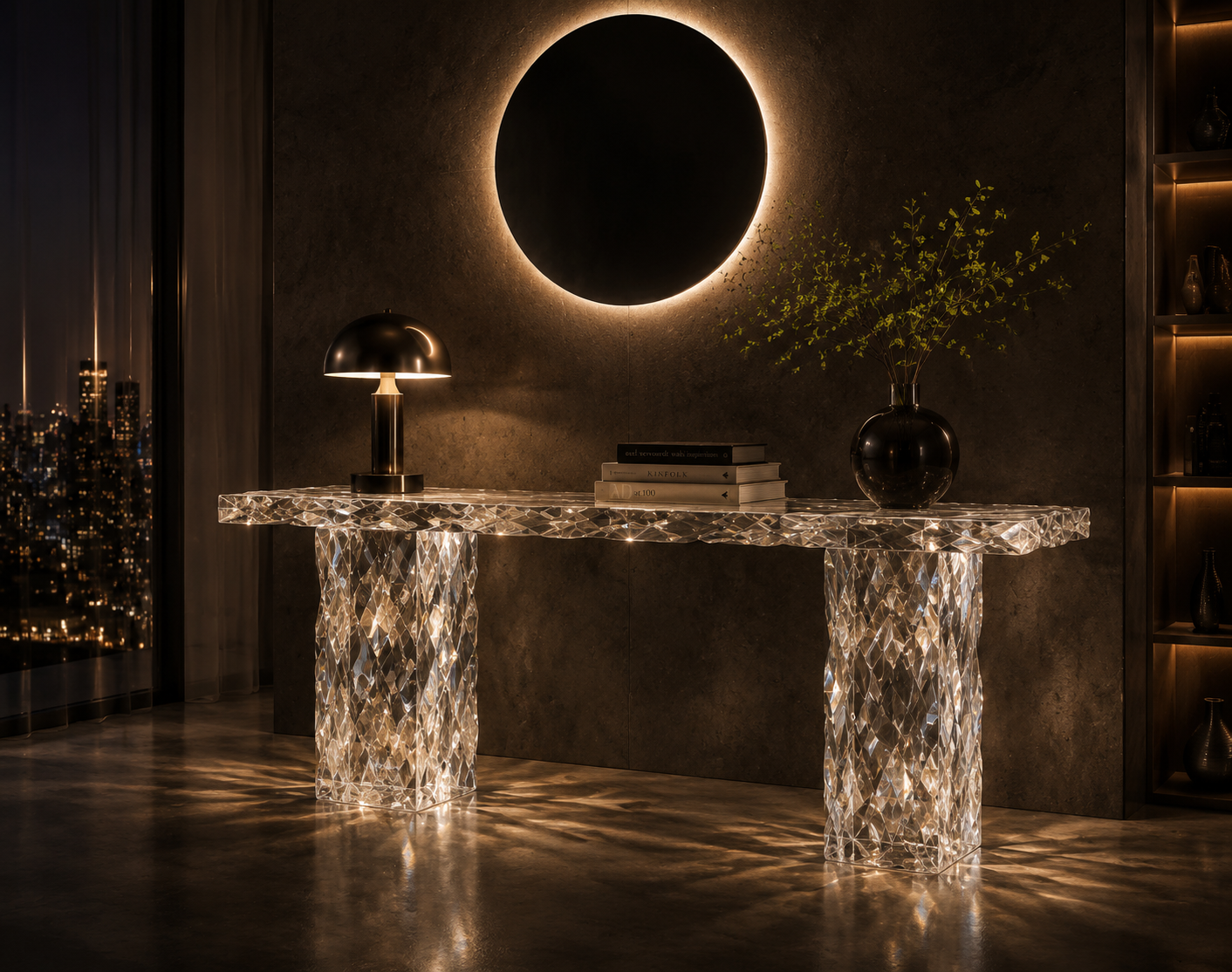
3. Design the Structure Around the Weak Point of Each Material
Durability is not determined by material alone. A well-designed acrylic table can outlast a poorly designed glass-like table, and a well-supported resin slab can outperform a thick but poorly cured decorative panel. The weak point of transparent furniture is usually not the flat center of the panel; it is the edge, corner, drilled hole, bonding seam, unsupported span or contact point with metal hardware.
For synthetic crystal or glass-like furniture, edge and corner treatment are critical. Sharp corners look elegant in renderings, but they concentrate impact risk in real homes and commercial spaces. A small radius, bevel or protective detail can significantly reduce chipping complaints. Support is equally important. A large transparent top should not rely on a few narrow contact points if users may lean, place heavy objects or move the table by the top. Designers should consider load paths: where does the force go when a person presses the corner? Where does vibration travel when the product is moved? If the answer is “through a brittle corner or small bonded point,” the design is likely to generate after-sales problems.
For resin furniture, thickness and curing are not the only issues. Internal stress, bubble control, moisture, temperature rise during curing and surface coating all affect long-term appearance. Thick resin pieces can look premium but may trap heat during cure or show internal defects if process control is weak. A resin slab used as a restaurant tabletop must also consider hot cups, alcohol wipes, oil, cleaning chemicals and sunlight. If the product is sold without use restrictions, the repair team may later face yellowing, soft marks, micro-scratches or surface dullness.
For acrylic furniture, the key design risks are stress concentration and chemical exposure. Holes should not be too close to edges. Screw tightening should be controlled because over-tightened hardware can create stress around the hole. Bonding seams should be clean, even and designed to avoid peel forces. Long unsupported acrylic spans should be checked for deflection, because customers interpret sagging as poor quality even when the material has not broken. If a chair, bench or table is intended for commercial use, the design should be tested with realistic load cycles, not just static showroom display.
This is where recognized testing concepts become useful. ASTM D256 evaluates the impact resistance of plastics using a standardized pendulum method, which reminds manufacturers that impact behavior can be measured rather than guessed. ANSI/BIFMA X5.5-2021, for desks and tables, highlights the importance of stability, strength, leg performance and other structural safety tests. Even if a decorative residential product is not legally required to meet every commercial standard, using similar thinking can reduce repair frequency. A product that passes a beautiful photo shoot but fails when pushed, moved, leaned on or cleaned is not durable furniture; it is fragile decoration.
4. Control Cleaning, Chemicals and Daily Maintenance Before Selling
Many after-sales repairs are caused by daily maintenance mistakes. The end user may believe that transparent furniture should be cleaned like glass. That assumption is dangerous for acrylic and some resin surfaces. Architectural Digest, in a care guide for Lucite and acrylic, advises using plastic-specific cleaner and clean microfiber cloth, and warns that household cleaners containing ammonia can break down acrylic and make it cloudy. The same guide also notes that acrylic can scratch easily and should be treated gently, with hard-edged objects lifted rather than dragged.
For suppliers, this means the maintenance guide is not optional. It is part of the product’s durability system. Every shipment should include a clear cleaning card. For acrylic furniture, the card should recommend clean microfiber cloth, mild soap solution or plastic-approved cleaner, and immediate removal of abrasive dust before wiping. It should warn against ammonia, strong alcohol, acetone, rough paper towels, dry wiping with grit, and dragging metal objects across the surface. For resin furniture, the card should mention heat protection, coaster use, avoidance of prolonged direct sunlight when applicable, and gentle cleaning with non-abrasive cloth. For synthetic crystal or glass-like products, the card should mention edge protection, safe lifting, avoiding sudden impact and using proper pads under hard objects.
A maintenance guide must be practical, not legalistic. A hotel housekeeping team will not read a complex manual. A restaurant server will not memorize a polymer compatibility chart. The best solution is a one-page visual guide: “Use this; do not use that; lift, do not drag; use pads under metal; avoid high heat; report cracks immediately.” For project buyers, the supplier should provide staff training before installation. Ten minutes of training can prevent months of repeated claims.
Cleaning protocol should also match the client type. A private villa may only need weekly cleaning instructions. A hotel lobby may require daily dust removal and scheduled polishing inspection. A restaurant tabletop may require clear rules about hot dishes, alcohol-based sanitation, tableware friction and quick spill removal. A retail store display may need gloves, soft cloths and dust-control tools because lighting makes every scratch visible. Frequent maintenance claims often happen because the product was sold to the right customer visually but the wrong cleaning environment operationally.

5. Use Standards, Supplier Data and Pilot Testing to Set Warranty Boundaries
Warranty disputes become intense when the buyer and seller use different definitions of durability. The buyer may believe “durable” means scratch-proof, heat-proof, sunlight-proof and chemical-proof. The seller may mean “durable under normal indoor use.” These are not the same promise. A professional warranty should translate durability into measurable conditions.
Start with material data. If acrylic is selected, the supplier can reference recognized PMMA data such as optical clarity, weight advantage, UV resistance and repairability, while also stating surface care limitations. If resin is selected, the supplier should specify whether the product is suitable for direct sunlight, high-heat contact or commercial cleaning chemicals. If synthetic crystal or glass-like material is selected, the supplier should specify whether it is tempered, laminated, bonded, supported, and suitable for horizontal surfaces under the expected load and contact conditions.
Then use pilot testing. For a hotel, place one sample in the actual lobby for thirty to sixty days before mass production. Let housekeeping clean it with the real cloths and chemicals they normally use. Let staff move around it. Let sunlight hit it. Inspect scratches, haze, yellowing, joint movement and stability. This simple field trial often reveals more than a perfect lab sample. For restaurants, test heat pads, alcohol wipes, plate dragging and cleaning frequency. For retail stores, test strong lighting and repeated touching. For offices, test monitor arms, cable movement and leaning loads.
Standards provide a language for this process. ASTM D256 gives a way to think about impact resistance of plastics. ASTM F2813 gives a safety reference for glass used as horizontal furniture surfaces. CPSC data reminds us that glass-table injuries are not theoretical. ANSI/BIFMA X5.5-2021 reminds us that desks and tables need stability and structural performance evaluation, not just visual inspection. NIOSH data on styrene also matters for resin manufacturing environments because styrene exposure has defined workplace limits and health effects; although a finished product is different from production exposure, responsible factories should control curing, ventilation and worker safety.
A fair warranty should separate manufacturing defects from use damage. Manufacturing defects may include poor bonding, internal bubbles beyond tolerance, unstable structure, premature seam failure, severe warping under specified conditions or incorrect material. Use damage may include scratches from dragging objects, clouding from prohibited cleaners, heat marks from hot pans, impact chips, outdoor exposure when sold for indoor use, or overloading beyond stated limits. When these boundaries are written before sale, after-sales repairs become more predictable and less emotional.
6. Build a Repair Strategy: Polish, Replace, Redesign or Re-educate
Once repairs become frequent, the company needs a decision tree. Not every issue deserves the same response. A shallow acrylic scratch can often be polished. A deep crack around a structural joint may require replacement and redesign. A resin yellowing issue may require batch review and formula improvement. A chipped crystal-like corner may require better packaging, larger edge radius or different material. A cloudy acrylic surface after ammonia cleaning may require customer education and a revised maintenance card.
The first category is polishable surface wear. Acrylic performs well here because minor scratches can often be improved with professional polishing systems. This makes acrylic attractive for commercial projects where appearance maintenance is expected. However, polishing should not be sold as a magic solution. Repeated polishing removes material and requires skill. The supplier should define what is repairable on site, what requires factory service, and what cannot be restored.
The second category is replacement-level damage. Broken glass-like surfaces, deep cracks, structural joint failure and severe impact damage may not be safe to repair. In these cases, the after-sales team should replace the part and examine the cause. If several customers report the same breakage location, the design is speaking. The company should not simply replace parts until the warranty expires; it should redesign the weak point.
The third category is process-related defect. If multiple resin pieces from one batch show similar yellowing, bubbles or surface softness, the factory should review resin system, mixing ratio, curing time, temperature control, UV stabilizer, coating and storage. If multiple acrylic pieces show seam whitening or cracking near holes, the factory should review bonding solvent, machining quality, polishing heat, hole position and screw torque. Frequent repairs are a quality database; ignoring the pattern wastes money.
The fourth category is usage mismatch. Some customers choose transparent furniture for beauty but use it in demanding environments: direct sun, high humidity, heavy daily cleaning, hot dishes, metal decoration, or public spaces with uncontrolled impact. In these cases, the best repair strategy may be re-education or material substitution. For example, a restaurant that wants a clear tabletop but uses aggressive chemical sanitation may need a protective top layer, replaceable pad, different cleaner or a different material. A hotel lobby that wants a crystal-clear sculpture table near floor-to-ceiling windows may need UV-resistant acrylic or a resin system tested for that light exposure.
The final category is expectation management. Transparent furniture shows damage more visibly than opaque wood or metal. A tiny scratch that disappears on a dark wood table may be obvious on a clear acrylic coffee table under LED lighting. This does not mean the product is defective; it means the product requires a higher care standard. Sales teams should explain this before purchase. When customers understand the trade-off—clarity and lightness versus surface sensitivity—they are less likely to treat maintenance as product failure.

Conclusion: Reduce Repairs by Designing the Whole Durability System
Frequent after-sales repairs are a signal. They tell the manufacturer that the durability system is incomplete. The solution is not to claim that synthetic crystal, resin or acrylic is universally better. Each material has a proper place. Synthetic crystal or safety glass can deliver hardness and luxury, but it needs serious edge, support and breakage-safety thinking. Resin can deliver artistic depth and custom shapes, but it needs careful control of curing, UV exposure, heat and yellowing risk. Acrylic can deliver clarity, light weight, fabrication flexibility and repairability, but it needs correct cleaning, stress-conscious design and scratch management.
The most reliable companies combine material knowledge with real-use testing. They classify failures, design around weak points, provide simple maintenance instructions, reference recognized standards, run pilot tests in actual environments, and use repair data to improve the next batch. When this system is in place, after-sales service becomes a strength rather than a cost center. Repairs become less frequent, customers trust the supplier more, and transparent furniture can keep its intended value: a clean, modern, light-filled design that remains practical in daily use.


