A high-end commercial space is rarely judged by furniture form alone. The first impression may come from a sculptural reception desk, a transparent acrylic display table, a luxurious lounge chair, or a dramatic conference setting, but the long-term value of the space depends on something less visible: material stability. In real projects, unstable materials create the problems that clients remember most—warped tabletops, loose joints, yellowed transparent panels, stained upholstery, cracked edges, chemical odor, scratched display surfaces, and furniture that looks premium on opening day but tired after six months of daily use.
That is why furniture selection for luxury offices, hotels, retail stores, clubs, galleries, medical aesthetics centers, restaurants, and brand showrooms should begin with performance, not only style. A beautiful design can attract attention, but stable materials protect brand image, reduce maintenance cost, and keep the space consistent under changing temperature, humidity, cleaning routines, lighting conditions, and heavy foot traffic. The following six points explain how to make a professional decision when choosing furniture for high-end commercial interiors.
1. Start with the business scenario, not the furniture catalog
The biggest mistake in commercial furniture selection is to treat the space like a showroom photo. In practice, the furniture must serve a business model. A boutique hotel lobby needs furniture that can handle luggage impact, waiting guests, food and beverage spills, cleaning chemicals, and daily movement. A luxury retail store needs display tables that stay level, surfaces that resist fingerprints, and materials that do not visually compete with the merchandise. A premium office lounge needs seating and tables that support collaboration, short meetings, informal socializing, and occasional events. A medical aesthetics reception area needs a clean, calm, high-trust appearance with surfaces that can be cleaned repeatedly.
Workplace research confirms that commercial spaces are being used in more diverse and experience-driven ways. Gensler’s 2025 Global Workplace Survey was based on 16,809 full-time office workers across 15 countries, and it emphasizes that workplaces must evolve with how people actually work, including more in-person collaboration, learning, and social interaction. CBRE’s 2024 Asia Pacific Office Occupier Survey also found that more than 60% of occupiers said office attendance had reached a steady state, while 32% expected office usage to increase over time. These findings matter for furniture selection because higher-value spaces are no longer passive interiors; they are active destinations.
For a high-end commercial project, the practical question is not “Which piece looks impressive?” but “What will this piece experience every day?” The answer should define the material. A transparent acrylic coffee table in a VIP lounge may be excellent when optical clarity and visual lightness are required, but its thickness, edge polishing, scratch resistance strategy, and cleaning instructions must be considered before purchase. A marble-look dining table may suit a restaurant concept, but if the surface absorbs stains or the base is poorly engineered, it can quickly become a liability. A wood veneer wall console may create warmth in a corporate reception area, but the substrate must resist deformation in air-conditioned rooms where humidity changes between seasons.
A professional selection process should map the furniture against several operating conditions: user volume, average contact frequency, food and drink exposure, sunlight exposure, cleaning frequency, mobility, expected lifespan, replacement difficulty, and brand visibility. In a luxury commercial environment, the most visible furniture usually needs the highest material stability because any defect is magnified by lighting, photography, and customer expectations. A small crack on a back-office cabinet may be manageable; the same crack on a transparent acrylic front desk can weaken the entire brand experience.
2. Treat structural stability as a design requirement
High-end furniture is often custom-made, and custom design can introduce structural risk. Unusual curves, thin profiles, floating shapes, oversized spans, and mixed-material details may look refined, but they also increase the need for engineering discipline. Structural stability means the furniture can retain its form, support expected loads, resist wobbling, and maintain safe connections over time. It is not only about strength on the first day; it is about keeping the same performance after repeated use.
For commercial and institutional furniture, BIFMA is one of the key organizations associated with safety, performance, and sustainability standards. BIFMA states that it sponsors the development and maintenance of standards that address furniture safety and performance. In practical procurement, this means buyers should ask whether seating, desks, storage, tables, and system furniture have been tested according to relevant ANSI/BIFMA standards or comparable third-party methods. A premium sofa is not premium if the frame sags early. A conference table is not premium if the top flexes when people lean on it. A display fixture is not premium if shelves lose level alignment after product rotation.
Structural stability starts with dimensions and thickness. For acrylic furniture, for example, the designer must consider sheet thickness, bending radius, bonding method, load distribution, and edge finishing. Acrylic is appreciated for its transparency and modern visual expression, but it is not magic; the material must be engineered according to span, load, and impact risk. A thin acrylic side table may work in a controlled showroom, while a commercial lounge may require thicker panels, reinforced joints, or a design that distributes weight through a more stable base. When transparent materials are used, every joint becomes visible, so structural accuracy and aesthetic quality are inseparable.
For wood-based furniture, stability depends heavily on substrate selection, moisture control, veneer quality, and edge sealing. Solid wood can be luxurious, but it naturally expands and contracts with humidity, so large commercial surfaces may perform better when engineered panels, proper veneer balance, and controlled construction are used. For metal furniture, stability depends on wall thickness, welding quality, corrosion protection, powder coating, and connection design. For stone or sintered stone tables, stability depends on substrate support, corner protection, base anchoring, and transport planning.
The practical recommendation is simple: require drawings, material specifications, load assumptions, connection details, and sample testing before mass production. In high-end commercial projects, the cost of a failed furniture piece is not limited to replacement. It can involve site disruption, brand damage, delayed opening, customer complaints, safety risk, and repeated installation labor. The more distinctive the shape, the more serious the stability review should be.
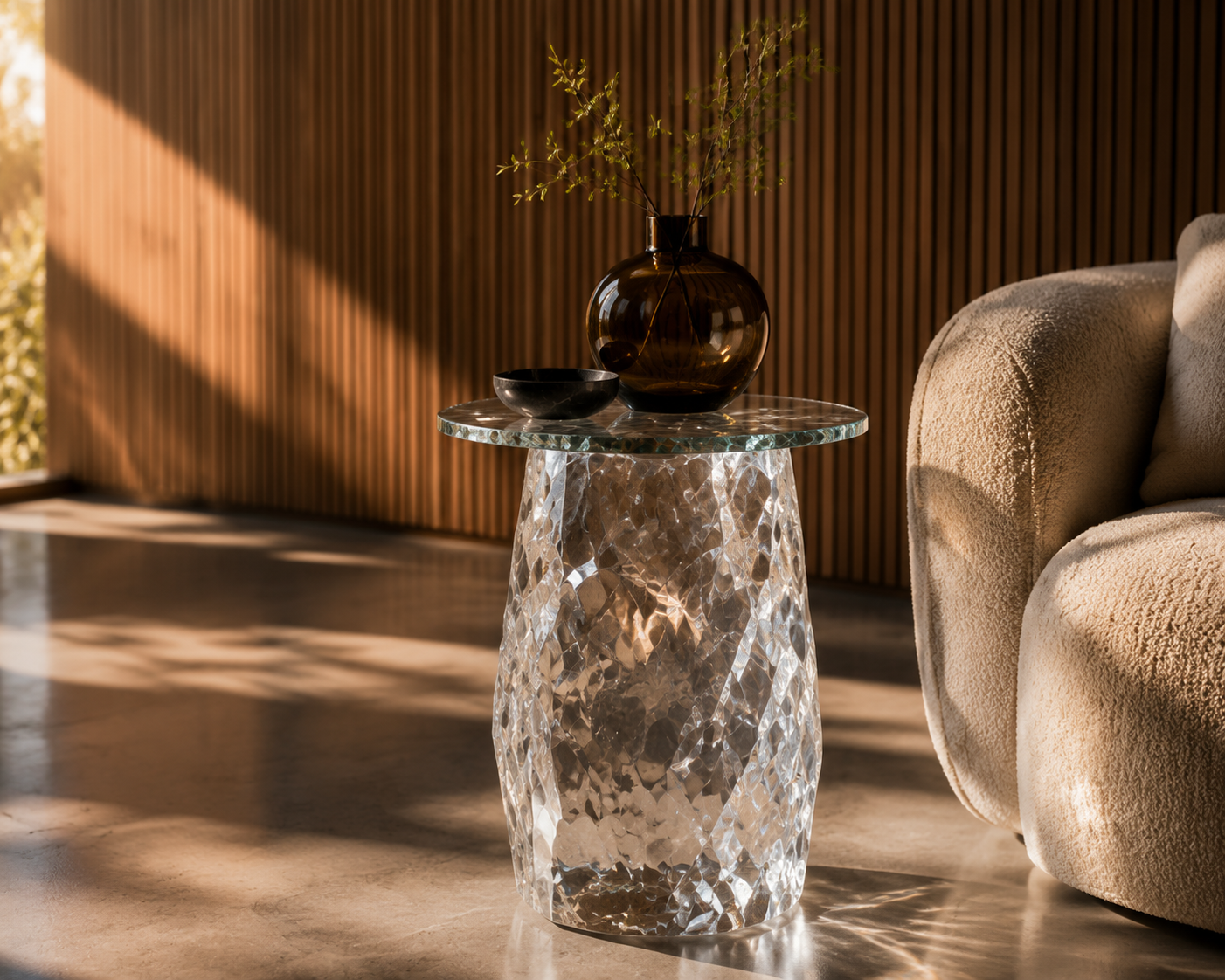
3. Evaluate how the material behaves under temperature, humidity, sunlight, and cleaning
Material stability is not a fixed label; it is a response to the environment. A material that performs well in one setting may fail in another. High-end commercial interiors often combine air conditioning, strong decorative lighting, glass façades, seasonal humidity, frequent cleaning, and long operating hours. These conditions make temperature resistance, UV resistance, water absorption, chemical compatibility, and dimensional stability essential.
Acrylic furniture is a good example. PMMA, commonly known as acrylic, is often selected for high-end commercial interiors because it offers excellent optical clarity, good stiffness, and a premium transparent appearance. A PMMA material datasheet lists properties such as density of 1.18 g/cm³, water absorption of 0.25% over 24 hours at 23°C, tensile strength of 65 MPa, flexural strength of 95 MPa, glass transition temperature of 105°C, and heat deflection temperature of 95°C at 1.8 MPa. These values help designers understand why acrylic can be suitable for display furniture, reception accents, partitions, and decorative tables—but they also remind us to avoid careless use near high heat, aggressive solvents, or unsupported long spans.
The same logic applies to other materials. Natural stone offers weight and luxury, but some stones stain, chip, or require sealing. Sintered stone and compact laminate can provide stronger stain resistance, but edge treatment and support design still matter. Stainless steel resists corrosion better than many ordinary metals, but brushed surfaces can show scratches under directional lighting. Leather can elevate an executive lounge, but it requires attention to abrasion resistance, color transfer, cleaning method, and sunlight exposure. Fabric can improve acoustic comfort, but it must meet commercial abrasion, flame, and cleaning requirements. Glass can be elegant, but edge safety, tempering, thickness, and impact risk must be addressed.
In real projects, the most common failures are not dramatic collapses; they are slow visible deterioration. A tabletop curls slightly. A white surface turns yellow near sunlight. A glossy panel scratches after repeated cleaning. A chair joint becomes noisy. A veneer edge opens because moisture entered the substrate. These defects may seem small, but in a luxury commercial environment they reduce perceived value quickly.
The professional method is to create a material risk table for each furniture type. For every key piece, ask: Will it be exposed to direct sunlight? Will guests place hot cups on it? Will alcohol-based cleaners be used? Will the surface be touched hundreds of times a day? Will the furniture be moved by staff? Will it sit near an entrance where outdoor humidity enters? The answers should decide whether acrylic, engineered wood, metal, stone, leather, fabric, laminate, glass, or a hybrid construction is the most stable choice.
4. Put cleanability and indoor air quality into the specification
High-end furniture must look good, but it must also support health, hygiene, and comfort. Since commercial spaces are shared environments, furniture surfaces are part of the operational cleaning system. The CDC advises regular cleaning of high-touch surfaces such as counters, door handles, stair rails, elevator buttons, touchpads, restroom fixtures, and desks, and it recommends using cleaning products appropriate for the surface. This guidance is directly relevant to furniture because reception desks, lounge tables, armrests, display counters, and checkout areas are often high-touch surfaces.
Cleanability is not simply whether a surface can be wiped. It includes resistance to staining, compatibility with disinfectants, edge design that avoids dirt traps, seam control, replaceable components, and the ability to maintain the original finish after repeated cleaning. A matte surface that looks refined in renderings may absorb fingerprints. A textured panel may hide scratches but trap dust. A soft-touch coating may feel luxurious but degrade under cleaning chemicals. A transparent acrylic piece may maintain a clean visual impression, but it needs microfiber cloths, suitable cleaners, and a maintenance guide to avoid haze or fine scratches.
Indoor air quality is another professional consideration. USGBC’s LEED guidance on low-emitting materials notes that higher concentrations of VOCs are typically found indoors and that specifying low-emitting or nonemitting products can significantly reduce indoor VOC exposure. The same guidance also states that ideally all interior building materials, including furniture and furnishings, would be compliant with recognized thresholds. UL Solutions explains that UL GREENGUARD Certification addresses indoor air quality through rigorous testing, and that GREENGUARD Gold sets lower VOC emission limits, with additional requirements under the California Department of Public Health standard method. IWBI’s WELL guidance similarly includes VOC emissions requirements for furniture and furnishings, cleanable environment considerations for high-touch surfaces, and material transparency features.
For decision-makers, the message is clear: furniture for high-end commercial spaces should not be selected only by appearance and unit price. It should be selected with documentation. Ask suppliers for low-VOC certificates, material safety information, finishing details, cleaning recommendations, and test reports where applicable. In hotels, schools, healthcare-adjacent spaces, premium offices, and luxury retail, these documents can support both user comfort and project compliance goals.
A practical example is a premium reception counter. The front face may be acrylic, metal, wood veneer, or stone, while the worktop may be a different high-use surface. If the counter receives constant hand contact, package placement, card payment interaction, and daily cleaning, the top surface should prioritize chemical resistance, scratch management, and low-maintenance hygiene. The decorative front can express brand identity, but the functional surface must be stable under operations.

5. Balance visual identity with lifecycle performance
The purpose of high-end commercial furniture is not to be invisible. It should express brand positioning. A luxury beauty clinic may want a clean, luminous, almost gallery-like atmosphere. A fashion boutique may need transparent acrylic display blocks that make products appear to float. A private club may prefer deep wood tones, leather, and metal details. A technology showroom may choose crisp lines, translucent materials, and integrated lighting. However, brand expression must be balanced with lifecycle performance.
Lifecycle performance means the furniture can keep its intended look through years of use. This includes scratch visibility, repairability, replacement of parts, stain control, color stability, surface aging, and maintenance cost. In many projects, the most expensive-looking material at the beginning is not the best long-term choice. A highly reflective black surface may photograph well but show dust, fingerprints, and micro-scratches. A very soft leather may feel premium but crease quickly in high-use public seating. A thin metal base may look minimal but wobble if the engineering is poor. A low-grade transparent plastic may imitate acrylic at first but lose clarity, yellow, or crack faster.
Material selection should therefore be linked to brand touchpoints. For customer-facing hero pieces, choose materials that remain visually stable under lighting and photography. For high-use furniture, choose finishes that age gracefully and can be cleaned easily. For movable furniture, choose materials that resist impact and edge damage. For built-in furniture, choose materials with predictable dimensional stability because replacement will be difficult after installation.
Acrylic furniture deserves special attention in this context because it can deliver a high-end visual effect without visual heaviness. Clear acrylic tables, display stands, plinths, chairs, and decorative panels can make commercial spaces feel open, modern, and premium. But the quality difference between ordinary plastic-looking pieces and true high-end acrylic furniture is significant. Buyers should check optical clarity, thickness, edge polish, bonding cleanliness, surface protection, UV performance, packaging, and maintenance instructions. A premium acrylic furniture supplier should be able to explain how the piece is fabricated, how the edges are finished, how loads are supported, and how the surface should be cleaned.
The lifecycle view also changes the budgeting conversation. A cheaper piece that needs replacement every year may cost more than a stable, well-made piece that lasts for several years. High-end commercial interiors are capital investments, and the furniture should support revenue, brand trust, and operational efficiency. The goal is not to buy the most expensive material; it is to buy the right material for the right exposure.
6. Choose suppliers by engineering capability, not only product photos
The final decision is supplier capability. In commercial furniture procurement, especially for custom acrylic furniture and mixed-material pieces, the supplier’s production control is as important as the material itself. Two suppliers may use similar materials, but the final stability can differ because of cutting accuracy, bonding technique, polishing quality, curing control, hardware selection, packaging, and quality inspection.
A professional supplier should provide more than attractive images. They should offer material specifications, shop drawings, samples, mockups, finish boards, edge details, installation methods, maintenance guidelines, and realistic production timelines. For custom pieces, they should be willing to discuss load, span, heat, sunlight, cleaning, transportation, and installation. They should also be transparent about limitations. A supplier who explains where acrylic should not be used is often more trustworthy than one who claims it can solve every problem.
Before approving production, project teams should review physical samples under actual lighting. Commercial lighting can change everything: transparent acrylic may reveal small scratches, metal may reflect surrounding colors, stone patterns may appear busier than expected, and fabric color may shift under warm light. Mockups also help test ergonomics, scale, edge comfort, and cleaning access. For large orders, a pre-production sample is essential. It allows the client, designer, contractor, and supplier to align expectations before the furniture reaches the site.
Installation and after-sales service also affect stability. Even well-made furniture can fail if it is installed on uneven floors, dragged without protection, exposed to unsuitable chemicals, or cleaned with abrasive tools. A good supplier should provide instructions for handling, installation, daily care, and long-term maintenance. For acrylic furniture, this may include protective film removal timing, approved cleaning cloths, recommended cleaners, scratch prevention, and storage conditions. For wood furniture, it may include humidity guidelines and spill response. For metal, it may include coating care. For stone, it may include sealing and edge protection.
In the end, selecting furniture for a high-end commercial space is a risk-management process disguised as a design decision. Shape creates desire, but material stability protects the investment. The best commercial furniture combines visual impact, engineering logic, cleanability, environmental responsibility, and supplier accountability. When decision-makers look beyond shape and ask how the material will perform under real business conditions, they create interiors that remain premium not only on opening day, but throughout the life of the space.
A useful final checklist is to ask five approval questions before signing the order. First, does the chosen material match the real traffic and cleaning routine of the space? Second, has the supplier confirmed thickness, reinforcement, hardware, and edge details in writing? Third, has the finish been reviewed under the same lighting that will be used on site? Fourth, are VOC, cleanability, and maintenance requirements documented? Fifth, is there a plan for repair, replacement, or future reordering if the space expands? These questions may seem basic, but they prevent many expensive mistakes.
For owners and designers, the smartest furniture decision is usually the one that combines emotion with evidence. The furniture should still be beautiful, memorable, and aligned with the brand. Yet every visual choice should be supported by a material reason. Clear acrylic should be chosen not only because it looks light, but because the grade, thickness, and fabrication method suit the intended use. Wood should be chosen not only for warmth, but because the construction can resist humidity-related movement. Metal should be chosen not only for precision, but because the coating and structure can survive commercial handling. This is how a high-end space stays high-end after opening day.