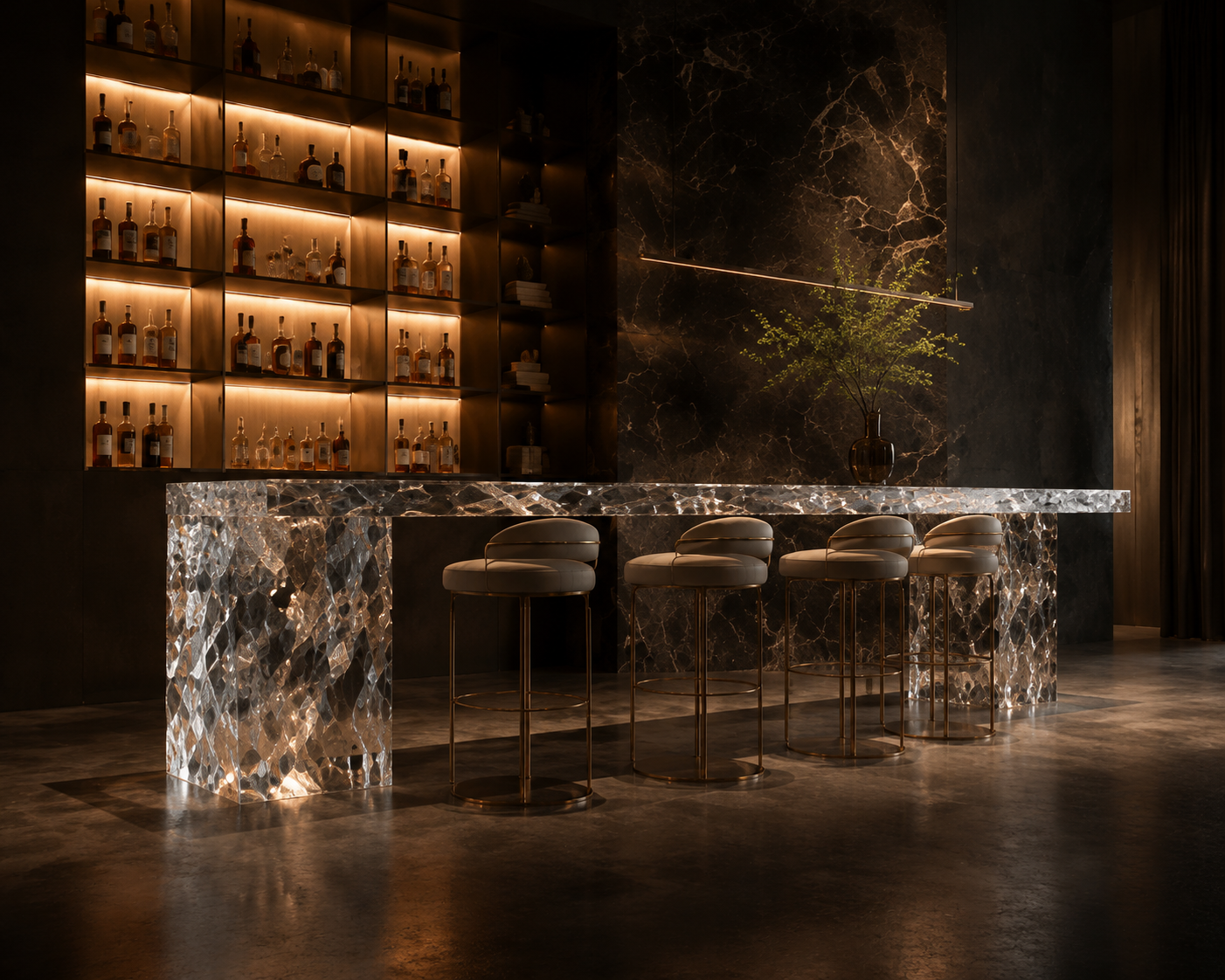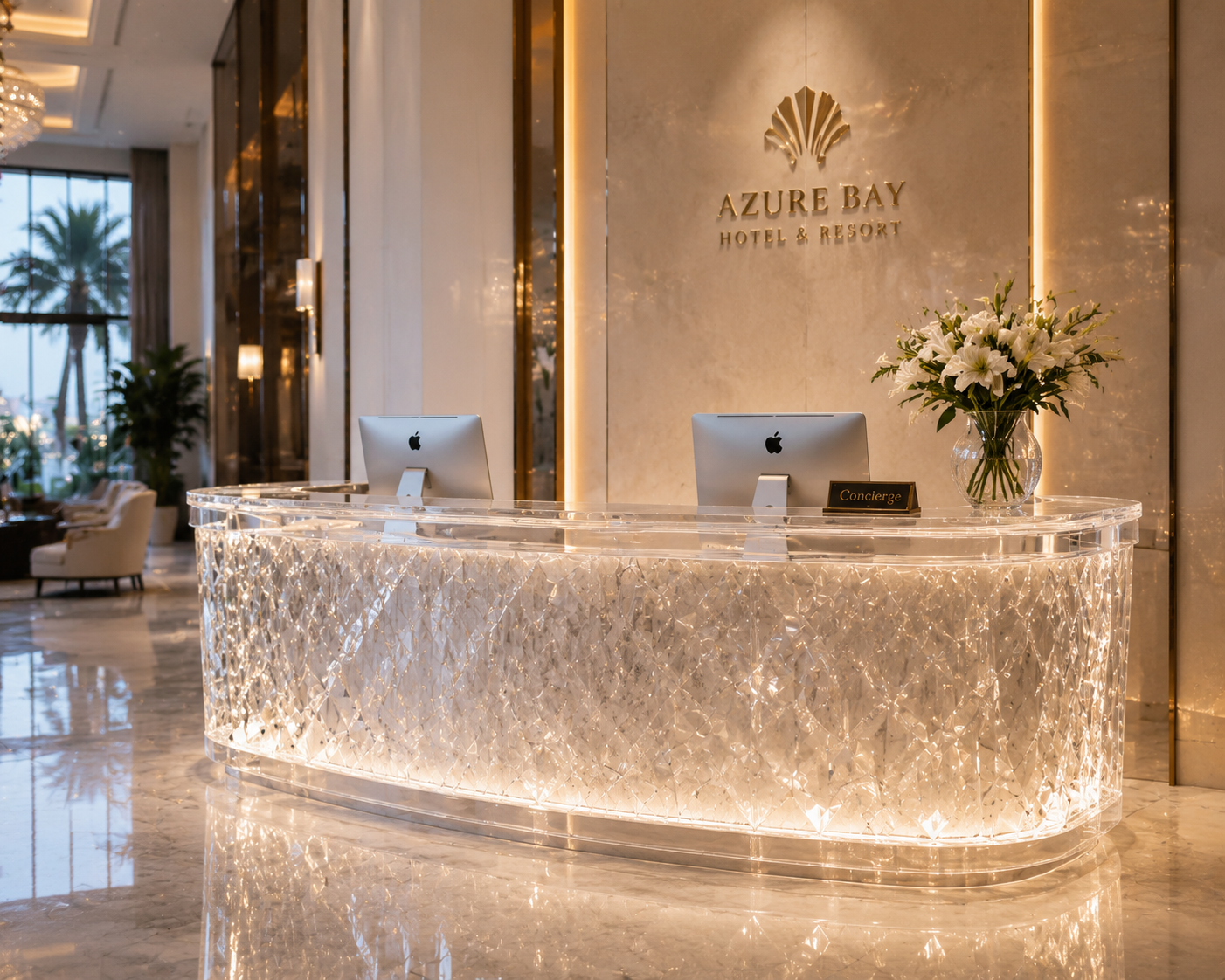
A material can look perfect on installation day. The surface is clean, the edges are sharp, the lighting is controlled, and nobody has lived with it yet. The showroom moment is seductive: a glossy table catches the light, a translucent panel gives depth to a wall, a clear resin detail makes a cabinet feel sculptural, and a crystal-like furniture element instantly suggests luxury. Yet six months later, that same material may begin to tell a very different story. The color looks slightly tired. The shine turns patchy. The surface holds fingerprints. Fine scratches appear where people place keys, trays, cups, or phones. Edges collect dust. Seams become visible. What once looked “premium” begins to feel temporary.
This is not just a question of taste. It is a question of material performance over time.
In interiors, quality is not judged only by how something looks when it is new. It is judged by how convincingly it keeps its visual promise after light, heat, humidity, touch, cleaning, and daily use begin to act on it. That is why some materials can impress in a photograph but disappoint in real life, while better-engineered materials become more convincing the longer they are used. For furniture made from synthetic crystal, high-end resin, platinum acrylic, and other transparent or semi-transparent decorative materials, this distinction is especially important. These materials rely on optical depth, clarity, surface smoothness, color stability, and precise fabrication. When they are made well, they can elevate a space. When they are made cheaply, every small defect becomes visible.
The real problem is not that certain materials age. All materials age. The problem is when the aging is visually uncontrolled. A natural wood surface may develop patina. A quality metal may mellow. A well-made acrylic or resin piece may retain clarity and polish for years with proper formulation and maintenance. But a poorly chosen decorative material often does something worse: it loses coherence. It no longer belongs to the rest of the room.
Below are six reasons why a material can look beautiful immediately after installation but lower the perceived quality of an interior within half a year.
1. Day-one beauty is often created by surface effect, not material integrity
Many disappointing interiors begin with a simple mistake: choosing a material for its first impression rather than its full life cycle. Day-one beauty is easy to produce. A glossy coating can create shine. A thin decorative film can imitate depth. A cheap transparent panel can look clean before it is touched. A resin surface can appear rich under controlled lighting. But these effects are only meaningful if the material underneath can support them over time.
The difference between a premium material and a decorative shortcut often appears after ordinary use begins. In a hotel lobby, a low-quality glossy surface may look expensive during opening week. After thousands of hands touch it, cleaning staff wipe it daily, sunlight crosses it every afternoon, and luggage occasionally brushes against it, the material begins to reveal whether its beauty was structural or superficial. The same is true in restaurants, luxury retail stores, villas, offices, and high-end residential interiors. The test is not the first photo. The test is the sixth month.
Institutions that study materials do not evaluate durability by appearance alone. They test exposure, abrasion, weathering, heat, water, and color change because real environments are complex. NIST has noted that predicting polymer service life is difficult because exposure conditions involve variables such as ultraviolet spectrum, UV intensity, moisture, and temperature variability. In other words, the same material may behave differently depending on where and how it is used.
This is exactly why transparent and high-gloss furniture materials need careful selection. A synthetic crystal table base, a high-end resin decorative panel, or a platinum acrylic console cannot rely on shine alone. It must be made with attention to optical clarity, internal consistency, surface hardness, UV stability, polishing quality, bonding quality, and maintenance compatibility. Otherwise, the initial “wow” becomes a liability. The clearer the material, the less it can hide.
A cheap opaque board can disguise many problems. A transparent luxury material cannot. Bubbles, cloudiness, yellowing, uneven polishing, adhesive lines, micro-scratches, and distorted reflections all become part of the visual experience. This is why premium clear materials demand a higher level of manufacturing discipline than many conventional furniture materials. They do not simply decorate a space; they expose the standard of the space.
For designers and buyers, the key question should never be, “Does it look good today?” The better question is, “Will this material still look intentional after six months of real use?” If the answer is uncertain, the material is not truly high-end. It is only temporarily attractive.
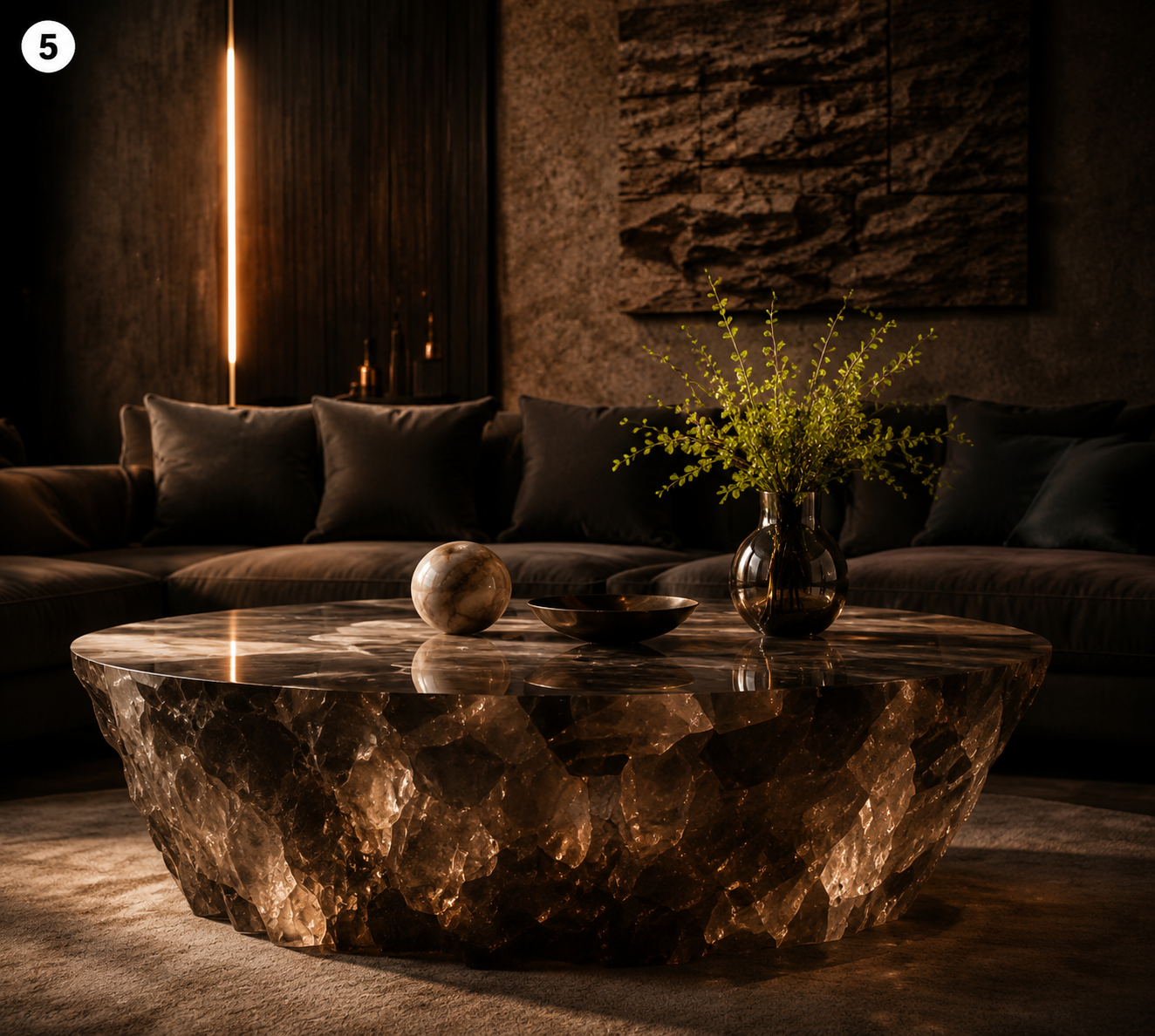
2. Light changes materials long before people realize the damage has begun
Light is one of the most underestimated causes of material decline. In interiors, people often think sunlight is harmless unless it is visibly intense. But light exposure is cumulative. It slowly changes color, gloss, surface chemistry, and sometimes even mechanical behavior. This is especially relevant for plastics, coatings, transparent materials, dyes, films, and resins.
The science is clear: polymer materials can undergo photodegradation when exposed to light, especially UV radiation. A NIST study on degraded polymers reported that UV exposure led to chemical changes and changes in molecular structure, which affected mechanical properties. ISO also publishes standards for exposing plastics to laboratory light sources, including fluorescent UV lamps, heat, and water, specifically to simulate weathering effects that occur when materials are exposed to solar radiation or window-glass-filtered solar radiation.
In practical design terms, this means a material can begin changing even in a beautiful indoor space. A lobby table beside a glass façade, a display shelf under strong retail lighting, or a decorative resin panel near a large window may not fail dramatically. Instead, it may slowly shift. Clear areas become slightly warm-toned. White areas become creamier. High-gloss surfaces lose depth. Colored pieces become uneven because one side receives more light than another.
This is where many cheaper materials damage the whole atmosphere of a room. The issue is rarely one obvious defect. It is the subtle mismatch that appears later. A once-clear furniture detail now looks yellow next to white marble. A resin surface that originally matched champagne metal now looks dull beside it. A transparent panel that once gave a crisp reflection now appears cloudy under afternoon light. The space still functions, but it no longer feels edited.
The Library of Congress gives a useful conservation reminder: filtering ultraviolet radiation removes the most damaging part of sunlight, but all light can contribute to fading or yellowing in sensitive materials. It also notes that acrylic glazing can be available in forms that filter ultraviolet light and that acrylic can be lighter and less brittle than glass. For furniture designers, the lesson is not that one material is automatically perfect. The lesson is that optical materials must be specified for the environment in which they will live.
High-end acrylic, premium resin, and synthetic crystal furniture should therefore be discussed not only in terms of beauty but in terms of stability. What is the expected exposure? Will the piece sit near a window? Will it be used under LED display lighting? Will it be in a coastal villa, a humid bathroom area, a retail store, a hotel suite, or a private dining room? Does the formulation include UV resistance? Has the surface been finished to reduce visible haze? Can it be cleaned without damaging the polish?
When light stability is ignored, the room slowly loses its color discipline. When it is engineered, transparent furniture can remain crisp, sculptural, and luxurious for much longer.
3. Touch, abrasion, and cleaning reveal whether a surface is truly premium
A material that cannot survive touch is not a furniture material; it is a photography prop.
Many surfaces look excellent before people begin using them. The first scratches may be invisible individually, but they accumulate into haze. This is especially common on glossy black surfaces, clear plastics, soft coatings, low-grade resin tops, and decorative films. Once micro-scratches scatter light, a surface loses its depth. It may still be smooth to the hand, but visually it becomes tired.
This is why abrasion testing matters. ASTM D4060 is a standard test method used to determine the abrasion resistance of organic coatings by using a Taber Abraser on a plane, rigid surface. The existence of such standards is important because luxury interiors are not protected museum displays. They are touched, wiped, leaned on, and used. A reception desk, coffee table, dining table, sideboard, shelving element, or decorative handle must be evaluated as a contact surface.
In real life, abrasion comes from ordinary behavior. A guest slides a ceramic cup. A handbag buckle touches a console. A child runs a toy car along the edge of a table. A housekeeper uses the wrong cloth. Dust is wiped dry instead of lifted gently. A restaurant team cleans quickly between service periods. Over time, each action leaves a small trace.
Cleaning can accelerate the problem. The CDC notes that in most situations, cleaning with soap and water can remove most germs from surfaces, and disinfecting is often not needed unless someone is sick or has recently visited. For furniture, this matters because aggressive disinfectants, alcohol-heavy cleaners, abrasive pads, and unsuitable all-purpose sprays can damage certain surfaces. The wrong maintenance routine can make an expensive-looking material age like a cheap one.
This is one reason high-end resin and acrylic furniture must be sold with care instructions, not just beauty claims. A premium material should be paired with a premium maintenance logic. For example, a clear acrylic or synthetic crystal surface should be cleaned with a soft microfiber cloth and a compatible cleaner. Dry dust should be removed gently because dust itself can act like a fine abrasive. Coated or polished surfaces should not be treated like ceramic tile. The more refined the optical finish, the more disciplined the cleaning protocol must be.
Poor materials fail this test quickly. Their shine is too shallow. Their surface is too soft. Their coating is too thin. Their repairability is poor. After six months, the object may still be structurally intact, but visually it reads as worn. In a luxury space, that is enough to lower the whole impression.
By contrast, better transparent furniture materials are designed with realistic contact in mind. They may use higher-quality raw material, better curing, improved polishing, protective surface treatments, thicker sections, better edge finishing, or replaceable components. The goal is not to make the material indestructible. The goal is to make normal use age gracefully rather than visibly degrade the design.
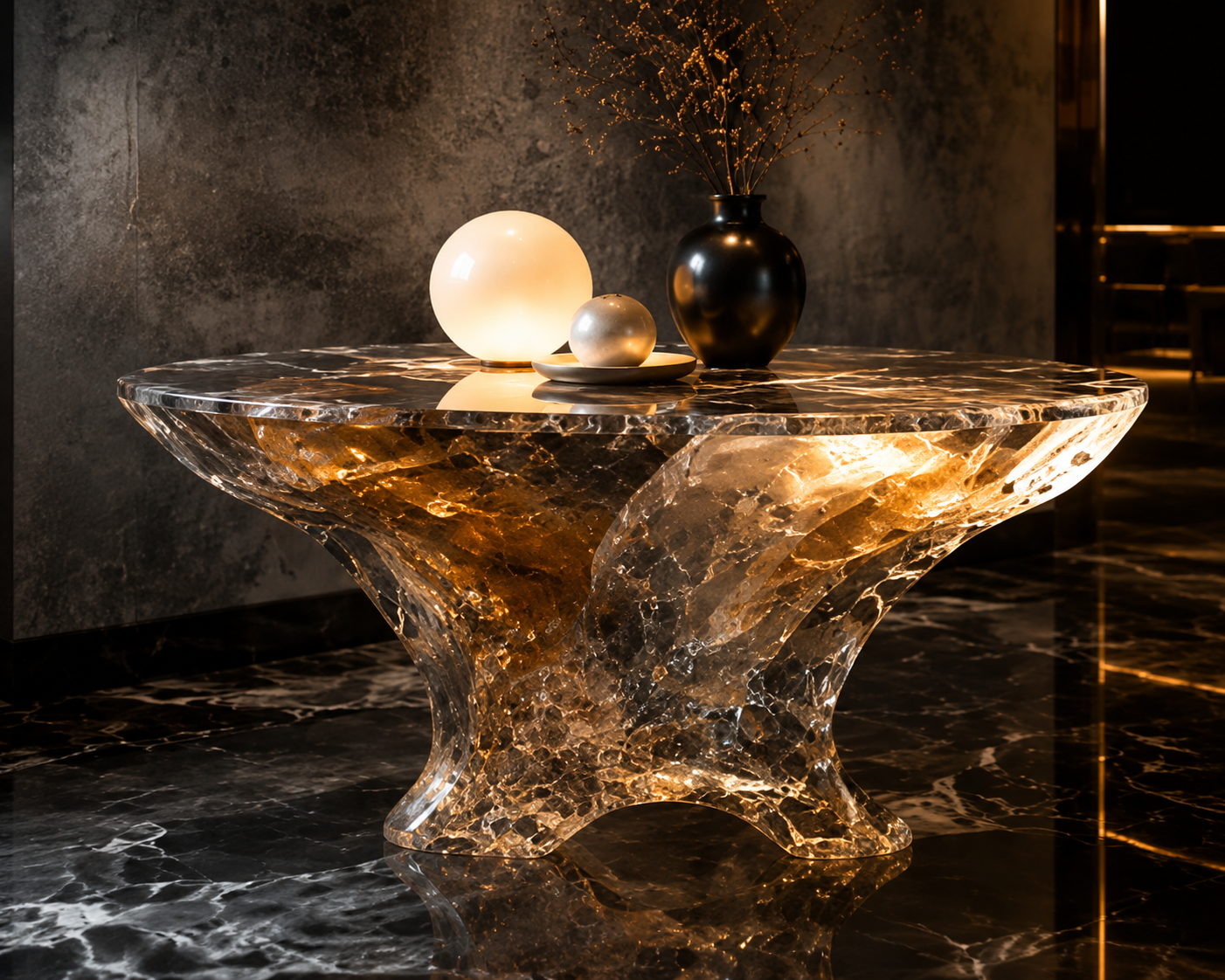
4. Heat, humidity, and moisture attack the details people notice most
A room does not need to be extreme for materials to move, swell, warp, soften, or separate. Ordinary indoor environments contain temperature changes, humidity changes, air-conditioning cycles, cooking moisture, bathroom steam, cleaning moisture, and seasonal shifts. Cheap materials often look acceptable in the center of a panel but fail at the edge, joint, seam, or underside.
These small areas matter because people read quality through details. An edge that lifts, a seam that darkens, a corner that swells, or a joint that opens immediately changes the emotional value of a piece of furniture. The eye may not identify the technical failure, but it senses that the object is no longer precise.
Moisture is especially dangerous in interiors because it affects both materials and indoor health. The World Health Organization’s indoor air quality guidelines on dampness and mould emphasize that preventing or minimizing persistent dampness and microbial growth on interior surfaces and building structures is the most important means of avoiding related health effects. Mayo Clinic also notes that indoor humidity higher than 50% can increase mold in the home.
For furniture, this creates a practical design issue. Materials used in humid climates, coastal homes, bathrooms, spa areas, restaurants, and hospitality environments need more than an attractive surface. They need stable construction, sealed edges, compatible adhesives, moisture-resistant substrates, and finishes that do not trap water in vulnerable joints. Otherwise, the problem may appear in half a year: swollen seams, cloudy bonding lines, metal corrosion stains, surface lifting, or musty odor.
High-end resin, synthetic crystal, and platinum acrylic offer strong design potential here because they can be used to create non-porous, visually clean, sculptural furniture elements. But quality depends on formulation and fabrication. Poorly cured resin may remain sensitive to heat or develop surface problems. Low-grade acrylic may craze if exposed to incompatible chemicals or stress. Bad bonding can make transparent joints look cheap. Improper polishing can leave heat marks or optical distortion. In transparent materials, the inside of the material becomes part of the visible finish.
Heat also matters. A table placed near a sunny window can become warmer than expected. A decorative piece under strong lighting can experience repeated thermal cycles. A resin or acrylic component near a fireplace, kitchen, or heated retail display may be exposed to conditions that were not considered during selection. If the material softens, expands unevenly, or stresses around fasteners, the result may be distortion, cracking, or joint movement.
This is why premium furniture manufacturing should include environmental thinking. Where will the piece be placed? What temperature range will it experience? Is it exposed to direct sun? Will drinks be placed on it? Will cleaning water reach the seams? Are metal inserts isolated from moisture? Are edges polished and sealed properly? These questions are not technical details hidden from luxury; they are the foundation of luxury.
A space feels expensive when details stay controlled. Heat and humidity attack that control first.
5. Invisible emissions and odors can make a “new” interior feel cheap
A material can look beautiful and still make a space feel wrong. Sometimes the problem is not visible. It is smell, air quality, or the physical discomfort people associate with a newly finished interior.
The EPA states that people in the United States spend about 90% of their time indoors and that concentrations of some pollutants are often two to five times higher indoors than outdoors. The EPA also explains that volatile organic compounds, or VOCs, are emitted as gases from certain solids or liquids and that many VOCs are consistently higher indoors than outdoors; products such as paints, varnishes, waxes, cleaning products, disinfectants, cosmetics, degreasers, and hobby products can all be sources.
This matters to interior materials because luxury is multisensory. A room that smells chemical does not feel refined, even if the furniture is visually impressive. A cabinet that releases odor, a panel that smells like adhesive, or a table surface that reacts with cleaning products can undermine the entire interior experience.
The EPA’s formaldehyde standards for composite wood products also show that regulators take emissions from furniture-related materials seriously. The agency explains that the Formaldehyde Standards for Composite Wood Products Act established emission standards for formaldehyde from composite wood products and that products sold, supplied, manufactured, or imported in the United States have compliance labeling requirements. For designers and buyers, the broader point is clear: material selection is not only about the visible finish. It is also about what a product contributes to the indoor environment.
Harvard’s Healthy Buildings research adds another layer. Its COGfx Study found that cognitive function test scores doubled in simulated green building environments with enhanced ventilation compared with conventional building environments. While furniture is only one part of indoor environmental quality, the finding supports a larger principle: interiors influence how people feel and perform, not just how they photograph.
For makers of synthetic crystal, high-end resin, and platinum acrylic furniture, this creates a strong positioning opportunity. Premium products should communicate low-odor finishing, responsible material selection, controlled curing, careful adhesive use, and cleanable non-porous surfaces. These qualities may not be as immediately dramatic as a glossy photo, but they are what allow a luxury space to feel calm after installation.
In many projects, cheaper materials are accepted because they reduce initial cost. Six months later, the hidden costs appear: odor complaints, extra ventilation, client dissatisfaction, surface replacement, cleaning difficulty, or a general sense that the interior feels less sophisticated than expected. A truly premium material should not simply look expensive. It should behave appropriately in the indoor environment.
6. Poor fabrication makes good materials look bad
Sometimes the material itself is not the problem. The problem is fabrication.
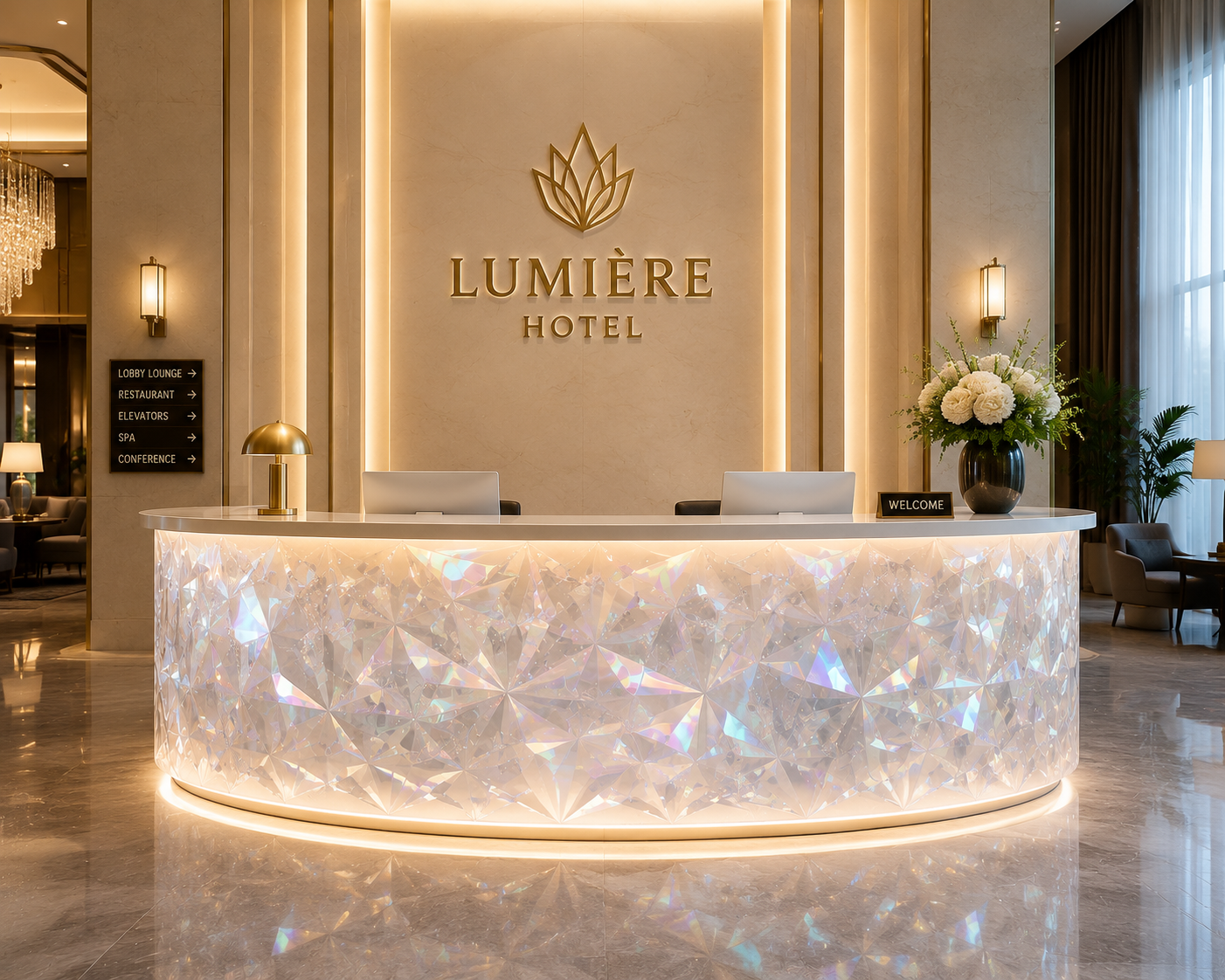
A high-quality resin, acrylic, or synthetic crystal can still look cheap if it is cut poorly, polished unevenly, bonded carelessly, or installed without understanding stress and movement. Luxury materials require luxury workmanship. The clearer and more reflective the material, the more important this becomes.
Transparent and translucent furniture materials are unforgiving. A bad seam cannot hide behind grain. A cloudy adhesive line cannot disappear into texture. A warped reflection will be visible from across the room. A rough edge will catch light. An uneven polish will make the surface look plastic rather than architectural. This is why fabrication quality is not a secondary issue. It is part of the material’s identity.
In practice, many six-month failures are actually specification failures. The designer chose a material without asking how it would be fabricated. The contractor used an adhesive that was not suitable for transparent bonding. The installer tightened hardware too much and created stress points. The cleaning team was not trained. The piece was placed in direct sunlight when it should have been positioned differently. The product was photographed like a luxury object but handled like a commodity.
This is where high-end furniture brands can differentiate themselves. A company working with synthetic crystal, premium resin, and platinum acrylic should not sell only “materials.” It should sell a complete standard: selection, formulation, optical control, fabrication, finishing, installation guidance, and maintenance education. The product should arrive with an understanding of how it will age in the real space.
The best luxury materials do not demand attention because they are loud. They create confidence because they remain composed. A platinum acrylic console that keeps its clarity, a resin dining table that resists haze, a synthetic crystal base with polished edges and controlled reflections—these objects support the whole interior. They do not become problems the designer has to explain later.
The real measure of quality is continuity. Does the object still match the ambition of the room after daily life begins? Does it still look intentional under natural light, evening light, and cleaning light? Does it still feel refined when touched? Does it still photograph well after use? Does it still make the client proud?
When the answer is yes, the material has done more than decorate. It has protected the value of the space.
Conclusion: luxury is not the first shine; it is the controlled aging of beauty
Some materials lower the quality of a space after six months because their beauty was never deep enough. They were selected for immediate effect, not long-term performance. They looked good before light, humidity, cleaning, abrasion, emissions, and workmanship exposed their weaknesses.
A truly premium material is different. It is not only clear, glossy, colorful, or fashionable. It is stable. It is appropriate for the environment. It is fabricated with discipline. It can be maintained without panic. It keeps its optical quality. It supports the interior rather than competing with it. It ages in a way that feels controlled.
For high-end interiors, this is especially important. Luxury clients do not pay only for the moment of installation. They pay for confidence. They expect the space to keep its dignity. They expect furniture to remain part of the design language, not become the weak point of the room.
That is why synthetic crystal, high-end resin, and platinum acrylic furniture should be understood as more than decorative alternatives. When engineered and finished properly, they offer a language of clarity, depth, light, and sculptural precision that many conventional materials cannot achieve. But their success depends on quality at every stage: raw material selection, UV stability, curing, polishing, bonding, abrasion resistance, cleaning compatibility, and installation context.
The material that looks best on day one is not always the best material. The better material is the one that still looks expensive after people have lived with it.