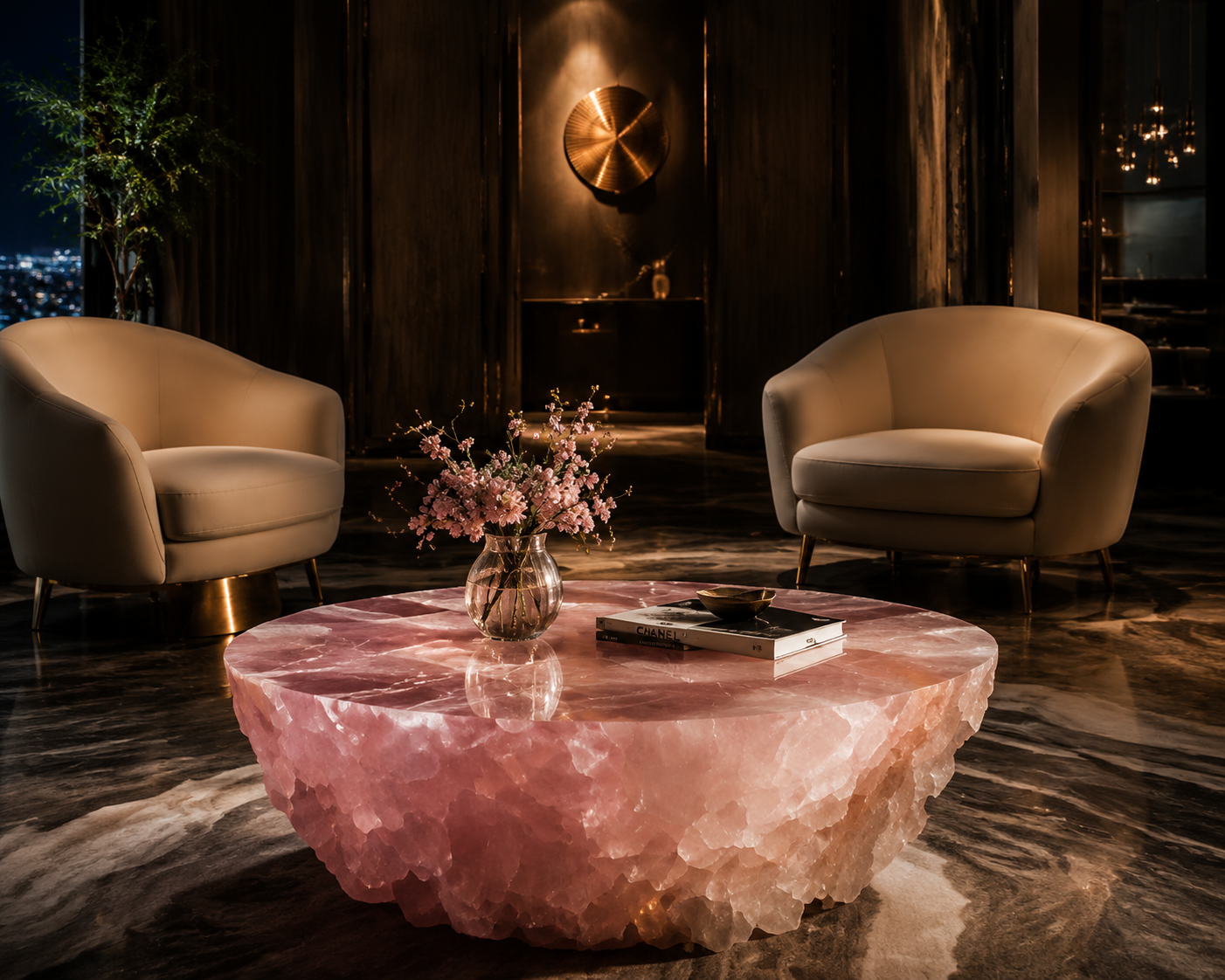
In luxury hospitality, statement furniture is often misunderstood.
Some projects treat it as decoration. Others use it as a way to make a space feel more expensive. In the least effective cases, too many sculptural pieces are placed throughout the property, creating visual competition, reducing clarity, and weakening the very impact they were intended to create.
The strongest luxury hotels take a different approach.
They do not place statement furniture everywhere.
They place it where it creates the greatest commercial, emotional, and visual value.
A single custom reception desk can define the arrival experience. A sculptural table in a lobby can become one of the most photographed objects in the hotel. A distinctive bar counter can shape the identity of a lounge. A carefully designed piece in a presidential suite can reinforce premium pricing and create a stronger sense of exclusivity.
This is why statement furniture should not be evaluated only as an object.
It should be evaluated as a strategic asset.
For hotel operators, developers, architects, and interior design teams, the real question is not, “How many feature pieces should we include?”
The better question is, “Which locations will allow each piece to create the highest return?”
That return may appear in several forms:
Stronger brand recognition
Higher perceived value
More memorable guest experiences
Greater social media visibility
Improved photography and marketing content
Longer guest dwell time
Stronger positioning of premium spaces
Better differentiation from competing properties
When statement furniture is placed correctly, it can influence how guests remember the hotel, how they photograph it, how they describe it, and how the property presents itself in the market.
This is particularly relevant for high end synthetic crystal furniture.
Synthetic crystal offers transparency, optical depth, color flexibility, sculptural potential, and a strong relationship with light. It can appear visually light while still creating a powerful focal point. It can reflect surrounding architecture, preserve sightlines, and change in appearance throughout the day.
However, these qualities create the most value only when the piece is positioned at the right point in the guest journey.
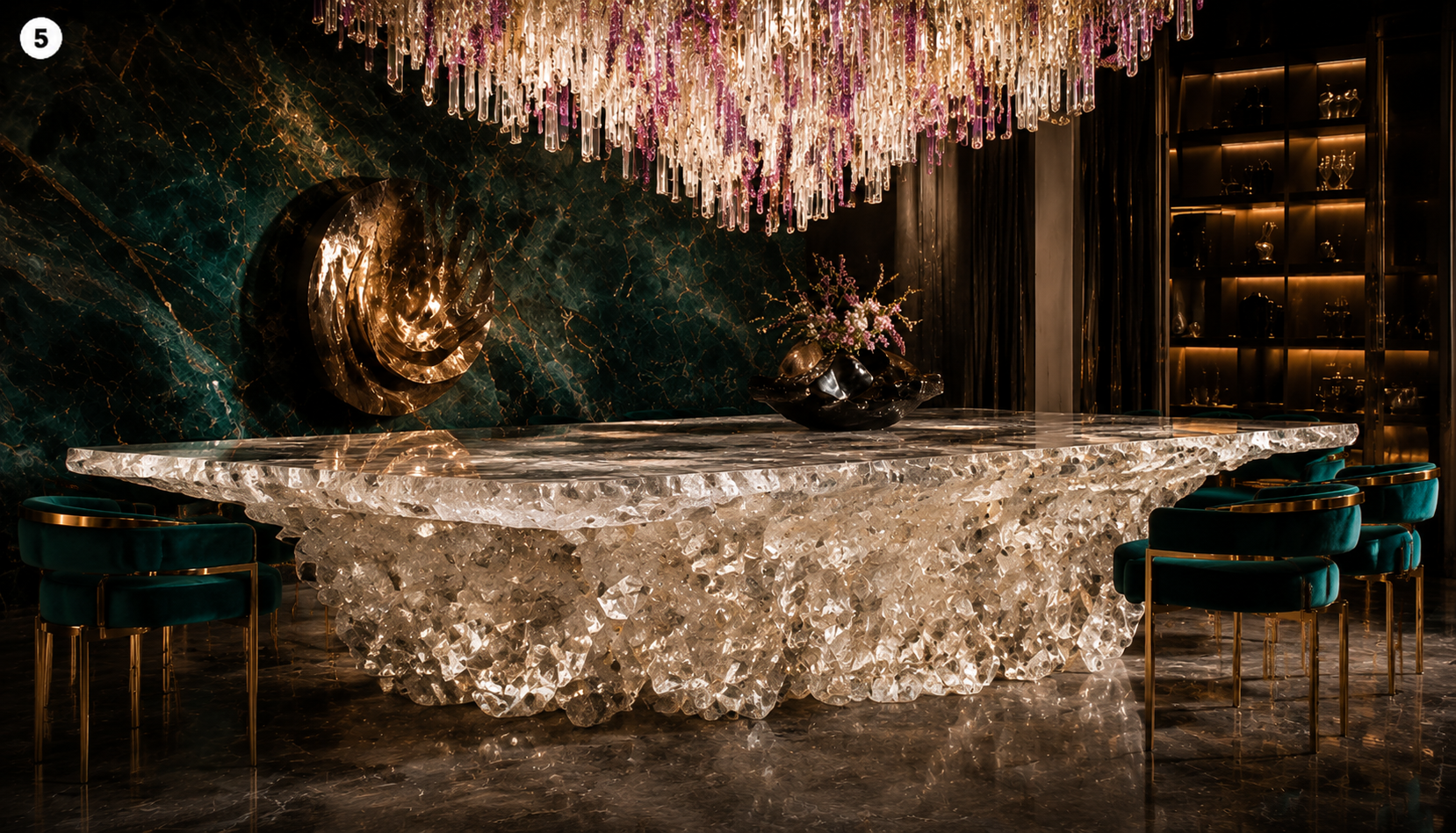
The Shift from Decorative Quantity to Strategic Placement
Luxury hotel design is becoming more selective.
In the past, a high budget interior might have been defined by the amount of custom furniture, decorative metalwork, rare stone, or oversized lighting included in the design. Today, many developers and operators are more focused on how each investment contributes to the guest experience and overall commercial performance.
This has changed the role of statement furniture.
Instead of filling every public area with sculptural objects, project teams are concentrating investment in a smaller number of high-value locations.
These locations often include:
The hotel entrance
The arrival lobby
The reception zone
The main lounge
A signature restaurant
A destination bar
The ballroom pre-function area
The presidential suite
VIP villas or branded residences
These spaces have one important quality in common.
They sit at moments where guest perception is especially sensitive.
At the entrance, guests form their first impression.
At reception, they evaluate the professionalism and identity of the hotel.
In the lounge, they decide whether the space feels memorable enough to stay, meet, order, and return.
In a signature restaurant, design supports the value of the dining experience.
In the presidential suite, every object contributes to the perception of exclusivity.
A statement piece placed in one of these locations can create far more value than several decorative pieces positioned in secondary areas.
Five Trends Changing the Role of Statement Furniture
1. Investment Is Increasing in High-Impact Areas
Hotel developers are becoming more disciplined about where design budgets are spent.
Rather than increasing the decorative budget across the entire property, they are prioritizing spaces with the greatest guest exposure and commercial influence.
This includes areas that appear frequently in hotel photography, booking platforms, media coverage, social content, event marketing, and sales presentations.
A custom synthetic crystal reception desk may cost more than a standard alternative, but it may also become the visual signature of the property. If it appears in thousands of guest photographs and official brand images, its value extends beyond furniture.
It becomes part of the hotel’s identity.
This is especially important for properties entering competitive luxury markets. Many hotels can offer high quality rooms, good service, and premium finishes. Fewer can offer a distinctive visual moment that guests immediately associate with the brand.
2. Visual Focal Points Are Being Designed More Deliberately
A focal point should not happen by accident.
It should be planned in relation to circulation, lighting, sightlines, scale, and guest behavior.
When guests enter a lobby, their attention naturally moves toward the reception desk, a major view, a lighting feature, or a central object. If several elements compete for attention, the space becomes less clear.
A well-positioned statement table or sculptural installation can organize the visual experience.
It gives the eye a destination.
Synthetic crystal is especially effective when the design team wants a focal point that feels strong without becoming visually heavy. Its transparency allows the surrounding architecture to remain visible, while its form, color, and interaction with light create presence.
The best results occur when the object is supported by the space around it.
A statement table placed beneath a large chandelier may work well if both elements are designed as one composition. The same table may lose impact if placed beside a dramatic wall, multiple art pieces, and several competing lighting features.
Visual hierarchy is essential.
3. Furniture Is Becoming More Artistic
Luxury hotels increasingly treat furniture as part of the art program.
A custom table may function as sculpture. A reception desk may become an installation. A bar counter may become the central visual object in a lounge.
This shift allows hotels to create stronger identity without relying only on traditional artwork.
Synthetic crystal supports this direction because it can be shaped into monolithic, curved, layered, faceted, or organic forms. It can also be developed in clear, tinted, frosted, or internally textured finishes.
Designers may use it to reference water, ice, minerals, mist, coral, glass, light, or local landscape forms.
The result can feel artistic without losing function.
This is important because hotel interiors must perform commercially. A sculpture may create visual interest, but a sculptural table, counter, or bench can create visual value while also supporting guest use.
4. Photography Value Is Influencing Design Decisions
Hotels are now experienced both physically and digitally.
A guest may first encounter a property through a booking platform, social media post, travel article, or video. In many cases, the visual identity of the hotel is formed before the guest arrives.
This has increased the importance of photographable design.
Statement furniture can become a powerful content asset when it has a clear silhouette, a distinctive material, and a strong relationship with light and background.
Synthetic crystal can be highly effective in photography because it reflects color, captures light, and changes depending on angle.
A clear or lightly tinted piece can appear elegant in daylight. Under evening lighting, the same object may become more dramatic. This gives the hotel different visual content throughout the day.
However, photography value should not be confused with theatrical excess.
The strongest images usually come from spaces where the statement piece feels naturally integrated into the architecture.
5. The Experience Economy Is Changing Furniture Placement
Luxury guests increasingly pay for memorable experiences rather than physical comfort alone.
This has changed how hotels design public areas.
Furniture placement is no longer based only on circulation and function. It is also based on emotional sequence.
Where does the guest pause?
Where do they look first?
Where do they take photographs?
Where do they meet others?
Where do they celebrate?
Where do they associate the hotel with a particular feeling?
A statement piece can strengthen these moments.
A sculptural table in the arrival lobby may support the emotional transition into the hotel. A luminous bar counter may define the energy of the evening. A custom dining table may turn a private room into a destination within the property.
The value comes from the relationship between object, moment, and guest behavior.
.png)
What Hotel Owners and Developers Now Expect
Hotel operators and developers are becoming more focused on return on investment.
They want to know why a feature piece is necessary, where it should be located, and what value it will create.
This does not mean every design decision must produce a directly measurable financial return.
It means the project team should be able to explain the strategic purpose of the investment.
For statement furniture, useful questions include:
Will this piece define the hotel entrance?
Will it strengthen the visual identity of the lobby?
Will it appear in official photography?
Will it encourage guests to stay longer in the lounge?
Will it support premium positioning in a restaurant or suite?
Will it remain relevant after the next interior refresh?
Will it be easy to maintain?
Can it be repaired or replaced if necessary?
Can it be produced and installed within the project schedule?
These questions help move the discussion from decoration to value.
Ten Design Questions That Determine Whether Statement Furniture Succeeds
1. How Does the Piece Relate to Guest Circulation?
Statement furniture should support movement, not obstruct it.
In a lobby, the piece may guide guests toward reception, elevators, or lounge seating. In a restaurant, it should not interrupt service circulation. In a ballroom pre-function area, it must allow large groups to move comfortably.
The design team should study the object from the guest’s arrival path.
Where is it first visible?
At what point does it become the focal point?
Can guests approach it without disrupting circulation?
A piece that looks successful in a rendering may create operational problems if its location is not tested against actual movement.
2. Is It the Primary Visual Focus?
A statement piece should have a clear role.
If it is intended to become the primary focal point, the surrounding space should support that decision.
The architecture, lighting, artwork, ceiling, and furniture should not compete equally.
In some spaces, the view should remain the main focus and the furniture should act as a secondary frame. In others, the statement piece should define the entire composition.
Synthetic crystal is useful when a strong object is required without completely blocking the surrounding environment.
Its visual weight can be controlled through transparency, color, form, and scale.
3. How Does Lighting Affect the Piece?
Lighting can determine whether statement furniture feels refined or disappointing.
Synthetic crystal is especially sensitive to lighting conditions.
Direct light may create sharp reflections.
Indirect light may reveal depth.
Integrated lighting may create a luminous effect.
Backlighting may emphasize texture or transparency.
The project team should test the piece under the intended color temperature and at different times of day.
A finish that looks elegant under 3000K lighting may feel colder under 4000K. A clear material near a sunlit façade may create glare. A tinted finish may become much richer under warm evening light.
Lighting review should be part of material approval, not an afterthought.
4. What Is the Main Viewing Distance?
Furniture is perceived differently from three meters away than from twenty meters away.
A lobby installation may need a strong silhouette to remain visible from the entrance. A suite table may require finer detailing because guests experience it at close range.
The design should respond to the dominant viewing distance.
Large spaces often require simpler, more powerful forms.
Small spaces allow more subtle detailing.
For synthetic crystal furniture, thickness, color intensity, edge treatment, and internal texture should be reviewed according to viewing distance.
A highly detailed surface may disappear in a large lobby. A bold form may feel too dominant in a compact suite.
5. Does the Piece Work from the Main Photography Angles?
Photography should be considered early.
The project team should identify the angles most likely to appear in marketing material, guest photographs, and social content.
This includes:
The entrance view
The main lobby view
The reception background
The view from the lounge
The restaurant entrance
The ballroom pre-function area
The suite arrival view
The statement piece should have a clear profile from these angles.
Its background should also be controlled.
A beautiful transparent object may lose definition against a visually busy wall. It may photograph better against stone, textured plaster, timber, or a carefully lit architectural surface.
6. Is the Scale Appropriate?
Statement furniture must be large enough to matter but not so large that it dominates the space unnecessarily.
Scale should be tested in relation to ceiling height, floor area, circulation, seating, and surrounding architectural elements.
A common mistake is approving a piece from a small rendering without understanding its physical presence.
Full-size mock-ups, tape layouts, three-dimensional models, and site measurements can help.
For synthetic crystal pieces, scale also affects optical depth, color intensity, weight, production, and transport.
A color that appears subtle in a sample may feel much stronger in a large object.
7. Does the Piece Still Function Properly?
Statement furniture must remain useful.
A reception desk must support staff operations.
A table must provide stable surfaces.
A bar counter must allow service access.
A bench must be comfortable enough for actual use.
A sculptural object that performs poorly can quickly become an operational problem.
Function should be reviewed alongside appearance.
For custom synthetic crystal furniture, this may include:
Ergonomic height
Load support
Edge comfort
Cable access
Storage integration
Lighting maintenance
Cleaning access
Module connections
Guest safety
The most successful pieces make the technical work invisible.
8. Does It Express the Brand?
Statement furniture should feel specific to the hotel.
It may reflect the brand through color, material, geometry, craftsmanship, or relationship with the destination.
A resort brand may prefer soft, organic forms. An urban luxury hotel may use sharper geometry. A coastal property may use clear or blue tones. A heritage-inspired hotel may combine synthetic crystal with metal or stone in a more formal composition.
The goal is not to place a recognizable object in every property.
The goal is to create an object that belongs to this property.
9. Can It Be Maintained Easily?
High visibility furniture must remain presentable.
A piece that becomes scratched, stained, dusty, or difficult to clean may reduce the perceived quality of the hotel.
Maintenance should be considered before specification.
Questions include:
How often will guests touch it?
Will drinks or food be placed on it?
Will luggage contact the surface?
Does the finish show fingerprints?
Can the surface be refinished?
Can individual modules be replaced?
Does lighting access require disassembly?
In some public areas, lightly frosted or tinted synthetic crystal may be easier to maintain than a completely clear polished finish.
10. What Commercial Value Does It Create?
A statement piece should be connected to a commercial objective.
That objective may include:
Defining a premium arrival experience
Increasing visual recognition
Supporting hotel photography
Improving restaurant positioning
Creating a destination lounge
Enhancing suite value
Supporting events and private functions
Encouraging social sharing
Strengthening brand memory
The project team should understand which objective matters most.
This allows budget to be concentrated where it has the strongest effect.
The Best Locations for Statement Furniture
1. Hotel Entrance
The entrance is one of the most valuable locations because it shapes the guest’s first physical impression.
A statement console, bench, sculptural table, or installation can establish the design language before guests reach reception.
At the entrance, the piece should be easy to understand quickly.
Guests may see it from a vehicle, through glazing, or while moving.
The form should be clear and the relationship with lighting should be strong.
Synthetic crystal works well in this location because it can capture daylight and exterior reflections without making the entrance feel blocked.
2. Main Lobby
The main lobby is often the highest-value location for statement furniture.
It is seen by nearly every guest.
It appears in photography.
It supports arrivals, meetings, waiting, and social activity.
A large synthetic crystal table or sculptural installation can become the central identity element of the space.
The piece should be positioned in relation to the entrance, reception, seating groups, ceiling features, and major views.
It should create visual presence without interrupting circulation.
In many cases, one well-designed central piece creates more value than several smaller decorative objects.
3. Reception Area
The reception desk is both functional and symbolic.
It represents the hotel’s professionalism, service, and brand.
A custom synthetic crystal reception desk can create a strong visual impression, especially when combined with lighting, metal, stone, or timber.
However, it must also support staff operations.
The design should consider storage, equipment, accessibility, cable management, luggage contact, cleaning, and long-term maintenance.
Large counters may need to be divided into modules for shipping and site access.
When module joints are planned carefully, the final desk can still appear monolithic.
4. Hotel Lounge
The lounge is a commercial space as well as a social space.
Statement furniture can help define seating zones, support longer guest dwell time, and create a stronger reason to use the space.
A sculptural coffee table, illuminated side table, or custom bar feature can differentiate the lounge from a standard waiting area.
The furniture should feel visually distinctive but comfortable enough to support actual use.
The strongest lounge pieces often become natural meeting points and photography locations.
5. Signature Restaurant
A signature restaurant requires its own identity.
Statement furniture can help separate the restaurant experience from the rest of the hotel.
Possible applications include:
A sculptural host desk
A feature table
A private dining table
A translucent bar
A custom service console
Synthetic crystal can support a more memorable atmosphere, particularly when the design interacts with evening lighting.
In private dining rooms, a custom table may become the main reason the space feels premium.
6. Destination Bar
Bars are ideal locations for high-impact materials.
Lighting is often controlled, guests remain in the space longer, and the bar itself naturally becomes a focal point.
A synthetic crystal bar front or counter can respond strongly to integrated lighting.
It may appear refined during the day and more dramatic at night.
The design should consider lighting access, heat management, service equipment, cleaning, impact resistance, and module replacement.
A visually successful bar can become one of the most commercially valuable spaces in the hotel.
7. Ballroom and Pre-Function Areas
Ballroom pre-function spaces are often large and visually neutral.
A statement table, sculptural bench, or installation can provide identity and improve the guest experience during events.
These pieces may also appear frequently in wedding, conference, and event photography.
The design should support high traffic, flexible circulation, and frequent operational change.
For synthetic crystal furniture, stability, surface maintenance, and protection during event setup should be considered carefully.
8. Presidential Suite
The presidential suite is one of the strongest locations for exclusive custom furniture.
Guests expect the space to feel different from standard guestrooms and suites.
A custom dining table, coffee table, console, bar, or sculptural object can reinforce the premium character of the suite.
Because the piece is experienced at close range, craftsmanship, edge quality, finish consistency, and tactile details become especially important.
The design should feel luxurious but residential.
It should not resemble a public lobby installation simply placed inside a suite.
9. VIP Villas and Branded Residences
In luxury villas and branded residences, statement furniture can support both hospitality and residential value.
Custom synthetic crystal pieces may be used in living rooms, dining areas, private bars, entrance halls, or master suites.
These environments allow more personal and sculptural expressions.
However, long-term maintenance and replacement become especially important because the furniture may remain in use for many years.
Where Statement Furniture Creates Less Value
Not every area requires a signature piece.
Back-of-house zones, secondary corridors, standard guestrooms, service areas, and low-visibility transitional spaces may not justify major investment.
This does not mean these areas should be poorly designed.
It means the budget should match the strategic importance of the location.
When statement furniture is used too widely, several problems may occur:
The visual impact becomes diluted
Maintenance becomes more complex
The hotel feels overly designed
Budget is spread too thinly
Guests struggle to identify the main memorable spaces
A smaller number of high-quality pieces usually creates a stronger result.
A Practical Placement Strategy
A successful statement furniture strategy can be organized into five steps.
Step 1: Map the Guest Journey
Identify the most important guest moments from arrival to departure.
Mark where guests pause, wait, meet, photograph, dine, and celebrate.
Step 2: Rank the Spaces by Value
Evaluate each location according to guest exposure, brand importance, photography potential, revenue contribution, and operational use.
Step 3: Assign One Main Purpose to Each Piece
Decide whether the piece is intended to:
Create a first impression
Define a focal point
Support social interaction
Strengthen a restaurant concept
Increase suite exclusivity
Create photography value
Support brand recognition
Step 4: Test Scale, Light, and Circulation
Use renderings, mock-ups, sample testing, and site measurements.
Evaluate the object under actual or intended lighting.
Step 5: Coordinate Production and Installation Early
Review structure, dimensions, weight, module divisions, packing, transport, access, and maintenance before final approval.
This is especially important for oversized synthetic crystal furniture.
A More Effective Investment Model
Developers can improve return by concentrating statement furniture investment in a limited number of high-value nodes.
A practical priority model may be:
First priority: Main lobby and reception
Second priority: Signature lounge, restaurant, or destination bar
Third priority: Ballroom pre-function and premium event areas
Fourth priority: Presidential suite, VIP villas, and branded residences
Lower priority: Secondary circulation and standard guest areas
This approach creates a clearer visual hierarchy.
It also allows the project team to invest more in quality, customization, and engineering where the effect will be most visible.
Frequently Asked Questions
How Many Statement Pieces Should a Luxury Hotel Have?
There is no fixed number.
The right quantity depends on the size of the property, brand strategy, architecture, and guest journey.
In most cases, fewer high-quality pieces create more value than many medium-impact pieces.
Is Synthetic Crystal Suitable for a Hotel Lobby?
Yes, it can be highly effective in lobbies because it offers visual presence without completely blocking sightlines.
The final design should be reviewed for scale, structure, lighting, maintenance, and circulation.
Should a Statement Piece Be Functional?
In hospitality, functionality usually increases value.
Tables, counters, benches, and bars can create artistic impact while supporting real guest or staff use.
How Should Lighting Be Tested?
Use the intended lighting temperature and direction whenever possible.
Review the piece under daytime and evening conditions.
For integrated lighting, test diffusion, hot spots, internal structure, cable access, and maintenance.
Can Large Synthetic Crystal Pieces Be Shipped Internationally?
Yes, but oversized pieces often require modular construction.
Container size, crate dimensions, weight, site access, elevators, doorways, and installation sequence should be reviewed early.
How Can a Transparent Piece Remain Visually Strong?
Use controlled tint, thickness, internal texture, background contrast, and lighting.
A fully clear object may disappear against a complex background.
Which Finish Is Easiest to Maintain?
The answer depends on the application.
In high-contact areas, lightly frosted or tinted finishes may show fingerprints and minor marks less clearly than fully transparent polished surfaces.
How Can the Piece Support Hotel Marketing?
Design it around key photography angles, lighting conditions, and brand identity.
A strong silhouette and distinctive material can make the piece recognizable across official images and guest content.
When Should the Supplier Join the Project?
The supplier should join before the design is fully fixed.
Early review helps identify production, structural, transport, installation, and maintenance requirements.
What Information Is Needed for an Initial Review?
Useful information includes drawings, renderings, dimensions, application area, lighting concept, surrounding materials, target schedule, site access, and intended guest interaction.
Creating Maximum Value with Fewer Pieces
Statement furniture creates the greatest value when it is selective, strategic, and specific to the hotel.
It should not be added simply because the project requires something dramatic.
It should be positioned where guest attention, brand identity, commercial activity, and visual communication are strongest.
For luxury hotels, the most valuable locations are usually the entrance, main lobby, reception area, lounge, signature restaurant, destination bar, ballroom pre-function area, and premium suites.
In these spaces, high end synthetic crystal furniture can create a rare combination of presence, transparency, light interaction, and artistic expression.
The material can help define a focal point without closing the space. It can support photography without feeling temporary. It can create visual impact while remaining functional. It can become part of the hotel’s identity rather than simply another object in the interior.
The strongest strategy is not to ask where more statement furniture can be added.
It is to identify the few places where one exceptional piece can influence guest memory, brand recognition, commercial performance, and the perceived value of the entire property.
Share your floor plan, key sightlines, lighting concept, target application, and visual references to begin evaluating where custom synthetic crystal furniture can create the greatest impact, because the most valuable space in your hotel may be waiting for the one piece that finally gives it a name.
READ MORE:
- Future Luxury Home Trends: How Synthetic Crystal Acrylic Is Redefining Furniture Aesthetics
- Synthetic Crystal Acrylic Furniture: Creating Irreplaceable Spatial Experiences Through Transparent Aesthetics
- Why Are High-End Customers Increasingly Focused on the “Material Expression” of Furniture?
- From “Furniture” to “Art Installation”: How Synthetic Crystal Acrylic Enhances Spatial Value
- Synthetic Crystal Acrylic Furniture: Why Is It Becoming the Visual Focus of High-End Spaces?
- Custom Furniture Without Project Delays: What Designers Should Confirm Before Production
- How Lighting Changes the Appearance of Transparent and Reflective Furniture
- How to Compare Decorative Materials Faster: A Practical Framework for Hospitality Projects
- Material Inspiration for Overseas Resort Projects: Creating a Distinctive Sense of Escape


